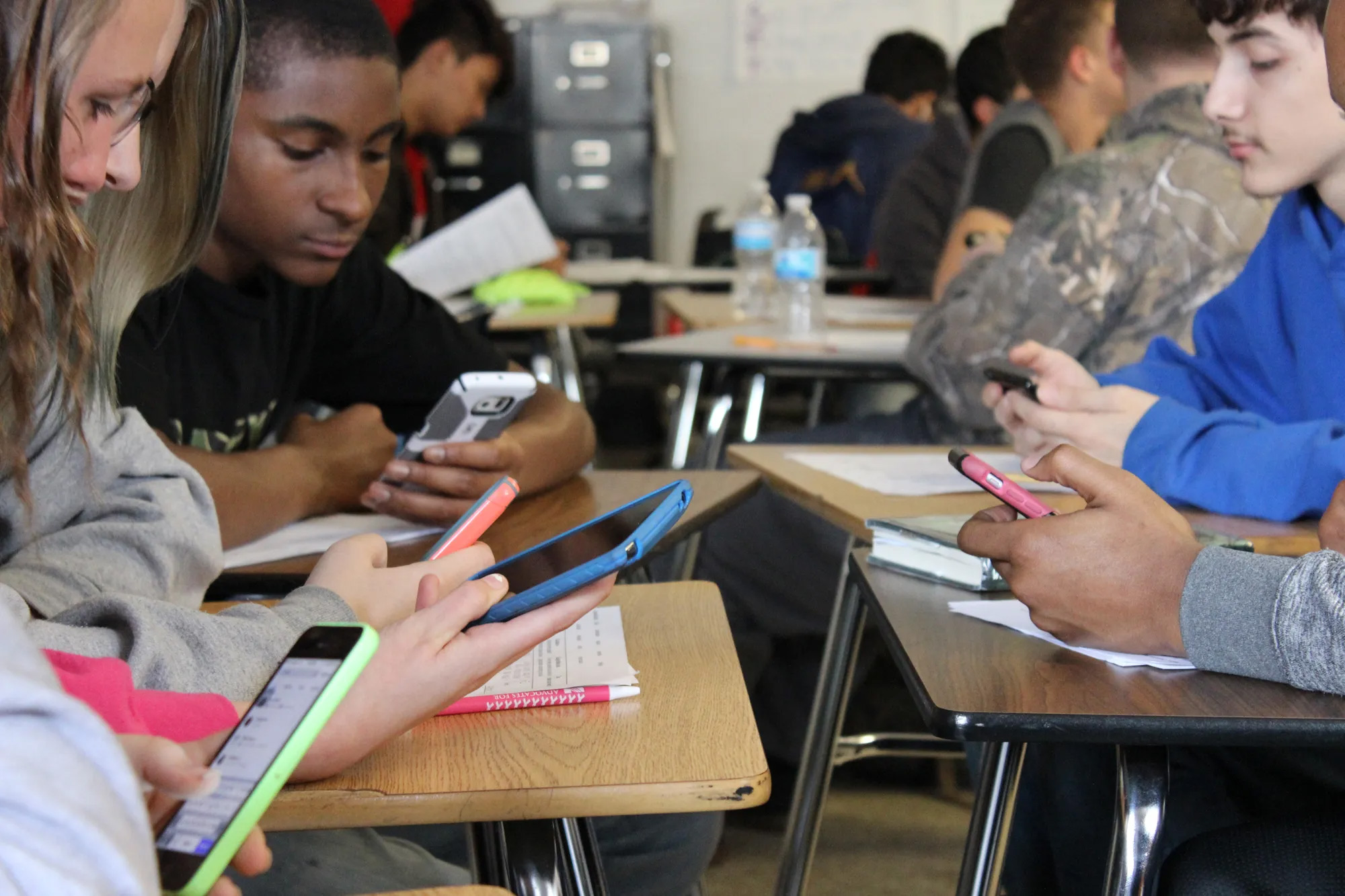
Thirty states now limit or ban cellphone use in classrooms, and teachers are noticing children paying attention to their lessons again. But it’s not clear whether this policy — unpopular with students and a headache for teachers to enforce — makes an academic difference.
If student achievement goes up after a cellphone ban, it’s tough to know if the ban was the reason. Some other change in math or reading instruction might have caused the improvement. Or maybe the state assessment became easier to pass. Imagine if politicians required all students to wear striped shirts and test scores rose. Few would really think that stripes made kids smarter.
Two researchers from the University of Rochester and RAND, a nonprofit research organization, figured out a clever way to tackle this question by taking advantage of cellphone activity data in one large school district in Florida, which in 2023 became the first state to institute school cellphone restrictions. The researchers compared schools that had high cellphone activity before the ban with those that had low cellphone usage to see if the ban made a bigger difference for schools that had high usage.
Indeed, it did.
Related: Our free weekly newsletter alerts you to what research says about schools and classrooms.
Student test scores rose a bit more in high cellphone usage schools two years after the ban compared with schools that had lower cellphone usage to start. Students were also attending school more regularly.
The policy also came with a troubling side effect. The cellphone bans led to a significant increase in student suspensions in the first year, especially among Black students. But disciplinary actions declined during the second year.
“Cellphone bans are not a silver bullet,” said David Figlio, an economist at the University of Rochester and one of the study’s co-authors. “But they seem to be helping kids. They’re attending school more, and they’re performing a bit better on tests.”
Figlio said he was “worried” about the short-term 16 percent increase in suspensions for Black students. What’s unclear from this data analysis is whether Black students were more likely to violate the new cellphone rules, or whether teachers were more likely to single out Black students for punishment. It’s also unclear from these administrative behavior records if students were first given warnings or lighter punishments before they were suspended.
The data suggest that students adjusted to the new rules. A year later, student suspensions, including those of Black students, fell back to what they had been before the cellphone ban.
“What we observe is a rocky start,” Figlio added. “There was a lot of discipline.”
The study, “The Impact of Cellphone Bans in Schools on Student Outcomes: Evidence from Florida,” is a draft working paper and has not been peer-reviewed. It was slated to be circulated by the National Bureau of Economic Research on Oct. 20 and the authors shared a draft with me in advance. Figlio and his co-author Umut Özek at RAND believe it is the first study to show a causal connection between cellphone bans and learning rather than just a correlation.
The academic gains from the cellphone ban were small, less than a percentile point, on average. That’s the equivalent of moving from the 50th percentile on math and reading tests (in the middle) to the 51st percentile (still close to the middle), and this small gain did not emerge until the second year for most students. The academic benefits were strongest for middle schoolers, white students, Hispanic students and male students. The academic gains for Black students and female students were not statistically significant.
I was surprised to learn that there is data on student cellphone use in school. The authors of this study used information from Advan Research Corp., which collects and analyzes data from mobile phones around the world for business purposes, such as figuring out how many people visit a particular retail store. The researchers were able to obtain this data for schools in one Florida school district and estimate how many students were on their cellphones before and after the ban went into effect between the hours of 9 a.m. and 1 p.m.
The data showed that more than 60 percent of middle schoolers, on average, were on their phones at least once during the school day before the 2023 ban in this particular Florida district, which was not named but described as one of the 10 largest districts in the country. (Five of the nation’s 10 largest school districts are in Florida.) After the ban, that fell in half to 30 percent of middle schoolers in the first year and down to 25 percent in the second year.
Elementary school students were less likely to be on cellphones to start with and their in-school usage fell from about 25 percent of students before the ban to 15 percent after the ban. More than 45 percent of high schoolers were on their phones before the ban and that fell to about 10 percent afterwards.
Average daily smartphone visits in schools, by year and grade level
Average daily smartphone visits during regular school days (relative to teacher workdays without students) between 9am and 1pm (per 100 enrolled students) in the two months before and then after the 2023 ban took effect in one large urban Florida school district. Source: Figlio and Özek, October 2025 draft paper, figure 2C, p. 23.
Florida did not enact a complete cellphone ban in 2023, but imposed severe restrictions. Those restrictions were tightened in 2025 and that additional tightening was not studied in this paper.
Anti-cellphone policies have become increasingly popular since the pandemic, largely based on our collective adult gut hunches that kids are not learning well when they are consumed by TikTok and SnapChat.
This is perhaps a rare case in public policy, Figlio said, where the “data back up the hunches.”
The Hechinger Report provides in-depth, fact-based, unbiased reporting on education that is free to all readers. But that doesn’t mean it’s free to produce. Our work keeps educators and the public informed about pressing issues at schools and on campuses throughout the country. We tell the whole story, even when the details are inconvenient. Help us keep doing that.
Two months after Education Secretary Linda McMahon was confirmed, she and a small team from the department met with leadership from the National Center for Learning Disabilities, an advocacy group that works on behalf of millions of students with dyslexia and other disorders.
Jacqueline Rodriguez, NCLD’s chief executive officer, recalled pressing McMahon on a question raised during her confirmation hearing: Was the Trump administration planning to move control and oversight of special education law from the Education Department to Health and Human Services?
Rodriguez was alarmed at the prospect of uprooting the 50-year-old Individuals with Disabilities in Education Act (IDEA), which spells out the responsibility of schools to provide a “free, appropriate public education” to students with disabilities. Eliminating the Education Department entirely is a primary objective of Project 2025, the conservative blueprint that has guided much of the administration’s education policy. After the department is gone, Project 2025 said oversight of special education should move to HHS, which manages some programs that help adults with disabilities.
But the sprawling department that oversees public health has no expertise in the complex education law, Rodriguez told McMahon.
“Someone might be able to push the button to disseminate funding, but they wouldn’t be able to answer a question from a parent or a school district,” she said in an interview later.
For her part, McMahon had wavered during her confirmation hearing on the subject. “I’m not sure that it’s not better served in HHS, but I don’t know,” she told Sen. Tim Kaine, D-Va., who shared concerns from parents worried about who would enforce the law’s provisions.
But nine days into a government shutdown that has furloughed most federal government workers, the Trump administration announced that it was planning a drastic “reduction in force” that would lay off more than 450 people, including almost everyone who works in the Office of Special Education Programs. Rodriguez believes the layoffs are a way that the administration plans to force the special education law to be managed by some other federal office.
Related: Become a lifelong learner. Subscribe to our freeweekly newsletter featuring the most important stories in education.
The Education Department press office did not respond to a question about the administration’s plans for special education oversight. Instead, the press office pointed to a social media post from McMahon on Oct. 15. The fact that schools are “operating as normal” during the government shutdown, McMahon wrote on X, “confirms what the President has said: the federal Department of Education is unnecessary.”’
Yet in that May meeting, Rodriguez said she was told that HHS might not be the right place for IDEA, she recalled. While the new department leadership made no promises, they assured her that any move of the law’s oversight would have to be done with congressional approval, Rodriguez said she was told.
The move to gut the office overseeing special education law was shocking to families and those who work with students with disabilities. About 7.5 million children ages 3 to 21 are served under IDEA, and the office had already lost staffers after the Trump administration dismissed nearly half the Education Department’s staff in March, bringing the agency’s total workforce to around 2,200 people.
For Rodriguez, whose organization supports students with learning disabilities such as dyslexia, McMahon’s private assurances was the administration “just outright lying to the public about their intentions.”
“The audacity of this administration to communicate in her confirmation, in her recent testimony to Congress and to a disability rights leader to her face, ‘Don’t worry, we will support kids with disabilities,’” Rodriguez said. “And then to not just turn a 180-degree on that, but to decimate the ability to enforce the law that supports our kids.”
She added: “It could not just be contradictory. It feels like a bait and switch.”
Five days after the firings were announced, a U.S. district judge temporarily blocked the administration’s actions, setting up a legal showdown that is likely to end up before the Supreme Court. The high court has sided with the president on most of his efforts to drastically reshape the federal workforce. And President Donald Trump said at a Tuesday press briefing that more cuts to “Democrat programs” are coming.
“They’re never going to come back in many cases,” he added.
In her post on X, McMahon also said that “no education funding is impacted by the RIF, including funding for special education,” referring to the layoffs.
But special education is more than just money, said Danielle Kovach, a special education teacher in Hopatcong, N.J. Kovach is also a former president of the Council for Exceptional Children, a national organization for special educators.
“I equate it to, what would happen if we dismantled a control tower at a busy airport?” Kovach said. “It doesn’t fly the plane. It doesn’t tell people where to go. But it ensures that everyone flies smoothly.”
Katy Neas, a deputy assistant secretary in the Office of Special Education and Rehabilitative Services during the Biden administration, said that most people involved in the education system want to do right by children.
“You can’t do right if you don’t know what the answer is,” said Neas, who is now the chief executive officer of The Arc of the United States, which advocates for people with intellectual and developmental disabilities. “You can’t get there if you don’t know how to get your questions answered.”
Families also rely on IDEA’s mandate that each child with a disability receives a free, appropriate public education — and the protections that they can receive if a school or district does not live up to that requirement.
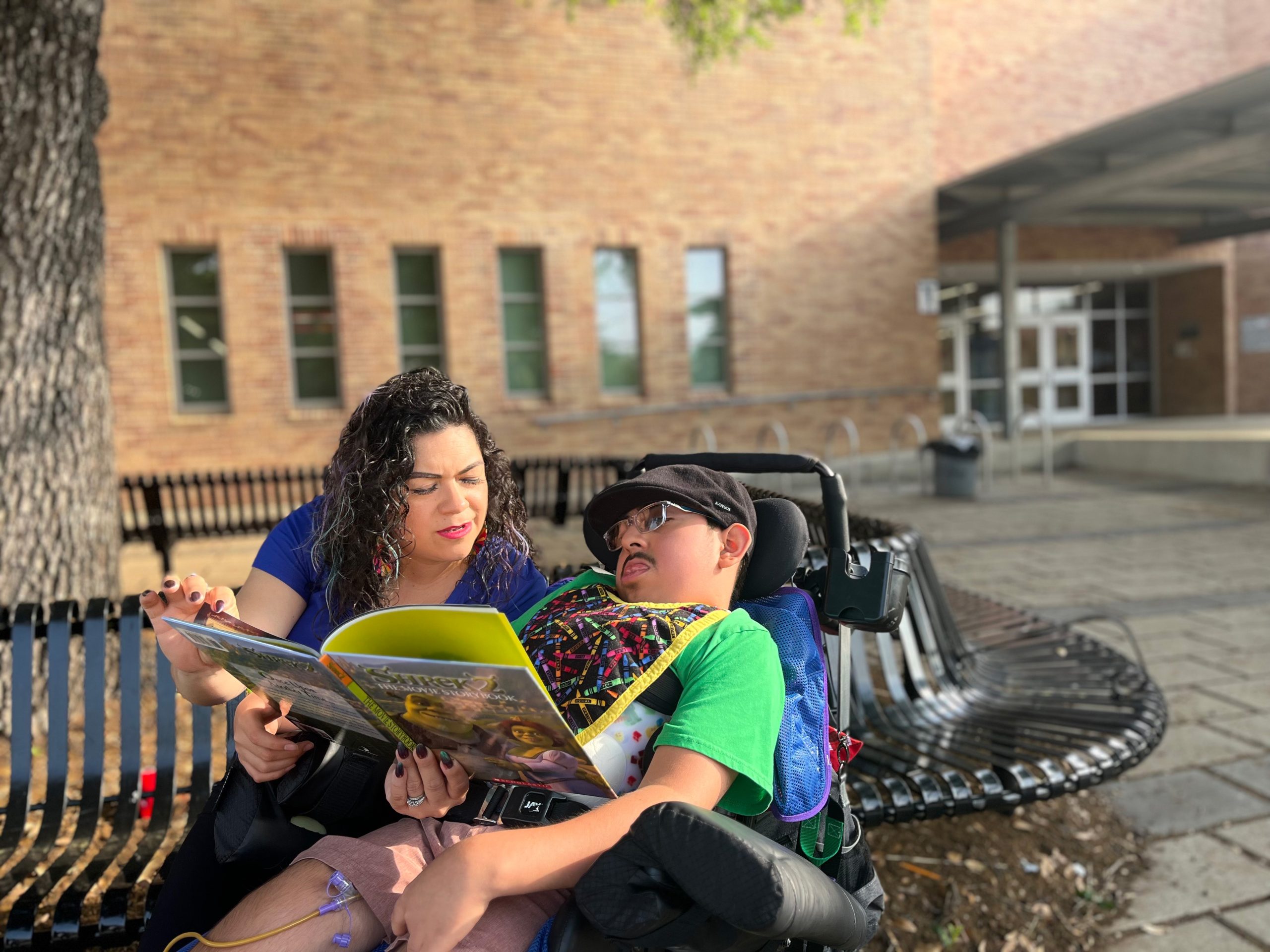
Maribel Gardea, a parent in San Antonio, said she fought with her son’s school district for years over accommodations for his disability. Her son Voozeki, 14, has cerebral palsy and is nonverbal. He uses an eye-gaze device that allows him to communicate when he looks at different symbols on a portable screen. The district resisted getting the device for him to use at school until, Gardea said, she reminded them of IDEA’s requirements.
Gardea, the co-founder of MindShiftED, an organization that helps parents become better advocates for their children with disabilities, said the upheaval at the Education Department has her wondering what kind of advice she can give families now.
For example, an upcoming group session will teach parents how to file official grievances to the federal government if they have disputes with their child’s school or district about services. Now, she has to add in an explanation of what the deep federal cuts will mean for parents.
Voozeki Gardea, who attends school in the San Antonio area, uses an eye-gaze communication device with the assistance of school paraprofessional Vanessa Martinez. The device verbalizes words and phrases when Voozeki looks at different symbols. Credit: Courtesy Maribel Gardea
“I have to tell you how to do a grievance,” she said she plans to tell parents. “But I have to tell you no one will answer.”
Maybe grassroots organizations may find themselves trying to track parent complaints on their own, she said, but the prospect is exhausting. “It’s a really gross feeling to know that no one has my back.”
In addition to the office that oversees special education law, the Rehabilitation Services Administration, which is also housed at the Department of Education and supports employment and training of people with disabilities, was told most of its staff would be fired.
“Regardless of which office you’re worried about, this is all very intentional,” said Julie Christensen, the executive director of the Association of People Supporting Employment First, which advocates for the full inclusion of people with disabilities in the workforce. “There’s no one who can officially answer questions. It feels like that was kind of the intent, to just create a lot of confusion and chaos.”
Those staffers “are the voice within the federal government to make sure policies and funding are aligned to help people with disabilities get into work,” Christensen said. Firing them, she added, is counterintuitive to everything the administration says it cares about.
For now, advocates say they are bracing for a battle similar to those fought decades ago that led to the enactment of civil rights law protecting children and adults with disabilities. Before the law was passed, there was no federal guarantee that a student with a disability would be allowed to attend public school.
“We need to put together our collective voices. It was our collective voices that got us here,” Kovach said.
And, Rodriguez said, parents of children in special education need to be prepared to be their own watchdogs. “You have to become the compliance monitor.”
It’s unfair, she said, but necessary.
Contact staff writer Christina Samuels at 212-678-3635 or [email protected].
The Hechinger Report provides in-depth, fact-based, unbiased reporting on education that is free to all readers. But that doesn’t mean it’s free to produce. Our work keeps educators and the public informed about pressing issues at schools and on campuses throughout the country. We tell the whole story, even when the details are inconvenient. Help us keep doing that.
The University of Melbourne was the highest ranked Australian university.
Australia’s universities have charged up the global leaderboard in a year where many of their international peers lost ground, according to a world-renowned tertiary rankings list.
Please login below to view content or subscribe now.
High school history teacher Antoine Stroman says he wants his students to ask “the hard questions” — about slavery, Jim Crow, the murder of George Floyd and other painful episodes that have shaped the United States.
Now, Stroman worries that President Donald Trump’s push for “patriotic education” could complicate the direct, factual way he teaches such events. Last month, the president announced a plan to present American history that emphasizes “a unifying and uplifting portrayal of the nation’s founding ideals,” and inspires “a love of country.”
Stroman does not believe students at the magnet high school where he teaches in Philadelphia will buy this version, nor do many of the teachers I’ve spoken with. They say they are committed to honest accounts of the shameful events and painful eras that mark our nation’s history.
“As a teacher, you have to have some conversations about teaching slavery. It ishard,”Stroman told me. “Teaching the Holocaust is hard. I can’tnotteach something because it is hurtful. My students will come in and ask questions, and you really have to make up your mind to say, ‘I can’t rain dance around this.’”
Related: Become a lifelong learner. Subscribe to our free weekly newsletter featuring the most important stories in education.
These are tense times for educators: In recent weeks, dozens of teachers and college professors have been fired or placed under investigation for social media posts about their views of slain 31-year-old conservative activist Charlie Kirk, ushering in a slew of lawsuits and legal challenges.
In Indiana, a portal called Eyes on Education encourages parents of school children, students and educators to submit “real examples” of objectionable curricula, policies or programs. And nearly 250 state, federal and local entities have introduced bills and other policies that restrict the content of teaching and trainings related to race and sex in public school. Supporters of these laws say discussion of such topics can leave students feeling inferior or superior based on race, gender or ethnicity; they believe parents, not schools, should teach students about political doctrine.
“It has become very difficult to navigate,” said Jacob Maddaus, who teaches high school and college history in Maine and regularly participates in workshops on civics and the Constitution, including programs funded by the Sandra Day O’Connor Institute. Almost 80 percent of teachers surveyed recently by the institute say they have “self-censored” in class due to fear of pushback or controversy. They also reported feeling underprepared, unsupported and increasingly afraid to teach vital material.
After Kirk’s death Trump launched a new “civics education coalition,” aimed at “renewing patriotism, strengthening civic knowledge, and advancing a shared understanding of America’s founding principles in schools across the nation.” The coalition is made up made up almost entirely of conservative groups,including Kirk’sTurning Point USA, whose chief education officer, Hutz Hertzberg, said in a statement announcing the effort that he “is more resolved than ever to advance God-centered, virtuous education for students.”
So far, no specific guidelines have emerged: Emails to the Department of Education — sent after the government shut down — were not returned.
Some students, concerned about the shifting historical narratives, have taken steps to help preserve and expand their peers’ access to civics instruction. Among them is Mariya Tinch, an 18-year-old high school senior from rural North Carolina. “Trump’s goal of teaching ‘patriotic’ education is actually what made me start developing my app, called Revolve Justice, to help young students who didn’t have access to proper civic education get access to policies and form their own political opinions instead of having them decided for them,” she told me.
Growing up in a predominantly white area, Tinch said, “caused civic education to be more polarized in my life than I would like as a young Black girl. A lot of my knowledge in regard to civic education came from outside research after teachers were unable to fully answer my questions about the depth of the issues that we are taught to ignore.”
Mariya Tinch, a high school senior in North Carolina, at the 2025 Ready, Set, App! competition (second from left). She developed an app to help students get access to policies and form their own political opinions. Credit: Courtesy of Mariya Tinch
Other students are upset about federal cuts to history education programs, including National History Day, a 50-year-old nonprofit that runs a history competition for some 500,000 students who engage in original historic research and provides teachers with resources and training. Youth groups are now forming as well, including Voters of Tomorrow, which has a goal of building youth political power by “engaging,educating, and empowering our peers.”
There will surely be more attention focused on the founders’ original ideals for America as we approach the 250th anniversary of the signing of the Declaration of Independence this July. Some teachers and groups that support civics teachers are creating resources, including the nonprofit iCivics, with its “We can teach hard things — and we should” guidelines.
How all of these different messages resonate with students remains to be seen. In the meantime, Jessica Ellison, executive director of the nonprofit National Council for History Education is fielding a lot of questions from history teachers and giving them specific advice.
“They might be anxious about any teaching that could get them on social media or reported by a student or parent,” Ellison told me, noting the strategy she shares with teachers is to focus on “the three S’s –— sources, state standards and student questions.”
Ellison also encourages teachers to “lean into the work of historians. Read the original sources, the primary sources, the secession documents from Mississippi and put them in front of students. If it is direct from the source you cannot argue with it.”
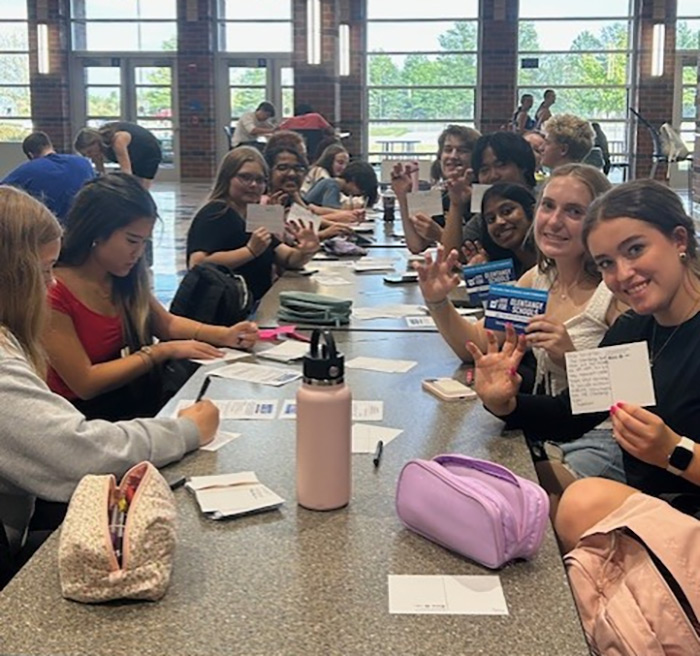
In September, students at Berlin High School in Delaware, Ohio, participated in a sign creation and postcard campaign for a levy on the ballot. Credit: Courtesy Michael LaFlamme
Michael LaFlamme has his own methods: He teaches Advanced Placement government and U.S. history at Olentangy Berlin High School outside of Columbus, Ohio, where many of his students work the polls during elections to see up close how voting works. They learn about civics via a participatory political science project that asks students to write a letter to an elected official. He also encourages students to watch debates or political or Sunday morning news shows with a parent or grandparent, and attend a school board meeting.
“There is so much good learning to be done around current events,” LaFlamme told me, noting that “it becomes more about community and experience. We are looking at all of it as political scientists.”
For Maddaus, the teacher in Maine, there is yet another obstacle: How his students consume news reinforces the enormous obstacles he and other teachers face to keep them informed and thinking critically. Earlier this fall, he heard some of his students talking about a rumor they’d heard over the weekend.
“Mr. Maddaus, is it true? Is President Donald Trump dead?” they asked.
Maddaus immediately wanted to know how they got this false news.
“We saw it on TikTok,” one of the students replied — not a surprising answer, perhaps, given that 4 out of 10 young adults get their news from the platform.
Maddaus says he shook his head, corrected the record and then went back to his regularly scheduled history lesson.
The Hechinger Report provides in-depth, fact-based, unbiased reporting on education that is free to all readers. But that doesn’t mean it’s free to produce. Our work keeps educators and the public informed about pressing issues at schools and on campuses throughout the country. We tell the whole story, even when the details are inconvenient. Help us keep doing that.
In his first two months in office, President Donald Trump ordered the closing of the Education Department and fired half of its staff. The department’s research and statistics division, called the Institute of Education Sciences (IES), was particularly hard hit. About 90 percent of its staff lost their jobs and more than 100 federal contracts to conduct its primary activities were canceled.
But now there are signs that the Trump administration is partially reversing course and wants the federal government to retain a role in generating education statistics and evidence for what works in classrooms — at least to some extent. On Sept. 25, the department posted a notice in the Federal Register asking the public to submit feedback by Oct. 15 on reforming IES to make research more relevant to student learning. The department also asked for suggestions on how to collect data more efficiently.
The timeline for revamping IES remains unclear, as is whether the administration will invest money into modernizing the agency. For example, it would take time and money to pilot new statistical techniques; in the meantime, statisticians would have to continue using current protocols.
Still, the signs of rebuilding are adding up.
Related: Our free weekly newsletter alerts you to what research says about schools and classrooms.
At the end of May, the department announced that it had temporarily hired a researcher from the Thomas B. Fordham Institute, a conservative think tank, to recommend ways to reform education research and development. The researcher, Amber Northern, has been “listening” to suggestions from think tanks and research organizations, according to department spokeswoman Madi Biedermann, and now wants more public feedback.
Biedermann said that the Trump administration “absolutely” intends to retain a role in education research, even as it seeks to close the department. Closure will require congressional approval, which hasn’t happened yet. In the meantime, Biedermann said the department is looking across the government to find where its research and statistics activities “best fit.”
Other IES activities also appear to be resuming. In June, the department disclosed in a legal filing that it had or has plans to reinstate 20 of the 101 terminated contracts. Among the activities slated to be restarted are 10 Regional Education Laboratories that partner with school districts and states to generate and apply evidence. It remains unclear how all 20 contracts can be restarted without federal employees to hold competitive bidding processes and oversee them.
Earlier in September, the department posted eight new jobs to help administer the National Assessment of Educational Progress (NAEP), also called the Nation’s Report Card. These positions would be part of IES’s statistics division, the National Center for Education Statistics. Most of the work in developing and administering tests is handled by outside vendors, but federal employees are needed to award and oversee these contracts. After mass firings in March, employees at the board that oversees NAEP have been on loan to the Education Department to make sure the 2026 NAEP test is on schedule.
Only a small staff remains at IES. Some education statistics have trickled out since Trump took office, including its first release of higher education data on Sept. 23. But the data releases have been late and incomplete.
It is believed that no new grants have been issued for education studies since March, according to researchers who are familiar with the federal grant making process but asked not to be identified for fear of retaliation. A big obstacle is that a contract to conduct peer review of research proposals was canceled so new ideas cannot be properly vetted. The staff that remains is trying to make annual disbursements for older multi-year studies that haven’t been canceled.
With all these changes, it’s becoming increasingly difficult to figure out the status of federally funded education research. One potential source of clarity is a new project launched by two researchers from George Washington University and Johns Hopkins University. Rob Olsen and Betsy Wolf, who was an IES researcher until March, are tracking cancellations and keeping a record of research results for policymakers.
If it’s successful, it will be a much-needed light through the chaos.
The Hechinger Report provides in-depth, fact-based, unbiased reporting on education that is free to all readers. But that doesn’t mean it’s free to produce. Our work keeps educators and the public informed about pressing issues at schools and on campuses throughout the country. We tell the whole story, even when the details are inconvenient. Help us keep doing that.
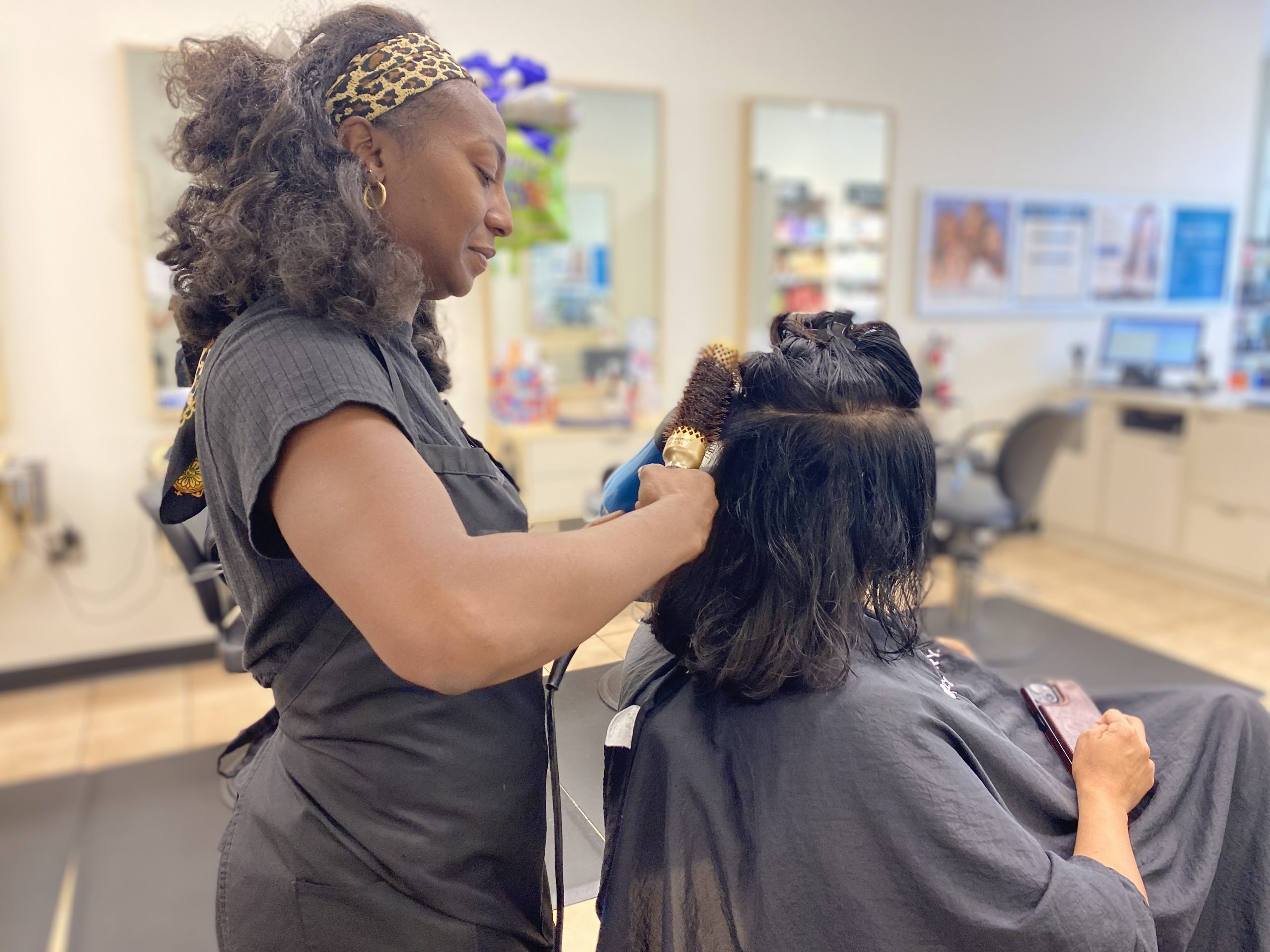
Remiah Ward’s shift at the SmartStyle salon inside Walmart was almost over, and she’d barely made $30 in tips from the haircuts she’d done that day. It wasn’t unusual — a year after her graduation from beauty school, tips plus minimum wage weren’t enough to cover her rent.
She scarcely had time to eat and sleep before she had to drive back to the same Walmart in central Florida to stock shelves on the night shift. That job paid $14 an hour, but it meant she sometimes spent 18 hours a day in the same building. She worked six days a week but still struggled to catch up on bills and sleep.
The admissions officer at the American Institute of Beauty, where she enrolled straight out of high school, had sold her on a different dream. She would easily earn enough to pay back the $10,000 she borrowed to attend, she said she was told. Ward had no way of knowing that stylists from her school earn $20,200 a year, on average, four years after graduating. Seven years later, her debt, plus interest, is still unpaid.
In July, Republicans in Congress pushed through policies aimed at ensuring that what happened to Ward wouldn’t happen to other Americans on the government’s dime; colleges whose graduates don’t earn at least as much as someone with a high school diploma will now risk losing access to federal student loans. But one group managed to slip through the cracks — thousands of schools like the American Institute of Beauty were exempt.
Remiah Ward worked two jobs while trying to make it as a hair stylist but never made enough to pay her all her bills and has had to put her dream career on hold. Credit: Courtesy Remiah Ward
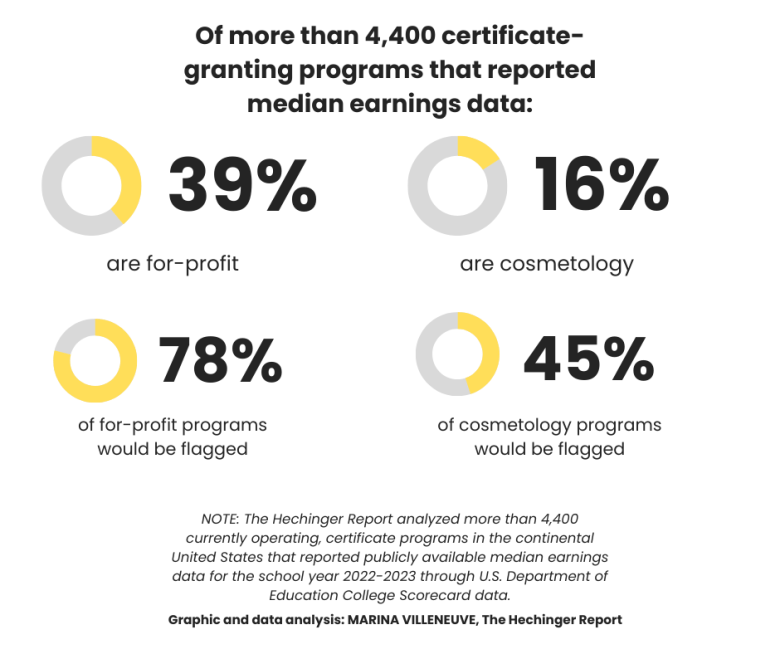
Certificate schools succeeded in getting a carve-out. The industry breathed a collective sigh of relief, and with good reason. At least 1,280 certificate-granting programs, which enrolled more than 220,000 students, would have been at risk of losing federal student loan funding if they had been included in the bill, according to a Hechinger Report analysis of federal data. [See table.] About 80% of those are for-profit programs, and 45 percent are cosmetology schools.
“There is this very strange donut hole in accountability where workforce programs are held accountable, two-year degree programs are held accountable, but everything in between gets off without any accountability,” said Preston Cooper, a senior fellow at the conservative think tank American Enterprise Institute.
The schools spared are known as certificate programs and, with their promise of an affordable and relatively quick path to economic security, are the fastest growing part of higher education. They usually take about a year to complete and train people to be hair-stylists, welders, medical assistants and cooks, among other jobs.
As with traditional colleges, there are big differences in quality among certificate programs. Some hair stylists can make a middle-class living if they work in a busy salon. But for people who have to pay back hefty student loans, the low wages for stylists in the early years can be an insurmountable obstacle.
Ward found herself facing that dilemma. When she could no longer sustain the lack of sleep from her double shifts at Walmart, she pressed pause on her styling career and took a job with Amazon, loading and unloading planes. She wasn’t ready to give up her dream career, though, so in addition to her 10-hour days moving boxes, she took part-time gigs at local hair salons. She didn’t have family to help pay rent, not to mention loan payments, so she couldn’t afford to work fulltime at a salon, which is essential to build up a regular clientele — and bigger tips. Without that, she couldn’t get much beyond minimum wage.
A representative from the American Institute of Beauty denied that Ward was told she would easily repay her loan.
“No admissions representative, not at AIB or elsewhere, would ever make such a statement,” Denise Herman, general counsel and assistant vice president of AIB, said in an email.
The high cost of many for-profit cosmetology schools — tuition can be upward of $20,000, usually for a one-year program — can leave former students mired in debt. In May, the government released data showing 850 colleges where at least a third of borrowers haven’t made a loan payment for 90 days or more, putting them on track to default. About 42 percent of those were for-profit cosmetology and barbering schools (including AIB).
Brittany Mcnew says she loves working as a stylist but that her income takes a hit when traffic is slow in her salon in Bethlehem, Pennsylvania. Credit: Meredith Kolodner/The Hechinger Report
Herman blamed the Biden administration policy that after the pandemic let borrowers forgo payments without any penalty.
“Debtors became ‘comfortable’ not making payments,” said Herman. “AIB provides the graduate with the information graduates need to make their payments. What that graduate decides to pay, or not pay, is not influenced by AIB.”
Under the “big beautiful bill” passed in July, two- and four-year colleges must ensure that, after four years, graduates on average make at least as much as someone in their state who has only a high school diploma. The colleges must inform students if they fail that test, and if it happens for two out of three years, the college will be ineligible to receive federal loan funds.
Some for-profit certificate schools lobbied hard for an exemption. The American Association of Career Schools, which represents proprietary cosmetology schools, spent $120,000 lobbying the Education Department and Congress, including on the “big beautiful bill,” in the first six months of this year. At the group’s major lobbying event in April, Sen. Bill Cassidy, chairman of the Senate Health, Education, Labor and Pensions Committee, was the keynote speaker.
Cassidy declined to answer questions about why certificate programs were excluded, but a fact sheet from his committee noted that they are already covered by something else, the gainful employment rule, which is also being challenged by the for-profit cosmetology industry.
That federal gainful employment regulation, updated in 2023, requires in essence that graduates from career-oriented schools earn enough to be able to pay back their loans and earn more than a high school graduate. It also requires that consumers, like Ward, be given more information about how graduates from all colleges fare in the workplace.
The rule posed an existential threat to a huge swath of cosmetology schools.
In 2023, the American Association of Career Schools sued to block the gainful employment rule.
“AACS supports fair and reasonable accountability measures,” Cecil Kidd, the AACS’s executive director, said in an email. “However, we strongly object to arbitrary or discriminatory policies such as the US Department of Education’s Gainful Employment rule, which unfairly targets career schools while exempting many public and private non-profit institutions that fail to meet comparable outcomes.”
He pointed to public comments in which AACS has argued that the rule imposes an unfair burden on cosmetology schools since stylists are predominantly women, who are more likely to have “personal commitments” that affect their earnings, and who rely on tips that are often pocketed as unreported income.
Cameron Vandenboom is a successful hair stylist but says the high cost of her private beauty school wasn’t worth thousands of dollars in student debt: “I absolutely should have gone to community college.” Credit: Courtesy Shanna Kaye Photo
In a twist that surprised advocates on both sides, the Education Department in May asked the court to effectively dismiss AACS’ lawsuit.
If the court rules in favor of the cosmetology schools, certificate programs will be free of all accountability requirements on their graduates’ earning levels, because they got the carveout in July.
Even if the court rules against cosmetology schools, advocates are pessimistic that the Trump administration will implement the gainful rules. The first Trump administration got rid of the original rules back in 2019 and Nicholas Kent, now the U.S. undersecretary of education, was previously the chief policy officer for Career Education Colleges and Universities, or CECU, the trade group that represents for-profit colleges, including certificate programs. He is a well-known critic of the rule.
“I would be very surprised, if the unlikely scenario plays out that the Biden rule is upheld, that this Department of Education would just say, OK, the court has spoken,” said Jason Altmire, CECU’s executive director. “We are not opposed to accountability for certificate programs, so long as it’s fair to everybody and we have a voice in how you’re measuring programs.”
Altmire said CECU didn’t lobby for certificate programs to be carved out of Congress’ bill, but did argue against the earnings formula that Congress landed on. Altmire said it doesn’t take into account part-time work and the gender gap in wages.
One objection from AACS, raised by CECU as well, is that the earnings measured don’t include tips, which are crucial to hair stylists’ income. Analyzed without including tips, 576 of 724 cosmetology schools in the Hechinger Report analysis would fail Congress’ earnings test. But even if tips were included and raised stylists’ income by 20 percent, 526 cosmetology schools would still fail.
Earlier this year, Remiah Ward made the difficult decision to leave Florida and move to Kentucky, where the cost of living was more forgiving. She’s working from 7 p.m. to 7 a.m. at an aluminum factory for $19.50 an hour.
One day, she might go back to styling after her debt is paid off. Like many former beauty school students, she wishes she’d had more information when she decided to enroll.
“They really sugar-coated it. I was 18 years old, and I needed a trade that I was already pretty good at,” said Ward, who is now 26. “Everybody thinks they’re going to make a high return, and it’s just not the reality.”
Marina Villeneuve contributed data analysis to this story.
The Hechinger Report provides in-depth, fact-based, unbiased reporting on education that is free to all readers. But that doesn’t mean it’s free to produce. Our work keeps educators and the public informed about pressing issues at schools and on campuses throughout the country. We tell the whole story, even when the details are inconvenient. Help us keep doing that.
ASHE COUNTY, N.C. — In the time it took to read an email, the federal money vanished before Superintendent Eisa Cox’s eyes: dollars that supported the Ashe County school district’s after-school program, training for its teachers, salaries for some jobs.
The email from the Department of Education arrived June 30, one day before the money — $1.1 million in total — was set to materialize for the rural western North Carolina district. Instead, the dollars had been frozen pending a review to make sure the money was spent “in accordance with the President’s priorities,” the email said.
In a community still recovering from Hurricane Helene, where more than half of students are considered economically disadvantaged, Cox said there was no way they could replace that federal funding. “It is scary to think about it, you’re getting ready to open school and not have a significant pot of funds,” she said.
School leaders across the country were reeling from the same news. The $1.1 million was one small piece of a nearly $7 billion pot of federal funding for thousands of school districts that the Trump administration froze — money approved by Congress and that schools were scheduled to receive on July 1. For weeks, leaders in Ashe County and around the country scrambled to figure out how they could avoid layoffs and fill financial holes — until the money was freed July 25, after an outcry from legislators and a lawsuit joined by two dozen states.
“I had teachers crying, staff members crying. They thought they were going to lose their jobs a week before school,” said Curtis Finch, superintendent of Deer Valley Unified School District in Phoenix.
About $1.1 million was at stake for the Ashe County school district in western North Carolina this summer when a portion of K-12 schools’ federal funding was frozen. Credit: Ariel Gilreath/The Hechinger Report
Now, as educators welcome students back to classrooms, they can no longer count on federal dollars as they once did. They must learn to plan without a playbook under a president intent on cutting education spending. For many districts, federal money is a small but crucial sliver of their budgets, potentially touching every part of a school’s operations, from teacher salaries to textbooks. Nationally, it accounts for about 14 percent of public school funding; in Ashe County, it’s 17 percent. School administrators are examining their resources now and budgeting for losses to funding that was frozen this summer, for English learners, after-school and other programs.
So far, the Trump administration has not proposed cutting the largest pots of federal money for schools, which go to services for students with disabilities and to schools with large numbers of low-income students. But the current budget proposal from the U.S. House of Representatives would do just that.
At the same time, forthcoming cuts to other federal support for low-income families under the Republican “one big, beautiful bill” — including Medicaid and SNAP — will also hammer schools that have many students living in poverty. And some school districts are also grappling with the elimination of Department of Education grants announced earlier this year, such as those designed to address teacher shortages and disability services. In politically conservative communities like this one, there’s an added tension for schools that rely on federal money to operate: how to sound the alarm while staying out of partisan politics.
For Ashe County, the federal spending freeze collided with the district’s attempt at a fresh start after the devastation of Helene, which demolished roads and homes, damaged school buildings and knocked power and cell service out for weeks. Between the storm and snow days, students here missed 47 days of instruction.
Cox worries this school year might bring more missed days: That first week of school, she found herself counting the number of foggy mornings. An old Appalachian wives’ tale says to put a bean in a jar for every morning of fog in August. The number of beans at the end of the month is how many snow days will come in winter.
“We’ve had 21 so far,” Cox said with a nervous laugh on Aug. 21.
Fragrant evergreen trees blanket Ashe County’s hills, a region that bills itself as America’s Christmas Tree Capital because of the millions of Fraser firs grown for sale at the holidays. Yet this picturesque area still shows scars of Hurricane Helene’s destruction: fallen trees, damaged homes and rocky new paths cut through the mountainsides by mudslides. Nearly a year after the storm, the lone grocery store in one of its small towns is still being rebuilt. A sinkhole that formed during the flooding remains, splitting open the ground behind an elementary school.
Ashe County Schools Superintendent Eisa Cox visits classrooms at Blue Ridge Elementary School during the first week of the school year in Warrensville, N.C. Credit: Ariel Gilreath/The Hechinger Report
As students walked into classrooms for the first time since spring, Julie Taylor — the district’s director of federal programs — was reworking district budget spreadsheets. When federal funds were frozen, and then unfrozen, her plans and calculations from months prior became meaningless.
Federal and state funding stretches far in this district of 2,700 students and six schools, where administrators do a lot with a little. Even before this summer, they worked hard to supplement that funding in any way possible — applying to state and federal grants, like one last year that provided money for a few mobile hot spots for families who don’t have internet access. Such opportunities are also narrowing: The Federal Communications Commission, for example, recently proposed ending its mobile hot spot grant program for school buses and libraries.
“We’re very fiscally responsible because we have to be — we’re small and rural, we don’t have a large tax base,” Taylor said.
When the money was frozen this summer, administrators’ minds went to the educators and kids who would be most affected. Some of it paid for a program through Appalachian State University that connects the district’s three dozen early-career teachers with a mentor, helps them learn how to schedule their school days and manage classroom behavior.
The program is part of the reason the district’s retention rate for early career teachers is 92 percent, Taylor said, noting the teachers have said how much the mentoring meant to them.
Also frozen: free after-school care the district provides for about 250 children throughout the school year — the only after-school option in the community. Without the money, Cox said, schools would have to cancel their after-school care or start charging families, a significant burden in a county with a median household income of about $50,000.
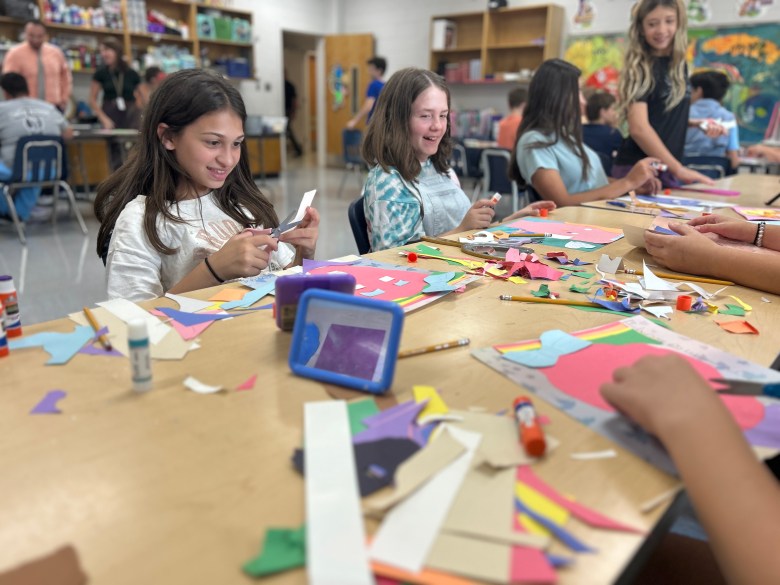
Sixth grade students make self-portraits out of construction paper during the first week of the school year at Blue Ridge Elementary School in Warrensville, N.C., in August. Credit: Ariel Gilreath/The Hechinger Report
The salary for Michelle Pelayo, the district’s migrant education program coordinator for nearly two decades, was also tied up in that pot of funding. Because agriculture is the county’s biggest industry, Pelayo’s work in Ashe County extends far beyond the students at the school. Each year, she works with the families of dozens of migrant students who move to the area for seasonal work on farms, which generally involves tagging and bundling Christmas trees and harvesting pumpkins. Pelayo helps the families enroll their students, connects them with supplies for school and home, and serves as a Spanish translator for parent-teacher meetings — “whatever they need,” she said.
Kitty Honeycutt, executive director of the Ashe County Chamber of Commerce, doesn’t know how the county’s agriculture industry would survive without the migrant students Pelayo works with. “The need for guest workers is crucial for the agriculture industry — we have to have them,” she said.
A couple of years ago, Pelayo had the idea to drive to Boone, North Carolina, where Appalachian State University’s campus sits, to gather unwanted appliances and supplies from students moving out of their dorm rooms at the end of the year to donate to migrant families. She’s a “find a way or make a way” type of person, Honeycutt said.
Cox is searching for how to keep Pelayo on if Ashe County loses these federal funds next year. She’s talked with county officials to see if they could pay Pelayo’s salary, and begun calculating how much the district would need to charge families to keep the after-school program running. Ideally, she’d know ahead of time and not the night before the district is set to receive the money.
Districts across the country are grappling with similar questions. In Detroit, school leaders are preparing, at a minimum, to lose Title III money to teach English learners. More than 7,200 Detroit students received services funded by Title III in 2023.
In Wyoming, the small, rural Sheridan County School District 3 is trying to budget without Title II, IV and V money — funding for improving teacher quality, updating technology and resources for rural and low-income schools, among other uses, Superintendent Chase Christensen said.
Schools are trying to budget for cuts to other federal programs, too — such as Medicaid and food stamps. In Harrison School District 2, an urban district in Colorado Springs, Colorado, schools rely on Medicaid to provide students with counseling, nursing and other services.
The district projects that it could lose half the $15 million it receives in Medicaid next school year.
“It’s very, very stressful,” said Wendy Birhanzel, superintendent of Harrison School District 2. “For a while, it was every day, you were hearing something different. And you couldn’t even keep up with, ‘What’s the latest information today?’ That’s another thing we told our staff: If you can, just don’t watch the news about education right now.”
There’s another calculation for school leaders to make in conservative counties like Ashe, where 72 percent of the vote last year went for President Donald Trump: objecting to the cuts without angering voters. When North Carolina’s attorney general, a Democrat, joined the lawsuit against the administration over the frozen funds this summer, some school administrators told state officials they couldn’t publicly sign on, fearing local backlash, said Jack Hoke, executive director of the North Carolina School Superintendents’ Association.
Cox sees the effort to slash federal funds as a chance to show her community how Ashe County Schools uses this money. She believes people are misguided in thinking their schools don’t need it, not malicious.
“I know who our congresspeople are — I know they care about this area,” Cox said, even if they do not fully grasp how the money is used. “It’s an opportunity for me to educate them.”
If the Education Department is shuttered — which Trump said he plans to do in order to give more authority over education to states — she wants to be included in state-level discussions for how federal money flows to schools through North Carolina. And, importantly, she wants to know ahead of time what her schools might lose.
As Cox made her rounds to each of the schools that first week back, she glanced down at her phone and looked up with a smile. “We have hot water,” she said while walking in the hall of Blue Ridge Elementary School. It had lost hot water a few weeks earlier, but to Cox, this crisis was minor — one of many first-of-the-year hiccups she has come to expect.
Still, it’s one worry she can put out of her mind as she looks ahead to a year of uncertainties.
Meanwhile, the anxiety about this school year hasn’t reached the students, who were talking among themselves in the high school’s media center, creating collages in the elementary school’s art class and trekking up to Mount Jefferson — a state park that sits directly behind the district’s two high schools — for an annual trip.
They were just excited to be back.
Marina Villeneuve contributed data analysis to this story.
Contact staff writer Ariel Gilreath on Signal at arielgilreath.46 or at [email protected].
The Hechinger Report provides in-depth, fact-based, unbiased reporting on education that is free to all readers. But that doesn’t mean it’s free to produce. Our work keeps educators and the public informed about pressing issues at schools and on campuses throughout the country. We tell the whole story, even when the details are inconvenient. Help us keep doing that.
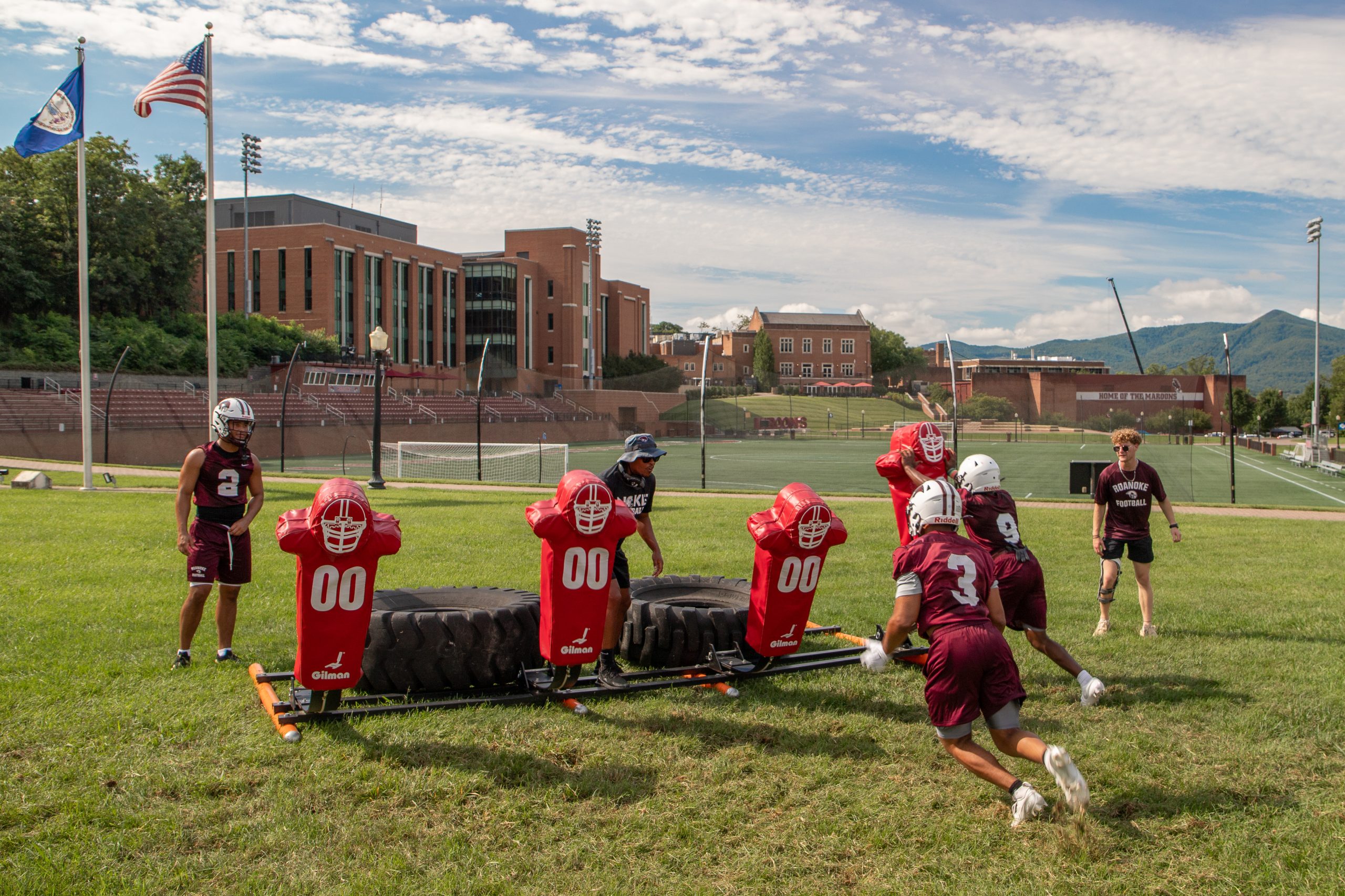
SALEM, Va. — On a hot and humid August morning in this southwestern Virginia town, football training camp is in full swing at Roanoke College. Players cheer as a receiver makes a leaping one-handed catch, and linemen sweat through blocking drills. Practice hums along like a well-oiled machine — yet this is the first day this team has practiced, ever.
In fact, it’s the first day of practice for a Roanoke College varsity football team since 1942, when the college dropped football in the midst of World War II.
Roanoke is one of about a dozen schools that have added football programs in the last two years, with several more set to do so in 2026. They hope that having a team will increase enrollment, especially of men, whose ranks in college have been falling. Yet research consistently finds that while enrollment may spike initially, adding football does not produce long-term enrollment gains, or if it does, it is only for a few years.
Roanoke’s president, Frank Shushok Jr., nonetheless believes that bringing back football – and the various spirit-raising activities that go with it — will attract more students, especially men. The small liberal arts college lost nearly 300 students between 2019 and 2022, and things were likely to get worse; the country’s population of 18-year-olds is about to decline and colleges everywhere are competing for students from a smaller pool.
“Do I think adding sports strategically is helping the college maintain its enrollment base? It absolutely has for us,” said Shushok. “And it has in a time when men in particular aren’t going to college.”
Women outnumber men by about 60 percent to 40 percent at four-year colleges nationwide. Roanoke is a part of this trend. In 2019, the college had 1,125 women students and 817 men.
This fall, Roanoke will have 1,738 students altogether, about half men and half women. But the incoming freshman class is more than 55 percent male.
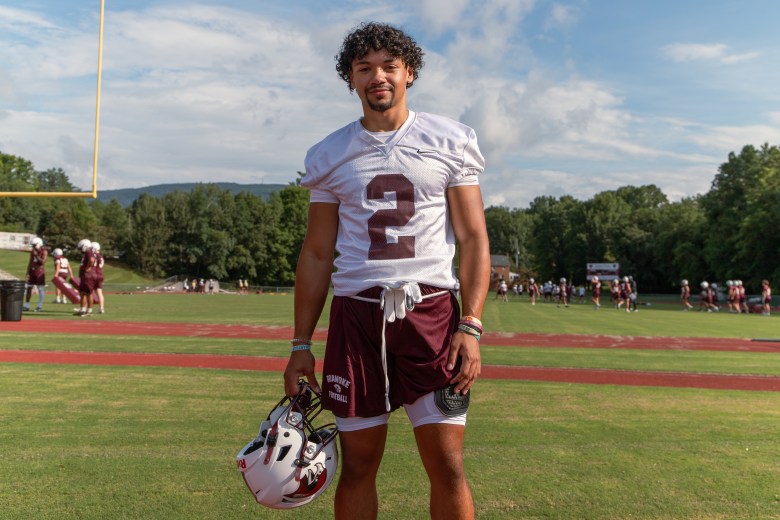
Sophomore linebacker Ethan Mapstone (26) jogs to the sideline at the end of a drill. Mapstone said he hadn’t planned to play college football until Roanoke head coach Bryan Stinespring recruited him. Credit: Miles MacClure for The Hechinger Report
“The goal was that football would, in a couple of years, bring in at least an additional hundred students to the college,” said Curtis Campbell, Roanoke’s athletic director, as he observed the first day of practice. “We’ve got 97 kids out there on the field. So we’re already at the goal.”
That number was 91 players as the season began, on Sept. 6 — and the Maroons won their first game, 23-7, over Virginia University of Lynchburg, on what Shushok called “a brilliant day full of community spirit and pride.”
“Our students were out in force, side by side with community members spanning the generations,” he said via email. “In a time when we all need more to celebrate and opportunities to gather, it is easy to say our first football game since 1942 was both historic and invigorating.”
Related: Interested in more news about colleges and universities? Subscribe to our free biweekly higher education newsletter.
In the NCAA’s Division III, where Roanoke teams compete, athletic scholarships are not permitted. Athletes pay tuition or receive financial aid in the same way as other students, so adding football players will add revenue. For a small college, this can be significant.
Shushok said it’s not just about enrollment, though: He wants a livelier campus with more school spirit. Along with football, he started a marching band and a competitive cheerleading team.
“It plays to something that’s really important to 18- to 22-year-olds right now, which is a sense of belonging and spirit and excitement,” said Shushok, who came to Roanoke after being vice president of student affairs at Virginia Tech. Its Division I football team plays in a 65,000-seat stadium where fans jump up and down in unison to Metallica’s “Enter Sandman” as the players take the field.
The Maroons play in the local high school stadium — it seats 7,157 — and pay the city of Salem $2,850 per game in rent. The college raised $1.3 million from alumni and corporate sponsors to get the team up and running.
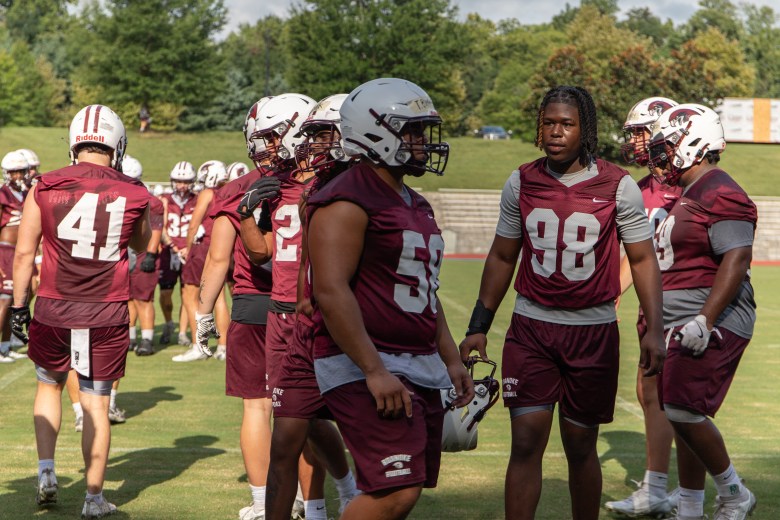
Roanoke College players gather on the sidelines during practice. Credit: Miles MacClure for The Hechinger Report
Despite the research showing limited enrollment gains from adding football, colleges keep doing it. About a dozen have added or relaunched football programs in the last two years, including New England College in New Hampshire and the University of Texas Rio Grande Valley. Several more plan to add football in 2026, including Chicago State University and Azusa Pacific University in California.
Calvin University in Michigan recently added football even though the student body was already half men, half women. The school wanted to broaden its overall appeal, Calvin Provost Noah Toly said, citing “school spirit, tradition, leadership development,” as well as the increased enrollment and “strengthened pipelines with feeder schools.”
“What you see is basically a one-year spike in male enrollment around guys who come to that school to help be part of starting up a team, but then that effect fades out over the next couple of years,” said Welch Suggs, an associate professor there and the lead author of that study. It found early modest enrollment spikes at colleges that added football compared to peers that didn’t and “statistically indistinguishable” differences after the first two years.
”What happens is that you have a substitution effect going on,” Suggs said. “There’s a population of students that really want to go to a football school; the football culture and everything with it really attracts some students. And there are others who really do not care one way or the other. And so I think what happens is that you are simply recruiting from different pools.”
Today, college leaders value any pool that includes men. Most prefer the campus population to be balanced between the sexes, and, considering the low number of male high school graduates going to college at all (39 percent in the last Pew survey), many worry about too few men being prepared for the future workforce.
“ I don’t know that we have done a good job of articulating the value, and of programming to the particular needs that some of our young men are bringing in this moment,” Shushok said. “I think it’s pretty obvious, if you read the literature out there, that a lot of men are feeling undervalued and perhaps unseen in our culture.”
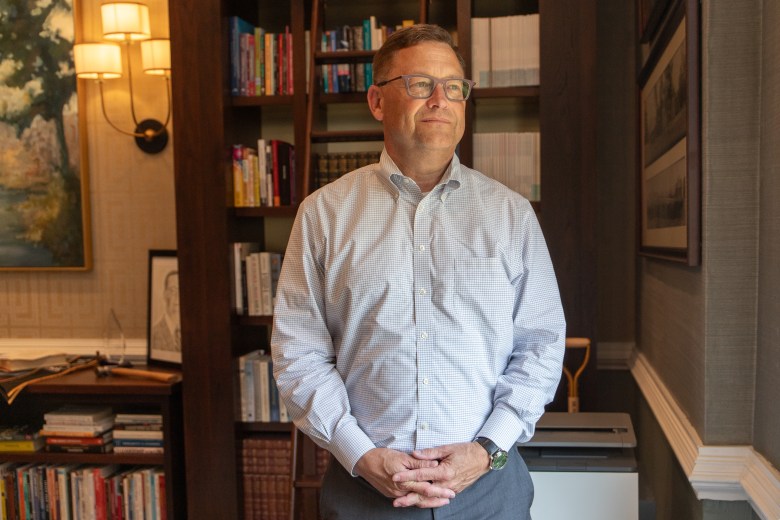
Roanoke College President Frank Shushok Jr. in his office. Shushok said he brought football back to Roanoke to boost enrollment and create a livelier campus. Credit: Miles MacClure for The Hechinger Report
Shushok said that Roanoke’s enrollment-building strategy was not centered on athletics. The college has also forged partnerships with local community colleges, guaranteeing students admission after they complete their associate degree, and has added nine new majors in 2024, including cannabis studies. Shushok pointed out that while freshman enrollment is down slightly this year, the community college program has produced a big increase in transfer students, from 65 in fall of 2024 to 91 this fall.
About 55 percent of Roanoke’s students come from Virginia, but 75 of the football team’s 91 players are Virginians. The head coach, Bryan Stinespring, a 61-year-old Virginia native, knows that recruiting territory, having worked on the coaching staffs at several Virginia universities in his career.
When Stinespring took over as head coach in 2023, hoping to inspire existing students and potential applicants to join his new team, there was no locker room, no shoulder pads or tackling dummies, no uniforms.
“The first set of recruits that came on campus, we ran down to Dick’s, got a football, went to the bookstore, got a sweatshirt,” said Stinespring, referring to a local Dick’s Sporting Goods store. “These kids came on campus and they had to believe in the vision that we had.”
Students bought into that vision; 61 of them joined a club team last fall, which played four exhibition games in preparation for this year. The community bought in, too; 9,200 fans showed up to the first club game, about 2,000 of them perched on a grassy hill overlooking the end zone.
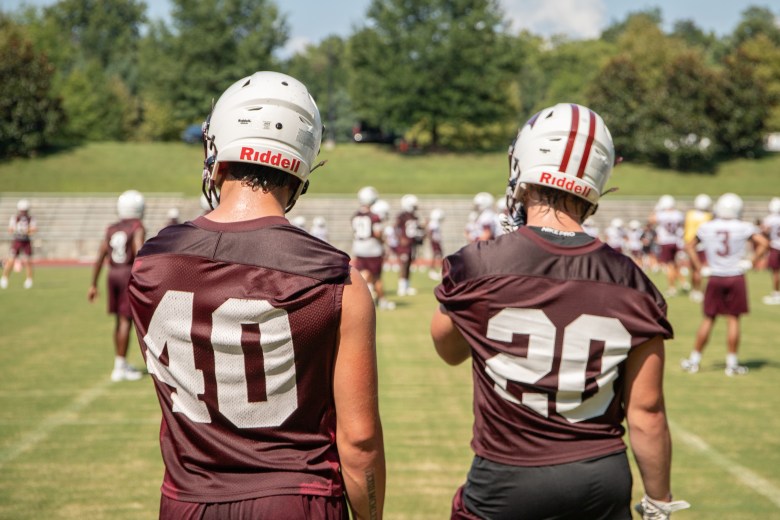
Linebackers Connor Cox (40) and Austin Fisher (20) look on from the sidelines. Credit: Miles MacClure for The Hechinger Report
Before Ethan Mapstone, a sophomore, committed to Roanoke, he was on the verge of giving up football, having sustained several injuries in high school. Then Stinespring called.
“I could hear by the tone of his voice how serious he meant everything he was saying,” said Mapstone, a 6-foot-1-inch linebacker from Virginia Beach. “I was on a visit a week later, committed two weeks later.”
To him, the football leaders at Roanoke seemed to be “a bunch of people on a mission ready to make something happen, and I think that’s what drove me in.”
KJ Bratton, a junior wide receiver and transfer student from the University of Virginia, said he was drawn to Roanoke not because of football but because of the focus on individual attention in small classes. “You definitely get that one-on-one attention with your teacher, that definitely helps you in the long run,” said Bratton.
Jaden Davis, a sophomore wide receiver who was an honor roll student in high school, said, “ The staff, they care about all the students. They’ll pull you aside, they know you personally, they’ll send you emails, invite you to office hours, and they just work with you to do the best you can.”
Not everyone was on board with football returning to the college when the plan was first announced. Some faculty and administrators were concerned football would change the campus culture, said Campbell, the athletic director.
Sophomore wide receiver Jaden Davis poses for a photograph before the first practice of the season. Davis said the individual attention he could get from professors is what attracted him to Roanoke. Credit: Miles MacClure for The Hechinger Report
“There were just stereotypes about football players,” he said. “You know, they’re not smart, they’re troublemakers. They’re gonna do this and they’re gonna do that, be disruptive.”
But the stereotypes turned out to be unwarranted,he said.When the club team started, he said, “I got so many compliments last year from faculty and staff and campus security about how respectful and polite and nice our students were, how they behaved in the classroom, sitting in the front row and just being role models.”
Payton Rigney, a junior who helps out with the football team, concurred. “All the professors like them because they say ‘yes, sir’ and ‘no, ma’am,’” she said.
Like most Division III athletes, the Roanoke players know that they have little chance of making football a professional career. Mapstone said there are other reasons to embrace the sport.
“It’s a great blessing to be able to do what we do,” he said. “There’s many people that I speak to who are older and, and they reminisce about the times that they had to play football, and it’s very limited time.
“And even though there’s not a future for it, I love it. It’s a Thursday, my only problem in the world is that there’s dew on my shoes.”
Contact editor Lawrie Mifflin at (212) 678-4078 or [email protected].
The Hechinger Report provides in-depth, fact-based, unbiased reporting on education that is free to all readers. But that doesn’t mean it’s free to produce. Our work keeps educators and the public informed about pressing issues at schools and on campuses throughout the country. We tell the whole story, even when the details are inconvenient. Help us keep doing that.
Tanish Doshi was in high school when he pushed the Tucson Unified School District to take on an ambitious plan to reduce its climate footprint. In Oct. 2024, the availability of federal tax credits encouraged the district to adopt the $900 million plan, which involves goals of achieving net-zero emissions and zero waste by 2040, along with adding a climate curriculum to schools.
Now, access to those funds is disappearing, leaving Tucson and other school systems across the country scrambling to find ways to cover the costs of clean energy projects.
The Arizona school district, which did not want to impose an economic burden on its low-income population by increasing bonds or taxes, had expected to rely in part on federal dollars provided by the Biden-era Inflation Reduction Act, Doshi said.
But under HR1, or the “one big, beautiful bill,” passed on July 4, Tucson schools will not be able to receive all of the expected federal funding in time for their upcoming clean energy projects. The law discontinues many clean energy tax credits, including those used by schools for solar power and electric vehicles, created under the IRA. When schools and other tax-exempt organizations receive these credits, they come in the form of a direct cash reimbursement.
At the same time, Tucson and thousands of districts across the country that were planning to develop solar and wind power projects are now forced to decide between accelerating them to try to meet HR1’s fast-approaching “commence construction” deadline of June 2026, finding other sources of funding or hitting pause on their plans. Tina Cook, energy project manager for Tucson schools, said the district might have to scale back some of its projects unless it could find local sources of funding.
“Phasing out the tax credits for wind and solar energy is going to make a huge, huge difference,” said Doshi, 18, now a first-year college student. “It ends a lot of investments in poor and minority communities. You really get rid of any notion of environmental justice that the IRA had advanced.”
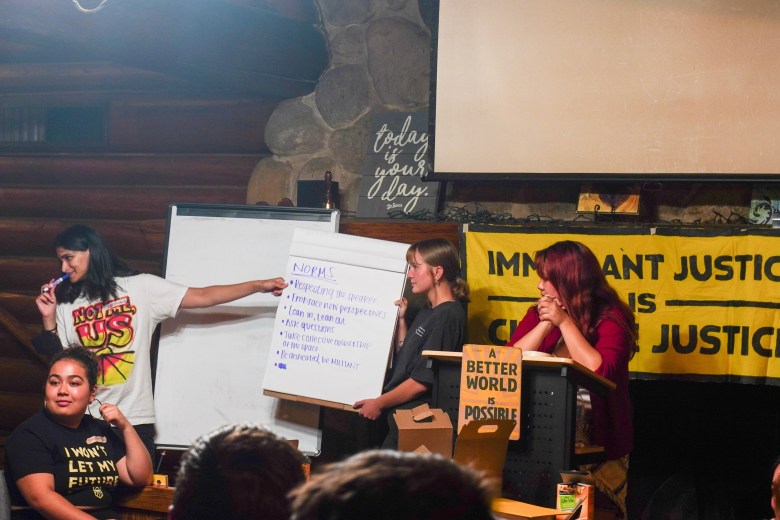
Emma Weber leads a chant at a Colorado state capitol rally in support of “The Green New Deal for Colorado Schools.” Credit: Courtesy of Emma Weber
The tax credits in the IRA, the largest legislative investment in climate projects in U.S. history, had marked a major opportunity for schools and colleges to reduce their impact on the environment. Educational institutions are significant contributors to climate change: K-12 school infrastructure, for example, releases at least 41 million metric tons of emissions per year, according to a paper from the Annenberg Institute at Brown University. The K-12 school system’s buses — some 480,000 — and meals also produce significant emissions and waste. Clean energy projects supported by the IRA were helping schools not only to limit their climate toll but also to save money on energy costs over the long term and improve student health, advocates said.
As a result, many students, consultants and sustainability leaders said, they have no plans to abandon clean energy projects. They said they want to keep working to cut emissions, even though that may be more difficult now.
Related: Become a lifelong learner. Subscribe to our free weekly newsletter featuring the most important stories in education.
Sara Ross, cofounder of UndauntedK12, which helps school districts green their operations, divided HR1’s fallout on schools into three categories: the good, the bad and the ugly.
On the bright side, she said, schools can still get up to 50 percent off for installing ground source heat pumps — those credits will continue — to more efficiently heat and cool schools. The network of pipes in a ground source pump cycles heat from the shallow earth into buildings.
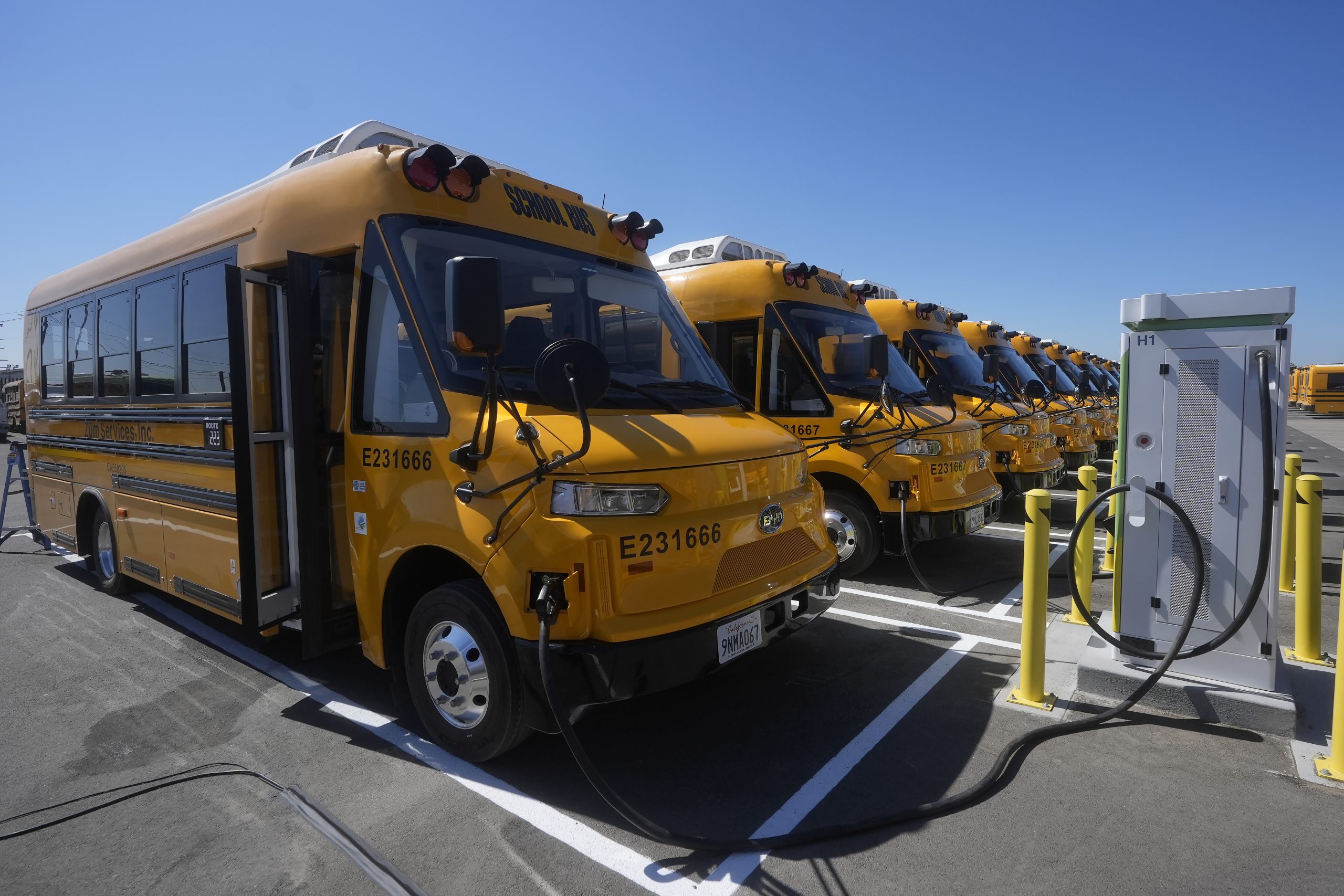
In the “bad” category, any electric vehicle acquired after Sept. 30 of this year will not be eligible for tax credits — drastically accelerating the IRA’s phase-out timeline by seven years. That applies to electric school buses as well as other district-owned vehicles. Electric vehicle charging stations must be installed by June 30, 2026 at an eligible location to claim a tax credit.*
The expiration of the federal tax credits could cost a district up to $40,000 more per vehicle, estimated Sue Gander, director of the Electric School Bus Initiative run by the nonprofit World Resources Institute.
Solar projects will see the most “ugly” effects of HR1, Ross said.
Los Angeles Unified School District is planning to build 21 solar projects on roofs, carports and other structures, plus 13 electric vehicle charging sites, as part of an effort to reduce energy costs and achieve 100 percent renewable energy by 2040. The district anticipated receiving around $25 million in federal tax credits to help pay for the $90 million contract, said Christos Chrysiliou, chief eco-sustainability officer for the district. With the tight deadlines imposed by HR1, the district can no longer count on receiving that money.
“It’s disappointing,” Chrysiliou said. “It’s nice to be able to have that funding in place to meet the goals and objectives that we have.”
Emma Weber, at left, trains student leaders at Sunrise Movement’s “summer intensive” in Illinois this year. Credit: Courtesy of Emma Weber
LAUSD is looking at a small portion of a $9 billion bond measure passed last year, as well as utility rebates, third-party financing and grants from the California Energy Commission, to help make up for some of the gaps in funding.
Many California State University campuses are in a similar position as they work to install solar to meet the system’s goal of carbon neutrality by 2045, said Lindsey Rowell, CSU’s chief energy, sustainability and transportation officer.
Tariffs on solar panel materials from overseas and the early sunsetting of tax credits mean that “the cost of these projects are becoming prohibitive for campuses,” Rowell said.
Sweeps of undocumented immigrants in California may also lead to labor shortages that could slow the pace of construction, Rowell added. “Limiting the labor force in any way is only going to result in an increased cost, so those changes are frightening as well,” she said.
New Treasury Department guidance, issued Aug. 15, made it much harder for projects to meet the threshold needed to qualify for the tax credits. Renewable energy projects previously qualified for credits once a developer spent 5 percent of a project’s cost. But the guidelines have been tightened — now, larger projects must pass a “physical work test,” meaning “significant physical labor has begun on a site,” before they can qualify for credits. With the construction commencement deadline looming next June, these will likely leave many projects ineligible for credits.
“The rules are new, complex [and] not widely understood,” Ross said. “We’re really concerned about schools’ ability to continue to do solar projects and be able to effectively navigate these new rules.”
Schools without “fancy legal teams” may struggle to understand how the new tax credit changes in HR1 will affect their finances and future projects, she added.
Some universities were just starting to understand how the IRA tax credits could help them fund projects. Lily Strehlow, campus sustainability coordinator at the University of Wisconsin, Eau-Claire, said the planning cycle for clean energy projects at the school can take ten years. The university is in the process of adding solar to the roof of a large science building, and depending on the date of completion, the project “might or might not” qualify for the credits, she said.
“At this point, everybody’s holding their breath,” said Rick Brown, founder of California-based TerraVerde Energy, a clean energy consultant to schools and agencies.
Brown said that none of his company’s projects are in a position where they’re not going to get done, but the company may end up seeing fewer new projects due to a higher cost of equipment.
Tim Carter, president of Second Nature, which supports climate work in education, added that colleges and universities are in a broader period of uncertainty, due to larger attacks from the Trump administration, and are not likely to make additional investments at this time: “We’re definitely in a wait and see.”
For youth activists, the fallout from HR1 is “disheartening,” Doshi said.
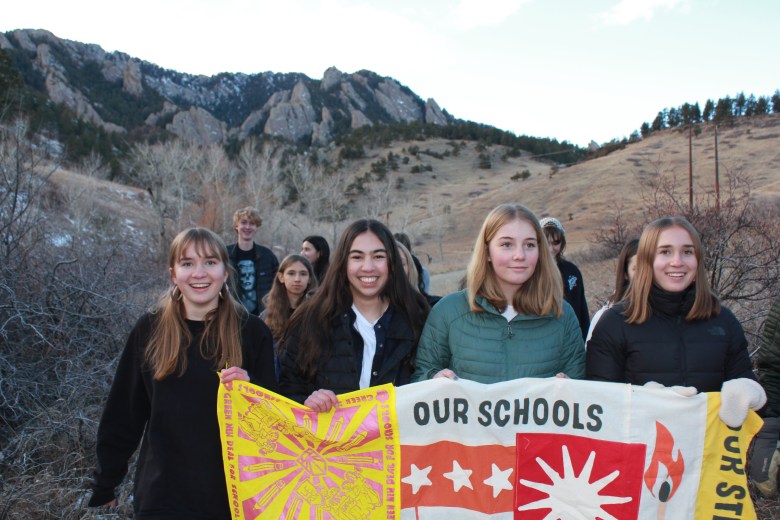
Emma and Molly Weber, climate activists since eighth grade, said they are frustrated. The Colorado-based twins, who will start college this fall, helped secure the first “Green New Deal for Schools” resolution in the nation in the Boulder Valley School District. Its goals include working toward a goal of Zero Net Energy by 2050, making school buildings greener, creating pathways to green jobs and expanding climate change education.
Emma, far left, and Molly Weber, far right, work with climate leaders from the Boulder Valley School District’s Sunrise Movement to prepare for Colorado’s legislative session. Credit: Courtesy of Emma Weber
“It feels very demoralizing to see something you’ve been working so hard at get slashed back, especially since I’ve spoken to so many students from all over the country about these clean energy tax credits, being like, ‘These are the things that are available to you, and this is how you can help convince your school board to work on this,’” Emma Weber said.
The Webers started thinking about other creative ways to pay for the clean energy transition and have settled on advocating for state-level legislation in the form of a climate superfund, where major polluters in a community would be responsible for contributing dollars to sustainability initiatives.
Consultants and sustainability coordinators said that they don’t see the demand for renewable energy going away. “Solar is the cheapest form of energy. It makes sense to put it on every rooftop that we can. And that’s true with or without tax credits,” Strehlow said.
*Correction: This version of the story includes updated information on the timeline for the expiration of tax credits for electric vehicle charging stations.
Contact editor Caroline Preston at 212-870-8965, via Signal at CarolineP.83 or on email at [email protected].
The Hechinger Report provides in-depth, fact-based, unbiased reporting on education that is free to all readers. But that doesn’t mean it’s free to produce. Our work keeps educators and the public informed about pressing issues at schools and on campuses throughout the country. We tell the whole story, even when the details are inconvenient. Help us keep doing that.
Writing can be hard, equal parts heavy lifting and drudgery. No wonder so many students are turning to the time-saving allure of ChatGPT, which can crank out entire papers in seconds. It rescues them from procrastination jams and dreaded all-nighters, magically freeing up more time for other pursuits, like, say … doomscrolling.
Of course, no one learns to be a better writer when someone else (or some AI bot) is doing the work for them. The question is whether chatbots can morph into decent writing teachers or coaches that students actually want to consult to improve their writing, and not just use for shortcuts.
Maybe.
Jennifer Meyer, an assistant professor at the University of Vienna in Austria, has been studying how AI bots can be used to improve student writing for several years. In an interview, she explained why she is cautious about the ability of AI to make us better writers andis still testing how to use the new technology effectively.
All in the timing
Meyer says that just because ChatGPT is available 24/7 doesn’t mean students should consult it at the start of the writing process. Instead, Meyer believes that students would generally learn more if they wrote a first draft on their own.
That’s when AI could be most helpful, she thinks. With some prompting, a chatbot could provide immediate writing feedback targeted to each students’ needs. One student might need to practice writing shorter sentences. Another might be struggling with story structure and outlining. AI could theoretically meetan entire classroom’s individual needsfaster than a human teacher.
Related: Our free weekly newsletter alerts you to what research says about schools and classrooms.
In Meyer’s experiments, she inserted AI only after the first draft was done as part of the revision process. In a study published in 2024, she randomly assigned 200 German high school students to receive AI feedback after writing a draft of an essay in English. Their revised essays were stronger than those of 250students who were also told to revise, but didn’t get help from AI.
In surveys, those with AI feedback also said they felt more motivated to rewrite than those who didn’t get feedback. That motivation is critical. Often students aren’t in the mood to rewrite, and without revisions, students can’t become better writers.
Meyer doesn’t consider her experiment proof that AI is a great writing teacher. She didn’t compare it with how student writing improved after human feedback. Her experiment compared only AI feedback with no feedback.
Most importantly, one dose of AI writing feedback wasn’t enough to elevate students’ writing skills. On a second, fresh essay topic, the students who had previously received AI feedback didn’t write any better than the students who hadn’t been helped by AI.
It’s unclear how many rounds of AI feedback it would take to boost a student’s writing skills more permanently, not just help revise the essay at hand.
And Meyer doesn’t know whether a student would want to keep discussing writing with an AI bot over and over again. Maybe students were willing to engage with it in this experiment because it was a novelty, but could soon tire of it. That’s next on Meyer’s research agenda.
A viral MIT study
A much smaller MIT study published earlier this year echoes Meyer’s theory. “Your Brain on ChatGPT” went viral because it seemed to say that using ChatGPT to help write an essay made students’ brains less engaged. Researchers found that students who wrote an essay without any online tools had stronger brain connectivity and activity than students who used AI or consulted Google to search for source materials. (Using Google while writing wasn’t nearly as bad for the brain as AI.)
Although those results made headlines, there was more to the experiment. The students who initially wrote an essay on their own were later given ChatGPT to help improve their essays. That switch to ChatGPT boosted brain activity, in contrast to what the neuroscientists found during the initial writing process.
These studies add to the evidence that delaying AI a bit, after some initial thinking and drafting, could be a sweet spot in learning. That’s something researchers need to test more.
Still, Meyer remains concerned about giving AI tools to very weak writers and to young children who haven’t developed basic writing skills. “This could be a real problem,” said Meyer. “It could be detrimental to use these tools too early.”
Cheating your way to learning?
Meyer doesn’t think it’s always a bad idea for students to ask ChatGPT to do the writing for them.
Just as young artists learn to paint by copying masterpieces in museums, students might learn to write better by copying good writing. (The late great New Yorker editor John Bennet taught Jill to write this way. He called it “copy work” and he encouraged his journalism students to do it every week by copying longhand the words of legendary writers, not AI.)
Meyer suggests that students ask ChatGPT to write a sample essay that meets their teacher’s assignment and grading criteria. The next step is key. If students pretend it’s their own piece and submit it, that’s cheating. They’ve also offloaded cognitive work to technology and haven’t learned anything.
But the AI essay can be an effective teaching tool, in theory, if students study the arguments, organizational structure, sentence construction and vocabulary before writing a new draft in their own words. Ideally, the next assignment should be better if students have learned through that analysis andinternalized the style and techniques of the model essay, Meyer said.
“My hypothesis would be as long as there’s cognitive effort with it, as long as there’s a lot of time on task and like critical thinking about the output, then it should be fine,” said Meyer.
Reconsidering praise
Everyone likes a compliment. But too much praise can drown learning just as too much water can keep flowers from blooming.
ChatGPT has a tendency to pour the praise on thick and often begins with banal flattery, like “Great job!” even when a student’s writing needs a lot of work. In Meyer’s test of whether AI feedback can improve students’ writing, she intentionally told ChatGPT not to start with praise and instead go straight to constructive criticism.
Her parsimonious approach to praise was inspired by a 2023 writing study about what motivates students to revise. The study found that when teachers started off with general praise, students were left with the false impression that their work was already good enough so they didn’t put in the extra effort to rewrite.
In Meyer’s experiment, the praise-free feedback was effective in getting students to revise and improve their essays. But she didn’t set up a direct competition between the two approaches — praise-free vs. praise-full — so we don’t know for sure which is more effective when students are interacting with AI.
Being stingy with praise rubs real teachers the wrong way. After Meyer removed praise from the feedback, teachers told her they wanted to restore it. “They wondered about why the feedback was so negative,” Meyer said. “That’s not how they would do it.”
Meyer and other researchers may one day solve the puzzle of how to turn AI chatbots into great writing coaches. But whether students will have the willpower or desire to forgo an instantly written essay is another matter. As long as ChatGPT continues to allow students to take the easy way out, it’s human nature to do so.
Shirley Liu is a graduate student in education at Northwestern University. Liu reported and wrote this story along with The Hechinger Report’s Jill Barshay.
The Hechinger Report provides in-depth, fact-based, unbiased reporting on education that is free to all readers. But that doesn’t mean it’s free to produce. Our work keeps educators and the public informed about pressing issues at schools and on campuses throughout the country. We tell the whole story, even when the details are inconvenient. Help us keep doing that.