Higher education institutions are complex ecosystems where policies shape the experiences of students, academics, and administrative staff.
However, the process of policy creation and implementation often lacks inclusivity, flexibility, and responsiveness to the rapidly evolving educational landscape.
If institutions are to thrive in an era of digital transformation, shifting student expectations, and increasing socio-economic challenges, they must rethink how policies are designed and enacted.
A more participatory, adaptive, and evidence-based approach is essential to creating institutional policies that truly serve the needs of all stakeholders.
Top down without engagement
Institutional policies often emerge from a centralised, top-down approach, where senior leadership teams develop policies without adequate engagement with those directly affected (students, faculty, and professional service staff).
This results in policies that may be well-intended but are disconnected from on-the-ground realities. For instance, policies surrounding Technology-Enhanced Learning (TEL) frequently fail because they do not account for academic workload constraints, staff and students’ digital literacy levels, or disparities in institutional infrastructure.
The gap between policy intentions and practical implementation then leads to confusion, resistance, and limited adoption.
Policies should not be dictated from the top – but rather co-created with those who will implement and be impacted by them. This requires institutions to foster genuine dialogue with diverse stakeholders, ensuring that different perspectives and experiences shape decision-making.
Adopting participatory approaches such as Change Laboratories, a method that engages stakeholders in problem-solving workshops, can provide a structured way for institutions to address contradictions and inefficiencies in their current policy frameworks.
A recent Change Laboratory intervention at a UK research-intensive university demonstrated the benefits of participatory policy development. The initiative brought together academics, administrators, and digital learning specialists to collaboratively identify barriers to effective blended learning adoption.
Through iterative discussions and problem-solving exercises, the group developed a Culturally Advanced Activity System (CAAS), aligning institutional policies with pedagogical realities. The process not only resulted in a more practical and effective policy framework but also increased staff engagement and willingness to adopt blended learning practices.
The success of participatory policy-making in blended learning highlights its potential application across other areas of policy. Institutions could apply similar methodologies to enhance policies related to assessment frameworks, student support services, diversity and inclusion, and faculty development. By institutionalising collaborative problem-solving approaches, HE governance structures can become more responsive to evolving educational needs.
Rigid policies that fail to account for evolving challenges and opportunities quickly become obsolete. HE institutions must adopt a more dynamic approach, treating policies as living documents that are regularly reviewed and updated based on data-driven insights.
For example, instead of prescribing a one-size-fits-all approaches, institutions should allow for staff-led experimentation, followed by structured evaluations to refine policies based on what works best in different disciplines.
An evidence-based policy culture?
Stakeholder-led policy development is crucial to ensuring that policies are not only relevant but also widely accepted and effectively implemented. By actively involving students, faculty, and administrative staff in the policy-making process, HE institutions can create frameworks that reflect the lived experiences of their communities.
This participatory approach fosters greater trust, encourages meaningful engagement, and enhances the practicality of policies. When stakeholders have ownership over policy development, they are more likely to support its implementation, leading to smoother transitions and sustainable institutional improvements.
Additionally, fostering a culture of continuous professional development ensures that policy decisions align with the latest pedagogical and technological advancements.
For HE institutions to remain relevant and responsive in the 21st century, they must overhaul how they create and implement policies. Moving away from rigid, top-down structures and embracing participatory, flexible, and evidence-driven approaches will ensure that policies are both effective and widely supported.
Institutional leaders must prioritise stakeholder engagement, foster a culture of continuous learning, and create policies that genuinely enhance teaching, learning, and student success.
Without these changes, HE risks stagnation in an era that demands adaptability and innovation. By embedding participatory mechanisms and evidence-based strategies in governance, HE institutions can pave the way for a more inclusive and forward-thinking educational environment.
Oklahoma wants some of its less-expensive universities to cut travel and operational costs, consolidate departments and reduce energy use — all in the name of saving money.
Already, earning a degree at one of these regional institutions is relatively inexpensive for students, costing in total as much as $15,000 less per year than bigger state universities in Oklahoma. And the schools, including Southeastern Oklahoma State University and the University of Central Oklahoma, graduate more teachers and nurses than those research institutions. Those graduates can fill critically needed roles for the state.
Still, state policymakers think there are more efficiencies to be found.
Higher education is one of the specific areas targeted by a new state-run agency with a familiar name, with the goal of “protecting our Oklahoma way of life,” Republican Gov. Kevin Stitt said in the first DOGE-OK report this spring. The Oklahoma Division of Government Efficiency, created around the same time as the federal entity with a similar title, counts among its accomplishments so far shifting to automated lawn mowers to cut grass at the state capital, changing to energy-efficient LED lighting and cutting down on state government cell phone bills. The Oklahoma governor’s office did not respond to a request for comment about this effort.
Oklahoma is one of about a dozen states that has considered an approach similar to the federal DOGE, though some state attempts were launched before the Trump administration’s. The federal Department of Government Efficiency, established the day Trump took office on Jan. 20, has commanded deep cuts to federal spending and the federal workforce, with limited justification.
As academia becomes a piñata for President Donald Trump and his supporters, Republican state lawmakers and governors are assembling in line: They want to get their whacks in too.
Related: Interested in more news about colleges and universities? Subscribe to our free biweekly higher education newsletter.
Beyond Oklahoma, Florida Gov. Ron DeSantis launched FL DOGE in February, with a promise to review state university and college operations and spending. Republicans in the Ohio statehouse formed an Ohio DOGE caucus. One of the Iowa DOGE Task Force’s three main goals is “further refining workforce and job training programs,” some of which are run through community colleges, and its members include at least two people who work at state universities.
The current political environment represents “an unprecedented attack on higher education,” said Veena Dubal, a law professor at the University of California, Irvine, and general counsel for the American Association of University Professors.
The state-level scrutiny comes atop those federal job cuts, which include layoffs of workers who interact with colleges, interdepartmental spending cuts that affect higher education and the shrinking of contracts that support research and special programs at colleges and universities. Other research grants have been canceled outright. The White House is pursuing these spending cuts at the same time as it is using colleges’ diversity efforts, their handling of antisemitism and their policies about transgender athletes to force a host of changes that go beyond cost-cutting — such as rules about how students protest and whether individual university departments require more supervision.
Florida Atlantic University students Zayla Robinson, Aadyn Hoots and Meadow Swantic (from left to right) sit together at the Boca Raton campus. Swantic objects to Florida’s efforts to dictate what subjects universities can or can’t teach: “You can’t erase history.” Credit: Michael Vasquez for The Hechinger Report
Higher education, which relies heavily on both state dollars and federal funding in the form of student loans and Pell grants, research grants and workforce training programs, faces the prospect of continued, and painful, budget cuts.
“Institutions are doing things under the threat of extinction,” Dubal said. “They’re not making measured decisions about what’s best for the institution, or best for the public good.”
For instance, the Trump administration extracted a number of pledges from Columbia University as part of its antisemitism charge, suspending $400 million in federal grants and contracts as leverage. This led campus faculty and labor unions to sue, citing an assault on academic freedom. (The Hechinger Report is in an independent unit of Teachers College.) Now Harvard faces a review of $9 billion in federal funding, also over antisemitism allegations, and the list of universities under similar scrutiny is only growing.
Budget cuts are nothing new for higher education — when a recession hits, it is one of the first places state lawmakers look to cut, in blue states or red. One reason: Public universities can sometimes make up the difference with tuition increases.
What DOGE brings, in Washington and statehouses, is something new. The DOGE approach is engaging in aggressive cost-cutting that specifically targets certain programs that some politicians don’t like, said Jeff Selingo, a special adviser to the president at Arizona State University.
“It’s definitely more political than it is fiscal or policy-oriented,” said Selingo, who is also the author of several books on higher education.
“Universities haven’t done what certain politicians wanted them to do,” he added. “This is a way to control them, in a way.”
The current pressure on Florida colleges extends far beyond budget matters. DeSantis has criticized college campuses as “intellectually repressive environments.” In 2021, Florida state lawmakers passed a law, signed by the governor, to fight this perceived ideological bent by requiring a survey of public university professors and students to assess whether there is enough intellectual diversity on campus.
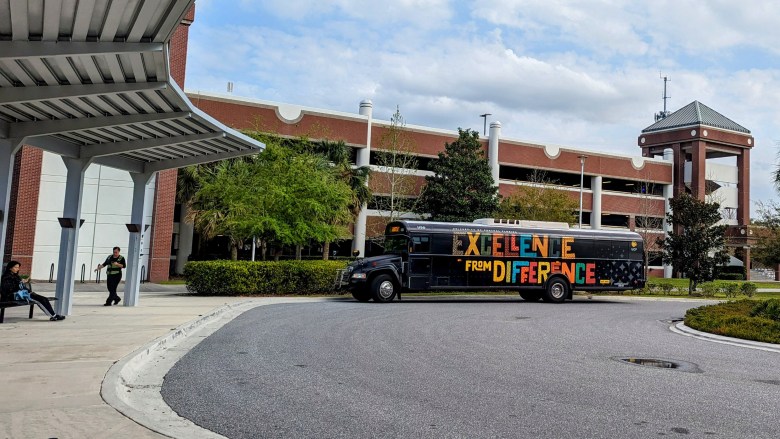
A diversity-themed bus transports students at the University of Central Florida’s Orlando campus. Credit: Michael Vasquez for The Hechinger Report
At New College in Sarasota, DeSantis led an aggressive cultural overhaul to transform the college’s atmosphere and identity into something more politically conservative. The governor has cited Hillsdale College, a conservative private Christian institution in Michigan, as a role model.
Faculty and students at New College sued. Their complaints included allegations of academic censorship and a hostile environment for LGBTQ+ students, many of whom transferred elsewhere. One lawsuit was ultimately dropped. Since the takeover, the college added athletics programs and said it has attracted a record number of new and transfer students.
Across America, Republicans control both the legislature and the governor’s mansion in 23 states, compared with 15 states fully controlled by Democrats. In those GOP-run states, creating a mini-DOGE carries the potential for increased political might, with little oversight.
In Florida, “state DOGE serves as an intimidation device,” one high-ranking public university administrator told The Hechinger Report. The administrator, who asked not to be named for fear of retribution, said “there’s also just this atmosphere of fear.”
In late March, university presidents received a letter signed by the “DOGE Team” at the governor’s office. The letter promised a thorough review by FL DOGE officials, with site visits and the expectation that each college appoint a designated liaison to handle FL DOGE’s ongoing requests.
The letter highlighted some of the items FL DOGE might request going forward, including course codes, descriptions and syllabi; full detail of all centers established on campus; and “the closure and dissolution of DEI programs and activities, as required by law.”
The student union at Florida Atlantic University in Boca Raton. Florida Gov. Ron DeSantis, a Republican, launched FL DOGE in February, promising to review state university and college operations and spending. Credit: Michael Vasquez for The Hechinger Report
The state did not respond to a question about whether FL DOGE is designed to attack higher education in the state. Molly Best, the deputy press secretary, noted that FL DOGE is now up and running, and cities and counties are also receiving letters requesting certain information and that the public will be updated in the future.
DOGE in Florida also follows other intervention in higher education in the state: Florida’s appointed Board of Governors, most of whom are chosen by the governor, removed dozens of courses from state universities’ core curriculum to comply with the Stop WOKE Act, a state law that took effect in 2022. The law, which DeSantis heavily promoted, discourages the teaching of concepts such as systemic racism or sexism. The courses removed from Florida’s 12 state universities were primarily sociology, anthropology and history courses.
“You can’t erase history,” said Meadow Swantic, a criminal justice major at Florida Atlantic University, a public institution, in an interview at its Boca Raton campus. “There’s certain things that are built on white supremacy, and it’s a problem.”
Fellow Florida Atlantic student Kayla Collins, however, said she has noticed some professors’ liberal bias during class discussions.
“I myself have witnessed it in my history class,” said Collins, who identifies as Republican. “It was a great history class, but I would say there were a lot of political things brought up, when it wasn’t a government class or a political science class.”
At the University of Central Florida in Orlando, political science major Liliana Hogan said she had a different experience of her professors’ political leanings.
“You hear ‘people go to university to get woke’ or whatever, but actually, as a poli-sci student, a lot of my professors are more right-wing than you would believe,” Hogan said. “I get more right-leaning perspectives from my teachers than I would have expected.” Hogan said.
Another UCF student, Johanna Abrams, objected to university budget cuts being ordered by the state government. Abrams said she understands that tax dollars are limited, but she believes college leaders should be trusted with making the budget decisions that best serve the student body.
“The government’s job should be providing the funding for education, but not determining what is worthy of being taught,” Abrams said.
Whatever their missions and attempts at mimicry, state-level DOGE entities are not necessarily identical to the federal version.
For instance, in Kansas, the Committee on Government Efficiency, while inspired by DOGE, is in search of ideas from state residents about ways to make the state bureaucracy run better rather than imposing its own changes. A Missouri Senate portal inspired by the federal DOGE works in a similar way. Yet the federal namesake isn’t taking suggestions from the masses to inform its work.
And at the federal level, then-DOGE chief Elon Musk in February emailed workers, asking them to respond “to understand what they got done last week,” he posted on X. “Failure to respond will be taken as a resignation.” Employees were asked to reply with a list of five accomplishments.
The Ohio DOGE Caucus noted explicitly it won’t be doing anything like that.
“We’re not going to be emailing any state employees asking them to give us five things they worked on throughout the week,” Ohio state Rep. Tex Fischer, a Republican, told a local radio station. “We’re really just trying to get like-minded people into a room to talk about making sure that government is spending our money wisely and focusing on its core functions that we all agree with.”
Contact editor Nirvi Shah at 212-678-3445, securely on Signal at NirviShah.14 or via email at [email protected].
The Hechinger Report provides in-depth, fact-based, unbiased reporting on education that is free to all readers. But that doesn’t mean it’s free to produce. Our work keeps educators and the public informed about pressing issues at schools and on campuses throughout the country. We tell the whole story, even when the details are inconvenient. Help us keep doing that.
Artificial intelligence will change higher education till 2025, presenting opportunities and challenges. Polls show 84% of higher education workers use AI daily.
ChatGPT lecturers use AI, and 92% of UK students embrace it.
Universities must negotiate AI’s complexities as it enhances teaching and overcomes natural limitations.
For AI to reach its potential, institutions must understand and overcome its major benefits and quick adoption challenges. Let’s discover all this in this post.
Opportunities: How AI is Transforming Higher Education in 2025
1. Automating Assessments & Grading
The Problem with Manual Grading & Feedback
Often labor-intensive and erratic, traditional grading systems are For a good chunk of their workweek, professors grade and offer comments. Teachers grade and provide comments for a median of five hours a week, according to a poll by Education Week.
In contexts of online learning, the time commitment could be much more important. According to a research written for the Online Journal of Distance Learning Administration, teachers dedicate roughly 12.69 hours a week to each online course—about 40% of which are used for grading and comments.
This large time commitment in grading can take away from other important duties such lesson planning and direct student involvement.
AI Tools for Grading and Student Feedback
AI-powered intelligent grading systems have become clear answers to improve consistency and efficiency in tests. By processing tests and assignments faster than hand grading, these AI systems help to lighten faculty workload and release their time for more critical chores.
Automating typical grading chores lets professors to concentrate more on educational tactics and individualized student interactions.
How to Automate Grading with AI in Higher Education
Using AI-driven tests calls for multiple steps of implementation, including:
Review current assessment techniques: Find how artificial intelligence could streamline processes.
Choosing AI Tools: AI grading systems should complement technology and educational objectives of the institution.
Launch of the pilot program: Try and get comments via a small-scale rollout.
Teach staff members and professors: Give thorough instruction to enable simple use of AI tools.
Watch and get better: Examine the system’s performance and modify it to produce the greatest outcomes.
Designed by the University of Toronto’s Rotman School of Management, “All Day TA,” an artificial intelligence assistant, answered 12,000 student queries annually. This suggests that real-world uses of artificial intelligence in education abound.
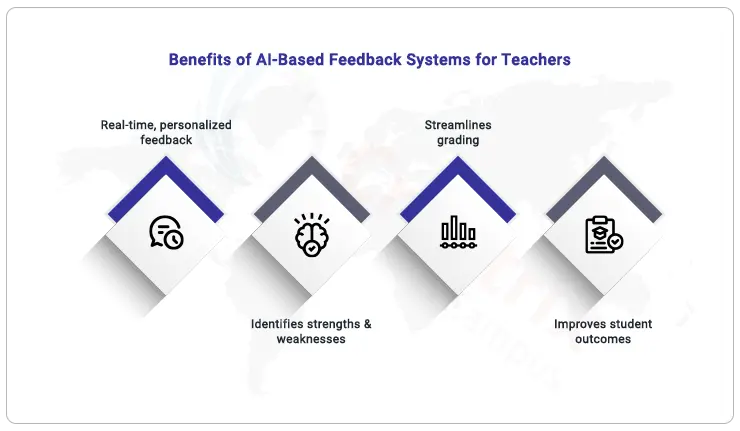
Benefits of AI-Based Feedback Systems for Teachers
AI-powered feedback systems give students individualized, real-time information that makes learning more fun. These tools can look at how students answered, figure out what they did well and what they could do better, and give them feedback that helps them get better.
Artificial intelligence (AI) makes grading easier, which gives teachers more time for teaching and helping students, which leads to better educational results.
2. Customized learning and student success
AI is a key part of personalized education because it lets faculty make learning paths that fit the needs of each student. AI-powered adaptive learning platforms can look at student performance data to change how material is delivered. This way, each student gets instruction that fits their learning style and speed through it.
AI-driven insights can also help find students who are at risk early on, so that they can get help when they need it to help them succeed and stay until they graduate.
3. Operations and administration on campus powered by AI
AI is simplifying college administrative tasks and research. Using AI to streamline admissions, course scheduling, and staff responsibilities saves time and money.
Universities can use their resources more efficiently and focus on long-term learning programs by automating mundane administrative tasks.
Challenges: Major Challenges Universities Face with AI in 2025
Universities must address data security, faculty adoption, and the delicate balance between automation and human control to employ AI ethically and effectively.
1. Data Privacy & Ethical Concerns
Personalization and grading are automated by AI-powered systems that process massive student data.
Universities should ensure compliance with data privacy laws (e.g., GDPR) to protect student data.
Monitor automated grading and recommendation systems to prevent bias.
Maintain transparency in AI-driven decisions to build trust with faculty and students.
2. Resistance from faculty and a lack of training
In spite of its benefits, AI is not easily utilized in higher education for the following reasons: The idea of limiting students’ freedom is still scary to many faculty . They don’t know how AI can be used to grade and leave notes.
Faculty may not be able to use AI tools well if they haven’t been taught properly. In order for AI to work well with other systems, organizations need to spend money on skill-building programs for people.
How to put it into action: Universities should start with test programs, offer ongoing training, and make sure that the rollout happens slowly so that teachers can get used to it before they start using it for real.
3. Balancing AI with Human Oversight
Though it speeds grading, artificial intelligence shouldn’t replace human judgment—especially for challenging tasks like essays and creative projects! Universities must have measures in place to prevent AI comments from being accepted at face value and maintain equity. The best way is: a clever combination of human supervision with artificial intelligence efficiency to maintain accurate, balanced, and correctness.
Conclusion
Offering game-changing efficiencies and new challenges, artificial intelligence is revolutionizing higher education. The secret for colleges is to strike the proper balance—using artificial intelligence for automation without sacrificing the human element in learning. Early adopters of artificial intelligence will not only improve student performance but also keep ahead in a landscape getting more competitive.
All set to use artificial intelligence for better, more effective administration of education? Get in touch with Creatrix Campus and investigate AI-driven solutions catered for universities.
TORONTO – April 28, 2025 – Whether it be student grades, assessment responses, engagement data, or contact information, the safety of your data is our priority at Top Hat. As the leading engagement platform used by more than 750 higher education institutions, we’ve implemented several technical and operational measures to keep our promise. That’s why we’re thrilled to announce that Top Hat has received a certificate of compliance for ISO/IEC 27001:2022!
Read on to learn what this means for our business and users.
A new milestone in Top Hat’s privacy and security journey
The ISO/IEC 27001:2022 certification is the international gold standard for information security management. This achievement highlights our dedication to safeguarding user data through a complete set of information security controls, which are routinely audited by an independent third party. CPSI Certifications Inc., a certification body with more than 30 years of experience, performed the audit and awarded the certification. Our certification reflects our continuous commitment to upholding the highest level of security standards to protect user data. This credential applies to both the Top Hat and Aktiv SaaS platforms.
“Achieving ISO/IEC 27001:2022 certification is a significant milestone for us. It reflects the strong security foundation we’ve built to protect our users’ data and demonstrates our commitment to maintaining the highest standards of information security,” says Que Sengmany, Director of Information Security at Top Hat. “For our users and partners, this certification provides assurance that we’re following globally-recognized best practices to manage risks and safeguard information.”
Our security philosophy
At Top Hat, we’ve used the following pillars to guide our security philosophy.
Confidentiality: Ensuring that information is accessible only to authorized individuals
Integrity: Maintaining the accuracy and completeness of information and processing methods
Availability: Guaranteeing that only authorized users have access to information when needed
These principles continue to be our North Star as we continue to safeguard sensitive company and user data. Curious to know more about our technical security measures? Visit our Security page today.
About Top Hat
As the leader in student engagement solutions for higher education, Top Hat enables educators to employ proven student-centered teaching practices through interactive content and tools enhanced by AI, and activities in in-person, online and hybrid classroom environments. To accelerate student impact and return on investment, the company provides a range of change management services, including faculty training and instructional design support, integration and data management services, and digital content customization. Thousands of faculty at 750 leading North American colleges and universities use Top Hat to create meaningful, engaging and accessible learning experiences for students before, during, and after class.
TORONTO – April 28, 2025 – Whether it be student grades, assessment responses, engagement data, or contact information, the safety of your data is our priority at Top Hat. As the leading engagement platform used by more than 750 higher education institutions, we’ve implemented several technical and operational measures to keep our promise. That’s why we’re thrilled to announce that Top Hat has received a certificate of compliance for ISO/IEC 27001:2022!
Read on to learn what this means for our business and users.
A new milestone in Top Hat’s privacy and security journey
The ISO/IEC 27001:2022 certification is the international gold standard for information security management. This achievement highlights our dedication to safeguarding user data through a complete set of information security controls, which are routinely audited by an independent third party. CPSI Certifications Inc., a certification body with more than 30 years of experience, performed the audit and awarded the certification. Our certification reflects our continuous commitment to upholding the highest level of security standards to protect user data. This credential applies to both the Top Hat and Aktiv SaaS platforms.
“Achieving ISO/IEC 27001:2022 certification is a significant milestone for us. It reflects the strong security foundation we’ve built to protect our users’ data and demonstrates our commitment to maintaining the highest standards of information security,” says Que Sengmany, Director of Information Security at Top Hat. “For our users and partners, this certification provides assurance that we’re following globally-recognized best practices to manage risks and safeguard information.”
Our security philosophy
At Top Hat, we’ve used the following pillars to guide our security philosophy.
Confidentiality: Ensuring that information is accessible only to authorized individuals
Integrity: Maintaining the accuracy and completeness of information and processing methods
Availability: Guaranteeing that only authorized users have access to information when needed
These principles continue to be our North Star as we continue to safeguard sensitive company and user data. Curious to know more about our technical security measures? Visit our Security page today.
About Top Hat
As the leader in student engagement solutions for higher education, Top Hat enables educators to employ proven student-centered teaching practices through interactive content and tools enhanced by AI, and activities in in-person, online and hybrid classroom environments. To accelerate student impact and return on investment, the company provides a range of change management services, including faculty training and instructional design support, integration and data management services, and digital content customization. Thousands of faculty at 750 leading North American colleges and universities use Top Hat to create meaningful, engaging and accessible learning experiences for students before, during, and after class.
As Education Secretary Linda McMahon was busy dismantling her cabinet department, she vowed to preserve one thing: the National Assessment of Educational Progress (NAEP), also known as the Nation’s Report Card. In early April, she told a gathering of ed tech companies and investors that the national exam was “something we absolutely need to keep,” because it’s a “way that we keep everybody honest” about the truth of how much students across the country actually know.
That was clearly a promise with an asterisk.
Less than two weeks later, on Monday of this week, substantial parts of NAEP came crumbling down when the board that oversees the exam reluctantly voted to kill more than a dozen of the assessments that comprise the Nation’s Report Card over the next seven years.
The main reading and math tests, which are required by Congress, were preserved. But to cut costs in an attempt to appease Elon Musk’s Department of Government Efficiency or DOGE, the National Assessment Governing Board (NAGB) scrapped a 2029 administration of the Long-Term Trend NAEP, an exam that has tracked student achievement since the 1970s.* Also cut were fourth grade science in 2028, 12th grade science in 2032 and 12th grade history in 2030. Writing assessments, which had been slated for 2032, were canceled entirely. State and local results were also dropped for an assortment of exams. For example, no state-level results will be reported for 12th grade reading and math in 2028, nor will there be district-level results for eighth grade science that year.
Related: Our free weekly newsletter alerts you to what research says about schools and classrooms.
“These are recommendations that we are making with much pain,” said board chair Beverly Perdue, a former North Carolina governor who was appointed to this leadership role in 2018 during President Donald Trump’s first term. “None of us want to do this.”
The board didn’t provide an official explanation for its moves. But the vice chair, Martin West, a Harvard professor of education, said in an interview that the cuts were an effort to save the 2026 assessments. “A moment of reckoning came more quickly because of the pressures on the program to reduce expenses in real time,” he said.
In other words, the board was effectively cutting off the patient’s appendages to try to save the brain and the heart. Despite the sacrifice, it’s still not clear that the gambit will work.
DOGE has been demanding 50 percent cuts to the $190 million a year testing program. Nearly all the work is handled by outside contractors, such as Westat and ETS, and five-year contracts were awarded at the end of 2024. But instead of paying the vendors annually, DOGE has diced the payments into shorter increments, putting pressure on the contractors to accept sharp cuts, according to several former Education Department employees. At the moment, several of the contracts are scheduled to run out of money in May and June, and DOGE’s approval is needed to restart the flow of money. Indeed, DOGE allowed one NAEP contract to run out of funds entirely on March 31, forcing ETS employees to stop work on writing new questions for future exams.
Reading and math tests are scheduled to start being administered in schools in January 2026, and so additional disruptions could derail the main NAEP assessment altogether. NAEP is taken by a sample of 450,000 students who are selected to represent all the fourth and eighth graders in the nation, and each student only takes part of a test. This sampling approach avoids the burden of testing every child in the country, but it requires Education Department contractors to make complicated statistical calculations for the number of test takers and the number of test sections needed to produce valid and reliable results. Contractors must then package the test sections into virtual test booklets for students to take online. The Education Department also must get approval from the federal Office of Management and Budget to begin testing in schools — yet another set of paperwork that is handled by contractors.
A DOGE dilemma
People familiar with the board’s deliberations were concerned that contractors might be pressured to agree to cuts that could harm the quality and the validity of the exam itself. Significant changes to the exam or its administration could make it impossible to compare student achievement with the 2024 results, potentially undermining the whole purpose of the assessment.
Board members were ultimately faced with a dilemma. They could cut corners on the full range of assessments or hope to maintain NAEP’s high quality with a much smaller basket of tests. They chose the latter.
The cuts were designed to comply with congressional mandates. While the Long-Term Trend assessment is required by Congress, the law does not state how frequently it must be administered, and so the governing board has deferred it until 2033. Many testing experts have questioned whether this exam has become redundant now that the main NAEP has a 35-year history of student performance. The board has discussed scrapping this exam since 2017. “The passage of time raises questions about its continued value,” said West.
The writing assessments, originally scheduled for 2032 for grades four, eight and 12, needed an overhaul and that would have been an expensive, difficult process especially with current debates over what it means to teach writing in the age of AI.
The loss of state- and district-level results for some exams, such as high school reading and math, were some of the more painful cuts. The ability to compare student achievement across state lines has been one of the most valuable aspects of the NAEP tests because the comparison can provide role models for other states and districts.
Cost cutting
“Everyone agrees that NAEP can be more efficient,” said West, who added that the board has been trying to cut costs for many years. But he said that it is tricky to test changes for future exams without jeopardizing the validity and the quality of the current exam. That dual path can sometimes add costs in the short term.
It was unclear how many millions of dollars the governing board saved with its assessment cancellations Monday, but the savingsare certainly less than the 50 percent cut that DOGE is demanding. The biggest driver of the costs is the main NAEP test, which is being preserved. The contracts are awarded by task and not by assessment, and so the contractors have to come back with estimates of how much the cancellation of some exams will affect its expenses. For example, now that fourth grade science isn’t being administered in 2028, no questions need to be written for it. But field staff will still need to go to schools that year to administer tests, including reading and math, which haven’t been cut.
Compare old and new assessment schedules
Outside observers decried the cuts on social media, with one education commentator saying the cancellations were “starting to cut into the muscle.” Science and history, though not mandated by Congress, are important to many. ”We should care about how our schools are teaching students science,” said Allison Socol, who leads preschool to high school policy at EdTrust, a nonprofit that advocates for equity in education. “Any data point you look at shows that future careers will rely heavily on STEM skills.”
Socol worries that DOGE will not be satisfied with the board’s cuts and demand more. “It’s just so much easier to destroy things than to build them,” she said. “And it’s very easy, once you’ve taken one thing away, to take another one and another one and another one.”
On April 17, the Education Department announced that the 2026 NAEP would proceed as planned. But after mass layoffs in March, it remained unclear if the department has the capacity to oversee the process, since only two employees with NAEP experience are left out of almost 30who used to work on the test. McMahon might need to rehire some employees to pull it off, but new hiring would contradict the spirit of Trump’s executive order to close the department.
Socol fears that the Trump administration doesn’t really want to measure student achievement. “There is a very clear push from the administration, not just in the education sector, to have a lot less information about how our public institutions are serving the people in this country,” Socol said. “It is a lot easier to ignore inequality if you can’t see it, and that is the point.”
The Education Department did not respond to my questions about their intentions for NAEP. McMahon has been quite forceful in articulating the value of the assessments, but she might not have the final say since DOGE has to approve the NAEP contracts. “What’s very clear is that the office of the secretary does not completely control the DOGE people,” said a person with knowledge of the dynamics inside the Education Department. “McMahon’s views affect DOGE priorities, but McMahon doesn’t have direct control at all.”
The ball is now in DOGE’s court.
Canceled assessments
Long-Term Trend (LTT) assessments in math and reading for 9, 13 and 17 year olds in 2029. (The Education Department previously canceled the 2025 LTT for 17 year olds in February 2025.)
Science: Fourth-grade in 2028, 12th grade in 2032
History: 12th grade in 2030
Writing: Fourth, eighth and 12th grades in 2032
State-level results: 12th grade math and reading in 2028 and 2032, eighth grade history in 2030
District-level results: Eighth-grade science in 2028 and 2032
*Correction: An earlier version of this sentence incorrectly said that two administrations of the Long-Term Trend NAEP had been scrapped by the governing board on April 21. Only the 2029 administration was canceled by the board. The 2025 Long-Term Trend NAEP for 17 year olds was canceled by the Education Department in February. Nine- and 13-year-old students had already taken it by April.
The Hechinger Report provides in-depth, fact-based, unbiased reporting on education that is free to all readers. But that doesn’t mean it’s free to produce. Our work keeps educators and the public informed about pressing issues at schools and on campuses throughout the country. We tell the whole story, even when the details are inconvenient. Help us keep doing that.
CLEVELAND — In a public school cafeteria here, 6- and 7-year olds were taking turns sketching their ideas for a building made of toothpicks and gummy bears. Their task: to design a structure strong enough to support a single subject notebook.
It was a challenge meant to test their abilities to plan ahead, work as a team and overcome setbacks. But first, they had to resist the urge to eat the building materials.
Zayden Barnes, a first grader at Clara E. Westropp School of the Arts, picked up a blue gummy bear and sniffed it. “That smells good,” he said, licking his lips.
Mia Navarro, another first grader, held a green gummy bear to her nose and inhaled deeply. “I can’t stop smelling them!” she exclaimed. “I just want to eat it, but I can’t!”
The lesson in engineering and self-control was part of an after-school program run by the nonprofit Horizon Education Centers. It’s one of a dwindling number of after-school options in a city with one of the highest child poverty rates of any large urban area in the country.
Last year, Horizon and other nonprofit after-school providers reached more than 7,000 students in Cleveland public schools, buoyed by $17 million in pandemic recovery aid. But when the money ran out at the end of that school year, nonprofits here had to drop sites, shed staff and shrink enrollment. Horizon, which was in five public schools last year, is now in just one.
Similar setbacks can be seen across the country, as after-school programs struggle to replace billions in federal relief money. While a few states are helping to fill the gap, Ohio isn’t among them. And many providers fear more cuts are coming, as the Trump administration continues its campaign to slash government spending and end “equity-related” grants and contracts.
The after-school sector plays a critical role in the nation’s economy, providing close to 8 million students, or nearly 14 percent of all school-aged children, with a safe place to go while their parents work. It offers homework help, enriching activities, healthy snacks and physical exercise — often for a fee, but sometimes for free.
Done well, after-school programs can strengthen students’ social and emotional skills, increase their engagement with and attendance in school, and reduce their risk of substance abuse or criminal activity. In some cases, they can help improve grades and test scores, too.
Yet the sector, which has existed for more than 100 years, has long been hobbled by inadequate funding, staffing shortages and uneven quality. There are long waitlists for many programs, and low-income families often struggle to find affordable options.
In a recent survey by the nonprofit Afterschool Alliance, more than 80 percent of program leaders said they were concerned about their program’s future, and more than 40 percent said they worried they’d have to close permanently.
“The state of afterschool in America feels very grim,” said Alison Black, executive director of the Cleveland affiliate of America Scores, a nonprofit that teaches soccer and poetry to students in 13 cities across North America.
Students build a gummy bear structure in an after-school program run by Horizon Education Centers, in Cleveland. Credit: Grace McConnell for The Hechinger Report
After-school programs emerged in the second half of the 19th century, in philanthropic settlement houses that provided English courses and health care to the children of immigrants, according to a Rand Corporation report. They multiplied after Congress passed child labor laws in the 1930s, and again during World War II, when women entered the workforce in large numbers.
In those early days, the programs functioned mostly as child care, offering a solution to the problem of the “latchkey kid.” But they began to take on a broader role in the 1960s, when the programs started to be seen as a way to both reduce youth crime and provide kids with positive role models, according to Rand.
In the 1980s and 1990s, policymakers and funders began demanding that after-school programs play a part in closing the academic gaps between wealthier and poorer kids. High-poverty schools began setting aside some of their Title I funds to provide after-school programs.
But it wasn’t until 1998 that the federal government offered targeted support to after-school programs, in the form of competitive grants awarded by the states through the newly created 21st Century Community Learning Centers Program. The first year, Congress appropriated $40 million for the program; by 2002, that number had swelled to $1 billion.
Today, the after-school sector is made up of a mix of programs providing academic support, enrichment (sports, theater and the like) or some combination. Their goals and funding streams vary, from public dollars to philanthropic and corporate gifts. Many survive by stitching together multiple sources of funding.
The 21st Century program remains the only dedicated federal funding stream for after-school and summer learning, providing $1.3 billion in support to 10,000 centers serving close to a fifth of students in 2023.
After-school programs are popular among parents, and demand for slots far exceeds the supply. For every child in an after-school program, there are three more who would participate if an affordable, accessible option was available to their families, according to surveys by the Afterschool Alliance.
Gina Warner, CEO of the National Afterschool Association, says afterschool is a space where kids can try new things and take risks they wouldn’t take at school, where the stakes are higher. “Afterschool is still a place where kids can fail” without consequence, she said.
The programs also connect students with positive adult role models who aren’t their teachers or caregivers, said Jodi Grant, executive director of the Afterschool Alliance. “Our biggest strength, when it gets down to it, is relationships,” Grant said.
But sustaining those connections can be difficult in a sector with low pay and limited opportunities for advancement. Turnover rates are high, and when staff don’t stick around, “You’re missing one of the best benefits of afterschool,” said Warner.
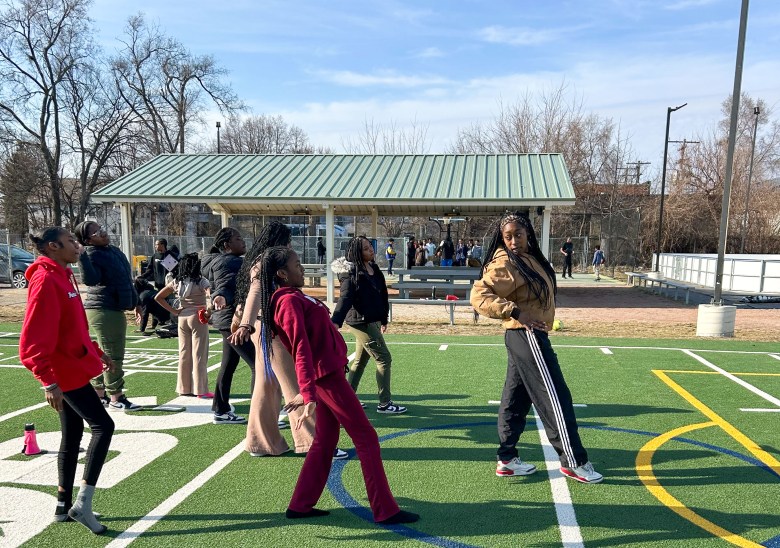
Students practice a dance routine at the Downtown Boxing Gym, in Detroit. Credit: Kelly Field for The Hechinger Report
For a sector accustomed to scraping by, the American Rescue Plan Act of 2021 was like a winning lottery ticket.
Over three years, after-school programs received roughly $10 billion in ARPA aid — money they used to add staff, improve pay and benefits and expand enrollment, according to the Afterschool Alliance. It estimates that programs were able to serve 5 million more kids as a result.
But the money has mostly been spent, and late last month, Education Secretary Linda McMahon told districts that their time to use any remaining funds was over. In Cleveland, which spent almost $28 million on out-of-school time programs between fiscal 2022 and 2024, Horizon and other nonprofits formed a coalition to try to convince the district to continue at least a portion of the aid. They held rallies, secured media coverage and brought parents to testify before the school board. But the district wouldn’t budge, said David Smith, Horizon’s executive director.
“There’s no opportunity to go back to the scale we were at during the pandemic, and we still have the same problems,” said Smith. “Kids are getting in trouble after school, and they still need the extra academic help.”
The Cleveland Metropolitan School District made significant gains under its last CEO, Eric Gordon, whose Cleveland Plan was credited with improved student outcomes, including a 25 percentage point increase in the high school graduation rate. But the pandemic erased some of those gains and Cleveland, like many districts, is still recovering.
The district’s new CEO, Warren Morgan, has defended his decision not to fund the nonprofit providers, noting that the district offers after-school sports and an arts program. But those extracurriculars vary by day and by school, and after-school advocates say many schools have been left without the consistent, comprehensive care working parents depend on.
“Our city is focused on workforce development without thinking about who cutting this care hurts,” said Black, of America Scores Cleveland.
Without continued support from the district, Black’s organization has had to dip into its rainy-day fund and drop fall soccer for middle schoolers. Serving elementary students feels more essential, she explained, since younger kids can’t stay home alone.
Other nonprofits have been harder hit. The Greater Cleveland Neighborhood Centers Association, or NCA, has closed half of its locations in the district, leaving programs in seven schools. The Boys and Girls Clubs of Northeast Ohio, which lost $3 million in pandemic relief dollars and other federal support this academic year, has shuttered 17 sites.
Dorothy Moulthrop, chief executive officer of Open Doors Academy, another nonprofit, thinks the losses might have been less severe if the after-school coalition had been able to show strong results for the federal money. Though individual programs handed over reams of data to the district, Moulthrop wasn’t able to get its leaders to share the data in a form that would allow providers to study their collective impact.
“We needed to be able to demonstrate our return on investment and we were not able to,” she said.
Students in a poetry class run by America Scores Cleveland. Credit: Grace McConnell for The Hechinger Report
Questions about whether after-school programs are a good investment of public dollars have dogged the sector since the early 2000s, when Mathematica Policy Research began publishing the results of an evaluation that found the 21st Century program had little impact on student outcomes.
The study, which is often cited by politicians seeking to gut after-school spending, was controversial at the time, and remains so. Defenders of afterschool argue the evaluation was methodologically flawed and point to other research that found that students who regularly attended high-quality programs saw significant gains. But one of the study’s two authors, Susanne James-Burdumy, said in an interview that it was the most rigorous of its time.
In the 20 years since the Mathematica reports were published, hundreds of dissertations and program evaluations have added to the evidence base for both sides of the debate. But large-scale, rigorous evaluations of after-school programs remain rare, and their findings are mixed, James-Burdumy and other researchers say.
Though some analyses have found after-school programs can boost reading and math achievement, promote positive social behaviors and reduce negative ones, other studies have shown little growth in those and other areas.
Some of that inconsistency likely stems from differences in the quality of programs, researchers and advocates say. When funding is tight, after-school programs tend to focus their dollars on services, rather than professional development or program evaluation.
“Quality often feels like an extra,” said Jessie Kerr-Vanderslice, a consultant at the American Institutes for Research who focuses on out-of-school time programs.
Advocates also note a misalignment between program goals and outcome measures: While after-school programs often prioritize relationships and social and emotional skill-building, their funders frequently focus on academic gains.
One variable that seems to matter in student outcomes is attendance: Studies have found that students who attend regularly reap greater benefits than those who show up sporadically.
Yet more than half of students who participated in programs paid for with 21st Century grants in 2022-23 attended for less than 90 hours, a program evaluation shows. That works out to just 30 days for a three-hour program.
At Clara E. Westropp Elementary in Cleveland, where Horizon Education Centers has been able to continue its after-school program with a 21st Century grant, 73 students are enrolled, but average daily attendance is less than half that.
Students descend the stairs during an after-school program run by America Scores Cleveland. Credit: Grace McConnell for The Hechinger Report
On the other side of Lake Erie, at Detroit’s Downtown Boxing Gym, students are required to attend at least three days a week. To keep them coming, the program offers a huge range of activities, from cooking to coding (but ironically, not boxing).
Inside the large building that houses the program, there’s a lab with a flight simulator and 3D printer, and a music studio paid for and built by one of Eminem’s former producers.
Outside, on a turf field where the program plans to build an addition that will enable it to double enrollment, a group of middle school majorettes was preparing for an upcoming dance performance.
Debra Beal, who became the caregiver to her niece’s two young sons when she was in her 50s, says the program saved her life — and theirs. It kept the boys, now 19 and 20, off the streets while she worked, provided them with exercise and tutoring, and even served them dinner. The staff became like family, supporting her when she struggled as a parent and offering to pay for counseling when one son lost his father and uncle from fentanyl overdoses on the same day.
“What they’re doing is life-changing,” said Beal, whose long denim coat had the word “Blessed” written in sequins on the back.
Financially, the Downtown Boxing Gym is on surer footing than its counterparts in Cleveland. The Michigan Legislature has provided $50 million in funding for after-school programs in each of the last two years, and the program recently received $3 million in funds from the state.
That doesn’t mean the program isn’t being pinched by the Trump administration’s cost-cutting campaign and purge of diversity, equity and inclusion programs, said Jessica Hauser, its executive director. Corporations the program was counting on for seven-figure gifts for the addition and program expansion are reconsidering their pledges, and a promised federal earmark now seems unlikely.
Hauser is also worried about potential cuts to federal child nutrition programs and student aid, which the program depends on for meals and college student tutors.
Back in Cleveland, the coalition Smith formed to fight for after-school funding has expanded to include the city, the county and a local foundation, which hired a consultant to come up with the cost to deliver quality after-school programming. To longtime advocates like Smith and Allison Wallace, executive director of the NCA, it feels like the sector is having to prove itself, yet again.
“They’re revisiting conversations we had 15 years ago, around best practices and identifying quality,” Wallace said. “We keep going over the same things, and we’re not getting any traction.”
Things could get even tougher in the next couple years, as the district shifts the costs of providing security and custodial services for after-school programs onto the nonprofit providers. Wallace estimates that the change will cost providers tens of thousands per site.
And future federal funding is far from guaranteed. Though the 21st Century program enjoys bipartisan support in Congress, Trump sought to eliminate it in every budget proposal he issued in his first term and is expected to do so again.
For now, though, after-school programs are still providing kids in Cleveland with caring staff, a safe place to spend the hours after school, and engaging activities like gummy bear construction.
The teams had 10 minutes to build structures that could support a notebook. When the timer went off, the structure built by Zayden and Mia’s group resembled a two-story house with a caved-in roof. Zayden wasn’t feeling optimistic.
“I think it’s going to fall,” he said.
“Think positive,” said Kathy Thome, a program administrator who is helping the group.
Ian Welch, the program’s site coordinator for Clara E. Westropp, picked up a notebook and approached the table. He reminded the teams that failure is part of the scientific method. If their structures collapse, they can try again, he said.
“It’s going to squish down,” Mia predicted.
She was right. But the flattened structure still held the notebook aloft. The kids jumped up and down, and Zayden did a little boogie.
“We’re so happy — we did it!” he said.
Welch rewarded their effort with some fresh gummy bears, and the kids, proud and hopped up on sugar, waited for their parents to pick them up.
Contact editor Caroline Preston at 212-870-8965, on Signal at CarolineP.83 or via email at [email protected].
This story was produced with support from the Education Writers Association Reporting Fellowship program.
The Hechinger Report provides in-depth, fact-based, unbiased reporting on education that is free to all readers. But that doesn’t mean it’s free to produce. Our work keeps educators and the public informed about pressing issues at schools and on campuses throughout the country. We tell the whole story, even when the details are inconvenient. Help us keep doing that.
When you’re looking for research on four-day school weeks or how to teach fractions, or trying to locate an historical document, such as the landmark Coleman Report of 1966, you might begin with Google. But the reason that high-quality research results pop up from your Google search is because something called ERIC exists behind the scenes.
ERIC stands for Education Resources Information Center and it is a curated online public library of 2.1 million educational documents that is funded and managed by the U.S. Education Department. The collection dates back to the 1960s and used to be circulated to libraries through microfiche. Today it’s an open access website where anyone can search, read online or download material. Neither a library card nor login credentials are needed. It is used by an estimated 14 million people a year. (I am one of them.) If you’re familiar with MedLine or PubMed for health care studies, this is the equivalent for the field of education.
This critical online library catalog is supposed to continue operating under a five-year contract that runs through 2028. Initially, ERIC was spared from the department’s mass contract cancellations in February. But according to Erin Pollard Young, the sole Education Department employee who managed ERIC until her job was eliminated in March, the Department of Government Efficiency or DOGE has since refused to approve disbursement of money that has already been authorized by Congress for the upcoming year.
Related: Our free weekly newsletter alerts you to what research says about schools and classrooms.
ERIC is scheduled to run out of money on April 23. After that date, no new documents can be added. “The contract, from my understanding, would die,” Pollard Young said in an interview.
“After 60 years of gathering hard to find education literature and sharing it broadly, the website could stop being updated,” Pollard Young posted on LinkedIn. “Yes, the data are backed up in so many places, and the website will likely remain up for a while. But without constant curation and updating, so much information will be lost.”
Parents, teachers, researchers and education policymakers are all affected. “Defunding ERIC would limit public access to critical education research, hindering evidence-based practices and informed policy decisions vital for the advancement of American education,” emailed Gladys Cruz, a superintendent of a school district called Questar III BOCES outside of Albany, New York, and a past president of the AASA, The School Superintendents Association.
Proposal to halve the cost
Pollard Young said that before she left the Education Department, she was frantically working to comply with a DOGE demand to slash ERIC’s annual budget by half, from $5.5 million to $2.25 million. The cuts were painful. She would have to cut 45 percent of the journals added to the database each year.The public help desk would be eliminated. And Pollard Young had agreed to personally take on the extra task of directly communicating with 1,500 publishers, something that had been handled by AEM Education Services, a vendor that collects, analyzes and manages data for the government.
These proposed cuts did not satisfy DOGE. Pollard Young said she received an email reply in all caps, “THIS IS NOT APPROVED,” with a request for more information. Pollard Young submitted the additional information but never received a response. She lost access to her work email about a week later on March 11, the day that Pollard Young and more than 1,300 other Education Department employees lost their jobs in a mass firing.
Pollard Young was the only Education Department employee who was involved with ERIC on a daily basis. She oversaw a team of 30 contractors at AEM Education Services, which did most of the work. Adding documents to the digital library involves many steps, from determining their importance to cataloging and indexing them. It is the metadata, or descriptive tags, that AEM inserts behind the scenes that allows documents on ERIC to be discoverable and rise to the top on Google searches. But the public can also search directly on the ERIC website.
“Fun fact,” Paige Kowalski, executive vice president of the Data Quality Campaign, an organization that advocates for data-driven decision making in schools, posted on LinkedIn. “Over the 20 years that DQC has been around we’ve had some poorly designed websites with atrocious search functions. I often couldn’t find resources I wrote! But could always find them on ERIC. Huge resource.”
The bulk of the collection consists of academic journal articles. Many are full text PDFs that would otherwise be inaccessible behind paywalls. ERIC also contains books, federal, state and local government reports and doctoral dissertations.
Gray literature
One of its gems is the large amount of “gray literature,” which Pollard Young described as unpublished studies from private research organizations and school district reports that are not cataloged in EBSCO, a private database of academic documents. That’s another reason that Google and AI cannot simply replace this curated ERIC collection. “In education so much research is produced outside of journals,” said Pollard Young. “Big, important RCTs [randomized controlled trials] are in white papers,” or special reports.
In response to specific questions about the future of ERIC, the Education Department responded more broadly about the need to restructure the Institute of Education Sciences (IES), where ERIC is managed. “Despite spending hundreds of millions in taxpayer funds annually, IES has failed to effectively fulfill its mandate to identify best practices and new approaches that improve educational outcomes and close achievement gaps for students,” said Madi Biedermann, deputy assistant secretary for communications, in an emailed statement. “The Department is actively evaluating how to restructure IES with input from existing leadership and expert stakeholders so that the Institute provides states with more useful data to improve student outcomes while maintaining rigorous scientific integrity and cost effectiveness.”
It is still possible that DOGE will approve the reduced budget proposal this week before the money runs out. But there will be no one at the Education Department to oversee it or communicate with publishers. “Best case scenario, ERIC operates at half of its budget,” Pollard Young posted on LinkedIn.
Like other Education Department employees who were fired in March, Pollard Young is on administrative leave until June. But she said she is willing to risk potential retaliation from the administration and speak on the record about the threat to ERIC, which she had managed for more than a dozen years.
“I am aware of what some of the consequences are,” said Pollard Young. “But to me, it is important for the field to know that I am doing everything in my power to save ERIC and also for the country to understand what is happening. As I’m talking to people across the country, it is clear that they don’t fully understand what is happening in D.C. Hopefully we can put some pressure on it so we can keep the funding or bring it back.”
This story about ERIC was written by Jill Barshay and produced by The Hechinger Report, a nonprofit, independent news organization focused on inequality and innovation in education. Sign up for Proof Points and other Hechinger newsletters.
The Hechinger Report provides in-depth, fact-based, unbiased reporting on education that is free to all readers. But that doesn’t mean it’s free to produce. Our work keeps educators and the public informed about pressing issues at schools and on campuses throughout the country. We tell the whole story, even when the details are inconvenient. Help us keep doing that.
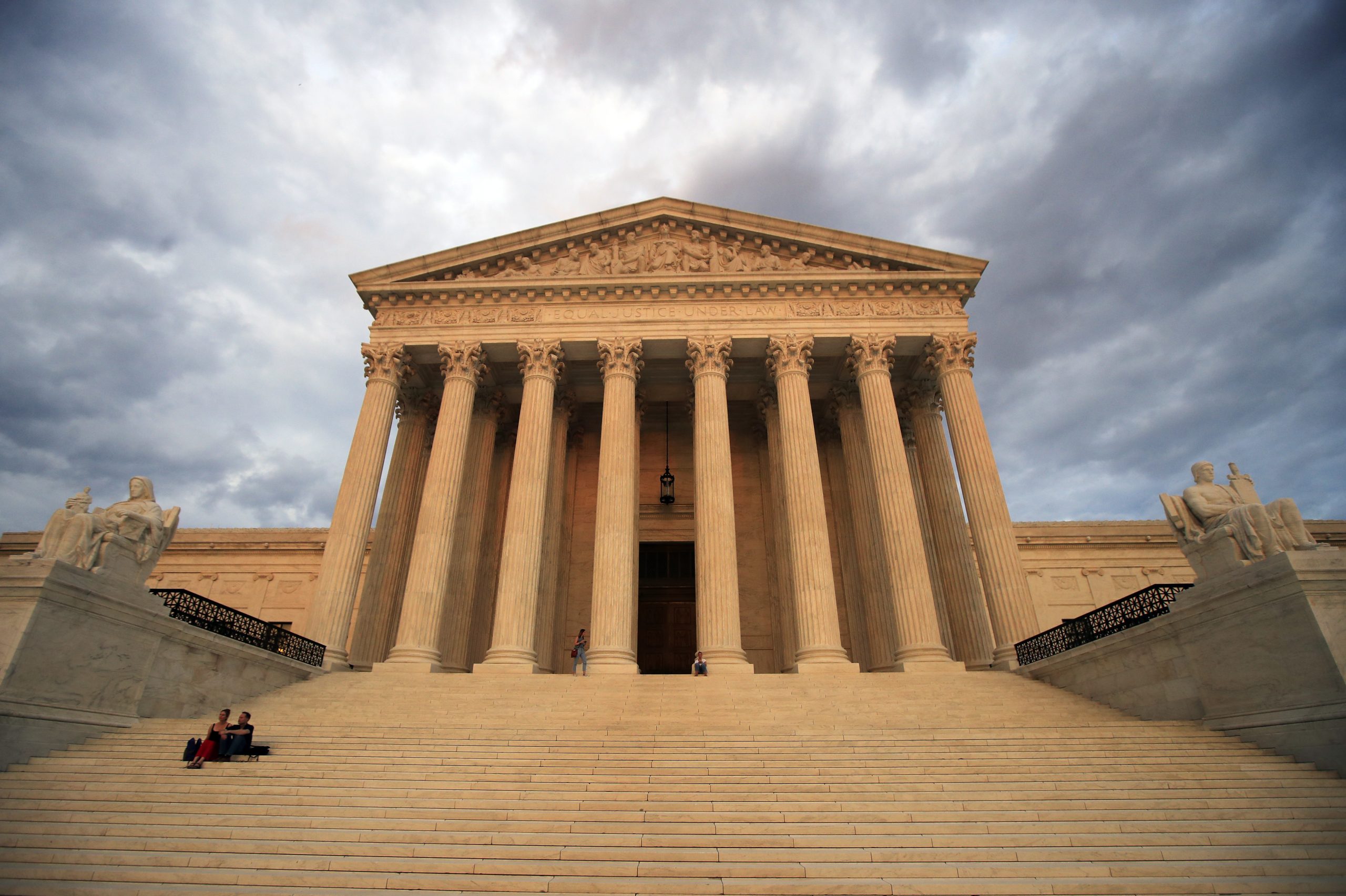
The Supreme Court over the next two weeks will hear two cases that have the potential to erode the separation of church and state and create a seismic shift in public education.
Mahmoud v. Taylor, which goes before the court on April 22, pits Muslim, Roman Catholic and Ukrainian Orthodox families, as well as those of other faiths, against the Montgomery County school system in Maryland. The parents argue that the school system violated their First Amendment right of free exercise of religion by refusing to let them opt their children out of lessons using LGBTQ+ books. The content of the books, the parents say, goes against their religious beliefs.
Oklahoma Statewide Charter School Board v. Drummond, which will be argued on April 30, addresses whether the St. Isidore of Seville Virtual Charter School should be allowed to exist as a public charter school in Oklahoma. The Archdiocese of Oklahoma City and the Diocese of Tulsa had won approval for the charter school from the state charter board despite acknowledging that St. Isidore would participate “in the evangelizing mission of the Church.”
The state’s attorney general, Gentner Drummond, later overruled the approval, saying the school could not be a charter because charter schools must be public and nonsectarian. The petitioners sued and ultimately appealed to the Supreme Court, claiming Drummond violated the First Amendment’s free exercise clause by prohibiting a religious entity from participating in a public program.
Teachers unions, parents groups and organizations advocating for the separation of church and state have said that rulings in favor of the plaintiffs could open the door for all types of religious programs to become part of public schooling and give parents veto rights on what is taught. In the most extreme scenario, they say, the rulings could lead to the dismantling of public education and essentially allow public schools to be Sunday schools.
At issue in both cases is the question of whether the First Amendment rights of parents and religious institutions to the free exercise of religion can supersede the other part of the amendment, the establishment clause, which calls for the separation of church and state.
“I think a chill wind is blowing, and public education as we know it is in extreme jeopardy of becoming religious education and ceasing to exist,” said Rachel Laser, president of Americans United for Separation of Church and State, an advocacy organization that has filed an amicus brief in the St. Isidore case. “The whole idea is to have churches take control of education for American children. It’s about money and power.”
For some conservative lawmakers, evangelical Christian groups and law firms lobbying for more religiosity in the public square, decisions in the petitioners’ favor would mean religious parents get what they have long been owed — the option of sending their children to publicly funded religious schools and the right to opt out of instruction that clashes with their religious beliefs.
“If we win this case, it opens up school choice across the country,” said Mathew Staver, founder of Liberty Counsel, an Orlando, Florida-based conservative Christian legal firm that has filed a brief supporting the petitioners in both cases. “I see school choice as a reaction to the failed system in the public schools, which is failing both in academia but also failing in the sense they are pushing ideology that undermines the parents and their relationship with their children.”
By taking the cases, the Supreme Court once again inserts itself in ongoing culture wars in the nation, which have been elevated by presidential orders threatening to take away funding if schools push diversity, equity and inclusion initiatives and state laws banning teaching on various controversial subjects. Legal scholars predict that the Supreme Court will lean toward allowing St. Isidore and the opt-outs for parents because of how the justices ruled inthreecases between 2017 and 2022. In each case, the justices decided that states could not discriminate against giving funds or resources to a program because it was religious.
Of the two cases, St. Isidore likely could have the greatest impact because it is attempting to change the very definition of a public school, say opponents of the school’s bid for charter status. Since charter schools first started in the 1990s, they have been defined as public and nonsectarian in each of the 46 state statutes allowing them, according to officials at the National Alliance for Public Charter Schools. Today,charter schools operate in 44 states, Guam, Puerto Rico and Washington, D.C., andserve roughly 7.6 percent of all public school students.
“It would be a huge sea change if the court were to hold they were private entities and not public schools bound by the U.S. Constitution’s establishment clause,” said Rob Reed, the alliance’s vice president of legal affairs.
A victory for St. Isidore could lead to religious-based programs seeping into several aspects of public schooling, said Steven Green, a professor of both law and history and religious studies at Willamette University in Salem, Oregon.
“The ramification is that every single time a school district does some kind of contracting for any kind of service or curricular issues, you’re going to find religious providers who will make the claim, ‘You have to give me an opportunity, too,’” Green said.
St. Isidore’s appeal to the Supreme Court is part of an increasing push by the religious right to use public funds for religious education, said Josh Cowen, a professor of education policy at Michigan State University and author of a 2024 book on school vouchers. Because of previous court decisions, several voucher programs across the country already allow parents to use public money to send their children to religious schools, he said.
“What’s going to happen if the court says a public school can be run by a religious provider?” Cowen asked. “It almost turns 180 degrees the rule that voucher systems play by right now. Right now, they’re just taking a check. They’re not public entities.”
The effect of a St. Isidore victory could be devastating, he added. “It would be one more slippery slope to really kicking down the wall between church and state,” Cowen said.
Jim Campbell, chief legal counsel for Alliance Defending Freedom, which is representing St. Isidore’s bid to become a charter, discounted the idea that a St. Isidore win would fundamentally change public schools. Like Staver, he views St. Isidore as simply providing another parental option. “We’re not asking the state to run a religious school,” Campbell said. “These are private entities that run the schools. This is a private organization participating in a publicly funded program.”
Opponents of religious charter schools question whether St. Isidore would have to play by the same rules as public schools.
“How are they going to handle it when there’s a teacher who has a lifestyle that doesn’t align with Catholic school teaching? They’re talking out of both sides of the mouth,” said Erika Wright, an Oklahoma parent and plaintiff in a lawsuit protesting a Bible in the classroom mandate by Oklahoma’s state superintendent of instruction. She also joined an amicus brief against St. Isidore’s formation.
“As a taxpayer, I should not be forced to fund religious instruction, whether it’s through a religious charter school or a Bible mandate,” Wright said. “I shouldn’t be forced to fund religious indoctrination that doesn’t align with my family’s personal beliefs.”
Notably, in the Montgomery County parents’ case going before the court, parents use similar reasoning to support their right to opt out of instruction. “A school ‘burdens’ parents’ religious beliefs when it forces their children to undergo classroom instruction about gender and sexuality at odds with their religious convictions,” the parents’ brief said.
The school district in 2022 adopted several books with LGBTQ+ themes and characters as part of the elementary language arts curriculum. Initially, families were allowed to opt out. But then the school system reversed its policy, saying too many students were absent during the lessons and keeping track of the opt-outs was too cumbersome. The reversal led to the lawsuit.
Historically, school districts have given limited opt-outs to parents who, for example, do not want their child to read a particular book, but the Montgomery County parents’ request is broader, said Charles C. Haynes, a First Amendment expert and senior fellow for religious liberty at the Freedom Forum in Washington, D.C. The parents are asking to exclude their children from significant parts of the curriculum for religious reasons.
“If the court sides with the parents, I think the next day, you’re going to have parents across the country saying, ‘I want my kids to opt out of all the references to fill-in-the-blank.’ … It would change the dynamic between public schools and parents overnight,” Haynes said.
Sarah Brannen, author of “Uncle Bobby’s Wedding,” one of the LGBTQ+ books Montgomery County schools adopted, sees major logistical issues if the school system loses. “Allowing parents to interfere in the minutia of the curriculum would make their already difficult jobs impossible,” she said.
Colten Stanberry, a lawyer with the Becket Fund for Religious Liberty representing the Montgomery County parents, disagreed. School systems manage to balance different student needs all the time, he said.
A triumph for the Montgomery County families and St. Isidore would cause much more than logistical issues, said Becky Pringle, president of the National Education Association. It could lead to a public education system where parents can pick a school based on religious beliefs or try to change a traditional public school’s curriculum by opting out of lessons in droves.
“For us to be a strong democracy, then we necessarily need to learn about all of us. To separate us flies in the face of why we were founded,” Pringle said.
The Hechinger Report provides in-depth, fact-based, unbiased reporting on education that is free to all readers. But that doesn’t mean it’s free to produce. Our work keeps educators and the public informed about pressing issues at schools and on campuses throughout the country. We tell the whole story, even when the details are inconvenient. Help us keep doing that.
Concerns about the Trump administration’s plans for higher ed loom large in a new report by the Association of Governing Boards of Universities and Colleges, outlining the top public policy issues facing higher ed governing boards.
The report looked at emerging public policy challenges through six different lenses:
Accountability and regulation
Judicial outcomes
Political intrusion
Federal and state funding
Federal tax legislation
Intercollegiate athletics
According to the report, boards could confront a wide range of issues in the 2025–26 academic year, including federal research funding cuts impacting university budgets, uncertainties about the future of federal financial aid, possible changes to the accreditation system, federal interference into institutional governance and shifting immigration policies affecting international student admissions and faculty hiring. The report raises additional concerns about how possible changes to the federal tax code could affect colleges and universities and how boards should respond to federal policies currently facing court challenges.
The report also offers lists of questions for boards to consider through each lens, like how students might be affected if income-contingent loan repayment programs undergo significant changes or how to honor donors’ intent for scholarships, endowed positions or research projects that could conflict with state or federal anti-DEI laws.
“Governing boards have a critical role to play in ensuring that their institutions emerge stronger, more adaptable, and committed to their core educational values and must be prepared to confront policy shifts head-on,” Ross Mugler, AGB board chair and acting president and CEO, said in a press release. “This report provides the essential knowledge trustees need to make informed, strategic decisions that preserve institutional missions, ensure financial sustainability, and promote student success.”