Prestigious EdTech Breakthrough award highlights Top Hat’s leadership in delivering flexible, AI-powered courseware to support faculty and students.
TORONTO – June 6, 2025 – Top Hat, the leader in student engagement solutions for higher education, has been named the 2025 Courseware Solution Provider of the Year. The annual EdTech Breakthrough Awards honor organizations that push the boundaries of educational technology—benefiting students, educators, and institutions across North America and around the world. In a global field of over 2,700 nominations, Top Hat stood out for its efforts to empower faculty to create and deliver engaging, connected, and affordable learning experiences for students.
“Receiving this award is an honor and supports our belief that better student outcomes begin with the course itself,” said Maggie Leen, CEO of Top Hat. “We’re proud to support thousands of faculty with tools that make it easier to adopt proven teaching practices, and grateful to our team for the creativity and care they show everyday in making great learning experiences a reality for more students.”
Now in its seventh year, the EdTech Breakthrough Awards have become a benchmark for excellence in educational technology. The program celebrates the industry’s most visionary companies—those dreaming bigger, innovating further, and setting new standards for enhancing the practice of teaching and learning. Top Hat’s selection reflects its track record of building solutions that drive measurable academic outcomes and dramatic improvements in student engagement, inside and outside the classroom.
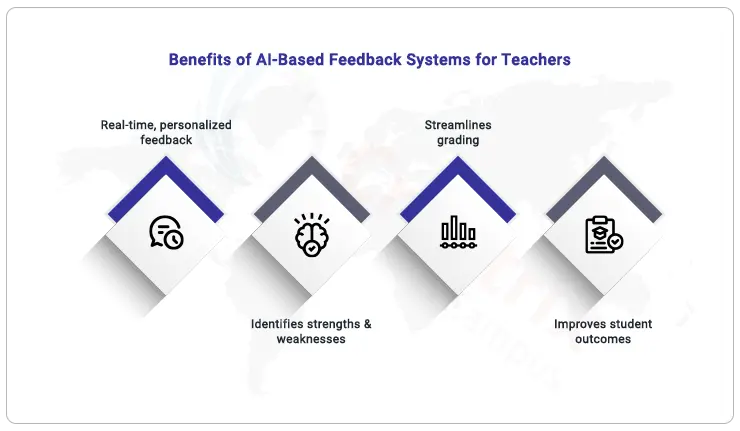
Top Hat’s courseware platform gives instructors unprecedented flexibility to tailor content to their teaching goals. The platform integrates interactive assessments, multimedia, and AI-powered tools that allow educators to instantly create in-class questions and reflection prompts. This makes it easier than ever for instructors to apply evidence-based practices like active learning and low-stakes assessment. Students also benefit from AI-powered on-demand study support and unlimited practice questions rooted directly in course content.
Top Hat has a long-standing commitment to helping faculty adopt, adapt, or create modern, interactive course materials that improve engagement and comprehension while advancing institutional goals around student affordability and equity. By supporting the use of low- or no-cost learning materials—including customizable OpenStax and OER titles enriched with interactive features—Top Hat empowers educators to design meaningful learning experiences that reflect their unique pedagogical goals while reducing costs for students.
About Top Hat
As the leader in student engagement solutions for higher education, Top Hat enables educators to employ evidence-based teaching practices through interactive content, tools, and activities in in-person, online, and hybrid classroom environments. Thousands of faculty at 900 leading North American colleges and universities use Top Hat to create meaningful, engaging and accessible learning experiences for students before, during, and after class. To learn more, please visit tophat.com.
This audio is auto-generated. Please let us know if you have feedback.
The U.S. Department of Education’s Office for Civil Rights is undergoing a slew of changes, including a significantly increased caseload after the Trump administration let go of hundreds of its employees. With the nomination of Kimberly Richey to fill the role of assistant secretary for civil rights, it’s likely the office tasked with enforcing equal educational access will shift even more.
Right now, attorneys are juggling on average 115 cases, according to Sen. Patty Murray, D-Wash., who shared the number with witnesses at a Thursday nomination hearing held by the Senate’s Health, Education Labor and Pensions Committee.
Prior to the March layoffs that resulted in the shuttering of seven out of 12 OCR offices nationwide, attorneys tasked with protecting the civil rights of students and educators had about 42 cases on their plate. That caseload was characterized as “untenable” by the former assistant secretary for civil rights, Catherine Lhamon, and had prompted former U.S. Education Secretary Miguel Cardona to advocate for an increase in the office’s funding under the Biden administration.
Murray said the newer caseload was now “making it difficult for those investigators to meaningfully investigate discrimination and to protect students’ rights.”
Thursday’s hearing was held to discuss the nomination of Richey to lead OCR, among nominations of other officials such as Penny Schwinn to be deputy secretary of education. Richey served under the first Trump administration as acting assistant secretary for the Office of Special Education and Rehabilitative Services and then as acting assistant secretary for civil rights.
Being ‘strategic’ with resources
When asked by multiple Democratic senators about how she would navigate a backlog of OCR complaints — which exceeds 25,000, said Murray — with half of the office’s former headcount and a budget that would be significantly slashed under President Donald Trump’s FY 26 proposal, Richey said she would have to be “strategic.”
“One of the reasons why this role is so important to me is because I will always advocate for OCR to have the resources to do its job,” said Richey. However, she dodged questions about whether OCR had enough resources to do its job under Trump’s first administration.
“I think that what that means is that I’m going to have to be really strategic if I’m confirmed, stepping into this role, helping come up with a plan where we can address these challenges,” she said.
That would include evaluating the current caseload and determining where complaints stand in their investigative timeline. It would also include looking at the current staff distribution and organizational structure of OCR, and helping Secretary of Education Linda McMahon come up with a plan to “ensure that OCR is able to meet its mission and its statutory purpose to prioritize all complaints.”
Richey said that rather than put certain investigations on pause, as has been the case under the second Trump administration, she would prioritize all complaints that fall at OCR’s footsteps.
Changes in Title IX enforcement
Richey raised the eyebrows of some Republican leaders when she said that she would enforce Title IX, the anti-sex discrimination statute, to protect LGTBQ+ students from discrimination based on gender identity and sexual orientation. The Trump administration and Republican leaders have prioritized enforcing the statute to exclude transgender students from women’s and girls’ athletics teams, locker rooms and other facilities.
When pressed, however, Richey clarified that she would enforce Title IX to protect LGTBQ+ students in a narrow number of cases, related to different treatment, bullying and harassment.
“We would also look at the relevance of sex in our cases,” Richey said. “Sex is relevant in regards to restrooms, and sex is relevant in regards to locker rooms and sex is relevant in regards to athletics.”
“That is not what we did under President Trump’s first term, and that is not what we will do under President Trump’s second term,” she said.
Will OCR threats to federal funding continue?
As for whether educational institutions should expect OCR’s threats to federal funding to become the new norm, Richey didn’t give a clear answer.
“I cannot speak to current actions that have been taken by the department,” she said when pressed about whether she would reverse the federal funding cuts made by the administration after short and targeted Title VI investigations related to antisemitism and Title IX investigations related to transgender athletics policies.
Maine, for example, currently faces a cut of up to $864 million in a case referred to the Department of Justice by the Education Department over the state’s athletic policies allowing transgender students to play on girls’ and women’s sports teams. Additional investigations have been opened in Minnesota and California.
In March, the administration also threatened to cut $9 billion in federal funds for Harvard University over what the administration claimed was a failure to protect Jewish students from antisemitism. By May, it had cut over $450 million in grants from Harvard, revoked its ability to enroll international students, and threatened to cut an additional $3 billion in federal grants.
Such threats have not been empty. Columbia University, for example, lost millions in federal grants and contracts, also over antisemitism investigations that Democratic leaders and some civil rights organizations have called “politically motivated.”
While Richey did not mention whether she supports those pending cuts, she said she believes antisemitism in schools has worsened since her first run at OCR and that there are a number of “tools” to help curb it, including issuing guidance “in a post-Oct. 7 world.”
“The climate is very different than what it was five years ago, four years ago, three years ago,” she said. “I think we look at the Title VI regulations to specifically address antisemitism.”
The HELP committee will schedule a vote on Richey and Schwinn in the coming weeks, after which the nominees will be referred to the full Senate floor for votes.
In today’s world, where attention spans are short and options are endless, student recruitment has become both an art and a science. Traditional methods (college fairs, brochures, high school visits) still play a role, but they can’t carry the weight alone anymore.
Gen Z expects more. And so do their parents. They want seamless digital experiences, personalized content, and authentic connections. If your institution isn’t delivering those things, you risk losing them to one that does. So, how do you stand out?
Whether you’re just starting to rethink your campus recruitment strategy or looking for new ways to level up, these 10 cutting-edge approaches, plus one powerful bonus, are designed to help you connect more deeply with prospective students and convert that interest into action.
Struggling with enrollment?
Our expert digital marketing services can help you attract and enroll more students!
1. Hyper-Personalize the Student Experience
Here’s the truth: blanket emails and generic web content just don’t cut it anymore.
Students today expect you to know them; their interests, their goals, even where they’re browsing from. That’s where hyper-personalization comes in. Rather than treating your prospects as a monolithic group, modern recruitment strategies for colleges leverage data to deliver one-to-one digital experiences at scale.
How does that look in action?
A high school student interested in business sees a landing page tailored with content about your BComm program, student stories, and upcoming info sessions.
An international applicant is greeted with region-specific admissions guidance and video testimonials from students from their home country.
A user who clicks on a scholarship link gets a follow-up email with a financial aid breakdown.
In short, personalization isn’t a perk. It’s expected.
Example: To personalize outreach at scale, the University of Idaho (U of I) introduced AI-driven personalized videos for interested applicants. Prospects received video messages addressing them by name, hometown, and academic interest.
Source: University of Idaho YouTube
2. Make Mobile a Priority, Not an Afterthought
More than 60% of student interactions with higher education websites now happen on mobile. If your site isn’t easy to navigate on a small screen, you’re likely losing leads by the dozen, especially since 53% of users will abandon a site that takes more than 3 seconds to load.
And it’s not just about having a “responsive” website anymore.
You also need:
Mobile-optimized application forms that are quick and easy to complete
Tap-friendly buttons and layouts that don’t frustrate the user
SMS alerts for key deadlines or virtual event reminders
Even better? Google’s mobile-first indexing means this doesn’t just affect UX, it directly influences your search rankings.
So if mobile optimization isn’t baked into your campus recruitment strategies, it’s time to fix that. Fast.
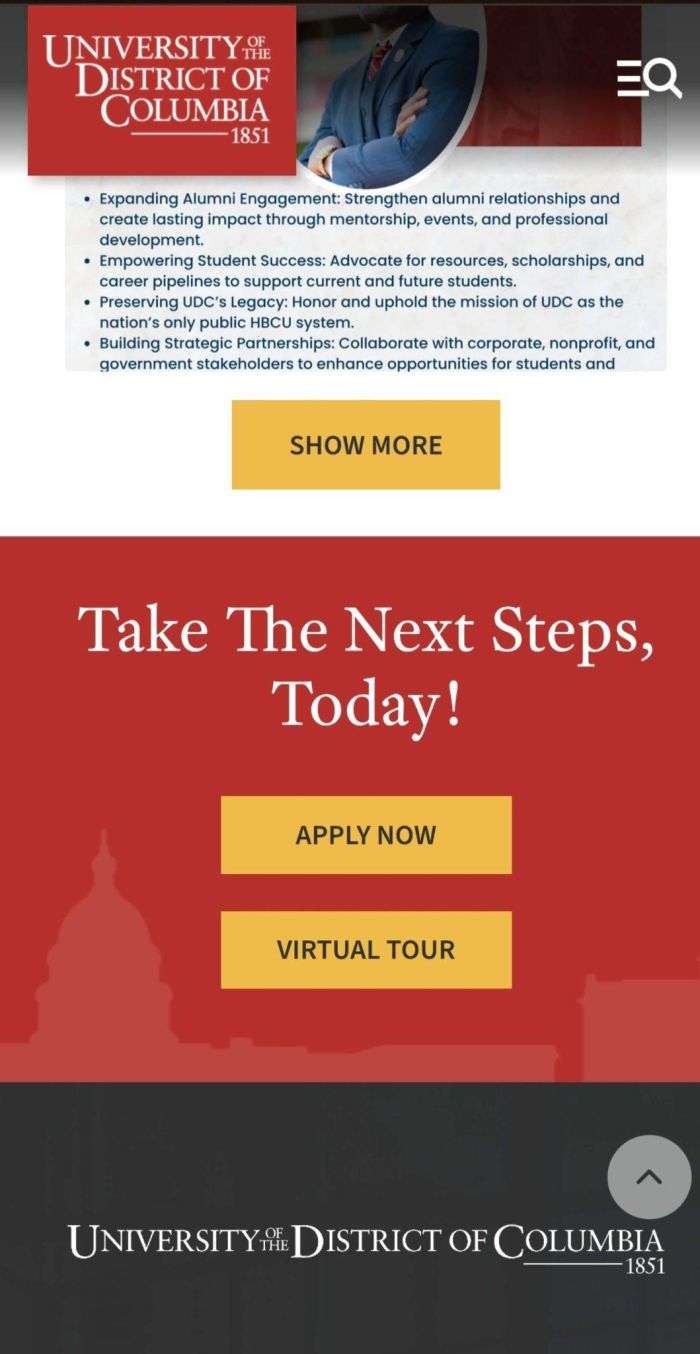
Example: University of the District of Columbia (UDC) launched a newly redesigned, mobile-first website in 2025 to enhance recruitment.
The site features a “mobile-friendly and accessible design” optimized for all devices. This responsive overhaul was part of a strategic initiative “aimed at…enhancing recruitment efforts” and making it easier for prospective students to explore academic programs. By improving navigation, search, and ensuring the site works seamlessly on phones, UDC’s digital entryway better serves today’s mobile-minded applicants.
3. Use Video to Tell Real Stories
Think about the last time you were captivated by a piece of content online. Chances are, it was a video. Video is more than just a nice-to-have. It’s one of the most effective ways to emotionally connect with prospective students and help them see themselves at your school.
Today’s students have grown up on YouTube, Instagram, and TikTok, and video content reigns supreme. Video accounts for over 80% of global internet traffic, and roughly 75% of video viewing now happens on mobile devices (aligning with Gen Z’s phone-first habits).
A recent guide on education video marketing noted that compelling videos can communicate complex ideas in seconds and resonate emotionally, which is why Gen Z “responds favorably to videos that are authentic, visually appealing, and emotionally resonant”.
Additionally, social algorithms favor video content, meaning your school’s videos are more likely to surface in feeds. With 80% of prospective students reporting that campus videos (tours, student stories, etc.) influenced their perception of a school, it’s clear that storytelling through video is no longer optional; it’s essential for recruitment success.
From quick TikToks to polished campus tours, the format you choose should match your audience and your message.
What works well?
Virtual tours for international students who can’t visit in person
Day-in-the-life vlogs from current students
Candid interviews with faculty or alumni
Instagram Reels that highlight clubs, campus life, or student events
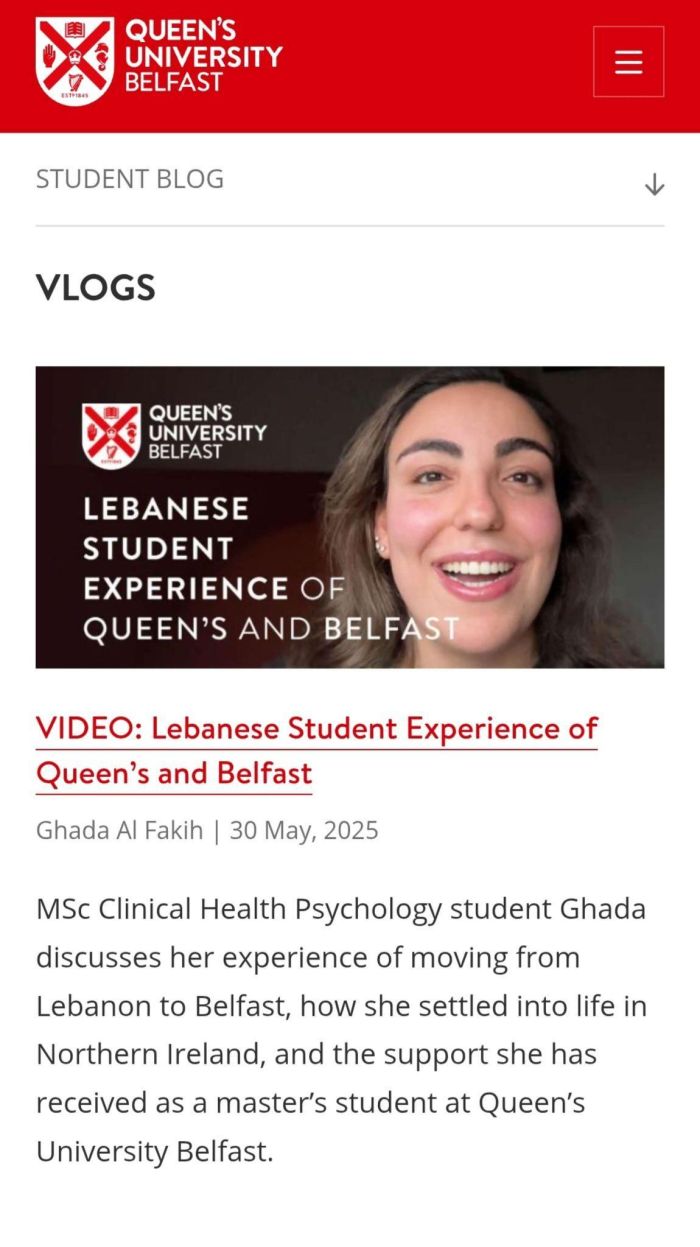
Example: Queen’s University Belfast’sofficial student blog features a dedicated “Vlogs” section where current students share their experiences via video.
These student-created videos range from day-in-the-life stories to campus tours and tips for new students. By showcasing real student life through vlogs, Queen’s gives prospective students an authentic, relatable window into the university experience.
4. Empower Student Ambassadors to Speak for You
No offense, but students trust other students more than they trust your marketing team.
That’s why student ambassadors are one of the most powerful (and underutilized) assets in your recruitment toolkit.
With just a little structure and support, they can:
Run TikTok takeovers during orientation week
Host live AMAs on Instagram about life at your school
Create vlogs or blog posts about their journeys
It’s authentic, it’s relatable, and it builds the kind of peer-driven trust that polished brochures never could. Best of all? Gen Z prefers real voices over institutional polish. So give them a platform and watch your reach expand.
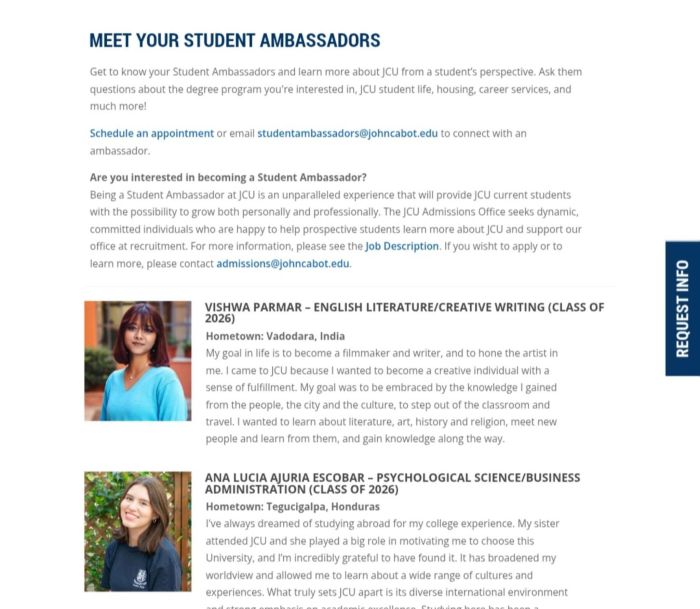
Example: John Cabot University (JCU) runs a robust Student Ambassador program that puts current students front and center in recruitment.
These ambassadors, hailing from around the world, actively engage with prospects through social media takeovers, Q&As, and one-on-one chats. JCU’s admissions website even features profiles and contact info for each student ambassador, inviting prospects to reach out directly.
5. Invest in SEO and Content That Answers Real Questions
You can’t enroll students who don’t know you exist. That’s where search engine optimization (SEO) and content marketing come in. When students start Googling “best film schools in Canada” or “how to get a student visa for the U.S.,” your institution should be right there with helpful, relevant answers.
Some essentials that build a strong foundation:
Blog posts that answer FAQs on tuition, housing, or programs
Program pages with embedded video, alumni outcomes, and clear CTAs
Long-tail keywords like “how to apply for nursing school in Ontario” that attract motivated searchers
Higher Education Marketing (HEM) helps clients rank on page one of Google for high-converting keywords, turning organic traffic into an ongoing stream of qualified leads.
And unlike paid ads, the impact of good SEO keeps compounding.
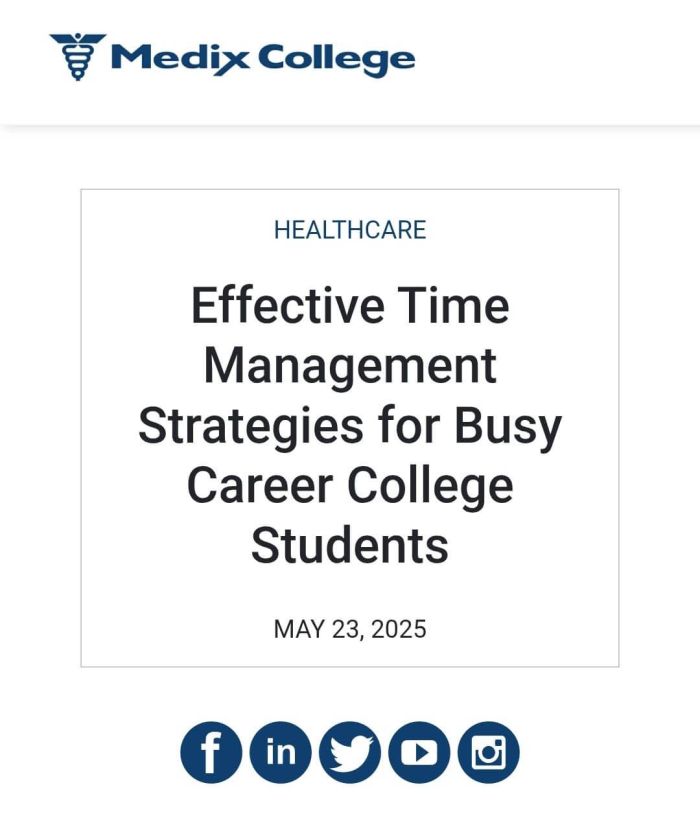
Example: Medix College attracts prospects by publishing a steady stream of useful, SEO-optimized content related to its healthcare programs. Its official blog functions as a hub of career tips, industry trends, and program insights tailored to prospective students.
By answering common career questions and highlighting emerging fields, Medix organically improves its search visibility. This content marketing strategy attracts web traffic from interested learners and establishes Medix as an authoritative, student-centric institution, leading to more inquiries and applications driven by informative content, rather than just ads.
6. Use CRM and Data Tools to Nurture Leads at Scale
Managing hundreds or thousands of prospective students without a proper system in place is a recipe for missed opportunities.
A CRM (Customer Relationship Management system) does more than just store contact info. It helps you track where students are in the funnel, personalize your outreach, and automate time-consuming tasks like follow-up emails or event reminders.
With the right CRM, you can:
Score leads based on engagement levels
Trigger personalized email or SMS messages based on behavior
Track ROI on every campaign or event
HEM’s CRM solutions are built specifically for higher ed, so you can identify, engage, and convert prospects without the guesswork.
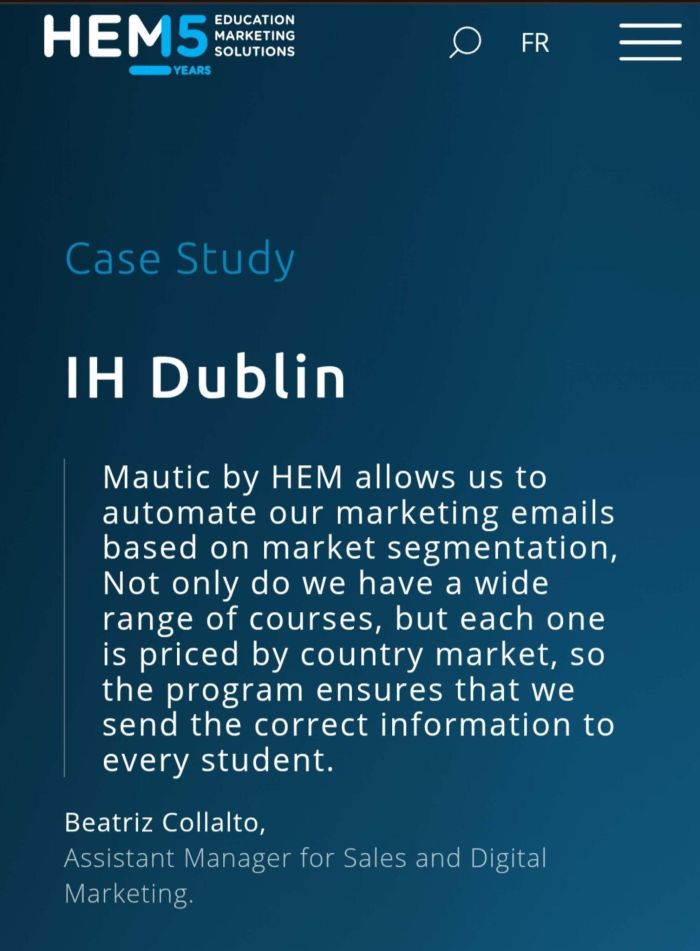
Example: IH Dublin implemented a customized CRM (Mautic by HEM) to automate and personalize its student recruitment communications, using market segmentation to ensure each prospective student receives course information tailored to their specific needs. This strategic CRM implementation streamlined lead management by automatically capturing inquiries and communications, saving staff countless hours and allowing them to focus on high-quality, individualized interactions with students.
By integrating web inquiry forms, social media, and email campaign data into one system, the school gained a comprehensive view of each prospect and leveraged these analytics insights to refine outreach strategies, improving the effectiveness of communications and boosting student recruitment conversions.
7. Strengthen Relationships with High Schools and Feeder Institutions
Want to build a pipeline that pays off year after year? Start earlier. By investing in relationships with guidance counselors, feeder schools, and partner institutions, you plant the seeds of trust long before application season.
What helps?
Hosting “College Nights” or virtual info sessions
Offering classroom-ready materials that educators can share
Regular check-ins with guidance counselors to keep your school top of mind
This long-game strategy ensures your name is the first one students hear when they start exploring their options.
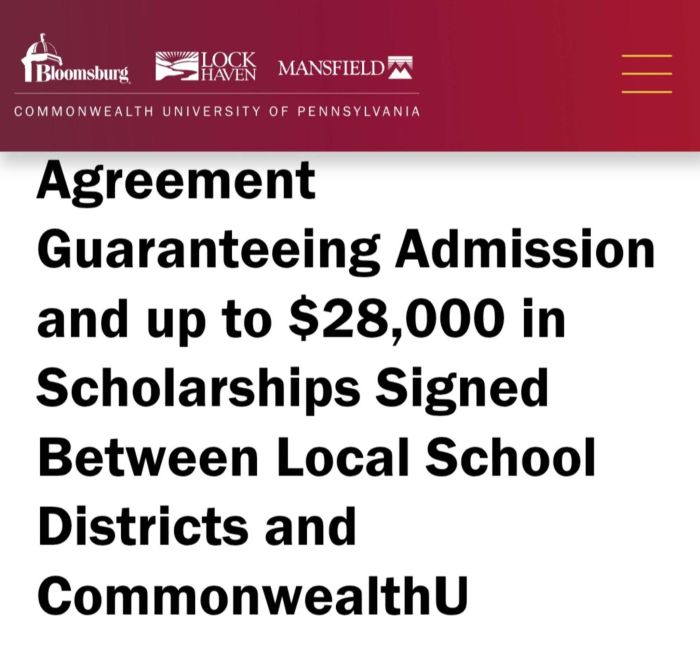
Example: Formed by the merger of Bloomsburg, Lock Haven, and Mansfield Universities, CommonwealthU has aggressively built feeder relationships in its region. In October 2022, it signed Local Scholar Agreements with 14 high school districts (expanding to 50 districts) in Pennsylvania to create a direct pipeline to its campuses. Under these agreements, any student graduating from a partner high school who meets basic criteria is guaranteed admission and up to $28,000 in scholarships to CommonwealthU.
Most application processes aren’t exactly thrilling. But what if they could be fun? That’s where gamification comes in. Adding interactive, game-like elements to your recruitment process can boost engagement and make your institution stand out. Ideas to try:
A quiz like “Which Degree Matches Your Personality?”
A digital scavenger hunt during virtual open houses
Points or prizes for completing milestones (like submitting an application or attending an event)
The result? More engagement, longer site visits, and a more memorable brand experience.
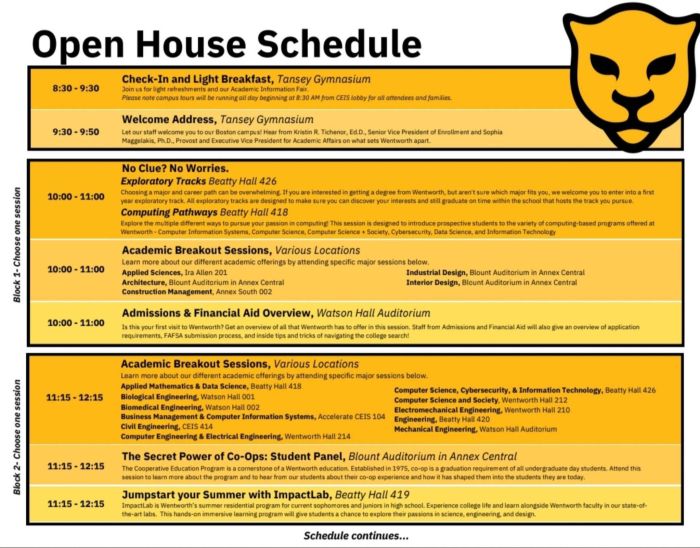
Example: To make campus visits and online events more engaging, Wentworth Institute of Technology (WIT) uses gamification elements in recruitment. For example, during a recent Open House, Wentworth organized a campus-wide scavenger hunt for visiting prospective students.
Attendees were challenged to explore campus and snap photos of specific “hidden” items or locations, then show an admissions staff member to collect a prize. This fun competition had students actively interacting with the campus environment. Wentworth also partnered with the ZeeMee app (a social platform for admitted students) to host virtual scavenger hunts and trivia nights for incoming freshmen, turning the admissions process into a game.
9. Remove Friction From the Application Process
What are the 7 steps of the recruitment process? They are planning, strategy, development, strategies, sourcing, screening, interviewing, selecting, and onboarding. Of these seven steps, the selection process is arguably the most crucial.
You’ve piqued their interest. Now don’t lose them at the finish line.
One of the biggest conversion killers? Complicated, outdated, or buggy application systems.
Here’s how to clean it up:
Make sure students can save their progress and come back later
Allow autofill using Google or LinkedIn accounts
Offer live chat support for real-time help
Automate gentle reminders for those who haven’t finished applying
The easier the process, the higher the completion rate. It’s that simple.
Example: A common trend in streamlining has been colleges joining the Common App or other unified platforms. This is because a simplified, one-stop application lowers the effort for students applying to multiple schools.
In this example, USI joins the Common Application, enabling students to apply to USI alongside multiple schools with one form. USI’s enrollment team notes that the Common App’s mobile-friendly interface and consolidation of application tasks meet students’ expectations for simplicity. Additionally, USI uses an online status portal where applicants can see missing items and upcoming steps at a glance, reducing back-and-forth emails.
10. Localize Your International Recruitment Strategy
Going global isn’t just about translation; it’s about cultural connection. To truly succeed in international markets, your recruitment approach needs to feel local, not foreign. That means:
Translating core content into key languages
Showcasing alumni from the same regions
Using familiar platforms like WeChat or WhatsApp to communicate
HEM specializes in multilingual campaigns that drive results across borders. Because when students see themselves represented, they’re more likely to say “yes.”
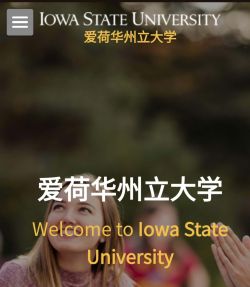
Example: To grow its Chinese student enrollment, Iowa State University invested in a heavily localized recruitment strategy for China. The university launched a fully localizedChinese-language website to engage students and parents in China on their terms. The site was hosted on a .cn domain for fast local loading and optimized for mobile, featuring ISU’s branding but with content written in Simplified Chinese.
Crucially, ISU didn’t just translate admissions info; it adapted content to address what Chinese families value (e.g., program outcomes, safety, career opportunities) and made navigation intuitive for that audience. In tandem, Iowa State ramped up its presence on Chinese social media: it ran an official WeChat account for one-to-one engagement and a verified Weibo account (China’s Twitter) for broader outreach.
BONUS: Align Marketing and Admissions
Too often, colleges treat marketing and admissions like separate silos. Be sure not to make this mistake.
Your recruitment strategy is only as strong as the connection between these two teams. When marketing generates leads but admissions isn’t looped in (or vice versa), those leads slip through the cracks. Here’s how to tighten things up:
Use shared dashboards so both teams see the same data
Hold weekly check-ins to align on goals, campaigns, and challenges
Make sure your CRM offers visibility and collaboration tools across departments
This alignment doesn’t just make your internal process smoother, it makes the entire student experience feel seamless.
Common Mistakes to Avoid
Even strong strategies can be weakened by a few missteps. Watch out for these:
Neglecting follow-up: Students expect timely responses. Delays kill momentum.
Generic messaging: One-size-fits-all language turns students off. Speak to their specific needs.
Skipping analytics: If you’re not tracking what works, how will you improve?
Fix these gaps, and your recruitment strategies for colleges will be far more effective.
HEM: Your Partner in Enrollment Success
At Higher Education Marketing, we’ve spent over a decade helping colleges and universities level up their recruitment.
We offer:
SEO and content strategy to boost visibility
CRM solutions to nurture leads efficiently
Paid ad campaigns across Google, Meta, and international platforms
Custom dashboards to track ROI and make data-informed decisions
No matter your goals, whether domestic growth, international expansion, or brand visibility. HEM is here to help you meet (and exceed) them.
Final Thoughts
The landscape of student recruitment is shifting, and fast. But that’s not something to fear. It’s an opportunity. Which is the best method for effective recruitment? A balanced mix of digital personalization and relationship-building tends to drive the best results.
By embracing data, technology, storytelling, and personalization, you can create a recruitment strategy that not only works but resonates. So here’s the real question: Are you ready to lead the way? Because the future belongs to the schools that adapt, connect, and engage with intention. Let’s build that future together.
Struggling with enrollment?
Our expert digital marketing services can help you attract and enroll more students!
Frequently Asked Questions
Question: What are the 7 steps of the recruitment process?
Answer: They are planning, strategy, development, strategies, sourcing, screening, interviewing, selecting, and onboarding.
Question: Which is the best method for effective recruitment?
Answer: A balanced mix of digital personalization and relationship-building tends to drive the best results.
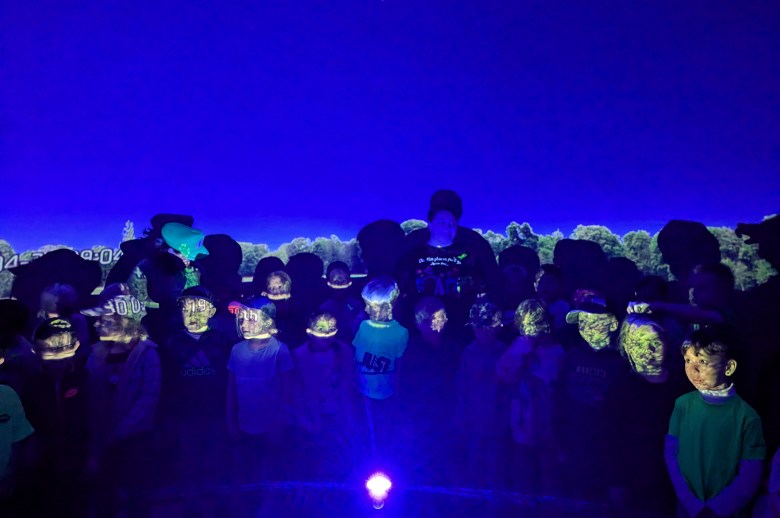
The kindergartners of South Dakota’s Hamlin County are, in fact, in space. To be specific, they are on planet Earth, near the geographic center of North America, sitting crisscross applesauce inside an 11-foot-high inflatable planetarium set up in their school gym.
The darkness is velvety. Childish whispers skitter around the dome like mice. The kids are returning from a short mission to Jupiter, piloted by Kristine Heinen, a young museum educator with a ponytail who knows how to make her voice BIG AND EXCITED and then inviting and quiet to hold little ones’ attention.
“Now we’re over China!” Heinen says.
“My friend went to China!” a girl calls out.
“The other side is nighttime and this side’s bright,” expounds a boy with a crew cut. “The sun shines here so it can’t shine over there.“
The school is in eastern South Dakota, 34 miles northeast of the settlement where Laura Ingalls Wilder grew up and attended a one-room schoolhouse. The sprawling Hamlin Education Center is a modern-day analogue, serving an entire district in one building, with just under 900 students, pre-K through 12. Notable graduates include U.S. Homeland Security Secretary Kristi Noem, the former governor of South Dakota.
The center is roughly equidistant from four tiny towns, surrounded by open fields where cornstalks shine in the sun; 95 percent of students arrive by bus, from up to 20 miles away. Over a third of them qualify for free or reduced-price lunch, said Dustin Blaha, the elementary school’s principal.
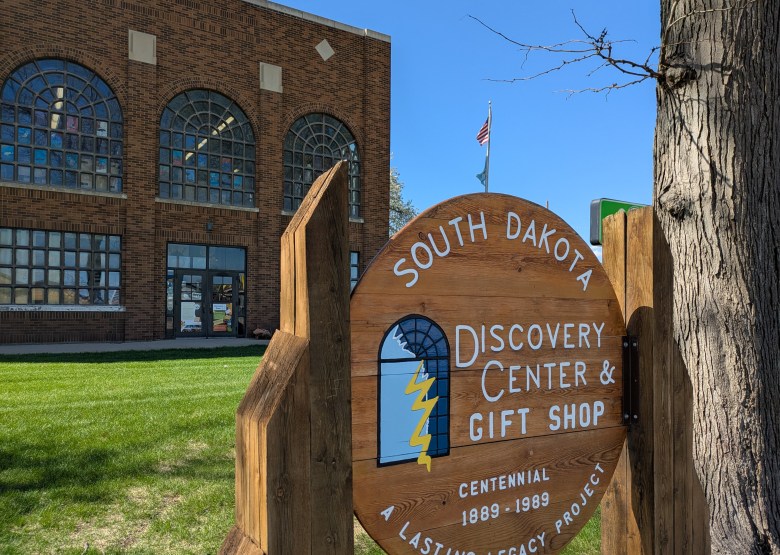
Hamlin Elementary students line up for their turn visiting a traveling planetarium sponsored by the South Dakota Discovery Center. Credit: Anya Kamenetz for The Hechinger Report
During the planetarium’s daylong visit to the small community of Hayti, S.D., an educator from the South Dakota Discovery Center wowed 500 elementary school students with a presentation about the planets and stars. Credit: Anya Kamenetz for The Hechinger Report
Many Hamlin Elementary haven’t had a chance to visit the South Dakota Discovery Center in Pierre three hours away, so the museum brings traveling exhibits like a portable planetarium to them. Credit: Anya Kamenetz for The Hechinger Report
Blaha said that most of these children have never been to the South Dakota Discovery Center, a hands-on science museum three hours west in the state capital. But thanks to a federal agency called the Institute of Museum and Library Services, a part of the museum can come to them.
The IMLS was established in 1996, combining previously separate programs. The small agency became the largest source of federal funding for museums and libraries, last year awarding $266.7 million in program grants, research and policy development across all 50 states. IMLS awarded the South Dakota Discovery Center about $45,000 in 2023 to upgrade this traveling planetarium.
But students around the state may be waiting a long time for the next upgrade.
Related: Young children have unique needs and providing the right care can be a challenge. Our free early childhood education newsletter tracks the issues.
President Donald Trump signed an executive order in mid-March calling for the agency to be “eliminated to the maximum extent consistent with applicable law.” Mass firings followed.
On May 1, the U.S. District Court in Washington, D.C., issued a temporary restraining order to block the agency’s dismantling, followed on May 6 by a second federal judge finding the dismantling of this and two other agencies unconstitutional. On May 20, the American Library Association reported that employees are returning to work and some grants have been restored.
But the administration is continuing its legal battle to all but shutter the IMLS. The latest post on the agency’s Instagram account is captioned, “The era of using your taxpayer dollars to fund DEI grants is OVER,” holding up for criticism grants that were aimed at addressing systemic racism in museums, equitable library practices, and diverse staff development. The IMLS and the Department of Government Efficiency did not respond to requests for comment.
A veteran of the agency who asked to remain anonymous because of fear of reprisal said they first saw DOGE staffers meeting with leadership on March 28. “On the 31st, we were put on administrative leave. We had about two hours to turn in your key cards, your ID, get everything off your laptop you’re ever going to need. We were locked out of our computer systems by 3:30 and told to get out of the building.” A skeleton crew was hastily rehired the next day.
The ex-staffer points out that the Institute of Museum and Library Services spends, or spent, just 7 percent of its budget on its 70 staff, passing the rest along as grants. “We are not a bloated agency.” They have two kids at home, one with special needs and are married to another federal employee whose job is also at risk; but they are almost as worried about their grantees as themselves.
“After 20 years, I didn’t even get to put an out-of-office response up. Is someone emailing me right now and getting nothing, because all of a sudden their grant just ended? I hate that,” the former IMLS employee said.
Almost all grants awarded required a one-to-one cost share out of the local institution’s budget, the staffer said. Plus, typically the grantees pay for activities first and then apply to get reimbursed. “We’re leaving these often small rural museums and libraries on the hook.”
Anne Lewis, executive director of the South Dakota Discovery Center, said that organizations like hers would be “wobbly” without federal funding and would have to scale back on ambitious programs like the planetarium upgrade.
“The new system has much better interaction and control,” said Heinen, the museum educator. An earlier version had a static point of view, but upgraded visual effects means that “now we have spaceship mode,” she said. “We can travel to destinations including planets, and go in a full 360-degree mode around galaxies.”
With a flick of the touchscreen menu, she can also display the constellations of a dozen different cultures including Lakota, a significant benefit especially when she visits tribal schools.
The South Dakota Discovery Center, based in Pierre, has used federal support from the Institute for Museum and Library Services to pay for a traveling planetarium exhibit. Credit: Anya Kamenetz for The Hechinger Report
It’s a lean operation: Heinen drove solo nearly 200 miles from Pierre to Watertown the evening before and spent the night at an Econo Lodge. From there, it was another 20-some miles to Hayti, where she arrived at 7:30 in the morning, set up the dome herself, and ran 30-minute programs all day.
The whole elementary school, about 500 kids in total, saw the planetarium, with each show customized to the children’s interest and grade level; and she also conducted a parent engagement program in the afternoon. Heinen said she never tires of being a “Santa Claus” for science. ”As soon as they see me, they know something fun is going to happen.”
During this visit, the fan favorites were Jupiter, Mars and the sun. “It was cool when we went to Mars,” said Nash Christensen, 6. “And the volcano on that one moon, and the big hurricane on Jupiter. I think Jupiter is a dangerous place to live.”
Grant recipients of the Institute of Museum and Library Services say the support from the federal government has been critical to running their programs. For example, the Boston Children’s Museum, the second-oldest children’s museum in the country, has used federal grant money to improve school readiness. One of the outcomes was a new exhibit in the museum, “Countdown to Kindergarten,” that mimics a kindergarten classroom, complete with a school bus you can sit in out front.
“It’s helpful not only for the kids, but some of our caregivers who came from other countries and may not have gone to a school like this,” said Melissa Higgins, the museum’s vice president of programs and exhibits.
At the Madison Children’s Museum in Wisconsin, federal funds paid for a multistate partnership that provides climate education for young children and their families. In Fort Lauderdale, Florida, a grant covered five “STEMobiles,” which offer hands-on science activities for children ages 3-5 in low-income parts of Broward County. The Philadelphia School District won a two-year planning grant to try to improve its pipeline of school librarians; they were down to only a handful for a district of 200,000 students.
But the greatest impact may come in rural, often deep-red areas.
“Rural communities have particularly unique challenges,” said Lewis at the South Dakota Discovery Center. “There’s 800,000 people in the state, and they’re dispersed. We don’t have a concentration of funders and donors who can help support these enrichment activities.”
She said the teachers she serves are “passionate, committed and, like every other place in the world, underfunded.” If not for institutions like hers, students would probably go without this kind of hands-on science experience, she said.
Blaha, the elementary school principal, concurred. “The planetarium brings excitement and expertise that we don’t typically have in a community like this,” he said.
For now, the excitement is coming to an end. The class has “landed” on a green lawn, under a deep blue sky. Heinen announces “It’s time to leave.” She’s met with a chorus of, “Noo!”
“You guys, we were in here for a full 30 minutes.”
“It felt like 10!”
“It felt like a second!”
Tonight, many of them will be able to look up at the dark sky over the prairie and show their parents Jupiter, Ursa Major and Mars.
Contact the editor of this story, Christina Samuels, at 212-678-3635 via Signal at cas.37 or [email protected].
The Hechinger Report provides in-depth, fact-based, unbiased reporting on education that is free to all readers. But that doesn’t mean it’s free to produce. Our work keeps educators and the public informed about pressing issues at schools and on campuses throughout the country. We tell the whole story, even when the details are inconvenient. Help us keep doing that.
Young people are often accused of naivety. But in journalism, naivety can be powerful.
Being naive means sounding innocent or unsophisticated about something. You often get accused of naivety when you question why things are the way they are. Many people hate being accused of that, so they accept generally accepted standards — a fancy term I like is “prevailing paradigms.”
Often these are notions that some problems are so rooted that they can’t be fixed so you just have to accept them: polluted rivers or entrenched corruption or homelessness or discriminatory policies.
When you question these notions you might be accused of being naive. I say wear that like a badge. Why? Because if we accept problems without seeking solutions we won’t ever improve a community or society or nation. And that means that you must reject the idea that some problems can’t be solved.
It means we have to go back to the idea that everyone deserves clean air and water, healthy food, a basic education, shelter and safety. Nowadays you might add internet access, heat and electricity to that list and maybe a decent transportation system. The more I add, the more naive I sound.
Question prevailing paradigms.
Good journalism comes from asking why people don’t have these things, not from accepting that they don’t have them.
So I suggest this: Draw an imaginary line. It represents a perfect world. In a perfect world everyone would have those things I listed: clean air and water, healthy food, etc. Then draw a line next to it that represents the current situation, and make the space between them wider the more off we are from that perfect world. Therein lies your story.
How far off is your community from having clean water or clean air? How bad are diets or how bad is the food shortage?
Then ask why. Why are people drinking or fishing out of contaminated water streams? Why are people going hungry? Why are people homeless? These are basic questions that come from the naive perspective that these problems shouldn’t exist in a perfect world.
Only when you ask these questions can you get to the heart of causes. Here is the hard part. The accusation of naivety comes not because these problems can’t be solved. It comes because the solutions are complicated. Sometimes they are really complicated. So the naivety comes in the idea that no one — including you or me — is willing to take the time and effort and brain power to unravel all those complications to get to solutions.
Prove them wrong.
This all gets to the two traits that make someone a great journalist: Persistence and patience. It is the persistence to not just walk away when someone tells you that you are being naive or that a problem is too complicated, and the patience to work through the complicated elements.
All the complications people will throw at you are like protective layers around a problem. They are like the levels you need to surmount in a video game.
Once you peel them away, you get to causes that are pretty basic: Not enough money because people with money aren’t willing to spend it; a lack of power because people with power aren’t willing to cede it; and basic human failings like racism, homophobia, sexism or greed.
If you can call out people or communities or government representatives on their racism or homophobia or sexism or greed, maybe you can get them to work on solutions. Only by finding solutions to problems can we get a little closer to that perfect world.
Isn’t a perfect world the one you want to work towards? Or am I being naive?
Questions to consider:
1. What does the author mean by “prevailing paradigms”?
2. Why can naivety be powerful in journalism?
3. What are some problems in your community that people seem to accept without question?
Reaching today’s college and university students, most of whom belong to Generation Z, requires more than a digital presence. It requires cultural fluency, authenticity, and a deep understanding of how this generation engages with the world.
Gen Zs, typically identified as those born between 1997 and 2012, are the first true digital natives. They’ve grown up with smartphones, social media, and streaming content, not as novelties, but as fixtures of daily life. According to Pew Research, nearly 95% of teens have access to a smartphone, and more than half report being online almost constantly. These habits carry into their post-secondary years, where connectivity is an expectation, not a luxury.
But modern college and university-age students aren’t always just online. They’re also highly discerning. They value transparency, social impact, and personalization. They’re quick to recognize inauthentic messaging and even quicker to disengage from it. For colleges and universities, this creates both a challenge and an opportunity: traditional, one-dimensional advertising methods, such as flyers or general announcements, may not cut it anymore, but the right strategy can foster a lasting connection and institutional trust.
This blog post offers a comprehensive guide to understanding and effectively advertising to college students against this backdrop. From leveraging digital platforms to embracing values-driven storytelling, we’ll explore the strategies that resonate with Gen Z and how institutions can adapt to meet them with relevance and respect.
Let’s begin by exploring why this age group deserves special attention.
Why Marketing to College Students (18–24) Matters
Let’s start with a simple truth: the 18–24-year-old demographic is one of the most important audiences for higher education marketers today.
Why? Because this isn’t just the age when students choose a school. It’s when they start forming lasting opinions about the institutions they trust. The connections you build now can influence enrollment, but they also shape alumni engagement, word-of-mouth referrals, and long-term brand loyalty.
Here’s the part that matters: Gen Z is different.
They’re not just digitally connected, they’re digitally fluent. According to a study, young adults between 18 and 24 now spend an average of four hours per day online, much of it on platforms like TikTok, YouTube, and Instagram.
That means your message is competing with algorithmically curated, visually captivating, and instantly engaging content. If your campaign doesn’t speak their language, it likely won’t even register.
And here’s where it gets even more interesting: Gen Z is highly influenced by their peers. One study found that 44% of Gen Zers make purchasing or participation decisions based on influencer recommendations, not traditional ads.
What does that mean for your institution? If students don’t see your message reflected in the voices and platforms they already trust, you’re missing out. Not just on visibility, but on credibility.
We’ve already seen this in action. Consider how Lancaster University in the UK leveraged TikTok to promote its online open days. By collaborating with student ambassadors to create a series of in-feed ads, the campaign achieved over 10 million impressions and more than 90,000 clicks, significantly boosting engagement and interest in their programs.
Advertising to college students is not just about being seen. It’s about being relevant, responsive, and real. When you create campaigns that feel native to their world, not imposed on it, you don’t just attract attention. You build trust.
Where and How to Reach Students in 2025
Reaching college students today is as much about being present as it is about being present in the right places. To effectively connect with this digitally native audience, a multi-channel approach that blends online platforms with on-campus touchpoints is essential.
Where can I advertise to college students? Effective channels include social media platforms (Instagram, TikTok, YouTube, Snapchat), on-campus signage, email and SMS campaigns, and peer networks such as student clubs and organizations. Let’s explore the most impactful channels:
1. Social Media Platforms
Social media is the heartbeat of student communication. Platforms like TikTok, Instagram, Snapchat, and YouTube are where students spend a significant portion of their time. TikTok has become a vital recruiting tool, with two-thirds of teenagers using the platform, making it essential for colleges to have a presence there. Paid advertising and organic content (stories, reels, challenges) on these platforms can yield high engagement.
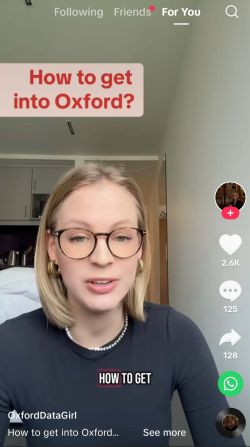
Example: Oxford University (UK) shared a series of TikTok videos featuring current students offering advice to incoming first-year “freshers,” creating authentic, peer-to-peer content that resonated strongly with its student audience.
When students are researching colleges or looking up information, they often turn to search engines and video platforms. Running targeted search ads ensures your college’s offerings appear when students are actively seeking information. On YouTube, short, engaging pre-roll ads can capture attention. Just remember to keep them concise and relevant.
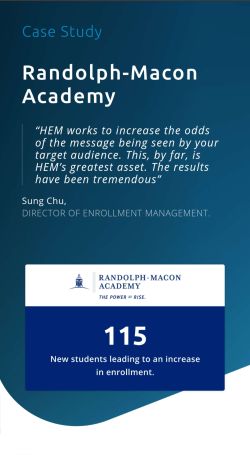
Example: Randolph-Macon Academy (R-MA) launched an aggressive Google Search ad campaign targeting families seeking strong academics during the COVID-19 pandemic. The effort paid off, R-MA saw tremendous results, enrolling 115 new students from May to August 2020 (boosting overall enrollment) and even doubling their summer school enrollment despite the disruption.
Don’t underestimate the power of physical presence when advertising at colleges. Traditional channels like campus bulletin boards, posters in dorms or the student union, campus newspaper ads, and flyers still have value, especially for promoting campus events.
Modern twists on these include digital signage (screens around campus displaying announcements) and QR codes on posters that students can scan for more info or to RSVP. Being visible where students live and study helps keep your message top-of-mind.
4. Email and Text Alerts: Direct and Personal Communication
Email remains a staple for official communication, and when crafted well, it can be an effective tool for reaching students. Concise, visually appealing newsletters about upcoming opportunities can capture attention.
Additionally, SMS/text message alerts are highly effective for timely announcements, as most students will see a text immediately. Always ensure you have permission to text students and use this channel sparingly to avoid overcommunication.
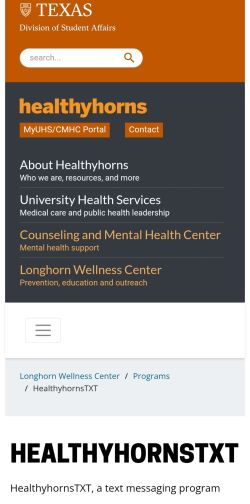
Example: The University of Texas at Austin runs a program called HealthyhornsTXT through its wellness center, sending students 2–3 text messages per week with health tips, stress-management advice, notices of campus wellness events, and motivational reminders. The messages are written in a friendly, encouraging tone by health educators (e.g., nudging students to take a stretch break or stay hydrated in the Texas heat) and often include interactive elements like a monthly giveaway to sustain engagement.
5. Student Organizations and Influencers: Leveraging Peer Networks
Peer influence is powerful. Partnering with student organizations, clubs, or Greek life groups can amplify your message. Engaging student ambassadors or micro-influencers, students with a following in specific niches, can promote your message authentically among their peers.
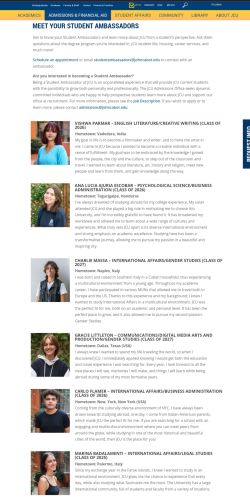
Example: John Cabot University (JCU) in Rome, Italy has a robust student ambassador program: current students are heavily involved in orientation, campus tours, event planning, and peer mentoring, serving as friendly points of contact for prospects. JCU’s website even features profiles and contact info for each ambassador, portraying an approachable, relatable face to prospective students.
By integrating these channels, your advertising efforts can effectively surround students in multiple contexts: online, in class, around campus, and on their phones. The key is to maintain cohesive messaging across platforms, ensuring that whether a student sees a flyer in the cafeteria or a story on Instagram, the campaign feels unified and relevant.
Current Trends in Digital and Social Media Marketing
To reach today’s college students effectively, your digital marketing must evolve as quickly as their online habits. Trends shift fast; what worked last semester might be outdated today. Here are the top strategies driving real engagement right now:
1. Short-Form Video & Challenges
TikTok and Instagram Reels continue to dominate student attention. Quick, relatable videos, like day-in-the-life clips or student-led challenges, are easy to share and resonate with Gen Z’s short attention span. Schools that lean into this format are seeing higher reach and better engagement.
2. Authentic Influencer Content
Students trust peers over polished promotions. That’s why institutions are turning to student ambassadors for social takeovers, Q&As, or vlog-style content. These collaborations feel more like honest advice than advertising, and they build credibility.
3. Interactive & User-Generated Campaigns
Interactive content invites students to participate rather than just consume. Polls, quizzes, and contests on social media are very effective. For example, using Instagram Stories to let students vote on a homecoming theme engages them in decision-making.
User-generated content campaigns are also trending. A classic approach is to encourage students to post with a specific hashtag (perhaps showcasing school spirit or their favourite study spot) and then reshare those posts. These social media campaign examples for students turn your audience into content creators, which increases engagement and provides authentic material to repost on official channels.
4. Personalized, Geotargeted Ads
Digital tools now allow you to tailor messages by interest, location, or academic background. For example, promoting a coding event to computer science majors or a concert to students living on campus ensures your outreach hits the right audience at the right time.
5. Ephemeral & Live Content
Instagram Stories, Snapchat updates, and livestreams offer real-time, behind-the-scenes access to campus life. Their temporary nature creates urgency, while the live format allows two-way interaction that deepens student connection.
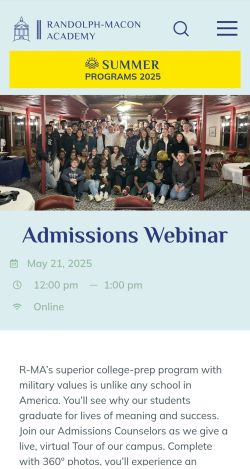
Example: Randolph-Macon Academy (RMA) hosts live virtual campus tour webinars to reach prospective families who cannot visit in person. RMA’s admissions team leads a live-streamed 360° campus tour followed by an in-depth Q&A presentation. This event is promoted through the school’s website and communications, allowing attendees worldwide to experience the campus in real time and ask questions, effectively extending the open-house experience beyond geographic limits.
Gen Z students care about social impact. Campaigns that highlight sustainability efforts, diversity, or local community involvement often outperform generic promotions, so long as the message is genuine. Authenticity matters.
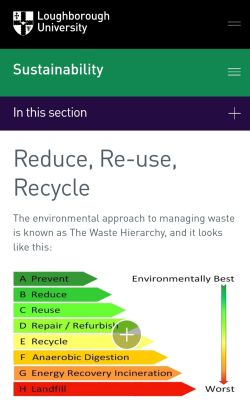
Example: Loughborough University (UK) provides a strong example with its “War on Waste” campaign – a bespoke sustainability initiative aimed at reducing waste and increasing recycling across campus buildings. Branded messaging around “Reduce, Re-use, Recycle” and visual prompts appeared throughout Loughborough’s facilities, encouraging students to adopt greener habits as part of campus life.
Staying on top of these trends ensures your message feels relevant, not recycled. Institutions that tap into these behaviours, without straying from their core identity, tend to gain more trust, attention, and traction from the student audience.
On-Campus Advertising Strategies That Still Work
While digital platforms dominate student attention, on-campus advertising still holds power, especially when promoting local events or building community awareness. The key is in making it modern, visible, and relevant. Here are five effective ways to do it:
1. Posters & Digital Billboards
Traditional posters still work, but now they come with upgrades. Many campuses feature rotating digital billboards in high-traffic spots like cafeterias or libraries. These can display videos, animations, and even repurposed TikToks. For printed posters, bold visuals and a QR code make it easy for students to scan and act instantly.
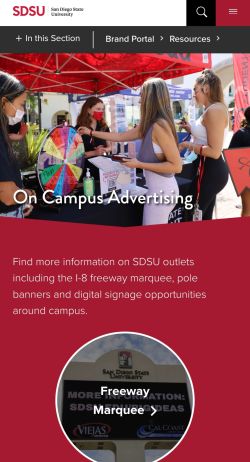
Example: San Diego State University (SDSU) employs a range of on-campus media to reach students: from digital signage screens in student centers to pole banners along walkways, and even a large marquee visible from a nearby freeway, all broadcasting campus events and messages
By strategically placing dynamic content in high-traffic areas, SDSU ensures students are constantly aware of upcoming activities and campus news.
Setting up a table in the student center or quad is a direct way to interact with students. Staff it with friendly student volunteers or staff, and have a clear call-to-action: whether it’s to promote a new program, a survey, or an event. Freebies (swag like T-shirts, stickers, snacks) are a timeless tactic; students love free stuff, and a branded item keeps your college or event in mind later. This face-to-face engagement can complement your online ads for colleges by giving a personal touch.
3. Campus Media Channels
Student-run newspapers, newsletters, and radio stations offer trusted, student-authored spaces to advertise. Sponsoring a segment or placing a well-designed ad in a campus magazine ensures your message lands where students are already tuned in.
4. Residence & Academic Buildings
Bring advertising into the spaces students frequent daily. Many residence halls allow posting on community boards or digital displays in lobbies. Similarly, academic buildings often have screens or boards for department-related notices; work with different departments to promote relevant opportunities (like a speaker event hosted by the business school should be advertised in the business building). Tailoring your message to the location can increase its relevance
5. Guerrilla Campaigns
Some of the most memorable campaign examples for students have been unconventional. Think flash mobs, chalk art on sidewalks, or pop-up experiences. A college could organize a quick flash mob dance in the dining hall to draw attention to an upcoming cultural festival, for example. Or use sidewalk chalk to create a path of clues leading to a secret prize location as part of a scavenger hunt campaign.
These fun stunts naturally get students talking (and posting on social media) because they break the monotony of campus life. Just be sure to get any necessary permissions from campus authorities beforehand.
When done right, on-campus efforts amplify your digital campaigns. If, for instance, a student sees a poster in the dorm, gets a text reminder, and then spots a student-led story on Instagram, it all clicks. That kind of message reinforcement is what turns curiosity into action.
How to Advertise Events to College Students
Promoting student events, whether it’s a club meeting or a major campus concert, requires clear, timely outreach across multiple channels. The goal isn’t just awareness; it’s attendance.
A pertinent question for education administrators then is: How can I market to 18 – 24-year-olds effectively? Utilize mobile-first, interactive, and values-aligned content. Focus on authenticity, relevance, and peer-driven engagement. Short-form video and tailored messaging yield the highest response.
Here’s how to get students to show up and spread the word.
1. Use a Multi-Channel Strategy
Start with a Facebook or event page, then promote it on Instagram, TikTok, Twitter, and email. Post countdown teasers, behind-the-scenes clips, and physical flyers across campus at least 1–2 weeks in advance. Repetition across platforms helps the message stick.
2. Lead with a Strong Hook
What makes the event worth attending? Free food? A headline performer? Networking opportunities? Whatever it is, make that the focal point on posters, email subject lines, and social captions. Students need a clear reason to care.
3. Tap Into Peer Networks
Encourage club members and student leaders to promote the event on their socials. Authentic, peer-shared content builds trust. Add a campaign hashtag and invite early adopters to post excitement-building previews like setup photos or teaser videos.
4. Leverage Campus Infrastructure
Ask professors to announce the event in relevant classes. Use the school’s app, email newsletter, events calendar, and even push notifications if available. A well-placed promo video from a student government leader can go a long way.
5. Simplify Signups
Use one-click links, QR codes on posters, and RSVP buttons that send reminders. Don’t make students dig for info; friction lowers turnout. Keep access to details and registration as effortless as possible.
On the day of the event, keep the buzz going. Add a selfie booth or branded hashtag display to encourage attendees to share their experience. When others see the fun they missed, they’ll be more inclined to show up next time. The right event marketing doesn’t just boost attendance, it builds momentum.
Creative Campaign Ideas to Spark Student Engagement in 2025
The best campaigns tap into real student life, encourage participation, and reflect your campus culture. Here are five proven and adaptable campaign ideas to consider:
1. ‘Day in the Life’ Video Series
Feature different students taking over your social channels, athletes, international students, first-years, to show authentic campus life. Promote each one in advance, save them to highlights, and repurpose the content for YouTube or digital signage. It’s both engaging and a valuable tool for prospective students.
2. Hashtag Challenge
Launch a branded hashtag (e.g., #MyCampusStory or #[Mascot]Pride) and invite students to post around a fun theme like favourite study spots or campus traditions. Offer prizes, reshare standout entries, and build a content library that feels both organic and community-driven.
3. Scavenger Hunt Campaign
Blend physical and digital by hiding QR codes or clues across campus during orientation or homecoming. Ask students to share their progress on social media using your hashtag. Offer swag for completion and a grand prize for added excitement, great for both visibility and participation.
4. Student Spotlight Series
Celebrate students with weekly features, short videos, or graphics showcasing their achievements, hobbies, or contributions to campus life. Share these across platforms to boost morale internally and show prospective students the real impact of your community.
In a nutshell, what’s the best way to promote events to college students? Use a multi-channel approach, emphasize the event’s value, and simplify registration. Build excitement through social proof, timely reminders, and on-site digital engagement strategies.
Example: The Academy of Applied Pharmaceutical Sciences (AAPS) in Toronto leverages student voices on social media by regularly sharing student and alumni success stories. This allows prospective students to envision themselves achieving similar goals, essentially seeing “people like me” thriving at the school.
Host timely, student-friendly events like a “Puppy Zone” during finals or a “Throwback Thursday” music party in the quad. Pair each with a livestream and pre-event polls or trivia to boost anticipation and extend reach to virtual audiences.
Keep it student-led, authentic, and relevant. Bring students into the planning process, they know what’s trending and what will spark interest. These ideas promote as well as create memorable experiences that students want to share.
Best Practices for Student Advertising
To ensure your marketing is both effective and respectful, consider these key principles:
Prioritize authenticity: Use real student voices and visuals. Avoid overpromising or overly polished messaging.
Optimize for mobile: Assume your content will be viewed on smartphones. Use vertical video, fast-loading pages, and concise layouts.
Maintain consistency: Align visual identity and messaging across platforms to reinforce recognition.
Respect timing: Be mindful of academic calendars and daily student rhythms. Avoid campaign launches during exam periods.
Gather feedback: Use polls or post-event surveys to measure effectiveness and refine future campaigns.
Adhere to campus policies: Ensure you comply with posting rules, privacy regulations, and student consent protocols.
Do you want to master the nuances of marketing to college students?
Contact Higher Education Marketing for more information.
Twitter: Reaching college students today requires more than visibility; it demands relevance. Learn how modern higher ed marketing leverages short-form video, student influencers, and personalized campaigns to make a lasting impact.
Facebook: Higher education advertising is evolving. Discover how to engage Gen Z through integrated campaigns that reflect their values, prioritize authenticity, and foster connection, both online and on campus.
LinkedIn: From social media to digital signage, today’s institutions are reimagining how to connect with students. Explore the most effective strategies for student-centred marketing in 2025.
Frequently Asked Questions
Question: Where can I advertise to college students?
Answer: Effective channels include social media platforms (Instagram, TikTok, YouTube, Snapchat), on-campus signage, email and SMS campaigns, and peer networks such as student clubs and organizations.
Question: How can I market to 18 – 24-year-olds effectively?
Answer: Utilize mobile-first, interactive, and values-aligned content. Focus on authenticity, relevance, and peer-driven engagement. Short-form video and tailored messaging yield the highest response.
Question: What’s the best way to promote events to college students?
Answer: Use a multi-channel approach, emphasize the event’s value, and simplify registration. Build excitement through social proof, timely reminders, and on-site digital engagement strategies.
DAVENPORT, Iowa — The Catholic prayer for the faithful echoed off the limestone walls and marble floor of the high-ceilinged chapel.
It implored God to comfort the poor and the hungry. The sick and the suffering. The anxious and the afraid.
Then it took an unexpected turn.
“Lord, hear our prayer for St. Ambrose and Mount Mercy University,” the young voice said, “that the grace of the Holy Spirit may help us to follow God’s plan for our new partnership.”
The speaker was talking about ongoing efforts to unite St. Ambrose University, where this weeknight Mass was being held, with fellow Catholic university Mount Mercy. Small religious schools in rural states are shutting down at an accelerating rate, a fate these two are attempting to avoid.
Credit: Mike Rundle for The Hechinger Report
“Lord, hear our prayer,” responded the congregation of students in St. Ambrose-branded T-shirts and hoodies.
The heads of both St. Ambrose and Mount Mercy, which is in Cedar Rapids, said they’ve watched as nearby religiously affiliated colleges, athletic rivals and institutions that employed their friends and former colleagues closed.
With falling numbers of applicants to college — especially in the Midwest — “we just don’t have the demographics anymore,” said St. Ambrose President Amy Novak. Now, as fewer graduates emerge from high schools, combining forces is a way to forestall “the reality that we might all see in five or seven years,” Novak said.
For many other small religiously affiliated institutions, time has already run out.
More than half of the 77 nonprofit colleges and universities that have closed or merged since 2020, or announced that they will close or merge, were religiously affiliated, according to a Hechinger Report analysis of news coverage and federal data. More than 30 that are still in business are on a U.S. Department of Education list of institutions considered “not financially responsible” because of comparatively low cash reserves and net income and high levels of debt.
Related: Interested in innovations in higher education? Subscribe to our free biweekly higher education newsletter.
Some small, religiously affiliated institutions that are not on these lists are also showing signs of strain. Saint Augustine’s University in North Carolina, which is Episcopal, has 200 students, down from 1,100 two years ago, and has lost its accreditation. The 166-year-old St. Francis College in New York, which is Catholic, has sacked a quarter of its staff. Catholic Saint Louis University in Missouri laid off 20 employees, eliminated 130 unfilled faculty and staff positions and sold off its medical practice after running a deficit.
Bluffton University in Ohio, which is Mennonite, is looking for a new partner after a planned merger fell through in February and the president resigned. Catholic St. Norbert College in Wisconsin is eliminating 11 majors and minors and 21 faculty positions. And Georgetown College in Kentucky averted closing only after an alumnus gave it $16 million, which, along with another $12 million in donations, was enough to pay off crippling debt that was costing the small Baptist institution $3 million a year just in interest.
Other religiously affiliated schools are also taking steps to buttress themselves against demographic and financial challenges. Ursuline College in Ohio, for instance, which has fewer than 1,000 students, has agreed to merge with larger Gannon University, 95 miles away. Both are Catholic. Spring Hill College in Alabama and Rockhurst University in Missouri, both also Catholic, are teaming up so they can jointly offer more academic programs, though they will remain independent.
More than a fifth of colleges and universities in the United States, or 849 out of 3,893, are religiously affiliated, according to the most recent figures from the National Center for Education Statistics.
The threats to them are getting new attention. Presidents of 20 Catholic universities and colleges met in November in Chicago at a conference sponsored by DePaul University and held at the offices of the Deloitte consulting firm, which collected data to help them figure out solutions to the challenges they face.
“The intent was to think about a blueprint for the future of Catholic higher education,” including more partnerships, shared services and other kinds of alliances, said Donna Carroll, president of the Association of Catholic Colleges and Universities. “Survival of the fittest is not the strategy that will advance the common good of Catholic higher education. We have to work together.”
The American Council on Education last year launched a Commission on Faith-Based Colleges and Universities, with leaders of what has since grown to 17 institutions including Pepperdine, Brigham Young and Yeshiva universities and the University of Notre Dame.
The idea of the commission, which is scheduled to meet in Washington in June, is “to increase visibility for the important contributions of religious and faith-based colleges and universities and to foster collaboration” among them.
Some religious colleges and universities are doing fine, and even posting enrollment gains — at least in part because of growing political divisions, campus protests and ideological attacks on secular institutions, said David Hoag, president of the Council for Christian Colleges and Universities.
Credit: Mike Rundle for The Hechinger Report
Parents are “wanting to put their son or daughter at a safe place that’s going to have a biblical worldview or a way to look at challenges that’s not polarized,” Hoag said. “At our institutions, you’re not going to be seeing protests or things that are happening at many of these [other] universities and colleges. You’re going to see them rallying together, whether it’s for a sporting event or for a revival or baptisms.”
Other trends also offer some hope to religiously affiliated colleges and universities. A long decline in the proportion of adults who consider themselves affiliated with a religion appears to have leveled off, the Pew Research Center finds. And while enrollment at parochial schools that feed graduates to Catholic universities fell more than 10 percent from 2017 to 2021, the most recent year for which the figure is available, the number of students at other kinds of religious primary and secondary schools is up.
Even religiously affiliated institutions confronting the realities of falling enrollment and financial woes fill a critically important role, their advocates say. They often serve low-income students who are the first in their families to go to college and are reluctant to enroll at large public universities.
Many are in rural areas where access to higher education is more limited than in urban and suburban places and is becoming less available still as public universities in rural states have merged or closed or cut dozens of majors.
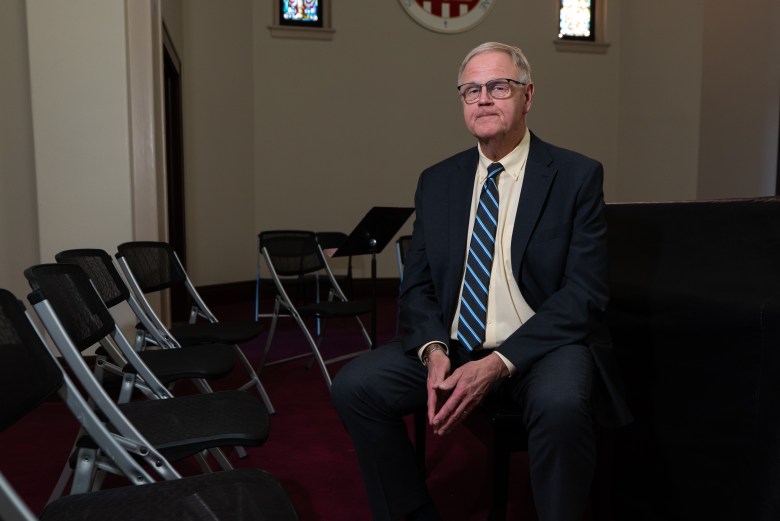
Attending a small rural, religiously affiliated institution “is, I think — especially for rural students — a great opportunity,” said Todd Olson, president of Mount Mercy, above the sound of trains crossing Cedar Rapids outside his window. “I know kids from very small towns around Iowa,” like the one where he grew up, Olson said. “This campus is a much more comfortable place for them.”
Credit: Mike Rundle for The Hechinger Report
When Jacob Lange arrived at St. Ambrose from East Dubuque, Illinois, and attended a Mass on campus, “all of a sudden all these new people I had never met were kind of chatting with me and it was really kind of nice. It felt like I was kind of included and I didn’t really think I would be originally,” he said. “You figure, ‘I’m probably going to sit in the back and probably not talk to anyone all night,’ and then I showed up, and I walked out here and all of a sudden they’re, like, ‘Here, come join our group.’ ”
His parents also liked that he decided to go to a Catholic university, Lange said. “You know, you go to one of these big schools with 25,000 kids, and you’re kind of worried about your kid — like, what kind of dumb things is he going to get up to?”
Catholic universities in particular have a slightly higher four-year graduation rate than the national average, according to the Center for Catholic Studies at St. Mary’s University in Texas. Graduates have a stronger sense of community purpose, the center found in a survey. Alumni are 9 percentage points more likely to say they participate in civic activities.
More students at religiously affiliated than at secular institutions receive financial aid, the American Council on Education says. Three out of five get scholarships from the colleges themselves, compared to fewer than one in four at other kinds of schools. At both Mount Mercy and St. Ambrose, which have about 1,450 and 2,700 students, respectively, 100 percent get financial aid.
But these benefits for students can be vulnerabilities for budgets, said Novak, at St. Ambrose.
“We serve the poor. We educate the poor,” she said. “That is a risky financial proposition at the moment for small, regional institutions that are largely tuition-driven.”
The threats to smaller religiously affiliated institutions in rural areas stem largely from the downturn in the already short supply of high school graduates choosing to enroll. The proportion of such students going straight to college has fallen even more sharply in many largely rural states.
While they’re generous with their financial aid, religiously affiliated colleges are also generally more expensive than many other higher education institutions, at a time when many families are questioning the return on their investments in tuition. Median tuition and fees average $25,416 a year, according to the American Council on Education.
St. Ambrose and Mount Mercy, about 90 minutes away,are teaming up from positions of relative strength. Publicly available financial documents suggest that neither faces the immediate enrollment or financial crises that threaten many similar institutions. But their leaders say that they’re trying to fend off problems that could arise later. By joining forces, each can increase its number of programs while lowering administrative costs.
Reaction among students and alumni has been mixed.
Combining with St. Ambrose “was kind of nerve-racking at the beginning because it’s, like, ‘Oh, this is a lot of change,’ ” said Alaina Bina, a junior nursing major at Mount Mercy.
She picked the university in the first place because she liked the small, hilly campus.
“I came from a small town, so I didn’t really want to go bigger,” she said. “Even when I came here on a tour, people would say ‘Hi’ to each other. You just know everyone, and that’s kind of how it is in a small town, too.”
Students were worried about what name would appear on their degrees (the degrees will still say “Mount Mercy”) and whether sports teams that once competed against each other would be merged. Novak and Olson promised to keep their athletics programs separate and even add a sport at Mount Mercy: football, beginning in 2026.
Combining sports teams “would not be wise at all from a business perspective,” Olson said the two agreed, because they are “a powerful enrollment driver” for both schools.
Credit: Mike Rundle for The Hechinger Report
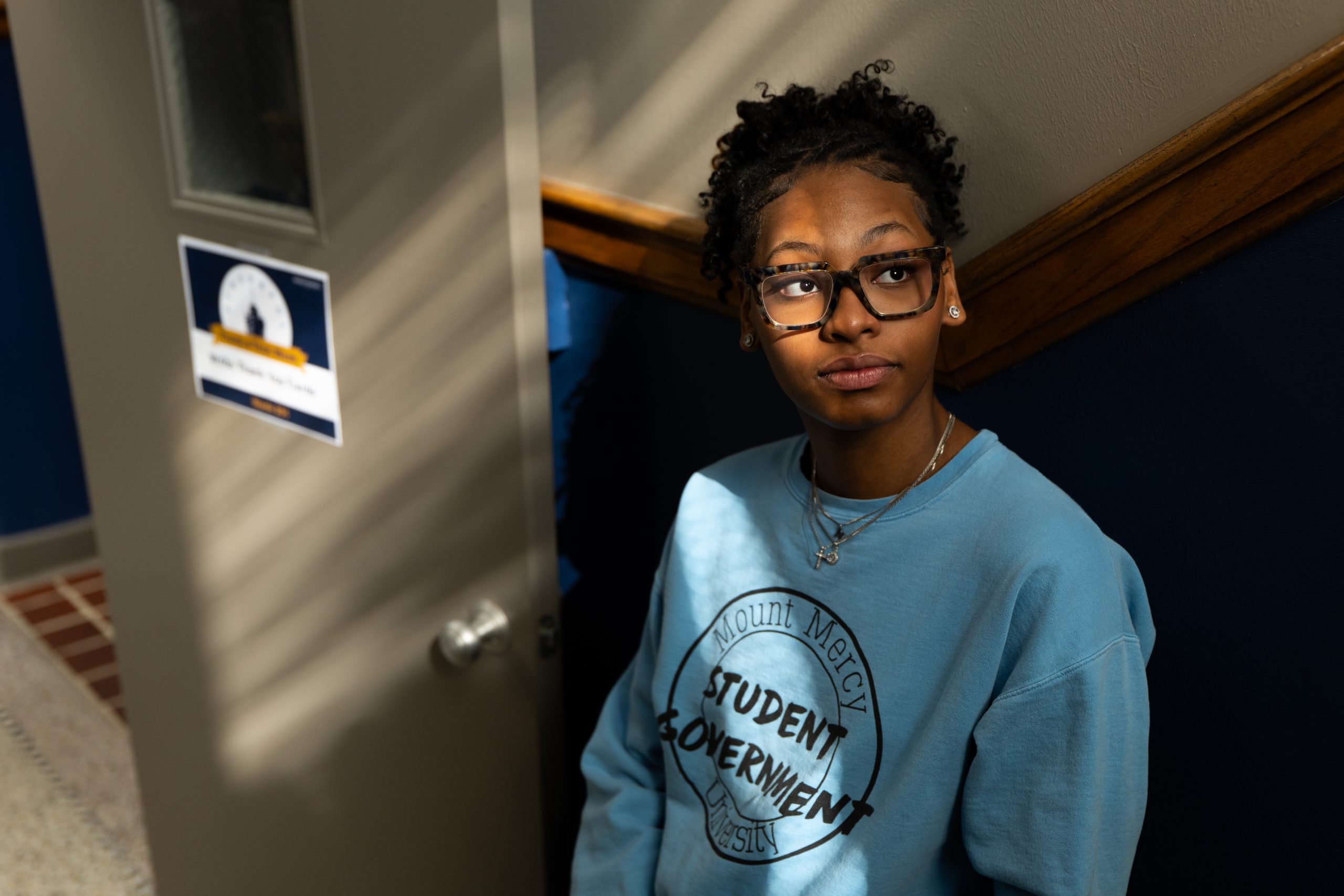
“Honestly, this was probably the biggest student concern,” said Nasharia Patterson, student government president at Mount Mercy, who was wearing a brace on her wrist from an awkward back tuck basket catch during cheer practice. Keeping the athletics teams “gives us a piece of Mount Mercy specifically to just hold on to.”
Among alumni, meanwhile, “there’s mixed feelings” about what’s happening to their alma mater, said Sarah Watson, a leadership development consultant who graduated from Mount Mercy in 2008.
Still, she said, “I know the great challenges that higher ed is facing right now. It’s not just Mount Mercy. It’s not just St. Ambrose. It’s the bigger schools, too. Enrollment numbers have dropped. The desire to go to a traditional four-year college is just not quite what it used to be.”
For Mount Mercy, which was founded by an order of nuns in 1928, Watson said, “If we don’t do this, what’s the alternative? We want to be around for another hundred years.”
After all, said Novak, the St. Ambrose president, “to watch universities close across the heartland because we can’t make it work will leave our communities fallow.”
Carroll, of the Catholic colleges and university association, said that many other religiously affiliated institutions are closely watching what’s happening at St. Ambrose and Mount Mercy.
“It’s a leap of faith,” she said. “And who better to take a leap of faith than a Catholic institution?”
Religiously affiliated colleges that have closed or merged, or announced that they will merge, since 2020
Alderson Broaddus University, West Virginia, Baptist
Alliance University, New York, Christian
Ancilla College, Indiana, Catholic
B. H. Carroll Theological Institute, Texas, Baptist
Birmingham-Southern College, Alabama, Methodist
Bloomfield College, New Jersey, Presbyterian
Cabrini University, Pennsylvania, Catholic
Cardinal Stritch University, Wisconsin, Catholic
Chatfield College, Ohio, Catholic
Clarks Summit University, Pennsylvania, Baptist
College of Saint Rose, New York, Catholic
Compass College of Film & Media, Michigan, Christian
Concordia College New York, Lutheran
Concordia University, Oregon, Lutheran
Eastern Nazarene College, Massachusetts, Christian
Finlandia University, Michigan, Lutheran
Fontbonne University, Missouri, Catholic
Holy Family College, Wisconsin, Catholic
Holy Names University, California, Catholic
Iowa Wesleyan University, Iowa, Methodist
Judson College, Alabama, Baptist
Limestone University, South Carolina, Christian
Lincoln Christian University, Illinois, Christian
MacMurray College, Illinois, Methodist
Magdalen College, New Hampshire, Catholic
Martin Methodist College, Tennessee, Methodist
Marymount California University, California, Catholic
Mount Mercy University, Iowa, Catholic
Multnomah University, Oregon, Christian
Nebraska Christian College, Nebraska, Christian
Notre Dame College of Ohio, Catholic
Ohio Valley University, West Virginia, Christian
Presentation College, South Dakota, Catholic
Rosemont College, Pennsylvania, Catholic
St. Louis Christian College, Missouri, Christian
St. Augustine College, Illinois, Episcopal
St. John’s University Staten Island campus, New York, Catholic
University of Saint Katherine, California, Orthodox Christian
Ursuline College, Ohio, Catholic
Wave Leadership College, Virginia, Christian
Wesley College, Delaware, Methodist
SOURCE: Hechinger Report analysis of news coverage and federal data.
The Hechinger Report provides in-depth, fact-based, unbiased reporting on education that is free to all readers. But that doesn’t mean it’s free to produce. Our work keeps educators and the public informed about pressing issues at schools and on campuses throughout the country. We tell the whole story, even when the details are inconvenient. Help us keep doing that.
Higher education institutions are complex ecosystems where policies shape the experiences of students, academics, and administrative staff.
However, the process of policy creation and implementation often lacks inclusivity, flexibility, and responsiveness to the rapidly evolving educational landscape.
If institutions are to thrive in an era of digital transformation, shifting student expectations, and increasing socio-economic challenges, they must rethink how policies are designed and enacted.
A more participatory, adaptive, and evidence-based approach is essential to creating institutional policies that truly serve the needs of all stakeholders.
Top down without engagement
Institutional policies often emerge from a centralised, top-down approach, where senior leadership teams develop policies without adequate engagement with those directly affected (students, faculty, and professional service staff).
This results in policies that may be well-intended but are disconnected from on-the-ground realities. For instance, policies surrounding Technology-Enhanced Learning (TEL) frequently fail because they do not account for academic workload constraints, staff and students’ digital literacy levels, or disparities in institutional infrastructure.
The gap between policy intentions and practical implementation then leads to confusion, resistance, and limited adoption.
Policies should not be dictated from the top – but rather co-created with those who will implement and be impacted by them. This requires institutions to foster genuine dialogue with diverse stakeholders, ensuring that different perspectives and experiences shape decision-making.
Adopting participatory approaches such as Change Laboratories, a method that engages stakeholders in problem-solving workshops, can provide a structured way for institutions to address contradictions and inefficiencies in their current policy frameworks.
A recent Change Laboratory intervention at a UK research-intensive university demonstrated the benefits of participatory policy development. The initiative brought together academics, administrators, and digital learning specialists to collaboratively identify barriers to effective blended learning adoption.
Through iterative discussions and problem-solving exercises, the group developed a Culturally Advanced Activity System (CAAS), aligning institutional policies with pedagogical realities. The process not only resulted in a more practical and effective policy framework but also increased staff engagement and willingness to adopt blended learning practices.
The success of participatory policy-making in blended learning highlights its potential application across other areas of policy. Institutions could apply similar methodologies to enhance policies related to assessment frameworks, student support services, diversity and inclusion, and faculty development. By institutionalising collaborative problem-solving approaches, HE governance structures can become more responsive to evolving educational needs.
Rigid policies that fail to account for evolving challenges and opportunities quickly become obsolete. HE institutions must adopt a more dynamic approach, treating policies as living documents that are regularly reviewed and updated based on data-driven insights.
For example, instead of prescribing a one-size-fits-all approaches, institutions should allow for staff-led experimentation, followed by structured evaluations to refine policies based on what works best in different disciplines.
An evidence-based policy culture?
Stakeholder-led policy development is crucial to ensuring that policies are not only relevant but also widely accepted and effectively implemented. By actively involving students, faculty, and administrative staff in the policy-making process, HE institutions can create frameworks that reflect the lived experiences of their communities.
This participatory approach fosters greater trust, encourages meaningful engagement, and enhances the practicality of policies. When stakeholders have ownership over policy development, they are more likely to support its implementation, leading to smoother transitions and sustainable institutional improvements.
Additionally, fostering a culture of continuous professional development ensures that policy decisions align with the latest pedagogical and technological advancements.
For HE institutions to remain relevant and responsive in the 21st century, they must overhaul how they create and implement policies. Moving away from rigid, top-down structures and embracing participatory, flexible, and evidence-driven approaches will ensure that policies are both effective and widely supported.
Institutional leaders must prioritise stakeholder engagement, foster a culture of continuous learning, and create policies that genuinely enhance teaching, learning, and student success.
Without these changes, HE risks stagnation in an era that demands adaptability and innovation. By embedding participatory mechanisms and evidence-based strategies in governance, HE institutions can pave the way for a more inclusive and forward-thinking educational environment.
Oklahoma wants some of its less-expensive universities to cut travel and operational costs, consolidate departments and reduce energy use — all in the name of saving money.
Already, earning a degree at one of these regional institutions is relatively inexpensive for students, costing in total as much as $15,000 less per year than bigger state universities in Oklahoma. And the schools, including Southeastern Oklahoma State University and the University of Central Oklahoma, graduate more teachers and nurses than those research institutions. Those graduates can fill critically needed roles for the state.
Still, state policymakers think there are more efficiencies to be found.
Higher education is one of the specific areas targeted by a new state-run agency with a familiar name, with the goal of “protecting our Oklahoma way of life,” Republican Gov. Kevin Stitt said in the first DOGE-OK report this spring. The Oklahoma Division of Government Efficiency, created around the same time as the federal entity with a similar title, counts among its accomplishments so far shifting to automated lawn mowers to cut grass at the state capital, changing to energy-efficient LED lighting and cutting down on state government cell phone bills. The Oklahoma governor’s office did not respond to a request for comment about this effort.
Oklahoma is one of about a dozen states that has considered an approach similar to the federal DOGE, though some state attempts were launched before the Trump administration’s. The federal Department of Government Efficiency, established the day Trump took office on Jan. 20, has commanded deep cuts to federal spending and the federal workforce, with limited justification.
As academia becomes a piñata for President Donald Trump and his supporters, Republican state lawmakers and governors are assembling in line: They want to get their whacks in too.
Related: Interested in more news about colleges and universities? Subscribe to our free biweekly higher education newsletter.
Beyond Oklahoma, Florida Gov. Ron DeSantis launched FL DOGE in February, with a promise to review state university and college operations and spending. Republicans in the Ohio statehouse formed an Ohio DOGE caucus. One of the Iowa DOGE Task Force’s three main goals is “further refining workforce and job training programs,” some of which are run through community colleges, and its members include at least two people who work at state universities.
The current political environment represents “an unprecedented attack on higher education,” said Veena Dubal, a law professor at the University of California, Irvine, and general counsel for the American Association of University Professors.
The state-level scrutiny comes atop those federal job cuts, which include layoffs of workers who interact with colleges, interdepartmental spending cuts that affect higher education and the shrinking of contracts that support research and special programs at colleges and universities. Other research grants have been canceled outright. The White House is pursuing these spending cuts at the same time as it is using colleges’ diversity efforts, their handling of antisemitism and their policies about transgender athletes to force a host of changes that go beyond cost-cutting — such as rules about how students protest and whether individual university departments require more supervision.
Florida Atlantic University students Zayla Robinson, Aadyn Hoots and Meadow Swantic (from left to right) sit together at the Boca Raton campus. Swantic objects to Florida’s efforts to dictate what subjects universities can or can’t teach: “You can’t erase history.” Credit: Michael Vasquez for The Hechinger Report
Higher education, which relies heavily on both state dollars and federal funding in the form of student loans and Pell grants, research grants and workforce training programs, faces the prospect of continued, and painful, budget cuts.
“Institutions are doing things under the threat of extinction,” Dubal said. “They’re not making measured decisions about what’s best for the institution, or best for the public good.”
For instance, the Trump administration extracted a number of pledges from Columbia University as part of its antisemitism charge, suspending $400 million in federal grants and contracts as leverage. This led campus faculty and labor unions to sue, citing an assault on academic freedom. (The Hechinger Report is in an independent unit of Teachers College.) Now Harvard faces a review of $9 billion in federal funding, also over antisemitism allegations, and the list of universities under similar scrutiny is only growing.
Budget cuts are nothing new for higher education — when a recession hits, it is one of the first places state lawmakers look to cut, in blue states or red. One reason: Public universities can sometimes make up the difference with tuition increases.
What DOGE brings, in Washington and statehouses, is something new. The DOGE approach is engaging in aggressive cost-cutting that specifically targets certain programs that some politicians don’t like, said Jeff Selingo, a special adviser to the president at Arizona State University.
“It’s definitely more political than it is fiscal or policy-oriented,” said Selingo, who is also the author of several books on higher education.
“Universities haven’t done what certain politicians wanted them to do,” he added. “This is a way to control them, in a way.”
The current pressure on Florida colleges extends far beyond budget matters. DeSantis has criticized college campuses as “intellectually repressive environments.” In 2021, Florida state lawmakers passed a law, signed by the governor, to fight this perceived ideological bent by requiring a survey of public university professors and students to assess whether there is enough intellectual diversity on campus.
A diversity-themed bus transports students at the University of Central Florida’s Orlando campus. Credit: Michael Vasquez for The Hechinger Report
At New College in Sarasota, DeSantis led an aggressive cultural overhaul to transform the college’s atmosphere and identity into something more politically conservative. The governor has cited Hillsdale College, a conservative private Christian institution in Michigan, as a role model.
Faculty and students at New College sued. Their complaints included allegations of academic censorship and a hostile environment for LGBTQ+ students, many of whom transferred elsewhere. One lawsuit was ultimately dropped. Since the takeover, the college added athletics programs and said it has attracted a record number of new and transfer students.
Across America, Republicans control both the legislature and the governor’s mansion in 23 states, compared with 15 states fully controlled by Democrats. In those GOP-run states, creating a mini-DOGE carries the potential for increased political might, with little oversight.
In Florida, “state DOGE serves as an intimidation device,” one high-ranking public university administrator told The Hechinger Report. The administrator, who asked not to be named for fear of retribution, said “there’s also just this atmosphere of fear.”
In late March, university presidents received a letter signed by the “DOGE Team” at the governor’s office. The letter promised a thorough review by FL DOGE officials, with site visits and the expectation that each college appoint a designated liaison to handle FL DOGE’s ongoing requests.
The letter highlighted some of the items FL DOGE might request going forward, including course codes, descriptions and syllabi; full detail of all centers established on campus; and “the closure and dissolution of DEI programs and activities, as required by law.”
The student union at Florida Atlantic University in Boca Raton. Florida Gov. Ron DeSantis, a Republican, launched FL DOGE in February, promising to review state university and college operations and spending. Credit: Michael Vasquez for The Hechinger Report
The state did not respond to a question about whether FL DOGE is designed to attack higher education in the state. Molly Best, the deputy press secretary, noted that FL DOGE is now up and running, and cities and counties are also receiving letters requesting certain information and that the public will be updated in the future.
DOGE in Florida also follows other intervention in higher education in the state: Florida’s appointed Board of Governors, most of whom are chosen by the governor, removed dozens of courses from state universities’ core curriculum to comply with the Stop WOKE Act, a state law that took effect in 2022. The law, which DeSantis heavily promoted, discourages the teaching of concepts such as systemic racism or sexism. The courses removed from Florida’s 12 state universities were primarily sociology, anthropology and history courses.
“You can’t erase history,” said Meadow Swantic, a criminal justice major at Florida Atlantic University, a public institution, in an interview at its Boca Raton campus. “There’s certain things that are built on white supremacy, and it’s a problem.”
Fellow Florida Atlantic student Kayla Collins, however, said she has noticed some professors’ liberal bias during class discussions.
“I myself have witnessed it in my history class,” said Collins, who identifies as Republican. “It was a great history class, but I would say there were a lot of political things brought up, when it wasn’t a government class or a political science class.”
At the University of Central Florida in Orlando, political science major Liliana Hogan said she had a different experience of her professors’ political leanings.
“You hear ‘people go to university to get woke’ or whatever, but actually, as a poli-sci student, a lot of my professors are more right-wing than you would believe,” Hogan said. “I get more right-leaning perspectives from my teachers than I would have expected.” Hogan said.
Another UCF student, Johanna Abrams, objected to university budget cuts being ordered by the state government. Abrams said she understands that tax dollars are limited, but she believes college leaders should be trusted with making the budget decisions that best serve the student body.
“The government’s job should be providing the funding for education, but not determining what is worthy of being taught,” Abrams said.
Whatever their missions and attempts at mimicry, state-level DOGE entities are not necessarily identical to the federal version.
For instance, in Kansas, the Committee on Government Efficiency, while inspired by DOGE, is in search of ideas from state residents about ways to make the state bureaucracy run better rather than imposing its own changes. A Missouri Senate portal inspired by the federal DOGE works in a similar way. Yet the federal namesake isn’t taking suggestions from the masses to inform its work.
And at the federal level, then-DOGE chief Elon Musk in February emailed workers, asking them to respond “to understand what they got done last week,” he posted on X. “Failure to respond will be taken as a resignation.” Employees were asked to reply with a list of five accomplishments.
The Ohio DOGE Caucus noted explicitly it won’t be doing anything like that.
“We’re not going to be emailing any state employees asking them to give us five things they worked on throughout the week,” Ohio state Rep. Tex Fischer, a Republican, told a local radio station. “We’re really just trying to get like-minded people into a room to talk about making sure that government is spending our money wisely and focusing on its core functions that we all agree with.”
Contact editor Nirvi Shah at 212-678-3445, securely on Signal at NirviShah.14 or via email at [email protected].
The Hechinger Report provides in-depth, fact-based, unbiased reporting on education that is free to all readers. But that doesn’t mean it’s free to produce. Our work keeps educators and the public informed about pressing issues at schools and on campuses throughout the country. We tell the whole story, even when the details are inconvenient. Help us keep doing that.
Artificial intelligence will change higher education till 2025, presenting opportunities and challenges. Polls show 84% of higher education workers use AI daily.
ChatGPT lecturers use AI, and 92% of UK students embrace it.
Universities must negotiate AI’s complexities as it enhances teaching and overcomes natural limitations.
For AI to reach its potential, institutions must understand and overcome its major benefits and quick adoption challenges. Let’s discover all this in this post.
Opportunities: How AI is Transforming Higher Education in 2025
1. Automating Assessments & Grading
The Problem with Manual Grading & Feedback
Often labor-intensive and erratic, traditional grading systems are For a good chunk of their workweek, professors grade and offer comments. Teachers grade and provide comments for a median of five hours a week, according to a poll by Education Week.
In contexts of online learning, the time commitment could be much more important. According to a research written for the Online Journal of Distance Learning Administration, teachers dedicate roughly 12.69 hours a week to each online course—about 40% of which are used for grading and comments.
This large time commitment in grading can take away from other important duties such lesson planning and direct student involvement.
AI Tools for Grading and Student Feedback
AI-powered intelligent grading systems have become clear answers to improve consistency and efficiency in tests. By processing tests and assignments faster than hand grading, these AI systems help to lighten faculty workload and release their time for more critical chores.
Automating typical grading chores lets professors to concentrate more on educational tactics and individualized student interactions.
How to Automate Grading with AI in Higher Education
Using AI-driven tests calls for multiple steps of implementation, including:
Review current assessment techniques: Find how artificial intelligence could streamline processes.
Choosing AI Tools: AI grading systems should complement technology and educational objectives of the institution.
Launch of the pilot program: Try and get comments via a small-scale rollout.
Teach staff members and professors: Give thorough instruction to enable simple use of AI tools.
Watch and get better: Examine the system’s performance and modify it to produce the greatest outcomes.
Designed by the University of Toronto’s Rotman School of Management, “All Day TA,” an artificial intelligence assistant, answered 12,000 student queries annually. This suggests that real-world uses of artificial intelligence in education abound.
Benefits of AI-Based Feedback Systems for Teachers
AI-powered feedback systems give students individualized, real-time information that makes learning more fun. These tools can look at how students answered, figure out what they did well and what they could do better, and give them feedback that helps them get better.
Artificial intelligence (AI) makes grading easier, which gives teachers more time for teaching and helping students, which leads to better educational results.
2. Customized learning and student success
AI is a key part of personalized education because it lets faculty make learning paths that fit the needs of each student. AI-powered adaptive learning platforms can look at student performance data to change how material is delivered. This way, each student gets instruction that fits their learning style and speed through it.
AI-driven insights can also help find students who are at risk early on, so that they can get help when they need it to help them succeed and stay until they graduate.
3. Operations and administration on campus powered by AI
AI is simplifying college administrative tasks and research. Using AI to streamline admissions, course scheduling, and staff responsibilities saves time and money.
Universities can use their resources more efficiently and focus on long-term learning programs by automating mundane administrative tasks.
Challenges: Major Challenges Universities Face with AI in 2025
Universities must address data security, faculty adoption, and the delicate balance between automation and human control to employ AI ethically and effectively.
1. Data Privacy & Ethical Concerns
Personalization and grading are automated by AI-powered systems that process massive student data.
Universities should ensure compliance with data privacy laws (e.g., GDPR) to protect student data.
Monitor automated grading and recommendation systems to prevent bias.
Maintain transparency in AI-driven decisions to build trust with faculty and students.
2. Resistance from faculty and a lack of training
In spite of its benefits, AI is not easily utilized in higher education for the following reasons: The idea of limiting students’ freedom is still scary to many faculty . They don’t know how AI can be used to grade and leave notes.
Faculty may not be able to use AI tools well if they haven’t been taught properly. In order for AI to work well with other systems, organizations need to spend money on skill-building programs for people.
How to put it into action: Universities should start with test programs, offer ongoing training, and make sure that the rollout happens slowly so that teachers can get used to it before they start using it for real.
3. Balancing AI with Human Oversight
Though it speeds grading, artificial intelligence shouldn’t replace human judgment—especially for challenging tasks like essays and creative projects! Universities must have measures in place to prevent AI comments from being accepted at face value and maintain equity. The best way is: a clever combination of human supervision with artificial intelligence efficiency to maintain accurate, balanced, and correctness.
Conclusion
Offering game-changing efficiencies and new challenges, artificial intelligence is revolutionizing higher education. The secret for colleges is to strike the proper balance—using artificial intelligence for automation without sacrificing the human element in learning. Early adopters of artificial intelligence will not only improve student performance but also keep ahead in a landscape getting more competitive.
All set to use artificial intelligence for better, more effective administration of education? Get in touch with Creatrix Campus and investigate AI-driven solutions catered for universities.