More than 400,000 K-12 educators across the country will get free training in AI through a $23 million partnership between a major teachers union and leading tech companies that is designed to close gaps in the use of technology and provide a national model for AI-integrated curriculum.
The new National Academy for AI Instruction will be based in the downtown Manhattan headquarters of the United Federation of Teachers, the New York City affiliate of the American Federation of Teachers, and provide workshops, online courses, and hands-on training sessions. This hub-based model of teacher training was inspired by work of unions like the United Brotherhood of Carpenters that have created similar training centers with industry partners, according to AFT President Randi Weingarten.
“Teachers are facing huge challenges, which include navigating AI wisely, ethically and safely,” Weingarten said at a press conference Tuesday announcing the initiative. “The question was whether we would be chasing it or whether we would be trying to harness it.”
The initiative involves the AFT, UFT, OpenAI, Microsoft, and Anthropic.
“We are actually ensuring that kids have, that teachers have, what they need to deal with the economy of today and tomorrow,” Weingarten said.
The academy will be based in a city where the school system initially banned the use of AI in the classroom, claiming it would interfere with the development of critical thinking skills. A few months later, then-New York City schools Chancellor David Banks did an about-face, pledging to help schools smartly incorporate the technology. He said New York City schools would embrace the potential of AI to drive individualized learning. But concrete plans have been limited.
Vincent Plato, New York City Public Schools K-8 educator and UFT Teacher Center director, said the advent of AI reminds him of when teachers first started using word processors.
“We are watching educators transform the way people use technology for work in real time, but with AI it’s on another unbelievable level because it’s just so much more powerful,” he said in a press release announcing the new partnership. “It can be a thought partner when they’re working by themselves, whether that’s late-night lesson planning, looking at student data or filing any types of reports — a tool that’s going to be transformative for teachers and students alike.”
Teachers who frequently use AI tools report saving 5.9 hours a week, according to a national survey conducted by the Walton Family Foundation in cooperation with Gallup. These tools are most likely to be used to support instructional planning, such as creating worksheets or modifying material to meet students’ needs. Half of the teachers surveyed stated that they believe AI will reduce teacher workloads.
“Teachers are not only gaining back valuable time, they are also reporting that AI is helping to strengthen the quality of their work,” Stephanie Marken, senior partner for U.S. research at Gallup, said in a press release. “However, a clear gap in AI adoption remains. Schools need to provide the tools, training, and support to make effective AI use possible for every teacher.”
While nearly half of school districts surveyed by the research corporation RAND have reported training teachers in utilizing AI-powered tools by fall 2024, high-poverty districts are still lagging behind their low poverty counterparts. District leaders across the nation report a scarcity of external experts and resources to provide quality AI training to teachers.
OpenAI, a founding partner of the National Academy for AI Instruction, will contribute $10 million over the next five years. The tech company will provide educators and course developers with technical support to integrate AI into classrooms as well as software applications to build custom, classroom-specific tools.
Tech companies would benefit from this partnership by “co-creating” and improving their products based on feedback and insights from educators, said Gerry Petrella, Microsoft general manager, U.S. public policy, who hopes the initiative will align the needs of educators with the work of developers.
In a sense, the teachers are training AI products just as much as they are being trained, according to Kathleen Day, a lecturer at Johns Hopkins Carey Business School. Day emphasized that through this partnership, AI companies would gain access to constant input from educators so they could continually strengthen their models and products.
“Who’s training who?” Day said. “They’re basically saying, we’ll show you how this technology works, and you tell us how you would use it. When you tell us how you would use it, that is a wealth of information.”
Additionally, Trevor Griffey, a lecturer in labor studies at the University of California Los Angeles, warned the New York Times that tech firms could use these deals to market AI tools to students and expand their customer base.
This initiative to expand AI access and training for educators was likened to New Deal efforts in the 1930s to expand equal access to electricity by Chris Lehane, OpenAI’s chief global affairs officer. By working with teachers and expanding AI training, Lehane hopes the initiative will “democratize” access to AI.
“There’s no better place to do that work than in the classroom,” he said at the Tuesday press conference.
Chalkbeat is a nonprofit news site covering educational change in public schools.
Virtual reality (VR) isn’t a silver bullet replacement for lectures or labs, but it is the most practical method to support higher education to deliver immersive learning more effectively at-scale.
Please login below to view content or subscribe now.
This is the latest of a series of contract cuts for the Institute of Education Sciences.
Caroline Brehman/CQ-Roll Call Inc./Getty Images
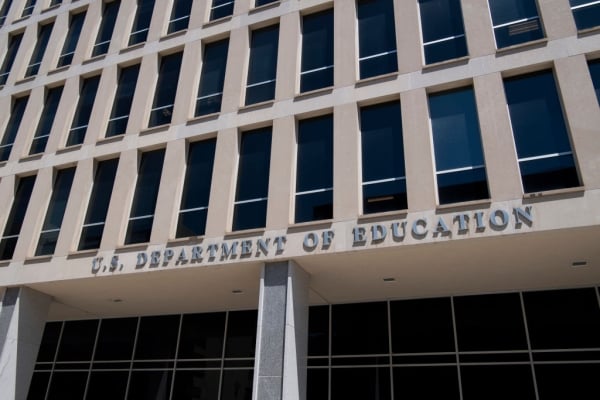
The Trump administration terminated a key contract to train college officials on how to report data to the Integrated Postsecondary Education Data System, a move that could further hamper the Education Department’s data infrastructure.
Used to track trends in higher education enrollment, completion, financial aid usage and other institutional characteristics, IPEDS survey data has long been critical to higher education research. But in order to access and utilize the data, institutions need to know how to properly complete the survey and researchers need to know how to navigate the database.
That’s where the Association of Institutional Research and its IPEDS training programs came in—or at least they used to.
In a social media post Thursday, AIR’s executive director, Christine Keller, announced that the organization’s subcontract with IPEDS and the National Center for Education Statistics would not be renewed for the upcoming academic year. This means that updated self-paced courses and video tutorials on how to report and use data, as well as in-person workshops on topics like how to set data-informed benchmarks and improvement plans for an institution, will no longer be available.
“When you’ve done meaningful work with committed partners for more than two decades, it’s difficult to acknowledge that it’s coming to an end,” Keller wrote. “While this chapter is closing, AIR’s commitment to supporting data-informed decision-making remains strong. We are actively exploring ways to continue offering select IPEDS training under the AIR brand to meet the needs of our community.”
But while AIR intends to continue similar training models, Keller was sure to clarify that any future coaching will come at a cost. Past resources were subsidized by the contract and therefore available for free.
The end of this subcontract will not, however, terminate other components of the IPEDS contract managed through RTI International—such as aiding in data collection, maintaining the IPEDS website and managing the help desk. (This paragraph has been corrected to reflect that RTI International contract for IPEDS.)
An Education Department spokesperson wrote in an email that the decision reflected its commitment to supporting “useful and relevant research” while “respecting the American taxpayer’s wallet.”
“Multiple federal contractors were collecting 50 percent or more in overhead costs, which is neither sustainable nor reasonable,” the spokesperson said. “We believe in the value of training users to make best use of federally funded databases. Thus, we are in [the] process of reexamining how that training might be more efficiently and effectively delivered in the future.”
College staff members and policy experts who focus on using institutional data to improve student outcomes, however, say the discontinuation of free AIR training programs will be devastating.
Henry Zheng, vice provost for institutional effectiveness and planning at Carnegie Mellon University, wrote on LinkedIn that this abrupt ending was “sobering” and that he is “pray[ing] that this program will continue on another day.”
Wesley Whistle, a project director on student success and affordability at New America, a left-leaning think tank, also took to LinkedIn to comment on the news, saying, “These trainings are vital for institutional researchers as they fulfill their reporting obligations.”
And this is not the first blow for IPEDS and NCES under the Trump administration. In February, Elon Musk’s Department of Government Efficiency announced that it had canceled nearly $900 million in contracts across the statistics center and its larger parent agency, the Institute of Education Sciences.
At the time, a DOGE official said 89 IES contracts were canceled, while other organizations put the total at closer to 170. (Previous Inside Higher Ed reporting has shown that the data being published by DOGE regarding the scope and effect of its cuts is likely inaccurate.)
Additionally, the department fired more than 80 percent of IES’s 120 employees. The Education Department said in recent budget documents that it is planning to reimagine “a more efficient, effective, and useful IES to improve support for evidence-based accountability, data-driven decision making, and education research for use in the classroom.”
Collectively, IPEDS, NCES and IES serve as the Education Department’s research and development arm, funding research on how to improve equity in education access and outcomes in the future as well as providing data on how students in K–12 and college fare in programs. So to discontinue the services that bolstered college staff members’ professional development could hurt their ability to report congressionally mandated statistics accurately, higher ed experts say.
In the end, some fear that losing the training could lead to less data-informed decision-making.
“We need to collect data both at the national level and at the institutional level. Without measuring the problem, we risk pretending it doesn’t exist,” wrote James Orlick, director of grant writing and innovation for inclusive excellence at the University of Louisville. “The belief that ‘if you don’t measure it, it isn’t a problem’ reinforces inaction and won’t solve the systemic issues we face.”
Decatur, Illinois, has been losing factory jobs for years. A training program at a local community college promises renewal and provides training for students from disenfranchised communities
DECATUR, IL. — A fistfight at a high school football game nearly defined Shawn Honorable’s life.
It was 1999 when he and a group of teen boys were expelled and faced criminal charges over the incident. The story of the “Decatur Seven” drew national headlines and protests led by the Rev. Jesse Jackson, who framed their harsh treatment as blatant racism. The governor eventually intervened, and the students were allowed to attend alternative schools.
Honorable, now 41, was encouraged by support “from around the world,” but he said the incident was traumatizing and he continued to struggle academically and socially. Over the years, he dabbled in illegal activity and was incarcerated, most recently after a 2017 conviction for accepting a large amount of marijuana sent through the mail.
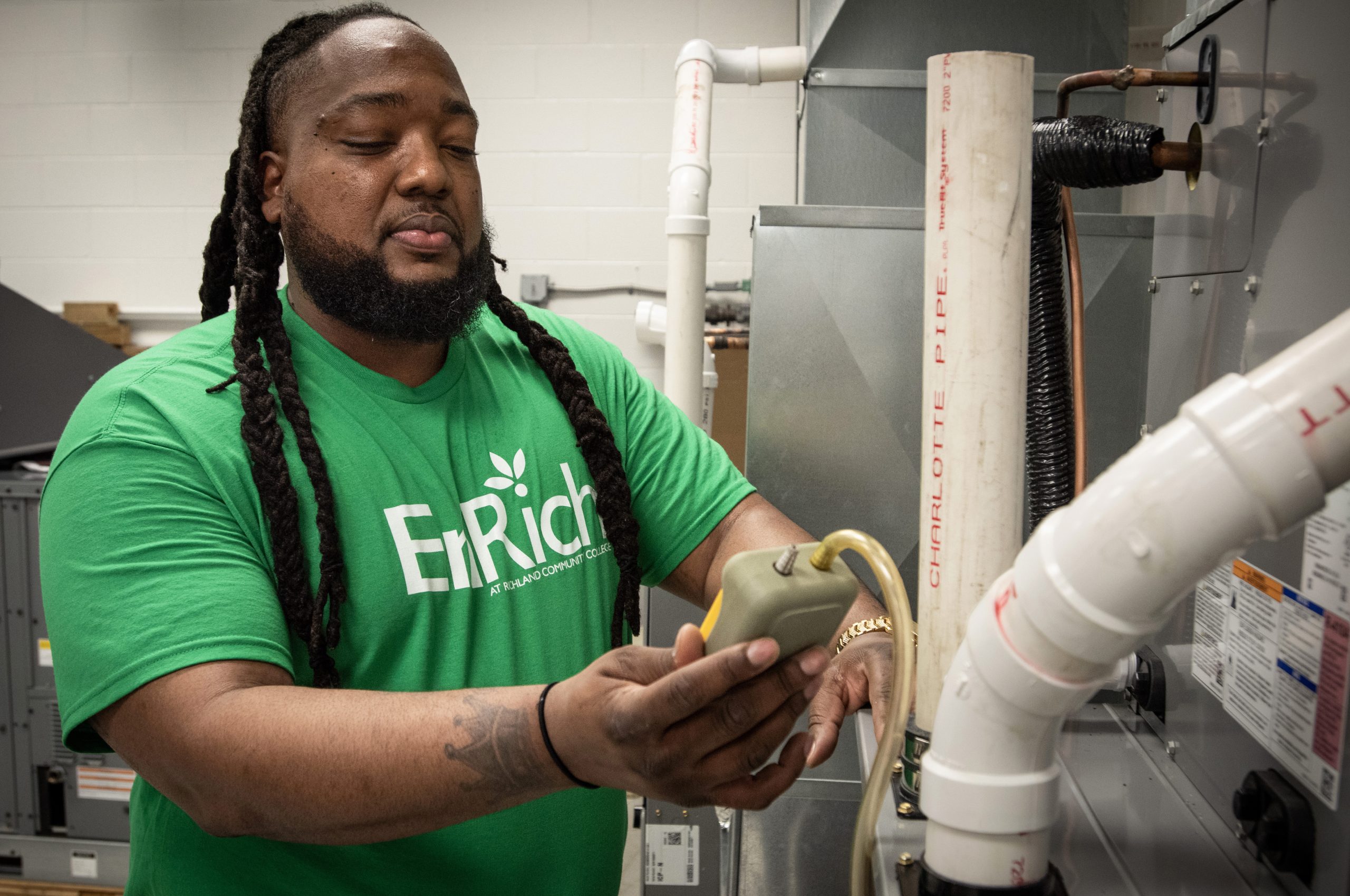
Today, Honorable is ready to start a new chapter, having graduated with honors last week from a clean energy workforce training program at Richland Community College, located in the Central Illinois city of Decatur. He would eventually like to own or manage a solar company, but he has more immediate plans to start a solar-powered mobile hot dog stand. He’s already chosen the name: Buns on the Run.
“By me going back to school and doing this, it shows my nephews and my little cousins and nieces that it is good to have education,” Honorable said. “I know this is going to be the new way of life with solar panels. So I’ll have a step up on everyone. When it comes, I will already be aware of what’s going on with this clean energy thing.”
Shawn Honorable graduated with honors last week from Richland Community College’s clean energy workforce training program in Decatur, Illinois, part of a network of hubs funded by the state’s 2021 Climate and Equitable Jobs Act. Credit: Lloyd DeGrane/Canary Media
After decades of layoffs and factory closings, the community of Decatur is also looking to clean energy as a potential springboard.
Located amid soybean fields a three-hour drive from Chicago, the city was long known for its Caterpillar, Firestone Tire, and massive corn-syrup factories. Industrial jobs have been in decline for decades, though, and high rates of gun violence, child poverty, unemployment, and incarceration were among the reasons the city was named a clean energy workforce hub funded under Illinois’ 2021 Climate and Equitable Jobs Act (CEJA).
Decatur’s hub, based at Richland Community College, is arguably the most developed and successful of the dozen or so established statewide. That’s thanks in part to TCCI Manufacturing, a local, family-owned factory that makes electric vehicle compressors. TCCI is expanding its operations with a state-of-the-art testing facility and an on-site campus where Richland students will take classes adjacent to the manufacturing floor. The electric truck company Rivian also has a factory 50 miles away.
“The pieces are all coming together,” Kara Demirjian, senior vice president of TCCI Manufacturing, said by email. “What makes this region unique is that it’s not just about one company or one product line. It’s about building an entire clean energy ecosystem. The future of EV manufacturing leadership won’t just be on the coasts — it’s being built right here in the Midwest.”
Powering Rural Futures:Clean energy is creating new jobs in rural America, generating opportunities for people who install solar panels, build wind turbines, weatherize homes and more. This five-part series from the Rural News Network explores how industry, state governments and education systems are training this growing workforce.
Related: Want to read more about how climate change is shaping education? Subscribe toour free newsletter.
The Decatur CEJA program has also flourished because it was grafted onto a preexisting initiative, EnRich, that helps formerly incarcerated or otherwise disenfranchised people gain new skills and employment. The program is overseen by the Rev. Courtney Carson, a childhood friend of Honorable and another member of the Decatur Seven.
“So many of us suffer significantly from our unmet needs, our unhealed traumas,” said Carson, who was jailed as a young man for gun possession and later drag racing. With the help of mentors including Rev. Jackson and a college basketball coach, he parlayed his past into leadership, becoming associate pastor at a renowned church, leading a highway construction class at Richland, and in 2017 being elected to the same school board that had expelled him.
Carson, now vice president of external relations at the community college, tapped his own experience to shape EnRich as a trauma-informed approach, with wraparound services to help students overcome barriers — from lack of childcare to PTSD to a criminal record. Carson has faith that students can overcome such challenges to build more promising futures, like Decatur itself has done.
“We have all these new opportunities coming in, and there’s a lot of excitement in the city,” Carson said. “That’s magnificent. So what has to happen is these individuals who suffered from closures, they have to be reminded that there is hope.”
Richland Community College’s clean energy jobs training starts with an eight-week life skills course that has long been central to the larger EnRich program. The course uses a Circle of Courage practice inspired by Indigenous communities and helps students prepare to handle stressful workplace situations like being disrespected or even called a racial slur.
“Being called the N-word, couldn’t that make you want to fight somebody? But now you lose your job,” said Carson. “We really dive deep into what’s motivating their attitude and those traumas that have significantly impacted their body to make them respond to situations either the right way or the wrong way.”
The training addresses other dynamics that might be unfamiliar to some students — for example, some male students might not be prepared to be supervised by a woman, Carson noted, or others might not be comfortable with LGBTQ+ coworkers.
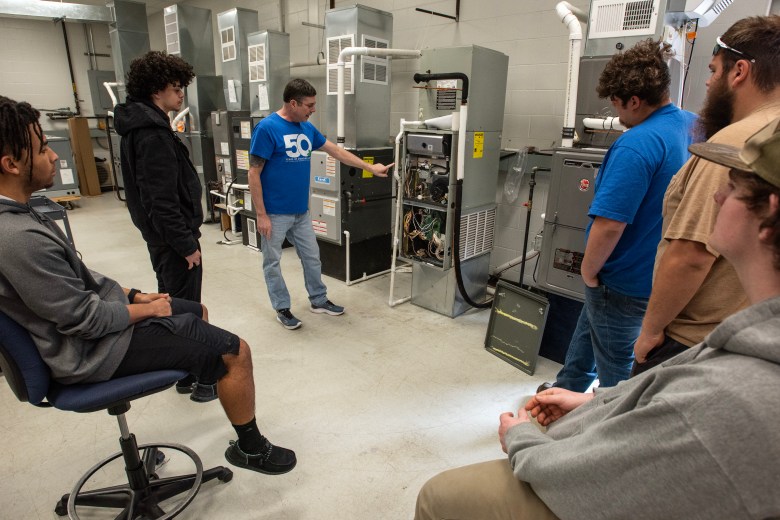
Karl Evans instructs Richland Community College students on the inner workings of a gas furnace. Credit: Lloyd DeGrane/Canary Media
Life skills are followed by a construction math course crucial to many clean energy and other trades jobs. During a recent class, 24-year-old Brylan Hodges joked with the teacher while converting fractions to decimals and percentages on the whiteboard. He explained that he moved from St. Louis to Decatur in search of opportunity, and he hopes to become a property manager overseeing solar panel installation and energy-efficiency upgrades on buildings.
Students take an eight-hour primer in clean energy fields including electric vehicles, solar, HVAC, and home energy auditing. Then they choose a clean energy track to pursue, leading to professional certifications as well as a chance to continue at Richland for an associate degree. Under the state-funded program, students are paid for their time attending classes.
Marcus James was part of the first cohort to start the program last October, just days after his release from prison.
He was an 18-year-old living in Memphis, Tennessee, when someone shot at him, as he describes it, and he fired back, with fatal consequences. He was convicted of murder and spent 12 years behind bars. After his release he made his way to Decatur, looking for a safer place to raise his kids. Adjusting to life on the outside wasn’t easy, and he ended up back in prison for a year and a half on DUI and drug possession charges.
Following his release, he was determined to turn his life around.
“After I brought my kids up here, I end up going back to prison. But at that moment, I realized, man, I had to change,” James told a crowd at an event celebrating the clean jobs program in March.
The Rev. Courtney Carson, vice president of external relations at the community college. Credit: Lloyd DeGrane/Canary Media
James said that at first, he showed up late to every class. But soon the lessons sank in, and he was never late again. He always paid attention when people talked, and he gained new confidence.
“As long as I put my mind to it, I can do it,” said James, who would like to work as a home energy auditor. Richland partners with the energy utility Ameren to place trainees in such positions.
“I like being out in the field, learning new stuff, dealing with homes, helping people,” James said, noting he made energy-efficiency improvements to his own home after the course.
Illinois’ 2017 Future Energy Jobs Act (FEJA) launched the state’s clean energy transition, baking in equity goals that prioritize opportunities for people who benefited least and were harmed most by the fossil fuel economy. It created programs to deploy solar arrays and provide job training in marginalized and environmental justice communities.
FEJA’s rollout was rocky. Funding for equity-focused solar installations went unspent while workforce programs struggled to recruit trainees and connect them with jobs. The pandemic didn’t help. The follow-up legislation, CEJA, expanded workforce training programs and remedied snafus in the original law.
Melissa Gombar is principal director of workforce development programs for Elevate, a Chicago-based national nonprofit organization that oversaw FEJA job training and subcontracts for a Chicago-area CEJA hub. Gombar said many community organizations tasked with running FEJA training programs were relatively small and grassroots, so they had to scramble to build new financial and human resources infrastructure.
“They have to have certain policies in place for hiring and procurement. The influx of grant money might have doubled their budget,” Gombar said. Meanwhile, the state employees tasked with helping the groups “are really talented and skilled, trying their best, but they’re overburdened because of the large lift.”
CEJA, by contrast, tapped community colleges like Richland, which already had robust infrastructure and staffing. CEJA also funds community organizations to serve as “navigators,” using the trust and credibility they’ve developed in communities to recruit trainees.
Richland Community College received $2.6 million from April 2024 through June 2025, and the Community Foundation of Macon County, the hub’s navigator, received $440,000 for the same time period. The other hubs similarly received between $1 million and $3.3 million for the past year, and state officials have said the same level of funding will be allocated for each of the next two years, according to the Illinois Clean Jobs Coalition.
CEJA hubs also include social service providers that connect trainees with wraparound support; businesses like TCCI that offer jobs; and affiliated entrepreneur incubators that help people start their own clean energy businesses. CEJA also funded apprenticeship and pre-apprenticeship programs with labor unions, which are often a prerequisite for employment in utility-scale solar and wind.
“The sum of the parts is greater than the whole,” said Drew Keiser, TCCI vice president of global human resources. “The navigator is saying, ‘Hey, I’ve connected with this portion of the population that’s been overlooked or underserved.’ OK, once you get them trained, send their resumes to me, and I’ll get them interviewed. We’re seeing a real pipeline into careers.”
The hub partners go to great lengths to aid students — for example, coordinating and often paying for transportation, childcare, or even car repairs.
“If you need some help, they always there for you,” James said.
In 1984, TCCI began making vehicle compressors in a Decatur plant formerly used to build Sherman tanks during World War II. A few decades later, the company began producing compressors for electric vehicles, which are much more elaborate and sensitive than those for internal combustion engines.
In August 2023, Gov. JB Pritzker joined TCCI President Richard Demirjian, the Decatur mayor, and college officials for the groundbreaking of an Electric Vehicle Innovation Hub, which will include a climatic research facility — basically a high-tech wind tunnel where companies and researchers from across the world can send EV chargers, batteries, compressors, and other components for testing in extreme temperatures, rain, and wind.
A $21.3 million capital grant and a $2.2 million electric vehicle incentive from the state are funding the wind tunnel and the new facilities where Richland classes will be held. In 2022, Pritzker announced these investments as furthering the state goal of 1 million EVs on the road by 2030.
Far from the gritty industrial environs that likely characterized Decatur workplaces of the past, the classrooms at TCCI feature colorful decor, comfortable armchairs, and bright, airy spaces adjacent to pristine high-tech manufacturing floors lined with machines.
“This hub is a game changer,” said Keiser, noting the need for trained tradespeople. “As a country, we place a lot of emphasis on kids going to college, and maybe we’ve kind of overlooked getting tangible skills in the hands of folks.”
A marketing firm founded by Kara Demirjian – Richard Demirjian’s sister – and located on-site with TCCI also received clean energy hub funds to promote the training program. This has been crucial to the hub’s success, according to Ariana Bennick, account executive at the firm, DCC Marketing. Its team has developed, tested, and deployed digital billboards, mailers, ads, Facebook events, and other approaches to attract trainees and business partners.
“Being a part of something here in Decatur that’s really leading the nation in this clean energy initiative is exciting,” Bennick said. “It can be done here in the middle of the cornfields. We want to show people a framework that they can take and scale in other places.”
With graduation behind him, Honorable is planning the types of hot dogs and sausages he’ll sell at Buns on the Run. He said Tamika Thomas, director of the CEJA program at Richland, has also encouraged him to consider teaching so he can share the clean energy skills he’s learned with others. The world seems wide open with possibilities.
“A little at a time — I’m going to focus on the tasks in front of me that I’m passionate about, and then see what’s next,” Honorable said. He invoked a favorite scene from the cartoon TV series “The Flintstones,” in which the characters’ leg power, rather than wheels and batteries, propelled vehicles: “Like Fred and Barney, I’ll be up and running.”
The Hechinger Report provides in-depth, fact-based, unbiased reporting on education that is free to all readers. But that doesn’t mean it’s free to produce. Our work keeps educators and the public informed about pressing issues at schools and on campuses throughout the country. We tell the whole story, even when the details are inconvenient. Help us keep doing that.
President Trump issued an executive order last month instructing federal officials to “reach and surpass” a million new active apprenticeships. It was an ambitious target that apprenticeship advocates celebrated, anticipating new federal investments in more paid on-the-job training programs, in new industries and via a more efficient system.
“After years of shuffling Americans through an economically unproductive postsecondary system, President Trump will refocus young Americans on career preparation,” federal officials wrote in a fact sheet on the order. They also emphasized that the federal government spends billions on the Workforce Investment and Opportunity Act, or WIOA, and Career and Technical Education, but “neither of these programs are structured to promote apprenticeships or have incentives to meet workforce training needs.”
Ryan Craig, author of the book Apprenticeship Nation, managing director of Achieve Partners, co-founder of Apprenticeships for America and an occasional contributor to Inside Higher Ed, said it was the first time a president set a goal for the number of apprentices in the U.S., as far as he’s aware.
Apprenticeships are “one of the few, perhaps the only area of education, of workforce development, where this administration has said, ‘We want more of this,’” he said shortly after the executive order dropped.
But the excitement for an expanded apprenticeship model in the U.S. might be short-lived. Craig and other apprenticeship advocates worry that Trump’s proposed budget for fiscal year 2026 doesn’t reflect the executive order’s vision. The proposal doesn’t promise any significant new investments in apprenticeship and slashes workforce development spending over all.
“The left hand doesn’t know what the right hand is doing here,” Craig said. “It’s not the sea change that the executive order promised.”
Mixed Signals
Among many highlights for advocates, the order also calls for a workforce development strategy with a focus on scrutinizing workforce programs’ outcomes, which currently aren’t carefully tracked.
Federal officials were given 90 days to review all federal workforce development programs and come out with a report on strategies to improve participants’ experiences, measure performance outcomes, identify valuable alternative credentials and reform or nix ineffective programs. The executive order also generally called for more transparent performance outcomes data, including earning and employment data, for such programs.
Trump’s skinny budget makes good on his promise to consolidate workforce development spending and cut programs the administration deems ineffective, but it also offers apprenticeships a small slice of that shrinking pie.
The proposal includes a $1.64 billion cut to workforce development funding under the Department of Labor and eliminates Job Corps, a free career training program for youth, and the Senior Community Service Employment Program, which offers job training and subsidized employment for low-income seniors. The administration also proposed a new program called Make America Skilled Again, or MASA. States would be required to spend 10 percent of their MASA grants on apprenticeships. Almost $3 billion, including WIOA funding, remains to fund the program, down from $4.6 billion, Work Shift reported.
The budget promises to “give states and localities the flexibility to spend workforce dollars to best support their workers and economies, instead of funneling taxpayer dollars to progressive non-profits finding work for illegal immigrants or focusing on DEI.”
Craig supports offering states more flexibility and cutting “train-and-pray programs that have little to no connection to employers or employment outcomes”—but he hoped money saved from those cuts would go toward apprenticeships, which are “by definition good jobs with career trajectories and built-in training.”
He said a mere 10 percent of block grant funding directed to apprenticeships feels “inconsistent” with the bold goals laid out in the executive order. He had high hopes Trump would consider radically changing how apprenticeships are funded, moving away from time-limited, individual grants to a more robust federal funding structure. At the very least, he believes apprenticeships should get the “lion’s share” of workforce development funding.
“My hope is it’s just the budget proposal and that things get worked out [to be] more consistent with the executive order,” he said, “but it was disappointing to see that.”
Vinz Koller, vice president of the Center for Apprenticeship and Work-Based Learning at Jobs for the Future, said he similarly felt hopeful about the executive order’s messaging, in particular its commitment to “further protect and strengthen” registered apprenticeships.
The wording represented a shift in approach.
During Trump’s previous term, the president sought to create industry-recognized apprenticeships, an entirely separate apprenticeship system to sidestep what he viewed as inefficiencies in the current system and excessive federal regulation. Koller was glad to see Trump interested in reforming and investing in the current system this time rather than making plans to “throw out the rule book.”
But the proposed budget isn’t “backing it up,” he said.
His organization recently put out a policy blueprint for expanding and improving apprenticeship—including calling for stronger incentives for employers and more investment in intermediary organizations that offer programs’ support—but those strategies aren’t possible without more federal funding, Koller said. The policy blueprint points out that in fiscal year 2024, the federal government spent at least $184.35 billion on higher education, while the Department of Labor’s apprenticeship budget was just $285 million.
But Koller also doesn’t believe slashing higher ed spending is the answer, and he’s worried about the proposed cuts to workforce training and to higher ed in the administration’s proposal. He said the goal is to give learners “choice-filled pathways,” including apprenticeships and other forms of work-based learning, not to “rob Peter to pay Paul.”
Grant consolidation and streamlining can be “positive,” he said, but “we just want to make sure that the support is there to actually do what is needed on the ground,” across program types. “We don’t want to dismantle the other aspects of a healthy educational workforce infrastructure as we build the new parts.”
Kerry McKittrick, co-director of the Project on Workforce at Harvard University, said the budget poses a double threat to workforce development funding. Not only would the proposal cut more than a billion dollars, but the budget would also dole out the remaining funds in block grants to states, a funding structure that has been shown to lack oversight and generally decrease funding over time.
The project’s research found “governors do want more flexibility,” she said. “At the same time, we continue to hear from them that the lack of resources is really the biggest problem with the workforce system and meeting workforce needs … There’s no way we’ll see an expansion in apprenticeship with such a massive cut.”
Lingering Hopes
Some apprenticeship proponents remain optimistic.
John Colborn, executive director of Apprenticeships for America, agreed the skinny budget doesn’t seem like “a recipe for substantial growth of apprenticeship,” but he isn’t giving up on the possibility of bold changes just yet.
He noted that the budget makes no mention of other possible funding sources for apprenticeship mentioned in the executive order fact sheet, such as career and technical education funds, so there may be plans for other funding streams in the works.
The proposed budget also alludes to a “reallocation” of adult education funding struck from the Education Department to “better support the innovative, workforce-aligned, apprenticeship-focused activities the Department seeks to promote,” though it doesn’t go into further detail.
He said, based on the executive order, federal officials still have time to draft a plan, and he’s going to wait until they do before arriving at any final conclusions about how apprenticeships will fare under a second Trump term.
“It’s probably a mistake to look at the skinny budget as a blueprint for the funding of an apprenticeship growth initiative,” he said. He plans “to take it seriously, because it’s a statement of intent from the president, but to not look to it as a constraining document for how we might be thinking about growing apprenticeships going forward.”
Shalin Jyotishi, managing director of the Future of Work and Innovation Economy Initiative at the left-wing think tank New America, emphasized that “any administration’s policy direction on apprenticeships should be judged on actions, not only words.”
He pointed out that multiple executive orders, including a recent one on artificial intelligence education, have called for expanding apprenticeships, but some such programs have also undergone cuts under Trump. He wants to instead see renewed investments, like those Trump made in degree-connected apprenticeships during his first term, and argued the field is “ripe” for such efforts.
“It’s heartening to see the administration emphasize the importance of registered apprenticeships,” Jyotishi wrote to Inside Higher Ed, “and education and workforce leaders will be looking for follow-through through actions, implementation, and resources.”
This audio is auto-generated. Please let us know if you have feedback.
Michigan Gov. Gretchen Whitmer signed an executive directive that instructs education and labor state agencies to actively reach out to men and inform them about tuition-free opportunities for college and skills training, according to an April 10 announcement from the governor’s office.
The directive is aimed at closing gender gaps in education and supporting Whitmer’s Sixty by 30 goal to increase the percentage of Michiganders with a post-secondary degree or certificate to 60% by 2030.
“Here in Michigan, we have been working hard to reduce costs and make it easier for folks to achieve their goals. But too many men don’t have the resources they need to succeed,” Whitmer said in a statement. “That’s why I’m proud to sign this executive order that will ensure more Michiganders are aware of and can access key programs that will lower the cost of education, ensuring more men can get a good paying job and put more money back in their pockets.”
Nationally, men are falling behind in education and employment, according to Whitmer’s office. Compared to 2004, the labor force participation rate for young men is 700,000 short.
Although most job growth has occurred in sectors where workers have degrees or training, undergraduate enrollment for men dropped by 10% in 2021. While about 55% of women nationwide hold an associate’s degree or higher, only 44% of men have reached the same level.
In addition, 45,000 fewer boys graduate high school each year, as compared to girls. Boys’ literacy rates are also falling, and boys make up about two-thirds of the bottom 10% of students.
Whitmer’s directive instructs the Michigan Department of Lifelong Education, Advancement and Potential and the Department of Labor and Economic Opportunity to review programming related to job training and post-secondary education, with an aim to lower costs for education and open up more job opportunities.
Although men in the U.S. still earn more than women on average, young women now earn the same as or more than their male peers in 22 of 250 metro areas, according to a 2022 analysis by the Pew Research Center. The narrowing of the gender gap is tied in part to younger women outpacing men in college graduation, Pew said.
Other factors play a role as well. Prescription opioids, for instance, could account for 44% of the national decrease in men’s labor force participation between 2001 and 2015, according to a report by the Federal Reserve Bank of Cleveland. Optimizing health benefits to serve employees’ needs can help.
Creating effective learning and development programs can help as well, particularly executive-style training for all employees, according to a CYPHER Learning report. Flexible, engaging options can attract and retain talent, particularly if L&D opportunities match workers’ interests, enhance their skills and advance their careers, the report found.
This audio is auto-generated. Please let us know if you have feedback.
Dive Brief:
Disparities in artificial intelligence implementation at the school district level appear to be persisting among low- and high-poverty districts, according to a recent survey by Rand Corp.
Between 2023 and 2024, the overall percentage of all districts training teachers on AI more than doubled from 23% to 48%. Still, low-poverty districts were far more likely to provide such training in fall 2024 than high-poverty districts at 67% vs. 39%.
Based on districts’ reported fall 2025 plans, Rand projects this gap won’t go away in the near future even as more districts provide training. This means districts serving students in high-poverty schools will “likely need additional support to prepare their teachers for AI,” researchers wrote.
Dive Insight:
Rand’s findings back up heightened fears that inequities will worsen when it comes to schools’ implementation of AI. These challenges come as the Trump administration has moved to shutter the U.S. Department of Education and has “abolished” the agency’s Office of Educational Technology.
For three decades, OET pushed at the federal level for equitable access to technology and developed resources to guide its use in schools. Those efforts included the release of several resources for schools and technology leaders on responsibly using AI in classrooms. Without the office, former OET employees said, it’s unclear how school districts with fewer resources will be able to keep up as AI continues to rapidly develop.
“The faster take-up of AI in historically advantaged settings raises concerns about wide disparities in teachers’ and students’ opportunities to learn with these tools — with the notable caveat that it remains unknown to what extent adoption of these generative AI tools will improve teaching and learning,” the Rand report said.
Even with AI’s classroom role and impact not yet clearly defined, Rand said that whatever best practices emerge from teachers’ use of the technology should be “equitably shared” through state and regional education networks. To close the teacher AI training gap, high-poverty districts will need targeted funding and support from state and federal agencies as well as from technical assistance centers and philanthropic organizations, the report suggested.
The Rand report also stressed that AI training at the district level can help address educators’ fears and hesitancy around the technology. Still, nearly all surveyed district leaders reported their training opportunities were optional for teachers.
Separate from the survey, Rand interviewed 14 district leaders about what exactly those AI trainings look like. Beyond addressing teachers’ anxiety with the technology, districts said they also wanted to empower educators to effectively use AI for tasks like lesson planning.
Efforts to define training priorities on student AI use, however, remain slowgoing. Rand said its interviews suggested “that districts are taking a cautious approach, focusing first on educator proficiency before integrating AI into student learning experiences.”
In a 5-4 split, the U.S. Supreme Court on Friday granted the Trump administration’s emergency request to maintain a freeze on millions of dollars in federal teacher training grants.
The administration’s emergency application, filed on March 26, asked the justices to vacate a district court judge’s order requiring the U.S. Department of Education to reinstate some of Trump’s $600 million in slashed funding. The justices granted Acting Solicitor General Sarah Harris’ call for an immediate administrative stay, which pauses the March 10 order by Judge Myong Joun of the U.S. District Court for the District of Massachusetts while the case continues.
In an unsigned opinion, the Supreme Court majority wrote that the recipient programs wouldn’t suffer permanent damages if the funds were withheld while the case moves through the lower courts. The “respondents have not refuted the Government’s representation that it is unlikely to recover the grant funds once they are disbursed,” the opinion said.
The opinion also suggested the lower court may not have had the authority to issue its order.
In a dissenting opinion, Justice Ketanji Brown Jackson, joined by Justice Sonia Sotomayor, wrote that the notion that some grant recipients may seek to draw down funds that the Trump administration seeks to terminate was the “only hint of urgency that the Government offers to justify its unusual request for our intervention.”
“If true, that would be unfortunate, but worse things have happened,” Jackson wrote.
In a separate dissent, Justice Elena Kagan characterized the majority’s decision as a “mistake” that followed a “barebones briefing,” no argument and little time for reflection. Chief Justice John Roberts did not join either dissent but disagreed with the majority.
The move is the first time the Supreme Court has considered any challenges to President Donald Trump’s efforts to significantly scale back federal education programs — and ultimately dismantle the Education Department.
In the administration’s March 26 emergency request, Harris said the case is an example of a broader question the Supreme Court needs to answer: “‘Does a single district-court judge who likely lacks jurisdiction have the unchecked power to compel the Government of the United States to pay out (and probably lose forever)’ millions in taxpayer dollars?”
“Unless and until this Court addresses that question, federal district courts will continue exceeding their jurisdiction by ordering the Executive Branch to restore lawfully terminated grants across the government, keep paying for programs that the Executive Branch views as inconsistent with the interests of the United States, and send out the door taxpayer money that may never be clawed back,” Harris wrote.
The case in question concerns the Education Department’s February cancellation of over $600 million in what it called “divisive” federal teacher training grants funds. The canceled grants had been made under the Teacher Quality Partnership Program and the Supporting Effective Educator Development program.
In March, eight Democratic attorneys general sued the Trump administration to restore the awarded funds. In response, Joun granted a temporary restraining order for the department to reinstate those funds to the eight plaintiff states: California, Colorado, Illinois, Maryland, Massachusetts, New Jersey, New York and Wisconsin.
If the Supreme Court were to order the Trump administration to reinstate the grants to those eight states, the acting solicitor general said, the department would have to disburse up to $65 million in remaining funds.
On March 28, the eight states urged in a 44-page filing that the Supreme Court leave Joun’s order in place. The states said the Trump administration’s “real concern” appears to involve other cases “where courts are grappling with a raft of legal disputes arising out of recent actions by the Executive Branch.”
“Those concerns are properly litigated in the context of those other cases,” the states said. “They provide no basis for this Court to grant emergency relief here, where the district court appropriately granted a narrow and time-limited restraining order to preserve the status quo while it adjudicates the preliminary-injunction motion that was argued earlier today.”
Advocates for the teacher preparation programs have said the disruption to the grant programs is harming K-12 educator pipeline initiatives and will add to teacher shortages.
In the March 10 district court order, Joun said the department’s justification for terminating the grants — that they promote diversity, equity and inclusion initiatives among other reasons — “does not reach the level of a reasoned explanation; indeed it amounts to no explanation at all.”
The 1st U.S. Circuit Court of Appeals on March 21 denied the Trump administration’s motion for a stay while the government appealed Joun’s order.
This audio is auto-generated. Please let us know if you have feedback.
In a 5-4 split, the U.S. Supreme Court on Friday granted the Trump administration’s emergency request to maintain a freeze on millions of dollars in federal teacher training grants.
The administration’s emergency application, filed on March 26, asked the justices to vacate a district court judge’s order requiring the U.S. Department of Education to reinstate some of Trump’s $600 million in slashed funding. The justices granted Acting Solicitor General Sarah Harris’ call for an immediate administrative stay, which pauses the March 10 order by Judge Myong Joun of the U.S. District Court for the District of Massachusetts while the case continues.
In an unsigned opinion, the Supreme Court majority wrote that the recipient programs wouldn’t suffer permanent damages if the funds were withheld while the case moves through the lower courts. The “respondents have not refuted the Government’s representation that it is unlikely to recover the grant funds once they are disbursed,” the opinion said.
The opinion also suggested the lower court may not have had the authority to issue its order.
In a dissenting opinion, Justice Ketanji Brown Jackson, joined by Justice Sonia Sotomayor, wrote that the notion that some grant recipients may seek to draw down funds that the Trump administration seeks to terminate was the “only hint of urgency that the Government offers to justify its unusual request for our intervention.”
“If true, that would be unfortunate, but worse things have happened,” Jackson wrote.
In a separate dissent, Justice Elena Kagan characterized the majority’s decision as a “mistake” that followed a “barebones briefing,” no argument and little time for reflection. Chief Justice John Roberts did not join either dissent but disagreed with the majority.
The move is the first time the Supreme Court has considered any challenges to President Donald Trump’s efforts to significantly scale back federal education programs — and ultimately dismantle the Education Department.
In the administration’s March 26 emergency request, Harris said the case is an example of a broader question the Supreme Court needs to answer: “‘Does a single district-court judge who likely lacks jurisdiction have the unchecked power to compel the Government of the United States to pay out (and probably lose forever)’ millions in taxpayer dollars?”
“Unless and until this Court addresses that question, federal district courts will continue exceeding their jurisdiction by ordering the Executive Branch to restore lawfully terminated grants across the government, keep paying for programs that the Executive Branch views as inconsistent with the interests of the United States, and send out the door taxpayer money that may never be clawed back,” Harris wrote.
The case in question concerns the Education Department’s February cancellation of over $600 million in what it called “divisive” federal teacher training grants funds. The canceled grants had been made under the Teacher Quality Partnership Program and the Supporting Effective Educator Development program.
In March, eight Democratic attorneys general sued the Trump administration to restore the awarded funds. In response, Joun granted a temporary restraining order for the department to reinstate those funds to the eight plaintiff states: California, Colorado, Illinois, Maryland, Massachusetts, New Jersey, New York and Wisconsin.
If the Supreme Court were to order the Trump administration to reinstate the grants to those eight states, the acting solicitor general said, the department would have to disburse up to $65 million in remaining funds.
On March 28, the eight states urged in a 44-page filing that the Supreme Court leave Joun’s order in place. The states said the Trump administration’s “real concern” appears to involve other cases “where courts are grappling with a raft of legal disputes arising out of recent actions by the Executive Branch.”
“Those concerns are properly litigated in the context of those other cases,” the states said. “They provide no basis for this Court to grant emergency relief here, where the district court appropriately granted a narrow and time-limited restraining order to preserve the status quo while it adjudicates the preliminary-injunction motion that was argued earlier today.”
Advocates for the teacher preparation programs have said the disruption to the grant programs is harming K-12 educator pipeline initiatives and will add to teacher shortages.
In the March 10 district court order, Joun said the department’s justification for terminating the grants — that they promote diversity, equity and inclusion initiatives among other reasons — “does not reach the level of a reasoned explanation; indeed it amounts to no explanation at all.”
The 1st U.S. Circuit Court of Appeals on March 21 denied the Trump administration’s motion for a stay while the government appealed Joun’s order.