Last week, Emily Suski, a law professor and associate dean at the University of South Carolina, was named the next dean of the University of Arkansas School of Law. But on Wednesday, her offer was rescinded after state legislators reportedly objected to her signing a “friend of the court” brief that made legal arguments in support of trans athletes.
The following statement can be attributed to FIRE Legal Director Will Creeley:
The University of Arkansas’ shameful capitulation to political pressure betrays its commitment to Professor Suski and threatens the rights of all who teach, study, and work there. The message to every dean, professor, and researcher is unmistakable: Your job hinges on whether politicians approve of your views.
Political interference in academic decisionmaking must be rejected. When universities make hiring decisions based on politics, left or right, academic freedom gets weaker and campuses grow quieter.
For years, state laws prohibiting transgender girls and women from playing on sports teams matching their gender identity have proliferated, along with legal challenges to these bans.
But now, the U.S. Supreme Court may settle what’s become a national controversy.
On Tuesday, the high court considered the legality of the bans in Idaho and West Virginia.
In more than three hours of oral arguments, the justices and attorneys debated when there should be exceptions allowed to broad legislation that discriminates against specific groups, how the presence or absence of medical testosterone regulation and biological performance advantages affect the legality of these prohibitions, whether sex should be defined as biological sex under Title IX, and what Title IX’s allowance for sex-segregated teams means if transgender women are allowed to play on women’s teams.
“You don’t think we should have an operating definition of sex in Title IX?” Chief Justice John Roberts said at one point to an attorney representing a trans child.
Lawyers representing the students who have challenged the bans said the cases were about access to athletics for a small number of transgender people, including those who are regulating their testosterone. Kathleen R. Hartnett, an attorney challenging the Idaho ban, said her client “has suppressed her testosterone for over a year and taken estrogen,” saying the Idaho law “fails heightened scrutiny” as applied to such trans women “who have no sex-based biological advantage as compared to birth sex females.”
Twenty-seven states ban trans women from participating at some level of athletics, according to lawyers both defending and arguing against such prohibitions. Repeatedly Tuesday, Justice Brett Kavanaugh asked whether states that don’t have such bans are breaking the law or should be allowed discretion—suggesting he’s considering a ruling affecting more than the restrictions in Idaho and West Virginia.
Kavanaugh asked whether states without prohibitions are violating Title IX and the Constitution’s Equal Protection Clause, and whether sex under Title IX could reasonably be interpreted to allow different states to define it differently. He said trans participation can harm girls who don’t make the cutoff for teams, but also expressed hesitancy to rule nationally, asking why the court should “constitutionalize a rule for the whole country while there’s still … uncertainty and debate.”
Justice Samuel Alito didn’t ask many questions, but when he did, he homed in on how sex should be defined under Title IX. He asked how the court could determine discrimination based on sex without determining what sex means. He also asked whether female athletes who oppose transgender women on their teams should be considered “deluded” or “bigots.”
At one point, Justice Neil Gorsuch said that “I’ve been wondering what’s straightforward after all this discussion.” Regarding whether puberty blockers eliminate all competitive advantage, Gorsuch said there’s a “scientific dispute about the efficacy of some of these treatments.”
Almost a year ago, long after West Virginia and Idaho passed their laws, President Trump signed an executive order banning trans women from participating in women’s sports and threatening universities with loss of federal funding if they disobey. The next day, the NCAA announced a policy restricting “competition in women’s sports to student-athletes assigned female at birth only.”
The Trump administration has since pressured institutions to bar trans women. In April, for example, the Education Department’s Office for Civil Rights concluded that the University of Pennsylvania violated Title IX by allowing a trans woman to compete on a women’s sports team—presumably referring to Lia Thomas, who last competed on the swim team in 2022, in accord with NCAA policies at that time.
Idaho and West Virginia
The court took up two cases Tuesday, Little v. Hecox and West Virginia v. B.P.J. These suits, which center on whether anti–transgender participation laws violate Title IX and the Fourteenth Amendment’s Equal Protection Clause, have been ongoing for years.
In 2020, Idaho became the first state to pass a law outright banning trans girls and women from participating in school sports matching their gender identity. Lindsay Hecox is a trans woman who was nevertheless able to participate in women’s club running and club soccer at Boise State University because she sued that same year and a district court blocked enforcement of the law against her.
In 2024, her lawyers wrote that she tried out for the university’s women’s cross-country and track teams but didn’t make it, “consistently running slower than her cisgender women competitors.” Her attorneys stress that her “circulating testosterone levels are typical of cisgender women.”
Hecox’s attorneys had opposed the Supreme Court taking up the case, previously writing that it’s “about a four-year-old injunction against the application of [the Idaho law] with respect to one woman, which is allowing her to participate in club running and club soccer.” Then, in September 2025, her lawyers argued the case had become moot, saying Hecox dismissed her claims and “committed not to try out for or participate in any school-sponsored women’s sports covered by” the state law.
“In the five years since this case commenced, Ms. Hecox has faced significant challenges that have affected her both personally and academically,” including an illness and her father’s death, her lawyers wrote. They said she’s “come under negative public scrutiny from certain quarters because of this litigation, and she believes that such continued—and likely intensified—attention in the coming school year will distract her from her schoolwork and prevent her from meeting her academic and personal goals.”
“While playing women’s sports is important to Ms. Hecox, her top priority is graduating from college and living a healthy and safe life,” they wrote.
But attorneys defending the Idaho law have argued not to dismiss the case—a position that may allow a national ruling from the high court.
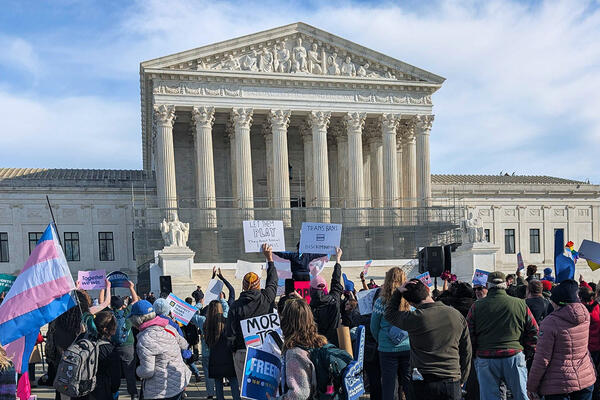
Protesters gathered outside the Supreme Court on Tuesday as the justices heard arguments in two cases concerning trans athletes.
Ryan Quinn | Inside Higher Ed
On Tuesday, Alan M. Hurst, Idaho’s solicitor general, argued that the case wasn’t moot, saying Hecox’s plans about whether to play sports have changed before and may change again. Justice Sonia Sotomayor challenged this, saying Hurst was asking the court to “force an unwilling plaintiff … to continue prosecuting this case.” Justice Ketanji Brown Jackson said “it’s a little odd that a defendant would not want a case dismissed.”
Hurst argued that Idaho’s law wasn’t about excluding transgender people, saying the Legislature there instead “wanted to keep women’s sports women-only.” He also said testosterone doesn’t reliably suppress performance.
“Sports are assigned by sex because sex is what matters in sports,” Hurst said.
Justice Amy Coney Barrett asked whether Hurst was arguing to allow separation by biological sex of even 6-year-olds in sports. Hurst replied that even at that age, boys have a small advantage, but co-ed sports could be an option.
The West Virginia case was filed by the mother of Becky Pepper-Jackson, then a transgender sixth grader, back in 2021. Judges blocked enforcement of the Mountain State’s law against the student.
“In West Virginia’s telling, it passed [its law] to ‘save women’s sports’ by staving off an impending tidal wave of ‘bigger, faster, and stronger males’ from stealing championships, scholarships, and opportunities from female athletes,” the student’s lawyers wrote. “In reality, West Virginia’s law banned exactly one sixth-grade transgender girl from participating on her school’s cross-country and track-and-field teams with her friends.”
Her attorneys wrote that the sports she’s participated in are non-contact, and that she “has received puberty-delaying medication and gender-affirming estrogen that allowed her to undergo a hormonal puberty typical of girls, with all the physiological musculoskeletal characteristics of cisgender girls and none of the testosterone-induced characteristics of cisgender boys.”
They wrote that she “wants to play sports for the same reasons most kids do: to have fun and make friends as part of a team.” She’s participated in post-season shot put and discus, “where her performance is well within the range of cisgender girls her age,” they wrote.
Lawyers defending the West Virginia law, though, wrote that “male athletes identifying as female are increasingly competing in women’s sports, erasing the opportunities Title IX ensured.” They wrote that “women and girls have lost places on sports teams, surrendered spots on championship podiums, and suffered injuries competing against bigger, faster, and stronger males.”
Michael R. Williams, West Virginia’s solicitor general, said the state’s law “is indifferent to gender identity because sports are indifferent to gender identity,” and said “we don’t have an actual transgender exclusion.” He also argued that Title IX defines sex as biological sex because that was the understanding at the time Congress passed it.
Barrett suggested West Virginia’s arguments could be used by a state to argue for separate math classrooms if it produced a study saying women’s presence in calculus was holding men back. Gorsuch made similar arguments.
Federal Intervention
In both cases Tuesday, the federal government defended the state laws. Hashim M. Mooppan, the U.S. principal deputy solicitor general, said Title IX regulations “say you can separate based on sex … the circulating testosterone levels are just legally irrelevant under the regulations.” He also said transgender women aren’t “being excluded from participating on the boys team.”
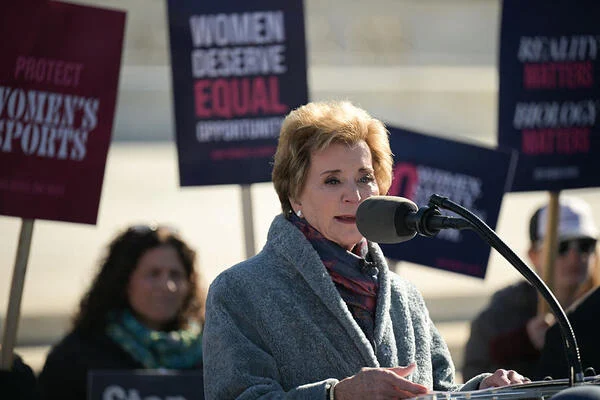
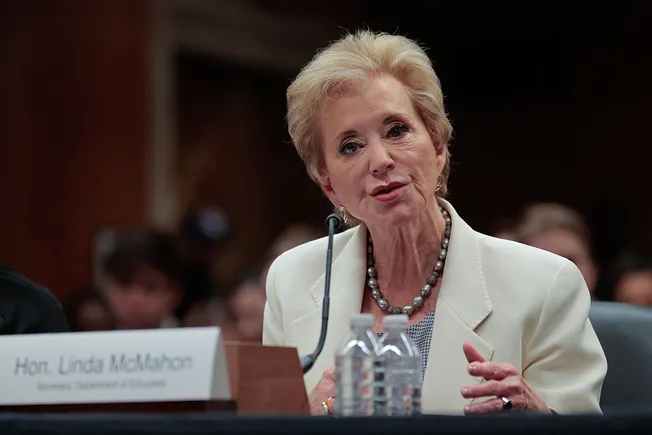
During and after the oral arguments, hundreds of proponents for trans athletes and opponents held dueling rallies right next to each other outside the Supreme Court, each with their own sound systems and speakers. Education Secretary Linda McMahon was among those who spoke in favor of the state bans.
Education Secretary Linda McMahon speaks outside the US Supreme Court as justices hear arguments in challenges to state bans on transgender athletes in women’s sports.
Photo by Oliver Contreras / AFP via Getty Images
In her remarks, McMahon praised a legal organization, Alliance Defending Freedom, that was defending the bans, and touted the Trump administration’s actions to “restore common sense by returning sanity to the sexes.” She also criticized the Biden administration’s regulations that declared that sex-based discrimination, which is barred under Title IX, includes discrimination based on sexual orientation or gender identity. A federal judge vacated those Title IX regulations in early 2025.
“In just four years, the Biden Administration reversed decades of progress, twisting the law to argue that ‘sex’ is not defined by objective biological reality, but by the subjective notion of ‘gender identity,’’’ she said. (The Title IX regulations took effect in August 2024 but federal courts had already blocked them in dozens of states.)
McMahon added that while the Supreme Court deliberates, the administration will continue enforcing Title IX “as it was intended, rooted in biological reality to ensure fairness, safety, and equal access to education programs for women and girls across our nation.”
“As President Trump has made clear, America is in its Golden Age, one where female students and athletes have equal access to fair and safe competitions and female-only intimate spaces, free from divisive and discriminatory ideologies,” she said.
The Trump administration demanded that UCLA pay $1.2 billion and restrict student freedoms.
Juliana Yamada/Los Angeles Times/Getty Images
The details of the Trump administration’s demands on the University of California, Los Angeles—in addition to the previously reported $1.2 billion payout the federal government asked for—have finally been revealed. A lawsuit by UC faculty unions forced the higher ed system to release a copy of a draft resolution agreement, shedding light on the terms UC was first faced with nearly three months ago.
The Trump administration has demanded, among other things, that UCLA not enroll “foreign students likely to engage in anti-Western, anti-American, or antisemitic disruptions or harassment.” In the same paragraph, the proposed resolution agreement says UCLA would have to “socialize international students to the norms of a campus dedicated to free inquiry and open debate.”
The federal government also demanded that UCLA ban overnight campus demonstrations and mandate that masked campus protesters reveal their identities when asked.
Multiple provisions aim to limit transgender individuals’ rights. The document demands that UCLA’s medical school and affiliated hospitals stop “performing hormonal interventions and ‘transgender’ surgeries” on anyone under 18; stop allowing transgender women to play on women’s sports teams; strip records, awards and other recognition from transgender women athletes; and send personal apologies to the cisgender women who placed lower than trans athletes.
California voters banned affirmative action in public education nearly 30 years ago, but the demand letter suggests the Trump administration doesn’t think UCLA has complied. It would require UCLA to bar providing “information about candidates’ race, sex, ethnicity, or other protected characteristics to faculty or other UCLA personnel with decision-making authority over hiring, retention, promotion or tenure.”
Other provisions target affirmative action in hiring and student admissions, including a line that says, “UCLA shall discontinue race- and ethnicity-based scholarships.” The proposed agreement says “proxies used to effectuate race-based or sex-based outcomes” aren’t allowed in selecting for fellowship programs and also bans the use of such undefined proxies in hiring and admissions.
The document’s release comes after UC said in early August that it would negotiate with the federal government, citing the estimated $584 million in funding that at least three different federal agencies had announced they were suspending. That funding freeze followed a July 29 letter to UC from the Department of Justice, which said its months-long investigations across the system had so far concluded that in its response to a pro-Palestinian protest encampment in spring 2024, UCLA violated the equal protection clause of the 14th Amendment and Title VI of the Civil Rights Act of 1964.
It was yet another example of the Trump administration accusing a selective university of tolerating antisemitism and cutting off hundreds of millions of federal dollars. But, unlike Harvard and Columbia Universities, UCLA is a public institution, and its targeting by the federal government represents an expansion of the administration’s campaign to overhaul higher ed.
Last week, the University of Virginia became the first known public institution to settle with the administration over discrimination allegations. That settlement didn’t require a payout, but among other things, UVA committed to not use proxies for race; to end all diversity, equity and inclusion programming; and to prohibit trans athletes from participating in sports.
Media earlier reported some of the administration’s demands on UCLA, but university officials didn’t make the details public until Friday, when a lawsuit by the UCLA Faculty Association and Council of UC Faculty Associations forced them to.
“Accession to these demands would be to undermine everything that has made the UC the successful engine of social mobility and economic might that it has been for our state,” Anna Markowitz, president of the UCLA Faculty Association, wrote in an email. “It will harm undergraduate learning opportunities, and hamper UC’s ability to be a scholarly leader on the international stage. It enshrines ideology at the heart of the institution rather than decades of empirical and scholarly understanding. We stand against this extortion effort.”
Markowitz said the “UCLA FA and CUCFA have stood with our union colleagues in calling for no negotiations since the beginning.” The university administration “is under intense federal pressure,” she said, and she urged them to resist—“particularly because other faculty legal action has resulted in the restoration of nearly all of the temporarily suspended federal grants.”
Indeed, Stett Holbrook, a UC spokesperson, wrote in an email to Inside Higher Ed Monday that “as for terminated federal research funds, that figure is in the tens of millions”—a far cry from the August estimate of $584 million.
He provided a statement saying, “UC has been clear it must evaluate its response to the administration’s settlement proposal that, like all settlement communications, is confidential. As stated previously, the proposed $1.2 billion settlement payment alone would derail work that saves lives, grows our economy, and fortifies our national security. UC remains committed to protecting the mission, governance, and academic freedom of the University.”
White House and DOJ officials didn’t respond to requests for interviews Monday or answer written questions.
The Texas Tech University System has ordered all faculty to refrain from classroom discussions of transgender identity, The Texas Tribune reported.
In a letter to the leaders of the five universities in the system, Texas Tech Chancellor Tedd Mitchell wrote that the institutions must comply with “current state and federal law,” which “recognize only two human sexes: male and female.“ He cited Texas House Bill 229, which defines sex strictly as determined by reproductive organs, a letter from Texas governor Greg Abbott directing agencies to “reject woke gender ideologies,” and President Trump’s January executive order—which is not a federal law—declaring the existence of just two genders.
“While recognizing the First Amendment rights of employees in their personal capacity, faculty must comply with these laws in the instruction of students, within the course and scope of their employment,” Mitchell wrote.
Mitchell’s letter provided little guidance for faculty about how to implement the new policy, suggesting it presents certain challenges.
“This is a developing area of law, and we acknowledge that questions remain and adjustments may be necessary as new guidance is issued at both the state and federal levels,” he wrote. “We fully expect discussions will be ongoing.”
This audio is auto-generated. Please let us know if you have feedback.
The U.S. Department of Education is proposing to abandon data collection on transgender and nonbinary students, including on whether they are victims of harassment and bullying and whether school districts have policies prohibiting those incidents, according to a Federal Register notice published this month.
The changes come as part of the Civil Rights Data Collection for the 2025-26 and 2027-28 school years, a mandated survey of all public school districts that has been administered for almost six decades. The department noted on its website that the CRDC has “captured data on students’ equal access to educational opportunities to understand and inform schools’ compliance with the civil rights laws enforced by the Department of Education’s Office for Civil Rights.”
The proposed changes to the upcoming collections also struck transgender students from the department’s definition of “rape” and “sexual assault.”
Whereas previous collections defined rape as something that could be done to “all students, regardless of sex, or sexual orientation, or gender identity,” the proposed collection says, “All students, regardless of sex, or sexual orientation can be victims of rape” — explicitly striking “gender identity” from the older definition.
The change “really sends a frankly terrible message to how schools should be responding to allegations of sexual assault and how they should be documenting that and bringing that data forward,” said Brian Dittmeier, director of LGBTQI+ equality at the National Women’s Law Center.
The department, however, maintained in an email to K-12 Dive that “the definition of rape and sexual assault remains virtually unchanged.”
“All students means all students, period,” said an Education Department spokesperson on Thursday.
The department submitted the proposed changes to the Office of Management and Budget for review on Aug. 7 and is accepting comments on the notice until Sept. 8.
The changes are being proposed to comply with the 2020 Title IX rule, which excludes LGBTQ+ students from sex-based discrimination protections. President Donald Trump’s Education Department told districts in January to follow that rule — published during his first term — as opposed to the 2024 rule finalized under the Biden administration, which protected LGBTQ+ students under the sex discrimination civil rights statute.
The Education Department is also proposing a change in its Civil Rights Data Collection to exclude transgender and nonbinary students in light of Trump’s January 2025 executive order “Defending Women from Gender Ideology Extremism and Restoring Biological Truth to the Federal Government.” That executive order directed federal agencies to only recognize two sexes, male and female, and said, “These sexes are not changeable and are grounded in fundamental and incontrovertible reality.”
The Education Department has since adopted that stance, and it has attempted to include the definitions “male” and “female” in state policies through its resolution agreements and to exclude transgender students from teams and facilities aligning with their gender identities.
The decision to now strike those students from the CRDC means the Education Department’s Office for Civil Rights — under the current administration and future ones — would have less data on how transgender and nonbinary students fared in the 2025-26 and 2027-28 school years.
“OCR uses CRDC data as OCR investigates complaints alleging discrimination to determine whether the federal civil rights laws it enforces have been violated, initiates proactive compliance reviews to identify particularly acute or nationwide civil rights compliance problems, and provides policy guidance and technical assistance to educational institutions, parents/guardians, students, and others,” a July 22 statement from the U.S. Department of Education to the Office of Budget and Management said. Other federal agencies, researchers and policymakers also use CRDC data, the department said.
Transgender and students questioning their gender identity showed higher rates of bullying and poor mental health, as well as the lowest rates of school connectedness, when compared to their cisgender peers, according to the first nationally representative survey data on transgender students released by the Centers for Disease Control and Prevention last year.
An overwhelming majority of LGBTQ+ students also said in 2024 that anti-LGBTQ+ policies had impacted their mental health, according to an annual survey released by The Trevor Project, a nonprofit that provides crisis support services for LGTBQ+ people.
“We’ll have less data to contextualize the problem and provide a clear picture to schools of what the experience of transgender and gender-nonconforming students is in school currently,” Dittmeier said. “And that will unfortunately make it more difficult to implement interventions that are needed to ensure a safe school environment for all.”
The university plans to “apologize to those who experienced a competitive disadvantage or experienced anxiety because of the policies in effect at the time.”
Photo illustration by Justin Morrison/Inside Higher Ed | Kyle Mazza/Anadolu/Getty Images | Rich von Biberstein/Icon Sportswire/Getty Images
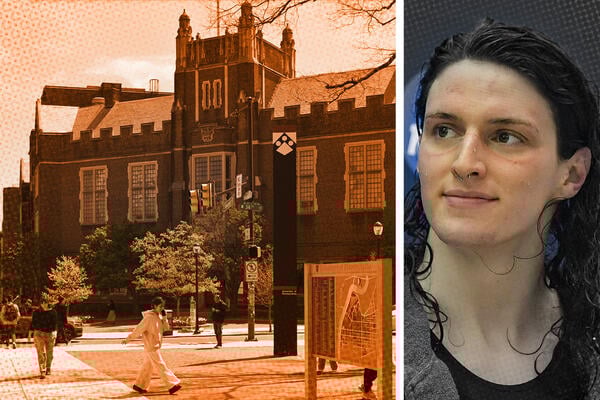
The University of Pennsylvania will concede to the Trump administration’s demands that the university “restore” swimming awards—and send apology notes—to female competitors who lost to a trans athlete, the Department of Education’s Office for Civil Rights announced Tuesday.
The department previously found that Penn violated Title IX for allowing a trans woman to compete on a women’s sports team—presumably referring to Lia Thomas, who rose to national attention while competing on Penn’s women’s swim team three years ago.
To end the investigation, the administration demanded in part that Penn apologize to cisgender women whose swimming awards and honors were “misappropriated” to trans women athletes. Multiple Title IX advocates lambasted the department’s demands, arguing the agency was misusing the landmark gender-equity law to punish trans students and their institutions.
Penn is one of multiple higher education institutions and K–12 schools that the administration has targeted for allowing trans women to play on women’s sports teams, in accordance with NCAA policy at the time. But it appears to be the first institution of higher education to reach a resolution agreement over the issue since Trump took office.
“Penn remains committed to fostering a community that is welcoming, inclusive, and open to all students, faculty, and staff,” Penn president J. Larry Jameson said in a statement Tuesday. “I share this commitment, just as I remain dedicated to preserving and advancing the University’s vital and enduring mission. We have now brought to a close an investigation that, if unresolved, could have had significant and lasting implications for the University of Pennsylvania.”
Separate from the department’s investigation, the White House paused $175 million in funding to the university because Penn “infamously permitted a male to compete on its women’s swimming team,” an official said in March. It’s not clear if the funding will be restored or when.
Jameson stressed in the statement that the university was in compliance with Title IX and all NCAA guidelines at the time that Thomas swam for Penn’s women’s team from 2021 to 2022. But, he said, “we acknowledge that some student-athletes were disadvantaged by these rules. We recognize this and will apologize to those who experienced a competitive disadvantage or experienced anxiety because of the policies in effect at the time.”
Title IX advocates have emphasized that trans athletes are not, in fact, explicitly forbidden from playing on women’s sports teams under the current Title IX regulations, which were finalized under the previous Trump administration and are the same ones that were in effect when Thomas was competing.
In addition to stripping Thomas’s awards, Penn agreed to ED’s demands to make a public statement that people assigned male at birth are not allowed in Penn’s women’s athletic programs or its bathrooms and locker rooms, according to the department’s news release. The institution must also promise to adopt “biology-based definitions for the words ‘male’ and ‘female’ pursuant to Title IX” and Trump’s February executive order banning trans athletes from playing on the team that aligns with their gender.
That statement also went up Tuesday. In it, the university promised to follow Trump’s trans athlete ban, as well as the executive order he signed that withdraws federal recognition of transgender people, with regard to women’s athletics.
In the department’s announcement, Paula Scanlan, one of Thomas’s former teammates who has since led the crusade against trans women athletes, said she was “deeply grateful to the Trump Administration for refusing to back down on protecting women and girls and restoring our rightful accolades. I am also pleased that my alma mater has finally agreed to take not only the lawful path, but the honorable one.”
Shiwali Patel, senior director of safe and inclusive schools at the National Women’s Law Center, criticized the agreement in a statement Tuesday as a “devastating and shameful outcome.” She blamed Penn’s “utter failure” as well as the department’s “continued manipulation of Title IX.”
“The Trump administration’s attacks on civil rights protections, including Title IX, and obsession with undermining bodily autonomy is the real harm to women and girls, unlike transgender athletes who want to compete in sports alongside their peers and pose no threat to women’s sports, contrary to Trump’s lies,” Patel said in the statement. “In fact, their inclusion benefits all women and girls. We will continue to support Lia Thomas and her peers and their right to compete.”
FIRE helped secure a victory this week for two educators in Oregon when the U.S. Court of Appeals for the Ninth Circuit sent Damiano v. Grants Pass School District back down to the federal district court, as FIRE had asked it to in our amicus brief.
When their school district passed a policy requiring teachers to address transgender students by their preferred names and pronouns, the plaintiffs, Oregon assistant principal Rachel Sager and teacher Katie Medart, started the grassroots campaign “I Resolve” to voice their opposition to the policy. Following complaints by students, parents, and community members, their local school district fired the teachers but later reinstated them to different roles.
The teachers sued. But the lower court ruled the school district was entitled to fire the teachers and granted summary judgment, meaning it did not see a need to go to trial.
FIRE saw things differently. And now, so has the appellate court. Our brief to the Ninth Circuit argued that Sager and Medart’s speech on a matter of public concern — as speech on the debate around gender issues undoubtedly is — must be properly balanced against the school district’s interest in providing services to the public. FIRE wrote:
Almost twenty years ago, this Court held “it is well-settled that a teacher’s public employment cannot be conditioned on her refraining from speaking out on school matters.” … Yet the district court here held that, under Pickering, Grants Pass School District could do exactly that. The court incorrectly concluded that the district did not violate the First Amendment by firing an assistant principal (Rachel Sager, née Damiano) and teacher (Katie Medart) for speaking out against the District’s gender identity policy … because their actions—namely, publishing an alternative model gender-identity education policy and accompanying video called “I Resolve”—allegedly caused significant community disruption.
The lower court put too much weight on the discomfort and controversy the teachers caused with their advocacy, and too little weight on their First Amendment right to speak as private citizens on a matter of public concern.
On top of that, the court found a genuine dispute to be resolved over whether the teachers’ advocacy actually disrupted the school’s operation. As such, the Ninth Circuit reversed the lower court’s opinion — meaning the educators’ First Amendment claim can now proceed to trial.
With its ruling, the Ninth Circuit has sent a pointed reminder that public employees don’t surrender their constitutional rights just because they work for the government.
This story was originally published by CalMatters. Sign up for their newsletters.
California’s schools and colleges receive billions in federal funding each year — money that President Donald Trump is threatening to terminate over the actions of one student. AB Hernandez, a junior from Jurupa Valley High School, is transgender, and on May 31 she won first- and second-place medals at the state track and field championship.
“A Biological Male competed in California Girls State Finals, WINNING BIG, despite the fact that they were warned by me not to do so,” Trump said in a social media post last week. “As Governor Gavin Newscum (sic) fully understands, large scale fines will be imposed!!!”
Despite this post and a similar threat a few days earlier to withhold “large-scale” federal funding from California, Trump lacks the authority to change the state’s policy toward transgender athletes without an act of Congress or a decision by the U.S. Supreme Court. And recent court cases suggest that Trump also may have a hard time withholding money from California.
California state law explicitly allows transgender students in its K-12 school districts to compete on the team that matches their preferred gender, but the Trump administration has issued multiple directives that restrict access to girls’ sports, including a letter last week from the U.S. Department of Justice telling high schools to change their policies.
On Monday, California Attorney General Rob Bonta sued the Justice Department over its letter, saying it had “no right to make such a demand.”
“Let’s be clear: sending a letter does not change the law,” said State Superintendent of Public Instruction Tony Thurmond in a statement to school districts. “The DOJ’s letter to school districts does not announce any new federal law, and state law on this issue has remained unchanged since 2013.” On Monday, Thurmond sent his own letter to the Trump administration, refuting its legal argument.
California receives over $2 billion each year for its low-income Title I schools, as well as over $1 billion for special education. At the college level, students receive billions in federal financial aid and federal loans. Even if Trump lacks the legal authority to change state law, he could still try to withhold funding from California, just like he tried with Maine. In February, Trump asked Maine Gov. Janet Mills if her state was going to comply with a presidential executive order — which is not a law — that directed schools to bar transgender girls from certain sports. Mills said she’d comply with “state and federal laws,” effectively rebuking the president.
The Trump administration has since tried to withhold funding from Maine, but legal challenges have prevented it.
The NCAA vs. California state law
Trump made banning transgender youth athletes a centerpiece of his 2024 presidential campaign, and it’s remained a focal point for his administration this year. Nationally, Americans increasingly support restrictions on transgender athletes, according to surveys from the Pew Research Center. Gov. Gavin Newsom, who last year signed legislation supporting trans students, spoke out against transgender athletes in a podcast this March, saying it was “deeply unfair” to allow transgender girls to compete in girls’ sports.
Female athletes with higher levels of testosterone or with masculine characteristics have long faced scrutiny, biological testing and disqualification. Debates about who gets to participate in girls’ or women’s sports predate the Trump administration — and Newsom — and policies vary depending on the athletic institution.
In 2004, the International Olympic Committee officially allowed transgender athletes to compete in the sport that aligned with their gender identity, as long as the athlete had sex reassignment surgery, only to change that policy in 2015 and require hormone testing. In 2021, the committee changed the policy again, creating more inclusive guidelines but giving local athletic federations the power to create their own eligibility criteria.
Across California, youth leagues, private sports leagues and other independent athletic associations all have their own policies. Some allow transgender women and men to participate; some restrict who can compete. Some require “confirmation” of a participant’s gender, such as a government ID or statements from health care professionals, while other associations take the athletes at their word.
California’s colleges and universities are not allowed to discriminate against transgender students but state law doesn’t provide any guidance beyond that. After the presidential executive order in February, the National Collegiate Athletic Association (NCAA), which independently regulates college sports, changed its rules, prohibiting transgender women from competing and putting colleges in a bind. Roughly 60 California universities are part of the NCAA, including almost all of the UC and many Cal State campuses. Community colleges, which represent the bulk of the state’s undergraduates, are not part of the NCAA.
“There’s a strong argument (the NCAA rules) could violate state law and federal equal protection,” said Elana Redfield, the federal policy director at UCLA’s Williams Institute, which studies LGBTQ+ issues.
Amy Bentley-Smith, a spokesperson for the California State University system, declined to comment about how the NCAA policy conflicts with state and federal regulations. She said the Cal State campuses abide by the NCAA rules — preventing transgender athletes from competing — while still following state and federal non-discrimination laws regarding trans students.
Stett Holbrook, a spokesperson for the University of California system, said the UC does not have a system-wide policy for transgender athletes. He did not respond to questions about whether the campuses abide by NCAA rules.
Unlike the NCAA, the California Community College Athletic Association allows transgender athletes to compete. A spokesperson for the association, Mike Robles, said he’s aware of the NCAA rules and the Trump administration’s priorities but he did not say whether the association will modify its own policy.
The U.S. Constitution is silent on trans students
In February, just days after the president’s inauguration and the executive order regarding transgender athletes, the U.S. Department of Education launched an investigation into San Jose State after a women’s volleyball player outed her teammate as transgender. The education department has yet to provide an update on that investigation.
With the Trump administration’s focus now on CA K-12 school districts, the legal debate has intensified. In its letter to the state’s public schools last week, Assistant U.S. Attorney General Harmeet Dhillon said allowing transgender girls to compete in girls’ sports is “in violation” of the Equal Protection Clause of the U.S. Constitution and asked schools to change their policies.
But the U.S. Constitution doesn’t say anything about transgender athletes, at least not explicitly.
Instead, Dhillon is offering an interpretation of the Constitution, “which doesn’t carry the full force of law,” Redfield said. The laws that do govern transgender athletes, such Title IX, aren’t clear about what schools should do, and the U.S. Supreme Court — the entity with the power to interpret federal law and the Constitution — has yet to decide on the matter.
That said, many lower level judges have already weighed in on whether the Constitution or Title IX law protects transgender students or athletes.“The preponderance of cases are in favor of trans plaintiffs,” Redfield said. “The federal government is contradicting some pretty strong important precedent when they’re making these statements.”
After Trump’s comments about AB Hernandez, the nonprofit entity that regulates high school sports, the California Interscholastic Federation, changed its policy, slightly. For the state’s track and field championship, the federation said it would implement a new process, whereby AB Hernandez would share her award with any “biological female” that she beat. All “biological female” athletes below Hernandez would also move up in ranking.
On May 31, Hernandez shared the first-place podium twice and the second-place podium once, each time with her competitors smiling supportively, the San Francisco Chronicle reported.
A spokesperson for the governor, Izzy Gardon, said that approach is a “reasonable, respectful way to navigate a complex issue without compromising competitive fairness.”
This audio is auto-generated. Please let us know if you have feedback.
The Trump administration has suspended $175 million in federal funding for theUniversity of Pennsylvania, citing its athletics participation policies for transgender students, according to a Wednesday post from a White House social media account.
The cuts are to discretionary spending from the U.S. Department of Defense and the U.S. Department of Health and Human Services, according toFox Business, the first to report the news.
“We are aware of media reports suggesting a suspension of $175 million in federal funding to Penn, but have not yet received any official notification or any details,” a Penn spokesperson said via email Wednesday.
The spokesperson added, “We have been in the past, and remain today, in full compliance with the regulations that apply to not only Penn, but all of our NCAA and Ivy League peer institutions.”
In an executive order last month, President Donald Trump barred colleges and K-12 schools from allowing transgender women to play on sports teams that align with their gender identity and threatened to pull all federal funding from institutions that don’t comply.
The day after Trump signed the directive, the U.S. Department of Education opened a Title IX investigation into Penn, San José State University and a K-12 athletics association over policies the agency said were out of step with the executive order.
Former Penn swimmer Lia Thomas, a transgender woman, has been at the center of polarizing debates over gender identity and college athletics participation.In 2022, Thomas became the first openly transgender athlete to win a NCAA Division I championship for her victory in the women’s 500-yard freestyle.
Last week, more than a dozen college athletes sued the NCAA, alleging that allowing Thomas to compete in the championship violated Title IX, the sweeping statute barring sex-based discrimination in federally funded institutions.
The complaint comes only a month after a similar lawsuit was filed against Penn and the NCAA over Thomas’ participation in the Ivy League’s 2022 swimming championship.
The NCAA updated its policies after Trump’s executive order to only allow students assigned female at birth to compete in women’s athletics.
Citizens elect representatives to advocate zealously on their behalf, empowering officials to vote according to their conscience and express themselves freely on controversial topics. That’s why the Maine House of Representatives’ recent actions are so alarming — withdrawing an elected representative’s right to speak or vote on the House floor for refusing to take down a Facebook post.
Three weeks ago, Representative Laurel Libby of Maine’s 64th District posted on Facebook that a high school athlete won first place in girls’ pole vaulting at the Class B state championship after having competed the year before in the boys’ event and finishing in a tie for fifth place.
Libby’s post is constitutionally protected. She was speaking out about the policy in her state, set by the Maine High School Principals Association, that a high school athlete may participate in competitions for the gender with which they identify. Her post was also part of a nationwide debate. Maine Governor Janet Mills and President Trump have publicly sparred over the president’s executive order proposing to cut off education funding if states do not ban transgender athletes from competing in girls’ sports.
But just days after Libby’s post, the Maine House speaker and majority leader demanded she take it down. When she refused, the majority leader introduced a censure resolution — to be heard in the House the next day — because Libby’s post had included photos and the first name of the student, who is a minor. Libby sought to defend herself in the hastily called House vote, but was repeatedly cut off. The censure resolution passed 75-70 on a party-line vote.
If all the censure did was express disapproval of Libby’s actions, that would be one thing.
A state legislative body is entitled to express displeasure with a member’s actions, which by itself does not violate the First Amendment, as the Supreme Court recently ruled.
But in Libby’s case, the Maine House went further, much further. When Libby refused to apologize for her protected speech, the House speaker declared she would be barred from speaking on the House floor or voting on any legislation until she capitulated. Thus, the House majority party has precluded Libby from doing her job and effectively disenfranchised her constituents, end-running Maine constitutional provisions that say a representative cannot be expelled absent a two-thirds vote or recall election.
These actions are a clear example of retaliation based on constitutionally protected speech and amount to removal of an elected representative essentially because the House majority disagrees with her views or how she chose to express them. Sixty-nine years ago the U.S. Supreme Court held that a state legislature could not refuse to seat a duly elected member because of his public statements about the Vietnam War: “The manifest function of the First Amendment in a representative government requires that legislators be given the widest latitude to express their views on issues of policy.”
This is still the law. Under the constitution, the Maine House cannot censor Libby as it has done.