Tag: trans

  • Trump signs order banning trans athletes in women’s sports

    Trump signs order banning trans athletes in women’s sports

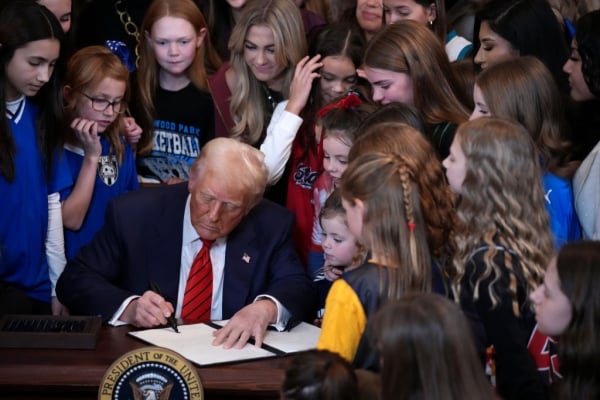
    President Donald Trump signed an executive order Wednesday banning transgender women from participating in women’s sports.

    “The war on women’s sports is over,” he said. “With my action this afternoon, we are putting every school receiving taxpayer dollars on notice that if you let men take over women’s sports teams or invade your locker rooms, you will be investigated for violations of Title IX and risk your federal funding.”

    The executive order, signed on National Girls and Women in Sports Day, declares that it’s “the policy of the United States to oppose male competitive participation in women’s sports more broadly, as a matter of safety, fairness, dignity, and truth.” Under the order, the assistant to the president for domestic policy will bring together representatives of “major athletic organizations and governing bodies, and female athletes harmed by such policies, to promote policies that are fair and safe, in the best interests of female athletes.”

    The president’s latest action builds on the GOP’s broader campaign to remove all recognition of transgender individuals from state and federal programs. On his first day in office, Trump signed a separate executive action declaring that there are only two sexes and banning federal funding for any program related to “gender ideology.” And House Republicans have passed a bill that would unilaterally ban trans women from competing in women’s sports. In nearly half of the country, trans women are banned from playing women’s sports at the K-12 or higher education level, but the order would take those bans nationwide.

    Additionally, the order calls on the education secretary to prioritize “Title IX enforcement actions against educational institutions (including athletic associations composed of or governed by such institutions) that deny female students an equal opportunity to participate in sports and athletic events by requiring them, in the women’s category, to compete with or against or to appear unclothed before males.” (Federally funded K-12 public schools and colleges are required to comply with Title IX, which bars discrimination based on sex in educational settings.)

    Charlie Baker, president of the National Collegiate Athletic Association, told Congress recently that out of the more than 500,000 college athletes, fewer than 10 were transgender. The NCAA released a statement Wednesday that said, “The NCAA Board of Governors is reviewing the executive order and will take necessary steps to align NCAA policy in the coming days, subject to further guidance from the administration.”

    As Trump spoke Wednesday, girls and women—including former University of Kentucky swimmer and anti-trans advocate Riley Gaines—stood behind him, often clapping in support.

    After thanking them, the president turned back to face the rest of the East Room audience. He acknowledged the federal lawmakers, state attorneys general and governors in attendance, describing them as “friends of women’s sports.”

    “My administration will not stand by and watch men beat and batter women,” he said. “It’s going to end and nobody’s gonna be able to do a damn thing about it because when I speak [I] speak with authority.” (Trump was referring to an Olympic gold medal–winning Algerian boxer whom some accused of being transgender; the boxer has publicly said she was born a woman.)

    Fatima Goss Graves, president of the National Women’s Law Center, said in a statement that trans students do not pose a threat in sports and deserve the same opportunities as their peers.

    “The far-right’s disturbing obsession with controlling the bodies, hearts, and minds of our country’s youth harms all students,” Graves said.

    Education secretary nominee Linda McMahon attended the ceremony, though her confirmation hearing for the office has yet to be scheduled. In the meantime, the department is being led by a collection of acting officials and appointees, including Deputy General Counsel Candice Jackson, who described the president’s order as “a demonstration of common sense.”

    “The President affirmed that this administration will protect female athletes from the danger of competing against and the indignity of sharing private spaces with someone of the opposite sex,” Jackson said in a news release. “The Department of Education stands proudly with President Trump’s action as we prioritize Title IX enforcement against educational institutions that refuse to give female athletes the Title IX protections they deserve.”

    Other Republican lawmakers praised the order Wednesday, arguing it would ensure women and girls won’t be pushed to the sidelines.

    But Representative Bobby Scott, a Democrat from Virginia and ranking member on the House education committee, was quick to oppose the order, calling it “yet another overreach by this administration” and saying its lack of clarity will further complicate what should be addressed by sports associations.

    “Rather than address the real, urgent issues that students and families are facing every day, this administration continues to target vulnerable students—specifically transgender girls and women—with a shameless attempt to bully them,” he said in a statement. “They are willing to use the most vulnerable Americans as pawns in a political game.”

    Source link

  • Ban on trans women in women’s sports passes the House

    Ban on trans women in women’s sports passes the House

    Representative Greg Steube, a Florida Republican, speaks at a press conference following the passage of his Protection of Women and Girls in Sports Act in the House of Representatives.

    Allison Robbert/AFP via Getty Images

    The House of Representatives voted 218 to 206 to pass a bill that would unilaterally ban trans women from competing in women’s sports Tuesday. The votes were nearly split along party lines, but two Democrats, Henry Cuellar and Vicente Gonzalez, both from Texas, voted for the bill.

    Sponsored by Representative Greg Steube, a Florida Republican, the legislation dubbed the Protection of Women and Girls in Sports Act, is the latest attempt in Congress to keep trans women off women’s sports teams and builds on efforts in the states to restrict the participation of transgender students in sports that align with their gender identity. Last Congress, identical legislation from Steube passed the House but didn’t move forward in the Democratic-controlled Senate.

    Now, Republicans hold the majority in both the House and the Senate, making it far more likely that this iteration will be more successful. In nearly half of the country, trans women are banned from playing women’s sports at the K-12 or higher education level, but the legislation would take those bans nationwide.

    Passing the bill was a top priority for House Republican leadership, who included it on a list of 12 pieces of legislation to be considered first when the new session of Congress kicked off earlier this month. Its place of prominence seems to indicate that Republican leadership will prioritize rolling back or restricting the rights of transgender people, whom Republicans have often put at the center of a culture war.

    Republicans and President-elect Donald Trump have criticized the Biden administration’s effort to amend Title IX of the Education Amendments of 1972 to prevent blanket bans that prohibit transgender students from participating in sports consistent with their gender identity. Last month, the Biden administration scrapped that proposal.

    Under the bill, institutions that receive federal funding would be prohibited from allowing “a person whose sex is male to participate in an athletic program or activity that is designated for women or girls.” It defines sex as being based on “a person’s reproductive biology and genetics at birth,” though it doesn’t expound upon how an institution would tell. The bill does not prevent trans men from playing on men’s teams.

    Anti-trans activists argue that allowing individuals assigned male at birth to play on women’s sports teams opens cis women athletes up to being injured by athletes who are more naturally powerful due to their physiques. There is sparse research on if this is true; however, the few studies that do exist haven’t backed up the idea that trans women retain significant advantage over athletes assigned female at birth.

    Supporters of the legislation—including some cis female athletes, like Riley Gaines, who have competed alongside and against trans athletes at the collegiate level—also argue that trans women take spots on women’s teams, going against Title IX’s promise of equal opportunity, and that it is uncomfortable for cisgender female athletes to share close quarters, like locker rooms, with individuals assigned male at birth.

    Representative Tim Walberg, the Michigan Republican who chairs the House Education and the Workforce Committee, echoed these sentiments in his argument on the House floor Tuesday.

    “Mr. Speaker, kicking girls off sports teams to make way for a biological male takes opportunities away from these girls,” he said. “This means fewer college scholarships and fewer opportunities for girls. It also makes them second-class citizens in their own sports and puts their safety at risk.”

    Some people who agree that trans women should not play on women’s teams say they broadly support transgender individuals but see it as unfair for them to take spots on women’s teams. But Steube took a different approach. When he announced the bill earlier this month, he quoted President-elect Donald Trump’s promise that “under the Trump administration, it will be the official policy of the United States government that there are only two genders—male and female.”

    Meanwhile, Democrats and LGBTQ+ advocates argue that trans women should have the opportunity to play sports—which have been shown to improve outcomes and mental health for youths across the board—on the team that matches their gender.

    “Transgender students—like all students—they deserve the same opportunity as their peers to learn teamwork, to find belonging and to grow into well-rounded adults through sports,” said Representative Suzanne Bonamici, an Oregon Democrat, on the House floor. “Childhood and adolescence are important times for growth and development, and sports help students form healthy habits and develop strong social and emotional skills. Sports provide meaningful opportunities for kids to feel confident in themselves and learn valuable life lessons about teamwork, leadership and communication. Teams provide a place for kids to make friends and build relationships.”

    Bonamici and other democrats dubbed the bill the “Child Predator Empowerment Act” and argued it wouldn’t make schools safer for students. In fact, she said that the vague language in the bill about what defines the male sex could lead to invasive examinations.

    “There is no way this so-called protection bill could be enforced without opening the door to harassment and privacy violations. It opens the door to inspection, not protection, of women and girls in sports,” she said. “Will students have to undergo exams to prove they’re a girl? We are already seeing examples of harassment and questioning of girls who may not conform to stereotypical feminine roles; will they be subject to demands for medical tests and private information? That’s intrusive, offensive and unacceptable, especially from a party of limited government.”

    Source link