Tag: Transformation

  • A Mandate for Transformation: Inside the 2026 Marketing and Enrollment Management Benchmarks 

    A Mandate for Transformation: Inside the 2026 Marketing and Enrollment Management Benchmarks 

    For too long, institutions have operated under an enrollment model built for a market that no longer exists. That status quo persists because it benefits entrenched service providers who profit from preserving the illusion that yesterday’s playbook will solve tomorrow’s challenges. These models feel safe, but they quietly divert resources away from the work of real institutional evolution. 

    At EducationDynamics, we reject that approach. We refuse to manage a legacy of decline. We are actively dismantling the traditional enrollment playbook to meet a new reality defined by rapid AI advancement, fundamental shifts in student behavior and a growing demand for data-driven action. 

    The 2026 Marketing and Enrollment Management Benchmarks is more than a collection of data. It is a strategic blueprint for institutions willing to challenge convention. Traditional benchmarks act like a rearview mirror. These benchmarks define the road ahead, focusing on the forces now driving growth: brand authority, AI visibility, intent-rich audiences, operational speed and measurable value. 

    The Forces Defining Higher Ed in 2026

    These trends are not incremental adjustments or cosmetic shifts. They represent a structural reset in how students discover institutions, how trust is earned and how enrollment engines generate growth. Together, they form the pillars of survival for institutions that intend to compete in the next decade, not merely endure it. 

    1. High-Value Branding

     Winning institutions treat brand equity and transparency as primary drivers of top-of-funnel performance. In an era of automated information, trust is the only currency that matters. Reputation is the new SEO. If students don’t trust you, they never search for you. 

    By 2025, nearly 60% of online learners started their journey by searching for a specific institution—a 354% increase in brand-first searches since 2015. The funnel is no longer program-first. Your brand is the search term. If students don’t already believe in your value, you may never enter their consideration set.

    This shift makes it clear: reputation, trust and visibility now shape the top of the enrollment funnel more than any single program. Institutions that invest in brand equity, AI-ready SEO and consistent messaging across channels are the ones that show up first when learners start their search. 

    Visibility is no longer earned by keywords alone; it is earned with reputation, authenticity and authority—especially in AI-driven environments: 

    • Answer Engine Optimization (AEO): Provide concise, factual responses to zero-click queries so AI surfaces your brand as the answer. 
    • AI Density: Measure how often your institution appears as a cited source within AI ecosystems, your new visibility metric in a Search Everywhere world. 

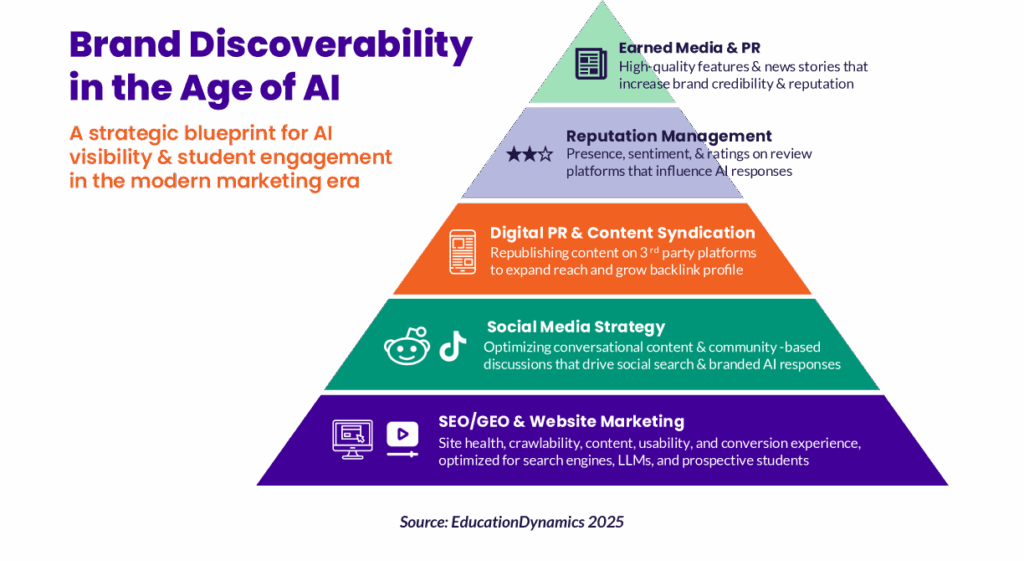
    The report introduces the AI Visibility Pyramid, a strategic framework that connects brand reputation, content, reviews and earned media into one system designed to make your institution the trusted answer inside AI ecosystems—not just another result if someone happens to click. 
     

    2. “Search Everywhere” Transformation

    The traditional search results page is disappearing. It is being replaced by conversational AI and a multi-platform ecosystem where students demand answers, not links. Visibility is now a conversation, not a click. 

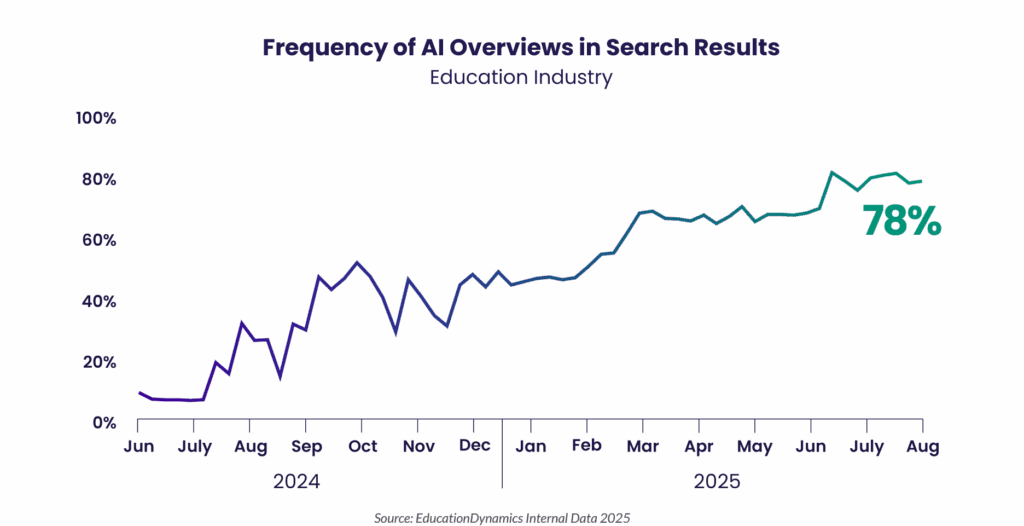
    An estimated 78% of education-related searches now return an AI Overview, and nearly 45% of Google searches end without a click. Students are building shortlists and making decisions from AI overviews, chatbots, social feeds and video long before your institution’s website loads. If your brand isn’t present in these AI-driven answers, you’ve lost the conversation before you see the prospect. 
    3.The Efficiency Imperative 

    Cost inflation is no longer a future concern. It is the operating reality for higher education marketing. In 2025, total digital media spend surpassed $2.77 billion, yet rising costs failed to produce proportional performance gains. 

    Efficiency across traditional acquisition channels has eroded. Non-brand paid search CPCs climbed 30.9% year over year, increasing the cost of competing on generic, high-intent keywords. That pressure is amplified by zero-click search behavior, which continues to weaken keyword-driven volume strategies. 

    In this environment, efficiency is not a budgeting exercise. It is a competitive advantage. Institutions outperforming the market are using AI-driven attribution models to understand how organic, paid, and brand touchpoints actually influence enrollment. The focus shifts from chasing clicks to identifying high-intent learners earlier and engaging them with precision. 

    The Efficiency Imperative is about where and how institutions invest. In 2026, growth will favor those who deploy capital intelligently, align messaging to intent, and reach the right learner at the decisive moment. 

    4. Value Outperforms Volume

    Inquiry volume once signaled success. In 2026, it signals inefficiency. High volumes of low-intent leads inflate costs, overwhelm admissions teams, and obscure real demand. 

    Institutions can no longer rely on inquiry-driven attribution to understand the market. Many of today’s strongest prospects never raise their hand. Growth now depends on brand authority within AI ecosystems, content structured for conversational search, and predictive models that surface high-intent learners before a form is ever submitted. 

    The data confirms this shift. Career Changers and Leadership Track learners convert at 9.75% and 15.73%, far outperforming less motivated segments. These learners are decisive, outcome-driven, and ready to act when value and ROI are clear. 

    At the same time, stealth applicants now account for 9.7% of total applications, up from just 1% in 2020. They research independently, build their own shortlists, and apply when confident, often without entering a traditional funnel. 
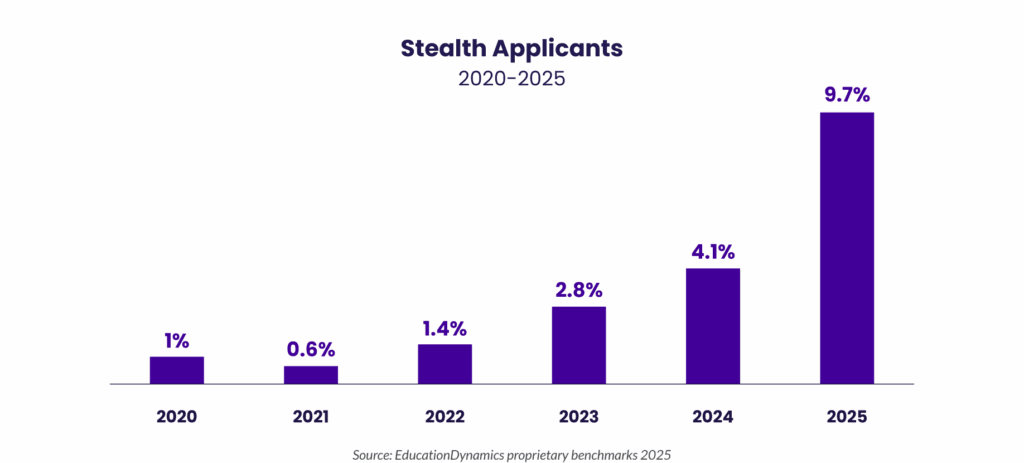
    Institutions that prioritize motivation, fit, and outcomes over raw inquiry counts build smarter funnels that convert faster and operate more efficiently. In 2026, success is defined not by how many leads you generate, but by how many of the right students you enroll.

    What this Means for Higher Ed Leaders 2026  

    Higher education has entered a new era, and the data leaves no room for debate. Modern Learners have rewritten how institutions are discovered, evaluated and chosen.  

    Institutions that prioritize scale over substance will fall behind in a market defined by AI-driven search, zero-click behavior and value-first decisions. Survival is not the goal. Growth is. 

    The strategic imperatives that follow are not recommendations. They are the minimum requirements for relevance in 2026 and beyond. 

    The Strategic Imperatives Higher Ed Leaders Must Prioritize 

    1. Mechanize Brand Authority for a Zero-Click World  

    Nearly half of searches now end without a click. Visibility no longer belongs to the best-ranked institutions. It belongs to the most trusted brands. In a zero-click world, institutions must optimize for AI Density, ensuring brand content, outcomes data and FAQs are cited inside AI Overviews, while actively defending brand authority across the decentralized platforms that shape AI answers. 

    2. Pivot from Lead Volume to Enrollment Value  

    The era of buying growth through lead volume is over. Rising CPIs have made mediocre leads an expensive distraction. More leads are not the objective. Enrolling the right students is. Success in 2026 requires abandoning vanity metrics and optimizing toward Cost per Application and Cost per Enrollment using first-party data and AI-driven optimization. 

    3. Engineer Velocity into the Funnel  

    Modern Learners move fast and reward speed. Most enroll at the first institution that admits them. Delay kills conversion. Institutions must design for velocity at every stage, using AI as a 24/7 admissions concierge to answer questions, engage stealth researchers, and eliminate friction across the funnel. 

    4. Move from Performative to Operational AI  

    In 2026, the greatest barrier to progress is not technology, but cultural paralysis. Institutions waiting for a “perfect plan” will end up optimizing a strategy the market has already outgrown. AI cannot live on the sidelines. Leadership must treat it as operational infrastructure, championing upskilling and cross-functional integration across marketing and enrollment. The advantage comes from using AI to drive real-time personalization and faster decisions, not from experimenting in isolation. 
    Source link

  • Tech Transformation: Why skills matter

    Tech Transformation: Why skills matter

    I’ve just returned from a school evaluation visit.  One of the things I most enjoy about these visits is having time with schools to discuss their programme development plans.  In the case of my recent visit, the plan was about the ATL skills.

    Many schools recognise that learning skills is essential – but the question remains WHAT skills – in a recent article I read that 35% of current key skills are projected to change.  This implies to me that the most important skills are those that transfer to what is needed outside of school – in life and work.

    The Future of Jobs Report 2025 considers skills that will be needed by 2030 given projected changes in global employment, rapid technological advances, and economic instability.  The forecast is that 170 million new jobs will be created, but 92 million will disappear – as a result almost 60% of workers will require reskilling over the next 5 years – and this of course has a huge impact on what schools need to teach.

    Jobs that require routine skills are declining, whereas jobs that involve digital, analytical and design thinking skills are on the increase.  A lot of this is being driven by technology such as automation and AI.  Another area of rapid expansion is the “green economy” with a focus on sustainability.  These jobs are linked to environmental science, clean energy and sustainable design, requiring skills of systems thinking and ethical reasoning.  And in this world of shifting economics and geopolitics, collaboration, strategic thinking and resilience are all called for.

    There are demographic shifts driving these changes too – as the world’s population is aging there are more demands for healthcare and caregiving – these require more interpersonal skills such as empathy.  

    In IB schools we have long recognised that it is not enough to master content – skills need to be explicitly taught and practiced, and woven into learning experiences.  Pedagogical approaches such as project-based learning and teaching through transdisciplinary and interdisciplinary units will help students develop transferable skills.  And perhaps most important of all, teachers also need to engage in continuous professional learning to keep pace with all these changes.

    Image by Gerd Altmann from Pixabay

    Source link

  • Preparing Students for Economic Transformation: Why Executive Function Skills Matter More Than Ever

    Preparing Students for Economic Transformation: Why Executive Function Skills Matter More Than Ever

    As we witness a fundamental shift in the American economy, the question facing parents and educators is no longer simply “Should my child go to college?” but rather “How do we prepare young people to thrive in a rapidly transforming workforce?” The answer lies in early intervention – building executive functioning skills, identifying areas of strength, and cultivating the confidence and competencies that will serve students throughout their lives, regardless of the path they choose. 

    A Manufacturing Renaissance and What It Means for Our Students

    Economist Nancy Lazar recently highlighted a transformation that’s been quietly unfolding for over a decade. As she explained, “This is transformational. It has actually been unfolding for about 15 years. It started last cycle, when capital spending started to come back to the United States… we started to get goods-producing jobs increased. 2010 through 2019.”

    This shift represents more than just economics – it’s a fundamental reimagining of what career success looks like. Lazar emphasized the multiplier effect of manufacturing jobs: “When you create factories, you need a support system around it. Other smaller factories, distribution centers, and then other services eventually, eventually unfold.”

    For our students, this means opportunity. But only if we prepare them properly.

    The Skills Gap Isn’t Insurmountable – It’s a Training Challenge

    One of the most encouraging aspects of Lazar’s analysis is her pragmatic view of the “skills gap.” When asked whether skills mismatches would create friction in this economic transformation, her response was refreshingly direct:

    “I visited a prison about 6 years ago, where they were training inmates as they got parole in skills. And they would train them, and they’d go out […] and they would get a job. So you can train people to work in factories. I grew up in a factory town. I saw it myself, and it’s training.”

    This is where executive functioning skills become critical. The ability to plan, organize, manage time, regulate emotions, and adapt to new situations – these are the foundations that make any training successful. Students who develop strong executive function early don’t just learn specific skills; they learn how to learn, how to persist through challenges, and how to present themselves as valuable contributors.

    Rethinking the College Paradigm

    Lazar’s interview included a striking moment when discussing Palantir’s hiring practices: “Palantir was in the news last week. They’re hiring high school kids. Great idea. Get a job, then see if you want to go, go to college, if you need to go, if you need to go to college.”

    Let’s be clear: this isn’t an anti-college message. It’s a pro-purpose message.

    College remains an invaluable experience for many students – particularly those pursuing fields that require specific credentials or advanced study. The college environment can foster character development, expose students to the humanities and sciences that broaden perspective, and provide the space for young adults to discover who they are and what they value. These are legitimate and important outcomes.

    However, when college costs approach $400,000-$500,000 for a four-year degree at a private institution, we must ask hard questions. If the primary goal is character building and general education, a $24,000 per year public university can accomplish that beautifully. If the goal is career preparation without a specific professional credential requirement, technical training may be more appropriate and cost-effective.

    The issue isn’t whether college has value – it does. The issue is whether the value received justifies the investment made, and whether we’re honest about what we’re purchasing.

    The Dignity and Promise of Technical Education

    Lazar put it plainly: “I do think this is transformational, is healthy for the economy, not everybody needs to go to college, wants to go to college, and there should be other job opportunities.”

    The data supports this transformation. According to the Bureau of Labor Statistics, median wages for skilled trades have increased significantly over the past decade. Electricians now earn a median salary of approximately $60,000 annually, with experienced professionals in specialized areas earning well over $80,000. Similarly, HVAC technicians, plumbers, and manufacturing technicians are seeing wage growth that outpaces inflation, with many positions offering comprehensive benefits and job security.

    A 2023 report from Georgetown University’s Center on Education and the Workforce found that 30% of workers with associate degrees earn more than the median bachelor’s degree holder. In fields like industrial machinery mechanics, respiratory therapy, and radiation therapy, two-year degree holders often out-earn four-year college graduates.

    These aren’t consolation prizes – they’re dignified, skilled professions that offer security, growth, and the satisfaction of tangible, meaningful work.

    Lazar emphasized the importance of community colleges and training partnerships: “Community college system, companies working with community colleges. I’m excited about it, rather than people depending upon the government, where they can actually go out and get a healthy, good job.”

    This is where we, as educators and parents, must examine our own biases. Have we unconsciously communicated that technical careers are somehow “less than”? Have we steered capable students away from hands-on work that might actually suit their strengths and interests better than a traditional academic path?

    Early Intervention: Building the Foundation for Any Path

    This is why our work at Novella Prep focuses so heavily on executive functioning skills, confidence building, and identifying individual strengths early in a student’s educational journey. Whether a student ultimately pursues:

    • A four-year university degree
    • Technical certification
    • Community college training
    • Apprenticeship programs
    • Entrepreneurship
    • Direct workforce entry

    …they will need the same core competencies:

    Organization and Planning: The ability to manage complex projects, meet deadlines, and coordinate multiple responsibilities.

    Self-Regulation: Managing frustration, persisting through difficulty, and maintaining focus in the face of distractions.

    Metacognition: Understanding how they learn best, identifying when they need help, and continuously improving their approach.

    Communication: Presenting ideas clearly, collaborating with others, and advocating for themselves appropriately.

    Adaptability: Adjusting to new environments, learning new systems, and remaining flexible as circumstances change.

    These skills aren’t taught in a single semester. They’re developed over years, through consistent practice, reflection, and coaching. The earlier we begin, the more deeply embedded these capacities become.

    Aligning Education with Purpose

    Here’s what we should be asking our middle and high school students:

    • What activities make you lose track of time because you’re so engaged?
    • What problems in the world bother you enough that you want to help solve them?
    • What skills do you already have that others find valuable?
    • What kind of work environment appeals to you – collaborative or independent, physical or sedentary, creative or systematic?

    And then, critically: What preparation path will best develop your strengths while addressing your growth areas, at a cost that makes sense for your goals?

    For some students, that will absolutely mean a selective four-year university. For others, it might mean starting at community college and transferring. For still others, it might mean a technical certification earned while working, allowing them to enter the workforce without debt while building real-world experience.

    The Role of Executive Function in Workforce Value

    Lazar noted that “80% of jobs are created in companies with less than 500 employees,” and emphasized the importance of small business growth. In smaller organizations, employees often wear multiple hats and must demonstrate initiative, problem-solving, and reliability from day one.

    These are executive function skills in action. An employee who can:

    • Anticipate needs before being asked
    • Organize their work efficiently
    • Communicate proactively about challenges
    • Adapt when priorities shift
    • Take ownership of outcomes

    …will always be valuable, regardless of their specific technical training or degree credentials.

    This is why we emphasize these skills alongside academic content. We’re not just preparing students for college admission; we’re preparing them to be the kind of people others want to work with, hire, and promote.

    Confidence Built on Competence

    Perhaps most importantly, early executive function training builds genuine confidence. Not the hollow self-esteem of participation trophies, but the real thing – confidence rooted in demonstrated competence.

    When students experience themselves as capable – when they successfully plan and execute a complex project, when they overcome a genuine challenge through persistence, when they see tangible results from their efforts – they internalize a sense of agency that serves them forever.

    This confidence allows them to:

    • Try new things without fear of failure
    • Advocate for themselves in educational and work settings
    • Recover from setbacks without catastrophizing
    • Make decisions aligned with their values rather than others’ expectations

    A Practical Path Forward

    For parents and educators reading this, here are concrete steps:

    1. Start Early: Executive function skills develop most rapidly before age 25. Don’t wait until junior year of high school to address organization, time management, and self-regulation challenges.
    2. Identify Strengths: Help students discover what they’re genuinely good at and interested in. Resist the urge to push them toward paths that seem prestigious but don’t fit their actual abilities and interests.
    3. Explore All Options: Visit technical schools and community colleges with the same care you’d visit four-year universities. Talk to people working in trades and technical fields. Challenge assumptions about what constitutes “success.”
    4. Run the Numbers: If a four-year private college costs $400,000+, be explicit about the return on investment. What specific outcomes justify that expense? If the answer is primarily “experience” and “education,” consider whether those outcomes could be achieved at lower cost.
    5. Prioritize Skills Over Credentials: Focus on building competencies that transfer across contexts – executive function, communication, critical thinking, technical literacy. These matter more than the name on the diploma.
    6. Embrace Multiple Pathways: Success isn’t linear. Many people benefit from working before college, or combining work and school, or pursuing technical training first and academic credentials later. There’s no single “right” way.

    Conclusion: Preparation for Purpose

    Nancy Lazar concluded her interview by expressing excitement about the economic transformation: “I’m excited about it, rather than people depending upon the government, where they can actually go out and get a healthy, good job.”

    That should be our goal for every student: a healthy, good job – or better yet, fulfilling work that leverages their strengths, provides economic security, and contributes value to others.

    Getting there requires more than test scores and GPAs. Life requires executive functioning skills, self-awareness, confidence built on competence, and the wisdom to choose a path aligned with individual strengths and goals rather than generic prestige.

    At Novella Prep, this is the work we’re committed to – helping students develop not just the skills to get into college, but the capacities to thrive in whatever path they choose. Because in a transforming economy, the most valuable credential isn’t a diploma. It’s the ability to learn, adapt, contribute, and grow throughout a lifetime.


    Dr. Tony Di Giacomo is an educational expert specializing in executive function development and college preparation. Through Novella Prep, his company works with students and families to build the skills, confidence, and strategic thinking necessary for long-term success.

    Source link

  • Advance HE must deepen our expertise in supporting transformation and change

    Advance HE must deepen our expertise in supporting transformation and change

    The challenges for higher education and research institutions – both in the UK and in many countries across the world – are acute and immediate.

    A combination of funding pressures, changing student demands, the rapid development of AI, international conflict and restrictive visa regimes are necessitating significant change and transformation.

    These tough challenges require all those working in higher education to think differently about how we lead, teach, support students and operate. Yet within these challenges lie opportunities for innovation and positive change.

    I am three months into the role as chief executive of Advance HE. My recent conversations with many of our members have reinforced the need for us to focus on how we can enhance our support for transformation and change.

    Time for a change

    I believe that to be successful, higher education institutions need good leadership; effective governance; they should promote excellence in teaching and learning; and embed equality, promote diversity and inclusion. These are the four key pillars of Advance HE’s work and will continue to be so. However, we cannot stand still. Supporting higher education institutions in this difficult and changing context means that Advance HE needs to change and modernise. Our portfolio, programmes and products need regular review, refreshing and revamping, to remain relevant, to be high value and high impact.

    There has been excellent work led by Universities UK’s transformation and efficiency taskforce, which set out a number of recommendations and challenges for the sector. Advance HE can play an important role in supporting transformation and change both at a sector level and an institutional level. In the context of financial pressures, changing student needs, international uncertainty and digital developments – we need to be an enhancement agency – a trusted partner for higher education and research institutions.

    Supporting enhancement, change and transformation will now be at the heart of what Advance HE does – embedded across our member benefits, our programmes and our consultancy. To help institutions through these challenging times we will apply our expertise, experience and resources to best support enhancement and service improvement, where it is needed.

    Collaborating with partner organisations that are supporting transformation and change will be central to our approach. Blending our expertise in leadership development, educational excellence, equality and inclusion, governance effectiveness with the experience of partners that have different but complementary skills and capabilities.

    Overall, our focus is primarily on people. We can play a role to enhance capabilities at all levels to lead and manage transformation and change – academics, professionals services, governing bodies.

    What we will do

    There are three practical steps I am taking now to strengthen our support for transformation and change:

    Firstly, we have made supporting transformation and change a core part of our membership offer. We are drawing on the areas where we have deep expertise – leadership development, educational excellence, governance effectiveness – to apply our expertise directly to the most pressing issues facing our members.

    For example, the new Educational Excellence Change Academy, a structured virtual six-month programme designed to help higher education staff to lead systemic educational transformation. The programme provides practical support to redesign curriculum to align with workforce needs, reimagine pedagogy to be inclusive, digital, and engaging; and enhancing student support models to strengthen wellbeing and retention.

    Additionally, we have launched the Merger Insights and Roadmap, a new resource for navigating institutional collaboration, partnerships and mergers. Drawing on recent case-studies from successful transformations, it considers early option-testing and due diligence through to culture integration and regulatory engagement.

    Secondly, later this autumn I will announce a new strategic advisory group who will work with our in-house expert to further enhance our support for transformation and change. We will further evolve our membership offer; review our portfolio of products and services; lead new research to share insights; and bring knowledge and learning from other sectors that have delivered significant transformation. We will also recruit new associates with deep and relevant transformation experience to work with our in-house experts.

    Thirdly, we will do more to realise the benefits of Advance HE being a global organisation with an international membership. Our 470 members are from 34 countries – with almost a third of our members outside the UK – in Australia, Ireland, in the Gulf, across Europe, in South-East Asia and beyond. The challenges facing higher education institutions in one part of the world are often mirrored in another. The solutions, approaches and innovations being developed in different contexts can offer fresh perspectives and practical ideas that translate across borders. We will do more to draw on the fact that we have a diverse, global membership to share insights, solutions, and good practice across our membership.

    At a time of significant challenge for higher education and research, institutions are increasingly needing to deliver transformational change in the way they operate. Advance HE is committed to supporting people working in higher education to do this successfully.

    Source link

  • HE transformation will only succeed when its people feel safe, supported and connected

    HE transformation will only succeed when its people feel safe, supported and connected

    In UK higher education, compassion is often treated as an optional extra, something to be considered once the metrics are met, the audits are done, and the strategies are signed off. This framing misses the point.

    Compassion is not a soft skill or a luxury. It is not something we add in once the “real work” is done. It is a strategic ethic and a way of designing systems, relationships, and institutions that enable people to thrive. It is about recognising suffering and taking meaningful action to alleviate it. It is about creating conditions in which students, colleagues, and leaders can do their best work, sustainably.

    In higher education, compassion is often misunderstood, mistaken for sentimentality or seen as incompatible with the rigour and excellence that universities are expected to uphold. This is a false dichotomy. Compassion is not the opposite of academic excellence; it is what makes it possible.

    When compassion is embedded into the culture and infrastructure of a university, it doesn’t lower standards, it sustains them. It doesn’t avoid challenges; it enables people to meet challenges without burning out. And it doesn’t replace accountability, it reframes it, through a lens of relational responsibility and shared purpose.

    The recent Universities UK report, Transformation and efficiency: towards a new era of collaboration, arrives at a moment of reckoning. The pressures facing the sector, whether financial, regulatory, or reputational, are not new, yet they have intensified. The report offers a clear and necessary diagnosis and outlines seven opportunities for transformation, including developing collaborative structures, sharing services and infrastructure, shared procurement, digital transformation, benchmarking efficiency and strengthening leadership and governance.

    These are important and they are also technical – but technical change, while necessary, is not sufficient. What’s missing is the cultural infrastructure that helps these changes take hold and endure. Without it, transformation risks becoming transactional and something done to people, rather than with them. This is where compassion becomes essential and as the connective tissue that binds strategy to sustainability as opposed to being an add-on. Compassion enables us to ask different questions: “What can we change?” AND “How will this change be experienced?” or “How do we become more efficient?” AND “How do we remain human while doing so?”

    Addressing burnout

    At this time of year, the signs are everywhere: exhaustion, disillusionment, a creeping sense that the work is never done, and the values that brought us into the sector are being eroded by the systems we now work within.

    Burnout is not a personal failing; it is a systemic signal. As Maslach and Leiter remind us in The truth about burnout, burnout arises when people face too much work, too little control, and a misalignment of values. These are organisational design problems as opposed to individual resilience problems. If we want transformation, we must prioritise the conditions in which people are expected to transform. Compassion, understood as a framework for action, offers a way to do this. It invites us to design systems that are effective, humane and investing in people’s capacity to give, as opposed to just demanding more.

    Humility is also something required of us at this moment, acknowledging that we are all stepping into the unknown; planned change in a complex system is, at best, hopeful fiction. We cannot predict exactly what will emerge and we can choose how we show up in the process.

    Compassion gives us permission to not have all the answers and it allows us to hold space for uncertainty, and to move forward anyway, together. Transformation is a collective endeavour and one that will only succeed if we create conditions in which people feel safe enough, supported enough, and connected enough to participate.

    Transformation needs cultural infrastructure

    Transformation is a human and technical exercise. It emerges or recedes in the spaces between people: how they experience change, how they relate to one another, and how they make sense of their work. Without attention to culture, even the most well-designed reforms risk faltering.

    Compassion offers a way to build the cultural infrastructure that transformation requires, inviting different, deeper questions, such as how change will affect relationships, how institutions can recognise and respond to emotional experience, what inclusive design looks like in different contexts, and where the spaces are that enable people to reflect, connect, and recover. These questions are central to whether transformation efforts succeed or stall; culture is the medium through which change happens.

    The Covid-19 pandemic gave us a glimpse of what compassionate institutions can look like. Faced with crisis, many universities responded with agility and care; extending deadlines, adapting policies, and prioritising inclusion. These were acts of strategy, not charity. They enabled continuity, protected equity, and demonstrated the sector’s capacity for humane innovation.

    They also revealed that compassion, when practised in systems not designed to support it, can come at a cost that is less often acknowledged. The compassion extended to others was not always matched by compassion for self. Many colleagues gave more than they had to give, and when the crisis faded, the systems around them reverted to old norms including rigid timelines, performance metrics and competitive cultures. The emotional weight of compassion is not inevitable; it becomes heavy when systems are misaligned, when care is expected and not enabled. In the right conditions, compassion is a way of working that restores us as opposed to a burden.

    This reveals a deeper truth: our systems were never designed to sustain compassion. If we want to embed it beyond moments of crisis, we must treat it as a core institutional value and to recognise that compassion includes ourselves.

    Compassion in practice

    Here are five shifts that can embed compassion into the fabric of transformation.

    1. Reframe wellbeing as strategic infrastructure

    Wellbeing is not a side project. It is foundational to performance, retention, and innovation. Institutions could move from monitoring wellbeing to designing it through embedding it in curricula, policies, workload models, and leadership practices.Boundaries can be enacted, encouraged, and celebrated.

    2. Recognise and resource emotional experience

    The work of care, whether in teaching, research, service, or leadership, is often invisible and undervalued. It can become labour and lead to empathic distress, when systems make it unsustainable. When time, space, and support are present, compassion is a source of meaning and connection. We can name it, measure it, and reward it, factoring it into workload models, promotion criteria, and professional development.

    3. Design for relational accountability

    Compassionate systems are relational systems. Transformation must ask: how will this affect relationships? What power dynamics are at play? Whether it’s a new assessment policy or a shared service model, the relational impact matters.

    4. Create space for reflection and connection

    Efficiency is not about doing more with less, it’s about doing the right things well. Institutions must create time and space for colleagues and students to reflect, connect, and recover. This is infrastructure, not an indulgence.

    5. Build on what already works

    Compassion is not new. Across the sector, there are already informal networks, communities of practice, and relational leadership approaches enacted that embody compassionate principles. The task is to amplify, connect, and learn from them.

    The Universities UK report rightly identifies collaboration as a route to transformation. Collaboration is a relational practice as well as a structural arrangement that requires trust, shared purpose, and the ability to navigate differences. These capabilities grow through connection and trust and cannot be mandated; they are human ones, developed through compassion and sustained by culture.

    Compassion can also help us rethink our perception of resistance. Too often, “resistance to change” is dismissed as inertia or protectionism when it is often a signal of fear, of loss, of values under threat. Compassionate leadership invites active listening to this signal and responsiveness with transparency, inclusion, and care.

    Compassion is a whole-university approach as opposed to be the responsibility of student services or human resources and notably visible in:

    • Teaching: through learning environments that prioritise dialogue, inclusion, and mutual respect.
    • Support services: by moving from transactional help to meaningful connection.
    • Leadership: by sharing power, modelling visibility, and practising relational accountability.
    • Policy: by asking, always, how decisions will affect relationships and wellbeing.

    The UUK report offers a timely and necessary roadmap for sector-wide transformation. To realise these ambitions, we will need to prioritise our focus on culture and connection alongside systems and structures; compassion is a strategic imperative.

    This is an invitation to those leading transformation, to see compassion as a driver of efficiency; to policymakers, to recognise that sustainable change requires care as well as compliance; and to all of us in the sector, to choose compassion for ourselves and others as a way of being and not just as a crisis response.

    The future of higher education depends on what we do and critically how we do it and, on the cultures, we choose to develop. If we create the conditions for compassion to thrive in higher education, it will no longer feel like a burden, it will become a source of meaning, connection, and renewal. This is how transformation becomes possible and sustainable.

    All views expressed in this blog are entirely those of the authors and do not represent the views or positions of any affiliated organisations or institutions.

    Source link

  • Universities should be architects of economic and social transformation

    Universities should be architects of economic and social transformation

    Britain’s universities stand at a critical juncture.

    The traditional funding model faces unprecedented pressure as costs spiral and resources dwindle, while successive government policy reversals on international students and graduate visas have created a destabilising environment.

    These converging forces threaten the very foundations of our higher education system.

    Simultaneously, Education Secretary Bridget Phillipson is challenging universities to deliver more with less – driving economic growth and enhancing student outcomes amidst severe financial constraints. The message is unambiguous – transformation is no longer optional.

    The uncomfortable reality is that with public funding constraints tightening and international income streams becoming increasingly unpredictable, universities can no longer sustain outdated operational models.

    To survive and thrive in this challenging landscape, institutions must fundamentally reimagine their approach – aligning their educational offerings with national priorities and market needs, adopting innovative commercial service models, and leveraging emerging technologies at scale.

    Pioneering a new paradigm

    Aston University’s recent report, Pathways to Success, provides a compelling blueprint for institutional evolution in response to these pressures. By transforming into a more agile, resilient, and globally connected institution, Aston has prioritised both student success and tangible socio-economic impact.

    This strategic pivot beyond traditional funding sources toward a partnership-driven approach has already generated over £1 billion for the regional and national economy, with ambitious plans to double this impact by 2030.

    Today’s most effective universities function as anchor institutions within vibrant innovation ecosystems. The Birmingham Innovation Precinct exemplifies this approach, seamlessly integrating innovative research, commercial ventures, and community development.

    Aston has expanded this concept with its “city within a city” model — a dynamic urban environment featuring public spaces, start-up accelerators, business incubators, community maker spaces, and comprehensive residential, health and recreational facilities.

    This integrated ecosystem drives placemaking and productivity through collaborative place-based innovation.

    Across Britain’s post-industrial cities, such innovation districts are becoming powerful engines of regional economic renewal. Aston’s focus on talent retention has resulted in approximately 70 per cent of graduates remaining in the West Midlands, providing essential high-level skills to local industries for the long run.

    This retention significantly enhances economic resilience, while the university’s three-year support scheme after graduation ensures sustained impact through graduate success.

    The university has constructed a comprehensive innovation ecosystem that accelerates research commercialisation, featuring the Aston Knowledge Transfer Partnership Unit, Aston Business Hub, Enterprise Hub, and Aston University Ventures, as well as a portfolio of partnered accelerators such as SPARK The Midlands Accelerator.

    Collaborative efforts with other institutions through the Midlands Innovation consortium and its investment arm Midlands Mindforge, alongside large-scale research commercialisation projects funded by Research England and Innovate UK, further amplify this impact.

    The results speak for themselves – KTP projects are projected to generate £266 million in pre-tax profit for partner companies and create 541 new jobs within three years, with participating companies achieving an average 1,107% return on investment.

    The quadruple helix: A new framework for innovation

    Forward-thinking institutions are increasingly adopting the “quadruple helix” model — an innovation framework that integrates academia, industry, government, and society.

    This approach has transformed our stakeholder engagement, focusing efforts on health technology, net zero initiatives, digital and engineering technologies, and biological sciences — areas aligned with national priorities and offering substantial employment opportunities.

    We demonstrate leadership in sustainability, on track to achieve net-zero carbon emissions by 2028, becoming the first university in the region to achieve this milestone, supported by a £35.5 million investment through the UK Public Sector Decarbonisation Scheme.

    We have also secured funding to establish the first national Transdisciplinary Research Hub and Doctoral Training Centre, enabling and supporting decarbonisation projects across vast networks of businesses and healthcare providers throughout the West Midlands.

    Those who fear that commercialisation threatens academic independence misinterpret this model. Robust governance frameworks protect intellectual integrity while facilitating meaningful partnerships that enhance rather than compromise research excellence through measurable impact.

    However, widespread adoption of this approach faces significant obstacles, particularly outdated performance metrics that continue to prioritise publication counts and academic citations over student outcomes and real-world impact.

    The forthcoming sector reforms must address these antiquated incentive structures if Britain is to maintain global economic competitiveness.

    Building a sustainable innovation pipeline

    The project-based funding model that dominates British research support creates chronic uncertainty, undermining long-term planning and investment.

    What we urgently need are strategic, decade-long commitments that provide the stability necessary for substantial infrastructure development and deep industry collaboration.

    The government’s forthcoming 10-year R&D budget must prioritise strengthening university-business collaboration. Only through such sustained investment can Britain cultivate the robust innovation pipeline essential for economic revitalisation.

    Universities must simultaneously align their educational offerings with evolving market needs for advanced skills.

    While the government’s focus on skill levels 1-5 is important, it remains insufficient. High-value sectors — artificial intelligence, advanced digital technologies, advanced manufacturing, and medical technology — require sophisticated capabilities that can only be effectively developed at scale through university-industry collaboration.

    University-led programmes, co-designed with industry partners, can deliver intensive training in these critical domains through more agile, flexible, digitally enabled learning approaches.

    The corporate challenge

    We must confront an uncomfortable truth: the firewall between industry and education is rapidly vanishing. Global technology giants, such as Google, Amazon, Microsoft, IBM, and Siemens, are already among the world’s largest training providers.

    Before long, they will either embed their programmes inside universities or create rival institutions that funnel graduates directly into high-value jobs. Students will inevitably gravitate toward whichever pathway offers the strongest prospects for employability and rapid career progression.

    The response must be proactive rather than defensive. Universities should forge strategic partnerships with businesses, policymakers, and private education providers to develop flexible, omni-channel learning models that integrate traditional campus experiences with industry-embedded learning opportunities, supported by sophisticated digital delivery platforms.

    For centuries, British universities have been intellectual powerhouses shaping minds and advancing knowledge. But the future of our higher education system now depends on a fundamental mindset shift.

    Institutions must become more commercially astute and globally connected, while remaining deeply rooted in their communities where their civic mission finds its most powerful expression.

    We must embrace industry and community like never before. That means forging strategic partnerships, embracing commercial imperatives, and converting research and skills into measurable socio-economic benefits.

    We can no longer rely solely on our storied academic traditions. If British universities are to thrive in the twenty-first century, they must transform and become active architects of economic and social transformation — or risk fading into obsolescence as relics of a bygone age.

    Source link

  • Together We Lead: A New Era of HBCU Transformation

    Together We Lead: A New Era of HBCU Transformation

    Dr. Michael Lomax, Dr. Harry L. Williams, and Jim Runcie

    By Michael L. Lomax, Harry L. Williams and Jim Runcie 

    At a time when higher education is facing increased scrutiny, economic headwinds, and technological disruption, a group of institutions is charting a new path forward—one grounded in legacy, strengthened by collaboration and built for the future. These are historically Black colleges and universities (HBCUs). And they are proving that with the right investments and strategic partnerships, transformation is not only possible—it’s scalable.

    Four years ago, UNCF, Thurgood Marshall College Fund (TMCF) and Ed Advancement launched the HBCU Transformation Project—a collective effort to strengthen institutional sustainability, enhance student success and modernize campus operations across a growing network of these mission-driven institutions.

    The results speak volumes. Between 2020 and 2024, while national higher education enrollment declined, institutions participating in the HBCU Transformation Project grew their enrollment by 5.1%. In an era of enrollment contraction, these colleges are not only holding the line—they’re expanding their impact.

    “This effort is rooted in a networked approach,” according to Dr. Michael L. Lomax, president and CEO of UNCF. “When we combine institutional insight with philanthropic investment and aligned technical support, we can accelerate change in ways that benefit students, campuses and communities.”

    The initiative currently supports more than 40 HBCUs—from urban campuses to rural colleges—each selected to represent the diversity and strength of the sector. Through this initiative, campuses have redesigned their enrollment systems, implemented new technology platforms, modernized financial aid processes and invested in data-informed student support services.

    What ties these efforts together is a shared commitment to transformation to secure long-term institutional health and improve outcomes for students. It’s about building the infrastructure that allows these colleges to thrive in a fast-evolving higher education marketplace.

    “Our students need more than degrees. They need meaningful pathways to jobs, leadership and advancement,” according to Dr. Harry L. Williams, president and CEO of TMCF. “This work ensures our institutions are positioned to align with 21st-century workforce needs, opening doors to opportunity.”

    Beyond enrollment and academic programs, the Transformation Project is helping these institutions rethink how they operate. By investing in operations, shared services and scalable back-office solutions, the initiative is removing the all too pervasive obstacles of outdated systems and under-resourced departments. We are making foundational changes that will yield a lasting impact.

    Jim Runcie, CEO of Ed Advancement, put it simply: “We’re helping institutions do what they already do well—but with the right tools, systems and capacity behind them. Sustainable growth starts with operational strength.”

    The economic importance of HBCUs cannot be overstated. According to UNCF’s 2024 Economic Impact Report, these institutions generate $16.5 billion annually and support over 136,000 jobs nationwide. Their graduates—from engineers to educators, scientists to entrepreneurs—fuel industries, build communities and lead across sectors.

    And yet, this value has too often gone underrecognized. The HBCU Transformation Project is shifting that narrative—moving from proof-of-concept to proof-of-impact.

    UNITE 2025, UNCF’s annual convening of institutional leaders and strategic partners, will spotlight this progress. With the theme Together We Lead, UNITE is the premier platform for sharing solutions, surfacing new ideas and catalyzing partnerships. It’s where transformation moves from theory to practice.

    Looking ahead, the path is clear. We must continue to strengthen these institutions—through technology, leadership development, data utilization and investment. The transformation of HBCUs is a smart strategy for the future of American higher education and for maximizing the opportunity to link arms with international partners, seeking to mobilize global communities in a different way.

    Now is the time for more partners—investors, policymakers, employers and innovators—to join us. The groundwork has been laid. The momentum is building. And the opportunity is real.

    Together, we lead.


    Dr. Michael L. Lomax is president and CEO of the United Negro College Fund (UNCF).

    Dr. Harry L. Williams is president and CEO of the Thurgood Marshall College Fund (TMCF).

    Jim Runcie is CEO and co-founder of the Partnership for Education Advancement.


    Source link

  • Should higher education be thinking in terms of evolution or transformation?

    Should higher education be thinking in terms of evolution or transformation?

    The pervasive sense that five years or a decade or 20 years hence the sector will look radically different might be an exciting topic for panel discussions but it’s not clear whether radical transformation is desirable – not least because the form that transformation might take remains far from clear.

    The drivers of change are well-rehearsed: while demand remains strong for higher education participation, as we’ll be exploring at our Secret Life of Students event this week, the traditional student experience is coming under intense pressure as students with diverse backgrounds, needs and aspirations try to wedge their lives into a fairly boilerplate model of higher education study. Most institutions don’t have the money to throw at additional services, or to carry the risks of innovating in how they structure their portfolio. Income from international students could go some way to smoothing out the rough edges but recent events have demonstrated the consequences of building a system on an income stream that’s so variable and subject to a change of direction in the political winds.

    The Westminster government’s current higher education policy agenda is a rag bag of “stuff we can all agree on” like access, quality, and civic engagement, and contextual mood music around industrial strategy, skills, devolution, and regional economic growth. Reading between the lines it seems there is a direction of travel towards a more coordinated regional post-18 offer broadly aligned to regional economic growth agendas, but against a punishing economic backdrop nobody’s very clear what this ought to look like, how deeply or broadly it should touch the general HE offer, or how it should happen.

    The lack of system-wide or even local coordination is a real worry, as individual institutions make decisions for sustainability and even survival that will have long term implications for the functioning of the system as a whole and the opportunities that are available to students. To give one example: colleges report that what they see as predatory behaviour by universities to try to scoop up the students that might more traditionally be seen in college-based higher education provision is placing that provision under significant strain.

    Choices for change

    Dealing with the immediate pressures on costs while also staring down the barrel of a call for reform is objectively a very difficult psychological space for higher education to be in. Everyone I speak to is desperate for more time in their day to reflect, digest, make sense, and plan. Something I often find useful when I find the world confusing (an alarmingly frequent occurrence) is some kind of model or map to help me structure my thoughts, especially when time is limited.

    I like putting one thing next to another thing and seeing what happens, and so for this case I put change actors on one continuum from individual institutions to multiple organisations in collaboration, and scale of change on the other, from evolution to revolution. I then tried to think of all the “change” activities that are either under way or are being mooted and assigned them to quadrants.

    I’ve taken a few things from this exercise.

    One is that I think it hugely unlikely that the sector will coalesce into one of the quadrants or even at the top or bottom of the model. I think we will see activity in all four quadrants depending on the context – and I think that policy should seek to support all four forms of change to give the sector the best chance of making a good fist of it. I have found arriving at this conclusion oddly freeing, as it stops the circular argument of advocating any single activity such as income diversification, or merger, or shared services, as a unified answer to the sector’s challenges. It is possible to argue, as we have at Wonkhe, that the policy environment could be more conducive to supporting radical forms of collaboration, without suggesting that all institutions must now hasten to adopt these forms if these do not serve wider missions and objectives. Likewise, it does not necessarily follow that introducing mechanisms to support collaboration would reduce competitive pressures in some parts of the sector or geographies, and the sector may collectively need to make its peace with that.

    Another is that it’s noticeable that the activity to the left in the “evolution” space is a much more “comfortable” space for higher education, in the sense that it’s possible to see it already in action and the sector knows how to do it, not that all the activities listed are necessarily things that are desirable in every case. There’s a question, then, about whether, IF substantial change is needed, it’s possible for the accumulation of practices in the evolution space to achieve it – or do we just end up with lots of random examples of interesting practice and not much that is fundamentally different. I instinctively think that policy should accept that the grain of sector practice runs in the direction of evolution rather than transformation, and seek to work with the sector on mapping critical paths towards the change that is desired rather than administering exogenous shocks to the system.

    Finally, I’d like to see what new ideas the sector could come up with in the right hand side of the diagram (especially the top right quadrant) – not necessarily to advocate for, but to help open up the conversation and ask meaningful questions of current practice. It’s quite easy to explain why all the ideas in the top right quadrant are unlikely to happen, so another way to come at that question is to ask whether there are other ideas that might be more plausible.

    Tone matters here though – for some that idea of transformation is something like a playground, where it’s fun to speculate about different possibilities and might spark some useful thinking. For others, it could carry a much more serious weight of strategic challenge and need to be approached accordingly as likely to have a material impact on people’s lives and working conditions. The stakes are much higher on this side of the evolution to transformation continuum, particularly where an institution is operating in the bottom right quadrant – the risks of failure are real.

    Source link

  • How does the higher education sector sustain digital transformation in tough times?

    How does the higher education sector sustain digital transformation in tough times?

    Higher education institutions are in a real bind right now. Financial pressures are bearing down on expenditure, and even those institutions not at immediate risk are having to tighten their belts.

    Yet institutions also need to continue to evolve and improve – to better educate and support students, enable staff to do their teaching and research, strengthen external ties, and remain attractive to international students. The status quo is not appealing – not just because of competitive and strategic pressures but also because for a lot of institutions the existing systems aren’t really delivering a great experience for students and staff. So, when every penny counts, where should institutions invest to get the best outcomes? Technology is rarely the sole answer but it’s usually part of the answer, so deciding which technologies to deploy and how becomes a critical organisational capability.

    Silos breed cynicism

    Digital transformation is one of those areas that’s historically had a bit of a tricky reputation. I suspect your sense of the reason for this depends a bit on your standpoint but my take (as a moderately competent user of technology but by no means expert) is that technology procurement and deployment is an area that tends to expose some of higher education’s historic vulnerabilities around coordinated leadership and decision-making, effective application of knowledge and expertise, and anticipation of, and adaptability to change.

    So in the past there’s been a sense, not of this exact scenario, but some variation on it: the most senior leaders don’t really have the knowledge or expertise about technology and are constantly getting sold on the latest shiny thing; the director of IT makes decisions without fully coordinating with the needs and workflows of the wider organisation; departments buy in tech for their own needs but don’t coordinate with others. There might even be academic or digital pedagogy expertise in the organisation whose knowledge remains untapped in trying to get the system to make sense. And then the whole thing gets tweaked and updated to try to adapt to the changing needs, introducing layer upon layer of complexity and bureaucracy and general clunkiness, and everyone heaves a massive sigh every time a new system gets rolled out.

    This picture is of course a cynical one but it’s striking in our conversations about digital transformation with the sector how frequently these kinds of scenarios are described. The gap between the promise of technology and the reality of making it work is one that can breed quite a lot of cynicism – which is the absolute worst basis from which to embark on any journey of change. People feel as if they are expected to conform to the approved technology, rather than technology helping them do their jobs more effectively.

    Towards digital maturity

    Back in 2023 Jisc bit the bullet with the publication of its digital transformation toolkit, which explicitly sought to replace what in some cases had been a rather fragmented siloed approach with a “whole institution” framework. When Jisc chief executive Heidi Fraser-Krauss speaks at sector events she frequently argues that technology is the easy bit – it’s the culture change that is hard. Over the past two years Jisc director for digital transformation (HE) Sarah Knight and her team have been working with 24 institutions to test the application of the digital transformation framework and maturity model, with a report capturing the learning of what makes digital transformation work in practice published last month.

    I book in a call with Sarah because I’m curious about how institutions are pursuing their digital transformation plans against the backdrop of financial pressure and reductions in expenditure. When every penny counts, institutions need to wring every bit of value from their investments, and technology costs can be a significant part of an institution’s capital and non-staff recurrent expenditure.

    “Digital transformation to us is to show the breadth of where digital touches a university,” says Sarah. “Traditionally digital tended to sit more with ‘digital people’ like CIOs and IT teams, but our framework has shown how a whole-institution approach is needed. For those just starting out, our framework helped to focus attention on the breadth of things to consider such as digital culture, engaging staff and students, digital fluency, capability, inclusivity, sustainability – and all the principles underpinning digital transformation.”

    Advocating a “whole institution approach” may seem counter-intuitive – making what was already a complicated set of decisions even more so by involving more people. But without creating a pipeline of information flow up, down and across the institution, it’s impossible to see what people need from technology, or understand how the various processes in place in different parts of the university are interacting with the technologies available to see where they could be improved.

    “The digital maturity assessment brought people into the conversation at different levels and roles. Doing that can often show up where there is a mismatch in experience and knowledge between organisational leaders and staff and students who are experiencing the digital landscape,” says Sarah.

    Drawing on knowledgeable voices whose experience is closer to the lived reality of teaching and research is key. “Leaders are saying they don’t need to know everything about digital but they do need to support the staff who are working in that space to have resources, and have a seat at table and a voice.”

    Crucially, working across the institution in this way generates an evidence base that can then be used to drive decision-making about the priorities for investment of resources, both money and time. In the past few years, some institutions have been revising their digital strategies and plans, recognising that with constrained finances, they may need to defer some planned investments, or sequence their projects differently, mindful of the pressures on staff.

    For Sarah, leaders who listen, and who assume they don’t already know what’s going on, are those who are the most likely to develop the evidence base that can best inform their decisions:

    “When you have leaders who recognise the value of taking a more evidence-informed approach, that enables investment to be more strategically targeted, so you’re less likely to see cuts falling in areas where digital is a priority. Institutions that have senior leadership support, data informed decision making, and evidence of impact, are in the best place to steer in a direction that is forward moving and find the core areas that are going to enable us to reach longer term strategic goals.”

    In our conversation I detect a sense of a culture shift behind some of the discussions about how to do digital transformation. Put it like this: nobody is saying that higher education leaders of previous decades didn’t practice empathy, careful listening, and value an evidence base. It’s just that when times are tough, these qualities come to the fore as being among the critical tools for institutional success.

    Spirit of collaboration

    There’s a wider culture shift going on in the sector as well, as financial pressures and the sense that a competitive approach is not serving higher education well turns minds towards where the sector could be more collaborative in its approach. Digital is an area that can sometimes be thought of as a competitive space – but arguably that’s mistaking the tech for the impact you hope it will have. Institutions working on digital transformation are better served by learning from others’ experience, and finding opportunities to pool resources and risk, than by going it alone.

    “Digital can be seen as a competitive space, but collaboration outweighs and has far more benefits than competition,” says Sarah. “We can all learn together as a sector, as long as we can keep sharing that spirit of internal and external collaboration we can continue that momentum and be stronger together.”

    This is especially relevant for those institutions whose leaders may secretly feel they are “behind the curve” on digital transformation and experience a sense of anxiety that their institution needs to scramble to “catch up”. The metaphor of the race is less than helpful in this context, creating anxiety rather than a sense of strategic purpose. Sarah believes that no institution can legitimately consider itself “ahead of the curve” – and that all should have the opportunity to learn from each other:

    “We are all on a journey, so some might be ahead in some aspects but definitely not all,” says Sarah. “No-one is behind the curve but everyone is approaching this in a slightly different way, so don’t feel ‘we have to do this ourselves’; use networks and seek help – that is our role as Jisc to support the sector.”

    Jisc is hosting Digifest in Birmingham on 11-12 March – sign up here for online access to sessions.

    Source link

  • Essays in the Transformation of Higher Education (Dan Morris and Harry Targ)

    Essays in the Transformation of Higher Education (Dan Morris and Harry Targ)

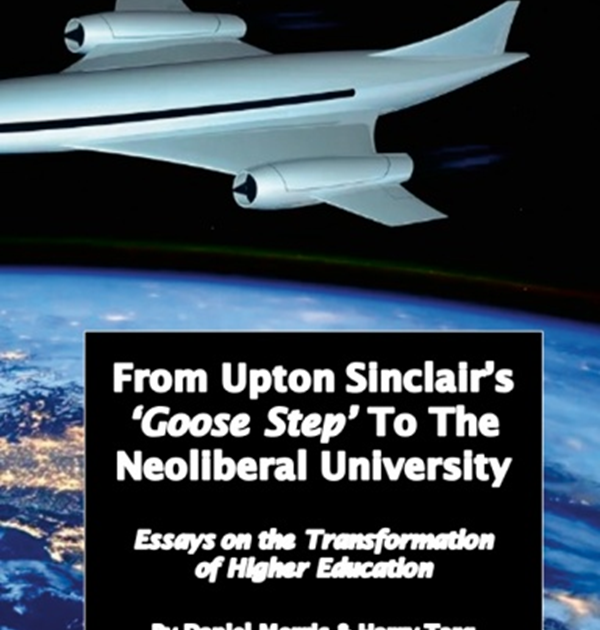
    From Upton Sinclair’s ‘Goose Step’ to the Neoliberal University (lulu.com)

    Table of Contents
    Introduction
    Chapter One: Macro and Micro Analyses of Higher Education
    Chapter Two: Discourses On Ideology
    Chapter Three: Branding
    Chapter Four: What Do Universities Do?
    Chapter Five: Universities and War:
    Conclusion
    Appendix

    Introduction

    In the following pages, you are going to find a lot of specific information about what is happening at one major public research university, but we believe what is happening at Purdue is analogous to a canary in a coal mine. We believe that Purdue under Mitch Daniels, a former George Walker Bush administrator and Governor of Indiana, is becoming a high profile and influential spokesperson for the transformation of public higher education in the 21st century in directions that we find dangerous and that go against how we value higher education. We realize that, while we address extensively institutional changes and policies at Purdue, Indiana’s Land Grant University, our interest is in using this case study to illustrate larger patterns and issues that should be of concern to readers who care about the future of higher education in a broader sense.

    Harry Targ’s pieces do tend towards a wider-angle perspective than do those by Dan Morris, although both of us rely on our “boots on the ground” level understanding of Purdue to counteract and contest official media versions of what is happening at Purdue. We write at a moment when there is something of a “media desert” in terms of local news coverage of higher education in small markets such as Lafayette, Indiana. We have both tried to work to rectify the “media desert” landscape in our community by contributing to the Lafayette Independent, an electronic newsletter. We appreciate efforts by local journalists such as Dave Bangert and the student staff of the Purdue Exponent to offer coverage of the university in ways that are more substantial, and, often, more critical, than what one finds in the area’s only mainstream newspaper, the Journal and Courier, and main local TV news source, and the Purdue NPR radio station, whose ownership in the last year has been mysteriously transferred to an Indianapolis corporation. Paradoxically the richest data for many of the essays below come from the official daily public relations newsletter from Purdue called Purdue Today. This public relations source celebrates Purdue’s latest connections with multinational corporations, the military, and state politics, and provides links to editorials published by Purdue’s President and other officials in the national press. Ironically, oftentimes what Purdue celebrates becomes the data for our more analytical and discursive writings.

    Like alternative media sources, we see this book as another intervention in offering an alternative view of what is happening at our campus, but we also write with the hope that readers can apply the readings we bring to Purdue to begin conversations about the promise and problems of contemporary higher education on campuses. The authors wish to praise and encourage further research and activism around the transformations of higher education in general. We identify with what some scholars have referred to as Critical University Studies (CUS). The essays below, we believe, are part of this emerging tradition of critical and self-reflective scholarship.

    The authors also wish to identify at least three major elements of the transformation of higher education. First, Purdue, like many other universities, is once again pursuing research contracts with huge corporations, and perhaps most importantly, the Department of Defense. As essays below suggest, Purdue research is increasingly justified as serving the interests of United States “national security.” Often this is conceptualized as helping the United States respond to “the Chinese threat,” rarely identifying what exactly is the threat, or considering the possibility that contributing to a new arms race with a perceived adversary may increase, rather than reduce, the possibility for conflict between nations.

    Second, the work below and other writings in CUS, highlight the purposive transformation of the content of higher education. Universities are moving resources away from the liberal arts, creating new programs in “artificial intelligence” and “data science,” and in response to political pressures are diminishing programs that emphasize interdisciplinarity, intersectionality, and the structural problems of race, class, gender, and sexual preference in history and contemporary society. Essays below on “civics literacy” suggest that leading administrators at Purdue, while refusing to defend its universally praised Writing Lab after it was ridiculed on Fox News for its recommendation that student writers select gender-neutral terms such as postal worker when writing about occupations, seek to avoid the controversaries around Critical Race Theory by requiring all students to study in some fashion “civics literacy.” President Daniels has made it clear that the study of civics literacy will illustrate the “vitality” of US political institutions (as opposed to over-emphasizing the slaughter of the original inhabitants of the North American continent or the history of slavery and white supremacy).

    Third, the essays below do not dwell enough on the transformation of the university as a workplace. While there have been attacks for years on the tenure system, a system of job security which was initially designed to protect faculty from external political pressures, recent additions to the transformations of the university as a work site should be noted.

    Adjunctification is a term that refers to the qualitative increase in the hiring of various forms of part time instructors: full-time instructors for a set time period, instructors to teach less than a full complement of courses, and instructors with various arrangements that limit their work life, their ability to do research and prepare for their class time, and their time to serve the many needs of students. The fundamental trend in higher education is to “cheapen” and make insecure instructors, ultimately to destroy the job security that comes with academic tenure. In many cases this impacts negatively on the quality of the educational experience. (In colleges and universities in general about 70 percent of classes now are taught by instructors who are not tenure-line faculty).

    And finally, every effort is made by universities to limit and derail the workplace concerns of non-teaching staff, particularly opposing their right to form unions.

    One positive development from all of this-destroying the tenure system and job security, adjunctification, increased exploitation of graduate students, and finally restricting the rights and the wages and benefits of staff has been the rise of labor militancy. The American Association of University Professors (AAUP), the American Federation of Teachers (AFT), and various unions such as the United Auto Workers (UAW) and the United Electrical Workers (UE) with a history of militancy have been organizing graduate students and staff.

    Finally, the authors acknowledge that in the months after we completed our manuscript, Purdue administrators and trustees have announced a series of initiatives without an appropriate level of input from university stakeholders and the wider Lafayette area community:

    1. Purdue is building a housing complex near the Discovery Park part of campus to attract higher income earning technologists to relocate in West Lafayette. To encourage new high-income residents, the West Lafayette city government has authorized $5,000 cash incentives for any purchasers of these new housing units adjacent to Purdue. Such offers are not available to lower income earners or students.

    2. To deal with record enrollments, Purdue has purchased a privately constructed apartment complex across from campus at a price well more than the cost of its construction.

    3. Purdue officials have expanded partnerships with Saab, Rolls Royce, the Raytheon Corporation, one of the world’s five largest military contractors, and undertaken a controversial business mission with the Indiana governor to Taiwan to pursue research and production of semi-conductors, in part to respond to what Purdue officials have described as a ”Chinese threat” to national security in the United States.

    4.The College of Liberal Arts has announced it will be partnering with the College of Science to develop a new interdisciplinary degree program in artificial intelligence. CLA calls its “new field” of interest, “sociogenomics.”

    5. Purdue received an award recognizing its “excellence in counterintelligence,” one of only four such award recipients in 2022. Purdue joins those few universities which protect “sensitive national information from foreign adversaries.” The award announced in Purdue Today, August 24, 2022, noted that the university continues to work with the Defense Counterintelligence and Security Agency (DCSA) and the FBI.

    In short, the transformation of Indiana’s Land Grant university continues at a rapid pace. And while the essays below concentrate on the developments and forces leading to these changes, the broader point of this collection of essays is to suggest that higher education in the twenty-first century is changing in a rapid and largely deleterious way. The appended essay by Carl Davidson reflects a similar critique of the university during the height of the Cold War. What we are witnessing today is a revitalization of that trend.

    For those who value the university as a site for informing students about the world and debating the value of changes occurring in it, the developments highlighted in these essays are a warning. And for faculty and students alike the antidote to the militarization of the university, the transformation of the curricula, and the disempowering of those who work in universities is organizing against those elements of change that are antithetical to the educational process.

    And More:

    “The Krach Institute for Tech Diplomacy at Purdue has created a category of its own. As part of the nation’s leading national security university, it is rapidly becoming the world’s premier institution focused on Tech Statecraft, a new model of diplomacy bridging the gap between technology experts, government officials and policymakers, and business leaders to ensure tomorrow’s tech secures our freedoms,” said (Daniel) Kurtenbach. ‘I’m excited to contribute to the Krach Institute’s already-impressive momentum by enhancing and building its innovative partnerships and relationships to achieve our shared vision of a future that prizes individual freedom through trusted technology.’ ”

    https://www.citybiz.co/article/378157/krach-institute-for-tech-diplomacy-at-purdue-names-daniel-kurtenbach-as-chief-growth-officer/

    Homepage – Tech Statecraft (techdiplomacy.org)

    Source link