Tag: transparency

  • A New Tool to Improve College Cost Transparency

    A New Tool to Improve College Cost Transparency

    Phillip Levine, an economics professor at Wellesley College, has been studying college financial aid and students’ higher ed spending habits for more than a decade. When his children first started applying to college about 15 years ago, he was amazed by how difficult it was to get a clear answer on how much it was really going to cost them—and he was a trained economist.

    Imagine, he thought, how the average family felt reading through interminable webpages and offer letters explaining the detailed price breakdowns, differences in tuition and fees, added expected costs, and loans versus grants. Then he tried to imagine how parents who’d never gone to college might feel.

    Since then, Levine has worked on a number of college cost transparency initiatives. His most recent project is the Instant Net Price Estimator, a streamlined digital tool that he hopes will make it easier for colleges to break through the noise and deliver a clear estimate to families.

    As public skepticism about the value of a postsecondary degree grows and $100,000 sticker prices make front-page news, colleges are in the market for a simple way to let families know that their degrees can be affordable. Washington University in St. Louis became the first institution to adopt the tool and served as a kind of pilot program this application cycle. Interest from colleges has grown swiftly: This fall, an additional 19 institutions will introduce Levine’s calculator on their websites, and he anticipates that number will triple next academic year.

    Levine spoke with Inside Higher Ed about his new tool, how low-income students get stuck in the financial aid “funnel” and how colleges can be better communicators in a time of widespread public distrust of higher ed. The conversation has been edited for length and clarity.

    Q: Walk me through the genesis of this idea. What were you hoping to achieve?

    A: I don’t think it’s a state secret that college pricing is complicated. If you go to any college website and look at the financial aid webpage, there’s tons of stuff there trying to explain how much they charge, but they overshoot it in terms of what people are looking for. You’re taking a high school kid and their family and giving them a Ph.D.-level course in financial aid. Not surprisingly, they don’t usually get it.

    I think about the admissions process like a funnel: You give me a little information, I’ll give you a basic answer that’s pretty imprecise. You give me more information, I’ll give you a better answer that’s a little more precise. You can keep going down the process until eventually, you know, ultimately you fill out the FAFSA or the CSS Profile.

    To maximize access, that funnel needs to have a very wide mouth at the top; in financial aid language, what that means is you need to communicate extremely quickly to as wide an audience as possible that college is not $100,000. It doesn’t even matter exactly what it is. But if you can’t get people off of the ledge at the $100,000 number—the mainstream media puts out stories all the time that college costs a million dollars a year, so their perception is that it’s extremely expensive. All you want them to do at the beginning stages is to be like, “Hey, maybe this is something I can afford.” Then you need to lead them through the rest of the funnel.

    Phillip Levine

    Ultimately, the financial aid process really is complicated because we have this concept of what a family can afford to pay, and there’s no right answer to that question, but we have all these complicated formulas that are trying to find it anyway. Over time, colleges have been trying to do a better job of getting past that point, just not very successfully. What I’ve been working on for the last 10 or 15 years is to make an easier entry point, and this tool is even higher up the funnel than what I’ve been working on in the past.

    It takes three seconds to get a sense of what college is going to cost you, and in particular to get you over that hurdle that it’s probably not $100,000. My goal is within a matter of literally a few seconds to give people a sense that college is very unlikely to be as expensive as they fear. And then you can start having a more substantive conversation. Otherwise, you close the door on the poor kids, way before they’re into the process.

    Q: Colleges have been trying to do this kind of thing on their own for a while. What makes your tool an improvement on institutional efforts?

    A: Colleges understand that this is a problem. But to be quite honest, the only people who actually understand the way the financial aid system works are the people in the financial aid office, and they don’t speak English, so to speak. It’s an unbelievably complicated process, very complex, and now they have to explain it to a regular person, and they can’t do that. It’s not their fault; they try, they’re just not successful. There’s a handful of people in the admissions office who understand it, too, but not many. And once you get past those two audiences, nobody else at the college understands it, including the public affairs people.

    I got started on this because when my kids were looking at colleges, I just wanted to know whether I was eligible for any financial aid, yeah. And I realized how unbelievably hard it was to figure it out. Back then [around 2010] it was actually impossible to figure out. Things have evolved a lot since then.

    Q: Like you said, there are other tools out there now. What makes this one different?

    A: I’m just trying to push it to the next stage of development. I’m an economist; I can speak geek as well as anyone. But as I started doing this, I’m learning more and more about how you sell a product, which is basically what you’re doing with college cost. I’m realizing how little time you have to communicate a message.

    I’m in a weird position, because I’m doing the research on the pricing issues, and I’m developing the tools. It was in one of the Brookings [Institution] papers I wrote when these ideas were just kind of coming together and we were thinking about how you do the graphics. And it just kind of came together that we can visually display this information in a simulator, what I really refer to as a simple game. So I thought, if I can do it for a Brookings paper, why can’t I do this for a school or a family? And about that time, Washington University [in St. Louis] came to me looking for assistance on some other issues, and I pitched this to them, and they bought into it. So they paid for the development, and it’s been up and running there since December. If you go to most schools’ webpages, including my own, there’s stuff there, but you gotta read forever. And you know as well as I do that nobody reads that much anymore.

    That’s what I’m trying to accomplish with this: just get the ball rolling with something that speaks to where students are.
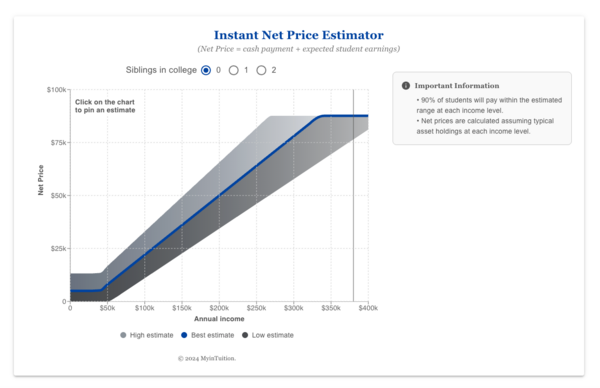
    A chart showing price

    A demo version of Levine’s Instant Net Price Estimator, which can be customized to fit colleges’ specific needs and profiles.

    Screenshot from myintuition.org

    Q: I assume the calculator doesn’t factor in things like merit aid?

    A: You want it as simple as possible. So you just slide your input and it essentially just tells you what the average cost is going to be for you based on income, and tells you the range, which may be very broad. At Washington University, they don’t give a lot of merit aid, so, like, it would not be a big deal there, but at schools that do a lot of merit aid, that range could also include merit. They can factor that into the calculator.

    But mainly, you just want the light bulb to go off of, “Oh, maybe I can afford this.” And then maybe they’re willing to go spend some time reading instead of getting scared off right from the start. Their initial instinct is, there’s no way I can afford to go to Washington University. And it’s the school’s job in terms of marketing to communicate to people. The problem, in my mind, is that the door is closed so early for so many people that you need to be able to just let them get through that first door in the process. There’s still a lot of hurdles you have to get through after that, yeah, but if you don’t make it through the first one, you don’t even approach any of the others.

    Q: There’s been legislation introduced at the federal level and passed in many states to mandate that colleges take certain steps toward cost transparency. Do you think there’s a good understanding of what that takes among policymakers?

    A: Clearly, policymakers have figured out that transparency is an issue, and they’re right. But their intentions are often better than their proposals. The net price calculator law [a federal law mandating institutions include a price calculator on their websites by 2011], for instance, was very well intended. But it’s easy to see the big picture problem; to then come up with a solution that actually works, you have to have a little bit more inside baseball. The net price calculator law is a perfect example. It was so well intended, they completely had the right idea, and they blew it. I obviously don’t know all of the details of all the different state laws, but I’ve seen proposals, and generally I look at them and go, right idea, wrong solution.

    Q: Have there been any good policy solutions?

    A: The College Cost Transparency Initiative. It’s much better if the schools can fix this problem on their own, because they know what they’re doing. It’s a tiny step, and you have to already apply and get accepted before you get your letter. And then it tells you, in a more clear way than it used to. It’s lower on the funnel, really at the bottom. But it’s a good step.

    [Levine later clarified that he sat on the technical advisory committee for the CCTI.]

    Q: Has there been a lot of interest in your instant price calculator from other colleges? And what kinds of colleges seem to be most invested in these transparency efforts?

    A: Nineteen more colleges will roll it out in the fall. It’s a small range right now, from relatively wealthy to very wealthy. I think at the very high end of higher ed, the Ivies and such, where they have a lot of money to spend on financial aid, they’re trying to increase access in a very direct way. It is good for them to enroll more lower-income students from a public relations perspective. And I think every school wants to do the right thing. But as you stray from the very top of the spectrum, there’s also an interest in simply increasing enrollment, where they don’t want to be turning away students because they think they can’t afford it when they can. They’re just looking for more students, especially because there’s fewer kids. So the ability to open the door to as many kids as possible at this moment has appeal.


    Source link

  • Effective academic support requires good data transparency

    Effective academic support requires good data transparency

    Academic support for students is an essential component of their academic success. At a time when resources are stretched, it is critical that academic support structures operate as a well-oiled machine, where each component has a clearly defined purpose and operates effectively as a whole.

    We previously discussed how personal and pastoral tutoring, provided by academic staff, needs to be supplemented by specialist academic support. A natural next step is to consider what that specialist support could look like.

    A nested model

    We’ve identified four core facets of effective academic support, namely personal tutoring (advising/coaching/mentoring etc), the development of academic skills and graduate competencies, all supported by relevant student engagement data. The nested model below displays this framework.

    We also suggest two prerequisites to the provision of academic support.

    Firstly, a student must have access to information related to what academic support entails and how to access this. Secondly, a student’s wellbeing means that they can physically, mentally, emotionally and financially engage with their studies, including academic support opportunities.

    Figure 1: Academic support aspects within a student success nested model

    Focusing on academic support

    Personal tutoring has a central role to play within the curriculum and within academic provision more broadly in enabling student success.

    That said, “academic support” comprises much more than a personal tutoring system where students go for generic advice and support.

    Rather, academic support is an interconnected system with multiple moving parts tailored within each institution and comprising different academic, professional and third-space stakeholders.

    Yet academics remain fundamental to the provision of academic support given their subject matter expertise, industry knowledge and their proximity to students. This is why academics are traditionally personal tutors and historically, this is where the academic support model would have ended. Changes in student needs means the nature of personal tutoring has needed to be increasingly complemented by other forms of academic support.

    Skills and competencies

    Academic skills practitioners can offer rich insights in terms of how best to shape and deliver academic support.

    A broad conception of academic skills that is inclusive of academic literacies, maths, numeracy and stats, study skills, research and information literacy and digital literacy is a key aspect of student academic success. Student acquisition of these skills is complemented by integrated and purposeful involvement of academic skills practitioners across curriculum design, delivery and evaluation.

    Given regulatory focus on graduate outcomes, universities are increasingly expected to ensure that academic support prepares students for graduate-level employability or further study upon graduation. Much like academic skills practitioners, this emphasises the need to include careers and employability consultants in the design and delivery of integrated academic support aligned to the development of both transferable and subject-specific graduate competencies.

    Engaging data

    Data on how students are participating in their learning provides key insights for personal tutors, academic skills practitioners and colleagues working to support the development of graduate competencies.

    Platforms such as StREAM by Kortext enable a data-informed approach to working with students to optimise the provision of academic support. This holistic approach to the sharing of data alongside actionable insights further enables successful transition between support teams.

    Knowing where the support need is situated means that these limited human and financial resources can be directed to where support is most required – whether delivered on an individual or cohort basis. Moreover, targeted provision can be concentrated at relevant points over the academic year. Using engagement data contributes to efficiency drives through balancing the provision of information and guidance to all students. The evidence shows it’s both required and likely to prove effective.

    Academic support is increasingly complicated in terms of how different aspects overlap and interplay within a university’s student success ecosystem. Therefore, when adopting a systems-thinking approach to the design and delivery of academic support, universities must engage key stakeholders, primarily students, academic skills practitioners and personal tutors themselves.

    A priority should be ensuring varied roles of academic support providers are clearly defined both individually and in relation to each other.

    Similarly, facilitating the sharing of data at the individual student level about the provision of academic support should be prioritised to ensure that communication loops are closed and no students fall between service gaps.

    Given that academic support is evolving, we would welcome readers’ views of what additional aspects of academic support are necessary to student success.

    To find out more about how StREAM by Kortext can enable data-informed academic support at your institution, why not arrange a StREAM demonstration.

    Source link

  • How colleges can improve financial transparency in fee payments

    How colleges can improve financial transparency in fee payments

    Effective higher education fee management maximizes revenue, reduces losses, and builds confidence with students and parents. However, 65% of institutions lose money owing to obsolete, manual processes (EDUFinance 2024). This is where student fees collection software shines.

    Let’s look at 10 data-driven strategies to improve student fee collection software for transparency and efficiency.


    Why Modern Student Fees Collection Software Matters

    Did you know 37% of college finance teams track fees using spreadsheets, which can lead to errors and miscalculations (Campus Finance Survey, 2024)? Student finance cloud technologies automate complex operations, reduce manual errors, and offer a transparent, real-time financial environment.


    How colleges can improve financial transparency in fee payments? 10 proven ways. 


    1. One seamless student registration and data sync

    Create comprehensive student profiles automatically matched with student information systems (SIS) including demographic data, course information, and financial details. Institutions running linked data systems report 23% faster fee processing.


    2. Clearly structured fees

    Fee breakdowns cause 48% of parents to argue (EdTech Insights, 2023). Flexible fees per department, course, or service offer upfront transparency and easier payments.


    3. Channel-wide fee collection automation

    Students prefer mobile payments 72% (Higher Ed Payment Trends, 2024). Make websites, mobile apps, and self-service portals accept rapid payments. Automated schools collected fees 27% faster and missed 15% fewer.


    4. Fine automation, absenteeism tracking

    Establish absenteeism and late payment penalties. Automation has reduced fee defaulters by 19% and ensures regular sanctions without manual follow-up.


    5. Role-based security to protect finances

    Role-based access control is non-negotiable even if 63% of higher education institutions report financial intrusions (EduCyberReport, 2024). Minimizing fraud and mistakes, only authorised staff should handle fee data.


    6. Parent portals for real-time fee visibility

    Parents demand more financial participation in their children’s education (82%, ParentPulse Survey, 2024). Parents receive transparent information regarding dues, invoices, and payment schedules via a portal, decreasing late payments.


    7. Automatic fee calculations for billing free of errors

    Errors in manual fee computation affect institutions’ annual income up to 4%. Calculate fees automatically using pre-defined criteria to guarantee correct, current billing for every student.


    8. Waivers, fee concessions, and flexible payment options

    Offer waivers, discounts, and flexible payment arrangements without any confusion on the back end. Supporting financially challenged students with structured payment plans resulted in 12% higher retention rates for colleges that have implemented this approach.


    9. Automatic fee reminders for on-time payments

    According to EduFinance Insights (2024), overlooked reminders account for 43% of late payments. Send automated fee reminders via email, SMS, and push notifications to significantly reduce the number of late payments.


    10. Real time financial transparency reports

    Access transaction history, income breakdowns, and outstanding amounts instantly. Real-time reporting improved financial forecasting and reconciliation for 89% of finance directors.


    The Bottom Line: Future-Proof Your Fee Management with Creatrix Campus

    Why let outdated processes drain your institution’s revenue? With Creatrix Campus Fee Management Software, higher education institutions can achieve:

    • Faster fee collection with automation and mobile payments
    • Enhanced financial transparency for students, parents, and administrators
    • Stronger security with role-based access and encrypted data
    • Real-time insights for smarter, data-driven financial decisions

    Ready to transform your fee collection process? Let Creatrix Campus help you boost efficiency, ensure transparency, and future-proof your institution’s financial operations.

    Source link

  • House Democrats push for Education Department closure transparency

    House Democrats push for Education Department closure transparency

    This audio is auto-generated. Please let us know if you have feedback.

    Dive Brief:

    • Democrats on the House Education and Workforce Committee introduced a resolution on Friday calling for transparency and information from the Trump administration and U.S. Secretary of Education Linda McMahon on their efforts to shutter the U.S. Department of Education.
    • Specifically, the resolution requests unredacted copies of all documents from the administration that refer to the Education Department’s closure, including decisions around workforce reductions and those that could affect the agency’s ability to carry out education laws like the Individuals with Disabilities Education Act and the Elementary and Secondary Education Act.
    • The resolution will be taken to the House floor for a vote if the Education and Workforce Committee, led by Chair Tim Walberg, R-Mich., does not adopt it within 14 legislative days.

    Dive Insight:

    The resolution’s introduction comes one day after President Donald Trump signed an executive order directing McMahon to close the Education Department to the “maximum extent appropriate and permitted by law.”

    “Abolishing a federal agency requires an Act of Congress,” said Rep. Bobby Scott, D-Va., ranking member of the House Education and Workforce Committee, in a Friday statement. “President Trump’s executive order has little regard for the irreparable harm it will cause to students, educators, our future workforce, and parents, who are already struggling.”

    After the Trump administration announced massive layoffs that cut the Education Department’s workforce in half earlier this month, the agency has denied that its key functions would be impacted.

    “Closing the Department does not mean cutting off funds from those who depend on them — we will continue to support K-12 students, students with special needs, college student borrowers, and others who rely on essential programs,” said McMahon in a Thursday statement praising the executive order.

    Additionally, Trump said before signing Thursday’s executive order that he plans to redistribute the department’s primary responsibilities to other parts of the government. That includes Pell Grants, Title I funding and resources for students with disabilities, he said. 

    The resolution introduced Friday appears to be part of a broader effort by Democrats in the House and Senate to challenge and seek more information over the slew of changes being made to the Education Department. 

    On March 17, leading Democrats on the congressional appropriations committees demanded details on the Education Department’s mass layoffs in a letter to the agency. The requested information included details on the number of staff terminated in each office and the expected savings from the staffing cuts.

    Source link

  • Another reprieve for gainful employment, financial value transparency reporting deadline

    Another reprieve for gainful employment, financial value transparency reporting deadline

    This audio is auto-generated. Please let us know if you have feedback.

    Dive Brief:

    • The U.S. Department of Education is extending the reporting deadline for the gainful employment and financial value transparency regulations to Sept. 30, according to an agency announcement last week. 
    • The seven-month extension aims to give college officials more time to submit the required information and to allow institutions that have already sent in their data to make corrections. 
    • The Education Department has pushed back the reporting deadline several times amid concerns that colleges didn’t have enough time or guidance to provide the data required under the new regulations. This extension, the first one under the Trump administration, will be the last, the announcement said.

    Dive Insight:

    The Education Department originally asked colleges to submit the gainful employment and financial value transparency data by July 2024, but higher education institutions requested more time given last year’s bumpy rollout of the revamped Free Application for Federal Student Aid. 

    The Biden administration released final gainful employment and financial value transparency regulations in 2023. 

    Under the gainful employment rules, career education programs must prove that their graduates earn enough money to pay off their student loans and that at least half of them make more than workers in their state who only have high school diplomas. Programs that fail those tests risk losing their access to Title IV federal financial aid. 

    Although the financial value transparency regulations don’t threaten federal financial aid, they create new reporting requirements for all colleges. Under the rule, the Education Department will post data collected from institutions about their programs — such as costs and debt burdens — on a consumer-facing website to help students make informed decisions about their college attendance. 

    The Biden administration extended the deadline for reporting requirements three times. Despite the delays, Education Department officials said late last year that they still expected to produce data in the spring to help students select their colleges. 

    With its latest announcement, the Trump administration’s Education Department is delaying that timeline also. 

    “The Department does not plan to produce any FVT/GE metrics prior to the new deadline and will take no enforcement or other punitive actions against institutions who have been unable to complete reporting to date,” it said. 

    It’s so far unclear how the Trump administration will handle the gainful employment regulations. In President Donald Trump’s first term, then-Education Secretary Betsy DeVos rescinded the Obama-era version of the rules, saying they unfairly targeted the for-profit college sector. 

    The Education Department is facing at least one lawsuit over the Biden administration’s version of the gainful employment rule. However, a federal judge earlier this month paused legal proceedings for 90 days after the new administration sought more time “to become familiar with and evaluate their position regarding the issues in the case,” according to court documents.

    The National Association of Student Financial Aid Administrators — one of the organizations that pushed for a delay — applauded the move to extend the regulatory reporting deadline.

    The change “is a sensible and welcome decision that will give financial aid offices much needed breathing room while they navigate unresolved issues in submitting their data and make necessary corrections to ensure the data they submit is accurate,” NASFAA Interim President and CEO Beth Maglione said in a statement last week.

    Source link

  • Federal Agencies Issue Proposed Rule on Pay Equity and Transparency for Federal Contractors – CUPA-HR

    Federal Agencies Issue Proposed Rule on Pay Equity and Transparency for Federal Contractors – CUPA-HR

    by CUPA-HR | February 14, 2024

    On January 30, the Department of Defense, General Services Administration, and NASA issued a proposed rule to amend the Federal Acquisition Regulation (FAR) to create a salary history ban and require pay transparency during the hiring process for federal contractors and subcontractors. The proposed rule aligns with the Biden administration’s 2022 Executive Order, “Advancing Economy, Efficiency, and Effectiveness in Federal Contracting by Promoting Pay Equity and Transparency.”

    According to the proposed rule, the FAR would be amended to implement a government-wide policy that would:

    1. prohibit contractors and subcontractors from seeking and considering job applicants’ previous compensation when making employment decisions about personnel working on or in connection with a government contract (“salary history ban”); and
    2. require these contractors and subcontractors to disclose on job announcements the compensation to be offered (“compensation disclosure” or “pay transparency”).

    The proposed rule comes as many states and localities have recently implemented salary history bans and pay transparency laws. As the Notice of Proposed Rulemaking notes, 21 states, 22 localities, and Washington, D.C., have put bans into place that prohibit employers from asking job applicants for their salary, and 10 states have pay transparency laws in place, with several other states working toward implementing such laws.

    The agencies have provided a 70-day comment period for the proposed rule, closing on April 1. Stakeholders are invited to submit comments on their support for or opposition to the provisions of the proposed rule. CUPA-HR will monitor for additional updates on this proposed rule and other policy initiatives at the federal level as they relate to pay transparency and salary history bans.


    Source link