Tag: TRAP

  • American Higher Education and the Debt Trap

    American Higher Education and the Debt Trap

    They call it a “path to opportunity,” but for millions of students and their families, American higher education is just Flirtin’ with Disaster—a gamble with long odds and staggering costs. Borrowers bet their future on a credential, universities gamble with public trust and private equity, and the system as a whole plays chicken with economic and social collapse. Cue the screeching guitar of Molly Hatchet’s 1979 Southern rock anthem, and you’ve got a fitting soundtrack to the dangerous dance between institutions of higher ed and the consumers they so aggressively court.

    The Student as Collateral

    For the last three decades, higher education in the United States has increasingly behaved like a high-stakes poker table, only it’s the students who are holding a weak hand. Underfunded public colleges, predatory for-profits, and tuition-hiking private universities all promise upward mobility but deliver it only selectively. The rest? They leave the table with debt, no degree, or both.

    Colleges market dreams, but they sell debt. Americans now owe more than $1.7 trillion in student loans. And while some elite schools can claim robust return-on-investment, most institutions below the top tiers produce increasingly shaky value propositions—especially for working-class, first-gen, and BIPOC students. For them, education is often less an elevator to the middle class than a trapdoor into a lifetime of wage garnishment and diminished credit.

    Institutional Recklessness

    Universities themselves are no saints in this drama. Fueled by financial aid dollars, college leaders have expanded campuses like land barons—building luxury dorms, bloated athletic programs, and administrative empires. Meanwhile, instruction is increasingly outsourced to underpaid adjuncts, and actual student support systems are skeletal at best.

    The recklessness isn’t limited to for-profits like Corinthian Colleges, ITT Tech, and the Art Institutes, all of which collapsed under federal scrutiny. Even brand-name nonprofits—think USC, NYU, Columbia—have been exposed for enrolling students into costly, often ineffective online master’s programs in partnership with edtech firms. The real product wasn’t the degree—it was the debt.

    A Nation at the Brink

    From community colleges to research universities, institutions are now being pushed to their financial and ethical limits. The number of colleges closing or merging has skyrocketed, especially among small private colleges and rural campuses. Layoffs, like those at Southern New Hampshire University and across public systems in Pennsylvania, Oregon, and West Virginia, show that austerity is the new norm.

    But the real disaster is systemic. The American college promise—that hard work and higher ed will lead to security—is unraveling in real time. With declining enrollments, aging infrastructure, and increasing political pressure to defund or control curriculum, many schools are shifting from public goods to privatized risk centers. Even state flagship universities now behave more like hedge funds than educational institutions.

    Consumers or Victims?

    One of the cruelest ironies is that students are still told they are “consumers” who should “shop wisely.” But education is not like buying a toaster. There’s no refund if your college closes. There’s no protection if your degree is devalued. And there’s no bankruptcy for most student loan debt. Even federal forgiveness efforts—like Borrower Defense or Public Service Loan Forgiveness—are riddled with bureaucratic landmines and political sabotage.

    In this asymmetric market, the house almost always wins. Institutions keep the revenue. Third-party contractors keep their profits. Politicians collect campaign checks. And the borrowers? They’re left flirtin’ with disaster, hoping the system doesn’t collapse before they’ve paid off the last dime.

    No Exit Without Accountability

    There’s still time to change course—but it will require radical rethinking. That means:

    • Holding institutions and executives accountable for false advertising and financial harm.

    • Reining in tuition hikes and decoupling higher ed from Wall Street’s expectations.

    • Fully funding community colleges and public universities to serve as real social infrastructure.

    • Expanding debt cancellation—not just piecemeal forgiveness—for those most harmed by a failed system.

    • Ending the exploitation of adjunct labor and restoring the academic mission.

    Otherwise, higher education in the U.S. will continue on its reckless path, a broken-down system blasting its anthem of denial as it speeds toward the edge.

    As the song goes:

    “I’m travelin’ down the road and I’m flirtin’ with disaster… I got the pedal to the floor, my life is runnin’ faster.”

    So is the American student debt machine—and we’re all strapped in for the ride.


    Sources:

    • U.S. Department of Education, Federal Student Aid Portfolio

    • “The Trillion Dollar Lie,” Student Borrower Protection Center

    • The Century Foundation, “The High Cost of For-Profit Colleges”

    • Inside Higher Ed, Chronicle of Higher Education, Higher Ed Dive

    • National Center for Education Statistics

    • Molly Hatchet, Flirtin’ with Disaster, Epic Records, 1979

    Source link

  • Higher education should lift students out of poverty – not trap them within it

    Higher education should lift students out of poverty – not trap them within it

    As a former student who benefited from welfare payments, I’ve long been consumed with the educational struggle of students on free school meals (FSM) —the official marker we have of relative poverty.

    That’s why I found recent newspaper headlines in autumn 2024 celebrating “record numbers” of poorer students entering university so troubling. On the face of it, this sounded like welcome progress. But this “record” in fact reflected a grim reality: rising numbers of pupils qualifying for free school meals in a growing bulge of 18-year-olds in the population.

    The government’s framing of the latest university admissions figures as good news was unwittingly celebrating rising levels of poverty. A pupil is eligible for free school meals (FSM) if their parent or guardian receives benefits or earns an annual gross income of £16,190 or less. As of January 2024, a quarter (24.6 per cent) of school pupils in England were on FSM – up from 18 per cent in 2018. This rapid rise meant that in the 2022–23 university intake, around 57,000 FSM students were enrolled (alongside 300,000 non-FSM students).

    The 2022–23 academic year will be remembered for an ignominious distinction – the university progression rate for FSM students declined for the first time since records began in 2005–06. The gap in degree enrolment between FSM and non-FSM students widened to a record-breaking 20.8 percentage points (29 per cent versus 49.8 per cent). A meagre 6.1 per cent of FSM pupils secured places at the UK’s most selective universities.

    These statistics are a damning indictment of our collective failure to uphold the principle that university should be open to all, regardless of background.

    Heating and eating

    This year’s Blackbullion Student Money & Wellbeing Survey, now in its fifth year, brings with it more alarming data, shining a harsh light on the lived realities of these university students. The findings are based on 1200 students, surveyed across the UK. This year they are also categorised by measures of disadvantage, including whether students have been eligible for FSM at any point during their school years.

    Almost three-quarters (72.94 per cent) of FSM students said they’d been too hungry to study or concentrate, compared with 47.32 per cent of their non-FSM peers. Nearly seven in ten (67.82 per cent) said they’d been too cold to focus, avoiding heating their homes because they couldn’t afford it (compared with 42.39 per cent of non-FSM students). They are also much more likely to report not being able to study because they are unable to purchase books. Just under half worry that work commitments get in the way of their study. More than eight in ten worry their final degree grade will be harmed by their lack of money.

    These latest findings lay bare the inequities that scar our higher education system—a system that should lift students out of poverty, not trap them within it. As someone who benefitted from a full maintenance grant during my own time at university, these reports of hunger, cold, and financial stress are heartbreaking. I know what a lifeline financial support can be. My termly cheques were a godsend, enabling me to focus on my studies without having to worry about affording the next meal or keeping the heater on in my room. Shorn of basic support, it’s been little surprise to me that recent waves of FSM students have been far less likely to complete their degrees compared with their better-off counterparts.

    Failure to maintain

    It’s time to reintroduce maintenance grants for FSM students in England as part of the new financial arrangements for universities being considered by the Labour government. The removal of grants in 2016 has meant that FSM students are graduating with the largest loan debts. This could understandably be putting many off applying to higher education in the first place.

    At the same time, maintenance loans should increase with inflation, building on the 3.1 per cent rise already announced for 2025–26, going some way to help all students facing immediate hardship while at university. This would be a fair settlement and mirror similar arrangements in Scotland.

    As education officials brace themselves for the toughest of government spending reviews, I don’t underestimate how hard it will be to fund such a reform. But to fail in this task would be a national travesty, betraying not only these students but also the very principle that a university education should be accessible to all, no matter their background or economic circumstances.

    Source link

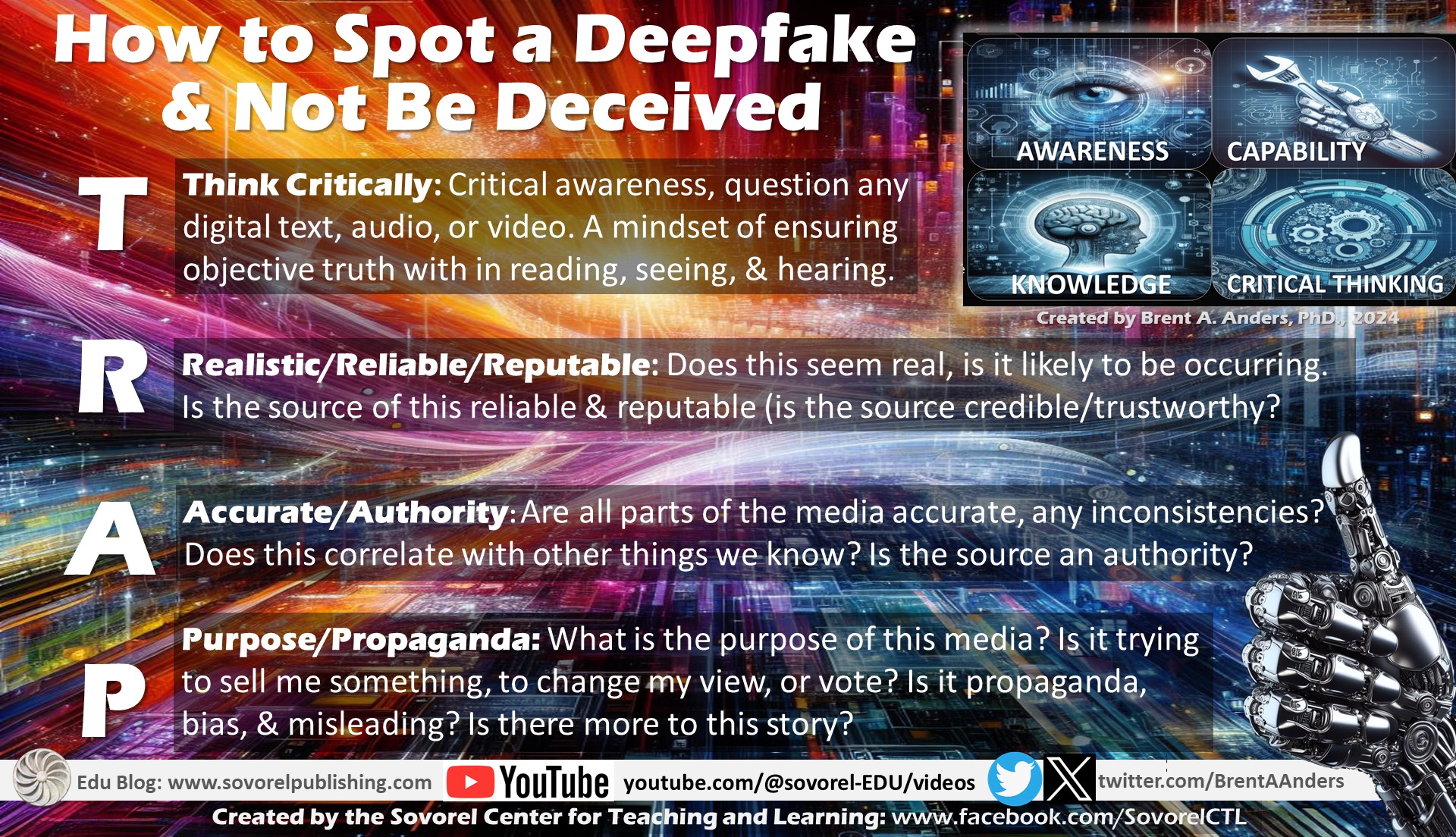
  • The TRAP Test to Spot AI Deepfakes and How to NOT Be Deceived – Sovorel

    The TRAP Test to Spot AI Deepfakes and How to NOT Be Deceived – Sovorel

    Everyone needs to develop AI Literacy skills in order to use AI properly and increase effectiveness/efficiencies, yet another vital part of AI Literacy is to develop critical thinking and awareness skills to avoid being deceived by synthetic data such as AI created deepfakes. Cyber Magazine, an international news source, expressed the importance of this issue by stating:

    Deepfakes are inevitably becoming more advanced, which is making it harder to spot and stop those that are used with bad intentions. As access to synthetic media technology increases, deepfakes can be used to damage reputations, fabricate evidence and undermine trust.

    With deepfake technology increasingly being used for mal-intent, businesses would do well to ensure that their workforce is fully trained and aware of the risks associated with AI-generated content. (Jackson, 2023)

    To address this important issue I have created the TRAP test:

    T: Think Critically. All of us must now have a critical awareness and mindset when using any type of digital media since all digital media can now be easily manipulated and created with generative AI. When encountering any digital text, images, audio, or video we need to realize that it might not be real and it might be trying to manipulate our perception. We need to use the TRAP test to ask further questions to help ensure that we are getting the object truth.

    R: Realistic/Reliable/Reputable: When using digital media or viewing a video, we need to ask ourselves the question “does this seem real and is it likely to occur?” We must also consider whether or not the source of the information is reliable and if it is coming from a reputable source. Is it from an official source, a well known news source, a government agency, or established organization? Always check the source.

    A: Accurate/Authority: Check to see if all parts of the digital media are accurate. As an example, if watching a video, are all parts accurate and consistent. Are there any issues with the eyes, the background, or the light sources? Is it similar and consistent with other videos, images, or text? Additionally, has the media been released or authenticated by an authority? These questions must be verified and answered to help ensure validity and accuracy.

    P: Purpose/Propaganda: When reviewing any digital media we must ask ourselves, “what is the purpose of this media? If the answer is that they are trying to get your money or to sway your vote in an election then you should be extra sure that the information is completely truthful. Ask yourself if the digital information presented is simply just propaganda, full of bias and misleading. Be sure to ask if there is more to the story that you are reading/watching.

    Using the TRAP test and asking these questions will help to prevent everyone from being scammed and/or deceived. Students, faculty, and everyone must develop AI Literacy skills like these.

    All aspect of this defined AI Literacy are important (Anders, 2023), but Awareness and Critical Thinking are key in developing the proper mindset to use the TRAP test. This is something that must be continually developed and used in order to ensure its greatest effectiveness.

    All of us in academia must work to ensure that student and everyone else develop these skills to use AI in the right way and be able to properly spot AI deepfakes and avoid being deceived. Please share this information with colleagues, students, family, and friend; especially the elderly who can at times be even more vulnerable. Together we make a major difference and improve our new world filled with AI.

    A video describing the TRAP test is also available on the Sovorel Educational YouTube channel:

    “How to Spot a Deepfake and NOT Be Deceived” (Anders, 2024)

    Please share your thoughts and comment below:

    References

    Anders, B. (2023). The AI literacy imperative: Empowering instructors & students. Sovorel Publishing.

    Jackson, A. (2023, October 13). The rising tide of deepfakes as AI growth cause concern. Cyber Magazin, Technology: AI. https://cybermagazine.com/technology-and-ai/the-rising-tide-of-deepfakes-as-ai-growth-cause-concern

    Source link