
Tag: tribute

  • A Tribute to Jesse Jackson

    A Tribute to Jesse Jackson

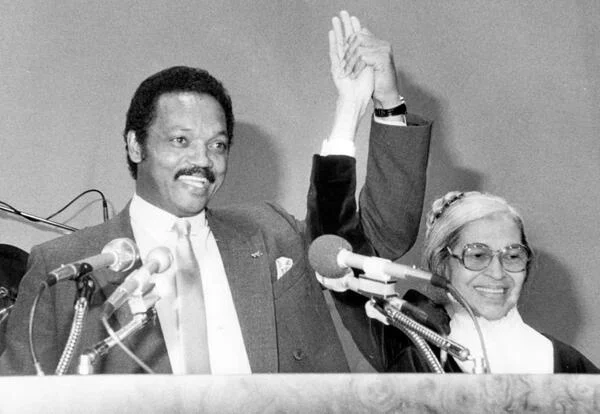
    The Rev. Dr. Martin Luther King Jr. was assassinated at the Lorraine Motel in Memphis, Tenn., on April 4, 1968. Jesse Jackson, his 26-year-old protégé, was there. Photos and videos from that era show Black people being hosed down by police officers, attacked by dogs, humiliated, beaten, bloody and facedown on concrete streets. Jesse Jackson was there.

    Black people were jailed for trying to integrate “whites-only” establishments, for attempting to vote and for sitting with dignity in the front of city buses. Jesse Jackson was there. In fact, he was repeatedly jailed for civil rights protests throughout the 1960s. The first time was when he was an 18-year-old college freshman; he and seven other Black teens were arrested and jailed for reading books at a whites-only public library in Greenville, S.C., Jackson’s birthplace.

    Time and time again throughout adulthood, Jackson was called to scenes all across America where racial injustice had occurred. Too often, Black children, women and men had been murdered. Too many were wrongly convicted of crimes and subjected to cruel circumstances in which they were treated as less than human. Jesse Jackson was there. He saw and experienced this all. And yet, he famously insisted that all Americans, especially Black citizens, “keep hope alive.”

    The Honorable Rev. Jesse Louis Jackson Sr. died. He was 84 years old. How can it be that someone who saw so much evil maintained hope and consistently inspired others to do the same? The King murder would have been enough for most people—they would have lost faith in the racial equality and social justice efforts for which their mentor and dear friend lived, fought and ultimately died.

    Yesterday, one television network referred to “keep hope alive” as a Jackson “catchphrase.” That was a mischaracterization. It was not merely a slogan that became most widely known during his two campaigns for the U.S. presidency. Instead, it was Jackson’s philosophy. It kept him fighting for and believing in justice, even when so much around him could have easily thrust him and others into apathy and hopelessness.

    Constantly calling Jackson to the scene of injustice over decades was sometimes met with critique. “Jesse Jackson doesn’t speak for all Black people” was the shortsighted complaint. Here is the thing: The Rainbow PUSH Coalition founder always spoke for Black people and was one of the most reliable leaders to ever do so. Also praiseworthy is how Jackson consistently answered the calls and showed up. He was there. We need more, not fewer defenders, protectors, ambassadors and freedom fighters like him. Courageous leaders who somehow still believe that our nation is capable of living up to its ideals and promises, in spite of its recurring contradictions and betrayals, are what we desperately need.

    There is a lot happening in the U.S. right now: snatching health care from poor, working class and elderly people; suppressing voting rights, which is guaranteed to disproportionately affect Black citizens; terrorizing immigrants and separating families; and unnecessarily killing unarmed Black people and peaceful protesters. That is just some of it. Jackson saw and experienced even more than this over his lifetime. So then, again, how did he manage to keep hope alive?

    I asked a version of this question to one of my beloved mentors, the legendary Black psychology professor Joseph L. White, who always reminded others and me to “keep the faith.” I still do because he always did, despite all the injustice to which he bore witness over his 84 years on this earth. It is my daily tribute to Dr. White. Henceforth, it will also become my daily tribute to Rev. Jackson.

    CNN NewsNight host Abby Phillip provides insights into Jackson’s philosophy in her 2025 book, A Dream Deferred: Jesse Jackson and the Fight for Black Political Power. Marshall Frady did so as well in his 1996 biography, Jesse: The Life and Pilgrimage of Jesse Jackson. Many other scholars in African American studies, political science and other academic fields have published research that provides windows into Jackson’s faith, optimism and enduring commitment to fulfilling King’s agenda as well as his own vision for America.

    These are tough times for our nation, including its higher education institutions. Surviving this particular moment requires us to be more like Jackson: hopeful, courageous, reliable, consistent, brave and enduring. Undoubtedly, there will be numerous tributes to his life, legacy and massive impact on America and its Democratic Party. But if we really want to honor this colossal civil rights icon, we will do exactly as he instructed: Keep hope alive.
    Shaun Harper is University Professor and Provost Professor of Education, Business and Public Policy at the University of Southern California, where he holds the Clifford and Betty Allen Chair in Urban Leadership. His most recent book is titled Let’s Talk About DEI: Productive Disagreements About America’s Most Polarizing Topics.

    Source link

  • A reflection and a grateful tribute to our field

    A reflection and a grateful tribute to our field

    My last name, Suominen, could translate to Finland. Years ago, while registering for the APAIE conference, I decided to internationalise it. Harry Finland was born. It was practical, memorable, and a little playful.

    Now, at the end of this year, Harry Finland will be no more.

    International education has been my way of living and understanding the world as it could be. It is one of the greatest collective stories of our time: how a single student crossing a border can transform an entire family’s future. How the world rarely changes in political summits, but changes every time young people from different countries become friends.

    After 20 years in this field, I am making one of the biggest shifts of my life and stepping away from the operational role that has shaped almost half of it. I want to write this to you, the PIE community, because this is not just a story about me. It is a story about us.

    From a bulletin board in Finland to a life in Asia

    In 2005, I had completed all my study credits and was preparing to graduate from my alma mater in Finland when I came across a bulletin board ad about studying in Shanghai as a freemover. I postponed my graduation by six months and travelled to Asia for the first time in my life.

    I didn’t know how deeply I would be bitten by the ‘Asian Fly’ – or how that decision would open the door to everything that later became a startup, a lifestyle, or simply my life. I didn’t know it would lead to already 17,000 life-changing student experiences from 130 countries. I didn’t know I would meet my Finnish wife, Susanne, under the Thailand sun. I didn’t know our two creations, Asia Exchange and Edunation, would one day find a home at Keystone Education Group.

    But I did have a quiet intuition that would later become our motto: the further you go, the more you grow.

    What makes this community extraordinary

    If there is one message I hope remains from my story, it is this: I never did anything alone. Asia Exchange was built with my high-school friend, Tuomas Kauppinen. Edunation was built with Tuomas and Susanne.

    And in 2024 Keystone became a home where our vision can expand and our impact deepen. None of this would be possible without the strength of our teams: people who work with heart, and who believe in the mission.

    This field is full of people who continue to care. And that is not a given in a world driven by efficiency, data points, and deadlines.

    But you, my dear colleagues:
    • listen to the student who has no one else
    • build programs whose impact is measured in decades, not quarters
    • believe in collaboration when division often feels more likely
    • work relentlessly so young people can realise their once-in-a-lifetime opportunities

    The work you do transforms individuals, institutions, countries, and entire societies.

    Five lessons learned from a life spent enabling study abroad

    As I stand between an ending and a beginning, I can summarize my journey in five reflections that explain why everyone should study abroad:

    1. Understanding the world and other people: studying abroad dismantles simplistic thinking. It teaches how to live alongside different values, beliefs, and ways of life. It builds empathy and cultural intelligence. These skills are essential for leadership and for preventing conflicts. I truly believe studying abroad can even prevent wars from happening. Imagine if today’s leaders of the major nations had grown up with these skills…
    2. Independence and resilience: Living and studying in a foreign country forces individuals to take responsibility for themselves. Navigating bureaucracy, language barriers, and uncertainty develops resilience, problem-solving skills, and confidence.
    3. Global competence and employability: students develop abilities that cannot be gained at home alone: working in multicultural teams, adapting quickly, communicating across cultures, and thinking globally.
    4. Lifelong networks: Studying abroad creates exceptionally strong human connections. The relationships built in transformative moments become lifelong friendships, collaborations, and opportunities.
    5. A deeper sense of identity: stepping outside one’s home culture helps individuals understand who they are and what they value. Studying abroad strengthens roots; it does not weaken them.

    In short, studying abroad may be the most meaningful experience a student ever has. You and your colleagues are the enablers of this.

    My mission in this field was always about building and enabling impact. Now it is time to step aside and allow a new chapter of my life to unfold. What it will be, I do not yet know. Hopefully something meaningful.

    Thank you.

    To the PIE community, colleagues, partners, students, and friends: thank you.
    You have turned this field into a movement that keeps growing, even as the world becomes more complex.

    The mission continues every time a student boards a plane, makes a friend abroad, or discovers a new version of themselves. It continues in the organisations we built, and especially in the people who are behind those organisations.

    Borders may divide countries, but they never stand a chance against people who dare to cross them.

    Thank you for letting me be part of this. Thank you for making this the most meaningful chapter of my life. Keep going. The world needs you.

    Staying curious,

    Harri Suominen
    Co-founder, Asia Exchange and Edunation (Keystone companies)
    From Finland, based in Malaysia

    Source link