Key points:
I know what it feels like to stand in front of a classroom that does not have enough. Not enough computers. Not enough up-to-date software and technical tools. Not enough resources to give every student the experience they deserve. When students notice these gaps, they notice more than the missing tools. They begin to question whether their education and, by extension, their potential really matters. That doubt can quietly drain their confidence.
This is why dependable resources are not simply a bonus in education. They are a lifeline. In my role leading the Scholastic Esports Academy in the Five Carat Choice Program at Palm Beach Lakes High School, I have watched how access to quality equipment and meaningful project-based learning transforms students from the inside out. It is not only about what they learn but about how they begin to see themselves.
I have been fortunate to develop partnerships with organizations like Cleverlike Studios, changing the game for my students by bringing advanced technology and creativity directly into the classroom. For example, they learned how to create new characters for Minecraft and designed custom esports jerseys for their Minecraft characters. Students were engaged while learning in games they know and love. These experiences allow them to express their creativity and see their ideas come to life while building complex skills such as coding, digital media, and game design.
When students make the leap from simple play to design, careers in technology and digital media suddenly seem accessible, even if they have never seen themselves in these fields before. Scholastic esports is an avenue within the educational landscape that merges the captivating realm of the video game industry with project based learning and educational objectives. It capitalizes on students’ existing interests for STEM subjects, including gamification, digital media, robotics, and financial literacy, directing them towards a structured and educational setting.
In just five years, the Palm Beach Lakes Scholastic Esports Academy has grown from a small club of ten students to more than five hundred, becoming a full CTE academy that operates both during the school day and after school. Through this experience, students are earning four to five industry certifications along their four year pathway. Their success demonstrates what happens when resources are reliable, relatable, and creativity is encouraged. Students are now able to see themselves in real time through 3D models and their own digital designs, creating new characters for Minecraft and customizing their own esports jerseys.
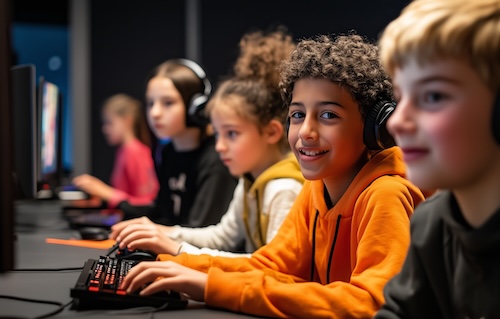
Recognizing this success, the Pew Foundation invested nearly $500,000 to expand our infrastructure and transform the program from an after school club into a full daytime classroom experience, creating even greater opportunities for growth and student success. Now, when our students walk into the Esports classroom, they enter a space built around their passions. They see powerful gaming computers, professional streaming equipment, and projects that speak their language. Suddenly, the skills they once thought were only for others become reachable. They begin to realize that their love for video games, robotics, and digital media can open doors to real world careers and college opportunities.
The results speak for themselves:
- In FY23 Palm Beach Lakes High School used a Pew Grant to launch the esports course and compared outcomes with a matched group of students.
- Students who participated in esports had significantly lower rates of in-school or out-of-school suspension, with about half as many incidents as their non-esports peers.
- Absenteeism among esports students was also slightly lower.
- While GPA and certification pass rates were similar, the behavioral improvements were clear and meaningful.
These numbers match what I see every day. Students who once struggled to stay engaged now show up early to practice. They stay late to collaborate. They treat each other with a level of respect and teamwork that carries over into their other classes.
None of this would be possible without reliable and relatable resources that connect directly to students’ interests and experiences. In a Title I school, these tools make learning meaningful by turning abstract ideas into hands-on projects that students can see, touch, and create. Expanding their minds through hands-on learning and project based materials from companies like Cleverlike Studios, our students gain access to educational tools that connect classroom lessons to real world applications. Coding challenges, game design projects, and digital media activities inspire creativity, critical thinking, and collaboration. Most importantly, this work helps students see that their ideas and talents have value and that their creativity can open doors to future opportunities.
For many of my students’ resources have always been scarce. But in the Scholastic Esports Academy they find more than equipment. They find opportunity. They discover that their skills have value beyond the game and that their voices and ideas matter. They begin to picture themselves as leaders in technology, media, and STEM fields.
Student Alyssa Chavez said, “Last year, we completed an assignment to design a jersey for our esports teams to wear on Minecraft. The Esports Jersey assignment was very helpful and even inspiring to me because it helped me learn to adapt and appeal to the suggestions and requirements that a client or partner would want me to apply to a project. The use of the Blockbench program helped me to understand the importance of knowing how to navigate and use a program to do my best work for certain projects. When making the jersey, I took the elements and colors of our ‘Retro Rams’ branding and applied them to the jersey to create a design that represents unity and teamwork, showcasing the unity of our esports team.”
This is why I believe scholastic esports is not just about gaming. It is about creating a bridge between curiosity and opportunity. It is about giving students in under-resourced communities the confidence to dream bigger and the tools to make those dreams real.
The ongoing success of our academy is proof that when education is supported with vision, dedication, and the right resources, students will rise. We have created a space where learning feels real, where creativity thrives, and where confidence is built through experience. Partners like Cleverlike Studios have played a part in this progress by providing educational tools that enhance what we do every day. Together, we are demonstrating that reliable and relatable learning environments not only inspire achievement but also prepare students to succeed beyond the classroom.