Tag: True

  • Is gamification the key to achieving true inclusion in special education?

    Is gamification the key to achieving true inclusion in special education?

    Key points:

    For students with special needs, learning can often resemble a trek through dense woods along a narrow, rigid path–one that leaves little to no room for individual exploration. But the educational landscape is evolving. Picture classrooms as adventurous hunts, where every learner charts their own journey, overcomes unique challenges, and progresses at a pace that matches their strengths. This vision is becoming reality through gamification, a powerful force that is reshaping how students learn and how teachers teach in K–12 special education.

    Personalized learning paths: Tailoring the adventure

    Traditional classrooms often require students to adapt one method of instruction, which can be limiting–especially for neurodiverse learners. Gamified learning platforms provide an alternative by offering adaptive, personalized learning experiences that honor each student’s profile and pace.

    Many of these platforms use real-time data and algorithms to adjust content based on performance. A student with reading difficulties might receive simplified text with audio support, while a math-savvy learner can engage in increasingly complex logic puzzles. This flexibility allows students to move forward without fear of being left behind, or without being bored waiting for others to catch up.

    Accessibility features such as customizable avatars, voice commands, and adjustable visual settings also create space for students with ADHD, autism, or sensory sensitivities to learn comfortably. A student sensitive to bright colors can use a softer palette; another who struggles with reading can use text-to-speech features. And when students can replay challenges without stigma, repetition becomes practice, not punishment.

    In these environments, progress is measured individually. The ability to choose which goals to tackle and how to approach them gives learners both agency and confidence–two things often missing in traditional special education settings.

    Building social and emotional skills: The power of play

    Play is a break from traditional learning and a powerful way to build essential social and emotional skills. For students with special needs who may face challenges with communication, emotional regulation, or peer interaction, gamified environments provide a structured yet flexible space to develop these abilities.

    In cooperative hunts and team challenges, students practice empathy, communication, and collaboration in ways that feel engaging and low-stakes. A group mission might involve solving a puzzle together, requiring students to share ideas, encourage one another, and work toward a common goal.

    Gamified platforms also provide real-time, constructive feedback, transforming setbacks into teachable moments. Instead of pointing out what a student did wrong, a game might offer a helpful hint: “Try checking the clues again!” This kind of support teaches resilience and persistence in a way that lectures or punitive grading rarely do.

    As students earn badges or level up, they experience tangible success. These moments highlight the connection between effort and achievement. Over time, these small wins raise a greater willingness to engage with the material and with peers and the classroom community.

    Fostering independence and motivation

    Students with learning differences often carry the weight of repeated academic failure, which can chip away at their motivation. Gamification helps reverse this by reframing challenges as opportunities and effort as progress.

    Badges, points, and levels make achievements visible and meaningful. A student might earn a “Problem Solver” badge after tackling a tricky math puzzle or receive “Teamwork Tokens” for helping a classmate. These systems expand the definition of success and highlight personal strengths.

    The focus shifts from comparison to self-improvement. Some platforms even allow for private progress tracking, letting students set and meet personal goals without the anxiety of public rankings. Instead of competing, students build a personal narrative of growth.

    Gamification also encourages self-directed learning. As student complete tasks, they develop skills like planning, time management, and self-assessment, skills that extend beyond academics and into real life. The result is a deeper sense of ownership and independence.

    Teachers as learning guides

    Gamification doesn’t replace teachers, but it can help teach more effectively. With access to real-time analytics, educators can see exactly where a student is excelling or struggling and adjust instruction accordingly.

    Dashboards might reveal that a group of students is thriving in reading comprehension but needs help with number sense, prompting immediate, targeted intervention. This data-driven insight allows for proactive, personalized support.

    Teachers in gamified classrooms also take on a new role, both of a mentor and facilitator. They curate learning experiences, encourage exploration, and create opportunities for creativity and curiosity to thrive. Instead of managing behavior or delivering lectures, they support students on individualized learning journeys.

    Inclusion reimagined

    Gamification is not a gimmick; it’s a framework for true inclusion. It aligns with the principles of Universal Design for Learning (UDL), offering multiple ways for students to engage, process information, and show what they know. It recognizes that every learner is different, and builds that into the design.

    Of course, not every gamified tool is created equal. Thoughtful implementation, equity in access, and alignment with student goals are essential. But when used intentionally, gamification can turn classrooms into places where students with diverse needs feel seen, supported, and excited to learn.

    Are we ready to level up?

    Gamification is a step toward classrooms that work for everyone. For students with special needs, it means learning at their own pace, discovering their strengths, and building confidence through meaningful challenges.

    For teachers, it’s a shift from directing traffic to guiding adventurers.

    If we want education to be truly inclusive, we must go beyond accommodations and build systems where diversity is accepted and celebrated. And maybe, just maybe, that journey begins with a game.

    Latest posts by eSchool Media Contributors (see all)

    Source link

  • “We Can’t Make It Here Anymore” Still Rings True

    “We Can’t Make It Here Anymore” Still Rings True

    More than twenty years after James McMurtry released We Can’t Make It Here Anymore, the song’s haunting verses continue to echo across the American landscape. Originally written during the early 2000s under the weight of offshoring, union busting, and post-9/11 disillusionment, McMurtry’s protest ballad has aged not with irrelevance but with renewed urgency.

    McMurtry wrote about Vietnam veterans pushed aside by a society eager to forget its mistakes. Today, those veterans have been replaced by men and women who served in Iraq and Afghanistan—some with missing limbs, some with invisible wounds, many with few job prospects. The system still tells them “thanks for your service” while it sends their factories overseas, their benefits into the shredder, and their children into debt servitude at for-profit colleges or underfunded public universities.

    The song’s refrain—“And the banks run the loan game, and the dollar jumps the track”—has only deepened in meaning in the era of trillion-dollar student loan burdens and the financialization of everything from housing to higher education. Entire zip codes have been gutted by opioid overdoses, job loss, and rising suicide rates. The technology is flashier now, but the despair McMurtry chronicled feels even more entrenched. The “big boys” still “don’t like to lose,” and the factories are still “boarded up,” not just in Michigan and West Virginia, but now in the shadows of elite universities, where campuses flourish while surrounding communities falter.

    Higher education, the supposed equalizer, has played its own part in this disillusionment. Where once it held the promise of upward mobility, it now too often offers low-wage adjunct jobs, debt without degrees, and institutions more concerned with branding and endowments than student welfare. McMurtry sings, “The doctor can’t be reached, he has moved back to LA,” and in 2025, that’s still true—except now the doctor’s been replaced by a telehealth AI, and the local hospital has been bought out by a hedge fund.

    We Can’t Make It Here Anymore is not nostalgia. It is indictment. It is reportage. It is prophecy. And like Woody Guthrie before him, McMurtry tells a story corporate media would rather ignore.

    The song’s last verse ends not with hope, but with observation:

    “Will work for food, will die for oil, will kill for power and to us the spoils.”

    Two decades later, the empire has not changed course. It has just changed spokespeople.

    The names may change—NAFTA to USMCA, Halliburton to BlackRock—but the machinery grinds on. And McMurtry’s anthem remains a soundtrack for those who never made it out of the wreckage, for the veterans of war and labor still trying to make it here.

    Sources

    • James McMurtry, We Can’t Make It Here Anymore, 2004

    • U.S. Department of Labor, Bureau of Labor Statistics

    • U.S. Department of Veterans Affairs

    • National Student Legal Defense Network

    • Higher Education Inquirer archives

    Source link

  • Helping Families See the True Cost of College

    Helping Families See the True Cost of College

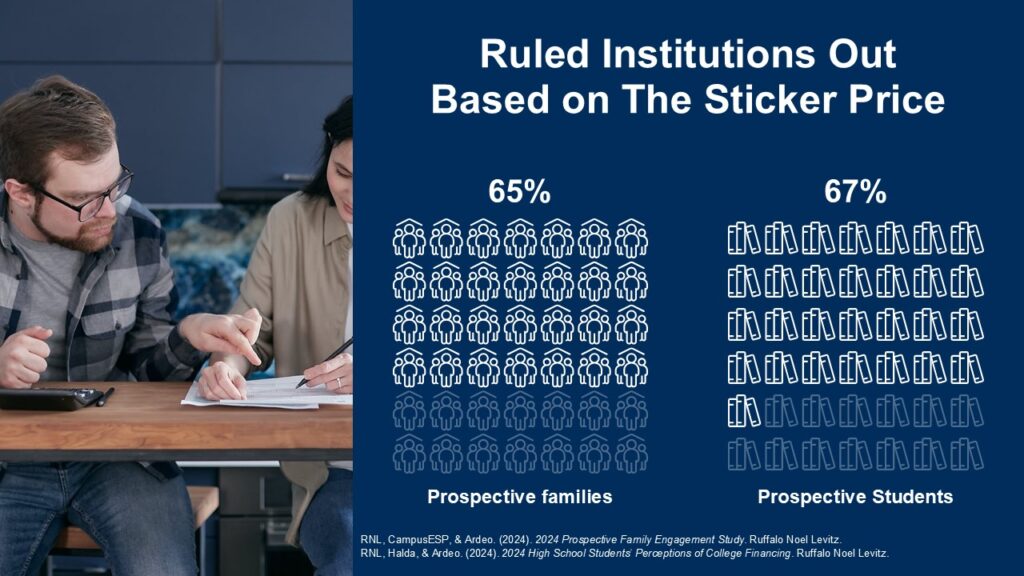
    When it comes to choosing a college, the sticker price can be a major turnoff. A significant 65% of prospective students and 67% of their families report ruling out institutions based solely on the advertised “sticker price”.

    Source: 2024 Prospective Family Engagement Report

    But what does this mean for colleges and universities, and how can they help families look beyond the sticker shock to understand the true affordability of a degree?

    The rising tide of sticker shock

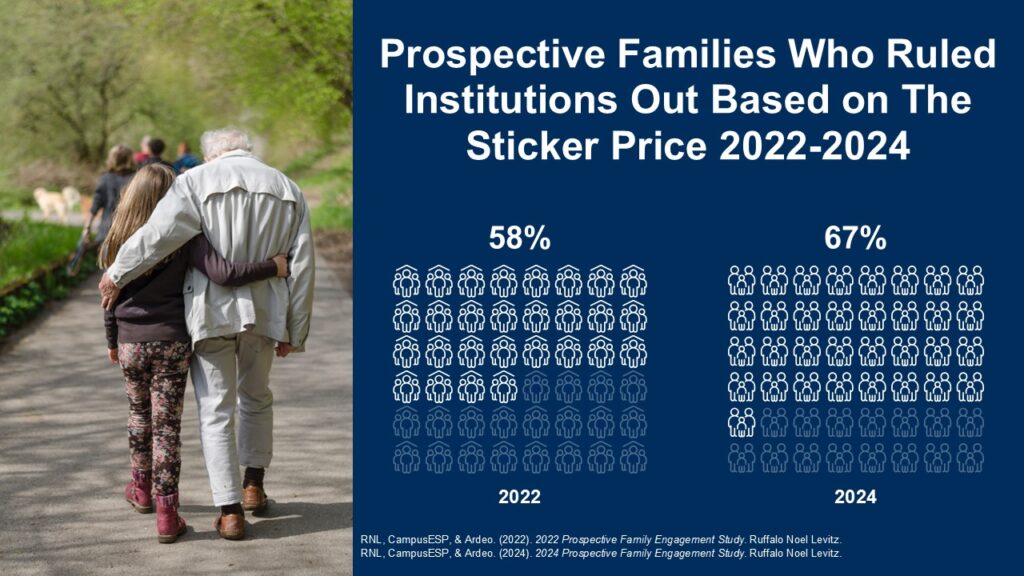
    Chart showing increase in number of families ruling out campuses because of price, from 58% in 2022 to 67% in 2024Chart showing increase in number of families ruling out campuses because of price, from 58% in 2022 to 67% in 2024
    Sources: 2024 Prospective Family Engagement and 2022 Prospective Family Engagement reports


    Ruling out colleges based on the sticker price is on the rise – and it’s happening fast. In just three years, the percentage of families eliminating schools from consideration due to high upfront costs has jumped from 58% in 2022 to 67% in 2024.

    This suggests that concerns about affordability are increasingly driving the college planning process, with families taking a hard look at the bottom line before even exploring other factors. But is this sticker shock reaction always a rational response, or might colleges be losing out on applicants who could afford to attend with the help of financial aid?

    The generational divide

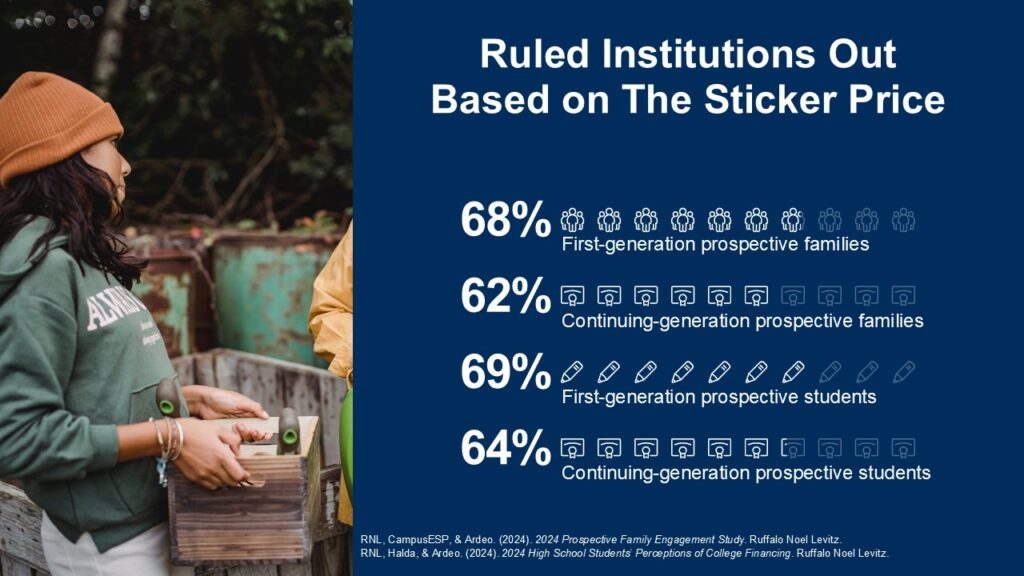
    Chart showing that that nearly 70% of first generation students and families have ruled out an institution based on price.Chart showing that that nearly 70% of first generation students and families have ruled out an institution based on price.
    Sources: 2024 Prospective Family Engagement and 2024 High School Students’ Perceptions of College Financing

    A notable divide emerges when comparing the sticker shock responses of first-generation college students to their continuing-generation peers. A full 69% of first-generation students reported ruling out schools based on sticker price, compared to 64% of continuing-generation students.

    This disparity is also reflected in families’ perceptions, with 68% of first-generation families eliminating schools due to cost versus 62% of continuing-generation families. This could suggest that first-generation students and families are less familiar with the intricacies of college financing and the crucial distinction between sticker and net price.

    As a result, they may be more likely to focus on the daunting upfront cost without fully exploring the available aid options. How can colleges better reach, educate, and support these first-generation students about affordability to prevent them from ruling out institutions that could be a great fit financially and academically?

    The role of family involvement

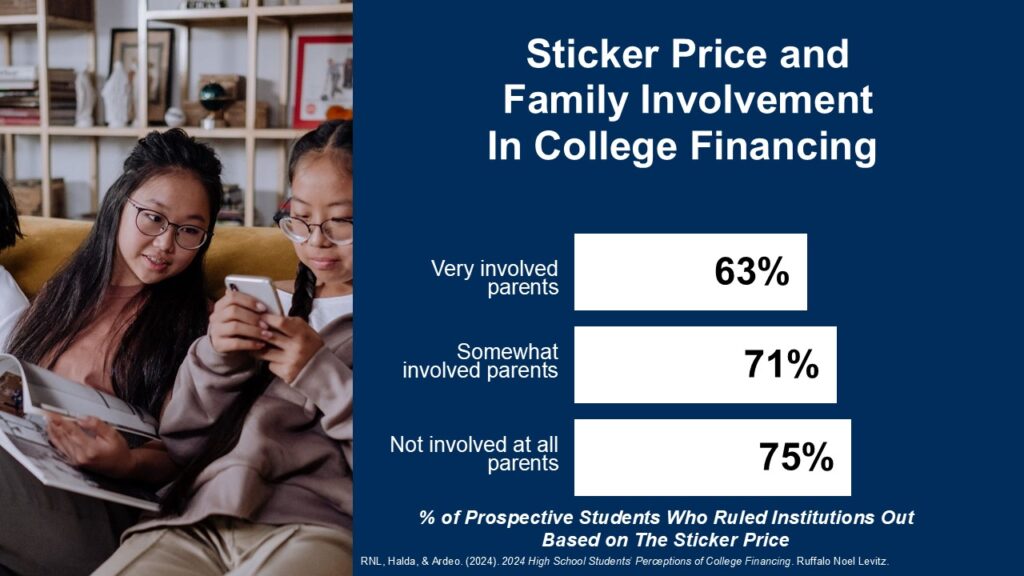
    Chart showing that 75% of students whose families are not involved in college planning will rule out an institution based on sticker price.Chart showing that 75% of students whose families are not involved in college planning will rule out an institution based on sticker price.
    Source: 2024 High School Students’ Perceptions of College Financing

    The level of family involvement in the college search process also plays a role in sticker shock decisions. Students with very involved parents were less likely to rule out colleges based on sticker price (63%), suggesting that parental guidance may help applicants look beyond the initial cost to consider the bigger financial picture.

    But what about students with less involved parents? A striking 75% of students with uninvolved parents ruled out colleges based on sticker price. How can colleges step in to provide the necessary counseling and education about affordability for these applicants?

    Loan anxiety and sticker shock: A shared concern for students and families

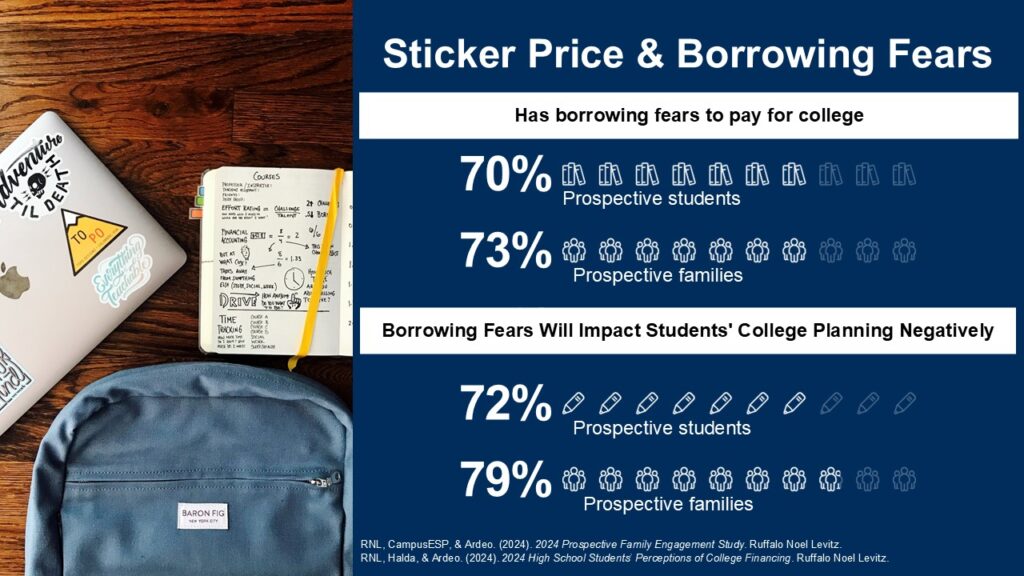
    For both students and their families, concerns about loan debt play a significant role in the sticker shock equation. A striking 70% of students who expressed concerns about borrowing to finance their education were more likely to rule out colleges based on high prices. Families share this loan anxiety – 73% of families with loan concerns reported ruling out institutions based on sticker price. This underscores the need for colleges to address loan concerns head-on through transparent communication about financing options, debt management strategies, and a degree’s long-term return on investment.

    Chart showing more than 70% of students have fears about borrowing to pay for college.Chart showing more than 70% of students have fears about borrowing to pay for college.
    Source: 2024 High School Students’ Perceptions of College Financing

    By providing reassurance and resources, institutions can help applicants feel more comfortable with the financial commitment and less likely to rule out schools due to initial sticker shock. Importantly, 72% of students and 79% of families reported that their borrowing concerns were negatively impacting their college planning, suggesting that proactive support from institutions is crucial in mitigating loan anxiety and promoting a more holistic view of affordability.

    The net price imperative

    While sticker price can be a major deterrent, the actual net price of attendance paints a very different picture. Institutions must do a better job of clearly communicating net price information to prospective students and families.

    This means highlighting available aid, scholarships, and financing options to demonstrate affordability. Tools like net price calculators can be powerful in helping applicants understand the true cost of attendance. But are these resources being effectively utilized and communicated to offset the sticker shock reaction?

    To help families and students look beyond sticker shock, institutions can take the following steps:

    1. Clearly communicate net price information: Highlight the difference between sticker price and net price on your website and in recruitment materials.
    2. Provide transparent financing information: Break down the costs of attendance and explain financing options in clear, easy-to-understand language.
    3. Offer user-friendly net price calculators: Help families estimate their actual out-of-pocket costs with interactive net price calculators.
    4. Proactively counsel about aid: Don’t wait for families to ask – offer personalized financial aid counseling to prospective students.
    5. Address loan anxiety: Provide resources and guidance to help students and families understand responsible borrowing and debt management.
    6. Highlight value beyond price: Showcase the long-term value and outcomes of a degree from your institution to demonstrate the return on investment.
    7. Partner with high schools: Collaborate with high school counselors to provide early education about college financing and affordability.
    8. Target outreach to first-gen students and their families: Recognize that first-generation students may need additional support and education about the college financing process.
    9. Follow up with sticker-shocked applicants: If a student expresses interest but seems deterred by the sticker price, proactively reach out with information about aid and affordability options.
    10. Leverage video and AI to personalize the process: Use video content and artificial intelligence tools to provide personalized, interactive explanations of financial aid and affordability. AI-powered chatbots can offer 24/7 support to answer families’ financing questions, while personalized video messages can break down complex aid packages in an easy-to-digest format. By embracing these technologies, institutions can create a more engaging, self-service-oriented experience that empowers families to confidently navigate the affordability landscape.

    The bottom line and more findings from our Perceptions report

    The sticker shock phenomenon is a real and growing concern in college admissions. However, by understanding the factors that drive these decisions and taking proactive steps to educate families, colleges can help prospective students see beyond the advertised tuition rate to consider the true affordability of a degree. This requires a nuanced understanding of the college financing landscape and a commitment to clear, transparent communication. With the right approaches, institutions can attract diverse applicants who may have otherwise been deterred by sticker shock.

    You can read more insights and findings in the 2024 High School Students’ Perceptions of College Financing report, co-sponsored by our partners Ardeo and Halda. This report captures data from a survey of more than 2,100 11th- and 12th-grade students. Read it now.

    Source link

  • Go Higher – a true sense of community and support, by Skye Brocklebank – ALL @ Liverpool Blog

    Go Higher – a true sense of community and support, by Skye Brocklebank – ALL @ Liverpool Blog

    I joined the GoHigher programme at just 19, I had always wanted to opportunity to be able to help others and wanted to serve justice and after doubting my self, it gave me an opportunity to follow my dream. I didn’t think I was capable of Law after leaving  school so took an NVQ route and planned on going into engineering.

    As a woman in STEM, it was extremely difficult to be taken seriously, so I thought, why not just put the shift in to do what I really wanted to do? Not only did I get into my goal university studying my dream subject, but I for the first time enjoyed learning, I felt a real sense of community and belonging in GoHigher, with students from different backgrounds and life experiences; it really is a shared learning experience with your peers. You’re all in it together and everyone in my time at GoHigher was incredibly open minded and accepting, with that being the tone set for the environment.

    The Go Higher teachers adore the subjects they teach and it really inspires people and makes the learning experience extremely enjoyable and rewarding. The broad range of subjects that are taught on this course are incredibly thought provoking and eye opening. I was able to engage in creative subjects that I know and love such as literature and arts and cultures, and also be intrigued by philosophy and social sciences, I also found a new liking to maths, which I always struggled with at school. The patience and support from all GoHigher staff is outstanding and all teachers, lecturers and professors should take a leaf out of their book.

    Image by Freepic

    Source link