Tag: Trump

  • Trump administration suspends dozens of Princeton University’s research grants

    Trump administration suspends dozens of Princeton University’s research grants

    Federal agencies have suspended “several dozen” federal research grants to Princeton University, the Ivy League institution announced Tuesday. The move comes as the Trump administration attacks high-profile colleges over campus antisemitism allegations.

    Multiple agencies, including the U.S. Department of Energy, the U.S. Department of Defense and NASA, notified the university of the freezes on Monday and Tuesday, Princeton President Chris Eisgruber said in a community message. 

    He noted that “the full rationale” for the agencies’ cancellation wasn’t clear yet but stated the university will comply with the law and is “committed to fighting antisemitism and all forms of discrimination, and we will cooperate with the government in combating antisemitism.”

    He added that Princeton would at the same time “vigorously defend academic freedom and the due process rights.”

    A reporter for The Daily Caller, a conservative outlet, reported late Monday that the Trump administration was pausing $210 million in funding to Princeton amid an ongoing campus antisemitism investigation. 

    The Education Department on Tuesday did not immediately respond to a request for confirmation of the pause.

    Like many college campuses, Princeton saw significant protest activity last spring, including a hunger strike, an encampment lasting three weeks and over a dozen arrests. During that time, the Biden administration opened an investigation into the university after a complaint was filed by a conservative activist, who filed more than 30 similar complaints at U.S. educational institutions.

    In March, the U.S. Department of Education under President Donald Trump named Princeton as one of 60 institutions that could face enforcement action over unaddressed antisemitism, though the agency didn’t specify any specific civil rights law violations. 

    The suspension of Princeton’s research grants is just the most recent of the Trump administration’s escalating financial attacks on colleges and the higher education sector. 

    On Monday, the administration announced it was reviewing billions of dollars in federal grants and contracts at Harvard University, another well-known institution mentioned on the Education Department’s March list. 

    Those moves come less than a month after the Trump administration canceled $400 million in research funding to Columbia University. 

    The Ivy League institution ceded to many of the government’s demands — including by adding three dozen security officers and appointing a senior vice provost to review its regional studies program. Late last month, the Trump administration called it “a positive first step in the university maintaining a financial relationship with the United States government.”

    Following the weeks of turmoil at the university, Columbia Interim President Katrina Armstrong stepped down late last week after less than eight months.

    Source link

  • Trump Dismantles US Institute of Museum and Library Services (YT Daily News)

    Trump Dismantles US Institute of Museum and Library Services (YT Daily News)

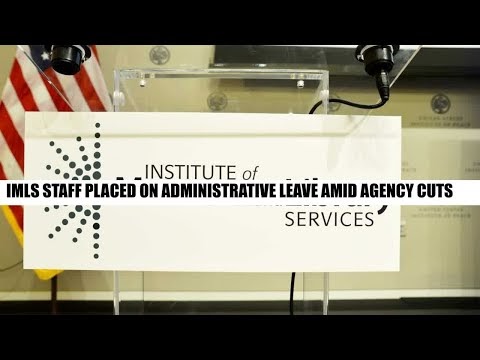
    The Institute of Museum and Library Services (IMLS) has put its entire staff on administrative leave following President Trump’s executive order to eliminate seven federal agencies, including IMLS. 
     
    Keith E. Sonderling has been appointed as the acting director during this transition. Staff were notified via email about their 90-day paid leave, which included instructions to return government property and had their email accounts disabled. 
     
    IMLS is a small federal agency, with about 70 employees,
    that awards grant funding to museums and libraries across the United
    States. Last year it granted $266 million to support essential cultural institutions.


    Source link

  • Survey: Trump Policies Push 75% of Scientists to Consider Leaving U.S.

    Survey: Trump Policies Push 75% of Scientists to Consider Leaving U.S.

    Survey: Trump Policies Push 75% of Scientists to Consider Leaving U.S.

    kathryn.palmer…

    Tue, 04/01/2025 – 03:00 AM

    Byline(s)

    Source link

  • Trump Investigates Harvard’s Federal Funding

    Trump Investigates Harvard’s Federal Funding

    Craig F. Walker/The Boston Globe via Getty Images

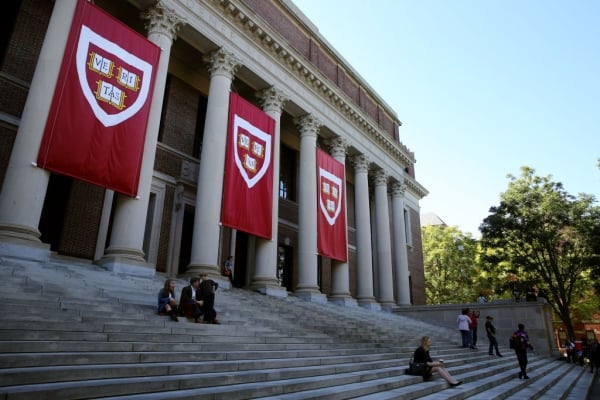
    Harvard University is the latest higher education institution to be investigated by the Trump administration in response to its alleged mishandling of antisemitic harassment on campus. The institution will undergo a “comprehensive” analysis of nearly $9 billion in federal grants and contracts, according to a multi-agency news release.

    The review, announced Monday afternoon, is part of ongoing efforts by the Justice Department’s Joint Task Force to Combat Anti-Semitism to tackle alleged antisemitic harassment on college campuses. The Departments of Education and Health and Human Services and the General Services Administration will carry out the investigation to “ensure the university is in compliance with federal regulations, including its civil rights responsibilities,” the news release said.

    The task force said its review process for Harvard will be similar to the one it is currently carrying out at Columbia University.

    “This initiative strengthens enforcement of President Trump’s Executive Order titled ‘Additional Measures to Combat Anti-Semitism,’” which “ensures that federally funded institutions uphold their legal and ethical responsibilities to prevent anti-Semitic harassment,” the news release said.

    In a matter of weeks, the task force’s investigation into Columbia has upended the institution. It received a notification in early March that the government had launched a review into $54.1 million in federal contracts. Then, on March 7, the department retracted $400 million in grants and contracts, and on March 13 it sent the university a sweeping list of demands, calling for immediate compliance in order to regain the funding. Columbia agreed to nearly all of the demands a week later, but the administration has not reinstated the funds.

    Shortly after announcing the decision to comply, the university’s interim president, Katrina Armstrong, resigned.

    The administration has said it will now review more than $255.6 million in federal contracts and $8.7 billion in multiyear grant commitments at Harvard.

    As with Columbia, the agencies will consider stop-work orders for any contracts the review identifies. But Harvard has also been ordered to submit a list of all federal contracts—both direct and through affiliates—that were not identified in the task force’s initial investigation.

    Addressing the review in a letter to the Harvard community, President Alan M. Garber acknowledged that nearly $9 billion in research funding is at risk: “If this funding is stopped, it will halt life-saving research and imperil important scientific research and innovation.”

    He said the institution had “devoted considerable effort” to addressing antisemitism on campus for the past 15 months, but added, “We still have work to do” and committed to working with the task force.

    “We resolve to take the measures that will move Harvard and its vital mission forward while protecting our community and its academic freedom,” he said.  

    Critics have broadly opposed the Trump administration’s tactics, saying they are prime examples of using claims of antisemitism to justify “aggressive” executive overreach.

    “What we’re seeing is an attempt to weaponize federal funding to punish schools that don’t align with their political views,” said Wesley Whistle, a project director at New America, a left-leaning think tank. “That kind of pressure stifles the free exchange of ideas—and that’s the whole point of higher education.”

    Meanwhile, Education Secretary Linda McMahon said the university’s “failure to protect students on campus from antisemitic discrimination—all while promoting divisive ideologies over free inquiry—has put its reputation in serious jeopardy.

    “Harvard can right these wrongs and restore itself to a campus dedicated to academic excellence and truth-seeking, where all students feel safe on its campus,” she said.

    Source link

  • Columbia University’s Interim President Resigns Amid Trump Administration’s Pressure Over Campus Activism

    Columbia University’s Interim President Resigns Amid Trump Administration’s Pressure Over Campus Activism

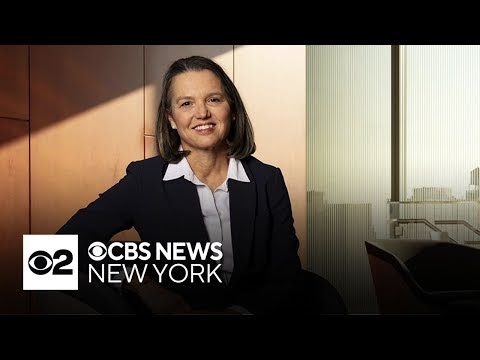
    Columbia University’s interim president, Dr. Katrina A. Armstrong, resigned on Friday, just days after the university made significant concessions to the Trump administration in exchange for the restoration of $400 million in federal research funding. Armstrong’s resignation follows a tumultuous period for the institution, already reeling from the departure of her predecessor, Minouche Shafik, in August 2024.

    Armstrong, who had stepped into the role of interim president during a time of political and social unrest, faced mounting pressure over the university’s handling of pro-Palestinian student activism, which sparked national controversy and calls for accountability from political leaders, including former President Donald Trump and his administration. Armstrong’s resignation marks the latest chapter in a series of leadership shifts at Columbia as it navigates the increasingly polarized political environment surrounding campus protests.


    Effective immediately, Claire Shipman, co-chair of Columbia’s Board of Trustees, has been appointed acting president. David J. Greenwald, chair of the Board of Trustees, praised Armstrong for her dedication to the university, acknowledging her hard work during a time of “great uncertainty.” Greenwald’s statement highlighted Armstrong’s contributions to the university, saying, “Katrina has always given her heart and soul to Columbia. We appreciate her service and look forward to her continued contributions to the University.” Armstrong, who will return to lead the Irving Medical Center, had taken on the interim presidency in a period marked by increasing tensions on campus over political activism and its fallout.

    Political Pressure and Concessions to the Trump Administration

    The resignation comes amid significant political pressure, as the Trump administration imposed a set of demands on Columbia in exchange for the release of crucial federal funding. Earlier this month, the administration presented the university with nine conditions to restore the $400 million in research grants that had been frozen over accusations of antisemitism linked to campus protests.

    In an effort to regain the funding, Columbia conceded to these demands, which included a ban on students wearing masks to conceal their identities during protests, except for religious or health reasons. Additionally, Columbia agreed to hire 36 new campus security officers with the authority to arrest students involved in protests. The university also committed to increasing institutional oversight by appointing a new senior vice provost to monitor the university’s Department of Middle East, South Asian, and African Studies.

    Perhaps most notably, Columbia pledged to adopt a stance of “greater institutional neutrality,” a policy that the university said would be implemented after working with a faculty committee. The decision was seen as an attempt to quell political tensions while navigating the contentious issues surrounding student activism.

    A Leadership Crisis at Columbia University

    Armstrong’s resignation follows the departure of Minouche Shafik, who faced widespread criticism for her handling of campus protests against the war in Gaza. Under Shafik’s leadership, Columbia became a focal point of national debates about free speech, activism, and the role of universities in responding to global conflicts. Shafik ultimately resigned after facing intense scrutiny for her handling of the protests and the occupation of an academic building by students, an incident that ended with NYPD officers forcibly removing the students.

    In Armstrong’s case, her tenure was similarly marred by controversies surrounding the university’s response to the growing political activism on campus. The university’s handling of pro-Palestinian protests, particularly those related to the ongoing Israel-Palestine conflict, led to calls for stronger action from political figures, especially within the Republican Party. Armstrong’s decision to oversee negotiations with the Trump administration over the university’s federal funding placed her at the center of a storm of political and social unrest, further intensifying the pressure on her leadership.

    Columbia’s Future Amidst Political Turmoil

    The resignation of Armstrong is a significant moment for Columbia, as the institution grapples with the broader implications of political activism within academia and the increasing role of government in shaping university policies. As the university enters another phase of leadership instability, the question remains: how will the next president balance the competing demands of activism, free speech, and political pressures from outside forces?

    Columbia’s decision to adopt a policy of institutional neutrality and increase security measures reflects the complex and polarized environment that universities are navigating in today’s political climate. The growing influence of political figures like Trump and the scrutiny placed on universities over their responses to student protests signal a new era for higher education, one where the lines between campus activism and political power are increasingly blurred.

    As the search for a permanent president continues, Columbia University will need to chart a course that both addresses the concerns of its diverse student body and faculty while navigating the external pressures that have shaped the university’s recent trajectory. The role of universities in fostering open dialogue, supporting activism, and protecting the rights of students will likely continue to be a central issue in higher education for years to come.

    Conclusion

    The resignation of Katrina Armstrong adds to a growing list of university presidents who have faced intense political pressure and scrutiny over campus activism, particularly surrounding Middle Eastern and global conflicts. Columbia’s next steps will be crucial not only for the future of the institution but also as a bellwether for how universities across the country navigate the increasingly complex landscape of political activism, academic freedom, and government intervention. The institution’s response to these challenges will undoubtedly have long-term implications for the role of higher education in a polarized society.

    Source link

  • Democratic senators call for probe of Trump Education Department cuts

    Democratic senators call for probe of Trump Education Department cuts

    This audio is auto-generated. Please let us know if you have feedback.

    Democrat efforts to challenge President Donald Trump’s dismantling of the U.S. Department of Education mounted Thursday, as 11 senators asked the agency’s acting inspector general, René Rocque, to investigate the push. 

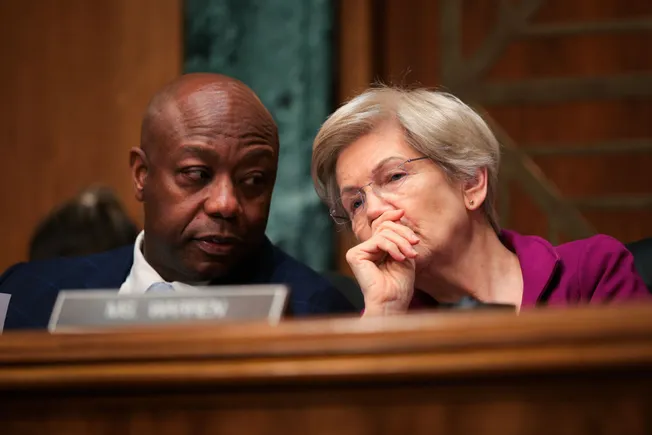
    Sen. Elizabeth Warren and senate Minority Leader Chuck Schumer were among those requesting an evaluation of whether the administration is undermining the Education Department’s ability to provide students with equal access to education and to help state and local governments’ education systems

    “Decimating the Department of Education’s abilities to administer financial aid, investigate civil rights violations, conduct research on educational outcomes, and oversee the use of federal education grants threatens to have disastrous consequences for American students, teachers and families,” they wrote in a March 27 letter to Rocque. 

    “The Trump Administration’s further attempts to close the Department entirely and transfer its responsibilities over to other agencies will likely interrupt and degrade education programs and services, causing additional pain for the 62 million students across the country that the Department serves.” 

    The administration’s gutting of the Education Department not only impacted nearly half of the department’s workforce, but also left civil rights investigation and enforcement offices at half their previous capacity, cut the Federal Student Aid office by over 450 employees, and slashed 90% of the Institute of Education Sciences staff. 

    These decisions would likely impede key functions of the department, including ensuring all students’ civil rights are protected, administering federal loans and overseeing lenders and FAFSA, and tracking students’ educational outcomes and the condition of education in the nation, the Democratic senators told Rocque.

    Rocque, who joined the Education Department’s Office of Inspector General as deputy inspector general in December 2023, became acting director in January.

    As with many other issues dividing lawmakers today, Democrats and Republicans have been starkly divided over the Trump administration’s efforts to eliminate the department altogether. This makes attaining a Senate supermajority of 60 votes — which is required to officially shut the department — unlikely. 

    House Democrats introduced a resolution on March 21 calling for transparency and information from the administration, including unredacted copies of all federal documents referring to the department’s closure and information on workforce reduction decisions.

    About a week after the massive reduction in force on March 11, Democrat lawmakers from both the House and Senate wrote the department demanding information on the layoffs, saying that halving its workforce could impact the agency’s ability to perform vital functions required by law.

    Meanwhile, Republicans in some states have taken the opportunity to ask the administration for more leeway in their education spending. 

    On March 25, for example, Oklahoma State Superintendent Ryan Walters sent a letter to the Education Department requesting a waiver to receive a block grant for all funds allocated to his state under the Every Student Succeeds Act. Such a consolidated block grant would “significantly enhance local flexibility” so “schools will be able to address their unique needs and priorities,” Walters wrote.

    The block grant would be used to “expand educational choices,” including attendance at private schools, and would loosen federal oversight of education spending requirements.

    Source link

  • Trump Administration Revokes 300 Student Visas, More to Come

    Trump Administration Revokes 300 Student Visas, More to Come

    The Trump administration has revoked more than 300 international students’ visas in the past three weeks, according to reporting from Axios

    Yesterday two Ph.D. students with revoked visas were detained by immigration agents and now await deportation: an Iranian student at the University of Alabama and a Turkish student at Tufts University in Massachusetts. 

    The Tufts student, Rumesya Ozturk, was abducted by plainclothes ICE agents on the street. At a press conference Thursday, U.S. secretary of state Marco Rubio said that any international student whose visa was revoked could be forcefully deported in such a manner. 

    “Once you’ve lost your visa, you’re no longer legally in the United States,” he said. “If you come to the U.S. as a visitor and create a ruckus for us, we don’t want it.”

    Axios also reported that the administration has discussed using a small arm of the Immigration and Customs Enforcement office to strip colleges they deem to be “pro-Hamas” of their ability to enroll international students.

    “You can have so many bad apples in one place that it leads to decertification of the school,” an unnamed White House official told Axios. “I don’t think we’re at that point yet. But it is not an empty threat.”

    The Student and Exchange Visitor Program normally investigates student visa fraud and international student recruiting practices, sometimes withdrawing colleges’ certification to enroll foreign students if there’s evidence that students are primarily enrolling as a pretext to reside and work in the U.S. instead of earn a degree. 

    Now, the SEVP may be tasked with a very different mandate: punishing colleges that have been the site of large pro-Palestine protests. 

    “What you’re going to see in the not-too-distant future is the universities … not doing anything to stop these demonstrations in support of Hamas … we can stop approving student visas for them,” a senior Justice Department official told Axios. “That’s one of their biggest cash cows, foreign students. That’s a meaningful source of revenue.” 

    Source link

  • Fascism Scholars, Trump Critics Leave Yale for Canada

    Fascism Scholars, Trump Critics Leave Yale for Canada

    As the Trump administration escalates its attack on universities, three fascism scholars and vocal Trump critics are leaving Yale University for the University of Toronto. But their given reasons for crossing the border vary.

    Jason Stanley, Jacob Urowsky Professor of Philosophy at Yale and author of multiple books—including How Fascism Works: The Politics of Us and Them—said he finally accepted Toronto’s long-standing offer for a position on Friday after seeing Columbia University “completely collapse and give in to an authoritarian regime.”

    In a move that has unnerved faculty across the country, Columbia’s administration largely conceded to demands from the Trump administration, which had cut $400 million of the university’s federal grants and contracts for what it said was Columbia’s failure to address campus antisemitism. Among other moves, the Ivy League institution gave campus officers arrest authority and appointed a new senior vice provost to oversee academic programs focused on the Middle East.

    “I was genuinely undecided before that,” Stanley said. Now he’s leaving Yale to be the named chair in American studies at Toronto’s Munk School of Global Affairs and Public Policy. According to the university, the intent is for Stanley also to be cross-appointed to the philosophy department. Two popular philosophy blogs previously reported the move.

    “What I worry about is that Yale and other Ivy League institutions do not understand what they face,” Stanley said. He loves Yale and expected to spend the rest of his career there, he said; while he still hopes for the opportunity to return some day, he’s nervous Yale “will do what Columbia did.”

    Stanley said Toronto’s Munk School “raided Yale” for some of its prominent professors of democracy and authoritarianism to establish a project on defending democracy internationally—an effort that began long before the election.

    Also leaving Yale for the Munk School is Timothy Snyder, author of books including The Road to Unfreedom: Russia, Europe, America, and Marci Shore, author of The Ukrainian Night: An Intimate History of Revolution and other works. Snyder and Shore are married.

    Stanley said Toronto reached out to him back in April 2023, during the Biden administration, and he restarted conversations after the election. He finally took the job Friday. The university told Inside Higher Ed it had been trying to recruit Snyder and Shore for years, saying, “We’re always looking for the best and brightest.”

    Snyder, the Richard C. Levin Professor of History at Yale, will become the Munk School’s inaugural Chair in Modern European History, supported by the Temerty Endowment for Ukrainian Studies. A spokesperson for Snyder said he made his decision for personal reasons, and he made it before the election.

    In an emailed statement Wednesday, Snyder said, “The opportunity came at a time when my spouse and I had to address some difficult family matters.” He said he had “no grievance with Yale, no desire to leave the U.S. I am very happy with the idea of a move personally but, aside from a strong appreciation of what U of T has to offer, the motivations are largely that—personal.”

    But when asked for her reasoning, Shore told Inside Higher Ed in an email that “the personal and political were, as often is the case, intertwined. We might well have made the move in any case, but we didn’t make our final decision until after the November elections,” she wrote.

    Shore, a Yale history professor, will become the Munk School Chair in European Intellectual History, supported by the same endowment as her husband.

    “I sensed that this time, this second Trump election, would be still much worse than the first—the checks and balances have been dismantled,” she wrote. “I can feel that the country is going into free fall. I fear there’s going to be a civil war. And I don’t want to bring my kids back into that. I also don’t feel confident that Yale or other American universities will manage to protect either their students or their faculty.”

    She also said it didn’t escape her that Yale failed to publicly defend Snyder when Vice President JD Vance criticized him on X in January. After Trump nominated Pete Hegseth as defense secretary, Snyder—who has repeatedly excoriated the Trump administration in the media—posted that “a Christian Reconstructionist war on Americans led from the Department of Defense is likely to break the United States.”

    Vance reposted that with the caption “That this person is a professor at Yale is actually an embarrassment.” Elon Musk, X’s owner, responded in agreement.

    ‘They Need to Band Together’

    Leaving for Canada might sound like a futile move, given that Trump has threatened to annex it.

    “That’s why I’m definitely not thinking of it as fleeing fascism; I’m thinking of it as defending Canada,” Stanley said. “Freedom of inquiry does not seem to be under threat in Canada,” he said, and moving there will allow him to be engaged in “an international fight against fascism.”

    Nonetheless, he said it’s heartbreaking to leave the Yale philosophy department. He would consider returning to Yale “if there’s evidence that universities are standing up more boldly to the threats,” he said. “They need to band together.”

    Yale spokesperson Karen Peart told Inside Higher Ed in an email that Yale “continues to be home to world-class faculty members who are dedicated to excellence in scholarship and teaching.” She added, “Yale is proud of its global faculty community which includes faculty who may no longer work at the institution, or whose contributions to academia may continue at a different home institution. Faculty members make decisions about their careers for a variety of reasons and the university respects all such decisions.”

    To be sure, the Yale professors are not the first or only U.S. faculty to accept academic appointments outside the country. European universities, at least, have been trying to recruit American researchers. But before Trump’s re-election, there was a dearth of data on the previously rumored academic exodus from red states to blue, supposedly spurred by conservative policy changes.

    Isaac Kamola, director of the American Association of University Professors’ Center for the Defense of Academic Freedom, said he’s now had conversations with multiple faculty members who are naturalized citizens “and still think that the administration might be coming after them.”

    And while star professors at Ivy League institutions are more likely than other faculty to have the opportunity to leave, Yale law professor Keith Whittington, founding chair of the Academic Freedom Alliance, said he thinks such professors are more likely to take those opportunities now.

    “I’ve seen efforts by high-quality academic institutions in other countries to start making the pitch to American academics,” Whittington said. He noted that even faculty at prestigious and well-endowed universities have concerns that their institution and higher ed as a whole are “not as stable as one might once have thought.”

    He said the Trump administration has targeted specific universities with “quite serious efforts to threaten those institutions with crippling financial consequences if they don’t adopt policies that the administration would prefer that they adopt.” And such a playbook could easily be repeated “at practically any institution in the country,” he said.

    Source link

  • AAUP, Middle East Studies Group Sue Trump Over Deportations

    AAUP, Middle East Studies Group Sue Trump Over Deportations

    Accusing the Trump administration of creating a “climate of repression and fear on university campuses,” two faculty groups sued the federal government Tuesday to stop the president’s efforts to deport noncitizen students and faculty who have participated in pro-Palestinian protests.

    The Middle East Studies Association and the American Association of University Professors argue in the lawsuit that what they call Trump’s “ideological-deportation policy” violates the First and Fifth Amendments and the Administrative Procedure Act. They are asking a federal judge to rule that the policy is unconstitutional. This is the second lawsuit challenging the policy, though this legal action includes more faculty and students.

    The litigation comes after immigration officers have, over the past month, targeted international students and postdoctoral fellows for alleged participation in pro-Palestinian protests, raiding their dorm rooms and revoking their visas.

    Tuesday afternoon, a federal judge blocked the Trump administration from deporting a Columbia student, who moved to the United States from Korea when she was 7 but is now a legal permanent resident. The New York Times reported that the government argued Yunseo Chung’s “presence in the United States hinders the administration’s foreign policy goal of stopping the spread of antisemitism.”

    But the judge said Tuesday that “nothing in the record” showed that Chung posed a “foreign-policy risk,” according to the Times.

    Chung has not yet been detained. She’s just the latest student to come under fire from the administration’s crackdown on those who protested the Israel-Hamas war. That crackdown has included revoking the visas of students and faculty, giving universities names of students to target, and a social media surveillance program, according to the AAUP lawsuit.

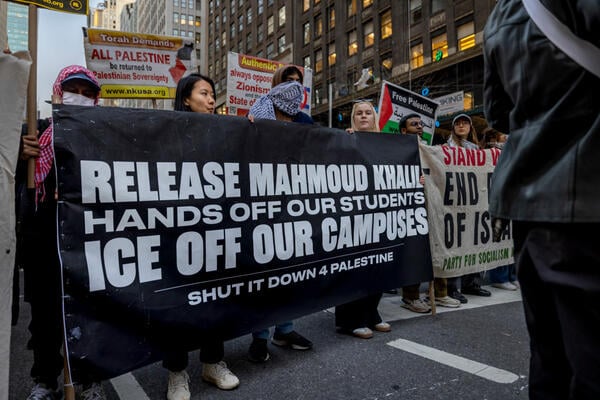
    The MESA and AAUP lawsuit, filed in the U.S. District Court of Massachusetts, specifically cites the cases of Chung; Badar Khan Suri, a Georgetown University postdoc; and Mahmoud Khalil, a recent Columbia University graduate. Judges have also blocked the government from deporting both men.

    “While President Trump and other administration officials have described pro-Palestinian campus protests as ‘pro-Hamas,’ they have stretched that label beyond the breaking point to encompass any speech supportive of Palestinian human rights or critical of Israel’s military actions in Gaza,” the suit says. “They have left no doubt that their new policy entails the arrest, detention and deportation of noncitizen students and faculty for constitutionally protected speech and association.”

    Attorneys from the Knight First Amendment Institute at Columbia are among the lawyers representing the scholarly groups.

    MESA and the AAUP—along with the AAUP chapters at Harvard, New York and Rutgers Universities—filed the suit against the federal government, Trump, Secretary of State Marco Rubio, Homeland Security secretary Kristi Noem and Immigration and Customs Enforcement acting director Todd Lyons, plus their agencies.

    A DHS spokesperson said in a statement that “taking over buildings, defacing private property, and harassing Jewish students does not constitute free speech.”

    “It is a privilege to be granted a visa to live and study in the United States of America,” the spokesperson added. “When you advocate for violence and terrorism that privilege should be revoked, and you should not be in this country.”

    The White House provided a similar statement from a Justice Department spokesperson, who said, “This department makes no apologies for its efforts to defend President Trump’s agenda in court and protect Jewish Americans from vile antisemitism.”

    Beyond the immediate implications for students and faculty who face deportation, the policy has a broader chilling effect on campus free speech, the lawsuit argues.

    “Out of fear that they might be arrested and deported for lawful expression and association, some noncitizen students and faculty have stopped attending public protests or resigned from campus groups that engage in political advocacy,” the suit says. “Others have declined opportunities to publish commentary and scholarship, stopped contributing to classroom discussions, or deleted past work from online databases and websites. Many now hesitate to address political issues on social media, or even in private texts.”

    The lawsuit adds the policy harms the plaintiff associations “because they are no longer able to learn from and engage with noncitizen members to the extent they once did, and because they have had to divert resources from other projects to address the all-too-real possibility that their noncitizen members will be arrested, imprisoned, and deported for exercising rights that the Constitution guarantees.”

    Source link

  • Trump cuts research funding to six Aus universities and counting – Campus Review

    Trump cuts research funding to six Aus universities and counting – Campus Review

    At least six Group of Eight (Go8) universities have had research grants terminated by the United States amid an anti-diversity and gender ideology studies crackdown from US President Donald Trump’s office.

    Please login below to view content or subscribe now.

    Membership Login

    Source link