
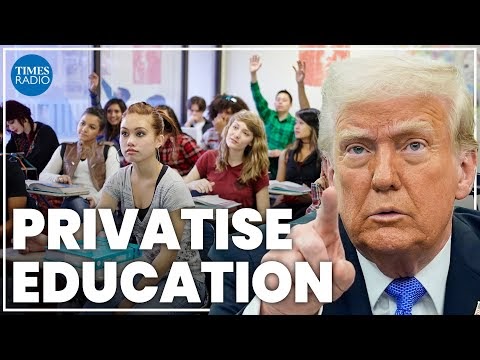
He will reduce the US educational establishment to a gigantic private school system, which means that large chunks of it will collapse. Except for Catholic parish schools, private day schools last maybe 25 years at their best, and that’s after a bunch of name changes or changes in location thanks to ownership changes. Trump is dooming the poorest states to shutting down huge numbers of public schools, because they will not find buyers. This situation is madness.
Tag: Trump
-
In Bid to Close Education Department, President Trump Looks to Rehouse Student Loans, Special Education Programs – The 74
President Donald Trump said Friday that the U.S. Small Business Administration would handle the student loan portfolio for the slated-for-elimination Education Department, and that the Department of Health and Human Services would handle special education services and nutrition programs.
The announcement — which raises myriad questions over the logistics to carry out these transfers of authority — came a day after Trump signed a sweeping executive order that directs Education Secretary Linda McMahon to “take all necessary steps to facilitate the closure” of the department to the extent she is permitted to by law.
“I do want to say that I’ve decided that the SBA, the Small Business Administration, headed by Kelly Loeffler — terrific person — will handle all of the student loan portfolio,” Trump said Friday morning.
The White House did not provide advance notice of the announcement, which Trump made at the opening of an Oval Office appearance with Defense Secretary Pete Hegseth.
The Education Department manages student loans for millions of Americans, with a portfolio of more than $1.6 trillion, according to the White House.
In his executive order, Trump said the federal student aid program is “roughly the size of one of the Nation’s largest banks, Wells Fargo,” adding that “although Wells Fargo has more than 200,000 employees, the Department of Education has fewer than 1,500 in its Office of Federal Student Aid.”
‘Everything else’ to HHS
Meanwhile, Trump also said that the Department of Health and Human Services “will be handling special needs and all of the nutrition programs and everything else.”
It is unclear what nutrition programs Trump was referencing, as the U.S. Department of Agriculture manages school meal and other major nutrition programs.
One of the Education Department’s core functions includes supporting students with special needs. The department is also tasked with carrying out the federal guarantee of a free public education for children with disabilities Congress approved in the Individuals with Disabilities Education Act, or IDEA.
Trump added that the transfers will “work out very well.”
“Those two elements will be taken out of the Department of Education,” he said Friday. “And then all we have to do is get the students to get guidance from the people that love them and cherish them, including their parents, by the way, who will be totally involved in their education, along with the boards and the governors and the states.”
Trump’s Thursday order also directs McMahon to “return authority over education to the States and local communities while ensuring the effective and uninterrupted delivery of services, programs, and benefits on which Americans rely.”
SBA, HHS heads welcome extra programs
Asked for clarification on the announcement, a White House spokesperson on Friday referred States Newsroom to comments from White House press secretary Karoline Leavitt and heads of the Small Business Administration and Health and Human Services Department.
Leavitt noted the move was consistent with Trump’s promise to return education policy decisions to states.
“President Trump is doing everything within his executive authority to dismantle the Department of Education and return education back to the states while safeguarding critical functions for students and families such as student loans, special needs programs, and nutrition programs,” Leavitt said. “The President has always said Congress has a role to play in this effort, and we expect them to help the President deliver.”
Loeffler and HHS Secretary Robert F. Kennedy Jr. said their agencies were prepared to take on the Education Department programs.
“As the government’s largest guarantor of business loans, the SBA stands ready to deploy its resources and expertise on behalf of America’s taxpayers and students,” Loeffler said.
Kennedy, on the social media platform X, said his department was “fully prepared to take on the responsibility of supporting individuals with special needs and overseeing nutrition programs that were run by @usedgov.”
The Education Department directed States Newsroom to McMahon’s remarks on Fox News on Friday, where she said the department was discussing with other federal agencies where its programs may end up, noting she had a “good conversation” with Loeffler and that the two are “going to work on the strategic plan together.”
Maine Morning Star is part of States Newsroom, a nonprofit news network supported by grants and a coalition of donors as a 501c(3) public charity. Maine Morning Star maintains editorial independence. Contact Editor Lauren McCauley for questions: [email protected].
Get stories like these delivered straight to your inbox. Sign up for The 74 Newsletter
-
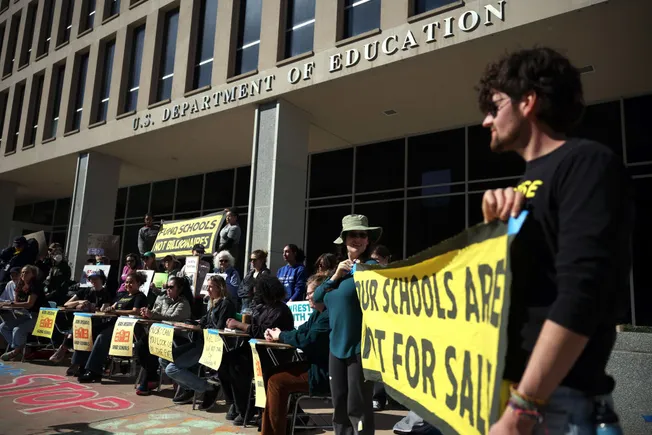
Trump says special education oversight will move to HHS
This audio is auto-generated. Please let us know if you have feedback.Federal special education operations, currently spearheaded by the U.S. Department of Education, will move to the U.S. Department of Health and Human Services, President Donald Trump said on Friday.
“It’s going to be a great situation. I guarantee that in a few years from now… I think that you’re going to have tremendous results,” said Trump, while seated in the Oval Office of the White House. Trump also said he would move federal student loan and school nutrition program oversight from the Education Department to the Small Business Administration.
Trump did not say when or how the transitions would occur. Additional information from the Education Department about logistics concerning the transfer of responsibilities was not available Friday afternoon.
U.S. Education Secretary Linda McMahon, in a Fox News interview Friday, said funding for the federal special education law — the Individuals with Disabilities Education Act — was in place before the creation of the Education Department in 1979. McMahon added that before the Education Department was created, special education programming was housed in what was then the U.S. Department of Health, Education and Welfare, “and it managed to work incredibly well.”
HHS Secretary Robert F. Kennedy, Jr. wrote on the social media platform X on Friday that HHS, “is fully prepared to take on the responsibility” of supporting students with disabilities. He added, “We are committed to ensuring every American has access to the resources they need to thrive. We will make the care of our most vulnerable citizens our highest national priority.”
.@HHSGov is fully prepared to take on the responsibility of supporting individuals with special needs and overseeing nutrition programs that were run by @usedgov. We are committed to ensuring every American has access to the resources they need to thrive. We will make the care of…
— Secretary Kennedy (@SecKennedy) March 21, 2025The Education Department oversees the distribution of about $15.4 billion for supports to about 8.4 million infants, toddlers, school children and young adults with disabilities. The department’s Office of Special Education and Rehabilatives Services and Office of Special Education Programs also conducts monitoring, provides technical assistance to states and districts, and holds states and districts accountable for compliance to IDEA.
The president’s comments come a day after he signed an executive order during a White House event directing McMahon to shutter the department to the “maximum extent appropriate.”
At the Thursday signing of the executive order and during comments on Friday, Trump said the low academic performance of U.S. students required a shakeup at the federal level.
He and his administration have also cited the desire to reduce federal bureaucracy in order to give more decision-making power to the state and local levels.
But public school supporters have vigorously denounced the Trump administration’s moves to dismantle the Education Department, which have already included reducing the workforce by half and canceling research and teacher preparation grants. At least one group — Democracy Forward — says it is planning legal action to stop the department shutdown.
Chad Rummel, executive director of the Council for Exceptional Children, said in a statement Friday, “IDEA is an education law, not a healthcare law, and belongs at the Department of Education.”
CEC is a nonprofit for professionals who work in special and gifted education.
Rummel added, “Moving IDEA programs to HHS would de-emphasize the purpose of IDEA to provide a free and appropriate public education and other critical activities to infants, toddlers, children, and youth with disabilities, and challenge the federal role to provide evidence-based research, personnel preparation, and technical assistance to advance the field of special education.”
National Parents Union President Keri Rodrigues said in a Friday statement, “This is not a minor bureaucratic reorganization — it is a fundamental redefinition of how our country treats children with disabilities.” The National Parents Union is a 1.7 million membership organization with more than 1,800 affiliated parent organizations in all 50 states, Washington, D.C., and Puerto Rico.
“We must call this what it is: an effort to dismantle protections, disempower families, and turn education into a battleground for profit-driven insurance corporations,” Rodrigues said. “We will not allow it.”
-
Trump signs executive order that aims to close U.S. Department of Education
This story was originally published by Chalkbeat. Sign up for their newsletters at ckbe.at/newsletters.
President Donald Trump has signed a much anticipated executive order that he said is designed to close the U.S. Department of Education.
The order Trump signed Thursday tells Education Secretary Linda McMahon to “take all necessary steps to facilitate the closure of the Department of Education and return authority over education to the States and local communities” to the “maximum extent appropriate and permitted by law.” At the same time, the order says McMahon should ensure “the effective and uninterrupted delivery of services, programs, and benefits on which Americans rely.”
Despite polling to the contrary, Trump said in his speech Thursday that closing the department is a popular idea that would save money and help American students catch up to other countries. He also said his order would ensure that other federal agencies take over major programs now housed at the Education Department, like those for students from low-income backgrounds and students with disabilities.
“Beyond these core necessities, my administration will take all lawful steps to shut down the department,” Trump said. “We’re going to shut it down, and shut it down as quickly as possible. It’s doing us no good. We want to return our students to the states.”
The executive order represents a symbolic achievement for Trump, who for years has expressed a desire to close the department. Yet the president has already radically transformed the department without relying on such an order. McMahon announced massive layoffs and buyouts earlier this month that cut the department’s staff nearly in half.
Beyond the rhetoric, it’s unclear how exactly the order will impact the department’s work or existence.
By law, only Congress can eliminate a cabinet-level agency authorized by Congress; White House Press Secretary Karoline Leavitt seemed to acknowledge as much Thursday before Trump signed the order, when she said that the Education Department will become “much smaller.” And during his Thursday remarks, Trump expressed hopes that Democrats as well as Republicans would be “voting” for the department’s closure, although prominent Democratic lawmakers have blasted the idea.
The order does not directly change the department’s annual budget from Congress. And federal law dictates many of the Education Department’s main functions–changing those would require congressional approval that could be very hard to secure.
Still, Trump’s move to dramatically slash the department’s staff could impact its capacity and productivity, even if officially its functions remain in place.
At her confirmation hearing, McMahon promised to work with Congress on a reorganization plan. Project 2025, a prominent blueprint for conservative governance from the Heritage Foundation released before Trump’s second term, says that along with closing the Education Department, the federal government should move the department’s education civil rights enforcement to the Department of Justice, while the collection of education data should move to the U.S. Census Bureau.
In a statement on Thursday, McMahon said closing the Education Department does not mean cutting off funds from those who depend on them.
“We will continue to support K-12 students, students with special needs, college student borrowers, and others who rely on essential programs,” she wrote. “We’re going to follow the law and eliminate the bureaucracy responsibly by working with Congress and state leaders to ensure a lawful and orderly transition.”
The executive order could be challenged in court. Many of Trump’s efforts to remake the federal bureaucracy are already tied up in litigation, including the Education Department layoffs.
The executive order notes that the Education Department does not educate any students, and points to low test scores on an important national assessment as evidence that federal spending is not helping students.
“Closing the Department of Education would provide children and their families the opportunity to escape a system that is failing them,” the order says.
Trump order is triumph for department’s foes
The Republican governors of Florida, Texas, Iowa, Indiana, Ohio, Louisiana, Tennessee, Idaho, and Nebraska were present during the signing ceremony. Trump said they “badly” wanted the federal government to give their states more control over education.
“Probably the cost will be half, and the education will be maybe many, many times better,” Trump said. States that “run very, very well,” he said, could have education systems as good as those in Finland, Denmark, Sweden, and Norway–countries that tend to outperform the United States on international reading and math tests.
The Education Department administers billions of dollars in federal assistance through programs such as Title I, which benefits high-poverty schools, and the Individuals with Disabilities Education Act, or IDEA, which offsets the cost of special education services.
The department also administers financial aid for college students, shares information about best practices with states and school districts, and enforces civil rights laws. And it oversees the school accountability system, which identifies persistently low-performing schools to extra support.
States and school districts already make most education decisions, from teacher pay to curriculum choices.
Conservatives have wanted to get rid of the U.S. Department of Education since it was created by President Jimmy Carter and Congress in 1979, and Trump talked about doing so in his first administration. But those efforts never gained traction.
Conservatives say that for decades the department has failed to adequately address low academic performance. They also see the department as generally hostile to their political and ideological perspectives.
The executive order says that McMahon must ensure that “any program or activity receiving Federal assistance terminate illegal discrimination obscured under the label ‘diversity, equity, and inclusion’ or similar terms and programs promoting gender ideology,” a reference to policies intended to make schools more welcoming for students of color and LGBTQ students.
The department has moved to publicly target and root out diversity-focused practices in schools in recent weeks. And the department has already threatened to withhold federal funding from Maine for allowing trans athletes to compete on teams that match their gender identity.
Public education advocates say critical expertise will be lost and students’ civil rights won’t be protected if Trump further diminishes the department. They also fear that a department overhaul could endanger billions in federal funding that bolsters state and local education budgets.
They say they’re already seeing impacts from layoffs, which hit the Office for Civil Rights, Federal Student Aid, and the Institute of Education Sciences particularly hard.
Even before McMahon took office, the U.S. DOGE Service, the cost-cutting initiative run by billionaire Elon Musk, canceled hundreds of millions of dollars worth of research grants and contracts.
The Education Department already was one of the smallest cabinet-level departments, with around 4,100 employees, before the layoffs. With buyouts and layoffs, the department now employs just under 2,200 people.
Chalkbeat is a nonprofit news site covering educational change in public schools.
Related:
The ED is dead! Long Live the ED!
Linda McMahon is confirmed as education secretary–DOGE and a department overhaul await herLatest posts by eSchool Media Contributors (see all) -
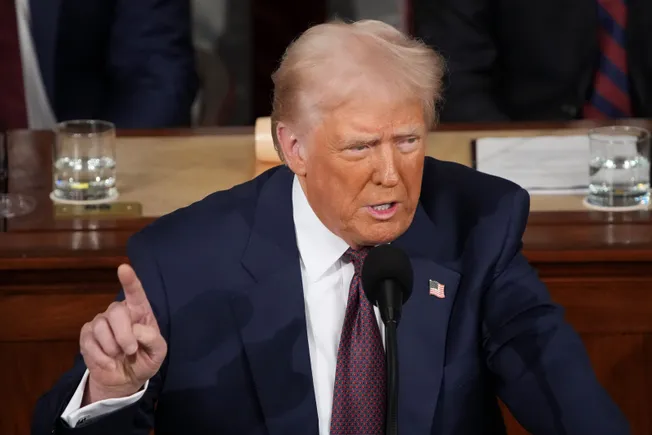
10 Trump changes education leaders need to know about
During the first two months of Donald Trump’s second presidency, a flurry of executive orders and other decisions have sent shock waves through the education sector.
The weeks leading up to an expected order on the U.S. Department of Education’s future have seen massive layoffs at the agency, the cancellation of research contracts, shifting guidance, restrictions on DEI efforts and more.
Here’s a recap of Trump actions so far that impact K-12 professionals nationwide.
Which topics are you following the closest? What topics would you like to see K-12 Dive report on more? Send us an email at [email protected].
-

Academic Publishers Braced for Slowdown as Trump DEI Purge Bites
Academic presses may face a slump in sales as U.S. university librarians become more cautious about buying books related to gender, politics or race in light of Donald Trump’s attack on “woke” research, publishers have warned.
With the Trump administration seeking to slash what it calls “radical and wasteful” spending on government diversity, equity and inclusion programs, American science agencies have begun cancelling active research projects on transgender populations, gender identity, environmental justice and any studies seen to discriminate on race or ethnicity.
Peer review panels have also been halted to ensure new grants align with “agency priorities,” with researchers urged to steer clear of diversity-linked language.
There are now fears that U.S. university libraries might soon be targeted if they are seen to be buying new titles related to politically sensitive areas.
Nicola Ramsey, director of Edinburgh University Press, told Times Higher Education that the DEI crackdown could significantly impact the global academic publishing industry.
“If librarians are told they cannot purchase content that references topics on gender, race, sexuality or minorities, sales will be negatively affected due to the nature of our publishing,” said Ramsey who noted the U.S. academic library market is “key for most university presses and other academic publishers as it’s so large and [universities] traditionally have had much bigger budgets.”
The “real commitment to bibliodiversity” among U.S. university libraries “especially among the Academic Research Libraries” underscored their importance to publishing, she added.
“Those libraries which had sought to build big collections—with a real commitment to bibliodiversity—might soon have to make difficult decisions on what they can buy,” explained Ramsey.
The Trump administration’s antipathy toward DEI initiatives was also likely to reduce research related to diversity that might lead to academic books on such subjects, she said.
“Most academic publishers have been committed in recent years to diversifying our lists, both in terms of author base and research areas [but] this research has relied heavily on federal grant funding, which is being cut from areas connected to DEI initiatives.”
Some university presses, such as Edinburgh, are still committed to publishing on diverse topics from a range of authors, added Ramsey. “This [crackdown] will not deter our editors from continuing to diversify in our publishing—it’s a fundamental commitment that can’t be swayed by one administration,” she said.
That need to uphold diversity in publishing was echoed by Anthony Cond, president of the Association of University Presses and director of Liverpool University Press.
“Many university presses have long histories of publishing on topics that could be construed as DEI. Recent policy announcements make that work more important, not less,” he said.
“In a challenging higher education sector across several countries, including financial pressure on libraries, the university press focus on values-based publishing will remain an essential component for the bibliodiversity of scholarship.”

-
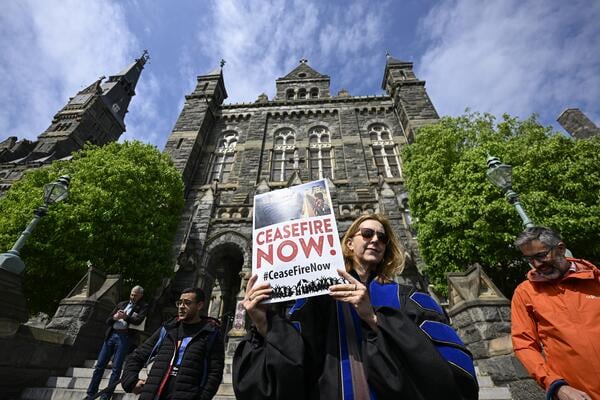
Trump Administration Attempts to Deport, Bar Entry to Scholars
Earlier this month, Immigration and Customs Enforcement (ICE) agents arrested Mahmoud Khalil, a green card holder and recent Columbia University graduate, and threatened him with deportation. The Trump administration said Khalil, who is of Palestinian descent, was a national security threat and accused him of terrorist activity for leading student protests at Columbia last year.
In a public statement to The Guardian, Khalil described himself as a “political prisoner.”
“The Trump administration is targeting me as part of a broader strategy to suppress dissent,” he said. “Visa holders, green-card carriers, and citizens alike will all be targeted for their political beliefs.”
That prediction has begun to come true. In the past three weeks, immigration officers have targeted international students they suspected of participating in pro-Palestinian protests, raiding their dorm rooms and revoking their visas. In recent days, the administration’s dragnet has widened to include faculty members, postdoctoral fellows, visiting scholars and researchers.
At least two of those international scholars were employed by U.S. institutions and in the country on valid work or academic visas. An Indian postdoctoral research fellow at Georgetown University was detained outside his home for alleged pro-Palestinian activity that the administration has yet to specify; and a Lebanese professor at Brown University’s medical school was denied reentry after attending the funeral of assassinated Hezbollah leader Hassan Nusrallah.
Another case involves an unidentified French scientist, who, according to a statement from the French Minister of Higher Education and Research, was denied entry into the U.S. because of his “personal opinion on the Trump administration’s research policy.”
Isaac Kamola, director of the American Association of University Professors’ Center for the Defense of Academic Freedom and an associate political science professor at Trinity College in Connecticut, said the administration’s “completely arbitrary” crackdown on foreign scholars threatens academic freedom and undermines the role of U.S. institutions in global research exchange and scholarship networks.
“I think it’s pretty clear that the administration has decided it’s going to use the force of the state to intimidate faculty and students,” he said. “They’re basically doing a kind of stochastic terrorism.”
The administration is also targeting international doctoral candidates who participated in pro-Palestinian protests last year, revoking their visas and sending ICE agents to apprehend them.
Momodou Taal, a British Ph.D. candidate at Cornell University who made national headlines when he overturned an academic suspension for protest activity that would have forced him to leave the country, received a visit from ICE agents on Wednesday. Just days earlier, Taal filed a lawsuit against the Trump administration seeking to block immigration officials from deporting international students for protesting.
Taal told Inside Higher Ed he’d been expecting a knock on his door since Trump’s inauguration, and that immigration officials were targeting students and scholars for protected pro-Palestinian speech.
“It goes against the ideals that this country espouses, or at least claims to espouse,” Taal said. “I’ve not been convicted of a crime, I’m not being charged with any crime or accused of any crime. So why should I be living in fear over what I decide to say and the causes I support?”
Teresa R. Manning, director of policy at the conservative National Association of Scholars, said, “We see it as more an issue of security and safety than an issue of academics or free speech.”
“The real threat to free speech is the complete leftwing domination of American education,” Manning said. “No conservatives are allowed. That’s the real threat, not our attempt to guard the nation’s security and safety and protect against potential terrorist threats.”
The White House did not respond to a request for comment Thursday, nor did a spokesperson for ICE. A spokesperson for the State Department’s Bureau of Educational and Cultural Affairs, which oversees and promotes global academic and research exchange, did not respond to a request for comment in time for publication.
Georgetown Fellow Detained
On Monday night, immigration officials arrested and detained Badar Khan Suri, an Indian postdoctoral fellow at Georgetown University, outside his home in Rosslyn, Virginia. Suri was in the country on a J-1 visa, a nonimmigrant document meant to promote academic and cultural exchange that is usually reserved for students and scholars; according to his lawyers, Department of Homeland Security agents told him his visa had been revoked.
A peace and conflict studies scholar, he was at Georgetown’s School of Foreign Service conducting research for his dissertation on the U.S. peace process in Iraq and Afghanistan.
“If an accomplished scholar who focuses on conflict resolution is whom the government decides is bad for foreign policy, then perhaps the problem is with the government, not the scholar,” Suri’s lawyer Hassan Ahmad wrote in a statement Thursday.
After his arrest, Suri was first brought to a migrant holding cell in Virginia before being transported to Louisiana, where he’s currently awaiting trial in the same detention center as Khalil, according to Suri’s lawyers.
Tricia McLaughlin, a spokesperson for the Department of Homeland Security, said in a statement on X that Suri had been detained for “spreading Hamas propaganda and promoting antisemitism on social media,” though she failed to provide any evidence.
Suri’s wife, a U.S. citizen of Palestinian descent and a graduate student at Georgetown, is the daughter of Ahmed Yousef, former adviser to the late Hamas leader Ismail Haniyeh, The New York Times confirmed. Yousef, who has called the Oct. 7, 2023 Hamas attacks a “terrible error,” told The Times that he left his position a decade ago and that his daughter and son-in-law have no involvement in political activism on behalf of the organization.
On Thursday, a federal judge in Virginia ordered that Suri be kept in the country until a lawsuit brought by his lawyers is resolved, according to The Washington Post.
In a post on BlueSky Thursday, Virginia representative Don Beyer wrote that “the arrests of academics like Suri and Mahmoud Khalil are intended to have a chilling effect and discourage the free expression of political views which Trump dislikes.”
A Georgetown spokesperson told Inside Higher Ed that the university was “not aware of [Suri] engaging in any illegal activity, and we have not received a reason for his detention.”
“Suri is an Indian national who was duly granted a visa to enter the United States to continue his doctoral research on peacebuilding in Iraq and Afghanistan,” the spokesperson wrote in an email. “We support our community members’ rights to free and open inquiry, deliberation and debate, even if the underlying ideas may be difficult, controversial or objectionable. We expect the legal system to adjudicate this case fairly.”
Brown Professor Denied Entry
Media outlets have reported that Rasha Alawieh, an assistant professor of medicine and clinician educator at Brown, was flown out of the U.S. last week despite a court order requiring the government to inform a judge ahead of any deportation. The federal government said Alawieh was returning from Lebanon, where she had attended the funeral of Hezbollah leader Hassan Nusrallah. Officials also said she had deleted “sympathetic photos and videos” of Hezbollah leaders from her phone.
Alawieh never made it past Boston’s Logan International Airport. On Monday, a DHS spokesperson posted on X that Nusrallah was “a brutal terrorist” and that Alawieh had “openly admitted” attending his funeral and supporting him.
“A visa is a privilege not a right—glorifying and supporting terrorists who kill Americans is grounds for visa issuance to be denied,” the spokesperson wrote. “This is commonsense security.”
The White House then reposted DHS’s statement with a photo of President Trump waving goodbye out of a drive-thru window at McDonald’s during a campaign stop.
Kamola, of the AAUP, said claims of Alawieh’s supposed connections to Hezbollah were “spurious.” One of Alawieh’s lawyers didn’t respond to requests for comment Thursday.
Asked whether Brown is defending Alawieh’s academic freedom or disciplining her, Amanda McGregor, a spokesperson for Brown, replied only that “Alawieh is an employee of Brown Medicine with a clinical appointment to Brown University.”
“Such appointments carry a faculty title, though the employment resides with Brown Medicine,” McGregor wrote in an email.
Interrogated for Anti-Trump Texts
Meanwhile, foreign academics traveling to the U.S. are being hassled and turned away by border agents.
Philippe Baptiste, France’s minister of higher education and research, told Agence France-Presse that a French scientist from the country’s National Center for Scientific Research was heading to a conference near Houston, Texas, when the scientist was denied entry and expelled. The minister did not reveal the scientist’s name.
“This measure was apparently taken by the American authorities because the researcher’s phone contained exchanges with colleagues and friends in which he expressed a personal opinion on the Trump administration’s research policy,” Baptiste said. “Freedom of opinion, free research and academic freedom are values we will continue to proudly uphold.”
On Wednesday, Baptiste met with counterparts from other European Union nations to discuss “threats to free research in the United States,” according to a post on X.
As the Trump administration escalates its attacks on foreigners in American academe, international students are increasingly apprehensive about studying at U.S. institutions and scholars worry about attending conferences or accepting fellowships in the country. Kamola said the end result may be the destruction of America’s reputation as a bastion of academic freedom.
“I think the message is: Everybody who wants to speak about Palestine, everybody who wants to argue that higher education should be more inclusive or diverse, anybody who wants to defend free speech in ways that the current regime finds unacceptable could potentially face retaliation,” Kamola said. “The intention is to not only sow chaos but to sow fear.”
-
Trump Signs Executive Order Directing Closure of the Department of Education
by CUPA-HR | March 20, 2025
On March 20, President Trump signed an executive order titled “Improving Education Outcomes by Empowering Parents, States, and Communities.” The order directs the secretary of education to “take all necessary steps to facilitate the closure of the Department of Education and return authority over education to the States and local communities while ensuring the effective and uninterrupted delivery of services, programs, and benefits on which Americans rely.”
The order additionally states that the secretary of education “shall ensure that the allocation of any Federal Department of Education funds is subject to rigorous compliance with Federal law and Administration policy.” According to the order, this includes compliance with federal requirements to terminate “illegal discrimination obscured under the label ‘diversity, equity, and inclusion’” and to terminate programs that promote gender ideology.
With respect to higher education, the executive order asserts that closure of the ED “would drastically improve program implementation.” It specifically discusses ED’s role in managing the federal student loan debt portfolio, and it claims that ED “is not a bank, and it must return bank functions to an entity equipped to serve America’s students.”
It is still unknown how Secretary McMahon will execute this order. Despite Trump’s clear intentions to close ED, Congress would still need to pass legislation to officially dissolve the department. It remains to be seen whether McMahon and the Trump administration will move ED’s subagencies and their functions to other federal agencies as speculated.
More information is needed from ED to understand how this order will be implemented. CUPA-HR will continue to monitor for additional news and guidance from ED as it relates to the order.
-
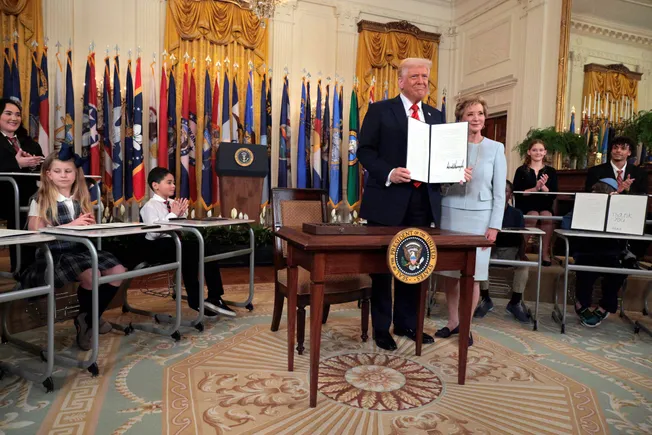
Trump signs order closing Education Department to ‘maximum extent appropriate’
This audio is auto-generated. Please let us know if you have feedback.President Donald Trump on Thursday afternoon ordered U.S. Secretary of Education Linda McMahon to “take all necessary steps to facilitate the closure of the Department of Education,” marking the boldest push from the president to shut down the agency since its establishment under the Carter administration over four decades ago.
Trump also said prior to the signing that he intends to disperse the department’s core functions — such as Pell Grants, Title I funding, and providing funding and resources for students with disabilities — to other parts of the government.
“They’re going to be preserved in full and redistributed to various other agencies and departments that will take very good care of them,” he said. “My administration will take all lawful steps to shut down the department. We’re going to shut it down and shut it down as quickly as possible.”
“It’s doing us no good,” he added.
The directive was originally expected to be released earlier this month. It comes less than two weeks after the Trump administration, under Education Secretary Linda McMahon’s leadership, abruptly cut the department’s workforce by half, shuttered over half of its civil rights enforcement offices, and fired all but a handful of National Center for Education Statistics employees.
The layoffs preceding the Thursday order impacted nearly 1,300 workers in addition to the nearly 600 employees who accepted “buyouts.”
Trump has repeatedly and forcefully threatened to shut down the department since his first term in the White House, citing what he has called the agency’s “bloated budget” and a need to return education control to the states. His push to dismantle the department is in line with the 2024 Republican agenda, which included closing the department to “let the States run our educational system as it should be run.”
In a Thursday speech, just prior to signing the order, Trump also cited low student test scores as reason to close the department.
“After 45 years, the United States spends more money in education by far than any other country, and spends, likewise, by far, more money per pupil than any country,” he said. “But yet we rank near the bottom of the list in terms of success. That’s where we are — like it or not — and we’ve been there for a long time.”
Abolishing the 45-year-old agency altogether, however, requires a Senate supermajority of 60 votes. A similar proposal from conservatives in the House failed in 2023 when 60 House Republicans joined Democrats to defeat the measure.
Given the current closely divided Congress, many have considered it a longshot that lawmakers would approve the department’s demise.
However, in his Thursday speech, Trump said he hopes Democrats would be onboard if the legislation to officially close the department eventually comes before Congressional lawmakers.
What will be impacted?
Although the administration technically needs Congressional action to close the department, the Thursday order tells McMahon to push its closures “to the maximum extent appropriate and permitted by law.”
The agency is responsible for a slew of programs key to school and college operations, including conducting federal civil rights investigations, overseeing federal student financial aid, and enforcing regulations on Title IX and other education laws. It is in charge of large programs that schools depend on, like Title I, which sends aid to low-income school districts, and the Individuals with Disabilities Education Act that supports special education services.
Following the layoffs earlier this month, the department claimed its key functions, including overseeing COVID-19 pandemic relief, wouldn’t be impacted.
“Closing the Department does not mean cutting off funds from those who depend on them — we will continue to support K-12 students, students with special needs, college student borrowers, and others who rely on essential programs,” said McMahon in a statement praising the executive order on Thursday.
However, former employees and education policy experts have warned that a department functioning on only half its former manpower could lead to a decline in oversight, guidance and student protections while creating systemic “chaos.”
“Eliminating it would roll back decades of progress, leaving countless children behind in an education system that has historically failed the most marginalized,” said Keri Rodrigues, president of National Parents Union, in a Thursday statement responding to the order. “Without federal oversight, states will have free rein to lower standards, siphon funds from public schools, and dismantle hard-won civil rights protections.”
Educators have also warned that gutting the department would eventually lead to an increase in class sizes and reduce special education services for students with disabilities.
McMahon disagreed.
“Teachers will be unshackled from burdensome regulations and paperwork, empowering them to get back to teaching basic subjects,” she said in the statement. “Taxpayers will no longer be burdened with tens of billions of dollars of waste on progressive social experiments and obsolete programs,” she added.
Order follows McMahon’s ‘final mission’
During her Feb. 13 Senate confirmation hearing, McMahon did not commit to closing the Education Department and acknowledged that closure of the entire Education Department would need congressional approval. The White House echoed those sentiments on Thursday, just prior to the order’s signing.
McMahon also said programs established by federal statute, such as Title I for low-income schools and services to students with disabilities under the Individuals with Disabilities Education Act, would need to continue with or without an Education Department. But some federal education statutes are specific about certain offices’ responsibilities within the Education Department.
The Office of Special Education Programs, for example, is to be within the Office of Special Education and Rehabilitative Services in the Education Department, according to the IDEA.
Still, on McMahon’s first day on the job last month, she publicly said she was planning for the “historic overhaul” of the department as its “final mission.”
“This review of our programs is long overdue,” she wrote in a letter posted by the department that same night, supporting what she called “elimination of bureaucratic bloat here at the Department of Education — a momentous final mission — quickly and responsibly.” McMahon and Trump have touted giving education decision-making power back to the states and parents.
However, “This is not about cutting bureaucracy — it’s about gutting the protections that safeguard our children’s education,” Rodrigues said in her statement.
Democratic lawmakers have also resisted the department’s recent cuts and have already pushed back against the order that followed it today.
“President Trump’s executive order to dismantle the Department of Education (ED) and ‘return education to the states’ will be challenged in the Courts,” said Rep. Bobby Scott, D-Va., ranking member on the House Committee on Education and the Workforce.
Sen. Patty Murray of Washington, along with two other Democratic lawmakers, also demanded answers from the agency in a 10-page letter sent Monday, asking McMahon and Institute of Education Sciences Acting Director Matthew Soldner how the agency intends to fulfill its statutory obligations with a reduced staff.
Others are celebrating the historic order.
“With the federal government stepping back, the potential for new, transformative education models has never been greater,” said Jeanne Allen, founder and CEO of the Center for Education Reform, in a statement on Wednesday night in anticipation of today’s order. “As every great innovator knows – whether in education, business, or technology – government interference stifles progress and disruptive innovations accelerate it.”
Many Republican lawmakers are also on board with gutting the agency.
“The key to improving education is empowering parents and students and reducing the role of Washington bureaucrats,” said House Committee on Education and the Workforce Chair Tim Walberg, R-Mi., in a Thursday statement. Walberg cited the Biden administration’s decisions during the pandemic, slowed student performance in the wake of the crisis, and its LGTBQ+ inclusive policies as some reasons to cut the department.
“Bottom line, the Department of Education has failed to deliver results for America’s students and today’s actions by the Trump administration will help ensure our nation’s youth are put first.”
-
Trump Admin Questions Canadian, Australian Researchers
The Trump administration has sent questionnaires to U.S.-funded Canadian and Australian researchers asking whether their research is a “DEI project,” whether it defends against “gender ideology” and whether it reinforces “U.S. sovereignty,” according to organizations in those countries.
The Canadian Association of University Teachers, a federation that says it represents 72,000 employees, provided Inside Higher Ed a copy of one of these surveys. One question asked, “Can you confirm that your organization does not work with entities associated with communist, socialist, or totalitarian parties, or any party that espouses anti-American beliefs?” Another asked, “Does this project reinforce U.S. sovereignty by limiting reliance on international organizations or global governance structures (e.g., UN, WHO)?”
David Robinson, executive director of the Canadian association, said his organization was informed of the questionnaires by U.S. Department of Agriculture–funded researchers who received them. The White House didn’t return Inside Higher Ed’s request for comment Wednesday.
“It’s just unbelievable,” Robinson said. He said the U.S. government is trying to “impose a certain ideological viewpoint on research.”
Robinson also provided a survey that he said Australian researchers received. It contains the same questions and more, including, “What impact does this project have on protecting religious minorities, promoting religious freedom, and combatting Christian prosecution [sic]?”
Both surveys say “OMB”—standing for Office of Management and Budget—at the top. Chennupati Jagadish, president of the Australian Academy of Science, said in a statement Monday that “Australian scientists have been surveyed to disclose their institution’s compatibility with United States (US) foreign and domestic policy.”
“Any reasonable assessment of the survey indicates that US Government funded research in Australia could be terminated because an Australian institution—not the research project—has links with several named countries, or links with the United Nations and its agencies, or impacts the protection and promotion of specific religions,” Jagadish said.
