We are grateful to Inside Higher Ed editor in chief Sara Custer in her recent column “Higher Ed Faces Competing Visions for Its Future” (Dec. 18, 2025) for mentioning Advancing Public Trust in Higher Education, the initiative we co-direct at the American Association of Colleges and Universities. We write to expand upon Custer’s review of the emerging responses to the trust problem and to clarify what our initiative is advocating and doing to invigorate public trust.
Higher ed cannot restore public trust in colleges and universities unless the sector reckons in a clear-eyed fashion with the causes of the current crisis. Simply put, the fundamental problem is that when the sector or its individual institutions draw public criticism, we are unable either to make quick changes in response, to explain compellingly why we should not do so, or to redirect public attention effectively toward the overall value and purpose of our work. Under increased scrutiny from the public and government alike, that paralysis is a recipe for a disastrous decline in public trust.
Solving this crisis will require a multipronged approach that balances internal reform—although not along the lines of the administration’s ill-fated Compact—with better communication and collective defense strategies. Higher education must become better and nimbler at making changes that already have wide support but are held back by parochial interests; better at relentlessly prioritizing engagement with local communities; and better at offering a meaningful welcome to all students, including those with conservative views and others who feel alienated from our institutions. We also need to be better at mounting a vigorous and coordinated sectorwide defense when we are in the right, and at communicating our value and purpose clearly and effectively so that the public can put things into context when we inevitably make mistakes.
Our view is that internal reform, improved communication, and better defense are inseparable parts of a whole; higher education will not regain public trust, or reestablish productive partnerships with the government and our communities, unless we pursue all three goals simultaneously. Our vision is of a sector that is agile, responsive, invitational, humble and trusted to generate new knowledge and transform students’ lives. If colleges and universities act smartly and collectively, we believe that vision is within reach.
We look forward to sharing more specifics about our approach with Inside Higher Ed’s readers over the coming months.
Jeremy C. Young is Senior Advisor for Strategic Initiatives, and Kathryn Enke is Vice President for Leadership and Strategy, at the American Association of Colleges and Universities
In today’s schools, whether K-12 or higher education, AI is powering smarter classrooms. There’s more personalized learning and faster administrative tasks. And students themselves are engaging with AI more than ever before, as 70 percent say they’ve used an AI tool to alter or create completely new images. But while educators and students are embracing the promise of AI, cybercriminals are exploiting it.
In 2025, the U.S. Department of Education reported that nearly 150,000 suspect identities were flagged in recent federal student-aid forms, contributing to $90 million in financial aid losses tied to ineligible applicants. From deepfakes in admissions to synthetic students infiltrating online portals and threatening high-value research information, AI-powered identity fraud is rising fast, and our educational institutions are alarmingly underprepared.
As identity fraud tactics become more scalable and convincing, districts are now racing to deploy modern tools to catch fake students before they slip through the cracks. Three fraud trends keep IT and security leaders in education up at night–and AI is supercharging their impact.
1. Fraud rings targeting education
Here’s the hard truth: Fraudsters operate in networks, but most schools fight fraud alone.
Coordinated rings can deploy hundreds of synthetic identities across schools or districts. These groups recycle biometric data, reuse fake documents, and share attack methods on dark web forums.
To stand a fair chance in the fight, educational institutions must work with identity verification experts that enable a holistic view of the threat landscape through cross-transactional risk assessments. These assessments spot risk patterns across devices, IP addresses, and user behavior, helping institutions uncover fraud clusters that would be invisible in isolation.
2. Deepfakes and injected selfies in remote enrollment
Facial recognition was once a trusted line of defense for remote learning and test proctoring. But fraudsters can now use emulators and virtual cameras to bypass those checks, inserting AI-generated faces into the stream to impersonate students. In education, where student data is a goldmine and systems are increasingly remote, the risk is even more pronounced.
In virtual work environments, for example, enterprises are already seeing an uptick in the use of deepfakes during job interviews. By 2028, Gartner predicts 1 in 4 job candidates worldwide will be fake. The same applies to the education sector. We’re now seeing fake students, complete with forged government IDs and a convincing selfie, slide past systems and into financial aid pipelines.
So, what’s the fix? Biometric identity intelligence, trusted by a growing number of students, can verify micro-movements, lighting, and facial depth, and confirm whether a real human is behind the screen. Multimodal checks (combining visual, motion, and even audio data) are critical for stopping AI-powered identity fraud.
3. Synthetic students in your systems
Unlike stolen identities, synthetic identities are crafted from real–and fake–fragments, such as a legit SSN combined with a fake name. These “students” can pass enrollment checks, get campus credentials, and even apply for financial aid.
Traditional document checks aren’t enough to catch them. Today’s identity verification tools must use AI to detect missing elements, like holograms or watermarks, and flag patterns including identical document backgrounds, which is a key sign of industrial-scale fraud.
AI-powered identity intelligence for education
As digital learning becomes the norm and AI accelerates, identity fraud will only get more sophisticated. However, AI also offers educators a solution.
By layering biometrics, behavioral analytics, and cross-platform data, schools can verify student identities at scale and in real time, keeping pace with advancing threats, and even staying one step ahead.
Ashwin Sugavanam, Jumio Corporation
Ashwin Sugavanam is currently the VP, AI & Identity Analytics at Jumio Corporation. Ashwin is a visionary Data and Analytics leader with two decades of overall experience out of which he has spent the last decade in helping organizations incubate and scale Data & AI practices. Over the last couple of years Ashwin has helped organizations drive measurable business outcomes by responsibly scaling Data and AI initiatives, implementing modern concepts like Data Mesh and MLOps, and leveraging tools such as the Data Scientist Co-Pilot to accelerate impact. He can be reached on LinkedIn and at the company website https://www.jumio.com/ .
Latest posts by eSchool Media Contributors (see all)
Earlier this year the University of East London’s Child Online Harms Policy Think Tank, launched in the House of Lords. At that launch, I first properly heard a phrase I’d only half-registered before, but which I now can’t stop thinking about: “escaping the matrix.”
For some young people, especially those immersed in online influencer culture, the phrase signals a rejection of conformity – a desire to think critically about the systems they’ve inherited. In its healthiest form, it’s scepticism. But in darker online spaces – the so-called “manosphere” – that questioning turns toxic. The “matrix” becomes a conspiracy; feminism is blamed for personal hardship; and traditional institutions, universities included, are dismissed as irrelevant or even hostile.
Here’s the irony: many of the same influencers peddling these anti-institution narratives are running their own “universities” – online courses, masterclasses, mentorships. The hunger to learn hasn’t gone away. What’s being rejected isn’t learning – in fact, more 18-year-olds than ever entered higher education this year – but the institutions seen to control it.
So, what should universities make of this moment? The answer is not to bend to the whims of misogynist influencers, but to reflect on why so many young people feel alienated from formal education. What is the role of higher education in a world where disaffection is marketed as enlightenment? And how might we create – and communicate – a post-matrix university that feels worth plugging into?
Build a better matrix
At UEL, we’ve been challenging ourselves on what “value” really means in a rapidly changing world. For us, that has meant a deep commitment to becoming a careers-first university. Over the last seven years, we’ve redesigned our curriculum and embedded employability into every aspect of the institution, aligning what we teach with the skills and opportunities our students need to thrive.
By embedding careers throughout study; forging deep, value-adding partnerships with employers; breaking down the barriers between learning, innovation and work; and developing validated, leaner and more predictive-of-success recruitment pipelines, we have lifted graduate employment rates by 25 percentage points in just five years, the fastest rise in England. Our enterprise support tells a similar story, as we have driven the sector’s fastest increase in graduate start-ups, with a 1000 per cent increase in businesses still active after three years.
This is not the only approach, nor the only vision for value. The government’s recent white paper encourages greater specialisation, and I have always believed that a diverse higher education sector is a strong one. But that diversity only thrives in a healthy ecosystem – not one pulling in all directions and competing for diminishing resources.
If universities are to prove their continuing value to students, graduates, families, government, businesses, and communities, we must work together. Just not in the same old ways. That is where government can play a smarter role: not by propping up legacy systems or mandating mergers, but by rewarding genuine innovation and collaboration.
Take employers
Research launched by UEL and London Economics at this year’s Labour Conference found that 97 per cent of businesses want closer partnerships with universities. Nearly nine in ten back a national digital “front door” – a single online platform connecting graduates and employers, streamlining recruitment, and supporting lifelong professional development.
Our students tell us they don’t just want a graduate job – they want a graduate career. Students are not just job seekers; they are job creators too. Meeting that ambition means building systemic partnerships that align degrees with the demands of a changing generation; innovative, connected investment in practice-based education; and giving employers confidence that universities are developing the higher skilled and enterprising talent they need.
Graduate recruitment has become a hall of mirrors: AI-generated applications screened by AI filters, relying on crude, out-dated proxies for talent that do not predict new routes for success. Real, diverse potential is lost in this algorithmic echo chamber and the approach is – at least in part – contributing to a 59 per cent increase in applications per graduate vacancy in just one year. The current model is working for too few: graduates underemployed, employers frustrated, trust eroded.
By listening to what students and businesses are telling us, even when those truths are uncomfortable, we can respond with something better: an education that is relevant, transformative, and visibly worth the investment of time, trust, and money; together with the collaborative recruitment practices that succeed both for future talent and the businesses that need them.
That, to me, is the essence of the “post-matrix university”: one that closes the gap between institution and individual, between learning and livelihood, between aspiration and outcome. It’s a university that earns trust not through authority, but through authenticity – proving that education isn’t an escape from reality, but a way to change it.
The U.K.’s Information Commissioner’s Office (ICO) recently warned of a surge in cyberattacks from “insider threats”–student hackers motivated by dares and challenges–leading to breaches across schools. While this trend is unfolding overseas, it underscores a risk that is just as real for the U.S. education sector. Every day, teachers and students here in the U.S. access enormous volumes of sensitive information, creating opportunities for both mistakes and deliberate misuse. These vulnerabilities are further amplified by resource constraints and the growing sophistication of cyberattacks.
When schools fall victim to a cyberattack, the disruption extends far beyond academics. Students may also lose access to meals, safe spaces, and support services that families depend on every day. Cyberattacks are no longer isolated IT problems–they are operational risks that threaten entire communities.
In today’s post-breach world, the challenge is not whether an attack will occur, but when. The risks are real. According to a recent study, desktops and laptops remain the most compromised devices (50 percent), with phishing and Remote Desktop Protocol (RDP) cited as top entry points for ransomware. Once inside, most attacks spread laterally across networks to infect other devices. In over half of these cases (52 percent), attackers exploited unpatched systems to move laterally and escalate system privileges.
That reality demands moving beyond traditional perimeter defenses to strategies that contain and minimize damage once a breach occurs. With the school year underway, districts must adopt strategies that proactively manage risk and minimize disruption. This starts with an “assume breach” mindset–accepting that prevention alone is not enough. From there, applying Zero Trust principles, clearly defining the ‘protect surface’ (i.e. identifying what needs protection), and reinforcing strong cyber hygiene become essential next steps. Together, these strategies create layered resilience, ensuring that even if attackers gain entry, their ability to move laterally and cause widespread harm is significantly reduced.
Assume breach: Shifting from prevention to resilience
Even in districts with limited staff and funding, schools can take important steps toward stronger security. The first step is adopting an assume breach mindset, which shifts the focus from preventing every attack to ensuring resilience when one occurs. This approach acknowledges that attackers may already have access to parts of the network and reframes the question from “How do we keep them out?” to “How do we contain them once they are in?” or “How do we minimize the damage once they are in?”
An assume breach mindset emphasizes strengthening internal defenses so that breaches don’t become cyber disasters. It prioritizes safeguarding sensitive data, detecting anomalies quickly, and enabling rapid responses that keep classrooms open even during an active incident.
Zero Trust and seatbelts: Both bracing for the worst
Zero Trust builds directly on the assume breach mindset with its guiding principle of “never trust, always verify.” Unlike traditional security models that rely on perimeter defenses, Zero Trust continuously verifies every user, device, and connection, whether internal or external.
Schools often function as open transit hubs, offering broad internet access to students and staff. In these environments, once malware finds its way in, it can spread quickly if unchecked. Perimeter-only defenses leave too many blind spots and do little to stop insider threats. Zero Trust closes those gaps by treating every request as potentially hostile and requiring ongoing verification at every step.
A fundamental truth of Zero Trust is that cyberattacks will happen. That means building controls that don’t just alert us but act–before and during a network intrusion. The critical step is containment: limiting damage the moment a breach is successful.
Assume breach accepts that a breach will happen, and Zero Trust ensures it doesn’t become a disaster that shuts down operations. Like seatbelts in a car–prevention matters. Strong brakes are essential, but seatbelts and airbags minimize the harm when prevention fails. Zero Trust works the same way, containing threats and limiting damage so that even if an attacker gets in, they can’t turn an incident into a full-scale disaster.
Zero Trust does not require an overnight overhaul. Schools can start by defining their protect surface – the vital data, systems, and operations that matter most. This typically includes Social Security numbers, financial data, and administrative services that keep classrooms functioning. By securing this protect surface first, districts reduce the complexity of Zero Trust implementation, allowing them to focus their limited resources on where they are needed most.
With this approach, Zero Trust policies can be layered gradually across systems, making adoption realistic for districts of any size. Instead of treating it as a massive, one-time overhaul, IT leaders can approach Zero Trust as an ongoing journey–a process of steadily improving security and resilience over time. By tightening access controls, verifying every connection, and isolating threats early, schools can contain incidents before they escalate, all without rebuilding their entire network in one sweep.
Cyber awareness starts in the classroom
Technology alone isn’t enough. Because some insider threats stem from student curiosity or misuse, cyber awareness must start in classrooms. Integrating security education into the learning environment ensures students and staff understand their role in protecting sensitive information. Training should cover phishing awareness, strong password practices, the use of multifactor authentication (MFA), and the importance of keeping systems patched.
Building cyber awareness does not require costly programs. Short, recurring training sessions for students and staff keep security top of mind and help build a culture of vigilance that reduces both accidental and intentional insider threats.
Breaches are inevitable, but disasters are optional
Breaches are inevitable. Disasters are not. The difference lies in preparation. For resource-strapped districts, stronger cybersecurity doesn’t require sweeping overhauls. It requires a shift in mindset:
Assume breach
Define the protect surface
Implement Zero Trust in phases
Instill cyber hygiene
When schools take this approach, cyberattacks become manageable incidents. Classrooms remain open, students continue learning, and communities continue receiving the vital support schools provide – even in the face of disruption. Like seatbelts in a car, these measures won’t prevent every crash – but they ensure schools can continue to function even when prevention fails.
Gary Barlet, Illumio
Gary Barlet is the public sector chief technology officer at Illumio, where he works with government agencies, contractors, and the broader ecosystem to incorporate Zero Trust Segmentation, or microsegmentation, as a strategic enabler of Zero Trust architecture. He can be reached at [email protected].
Latest posts by eSchool Media Contributors (see all)
Chalkbeat Ideas is a new section featuring reported columns on the big ideas and debates shaping American schools. Sign up for the Ideas newsletter to follow our work.
Democrats are in disarray on education — according to a growing chorus of Democrats.
A variety of left-leaning journalists, politicians, and advocates have all recently claimed that voters have become disillusioned with the party’s approach to schools. Often, these commentators cite anger over pandemic-era closures and argue that Democrats need to embrace tougher academic standards or school choice.
“For decades, when pollsters asked voters which party they trusted more on education, Democrats maintained, on average, a 14-point advantage. More recently that gap closed, then flipped to favor Republicans,” wrote former Chicago Mayor Rahm Emanuel last month.
Is this emerging conventional wisdom true, though? This assertion has typically relied on one or two surveys, rather than a comprehensive look at the data. So I compiled all publicly available polls I could find that asked voters which party they preferred on education.
The verdict was clear: In more than a dozen surveys conducted this year by eight different organizations, all but one showed Democrats with an edge on education. This ranged from 4 to 15 points. Among all 14 polls, the median advantage was 9 points. Although Democrats appear to have briefly lost this edge a few years ago, voters again now tend to trust Democrats on the issue of education, broadly defined.
The narrative that Republicans had wrested the issue of education from Democrats emerged in 2021, after Virginia’s Glenn Youngkin won a come-from-behind victory in the governor’s race after campaigning on parents’ rights.
Long-running data from the Winston Group, a political consulting firm, showed that in late 2021 and early 2022 Republicans really had eroded Democrats’ lead on education. The parties were even briefly tied for the first time since the early 2000s, when former President George W. Bush was championing No Child Left Behind. Polling commissioned in 2022 and 2023 by Democrats for Education Reform, a group that backs charter schools and vouchers, also showed Democrats falling behind on education.
Since then, though, Democrats appear to have regained their edge. In the run-up to the 2024 presidential election, the party held at least a 10-point lead, according to Winston Group. Other polls from last year also found that more voters preferred Democrats’ approach on education, even as the party lost the presidency.
Emanuel pointed me to polling from 2022. “Democrats have not gained ground as much as Trump has cost GOP gains they have made,” he says when asked about the more recent surveys.
This year in Virginia, Democrat Abigail Spanberger easily won in her bid to replace Youngkin. Education was one of her stronger issues, according to a Washington Post survey.
Some argue that these election results disprove the idea that Democrats are losing on schools. “That’s not what panned out at all,” says Jennifer Berkshire, a progressive author who writes and teaches about education. She notes that the Republican governor candidate in New Jersey also tried to make schools an issue and lost badly.
The Winston poll shows Democrats’ advantage is currently below its peak between 2006 and 2009 but is comparable to many other periods, including the tail end of the Obama administration and part of the first Trump administration.
Keep in mind: These surveys ask about education broadly, not just K-12 schools. When given the option, a good chunk of voters don’t endorse either party’s approach. For instance, a YouGov survey found Democrats up 39%-32% on education with another 29% saying they weren’t sure or that the parties were about the same.
The one public poll in which Democrats did not have an advantage came from Blue Rose Research, a Democratic-aligned firm. Ali Mortell, its head of research, says different survey methodologies can lead to different results.
Regardless, she wants to see Democratic politicians lean into the issue more. “Say they do have that trust advantage right now, [education] is still not something that they’re really talking about a lot,” Mortell says.
One of the top messages that resonates with voters focuses on addressing teachers’ concerns about stagnant pay and large class sizes, Blue Rose polling finds.
Democrats’ lead on education doesn’t appear to have grown much over the last year, according to surveys from Winston, YouGov, and Ipsos. That’s somewhat surprising since Trump’s approval has sunk generally and is low on education specifically.
Jorge Elorza, the CEO of Democrats for Education Reform, points to a survey it commissioned showing the two parties tied when it comes to making sure schools emphasize academic achievement. “Democrats should be focused on delivering results,” he says. “When we ask voters about that, it’s a toss up.” A separate DFER poll found the party with only a 1-point lead on who voters trust to ensure “students are prepared for success after high school.”
Democrats’ overall polling advantage on education does not necessarily speak to the substantive merits of their policies, however. One analysis found that Democratic-leaning states have seen bigger declines in student test scores in recent years. At a national level, Democrats have not offered a particularly clear message on K-12 education, unlike Trump.
“For the last six years there’s [been] no proactive agenda for Democrats on educational excellence,” says Emanuel.
The party’s approach to schools has clearly lost a segment of America’s political tastemakers including center-left nonprofit executives, political strategists, and even some Democratic politicians. Yet, despite insistent assertions otherwise, regular voters don’t seem to share this view, at least at the moment.
I relied on the following polls from this year, with Democrats’ lead in parentheses: Blue Rose Research (February, tied); Fox News (July +15); Ipsos (February +6, April +4, October +7); Napolitan News Service (August +9, October +6); Navigator (August +9); Strength in Numbers (May +11, October +15); YouGov (May +7); Winston (April +15, June +14, August/September +11). To find these surveys, I conducted my own search and asked a variety of large pollsters, as well as a number of advocates. Differences in results between polls can come from random error, as well as differences in sampling and question wording. Although the precise wording varied, each poll asked voters which party they preferred on education.
Chalkbeat is a nonprofit news site covering educational change in public schools.
Did you use this article in your work?
We’d love to hear how The 74’s reporting is helping educators, researchers, and policymakers. Tell us how
The higher education sector is focussing too much on inward-facing debates on research culture and are missing out on a major opportunity to expose our culture to the public as a way to truly connect research with society.
REF can underpin this outward turn, providing mechanisms not only for incentivising good culture, but for opening up conversations about who we are and how we work to contribute to society.
This outward turn matters. Research and Development (R&D) delivers enormous economic and societal value, yet universities struggle to earn public trust or support for what they do. Recent nation-wide public opinion research by Campaign for Science and Engineering (CaSE) has shown that while 88 per cent of people say it is important for the Government to invest in R&D, just 18 per cent can immediately think of lots of ways R&D benefits them and their family. When talking about R&D in public focus groups, universities were rarely front of mind and are primarily seen as education institutions where students or lecturers might do R&D as an ancillary activity.
If the university sector is to sustain legitimacy – and by extension, the political and financial foundations of UK research – we must find new ways to make our work visible, relatable, and trusted. Focusing on the culture that shapes how research is done may be the most powerful way to do this.
Why culture matters
Public opinion is not background noise. Public awareness, appetite and trust all shape political choices about funding, regulation, and the role of universities in national life. While CaSE’s work shows that 72 per cent of people trust universities to be honest about how much the UK government should invest in R&D, the lack of awareness about what universities do and how they do it leaves legitimacy fragile.
This fragility is starkly illustrated by recent polling from More in Common: when asked which government budgets they would most like to see cut, the public didn’t want funding cuts for R&D, yet placed universities third on the list for budgets that they would be happy to be cut (alongside foreign aid and funding for the arts).
Current approaches to improving public opinions about research in our sector have had limited success. The sector’s instinct has been to showcase outputs – discoveries, patents, and impact case studies – to boost public awareness and build support for research in universities. But CaSE polling evidence suggests that this approach isn’t cutting through: 74 per cent of the public said they knew nothing or hardly anything about R&D in their area. This lack of connection does not indicate a lack of interest: a similar proportion (70 per cent) would like to hear more about local R&D.
Transparency
Evidence from other sectors shows that opening up processes builds trust. In healthcare, for example, the NHS has found that when patients are meaningfully involved in decisions about their care and how services are designed, trust and satisfaction increase – not just because of outcomes, but because people can see and influence how decisions are made.
Research from business and engineering contexts shows that people are more likely to trust companies that are open about how they operate, not just what they deliver. Together, these lessons reinforce that we should not rely on showcasing outputs alone: legitimacy comes from making visible the processes, people and cultures that underpin research.
Universities don’t just generate knowledge; they develop the individuals who carry skills and values into the wider economy. Researchers, technicians, professional services staff and others who enable research in higher education bring curiosity, collaboration and critical thinking into every sector, both through direct collaboration and when they move beyond academia. These skills fuel innovation and problem-solving across the economy and public services, but they can only develop and thrive in supportive, inclusive research cultures. Without attention to culture, the talent pipeline that government and industry rely on is put at risk.
Research culture makes these processes and people visible. Culture is about how research is done: the integrity of methods, the openness of data, the inclusivity of teams, the collaborations – including with the public – that make discoveries possible. These are the very things the public are keen to understand better. By opening up the black box of research and showing the culture that underpins it, we can make university research more relatable, trustworthy, and visible in everyday life.
The role of REF in shifting the conversation
The expansion of the old Environment element of REF to encompass broader aspects of research culture offers an opportunity to help shift from an inward to a more outward looking narrative and public conversation. The visibility and accountability that REF submissions require matters beyond academia: it gives the sector a platform to showcase the values and processes that underpin research. In doing so, REF can help our sector build trust and legitimacy by making research culture part of the national conversation about R&D.
Openness, integrity, inclusivity, and collaboration – core components of research culture – are values which the public already recognise and expect. By framing research culture as part of the story we tell – explaining not just what our universities produce but how they produce it – we can build a stronger connection with the public. Culture is the bridge between the abstract notion of investing in R&D and a lived understanding of what universities actually do in society.
Public support for research is strong, but support for universities is increasingly fragile. Whatever the REF looks like when we unpause, we need to avoid retreating to ‘business as usual’ and closing down this opportunity to open up a more meaningful conversation about the role universities play in UK R&D and in the progress of society.
Every family’s college search tells a story, one built on hopes, questions, and the quiet moments when a parent whispers, “This feels right.” Over the past year, I have immersed myself in both research and real voices to understand what drives that feeling.
This blog brings those insights together. I begin with what the research shows, how campus visits, family engagement, and equity intersect, and then layer in fresh data from the 2025 RNL, Ardeo, and CampusESP Prospective Family Engagement Report.
Together, they reveal a simple truth that feels anything but small: families want to feel seen, informed, and included in the journey. For me, this work is not just about enrollment; it is about belonging, trust, and designing experiences that make families confident in saying, “Yes, this is our place.”
The research story: Why families and visits matter
Across K–12 and higher education, families and campus visits consistently emerge as pivotal mechanisms shaping students’ aspirations, access, and belonging. In A Review of the Effectiveness of College Campus Visits on Higher Education Enrollment, Case (2024) shows that campus visits not only help students assess academic and cultural fit but also allow parents and guardians to evaluate safety, hospitality, and organizational factors that directly influence trust and enrollment decisions.
Amaro-Jiménez, Pant, Hungerford-Kresser, and den Hartog (2020) reinforce that family-centered outreach, such as Latina/o Parent Leadership Conferences that combine campus tours with financial aid and admissions workshops, increases parents’ College Preparedness Knowledge (CPK) and confidence in guiding their children. These immersive experiences turn visits into learning opportunities that demystify college processes and affirm parental agency.
From an operational lens, Kornowa and Philopoulos (2023) emphasize that admissions and facilities management share responsibility for the campus visit, describing it as “a quintessential part of the college search process for many students and families” (p. 96). Every detail, from signage to staff warmth, shapes families’ perceptions of authenticity and belonging, making visits both emotional and informational experiences.
In K–12 contexts, Robertson, Nguyen, and Salehi (2022) find that underserved families, particularly those with limited income, face barriers such as inflexible schedules and unwelcoming environments when attending school tours. They call for trust-based, personalized engagement, often led by parent advocates, to turn visits into equitable opportunities rather than exclusive events.
Similarly, Byrne and Kibort-Crocker (2022) frame college planning through Family Systems Theory, viewing the college search as a shared family transition. Families’ involvement in campus visits, financial planning, and orientation sessions fosters understanding and belonging, especially when institutions provide multilingual materials and parent panels. Even when parents lack “college knowledge,” their emotional support and presence remain vital assets.
Finally, Wilson and McGuire (2021) expose how stigma and class-based power dynamics shape family engagement in schools. Working-class parents often feel judged or dismissed in institutional spaces, leading to withdrawal rather than disinterest. The authors urge empathetic, flexible communication to dismantle these barriers and create welcoming, inclusive climates for all families.
Taken together, these six studies show that family engagement and visits are deeply intertwined acts of trust, access, and belonging. Whether evaluating campus safety, building college knowledge, or navigating inequities, families who feel welcomed, informed, and respected become co-authors in their children’s educational journeys.
The research paints a clear picture: families want to feel informed, included, and welcomed. Our latest data with RNL, Ardeo, and CampusESP shows exactly where those feelings take root, and which experiences most influence their decision to say, “Yes, this is the right college for my student.”
What families told us: Insights from the 2025 Prospective Family Engagement Report
Families are not passive bystanders; they are active partners in the college search, weighing what they see, hear, and feel. Their feedback reveals a clear pattern: human connection and real-world experiences matter far more than abstract or digital tools.
Campus visits and human touchpoints build trust
The most powerful influences on family support are on-campus visits (97%) and face-to-face interactions with admissions staff (93%), faculty (92%), and coaches (88%).
For first-generation (98%) and lower-income families (96%), these experiences are even more critical. Seeing the campus, meeting people, and feeling welcomed helps them imagine their student thriving there.
Key insight: Families decide with both heart and head. A warm, well-organized visit remains the single most persuasive factor in earning their support.
Virtual engagement expands access
Two-thirds of families (67%) value virtual visits, but that rises to 75% for first-generation and 80% for lower-income families, groups often limited by cost or travel. Virtual experiences can level the playing field when they feel personal and guided, not automated.
Key insight: Virtual visits are equity tools, not extras. They must be designed with care, warmth, and a human presence.
Counselors and college fairs still count
About 73% of families see college fairs and high school counselors as meaningful sources, especially first-generation (81%) and lower-income (84%) families. These trusted guides help families translate options and make sense of complex processes.
Key insight: Families lean on human interpreters, counselors, fairs, and coaches to navigate choices with confidence.
AI tools spark curiosity, not confidence
Fewer than half of families find AI tools, such as chatbots, program matchers, or demos, meaningful (40–43%). Interest is higher among first-generation (53–56%) and lower-income (55%) families, who may see AI as a learning aid. Still, most want human reassurance alongside it.
Key insight: AI works best as a co-pilot, not a replacement. Pair technology with empathy and guidance.
Communication quality matters most
Two experiences top the list:
Information about the program or school (97%)
Quality of communication with parents and families (96%)
For first-generation and lower-income families, both climb to 98%, showing that clear, bilingual, and affirming outreach builds trust and inclusion.
Key insight: Families value how colleges communicate care; clarity and tone matter as much as content.
Equity lens: More support, more belonging
Across nearly every measure, first-generation and lower-income families report higher experiences. They seek more touchpoints, more guidance, and more invitations into the process.
Key insight: Equity is about designing belonging, mixing in-person and virtual options, speaking their language, and centering relationships.
This story does not end with the data; it begins there
Every number and story in this study points to the same truth: families want to feel invited in. They want experiences that inform people who listen, and moments that confirm their student belongs. Our work is to create those moments, to build trust in the details, warmth in the welcome, and clarity in the journey. Because when families feel it, when they walk the campus, meet the people, and think, “This feels right!”, they do not just choose a college. They choose belonging.
Ready to reach your enrollment goals? Let’s talk how
Our enrollment experts are veteran campus enrollment managers who now work with hundreds of colleges and universities each year. Find out how we can help you pinpoint the optimal strategies for creating winning student search campaigns, building your inquiry and applicant pools, and increasing yield.
Amaro-Jiménez, C., Pant, D., Hungerford-Kresser, H., & den Hartog, S. (2020). Identifying the impact of college access efforts on parents’ college preparedness knowledge. Journal of College Access, 6(2), 7–27.
Byrne, R., & Kibort-Crocker, E. (2022). What evidence from research tells us: Family engagement in college pathway decisions. Washington Student Achievement Council.
Case, R. D. (2024). A review of the effectiveness of college campus visits on higher education enrollment. International Journal of Science and Research, 13(9), 716–718. https://doi.org/10.21275/SR24911223658
Kornowa, L., & Philopoulos, A. (2023). The importance of a strong campus visit: A practice brief outlining collaboration between admissions and facilities management. Strategic Enrollment Management Quarterly, 11(1), 54–74.
Robertson, M., Nguyen, T., & Salehi, N. (2022). Not another school resource map: Meeting underserved families’ information needs requires trusting relationships and personalized care. Digital Promise Research Brief.
Wilson, S., & McGuire, K. (2021). ‘They had already made their minds up’: Understanding the impact of stigma on parental engagement. British Journal of Sociology of Education, 42(5–6), 775–791. https://doi.org/10.1080/01425692.2021.1908115
Student recruitment has never been more competitive, or more personal. The institutions standing out right now aren’t the ones shouting the loudest; they’re the ones showing the most truth. That’s where authenticity comes in.
Prospective students want to see real stories from real people, not polished marketing copy or staged photos. They want to hear from the student who filmed a late-night study session, the alum who just landed their first job, or the professor who shares genuine classroom moments. That’s the power of user-generated content (UGC). It turns your community into your most credible storytellers.
In this guide, we’ll look at what authentic content really means, why it works, how to build it into your strategy, and how to measure its impact. Along the way, you’ll see examples of schools already doing it well and learn simple ways to kickstart your own approach.
If your goal is to humanize your brand and connect with Gen Z on a deeper level, authenticity isn’t a trend. It’s the foundation. Let’s get into it.
Struggling with enrollment?
Our expert digital marketing services can help you attract and enroll more students!
What Is User-Generated Content (UGC) in Higher Education Marketing
User-Generated Content (UGC) is any material created by people outside your marketing team: students, alumni, faculty, or even parents. It includes everything from TikToks and Instagram stories to blog posts, reviews, and testimonial videos. What makes UGC powerful is its honesty. It’s not scripted or staged; it’s content created by individuals sharing their own experiences. That authenticity lends it credibility that traditional marketing can’t replicate.
Authentic content, on the other hand, goes beyond UGC. It’s any content that feels real, relatable, and trustworthy, even if your institution produces it. A student-led vlog created by your admissions team, a behind-the-scenes video from orientation week, or an unfiltered faculty Q&A on LinkedIn can all count as authentic content. The goal is to showcase genuine stories without the hard sell.
Here’s the distinction: UGC is always created by your community, while authentic content can come from anyone, as long as it feels natural and transparent. The most effective education marketers use both. Inviting their audiences to create, while also producing school-made content that keeps the same raw, human touch. Together, they tell a believable story that draws students in and builds lasting trust.
What Is Authentic Storytelling in Higher Education Marketing?
Authenticity is the backbone of modern education marketing. Students trust people more than institutions, and they can spot inauthenticity instantly, especially Gen Z, who’ve grown up spotting inauthenticity from miles away. Research shows people are about 2.4× more likely to say UGC feels authentic than brand-created content. That difference matters: authentic stories make prospects stop scrolling, listen, and believe.
Authenticity also builds emotional connection. Gen Z and Millennials want to see themselves in your content, to think, “That could be me at that school.” A student-run TikTok showing dorm life or a grad’s blog about their first job after graduation brings that feeling to life. It’s no surprise that social is now a default research channel. The vast majority of students use social media to research colleges, and peer-created posts carry even more sway.
The impact extends to engagement. Across benchmarks, UGC often delivers meaningfully higher social engagement and can drive up to ~4× higher CTR in ads. And over time, that engagement builds trust: 81% of consumers trust UGC more than branded content. In a high-stakes decision like education, that trust can make all the difference.
Benefits of UGC in Campaigns
Incorporating user-generated content (UGC) into your marketing mix delivers tangible gains in both performance and perception. The first, and often most noticeable, benefit is higher engagement. According to industry data, social campaigns featuring UGC see up to 50% higher engagement, while ads with UGC achieve 4× higher click-through rates (CTR) than standard creative. The reason is simple: real photos and videos from students feel relatable. Prospects engage with them more readily than with polished brand assets. The August 2025 HEM webinar confirmed this pattern, showing that UGC consistently lifted social engagement by 50% and CTRs by a factor of four.
UGC also stretches your marketing budget. Instead of producing every asset in-house, you can tap into the creativity of your student community. UGC can reduce content production costs by shifting more creation to students and alumni, and in paid campaigns, CPC/CPL are often lower when UGC is used.
Beyond performance metrics, UGC builds credibility. It’s a living form of social proof, real students sharing their experiences in their own words. That authenticity creates trust and fosters community pride. When students and alumni contribute content, they become advocates, helping schools turn everyday stories into powerful recruitment tools that attract, engage, and convert.
Best Practices for Implementing UGC
Launching a user-generated content (UGC) initiative takes planning and structure. Here’s how to build a sustainable, effective framework that keeps authenticity at the heart of your strategy.
Make UGC a Core Content Pillar: Treat UGC as a foundational part of your marketing plan, not an add-on. Include it in your annual content calendar alongside official updates, blogs, and campaigns. Schools that do this well, like the University of Glasgow’s #TeamUofG campaign, consistently weave student voices into their newsletters, social feeds, and websites, making authenticity a constant thread, not a seasonal feature.
Align with Enrollment Cycles: Timing matters. Match UGC themes with where prospects are in the funnel. Early awareness? Share student life and orientation highlights. Decision season? Spotlight testimonials and day-in-the-life videos. Seasonal UGC enrollment marketing tactics, like winter study sessions or graduation snapshots, keep your school top of mind year-round.
Assign Ownership and Collaboration: Even though UGC is created externally, internal management is key. Assign a small cross-functional team, including marketing, admissions, and communications, to coordinate, moderate, and track results. Admissions can identify standout students to act as ambassadors, while marketing supports them with creative direction.
Guide Contributors Without Scripted Control: Students thrive with light structure. Provide a short framework—Hook → Introduction → Key Message → Call-to-Action. To help them share meaningful stories that align with your brand. Offer practical production tips: use natural light, steady shots, and clear audio. Authentic doesn’t mean low quality.
Protect Participants and Your Brand: Always secure written permission before reposting UGC, especially when featuring minors. Create clear content-use policies, moderate posts regularly, and track your branded hashtags with social listening tools. This ensures alignment with your school’s tone and values.
Prioritize Diversity and Inclusion: Feature a range of student perspectives, including international, mature, online, and graduate learners. Authentic storytelling thrives on variety. Prospects should be able to see themselves reflected in your content.
Examples of Real UGC Applications in School Marketing
To inspire your own strategy, let’s look at the many ways schools are using UGC and authentic storytelling to strengthen engagement and humanize their brands. Across the education sector, institutions are experimenting with creative formats that empower students, faculty, alumni, and even parents to share their real experiences.
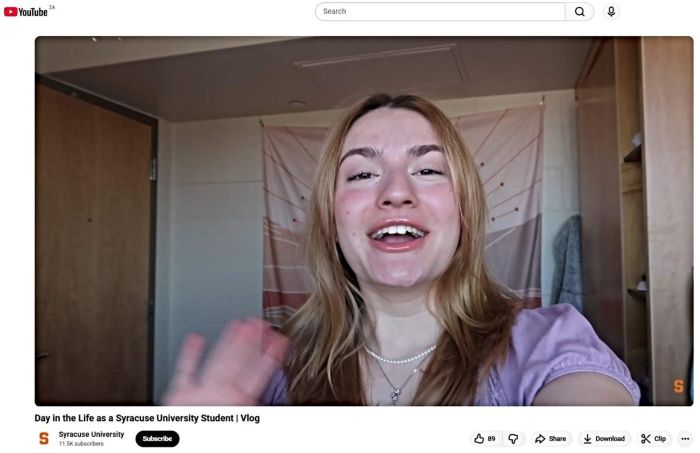
Example: Syracuse University, Student Vlog on YouTube. A Syracuse student’s “Day in the Life” YouTube vlog offers an unscripted, immersive look into campus life: lectures, study sessions, and community activities. YouTube’s longer format allows for deeper storytelling and helps prospective students experience the campus virtually.
Student “Day in the Life” Takeovers One of the most effective UGC formats is the student takeover, where a student documents a typical day on campus through Instagram or TikTok. These videos often follow an unscripted, narrative flow, showing classes, dorm life, study sessions, and social activities from morning to night. Schools typically host these takeovers on official channels or promote student posts through hashtags. This format resonates because it offers an unfiltered look at campus life and helps prospective students picture themselves in that environment.
Example: Stanford University, UGC Nature Reel Stanford University curated a student-shot Instagram Reel featuring the aurora borealis over Pinnacles National Park. The video, captured entirely by a student, embodies the spirit of authentic storytelling, showing beauty, wonder, and student life through the lens of a real experience.
Behind-the-Scenes of Events UGC thrives on authenticity, and few things feel more genuine than spontaneous moments from student events. Encouraging students to share behind-the-scenes perspectives from orientations, club fairs, or sports games helps outsiders experience the energy and community spirit that define your school. These candid glimpses make institutional content more approachable and emotionally engaging.
Faculty or Staff Takeovers and Reflections Authentic content doesn’t have to come solely from students. Faculty and staff can also contribute by sharing casual reflections or quick videos about their daily work. A professor might record a short lab update, while an admissions officer could post a quick tour from a college fair. These snapshots add a human touch to your education marketing strategies by showing the passion, personality, and commitment that drive your institution.
Student-Run Q&As and AMAs Interactive Q&A sessions, where current students answer prospective students’ questions live on Instagram or through social threads, are among the most effective UGC formats. This setup offers unfiltered, peer-to-peer insights that prospects trust. When real students respond in their own voices, it builds transparency and community, turning your social platforms into spaces for genuine connection.
Social Media Contests and Hashtag Campaigns Encouraging students to create around shared prompts or themes is another great UGC driver. Campaigns like “Show your campus pride” or “Dorm room decor challenge” can generate dozens of authentic submissions in a short time. Just ensure clear rules and creator permissions (and parent consent for minors) so you can safely feature the best entries across your platforms. These initiatives not only supply fresh content but also boost engagement and school spirit.
Testimonials from Parents and Alumni UGC isn’t limited to current students. Parents and alumni can offer powerful, credible perspectives through short testimonial videos or written stories. Sharing how a parent watched their child grow or how an alumnus found career success can feel more authentic than any scripted message, and often connects strongly with audiences considering your programs.
Example: Louisiana State University, Alumni-Submitted Carousel LSU showcased an alumna’s entrepreneurial journey through a carousel post featuring her photos and story. The alumni-submitted visuals celebrate post-graduation success while reinforcing a sense of lifelong belonging, transforming alumni into ambassadors for the LSU brand.
Fun Trends and Challenges Participating in lighthearted social trends can also create strong UGC moments. Whether it’s a campus meme, a TikTok challenge, or a humorous group video, joining or amplifying these moments signals that your institution is lively, student-centered, and culturally aware. These pieces of content not only entertain but also reinforce your brand’s relatability and spirit.
Using Podcasts to Showcase Authenticity
Podcasts have become one of the most powerful tools for education marketers looking to connect with audiences through genuine, long-form storytelling. Unlike short-form social media content, podcasts allow room for nuance, emotion, and conversation, making them ideal for showcasing the real voices and experiences that define your school community. Whether you’re featuring students, faculty, or alumni, the format gives your audience something they crave: authenticity.
Set a Clear Purpose and Goals Before launching a podcast, clarify its purpose.
What role will it play in your marketing strategy?
Is it meant to support recruitment by spotlighting programs and student experiences?
To engage current students through campus discussions?
To deepen alumni connections with nostalgia and advice?
Each episode can have a distinct focus, but your overall series should align with strategic objectives. Identify your audience: prospective students, parents, current students, or alumni, and craft episodes that meet their needs. A school emphasizing innovation might produce a series around student research and campus projects, while one focused on student life could highlight real stories about growth, belonging, and discovery.
Plan Your Content Strategy Successful podcasts rely on structure and consistency. Choose a defined theme or niche rather than covering every topic under the sun. Themes like Student Voices: First-Year Journeys or Faculty Conversations: Research That Matters help listeners know what to expect. Pre-plan your first 8–10 episodes to maintain a steady release rhythm.
Aim for a predictable cadence (biweekly or monthly) so listeners know when to expect new episodes. Formats can vary: student interviews, faculty discussions, narrative storytelling, or on-site event recordings. Involving student co-hosts or interviewers adds natural authenticity and relatability, bridging the gap between your institution and prospective students.
Focus on Storytelling and Value Every episode should deliver something meaningful. Encourage guests to share honest stories, not scripted talking points. A student might recount a defining academic challenge; a professor might discuss what inspires their teaching; an alum could describe their career journey post-graduation.
Let conversations unfold naturally; even small moments of humor or vulnerability can make an episode memorable. Strive to balance emotional connection and practical value, offering listeners insight, inspiration, or tangible takeaways.
Feature Diverse Voices Authenticity thrives on diversity. Feature a wide range of speakers—students from different backgrounds, professors across disciplines, and staff who shape campus life behind the scenes. Mixing perspectives gives your audience a fuller, more human picture of your institution. Episodes could spotlight student-led initiatives, faculty research, or stories that reflect different aspects of campus life, from residence halls to community outreach.
Production and Promotion Good audio quality matters. Use a reliable microphone, record in a quiet space, and lightly edit to maintain clarity while preserving natural conversation flow. Publish episodes consistently and promote them across channels, email newsletters, your website, and social media. Short audiograms or quote graphics can extend your podcast’s reach while reinforcing its authentic tone.
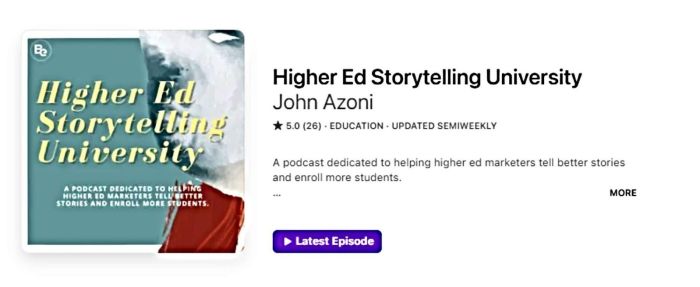
Example: Higher Ed Storytelling University Podcast. The Higher Ed Storytelling University podcast features marketers, educators, and students discussing authenticity, narrative strategy, and digital storytelling. This example illustrates how schools and industry experts are using long-form audio to humanize their messaging and reach broader audiences.
Building a successful user-generated content (UGC) strategy doesn’t require starting from scratch. With the right tools and a few well-planned quick wins, your institution can begin collecting and showcasing authentic stories almost immediately. Below are practical tools and easy-to-implement tactics that can help you get started.
UGC Creation and Curation Tools
Canva: A go-to tool for both marketing teams and students. Canva makes it easy to design branded graphics, quote cards, and short visuals using preset templates. Students can create Instagram takeover intros, testimonial cards, or club event spotlights, all while staying on-brand thanks to shared school colors and fonts.
CapCut: A free, mobile-friendly video editing app perfect for short-form social content. Encourage students to use it to trim clips, add subtitles, and polish their footage before submission. Subtitles, in particular, improve accessibility and help engagement since many viewers watch videos without sound.
Later or Buffer: Social media scheduling platforms like these help teams plan and publish UGC consistently. For example, you can schedule weekly “Student Spotlight” features or testimonial series, keeping your feeds active with minimal daily effort.
TINT or Tagboard: These UGC management tools collect content tagged with your campaign hashtags across multiple platforms into one dashboard. They also help you request permissions, filter submissions, and display curated UGC feeds on your website (such as a live “#CampusLife” wall on your admissions page).
Quick Wins to Kickstart UGC
Identify 3 Student Storytellers: Start small. Find three enthusiastic students, perhaps a club leader, athlete, or international student, and invite them to share their stories through takeovers, vlogs, or blog posts. Their content will serve as authentic examples and inspire others to participate.
Launch a Branded Hashtag: Create a memorable, campaign-specific hashtag like #[YourSchool]Life or #Future[YourMascot] and start promoting it immediately. Add it to your bios, marketing emails, and on-campus signage. Repost tagged content regularly to reward engagement and grow participation.
Pilot an Authentic Video Post: Experiment with one short, genuine video on Instagram or TikTok. Try a student Q&A, a “what I wish I knew” segment, or a move-in day recap. Compare engagement metrics with your usual posts. You’ll often find authentic, lightly produced clips outperform polished ads.
Amplify Existing UGC: Look for what’s already out there. Students are likely tagging your school in posts or videos. Engage with those by resharing or commenting, signaling that you value authentic voices.
Offer Student Club Consultations: Provide quick content workshops or audits for student groups. Helping them improve their storytelling or branding indirectly elevates the quality of UGC being created across campus.
Measuring the Impact of UGC
Just like any other marketing initiative, your user-generated content (UGC) strategy needs to be measured to prove its value and refine future campaigns. The impact of UGC goes beyond clicks and likes. It touches trust, community sentiment, and enrollment. That’s why it’s important to measure both quantitative and qualitative outcomes. Here’s how to assess what’s working and why.
Track Engagement and Reach Start with the fundamentals: likes, comments, shares, saves, and views. Compare these against your institution’s regular branded posts. UGC often performs better, signaling a stronger connection and authenticity. Also track reach and impressions—are your hashtags expanding visibility? If your student takeover generates thousands of views and dozens of replies, that’s evidence of increased awareness and interest at the top of the funnel.
Monitor Cost Efficiency If UGC is part of paid campaigns, track cost per click (CPC) and cost per lead (CPL). Ads using student-generated content tend to have higher click-through rates and lower costs because they appear more genuine. Run A/B tests: one glossy ad versus one featuring a real student photo. If the authentic ad drives more engagement at a lower cost, you’ve got clear ROI data to share with stakeholders.
Measure Conversions and ROI Track what happens after engagement. Did a UGC-driven post increase form submissions or event sign-ups? Ask applicants how they heard about your school. If they mention your social media or specific student stories, that’s qualitative proof of impact. You can also calculate Return on Ad Spend (ROAS) by comparing tuition value or lead generation to ad spend, or use proxy metrics like cost-per-application to show improved performance. Learn more in HEM’s social media playbook.
Gather Feedback from Students and Staff Numbers don’t tell the whole story. Collect feedback from your community through surveys or informal polls. Ask whether students feel represented in your content or whether prospective students found your UGC helpful. Anecdotal comments, like “Your Instagram takeovers made me want to apply,” are qualitative gold and demonstrate the emotional impact of authenticity.
Track Sentiment and Community Growth Pay attention to the tone of comments and discussions. Are people tagging friends or expressing excitement? Positive sentiment indicates your content resonates. Also, monitor the growth of branded hashtags and organic posts. If more students are tagging your school or sharing their own stories without prompting, your UGC strategy is inspiring real advocacy.
Build a UGC Dashboard Bring it all together with a simple dashboard that tracks UGC performance quarterly, engagement rates, CPC/CPL trends, sentiment highlights, and standout examples. This helps visualize the tangible outcomes of authenticity-driven marketing and makes it easier to communicate results to leadership.
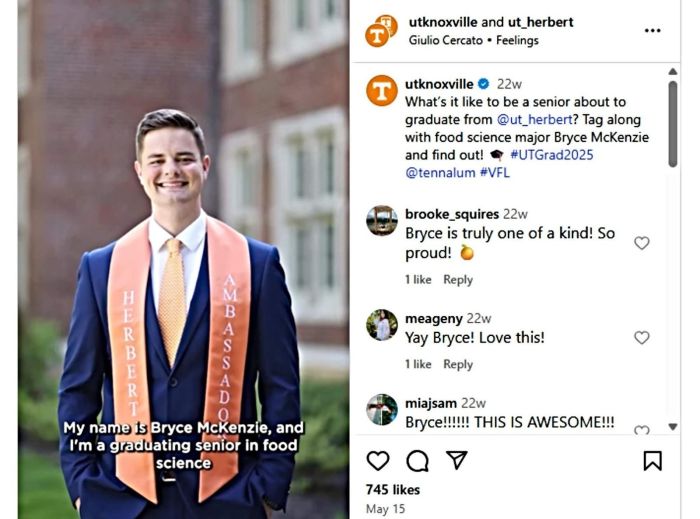
Example: University of Tennessee, Knoxville A University of Tennessee senior’s “Day in the Life” video exemplifies how authentic, student-produced content can outperform traditional marketing posts. The Reel’s organic engagement, thousands of views, and high interaction highlight the measurable impact of relatability on social media reach and engagement.
Authenticity in marketing is the foundation of meaningful connection. By weaving user-generated and authentic content into your strategy, your institution can foster trust, spark engagement, and inspire real relationships with students and families. Throughout this guide, we’ve explored how to define UGC, why it works, and how to implement it strategically through proven best practices and simple quick wins. The takeaway is clear: campaigns that feel real outperform those that feel rehearsed.
Of course, launching an authenticity-driven strategy takes more than good intentions. It demands planning, creativity, and a partner who understands how to balance storytelling with measurable results. That’s where Higher Education Marketing (HEM) comes in. Our team has helped colleges and universities around the world capture genuine student stories and transform them into powerful digital campaigns. Whether you’re planning a branded hashtag initiative, building a library of student video testimonials, or training student ambassadors and UGC programmes to create engaging social content, HEM can guide you every step of the way.
Authentic voices are your greatest marketing asset, and with HEM’s expertise, you can amplify them strategically. Reach out today for a free UGC strategy consultation and discover how genuine stories can drive real enrollment results. Let’s build trust, engagement, and community authentically.
Struggling with enrollment?
Our expert digital marketing services can help you attract and enroll more students!
Frequently Asked Questions
Question: What Is User-Generated Content (UGC) in Higher Education Marketing
Answer:User-Generated Content (UGC) is any material created by people outside your marketing team: students, alumni, faculty, or even parents. It includes everything from TikToks and Instagram stories to blog posts, reviews, and testimonial videos.
Question: What Is Authentic Storytelling in Higher Education Marketing?
Answer: Authenticity is the backbone of modern education marketing. Students trust people more than institutions, and they can spot inauthenticity instantly, especially Gen Z, who’ve grown up spotting inauthenticity from miles away.
Your job now requires a new level of transparency that you are reluctant to provide. This media crisis will burn for several more days if we sit silent. We are in a true leadership moment and I need you to listen to your communications expert. I can make your job easier and more successful.
Signed,
Your Communications Director
As superintendents come under more political fire and frequent negative news stories about their school districts circulate, it is easy to see where the instinct to not comment and just focus on the work might kick in. However, the path forward requires a new level of transparency and truth-telling in communications. In fact, the work requires you to get out in front so that your teachers and staff can focus on their work.
I recently spoke with a school district facing multiple PR crises. The superintendent was reluctant to address the issues publicly, preferring one-on-one meetings with parents over engaging with the media or holding town hall-style parent meetings. But when serious allegations of employee misconduct and the resulting community concerns arise, it’s crucial for superintendents to step forward and take control of the narrative.
While the details of ongoing human resources or police investigations cannot be discussed, it’s vital to inform the community about actions being taken to prevent future incidents, the safeguards being implemented, and your unwavering commitment to student and staff safety. All of that is far more reassuring than the media reporting, “The district was not available for comment,” “The district cannot comment due to an ongoing investigation,” or even worse, the dreaded, “The school district said it has no comment.”
Building trust with proactive communication
A district statement or email doesn’t carry the same weight as a media interview or an in-house video message sent directly to community members. True leadership means standing up and accepting the difficult interviews, answering the tough questions, and conveying with authentic emotion that these incidents are unacceptable. What a community needs to hear is the “why” behind a decision so that trust is built, even if that decision is to hold back on key information. A lack of public statement can be perceived as indifference or a leadership void, which can quickly threaten a superintendent’s career.
Superintendents should always engage with the media during true leadership moments, such as district-wide safety issues, school board meetings, or when the public needs reassurance. “Who Speaks For Your Brand?” looks at a survey of 1,600 school staff who resoundingly stated that the superintendent is the primary person responsible for promoting and defending a school district’s brand. A majority of the superintendents surveyed agreed as well. Promoting and defending the district’s brand includes the negative–but also the positive–opportunities like the first day of school, graduation, school and district grade releases, and district awards.
However, not every media request requires the superintendent’s direct involvement. If it doesn’t rise to the severity level worthy of the superintendent’s office, an interview with a department head or communications chief is a better option. The superintendent interview is reserved for the stories we decide require it, not just because a reporter asks for it. Reporters ask for you far more than your communications chief ever tells you.
It is essential to communicate directly and regularly with parents through video and email using your district’s mass communication tools. You control the message you want to deliver, and you don’t have to rely on the media getting it right. This is an amazing opportunity to humanize the office. Infuse your video scripts with more personality and emotion to connect on a personal level with your community. It is far harder to attack the person than the office. Proactive communications help build trust for when you need it later.
I have had superintendents tell me that they prefer to make their comments at school board meetings. School board meeting comments are often insufficient, as analytics often indicate low viewership for school board meeting live streams or recordings. In my experience, a message sent to parents through district alert channels far outperforms the YouTube views of school board meetings.
Humanizing the superintendent’s role
Superintendents should maintain a consistent communications presence via social media, newsletters, the website, and so on to demonstrate their engagement within schools. Short videos featuring interactions with staff and students create powerful engagement opportunities. Develop content to create touch points that celebrate the contributions of nurses, teachers, and bus drivers, especially on their national days of recognition. These proactive moments of engagement show the community that positive moments happen hourly, daily, and weekly within your schools.
If you are not comfortable posting your own content, have your communications team ghostwrite posts for you. You never want a community member asking, “What does the superintendent do all day? We never see them.” If you are posting content from all of the school visits and community meetings you attend, that accusation can never be made again. You now have social proof of your engagement efforts and evidence for your annual contract review.
Effective communication is a superintendent’s superpower. Those who can connect authentically and show their personality can truly shine. Many superintendents mistakenly believe that hard work alone will speak for itself, but in today’s politically charged landscape, a certain amount of “campaigning” is necessary while in office. We all know the job of the superintendent has never been harder, tenure has never been shorter, and the chance of being fired is higher than ever.
Embrace the opportunity to engage and showcase the great things happening in your district. It’s worth promoting positive and proactive communications so that you’re a seasoned pro when the challenging moments come. There might just be less of them if you get ahead.
Greg Turchetta, Apptegy
Greg Turchetta is the Strategic Communications Advisor at Apptegy and was the Senior Chief Communications Officer for the Richland School District in Columbia, South Carolina.
Latest posts by eSchool Media Contributors (see all)
Trust is fundamental to all of our relationships, and it is vital for meaningful relationships.
It can be an anchor in uncertain times, as explored in this special edition of the International Journal of Academic Development. Within higher education, trust underpins our diverse institutional relationships with students, and their families, friends and supporters; colleagues, regulatory bodies, employers, trade unions, students’ unions, prospective students and schools, international partners as well as local communities and many other groups. These individual interactions combine to build a complex matrix of relationships in which trust originates, takes form or develops.
Or sometimes, it doesn’t. Uncertainty and complexity can stifle relationships, suppressing trust as partners hold back or withdraw, leading to a crisis in confidence. A lack of trust can derail any relationship, well intended institutional narrative or strategy.
Having trust often means believing that you matter in some way to a person, or to the people working in an organisation, or system, enough for them to care about your experiences and feelings. It’s possible to trust without being highly engaged, but it’s difficult to get engaged without having trust.
Trust matters in higher education because universities are there to support individuals to achieve their goals, whether these are in teaching or research. Those individuals need to feel that people and systems are designed to include and support them. Trust has to be earned and it can easily be lost. Reflecting on the many challenges for the UK higher education sector and the multifaceted priorities and constraints it will be impossible to meet the expectations and aspirations of our students, colleagues and partners unless there is trust at every level.
When we encounter media articles like this one from the Guardian, we are asked to consider the possibility that trust in the whole system of higher education is beginning to fail – perhaps a consequence of massification and a loss of faith in education for its own sake, rather than as a passport to a shrinking pool of traditional jobs. We need to talk about why higher education remains worthwhile, and how we can work together to maintain trust in it and to ensure that students feel their own value as part of its systems.
Nurturing relationships
When we build trust we are also building partnerships. When we recognise an institution as trustworthy, we are frequently noting that it delivers on what it has promised and that it values relationships with its stakeholders; it holds itself accountable. And it is not just about the large-scale sector wide challenges, it is also about considering how we build trust through the average everyday experiences of our diverse student and colleague communities.
Creating trustful spaces in the classroom is one element of this. Teachers’ perception of trust-building has shown that trust is based on teachers’ care and concern for students as much as on their subject knowledge and teaching ability. Research on how students in engineering perceive trust-building efforts also shows that they value attention to them as individuals most highly. They also use their trust in the institution to mitigate perceived problems with individual colleagues or services, believing that the university, or their department, makes student-centred decisions with respect to recruiting and training lecturers and professional services staff, and accepting that occasionally, they may not find an individual teacher trustworthy.
Trust and accountability also underpin meaningful cultural change in uncomfortable spaces and sensitive areas. When we trust each other we can have difficult conversations and begin to accept the existence of hidden barriers across our diverse colleague and student groups. Inside the university, teams must trust each other, empathising with each other’s views and values – 2024’s report from AdvanceHE and Wonkhe showed that trust is paramount when leading strategic change in challenging times. Because of this, trust underpins institutional sustainability; particularly within a sector that is currently responding to rising costs and income constraints.
Nurturing relationships through difficult choices about resources and provision requires a fine balance, transparency, and accountability if trust is to be maintained and difficult decisions explained. Few people would continue a relationship in which trust has broken down or with someone or something that they would describe as untrustworthy, but many of use will recognise the situation where this has happened and all parties feel powerless to rebuild the trust.
What can individuals and leaders do?
Trust can be expressed in many forms: You can trust me, I trust you, you can trust yourself, you can trust each other. Within a complex array of opportunities and challenges which call for attention, HE institutions will benefit from finding the most appropriate strategies, performance indicators and (regulatory) endorsements which will create trust and accountability in their provision to build their reputation. As leaders, how do we show colleagues that we trust them? How do we encourage others to show that they trust us? What do we do to ensure that we are trustworthy?
At a larger scale, a trustworthy research partner shares ideas, makes it easy to distribute funding between institutions, invites contributions from stakeholders, colleagues working in the field, and students. A trustworthy community partner supports students and employees from the local area, ensuring that they feel welcome and valued, and uses local services. A trustworthy internationalised university supports cultural diversity and makes both moving to and working with research and teaching easier by explaining practical and organisational differences. By considering how long-term relationships are built and maintained, we can develop a track record of ‘quality’ provision and demonstrate that they are ‘worth it’ to students, colleagues, funders, regulatory bodies, employers and other partners.
When trust in leaders or institutions is lost, the response is often rapid and drastic, with changes in staff and policies having the potential to create further turbulence. As the research with students showed, trust in institutions and systems can survive individual lapses. Maybe a first step should always be to try to rebuild relationships, making oneself, the university, or the system slightly vulnerable in the short term as we work to show that higher education is a human activity which may sometimes not work out as planned, but which we believe in enough to repair.
We can work at all kinds of levels to build and foster trust in our activities. Public engagement has the power to counter hostile narratives and build trust and so does effective partnership work with our local communities, students and Students’ Unions. Working together, listening to and valuing our partners’ perspectives enables us to identify and mitigate the impacts of challenges and take a constructive and nuanced approach to build both trust and inclusive learning communities. If we are to tackle our current pressing sector challenges and wicked problems such as awarding gaps when trust in public institutions is low, it has never been more important to collaborate with our partners, be visibly accountable and focus on equity.
So how can we work together to offer a holistic view of the benefits and value that focusing on trust building can bring? We are keen to build a community of practice to systematically strengthen trust across the HE sector. Join us to develop a trust framework which will explore environments that increase or decrease trust across stakeholder groups and consider how to encourage key trust behaviours such as sharing, listening, and being accountable in a range of professional contexts.
If you are interested, get in touch and let us know what trust in higher education means to you: Claire HamshireRachel Forsyth. Claire and Rachel will be speaking on this theme at the Festival of Higher Education on 11-12 November – find out more and book your ticket here