Tag: trustees

  • The Growing Diversity of Community College Trustees

    The Growing Diversity of Community College Trustees

    Maricopa County Community College District

    New data shows that community college trustees have become more reflective of the diverse student bodies they serve over the past three decades.

    That’s one of the big takeaways from a report the Association of Community College Trustees published last week in partnership with the Center for the Study of Community Colleges, which shows that the proportion of women serving on community college boards is on the rise. Between 1997 and 2025, female representation on the boards grew from 33 percent to 47 percent, with the biggest increases coming in the past seven years. During the same time frame, the proportion of nonwhite trustees grew from roughly 12 percent to 27 percent.

    Association of Community College Trustees/Center for the Study of Community Colleges

    While disparities remain, that breakdown is now closer to mirroring the diversity of community college students. In 2025, 57 percent of students were women and 58 percent identified as people of color, according to data from the American Association of Community Colleges.

    The report, “Community College Trusteeship in 2025: A Commitment to Serve,” draws on surveys of more than 2,000 community college trustees and 40 qualitative interviews with trustees, building on similar reports from 1997 and 2018. The study demonstrates that trustees “have a pulse on their communities’ needs, a deep commitment to the community college mission of open access to high-quality higher education for all people, and the kind of visionary thinking needed to keep their institutions thriving,” ACCT president and CEO Jee Hang Lee said in a news release.

    That’s in part because community college governing boards are also more likely now to have members who attended a community college.

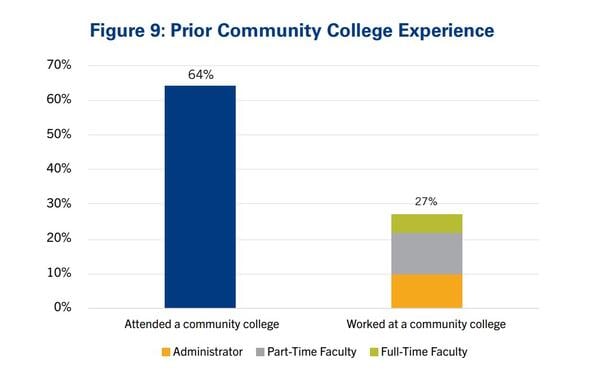
    In 2025, 64 percent of trustees attended a community college and 27 percent previously worked at one, according to the report. In 1997, only 51 percent of trustees had been community college students and 22 percent had been employees. Today’s trustees also are also showcasing the earning potential of community college graduates: 71 percent of trustees who attended a two-year college made at least $100,000 a year in 2025, while 31 percent made close to $200,000, according to the report.

    community college trustee experience

    Association of Community College Trustees/Center for the Study of Community Colleges

    In an interview, one such trustee said that attending a community college first allowed them to continue on to a university “to get my education at a reasonable cost and also to improve my life and my business.”

    For many trustees, those firsthand experiences with the community college system have also translated into enthusiasm for higher education governance work. “I was a nontraditional college student,” one said in an interview for the report. “I went back to school with three kids in tow and got my bachelor’s and my master’s, and it’s just something that I believe in.”

    That’s a common trajectory for community college trustees.

    Among trustees who were once community college students, 83 percent have a bachelor’s or higher degree, and 54 percent have a graduate or professional degree. And over all, trustees have become even more educated over the past 28 years. Although the vast majority of trustees have long held a college degree, the proportion with a bachelor’s degree rose from 84 percent to 86 percent between 1997 and 2025; the proportion with a graduate or professional degree rose from 50 percent to 59 percent.

    But other aspects of community college governance haven’t changed as much since the 1990s, the report shows.

    In 2025, trustees spent an average of five hours a week on board duties—hardly any change from 1997. Similarly, trustees identified funding, access and affordability as top challenges in 1997, 2018 and in 2025. This year, however, 63 percent of trustees also cited enrollment as a top issue, “likely stemming from the fact that most states have begun to experience the anticipated enrollment cliff,” the report noted.

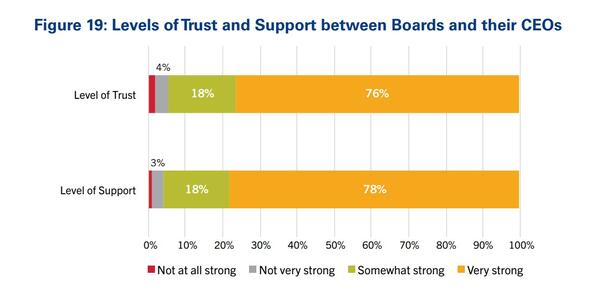
    Community college trustees have also maintained high levels of trust in and support for their college leaders. In 2025, 94 percent of respondents indicated a “somewhat or very strong level of trust” between boards and presidents, while 96 reported somewhat or very strong levels of support—numbers that have hardly changed since 1997.

    community college trustee trust and support

    Association of Community College Trustees/Center for the Study of Community Colleges

    And that’s an essential aspect of effective governance, one trustee said in an interview.

    “The demands [on] a college president are huge, and [it’s a] difficult job, which is one reason [that] when you get somebody, you’ve got to support them,” they said. “You hire somebody and then you get out of their way and let them do what you hired them to do. That is so important.”

    Source link

  • Secretive Big Ten Deal Riles Trustees

    Secretive Big Ten Deal Riles Trustees

    Trustees at member institutions across the Big Ten are pushing back on a proposed $2.4 billion private equity deal that some argue has been too rushed, lacking transparency and proper vetting.

    Now, with trustee criticism mounting, the conference appears to be prolonging talks amid a push to finalize a plan to establish a for-profit arm of the Big Ten, which would control its media and sponsorship rights and sell a 10 percent stake of that entity to the investor. The deal would give members an immediate cash infusion, with a minimum $100 million disbursement across the league, while more prominent athletic programs would receive an even higher revenue share. That money is needed, even at wealthy institutions, as universities adjust to a changing world of college athletics, which includes direct payments for players that began earlier this year.

    The proposal would also maintain the current 18 universities as Big Ten members through 2046.

    Dissent among the Big Ten ranks seems to have prompted the potential investor—the University of California pension fund, or UC Investments—to slow down the deal.

    While UC Investments indicated in a Monday statement that it “remains very excited” about the offer, officials wrote they will work with members in the “coming months” to solidify the deal. (Prior reports indicated the conference hoped to put the deal to a league vote by mid-November.)

    “As we have continued to evaluate this opportunity over the past five months, we remain convinced that the unity of the 18 Big Ten university members is key to the success of Big Ten Enterprises,” Chief Investment Officer Jagdeep Singh Bachher wrote in the statement. “We also recognize that some member universities need more time to assess the benefits of their participation. UC Investments likewise requires some additional time to complete our due diligence as recent developments unfold and we continue to engage with the conference.”

    The CIO also lauded Big Ten commissioner Tony Petitti and his team.

    “The process they have led has been rigorous, honest and fair—among the best we’ve seen. Recent misinformation has distorted some aspects of its effort,” Bachher wrote in the statement.

    But several trustees at Big Ten member institutions have raised concerns about a lack of transparency into the deal, saying they have received little information about the arrangement and yet been asked to rubber-stamp it on a compressed timeline.

    Trustee Dissent

    UC Investments announced a commitment to a unified process for making a deal just a few days after the American Council of Trustees and Alumni held an online meeting with individual board members representing five Big Ten institutions. The meeting, held Friday, included trustees from the University of Michigan, the University of Minnesota, the University System of Maryland, Pennsylvania State University and the University of Southern California, all of whom had concerns about the deal.

    Tom McMillen, a Maryland regent, said in the recorded meeting that “no trustee has been given a balanced view” of the pros and cons of the proposal, according to his conversations with other governing board members across the conference. He also called for third-party evaluations of the arrangement.

    “It’s shocking to me that a decision of this magnitude, there are no opposing views presented,” McMillen said.

    Michigan regent Sarah Hubbard echoed similar concerns on the ACTA call, arguing that there was a need for more oversight and for trustees to have a formal role in discussing the proposal. She also questioned the need to expedite the process with such limited information available.

    “This lack of transparency and information for the fiduciaries at our universities is unacceptable,” Hubbard said.

    Penn State trustee Jay Paterno questioned the need for secrecy around the potential investment. Given that the Big Ten is about to create “a for-profit company using what are essentially public dollars,” he argued, boards need to know more in order to be able to advise their institutions accordingly. Ultimately, Paterno said, he wanted to see the Big Ten put its cards on the table.

    “If it’s such a great deal, show us the deal and let’s go,” Paterno said.

    Outstanding Concerns

    UC Investments signaled it would work on the deal over the “coming months”—likely signaling a slowdown in the process—but it has offered no information about where things stand.

    A UC Investments spokesperson referred questions about trustee concerns to the Big Ten, which did not respond to a request for comment from Inside Higher Ed.

    But outside analysts echo many of the concerns raised by trustees. Armand Alacbay, chief of staff and senior vice president of strategy at ACTA, said the organization has no position on the proposal itself but got involved because of concerns about trustees being shut out of the deal.

    “Anyone we’ve heard from on this has said it’s not enough time, not enough information, not enough of anything to make this decision. Some have been told that it’s a nonvoting decision for them, that they don’t even have a right to make a decision because it’s the conference,” Alacbay said. “Well, I would say that the intellectual property and media rights of your athletic department are a significantly large asset of the institution and justify a level of board oversight.”

    Karen Weaver, an adjunct assistant professor at the University of Pennsylvania Graduate School of Education, told Inside Higher Ed that while private equity has seeped into numerous areas of college athletics in recent years, the investment in a conference is a new approach. And what happens with the Big Ten will likely set the stage for other conferences.

    She said if the Big Ten can successfully navigate a maze of thorny legal and political concerns, then other athletic conferences will be more likely to follow in their footsteps. “But if they constantly get land mines and roadblocks thrown in the way,” others will be more hesitant, she said.

    Weaver also pointed to concerns lawmakers raised that could upend or complicate the deal.

    Last week U.S. Senator Maria Cantwell, a Washington Democrat, issued warnings about the proposal in a statement and individual letters to both university and conference leadership. She argued that such a deal “may be counter to your university’s academic goals, may require the sale of university assets to a private investor, and may affect the tax-exempt purpose of those assets.”

    Cantwell also emphasized the different priorities of universities and private equity investors.

    “The primary goal of these companies is to make money for the firm, which is unlikely to align with the academic goals of your university or its obligations as a not-for-profit organization,” Cantwell wrote. “These investors will be focused on maximizing their investment, not on preserving and growing athletic and academic opportunities for student athletes.”

    Source link

  • A Few Words About Trustees (opinion)

    A Few Words About Trustees (opinion)

    University governing boards are the black boxes of higher ed. As with marriages, the only people who know what they’re really like are the ones in the relationship. Sometimes not even them.

    Like most faculty members, I knew almost nothing about the Board of Trustees at my regional public university, other than hearing my colleagues rail against their hiring decisions. In my nearly two decades on the faculty, we’ve had six presidents. That should tell you something.

    After a no-confidence vote in a previous president, the board held a public Zoom session where faculty, students and community members gave them hell. I watched, embarrassed. At the board’s request for further comment, I wrote a letter explaining from my limited perspective how things had gotten so bad.

    The next day, a trustee emailed to thank me and asked if I’d be willing to talk. I was. I knew some of my colleagues had go-out-drinking relationships with board members. I have never been cool, so I was, of course, flattered. (Frailty, thy name is Rachel.)

    The trustee asked if there were other faculty members they could contact. I gave names. We kept in touch. Eventually, the board fired the president and hired someone new. The trustee would occasionally reach out. We’d talk about campus issues—but also books and dogs. Our conversations made me feel seen and valued—a rarity for me.

    Only when I began writing a weekly newsletter for Inside Higher Ed, having confidential and off-the-record conversations with sitting presidents, did I realize that my friendly back channel might not have been entirely kosher. Recently, I finally looked at our board’s bylaws. They said, essentially, that trustees aren’t supposed to go around the president to make requests of university employees.

    Oops.

    That rule is there for a good reason. While it is theoretically great for trustees to be more knowledgeable about the institutions on whose boards they serve, their main functions are fiduciary and to hire and (increasingly often) fire the president, who is responsible in turn for educating them. Most faculty and staff will have plenty to say if asked (I sure did) but will have only a limited perspective on the administrative realities (which never stops us from opining). And some board members, like some of us faculty, just like to stir up shit.

    That was not the case with the trustee at my university, who loved the institution, was smart and caring, and wanted only to understand and help make things better. But the reason for bylaws is because not everyone acts honorably. Or is even informed. One thing I’ve learned: Many board members (and some presidents) don’t pay much attention to those pesky board documents. And they’re rarely updated. I just heard from a current president that when he came into the job, the bylaws stated that documents were to be sent electronically. By telegram!

    In the last two years, I’ve heard plenty of stories about good relationships between presidents and helpful boards working together to lead all sorts of different types of institutions. Those tales are happily dull.

    Frequently, though, I’ve heard horror stories about board behavior. Trustees reliving their frat years, getting hammered and passing out on the president’s couch. Grabbing butts and commenting on legs. Weighing in on clothing and jewelry choices. But not all offenses are so blatant. More often, presidents tell me about covert alliances between trustees and executive team members who want to undermine the president—and get away with it because of personal relationships. Or the board members who go around the president to talk to faculty (um, right).

    I have come to believe that many of the problems in higher ed are a result of the fact that there’s no real oversight of trustees, and often not even a shared understanding of what they’re supposed to be doing. There are associations and consultants, but the institutions that seek them out are the ones who already know they need help, and only because things are seriously messed up. Most “training” happens after everything goes pear-shaped and someone with a title and willingness to spend some coin brings in the consultants.

    You’d think leaders would recognize a dysfunctional board. But as one of those consultants likes to say, when you’ve seen one board, you’ve seen one board. Many presidents don’t realize they are in an abusive relationship until they move on (by their own choice, or not) and realize that the next board isn’t like the last. That’s when it hits: Oh. That wasn’t normal.

    Boards sometimes bring in a president to shake things up or solve a big problem (there’s no money in the budget). But when a place is used to doing things a certain way—especially if there’s been a long-serving president—the new person often ends up being blamed for making everyone feel uncomfortable. When trustees start hearing complaints from their golf buddies about how their alma mater is “changing too much” or faculty vote no confidence, guess who takes the hit?

    Some say big boards are better—fewer people means fewer checks on the loudest voices. Most trustees are used to being in charge and seeing quick results. Higher ed doesn’t work that way. And we haven’t even started talking about shared governance. (That’s a whole other can of night crawlers.)

    Presidents have to walk a fine line: Give the board enough information to fulfill their duties without overwhelming them. Some create board books of many hundreds of pages and hope no one reads too closely. Others spoon-feed just what’s needed so they can take advantage of the real expertise and wisdom of the board members. Good trustees are curious and thoughtful. But not all of them got the memo that this is a governing role, not a management one. (Same is true for shared governance.)

    As with faculty development, those who are eager to get better at their jobs attend learning sessions and those who most need training rarely show up. The bullies call themselves “critical thinkers.” A former president–turned–consultant told me that in the old days, other board members would call out bad behavior. Now, she says, when the flamethrowers show up, everyone else suddenly finds their phones fascinating.

    Good trustees know their role. One I’ve spoken to told his president, “If I ever feel like I’m running the place, I know it’s time to find a new president.” That’s what a good marriage sounds like—mutual trust, healthy boundaries, a sense of being on the same team without Monday-morning quarterbacking.

    But like all relationships, presidencies can sour. Many presidents have had great relationships with strong, supportive board chairs. But then the chair rotates. Or a new crop of trustees arrives. Suddenly, everything changes. And there’s no way to explain what happened—only that it did.

    That’s when we see the press release that says the president “resigned abruptly.” The board thanks them for their service, announces an interim and closes the door behind them. In a few recent cases, the interim is the board chair, who then takes over as president.

    Which is why seasoned presidents negotiate their contracts like they’re signing a prenup. Because as with any marriage, you want to believe it’s forever—but you’d be wise to plan for the day one of you decides to walk away.

    Rachel Toor is a contributing editor at Inside Higher Ed, where she writes and edits the Insider membership newsletter The Sandbox.

    Source link

  • After Michigan State trustees told students to call professor a racist, his lawsuit is moving ahead

    After Michigan State trustees told students to call professor a racist, his lawsuit is moving ahead

    Professor Jack Lipton scored a victory for free speech last week after a federal court allowed his lawsuit to move forward against two Michigan State University trustees who he claims not only urged students to call him racist, but told them how to phrase it.

    In his lawsuit, Lipton alleged that two trustees, Rema Vassar and Dennis Denno, met with MSU students, encouraged them to file complaints against Lipton with MSU’s internal civil rights office, and asked students to condemn Lipton as racist in public statements, op-eds, and on social media. MSU hired the law firm Miller & Chevalier to conduct an independent investigation, producing a report you can read online. According to Lipton, it found that Vassar and Denno planned the attacks and even provided others with specific language to paint Lipton as racist, anti-Palestinian, and anti-Muslim.

    For example, in one recorded conversation, Denno told students, “The other thing you can do to help us is attack Jack Lipton, the Chair of the Faculty Senate . . . call him out, call him a racist.”

    What was Lipton’s “racist” crime?

    In October 2023, at a public Board of Trustees meeting that followed an open letter accusing then-BOT Chair Vassar of ethics violations, Lipton read a resolution on behalf of faculty calling for Vassar’s resignation. The meeting erupted in chaos, marked by jeers from Vassar’s supporters.

    The Constitution doesn’t cease to exist just because someone’s feelings got hurt at a trustee meeting.

    The next day, while making clear he was speaking in his personal capacity and not as a faculty representative, Lipton told a reporter that Vassar could have stopped the chaos of the meeting with “a single statement … yet she elected to let the mob rule the room.”

    That single word — mob — triggered what Lipton describes as a coordinated retaliation campaign by Vassar and Denno.

    Lipton apologized for using the word “mob,” as well as for any unintended racial undertones, but did not stop calling for accountability over Vassar’s alleged ethics violations — and he says Vassar and Denno’s harassment of him continued.

    In November 2023, the NAACP Michigan State Conference Youth & College Division released a statement accusing Lipton of “racial terrorism.” Also that month, the organization Diverse: Issues In Higher Education published an op-ed arguing that Lipton had used the word “mob” because he wanted to traumatize black and Palestinian students. At a BOT meeting that December, Denno read a statement accusing Lipton of “criminalizing students” and described his use of the word “mob” as “racism and violent language.”

    What’s more, even though the board eventually voted to censure both Vassar and Denno, as advised by investigators for a range of misconduct including their attacks on Lipton, Vassar didn’t stop there. At a meeting in September 2024, she mocked Lipton and questioned his right to speak on matters of civil discourse, which he cites as yet another effort to chill his speech.

    In language as dry as it was devastating, the court summarized the allegations that these trustees abused their power to carry out what amounts to a smear campaign. Lipton claims that Vassar and Denno “used their positions as BOT members to attack Lipton for the comment he made as a private citizen” and “used their BOT pulpit to funnel adverse action towards Lipton via proxies, leveraging their BOT membership to speak through students, supporters, and members of the public.”

    The court also noted that Lipton’s original “mob” comment was “speech regarding matters of public concern,” as it critiqued the behavior of a public official at a public meeting, and Lipton made the remark as a private citizen. The First Amendment protects faculty when they speak as private citizens on matters of public concern, such as raising state university ethics violations to the media, as Lipton did.

    UPDATE: Another federal appeals court backs academic free speech for public employees

    After FIRE secured a lawyer for a law professor at the University of Illinois Chicago, the school reached a resolution but later reneged on the deal. That’s when the professor sued.


    Read More

    While the court dismissed MSU and its Board of Trustees as defendants, Lipton is now free to pursue his claims against Vassar and Denno themselves — and they have not exactly covered themselves in glory. The university investigation that recommended their censure found that Vassar had taken courtside tickets and free flights while Denno had pressured consultants reviewing MSU’s response to the 2023 mass shooting on campus to tone down any criticism of the trustees. In fact, just this week, Gov. Gretchen Whitmer declined the MSU board’s official request to remove Vassar and Denno, though the governor’s counsel said this “by no means indicates a condoning of the conduct alleged in the referral.” Vassar and Denno may have retained their seats on the board, but they are hardly out of the woods. 

    Now, Lipton’s case moves to discovery, where we’ll get a closer look at how MSU’s top brass reacted when a faculty member stepped out of line by doing his civic duty, and potentially to trial. While this week’s court decision is far from a final ruling, it shows the court believes Lipton’s allegations deserve to be heard, and it’s a reminder that the Constitution doesn’t cease to exist just because someone’s feelings got hurt at a trustee meeting.

    Source link

  • Michigan Governor Declines to Remove Two MSU Trustees

    Michigan Governor Declines to Remove Two MSU Trustees

    After more than a year of uncertainty, Michigan governor Gretchen Whitmer has decided not to remove two Michigan State University trustees as requested by the board, The Lansing State Journal reported.

    Michigan State’s Board of Trustees asked the Democratic governor to remove Rema Vassar and Dennis Denno last year after a university investigation found both trustees violated MSU’s code of conduct. The investigation determined that the pair had “created a fear of retaliation amongst administrators and other MSU personnel,” according to the report, which said they encouraged students to call a frequently critical faculty member a racist. Vassar also accepted gifts from donors, including flights and tickets to athletic events, the report said.

    (Vassar and Denno are currently facing a lawsuit from the professor they allegedly targeted.)

    The report also found the duo intended to “embarrass and terrify” former interim president Teresa Woodruff. The trustees have refuted most allegations and taken issue with the findings.

    Both trustees were stripped of their duties by the board and Vassar stepped down as chair.

    While Whitmer called Vassar and Denno’s actions “shameful,” she decided not to remove her fellow Democrats. (Trustees at Michigan State are elected, unlike at most institutions nationally.)

    “The denial of the request by no means indicates a condoning of the conduct alleged in the referral,” Whitmer’s deputy legal counsel Amy Lishinski wrote in a letter to the MSU board obtained by the newspaper. “Rather, it only means that other considerations related to the Governor’s removal authority weigh against removal under these circumstances at this time.”

    Source link

  • Unclear legal duties can leave university trustees exposed when things go wrong

    Unclear legal duties can leave university trustees exposed when things go wrong

    Not many university trustees or senior management teams have three hours spare at the moment. If they did, however, they would be well advised to watch last month’s Education Committee meeting of the Scottish Parliament regarding the University of Dundee.

    Regardless of your views on select committees, it’s a timely reminder of how trustee boards and senior management teams need to communicate clearly and work with each other, especially, in circumstances where university finances and governance are also occupying Westminster select committee time, and making guest appearances on Radio 4’s Today programme.

    I have written previously about the merits of a special administration for the higher education sector. I will not repeat those views, save in respect of trustee duties.

    As outlined in the above, where a higher education provider is not incorporated as a company, the legal position on trustee duties and where the higher education provider is in financial difficulty is unclear.

    In circumstances of financial distress, trustees could be facing potential personal liability, so a lack of clarity on legal duties is clearly wholly unsatisfactory in that situation.

    Managing insolvency with special administration

    One way to attempt to mitigate this situation is through a special administration regime. This could be along the lines of the further education process, would assist trustees of a provider in financial distress by making it clear that the Companies and Insolvency legislation would apply to all higher education providers, regardless of whether they are companies or not.

    The trustees, like company directors, would then be aware of the rules of engagement, who should be given priority and how to mitigate the risks.

    In addition, the position of students is not specifically protected in a financially distressed situation, above and beyond their status as creditors, in respect of any claims they might have, particularly if there is a market exit of a provider.

    Special administration, again along the lines of the regime in the FE sector, would assist, by providing for a predominant duty to act in the best interest of students and would enable the trustees to put students at the forefront of their minds in a time of financial distress.

    This supports trustees to focus on the interest of students in a financially distressed situation, and make it clear that acting in the best interests of creditors is secondary to avoiding or minimising disruption to the studies of existing students.

    Protection as a charity

    In a solvent situation, again, the companies legislation will not apply to a non-company, but, assuming that the HE provider is a charity, the charity legislation provides that the charity trustees have ultimate responsibility for the affairs of the charity.

    They must also ensure that the charity is solvent and able to deliver its charitable purposes for the benefit of the public, which is where protection for students tends to come in, assuming that some or all of the charitable objects relate to students.

    The duties of trustees come from the fiduciary nature of being a charity trustee, the legal and regulatory framework as well as the governing documents of the charity.

    The Charity Commission sets out 6 key duties for charity trustees:

    • Ensuring the charity carries out its purposes for the public benefit
    • Comply with the charity’s governing document and the law
    • Act in the best interest of the charity
    • Manage the charity’s resources responsibly
    • Act with reasonable care and skill
    • Ensure the charity is accountable

    The position is clearer where a charity HE provider is solvent, rather than in financial distress.

    But whilst the lack of legal clarity for trustees is legally challenging, what the University of Dundee situation has demonstrated is the practical challenge of the management structures in higher education providers and charities.

    Company vs charity

    The structures of a charity are normally inverse to what you would have in a company. In a company, the board of directors would be both legally and practically responsible for the operations of the company, whether it was solvent or insolvent.

    The board of directors would normally carve up management roles between them, or they may delegate some of those roles outside the board to employees, but they should, and generally do, ensure that non-directors report back to the board, with the directors making the final decisions.

    With most higher education providers, the director equivalents are the trustees, who have ultimate responsibility for the actions of the HE providers, but are normally unpaid volunteers who see themselves more as non-executive directors. The trustees will usually delegate management responsibilities to a management team.

    The fiduciary duty issue with that structure, is that the management team runs the risk of being the equivalent of de facto or shadow directors, to the extent that they are making the ultimate management decisions, with no substantive involvement from the trustees.

    Under the Companies and Insolvency legislation, de facto and shadow directors can be equally liable, in both solvent and insolvent situations, as actual directors.

    The management team members therefore need, to protect themselves from liability, to ensure that the executive decisions in respect of the higher education provider, are made by the trustees.

    The trustees, on the other hand, need to ensure that they have proper oversight of the senior management team and, whilst enabling them to fulfil their roles, that they are aware of the executive decisions that the management team are proposing. Ultimately they are taking responsibility for those decisions so they can be accountable for them.

    The problems arise, as was played out for all to see in glorious technicolour last month, when there is a breakdown of communication between the trustees and management team on the decisions being made and the consequences of those decisions.

    Now, more than ever, trustees need to be completely up to speed on the decisions made so, in the very unlikely event that they appear in front of a select committee, they can fully explain and take responsibility for the decisions made and actions taken.

    Source link