This audio is auto-generated. Please let us know if you have feedback.
Dive Brief:
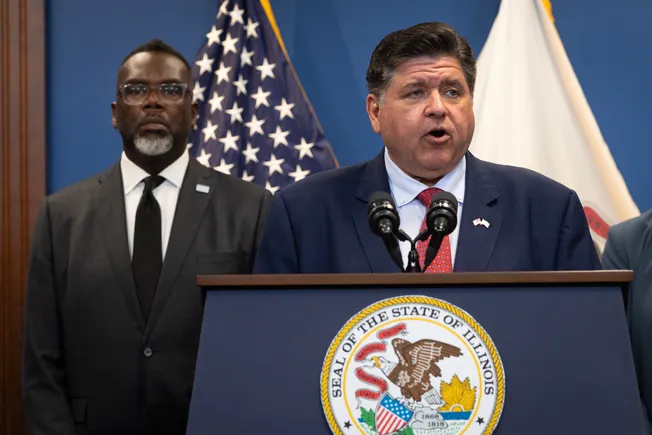
The U.S. Department of Justice is suing Illinois over state laws allowing certain undocumented college students to pay in-state tuition rates at public colleges and receive state-administered scholarships.
Under Illinois law, an undocumented student is eligible for in-state tuition if they attended a high school in the state for at least three years, graduated from high school or earned a GED in Illinois, and sign an affidavit saying they will apply to become a permanent U.S. resident as soon as possible.
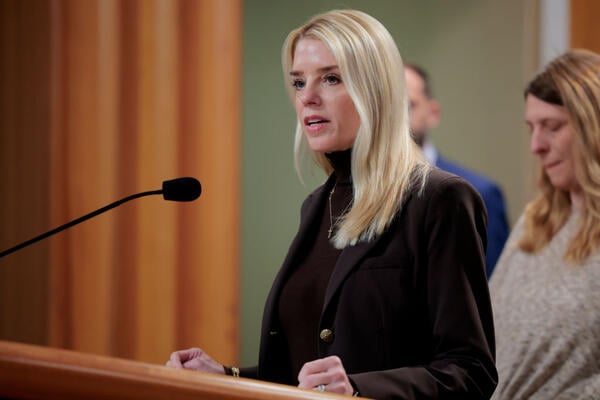
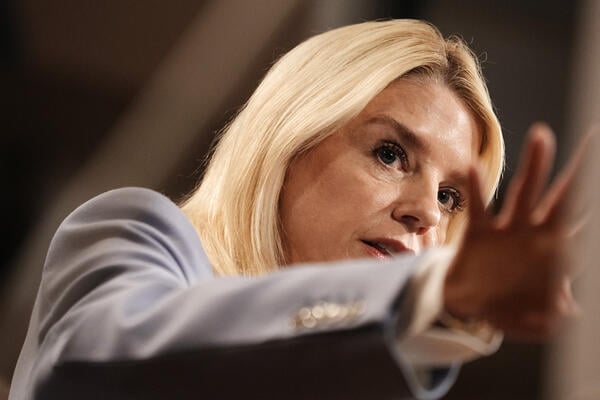
U.S. Attorney General Pamela Bondi on Tuesday argued that in-state tuition rates for undocumented students illegally provide benefits not offered to all U.S. citizens. A spokesperson for Illinois Gov. JB Pritzker’s office defended the policy on Wednesday, saying it is consistent with federal law.
Dive Insight:
As of May, Illinois was one of at least 25 states that, along with Washington, D.C., had policies making undocumented students eligible to pay in-state rates at some or all public colleges.
Over 27,600 undocumented students attended Illinois colleges in 2023, according to the Higher Ed Immigration Portal.
Illinois has had its in-state tuition policy for eligible undocumented students in place since 2003. And in 2011, the state General Assembly established the Illinois DREAM Fund Commission, which raises private donations to fund scholarships for those students.
Since June, the DOJ has sued at least five states, including Illinois, over the practice.
The same day the DOJ filed a lawsuit against Texas, the state attorney general’s office partnered with the department to ask the court to strike down the policy.A federal judge declared it unconstitutional shortly afterward,though civil rights groups are seeking to intervene and challenge the ruling.
In Oklahoma, the state attorney general similarly worked with the DOJ to end its policy, a request approved by a federal judge on Friday.Florida repealed its policy through legislation this year independent of federal intervention.
“This Department of Justice has already filed multiple lawsuits to prevent U.S. students from being treated like second-class citizens — Illinois now joins the list of states where we are relentlessly fighting to vindicate federal law,” Bondi said in a Tuesday statement.
Steven Weinhoeft, U.S. attorney for the Southern District of Illinois, similarly alleged that Illinois’ law unlawfully disadvantages the state’s citizens and uses tax funding to incentivize illegal immigration.
“Illinois has an apparent desire to win a ‘race to the bottom’ as the country’s leading sanctuary state,” he said in a statement. “Illinois citizens deserve better.”
Sanctuary jurisdictions, such as cities and states, are generally considered areas with policieslimiting local authorities’ cooperation with federal immigration enforcement efforts. Bondi has promised to “eradicate” such policies across the country.
Weinhoeft in February took over as the district’s attorney for Rachelle Aud Crowe, following Trump’s promise to fire all U.S. attorneys appointed by former President Joe Biden.
Unlike Texas and Oklahoma, Illinois is a solidly blue state, with Democratic control over the governor’s mansion and both chambers of the Legislature.And Pritzker has been one of the most outspoken opponents of President Donald Trump.
A spokesperson for the governor’s office called the lawsuit “yet another blatant attempt to strip Illinoisans of resources and opportunities.”
“While the Trump Administration strips away federal resources from all Americans, Illinois provides consistent and inclusive educational pathways for all students — including immigrants and first-generation students — to access support and contribute to our state,” the spokesperson said in an email Wednesday. “All Illinoisans deserve a fair shot to obtain an education, and our programs and policies are consistent with federal laws.”
The DOJ’s lawsuit names as defendants:
The state of Illinois.
Pritzker.
Illinois Attorney General Kwame Raoul.
Southern Illinois University’s board of trustees.
Rend Lake College’s board of trustees.
The University of Illinois’ board of trustees.
Chicago State University’s board of trustees.
Eastern Illinois University’s board of trustees.
Illinois State University’s board of trustees.
Northeastern Illinois University’s board of trustees.
Illinois Student Assistance Commission.
Illinois DREAM Fund Commission.
The University of Illinois system said Wednesday it is reviewing the complaint and had no comment. Chicago State said it does not comment on pending litigation. And Rend Lake declined to comment on the lawsuit, citing ongoing talks with its legal counsel.
The remaining colleges did not immediately respond to requests for comment Wednesday.
The difference between in-state and out-of-state tuition can be substantial.
In-state students who enrolled full time at Illinois State in fall 2025 paid $12,066 for a year of tuition.For out-of-state students, the cost was $24,132.
At Chicago State, new in-state students paid $352 per credit hour, while incoming out-of-state students paid $697.
The 18-year-old from Houston was going to start college in the fall at the University of Texas at Tyler, where she had been awarded $10,000 a year in scholarships. That, she hoped, would set her up for her dream: a Ph.D. in chemistry, followed by a career as a professor or researcher.
“And then the change to in-state tuition happened, and that’s when I knew for sure that I had to pivot,” said Ximena, who was born in Mexico but attended schools stateside since kindergarten. (The Hechinger Report is referring to her by only her first name because she fears retaliation for her immigration status.)
In June, the Texas attorney general’s office and the Trump administration worked together to end the provisions in a state law that had offered thousands of undocumented students like her lower in-state tuition rates at Texas public colleges. State and federal officials successfully argued in court that the long-standing policy discriminated against U.S. citizens from other states who paid a higher rate. That rationale has now been replicated in similar lawsuits against Kentucky, Oklahoma and Minnesota — part of a broader offensive against immigrants’ access to public education.
At UT Tyler, in-state tuition and fees for the upcoming academic year total $9,736, compared to more than $25,000 for out-of-state students. Ximena and her family couldn’t afford the higher tuition bill, so she withdrew. Instead, she enrolled at Houston Community College, where out-of-state costs are $227 per semester hour, nearly three times the in-district rate. The school offers only basic college-level chemistry classes, so to set herself up for a doctorate or original research, Ximena will still need to find a way to pay for a four-year university down the line.
Her predicament is exactly what state lawmakers from both political parties had hoped to avoid when they passed the Texas Dream Act, 2001 legislation that not only opened doors to higher education for undocumented students but was also meant to bolster Texas’s economy and its workforce long-term. With that law, Texas became the first of more than two dozen states to implement in-state tuition for undocumented students, and for nearly 24 years, the landmark policy remained intact. Conservative lawmakers repeatedly proposed to repeal it, but despite years of single-party control in the state legislature, not enough Republicans embraced repeal even as recently as this spring, days before the Texas attorney general’s office and the federal Department of Justice moved to end it.
Now, as the fall semester approaches, immigrant students are weighing whether to disenroll from their courses or await clarity on how the consent agreement entered into by the state and DOJ affects them.
Immigration advocates are worried that Texas colleges and universities are boxing out potential attendees who are lawfully present and still qualify for in-state tuition despite the court ruling — including recipients of the Deferred Action for Childhood Arrivals program, asylum applicants and Temporary Protected Status holders — because university personnel lack immigration expertise and haven’t been given clear guidelines on exactly who needs to pay the higher tuition rate.
At Austin Community College, which serves an area as large as Connecticut, members of the board of trustees are unsure how to accurately implement the ruling. As they await answers, they’ve so far decided against sending letters asking their students for sensitive information in order to determine tuition rates.
“This confusion will inevitably harm students because what we find is that in the absence of information and in the presence of fear and anxiety, students will opt to not continue higher education,” said Manuel Gonzalez, vice chair of the ACC board of trustees.
A billboard promoting Austin Community College in Spanish sits on a highway that leads to Lockhart, Texas. Credit: Sergio Flores for The Hechinger Report
Policy experts, meanwhile, warn that Texas’s workforce could suffer as talented young people, many of whom have spent their entire education in the state’s public school system, will no longer be able to afford the associate’s and bachelor’s degrees that would allow them to pursue careers that would help propel their local economies. Under the Texas Dream Act, beneficiaries were required to commit to applying for lawful permanent residence as soon as possible, giving them the opportunity to hold down jobs related to their degrees. Without resident status, it’s likely they’ll still work — just more in lower-paying, under-the-radar jobs.
“It’s so short-sighted in terms of the welfare of the state of Texas,”said Barbara Hines, a former law school professor who helped legislators craft the Texas Dream Act.
Related: Become a lifelong learner. Subscribe to our free weekly newsletter featuring the most important stories in education.
For retired Army National Guard Maj. Gen. Rick Noriega, a Democrat who served in the Texas Legislature at the time, that reality hit close to home when he learned of a young yard worker in his district who wanted to enroll at the local community college for aviation mechanics but couldn’t afford out-of-state tuition.
Noriega called the school chancellor’s office, which was able to provide funding for the student to attend. But that experience led him to wonder: How many more kids in his district were running up against the same barriers to higher education?
So he worked with a sociologist to poll students at local high schools about the problem, which turned out to be widespread. And Noriega’s district wasn’t an outlier. In a state that has long had one of the nation’s largest unauthorized immigrant populations, politicians across the partisan divide knew affected constituents, friends or family members and wanted to help. Once Noriega decided to propose legislation, a Republican, Fred Hill, asked to serve as a joint author on the bill.
To proponents of the Texas Dream Act, the best argument in support of in-state tuition for undocumented students was an economic one. After the state had already invested in these students during K-12 public schooling, it made sense to continue developing them so they could eventually help meet Texas’ workforce needs.
“We’d spent all this money on these kids, and they’d done everything that we asked them to do — in many instances superstars and valedictorians and the like — and then they hit this wall, which was higher education that was cost prohibitive,” said Noriega.
The legislation easily passed the Texas House of Representatives, which was Democratic-controlled at the time, but the Republican-led Senate was less accommodating.
“I couldn’t even get a hearing,’” said Leticia Van de Putte, the then-state senator who sponsored the legislation in her chamber.
To persuade her Republican colleagues, she added several restrictions, including requiring undocumented students to live in Texas for three years before finishing high school or receiving a GED. (Three years was estimated as the average time it would take a family to pay enough in state taxes to make up the difference between in-state and out-of-state tuition.) She also included the clause mandating that undocumented students who accessed in-state tuition sign an affidavit pledging to pursue green cards as soon as they were able.
Van de Putte also turned to Texas business groups to hammer home the economic case for the bill. And she convinced the business community to pay for buses to bring Latino evangelical conservative pastors from Dallas, San Antonio, Houston and other areas of the state to Austin, so they could knock on doors in support of the legislation and pray with Republican senators and their staff.
After that, the Texas Dream Act overwhelmingly passed the state Senate in May 2001, and then-Gov. Rick Perry, a Republican, signed it into law the following month.
Yet by 2007, even as immigrant rights advocates, faith-based groups and business associations formed a coalition to defend immigrants against harmful state policies, the Texas legislature was starting to introduce a wave of generally anti-immigrant proposals. In 2010, polling suggested Texans overwhelmingly opposed allowing undocumented students to pay in-state tuition rates.
By 2012, a new slew of right-wing politicians was elected to office, many philosophically opposed to the law — and loud about it. Perry’s defense of the policy had come back to haunt him during the 2012 Republican presidential primary, when his campaign was dogged by criticism after he told opponents of tuition equity during a debate, “I don’t think you have a heart.”
Still, none of the many bills introduced over the years to repeal the Texas Dream Act were successful. And even Texas Gov. Greg Abbott, a Republican border hawk, at times equivocated on the policy, with his spokesperson saying in 2013 that Abbott believed “the objective” of in-state tuition regardless of immigration status was “noble.”
Legislative observers say that some Republicans in the state continue to support the policy. “It’s a bipartisan issue. There are Republicans in support of in-state tuition,” said Luis Figueroa, senior director of legislative affairs at the public policy research and advocacy nonprofit Every Texan. “They cannot publicly state it.”
Meanwhile, as the topic became more politically charged in Texas, the Texas Dream Act ended up amplifying a larger conversation that eventually led to the creation of DACA, the Obama-era program that has given some undocumented immigrants access to deportation protections and work permits.
Even before DACA, many immigrants worked, and those who remain undocumented often still do, either as independent contractors for employers that turn a blind eye to their immigration status or by starting their own businesses. A study from May 2020 found that unauthorized residents make up 8.2 percent of the state’s workforce, and for every dollar spent toward public services for them, the state of Texas recouped $1.21 in revenue.
But without the immediate legal permission to work, undocumented college graduates who had benefited from the Texas Dream Act found themselves limited despite their degrees. As the fight for tuition equity spread to other states, so did the fight for a legal solution to support the students it benefited.
When these young people — affectionately dubbed Dreamers — took center stage to more publicly advocate for themselves, their plight proved sympathetic. By 2017, the same year Trump began his first term, polling had flipped to show a plurality of Texans in support of in-state tuition for undocumented students. More recently, research has indicated time and time again that Americans support a pathway to legal status for undocumented residents brought to the U.S. as children.
But arguments against in-state tuition regardless of immigration status also grew in popularity: Critics contended that the policy is unfair to U.S. citizens from other states who have to pay higher rates, or that undocumented students are taking spots at competitive schools that could be filled by documented Americans.
The DOJ leaned on similar rhetoric in the lawsuit that killed tuition equity in Texas, saying the state law is superseded by 1996 federal legislation banning undocumented immigrants from getting in-state tuition based on residency. That argument has become a template as the Trump administration has sued to dismantle other states’ in-state tuition policies for undocumented residents.
In Kentucky, state Attorney General Russell Coleman, a Republican, has followed in Texas’ footsteps, recommending that the state council overseeing higher education withdraw its regulation allowing for access to in-state tuition instead of fighting to defend it in court.
At the same time, the Trump administration has found other ways to cut back on higher education opportunities for undocumented students, rescinding a policy that had helped them participate in career, technical and adult education programs and investigating universities for offering them scholarships.
Back in Texas, the sudden policy change regarding in-state tuition is causing chaos. Even the state’s two largest universities, Texas A&M and the University of Texas, are using different guidelines to decide which students must pay out-of-state rates.
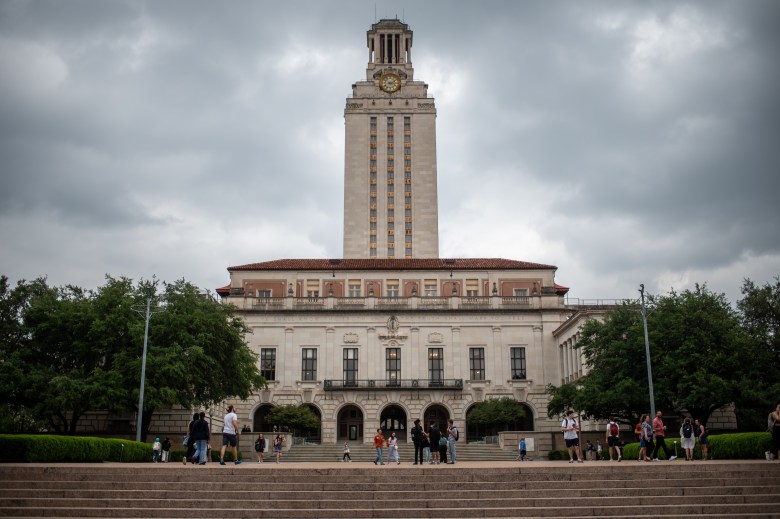
Clouds fill the sky behind the tower at the University of Texas. Credit: Sergio Flores for The Washington Post via Getty Images
“Universities, I think, are the ones that are put in this really difficult position,” Figueroa said. “They are not immigration experts. They’ve received very little guidance about how to interpret the consent decree.”
Amid so much confusion, Figueroa predicted, future lawsuits will likely crop up. Already, affected students and organizations have filed motions in court seeking to belatedly defend the Texas Dream Act against the DOJ.
In the meantime, young scholars are facing difficult choices. One student, who asked to remain anonymous because of her undocumented immigration status, was scrolling through the news on her phone before bed when she saw a headline about the outcome of the DOJ court case.
“I burst in tears because, you know, as someone who’s been fighting to get ahead in their education, right now that I’m in higher education, it’s been a complete blessing,” she said. “So the first thing that I just thought of is ‘What am I going to do now? Where is my future heading?’ The plans that I have had going for me, are they going to have to come to a complete halt?’”
The young woman, who has lived in San Antonio since she was 9 months old, had enrolled in six courses for the fall at Texas A&M-San Antonio and wasn’t sure whether to drop them. It would be her final semester before earning her psychology and sociology degrees, but she couldn’t fathom paying for out-of-state tuition.
“I’m in the unknown,” she said, like “many students in this moment.”
Contact editor Caroline Preston at 212-870-8965, via Signal at CarolineP.83 or on email at [email protected].
The Hechinger Report provides in-depth, fact-based, unbiased reporting on education that is free to all readers. But that doesn’t mean it’s free to produce. Our work keeps educators and the public informed about pressing issues at schools and on campuses throughout the country. We tell the whole story, even when the details are inconvenient. Help us keep doing that.
The U.S. Department of Justice sued the state of Oklahoma Tuesday over a state law that allows undocumented students to pay in-state tuition rates. Oklahoma is now the fourth state the DOJ has sued for having such a policy.
The state’s Republican attorney general, Gentner Drummond, swiftly sided with the federal government and filed a joint motion in support of quashing the law. He said in a statement that it’s “discriminatory and unlawful” to offer noncitizens lower in-state tuition rates “that are not made available to out-of-state Americans.”
“Today marks the end of a longstanding exploitation of Oklahoma taxpayers, who for many years have subsidized colleges and universities as they provide unlawful benefits to illegal immigrants in the form of in-state tuition,” Drummond said.
Now the state and the DOJ await a ruling from the U.S. District Court for the Eastern District of Oklahoma.
Oklahoma’s quick support for the legal challenge is reminiscent of what happened in Texas when the DOJ sued the state in June: Within hours of the lawsuit, Texas sided with the Justice Department and a judge ruled in favor of a permanent injunction, ending in-state tuition for noncitizens. The DOJ then filed similar lawsuits against Kentucky and Minnesota, though those legal fights are still ongoing.
The lawsuits follow an executive order issued by President Donald Trump in April calling for a crackdown on so-called sanctuary cities and state laws unlawfully “favoring aliens over any groups of American citizens,” citing in-state tuition benefits for noncitizens as an example.
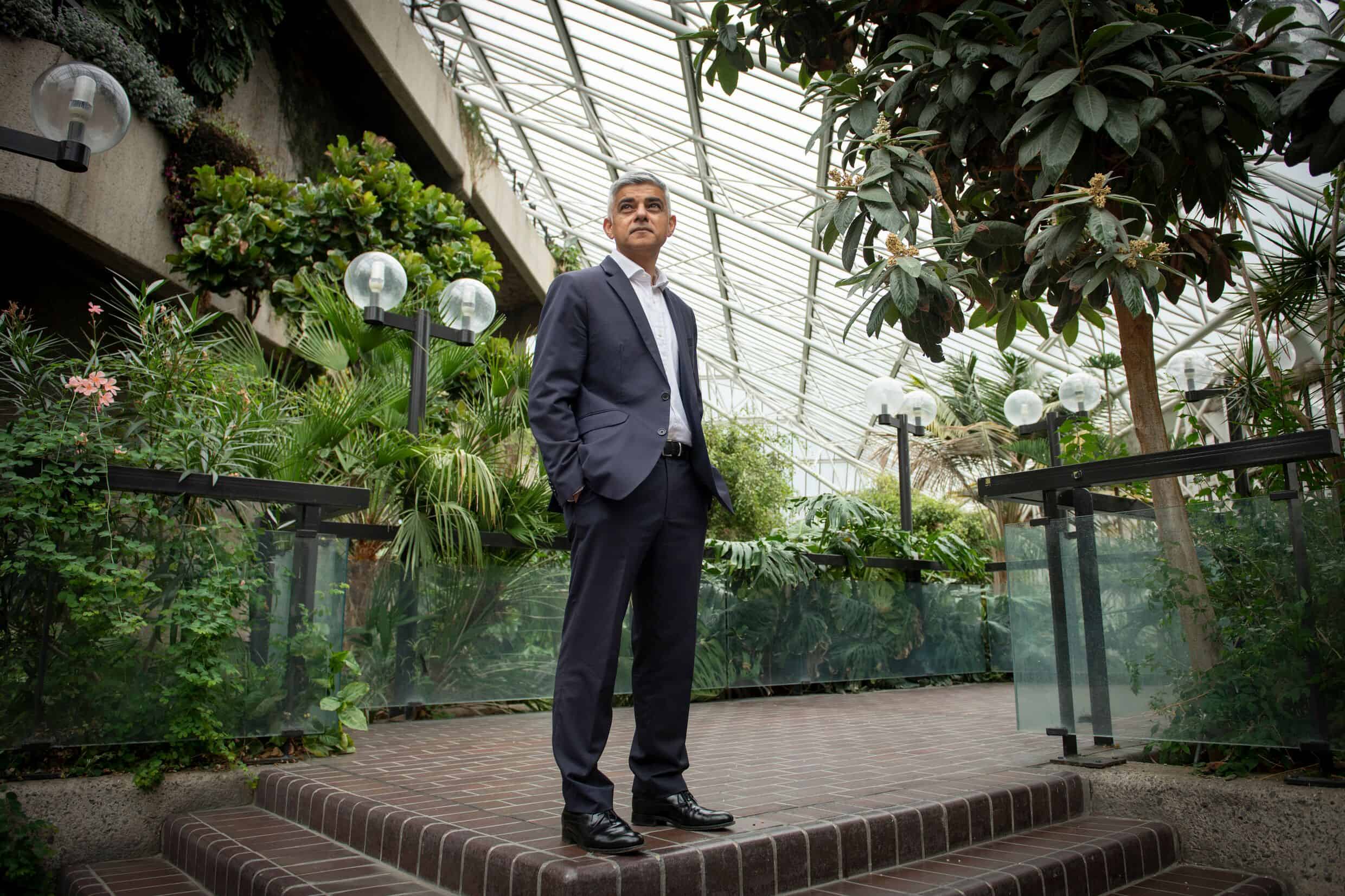
In a keynote address earlier this week at Imperial Global Ghana – Imperial College London’s overseas branch campus in Accra – Sadiq Khan warned that proposals for a new levy on international university fees would hit the UK’s finances hard, describing the policy as “an act of immense economic self-harm”.
The UK government is currently considering a new levy on income that English universities generate from international students as part of its immigration whitepaper, which could not only put students off coming from overseas but also create a substantial extra financial burden for already stretched universities.
International students contribute about £12.5 billion to London, and another £55bn to the national economy every year, Khan pointed out. For this reason, the government should not make it difficult for these students to study in the UK, Khan said at the event – which formed part of his trade mission to Ghana.
With 5% of students in London’s higher education institutions coming from Africa, Khan stressed the need to ensure that international students are not frustrated.
“Closing our economy to global talent would be an act of immense economic self-harm. One that would slow down growth and leave working people in Britain worse off than before. At a time when President Trump is attacking international students, we should be welcoming them,” he added.
Khan said the international students also bring a longer-term labour market value, as many stay after their studies to work in key economic sectors from tech and AI to finance and creative industries. For this reason, he disagreed with the view that, “we should pull up the drawbridge to international students or punish universities that choose to welcome people from around the world”.
On Imperial College opening up a hub in Ghana, he said London is ready to contribute to the development effort of Ghana, “not as a patron, but as a partner. In a genuinely reciprocal relationship that brings benefits to us both”.
President Trump is attacking international students, we should be welcoming them Sadiq Khan, Mayor of London
The vice-chancellor of the University of Ghana, Nana Aba Appiah Amfo, said the university is committed to providing to its students with a transformative experience that goes beyond the classroom to nurture innovation, leadership and practical problem solving, adding that “this commitment is rooted in our strategic plan, which prioritises student success, impactful research and strategic partners”.
“One such partnership, rich in promise and results, is with Imperial College London. What began as a collaboration between two researchers has evolved into a university-wide alliance, advancing work in climate change, diagnostics, and entrepreneurship. It is a powerful model of what mutual trust and shared purpose can achieve,” Amfo added.
She said the Student Venture Support Programme has become the flagship agenda of the partnership which was launched in 2022 with the Imperial College and is equipping students with skills, mentoring and funding to turn ideas into viable ventures.
To date, it has supported over 400 students and more than 115 startups, spanning four universities across Ghana.
Despite Khan’s strong opposition to the levy, it looks likely to go ahead.
At last week’s BUILA conference, skills minister Jacqui Smith doubled down on the need for the levy, saying it would reinforce public confidence in the UK’s international education sector.
Undocumented students who grew up in the U.S. were allowed to pay in-state college tuition in roughly half of states. But now those benefits are under attack, and some states are walking back their policies, leaving thousands of students scrambling.
This summer, the U.S. Department of Justice sued three states—Kentucky, Minnesota and Texas—over laws that permit noncitizens who grew up in these states to pay the same rates as their peers.
In a shocking move, Texas sided with the federal government within hours of the first lawsuit in June, abruptly ending in-state tuition for noncitizens in the state. Now undocumented students in Texas and multiple civil rights groups are seeking to intervene and reopen the case. They argue Republican state lawmakers and the federal government colluded to reach a speedy resolution, and affected students didn’t get to have their day in court.
The defendants in the Kentucky case—Gov. Andy Beshear, Commissioner of Education Robbie Fletcher and the Kentucky Council on Postsecondary Education—have until mid-August to respond to an amended complaint from the DOJ. The Minnesota lawsuit has been assigned to a federal district judge. Gov. Tim Walz, Minnesota attorney general Keith Ellison and the Minnesota Office of Higher Education received a summons in late June.
The rash of lawsuits comes after President Donald Trump issued an executive order in April calling for a crackdown on sanctuary cities and state laws unlawfully “favoring aliens over any groups of American citizens,” citing in-state tuition benefits for noncitizens as an example. The recent DOJ lawsuits allege that these state laws favor undocumented students over American out-of-state students.
As these in-state tuition policies become a political flashpoint across the country, here’s what you need to know about them.
1. These laws are more than two decades old.
Texas became the first state to offer in-state tuition rates to certain undocumented students in 2001 when the Texas Dream Act was signed into law. California soon followed, enacting a similar law later that same year.
Currently, 23 states and the District of Columbia have such policies, according to the Higher Ed Immigration Portal. Another four states allow in-state tuition rates for noncitizens at some but not all public universities. And five states permit in-state tuition only for participants in the Deferred Action for Childhood Arrivals program. For about a decade, Florida also allowed in-state tuition for undocumented students who met certain requirements, but the state rolled back the policy earlier this year.
2. They’ve historically been bipartisan.
While in-state tuition for noncitizens has become a politically polarizing issue, these policies historically enjoyed broad support from state lawmakers of both parties. Republican and Democratic advocates argued that helping undocumented students who attended local high schools go to college would set these students on career paths that benefit state economies. Opponents now argue these laws incentivize illegal immigration.
The Texas Dream Act was signed by Republican governor Rick Perry 24 years ago. He stood by the policy during his 2012 run for president, despite pushback.
“If you say that we should not educate children who come into our state for no other reason than that they’ve been brought there through no fault of their own, I don’t think you have a heart,” Perry said during a 2011 Republican primary debate. “We need to be educating these children because they will become a drag on our society.”
Perry opposed the federal DREAM Act, which would have created a pathway to citizenship, but advocated for in-state tuition decisions to be left up to states.
The author of Oklahoma’s in-state tuition law, enacted in 2007, was also a Republican lawmaker, Oklahoma representative Randy Terrill. His bill, which won bipartisan support in the state House and Senate, was signed into law by Democratic governor Brad Henry.
Florida Republican governor Rick Scott signed a similar law in 2014, which was scrapped as part of broader immigration legislation signed by Gov. Ron DeSantis earlier this year.
When asked about the prospect of the law’s repeal in 2023, Scott told The Florida Phoenixhe was “proud” to have signed the bill and “would sign [it] again today.”
Other Republicans rescinded their support.
“It’s time to repeal this law,” Jeanette Nuñez, former lieutenant governor of Florida and current president of Florida International University, wrote on X shortly before the law’s demise. “It has served its purpose and run its course.”
3. Undocumented students must meet specific criteria in each state to qualify.
Each state law comes with different requirements, but undocumented students generally need to prove they’ve lived in a state for a significant amount of time and attended local high schools to qualify for in-state tuition benefits.
For example, in Oklahoma, noncitizens must have graduated from an Oklahoma high school and spent two years with a parent or guardian in the state while taking classes. They also must sign an affidavit promising to apply for legal status when able or show proof they’ve already petitioned U.S. Citizenship and Immigration Services for legal status.
Undocumented students in Washington State must have spent their senior year at a local high school or earned a G.E.D. in the state, live in the state for at least three consecutive years, as of the date they graduated, and pledge to seek legal permanent residency as soon as legally possible.
4. The laws are designed to also apply to citizens.
These in-state tuition laws are typically crafted to offer in-state tuition rates to students who meet their specific criteria—regardless of immigration status.
That means, in California, for example, any nonresident who spent three years in California high schools is eligible for in-state tuition. So, the policy not only applies to undocumented students but also U.S. citizens who perhaps grew up in the state but may have left and returned for any reason.
Similarly, before the Texas law was dismantled, out-of-state students could gain residency and eligibility for in-state tuition if they graduated from a Texas high school and spent at least three years prior in the state. The policy benefited citizens born and raised in Texas whose parents moved out of the state before they enrolled in college, according to an amicus brief filed by the Intercultural Development Research Association in 2022, when the law faced a legal challenge from the Young Conservatives of Texas.
Advocates for these policies say that’s why they don’t violate the Illegal Immigration Reform and Immigrant Responsibility Act of 1996, which prohibits states from providing higher ed benefits to undocumented immigrants unless citizens are also eligible. Trump cited the federal statute in his executive order.
Over the years, these laws have been challenged multiple times in court, but until the DOJ’s lawsuit against Texas, none succeeded.
Just over one in 10 higher education institutions enroll at least 20 percent international students.
Photo illustration by Justin Morrison/Inside Higher Ed | skynesher/E+/Getty Images
Colleges and universities with a high percentage of international students face a credit risk as the federal government continues to target international students, according to a new report from Moody’s Ratings.
Those most at risk include the 11 percent of American institutions where international students make up more than 20 percent of the student body, the ratings agency said, as well as institutions that are already struggling financially. (In total, 6 percent of students at U.S. institutions come from other countries.)
“The reduction in international students presents a credit risk for universities heavily reliant on this demographic because of potential declines in tuition income, as international students typically pay full tuition fees,” the report states. “Additionally, with declining numbers of high school students over the next several years in the U.S. leading to fewer domestic students, universities intending to fill the gap with more international students may fall short.”
The report follows the Trump administration’s months-long attack on immigrants and international students specifically, which began with the sudden removal of thousands of students from the Student Exchange and Visitor Information System, putting their legal status at risk. Since then, the administration has implemented a travel ban that includes 12 countries, prohibiting students from those countries from studying in the United States, and has targeted international students at Harvard University specifically, attempting to end the university’s ability to host international students. The State Department has also increased scrutiny into student visa applicants’ social media presences.
It’s unclear as of yet how those factors will impact international enrollment in the fall. According to a recent report by the Institute of International Education, an approximately equal number of colleges and universities said they expected their international enrollment in the 2025–26 academic year to increase (32 percent), decrease (35 percent) and stay the same (32 percent) from this year’s numbers. But the percentage who expect a decrease was much higher than last year, when only 17 percent of institutions thought they might lose international students.
The hit to the sector may not be as significant as it would be in countries like the United Kingdom and Australia, where about 25 percent of all students are international, Moody’s reported. Still, if the U.S. lost 15 percent of its international student population, a substantial number of colleges could experience at least moderate financial repercussions, according to one projection.
About one in five colleges’ and universities’ EBIDA (earnings before interest, depreciation and amortization) margins would shrink by 0.5 to two percentage points, according to the ratings agency’s calculations.
“For entities that already are under fiscal stress and have low EBIDA margins (the median EBIDA for private nonprofit colleges and universities was 11.7 percent in fiscal 2024 and 10.7 percent for publics), a change of one or two percentage points could push them into negative territory, especially if they are heavily discounting domestic tuition or losing enrollment because of demographic shifts,” according to the report. “Also, many small private schools may need to contend with federal changes to student loan and aid programs, further depressing domestic enrollment prospects and stressing budgets, especially for those with low liquidity.”
The report stresses that this model does not account for any steps the institutions might take to mitigate those losses—especially at wealthier institutions. (Fifty-four percent of institutions with at least 15 percent international students are highly selective, while 25 percent are nonselective.)
“Institutions that are highly selective, or those with considerable reserves, may better absorb the impacts by adjusting operations or increasing domestic enrollment,” it states. “Some elite institutions are less reliant on tuition, deriving income from endowments, fundraising or research, thereby mitigating the financial impact.”
The U.S. Department of Justice sued Minnesota lawmakers Wednesday over the state’s policy allowing in-state tuition benefits for undocumented students.
The lawsuit names Gov. Tim Walz, Attorney General Keith Ellison and the state’s Office of Higher Education as defendants. It claims Minnesota is violating federal law and discriminating against U.S. citizens by permitting noncitizens who grew up in the state to pay in-state tuition rates. Under the Minnesota Dream Act, signed into law in 2013, undocumented students have to meet various criteria to qualify, including spending three years at and graduating from a Minnesota high school.
The suit also takes issue with the state’s North Star Promise Program, a free college program launched last year for Minnesotans who meet certain requirements, including undocumented students who live in the state.
The lawsuit comes after the Justice Department successfully sued Texas over the same issue earlier in June. Texas swiftly sided with the federal government, and within hours, its two-decade-old law allowing in-state tuition for undocumented students became moot. The DOJ also sued Kentucky politicians over its in-state tuition policy last week. The lawsuits cite President Donald Trump’s May executive order that called for a crackdown on cities and states with laws that benefit undocumented immigrants, including those that offer in-state tuition benefits.
“No state can be allowed to treat Americans like second-class citizens in their own country by offering financial benefits to illegal aliens,” Attorney General Pamela Bondi said in a news release. “The Department of Justice just won on this exact issue in Texas, and we look forward to taking this fight to Minnesota in order to protect the rights of American citizens first.”
Undocumented students and immigrant advocacy organizations are still reeling after Texas, earlier this month, swiftly sided with a U.S. Department of Justice lawsuit against its policy of permitting in-state tuition for undocumented students. The two-decade-old law, which Republican state lawmakers had recently tried and failed to quash, was dismantled within a matter of hours in a move some critics called collusive.
Now the DOJ is employing the same strategy all over again—this time in Kentucky. The department filed a complaint in U.S. District Court for the Eastern District of Kentucky on Tuesday challenging the in-state tuition policy for undocumented students. The lawsuit, which names Democratic governor Andy Beshear, Commissioner of Education Robbie Fletcher and the Kentucky Council on Postsecondary Education, takes issue with a policy that allows graduates of Kentucky high schools who live in the state, regardless of citizenship, to access in-state tuition benefits.
“No state can be allowed to treat Americans like second-class citizens in their own country by offering financial benefits to illegal aliens,” U.S. attorney general Pamela Bondi said in a statement. “The Department of Justice just won on this exact issue in Texas, and we look forward to fighting in Kentucky to protect the rights of American citizens.”
Beshear is trying to distance himself from the legal battle. Crystal Staley, communications director for the governor’s office, said in a statement that the office hasn’t been served with a lawsuit, nor did it receive advance notice or hold prior conversations with the department about the regulation. She emphasized that the in-state tuition policy was established by the Kentucky Council on Postsecondary Education more than a decade ago.
“Under Kentucky law, CPE is independent, has sole authority to determine student residency requirements for the purposes of in-state tuition, and controls its own regulations,” Staley wrote. “The Governor has no authority to alter CPE’s regulations and should not be a party to the lawsuit.”
The Kentucky Council on Postsecondary Education also only became aware of the lawsuit Wednesday morning and reported that afternoon that it had not yet been served legal documents.
“Our staff General Counsel is reviewing pertinent federal laws and state regulations at this time to determine next steps,” Melissa Young, the council’s communications senior fellow, wrote in an email to Inside Higher Ed.
As of Wednesday evening, no new developments in the case had taken place, but Kentucky attorney general Russell Coleman, a Republican, indicated in a statement to Inside Higher Ed that his office planned to support the lawsuit.
“Preserving in-state tuition for our citizens at the commonwealth’s premier public universities is important to fostering Kentuckians’ potential and encouraging a vibrant state economy,” Coleman said in the statement. “Our Office will support the Trump Administration’s efforts to uphold federal law in Kentucky.”
As in Texas, a group of Republican lawmakers proposed legislation earlier this year to prevent noncitizens in Kentucky from qualifying as residents and accessing in-state tuition benefits. But the bill didn’t proceed further.
The new lawsuit heightens fears among undocumented students’ advocates that the Trump administration could target in-state tuition policies across the country, which help undocumented students in 23 states and D.C. pay for college when they can’t access federal financial aid. Advocates also worry the Trump administration could continue to sue red states to secure policy wins desired by both Republican state lawmakers and the federal government. (In Kentucky, Republicans control the attorney general’s office and the State Legislature.)
Monica Andrade, director of state policy and legal strategy at the Presidents’ Alliance on Higher Education, predicted after the Texas lawsuit, “This might only be the beginning, and there might be future actions that extend beyond Texas.”
Now she worries she’s been proven right.
Pushback in Texas
The move in Kentucky comes as undocumented students and civil rights organizations are fighting back in Texas.
The Mexican American Legal Defense and Educational Fund, a Latino civil rights organization, filed a motion on behalf of undocumented students in Texas to intervene in the DOJ lawsuit. The motion argues that the speed at which Texas and the DOJ came to an agreement and the judge closed the case provided no opportunity for a hearing or for the public to weigh in.
“Our federal courts are public agencies,” said Thomas A. Saenz, president and general counsel at MALDEF. “They’re supposed to undertake their work in the public eye. The two parties and the court did all of this behind closed doors in one afternoon, without setting a public hearing … That is a complete abuse of the judicial system.”
“To come up with a consent judgment like that, they had to have been planning this for weeks,” he said. “Every Texan should be offended if something their legislators passed and then never repealed was so easily killed by the attorney general acting in collusion with the Department of Justice.”
MALDEF is representing unnamed affected students, including three DACA recipients: a third-year biomedical science student at the University of Texas Rio Grande Valley who is planning to pursue medical school, a student earning a master’s in higher education at University of Houston who was planning to apply to Ph.D. programs and a master’s student in clinical mental health counseling at the University of North Texas.
“She cannot afford to pay out-of-state tuition and will likely be forced to drop out of her program,” the motion says of one student.
The goal is for the student group to become a party in the lawsuit so that it can appeal the decision. Texas and the federal government have until early July to oppose MALDEF’s motion to intervene, but if the judge denies an intervention, MALDEF could appeal that decision as well.
Andrade said that what MALDEF is doing could possibly be replicated in other states if the DOJ challenges more in-state tuition laws, though some states might face different challenges that require different approaches. For example, Republican lawmakers in Arizona included a provision in their House budget, approved June 12 by the House Appropriations Committee, that colleges can’t use public money to reduce tuition for noncitizens, The Arizona Capitol Times reported. Some cited the Texas lawsuit.
The Presidents’ Alliance is in “close coordination with legal, with advocacy and institutional partners to explore—whether it’s immediate or longer-term—actions that we can take” to prepare for different kinds of attacks, Andrade said. “Folks in the states where we’re having conversations, their laws comport with federal law. But given everything that’s been going on, that doesn’t mean that folks should not be preparing for any type of challenge.”
The organization is also trying to advise Texas undocumented students who are “scrambling,” in the absence of any state guidance to higher ed institutions as to when the tuition rate change goes into effect and to whom the shift applies. It’s unclear, for example, whether students with DACA or Temporary Protected Status are included.
“We’re telling students to continue to take their classes and do not make any drastic changes based on this,” Andrade said.
TheDream.US, a scholarship provider for undocumented students, is also gearing up to help Texas students find more affordable programs if they can’t pay their colleges’ out-of-state tuition prices. MALDEF predicted some students’ costs would increase up to 800 percent—in some cases, from $50 to $450 per credit hour.
Gaby Pacheco, president and CEO of TheDream.US, said the organization is prioritizing helping students connect with online programs, because many live in Texas border towns, where commuting to a more distant college could require having to cross immigration control checkpoints.
In the meantime, Texas institutions and students are embroiled in “confusion and uncertainty and chaos” as they await more information, she said.
Daniel I. Morales, an associate professor of law and Dwight Olds Chair at University of Houston Law Center, said what happened in Texas is the latest example of a national trend: the “absolute erasure” of state and local issues in favor of the administration’s priorities.
Morales said two decades ago, Texas’s in-state tuition policy was born out of Republican governor Rick Perry’s recognition of “the reality locally in Texas, that we have an enormous undocumented population that is enormously productive if given the opportunity to go to college,” which benefits the state economy. But now, state lawmakers fear risking their career trajectories if they don’t prioritize partisan national interests, he said.
He doesn’t know what’s going to happen in Kentucky. But if it goes the way of Texas and the attorney general files a joint motion with the DOJ, civil rights organizations such as MALDEF would have to be the ones to fight it, with students as the plaintiffs, he said.
“Students, if they don’t have the resources to pay out-of-state tuition, they don’t have the resources to litigate, either,” at least not on their own, he said. “There’s very little recourse.”
This audio is auto-generated. Please let us know if you have feedback.
Dive Brief:
A federal judge on Wednesday signed off on a joint motion from the U.S. Department of Justice and Texas to strike down the state’s 24-year-old law offering in-state tuition rates to undocumented students.
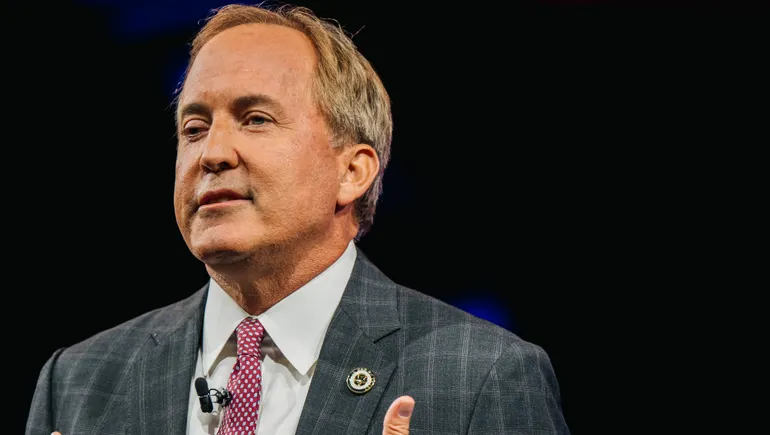
Texas Attorney General Ken Paxtoncalled the law a “discriminatory and un-American provision” in a statement and claimed victory for the court order holding it to be unconstitutional.
The change, effective immediately, will likely affect tens of thousands of Texas students. One report estimated that 59,000 undocumented students in the U.S. attended Texas colleges in 2021.
Dive Insight:
More than two decades ago, the Texas Legislature passed a bipartisan bill removing immigration status as an eligibility factor for in-state tuition. If an undocumented student attended a Texas high school, graduated or received a GED and met “the minimum residency, academic, and registration criteria,” they could enroll at a public state college at the in-state rate.
Then-Gov. Rick Perry signed the bill into law, making Texas the first state with such a policy.
Since then, 24 states and Washington, D.C., have enacted policies that allow undocumented students to attend at least some public colleges at in-state rates. Florida’s law is set to be revoked effective July 1.
DOJ sued Texas over its policy on Wednesday, with U.S. Attorney General Pam Bondi arguing that it illegally offered undocumented students benefits not provided to all U.S. citizens.
“The Justice Department will relentlessly fight to vindicate federal law and ensure that U.S. citizens are not treated like second-class citizens anywhere in the country,” she said in a statement.
Texas voiced support for DOJ’s lawsuit soon after it was filed. But in the short time prior to U.S. District Judge Reed O’Connor’s sign-off, student advocates questioned the legal standing of DOJ’s allegations.
“To suggest that undocumented students are receiving benefits denied to citizens is false and misleading,” Monica Andrade, director of state policy and legal strategy at The Presidents’ Alliance on Higher Education and Immigration, said in a Wednesday statement.
“In fact, any U.S. citizen who meets the same criteria — such as attending and graduating from a Texas high school — qualifies for in-state tuition. These requirements apply regardless of immigration status,” she said.
Gaby Pacheco, president and CEO of the undocumented youth advocacy group TheDream.US, called the lawsuit “harmful and self-defeating for the future of Texas.”
Average in-state costs for Texas public colleges are below the national average, $8,195 versus $9,750 in 2022-23, respectively,according to the Education Data Initiative.
But for out-of-state students, tuition is significantly higher. At the University of Texas-Austin, for example, out-of-state students paid $48,712 in 2024-2025, compared to $13,576 for state residents.
Prior to Bondi’s lawsuit, the Texas Legislature this session had considered a bill to repeal in-state tuition eligibility for undocumented students. The proposal, which did not advance, would have also required such students who had already received in-state tuition to pay the difference within 30 days of being notified or risk having their diplomas withheld.
Amid continued growing global uncertainty, the First Minister has announced Scotland’s Programme for Government for 2025/26, its last before the Scottish election in May next year.
Amongst its many promises is a commitment to “work with partners to secure a long-term and sustainable future for further and higher education”.
Does that mean we can draw a collective sigh of relief? Well, not quite. Despite Scotland’s universities continuing to face an uncertain future, there’s little in the government’s plan for the next twelve months which is likely to give the higher (or wider tertiary) education sector much comfort.
In March, the Carnegie Trust for the Universities of Scotland published our first research report, marking the beginning of a new direction for the charity as we seek to increase our impact and voice on issues of equity and inclusion in higher education in Scotland.
The report by Ipsos highlighted public views on the value, accessibility and funding of universities. The study, the first of its kind in many years, was featured widely in the Scottish media, and appeared on the front pages of the Scotsman, the Herald and the Daily Telegraph.
Most newspapers led with the headline figure that 48 per cent of respondents to Ipsos’ poll would support a change to Scotland’s university tuition fee model based on ability to pay.
However, other than on Wonkhe, what wasn’t picked up by many was what the polling tells us about the varied ways in which age, geography and wealth appear to have shaped how Scottish people have experienced and benefitted from the current post-school system.
Understanding the public’s views
The Trust’s interest in commissioning the research was to fill a hole in the evidence base – the public voice having been all but absent from recent discussions around the future of post-school education and skills in Scotland. Whether we or our politicians agree with the public is not really the point. Instead, we have a duty to ask why those views exist and what they might mean for the future of the system.
Alongside the 48 per cent who would support a change in the tuition fee model, a similar figure (49 per cent) expressed the view that studying courses that don’t directly lead to a profession is a waste of time. There are many ways in which higher education brings value to the individual and society underpinned by evidence, but clearly something in that messaging is falling short.
As a Trust that has always championed funding across the full curriculum, and as someone whose own undergraduate degree did not point to obvious employment, that is a challenging outlook. However, it’s important to acknowledge this opinion and to reflect on the reasons why nearly half the Scottish public feels this way.
In highlighting some of the nuance within public attitudes, we had hoped that the debate on funding might be able to move forwards from its current stasis – that the ground might be laid or a more open, grown-up and intelligent discussion on how we might address some of the challenges in the current system.
Unfortunately, the immediate reaction from the government wasn’t to acknowledge the public’s opinions, but to double down on the current policy.
I suppose, on reflection, this shouldn’t be surprising. Free tuition is a hallmark of Scottish devolution and a promise of what a modern Scotland would offer its people; part of a “social contract” between the government and its citizens.
To question it would be to question the social and democratic principles which underpin it and, it follows, that stepping away from it, even showing a willingness to entertain alternatives, would be to betray those values. It would certainly involve admission and acceptance that, despite its aspirations, the policy does not necessarily reflect the reality of the structures in which it is implemented.
But the reality is that free tuition sits in a wider operating context. The policy might be uniquely Scottish (at least in the UK), but as we have seen, the external factors that impact on it, are not within the current government’s direct control.
Our report was published just days after the latest statistics showed a sharp drop in international students attending university in Scotland, and in the same week as the UK Chancellor’s Spring Statement which the IFS estimated will cut the Scottish Budget by £400m by 2030.
It also came days before the Scottish Government announced that it had failed to deliver its interim child poverty targets, despite significant additional investment in social security. Continuing to operate the current higher education funding policy, already under strain, against this backdrop looks set to become considerably more challenging in coming years.
What should the priorities be for post-school education funding?
Delivering “free tuition” in the current context already means drawing lines in the sand. Currently these are drawn around full-time education (those studying part-time are means-tested and can’t currently access maintenance loans), the number of years of public support (for most people the length of the course plus one – the Trust picks up the tab for many students whose learner journeys are atypical), and around the number of places available to Scottish students (controversially capped according to the available budget and, as such, allegedly more competitive than rUK and international places).
They are also drawn around undergraduate courses (there are no government grants available for students to access postgraduate study) and university funding itself, despite the implications for colleges and apprenticeships which come from the same portfolio budget. It’s these choices – and they are choices – which determine who benefits from post-school education funding and have led some people to claim the current system is not only unaffordable, but unfair.
In defending the government’s policy, the Minister was unequivocal that “our support for free tuition is about more than ideology – it was founded on an equity-of-access approach [and] is based on simple logic”.
This deserves some unpicking because there is a clear difference between a universal approach based on equality, where everyone gets the same, and equity, where resources are directed to those who need them the most in order to deliver equal outcomes.
In a system of finite and diminishing resources, the former approach can simply serve to further embed inequalities as those with capital (be that economic or social) are better able to navigate the system, making them more likely to reap the rewards. Put simply, it’s not so easy to draw a direct line between free tuition and fair access.
A more equitable approach?
When Andrew Carnegie set up the Carnegie Trust for the Universities of Scotland, it was equity that was the driving force. His treatise on philanthropy, The Gospel of Wealth sets out that he saw it as the responsibility of those who were fortunate enough to be rich, to use their surplus wealth in a manner which would benefit society.
Carnegie sought to instill this ideology within the Trust, to ensure that ‘no capable student should be de-barred from attending the university on account of the payment of fees.’ However, he was clear about who should benefit, noting that the honest pride for which my countrymen are distinguished would prevent applications from those who didn’t need the Trust’s assistance.
He went further and built this benevolence into the Trust’s governance as it became the only one of his Trusts to date that could accept donations to:
…enable such students as prefer to do so to consider the payments made on their account merely as advances which they resolve to repay if ever in a position to do so….
In the first half of the 20th century this approach was instrumental in expanding access to higher education to enable individuals from disadvantaged backgrounds, including record numbers of women, to benefit from its rewards.
By 1910 the Trust was responsible for funding around half of the students going to university in Scotland. To put that in today’s terms, that’s 50 per cent of students in Scotland from “widening access” backgrounds.
Compare that to the current day. On paper Scotland has made impressive progress on widening access in the last ten years. Recent statistics show 16.7 per cent of Scottish first-degree entrants in 2023/24 were from the poorest neighborhoods.
But as many have highlighted the current national indicator for widening access, SIMD20, is not a measure of household or individual deprivation, and therefore masks a complex landscape of inequality. In other words, in spite of nearly two decades of free tuition, inequalities exist and persist. Data on graduate outcomes suggests that those from wealthier backgrounds are more likely to complete their degrees and to benefit most in the labour market, and we can see from the Ipsos survey that those from high earning households are also less likely to support changes to funding in which they or their families aren’t direct beneficiaries.
Is university still worth it?
To demonstrate the success of free tuition, the government has pointed to the record numbers of students from Scotland securing places at university. But the rewards for those students are also changing. The IFS has noted a worrying downward trend in the graduate premium (the amount a graduate can expect to earn compared to a non-graduate) which has fallen by at least 10 per cent in the period 1997 to 2019.
This perhaps explains why the Ipsos polling shows that the public are less certain about the value of attending university nowadays. The IFS also note issues of underemployment of graduates. In 2021/22, around a quarter of graduates who participated in the HESA graduate outcomes survey weren’t in graduate jobs and if we dive into access to postgraduate qualifications, where it’s suggested the wage premium jumps by around 20-40 per cent, we would be forgiven for questioning whether inequality has simply shifted further up the pipe.
It is in this light that the Scottish Government response disappoints. Rather than showing desire to understand the views of their constituents, or to explore the evidence, we just keep returning to the same unqualified maxim, that access to higher education should be based on “ability to learn” rather than “ability to pay”.
A more intelligent response would surely be to acknowledge the ideals and aspirations underpinning free tuition and engage in an exploration of whether those are being met through the current approach and, if not, how best to deliver them in the current context.
Were that to happen we might instead be able to have a discussion, not about the concept of free tuition, but about whether it is possible to identify a funding approach that is at once “free”, “equitable” and “sustainable” and about where we might draw lines around public investment in tertiary education in a way that will best deliver on Scotland’s outcomes and ambitions.
Injecting some democracy into the funding debate
Central to the success of such a debate should also be a commitment to engage with the public on what they want from the post school system and how we can deliver that in today’s Scotland.
Our sister organization, Carnegie UK’s Life in the UK 2024 index for Scotland shows that public trust in government and politics has reached a record low with nearly two thirds of people feeling that they have no influence over decisions affecting the country. That’s likely in no small part due to the gap between policy promises and the ways in which they find expression in Scotland’s communities. In this context, continuing to stick to a now decades-old policy position without attempting to evaluate it appears, at best, short-sighted and, at worst, undemocratic.
To address this there are calls for more participative forms of engagement which have been shown to provide opportunities for diverse groups to be involved in decision-making; shaping and enhancing policy development to deliver improved outcomes that meet a wider range of needs. The Citizen Jury we’ll be running with Ipsos this year intends to do just that.
It will bring together a diverse group of people from across Scotland to consider evidence on tertiary education funding and make recommendations for the future. This could be an opportunity to rebuild public trust and to develop a new social contract, one that is co-produced with citizens. Our political leaders in Scotland should care about that and not be too quick to dismiss the public attitudes we’re working to uncover.