
Tag: Turbulent

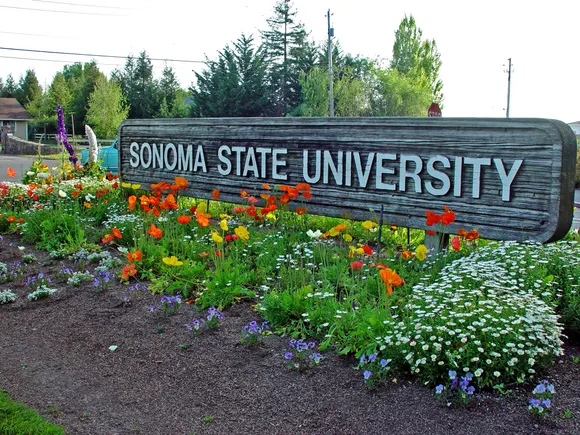
  • Sonoma State University gets new leader after turbulent year of cuts

    Sonoma State University gets new leader after turbulent year of cuts

    Dive Brief:

    • Sonoma State University will have a new president in January as the public institution weathers continued enrollment declines and tries to pull off a financial turnaround after announcing massive budget cuts this year. 
    • The California State University system’s governing board on Wednesday named Michael Spagna as the new permanent leader of Sonoma State. Spagna currently serves as interim president of California State Polytechnic University, Humboldt. 
    • When he takes office on Jan. 20, Spagna will have to grapple with the institution’s financial challenges and continued enrollment declines — with its fall headcount down over 13% from last year.

    Dive Insight:

    Sonoma State has been without a permanent leader since former President Mike Lee resigned last spring after Cal State officials said he forged an agreement with pro-Palestinian protesters without proper approvals and put him on leave. 

    In Spagna, Sonoma State will get a veteran leader of the Cal State system, with years of experience as a provost at CSU Dominguez Hills and as a dean at CSU Northridge, among other positions. 

    “Sonoma State’s success is critically important to the CSU, and the committee was confident that Dr. Spagna possesses the experiences and qualities to lead the university at this consequential moment in its history,” Mark Ghilarducci, a Cal State trustee and chair of the presidential search committee, said in a statement Wednesday. 

    The enrollment declines of recent years have taken their toll on the institution. Early this year, Sonoma State’s current interim leader, Emily Cutrer, described “sobering news” as she confronted the depth of the university’s budget hole, with what was then a larger-than-expected deficit of nearly $24 million. 

    In January, Cutrer announced broad-based cuts to staff jobs and faculty contracts, and further planned to axe around two dozen academic programs and Sonoma State’s NCAA Division II athletic department.

    The cuts drew angry protests on campus, a rebuke from the university’s academic senate and a lawsuit over the elimination of sports.

    A turnaround plan the university released in the spring called for boosting enrollment, shaving costs, and creating new programs and career pathways for students. Specifically, Sonoma State is looking to increase enrollment 20% in five to seven years, to the equivalent of 6,800 full-time students. 

    In June, the state gave a one-time infusion of $45 million to the university to stabilize its finances, launch new programs in high-demand areas such as data science, and undo some of the cuts to jobs and programs. A portion of the funds will also support the continuation of NCAA athletics over three years. 

    For now, enrollment is still falling at Sonoma State. The university’s fall headcount fell to 5,000 students, down 13.2% from last year and down 30.2% from 2021, according to an October presentation from the university. But in the presentation officials also pointed to “silver linings” in the university’s targeted enrollment efforts. 

    Bright spots included increased enrollment from community college students and from smaller high school districts the university focused on. The university also saw the highest application levels in five years from larger cities, including Oakland and Sacramento.

    The university’s total fall head count also beat its budgeted headcount by 125 students.

    Source link

  • Turbulent times require both immediate and long views

    Turbulent times require both immediate and long views

    I don’t remember where I heard this bit of wisdom, if I read it in a book or someone else told it to me, but it’s something I’ve carried around for a while now: There’s always going to be a next, until there isn’t.

    My interpretation is a kind of combination of “this too shall pass” with “time marches on,” along with a reminder of the certainty that at some point all things and all people cease to exist.

    (I find that last bit sort of comforting, but maybe I’m weird that way.)

    It comes in handy when thinking about both exciting and difficult times. What is happening in a moment is not eternal, and something else will be coming along. In order to make that next thing as positive and beneficial as possible, we have to deal with both the present and those possible futures.

    I think this mindset might be helpful to anyone who is considering the coming couple of years for higher education and bracing for the possible impact of a presidential administration that appears hostile to the work of colleges and universities and intends to bring this perceived hostile group to heel. I’m concerned that many institutions are not considering that there’s always going to be a next, and short-term accommodations are going to result in long-term problems.

    What comes next will be far worse than it needs to be.

    It’s strange to think that institutions that are so well established with such long histories should act with such fragility in the face of present uncertainty, but there are signs of what scholar of authoritarianism Timothy Snyder calls “obeying in advance” everywhere.

    As reported by IHE’s Ryan Quinn, Texas A&M, along with other public higher ed institutions in the state, following threats ginned up by right-wing conservative billionaire-backed activist Christopher Rufo, has ended their participation in the PhD Project, a conference meant to help increase the number of doctoral students identifying as “Black, African American, Latino, Hispanic American, Native American or Canadian Indigenous.”

    The institutions had previously participated for a number of years but have now rescinded their sponsorship because of Texas law SB 17, banning DEI programs at public universities. Texas governor Greg Abbott threatened to fire A&M president Mark Welsh. Welsh folded, issuing a statement that said, “While the proper process for reviewing and approving attendance at such events was followed, I don’t believe we fully considered the spirit of our state law in making the initial decision to participate. We need to be sure that attendance at those events is aligned with the very clear guidance we’ve been given by our governing bodies.”

    The intention behind these attacks by Rufo and his backers is to, essentially, resegregate higher education under an entirely twisted definition of “fairness.” This point of view is ascendant, as multiple states have banned so-called DEI initiatives, and the rolling back of affirmative action in college admissions has already resulted in a decline in Black first-year students, something most pronounced at “elite” institutions.

    So, this is now, but in acting this way now, what’s likely to be next? Will Texas A&M regress to a de facto policy of segregation? Is this healthy for the institution, for the state of Texas?

    I grant that it is possible that a program of resegregation is consistent with the desires of a majority of the state’s citizens and the elected legislators are simply reflecting the desire of their constituency. If so, so be it … I guess. I wonder how long the institutions can last when it allows Chris Rufo or Elon Musk or Charlie Kirk or any other outside individual or group to dictate its policies. Is this a good precedent for whatever is next?

    There’s going to be a next. What happens now will give shape to what that next might be. I worry that the folks making decisions believe there is only the now, not the next.

    Thankfully, most of us do not have to make consequential decisions that impact many people working in large institutions, but we can use this framing in considering our individual fates as well.

    In a couple of weeks my next book, More Than Words: How to Think About Writing in the Age of AI, will be in the world. I’ve invested a lot in this book, not just time and effort, but some measure of my hopes for my career and the impact my ideas may have on the world of writing and teaching writing.

    It is a fraught thing to invest too much into something like a single book. Books fail to launch all the time, as I’ve experienced personally … more than once. Finding the balance between investing sufficient effort to take advantage of the now, while also recognizing that I will have to do something next, has been a bit tricky, but necessary.

    Maybe what’s next will be closely related to the now: more speaking, more workshops related to my vision for teaching writing, a truly tangible impact on how we collectively discuss these issues after being more of a gadfly and voice in the woods. But also, maybe this is closer to the end of a cycle that started with a previous book.

    To calm my worries, I spend time thinking about what would be next if 50 percent or even 90 percent of what I now do for my vocation and income dried up. This is what I did when it became clear that teaching off the tenure track was not going to continue to be a viable way forward—a process that has put me in this moment.

    Imagining a next, I think I would call my local School of Rock and see if they needed someone to teach kids the drums, and I also would get to work on a novel that’s been rolling around my head. I picture that possible next, and while there is a sadness that what I’m hoping to achieve now did not come to fruition, I can also envision real pleasure in that other path.

    To preserve their essential mission, institutions must be prepared for turbulence and change by knowing there will be a next. To survive in this time, individuals must both be present in the now and consider what might have to happen next.

    Not easy, but always necessary.

    Source link