In the murky world of political nonprofits and student organizations, foreign influence is often subtle—but sometimes the signs are hard to ignore. Turning Point USA (TPUSA), the high-profile conservative nonprofit mobilizing students across the United States, has come under our scrutiny for potential infiltration by individuals with Kremlin connections.
Central to this story is Alexandra Hollenbeck, a former student journalist and TPUSA associate whose activities raise questions about Russian influence in American student politics. While much of the information has been scrubbed from the Internet, we still hold considerable evidence.
Hollenbeck’s Background and Unusual Affiliations
Alexandra Hollenbeck has contributed to conservative publications such as The Post Millennial, Washington Examiner, and TurningPoint.News. Her work includes coverage of pro-Trump narratives, student activism, and international affairs.
In a 2017 article for TPUSA’s Student Action Summit, Hollenbeck reported on former Trump strategist Sebastian Gorka’s speech, highlighting his devotion to combating jihadists and supporting Trump’s agenda. Gorka’s talk drew historical parallels, beginning with the story of Paul, a 15-year-old boy walking through post-war Budapest, emphasizing that “liberty is as precious as it is fragile.”
Hollenbeck’s prominence within TPUSA circles became more conspicuous after she was photographed at the Kremlin during a pro-Putin rally—a rare and striking connection for a U.S.-based political journalist.
Attempts at Federal Oversight and Silence
Inquiries to the FBI regarding Hollenbeck’s activities yielded no response. TPUSA also never responded to our questions.
Why TPUSA Could Be Vulnerable
TPUSA operates extensive student networks and organizes high-profile events that attract donors, media, and political figures. While the organization is influential within U.S. conservative circles, its internal vetting procedures for affiliates and journalists are less transparent. This opacity creates opportunities for individuals to gain access to sensitive networks, messaging, and potentially student data.
Hollenbeck’s activities—her Kremlin presence, her coverage of pro-Trump events, and her involvement in TPUSA events—illustrate why external scrutiny is warranted. While no definitive proof of espionage or formal Russian affiliation has been established, the pattern of her engagements suggests a potential risk of foreign influence.
Implications for Student Organizations
Hollenbeck’s case highlights broader vulnerabilities. U.S. student political organizations, particularly those with ideological missions and national reach, can be attractive targets for foreign influence. The combination of access to young adults, credibility on campuses, and ties to political figures creates strategic opportunities for external actors.
Even the perception of foreign infiltration can damage trust, complicate fundraising, and raise national security concerns, particularly when student data or organizational communications could be exposed.
Vigilance and Transparency Are Essential
While no concrete evidence has emerged proving that Hollenbeck acted on behalf of the Russian government, her Kremlin connections, TPUSA involvement, and early work covering ideologically charged events like Gorka’s summit illustrate a cautionary tale. Student organizations, nonprofits, and journalists must remain alert to potential foreign influence and implement safeguards to protect institutional integrity.
For TPUSA, this means auditing affiliations, reviewing internal vetting procedures, and ensuring participants act in the organization’s and public’s best interests. For journalists and watchdogs, it underscores the importance of persistent investigation into intersections between U.S.-based political networks and foreign actors.
The case of Alexandra Hollenbeck demonstrates that in today’s political environment, the lines between ideology, influence, and infiltration are increasingly blurred—and the stakes for student organizations and U.S. democracy are higher than ever.
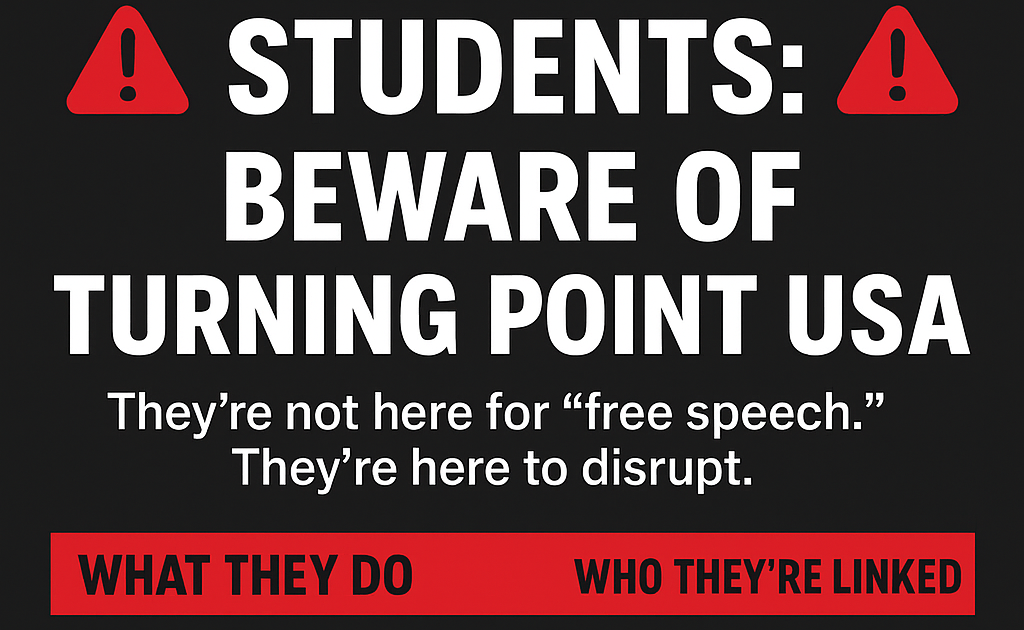
Turning Point USA (TPUSA) brands itself as a conservative youth movement dedicated to free markets and limited government. In reality, a growing body of investigative reporting, watchdog research, and student testimony reveals an organization built on intimidation, manipulation, and close ties to extremists. Students should be aware of the risks before engaging with TPUSA in any capacity.
From its inception, TPUSA has sought to be confrontational. One of its most notorious tools, the Professor Watchlist, publishes the names, photos, and alleged offenses of professors the group deems “anti-conservative.” This public shaming campaign has been condemned by educators and civil liberties advocates as a threat to academic freedom and personal safety. In more recent years, TPUSA has expanded its targets beyond individual professors, with initiatives like the School Board Watchlist, designed to stir distrust of public education and stoke fear around diversity, equity, and inclusion initiatives.
These campaigns are paired with questionable political tactics. Investigations have shown that TPUSA has engaged in covert influence efforts on college campuses, including secretly funding student government elections and running coordinated online disinformation campaigns. Their political arm, Turning Point Action, has been compared to a troll farm for its use of deceptive social media operations.
The group’s leadership and chapters have repeatedly been linked to white supremacist and far-right extremist figures. TPUSA events have hosted or associated with members of Nick Fuentes’ “Groyper” movement, Holocaust deniers, and other alt-right personalities. The Southern Poverty Law Center, Anti-Defamation League, and multiple journalists have documented these associations, which TPUSA leaders routinely downplay. Internal communications and leaked chapter messages have exposed racist, homophobic, and Islamophobic rhetoric from members. Charlie Kirk, TPUSA’s founder, once falsely claimed that a Black woman had “taken his place” at West Point, a statement criticized as both untrue and racially inflammatory.
TPUSA’s messaging also extends beyond politics into science denial. The group has repeatedly dismissed the scientific consensus on climate change, framing environmental concerns as a hoax or left-wing scare tactic, and hosting events that platform climate change skeptics over credible experts. TPUSA has received significant funding from fossil fuel interests, including Koch network-affiliated donors, and from political megadonors such as Foster Friess and Rebekah Mercer, who are known for underwriting climate denial campaigns. Other key allies include right-wing think tanks like the Heritage Foundation and media figures such as Tucker Carlson, who have amplified TPUSA’s messaging to broader audiences. The organization has also benefitted from support by religious nationalist groups and political operatives who share its hardline positions on education, race, and gender.
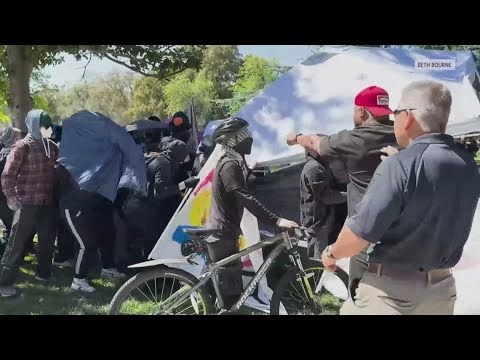
TPUSA’s confrontational model often invites chaos. At UC Davis, a TPUSA-sponsored event erupted into physical clashes involving Proud Boys. Across campuses, students and faculty report that TPUSA representatives deliberately provoke heated exchanges, record them, and circulate the footage to mobilize their base and fundraise off manufactured outrage. Former members have confirmed that such confrontations are not accidental, but rather part of the playbook.
While TPUSA presents itself as a mainstream conservative voice, the evidence paints a darker picture: an organization willing to distort, harass, and align with extremists to achieve its goals. Students seeking honest political debate should look for groups that engage in respectful dialogue, value truth over theatrics, and reject intimidation as a tool.
Sources:
Southern Poverty Law Center – Turning Point USA: Case Study in the Hard Right
Media Matters – Turning Point USA’s History of Racism and White Nationalist Ties
The New Yorker – A Conservative Nonprofit That Seeks to Transform College Campuses Faces Allegations of Racial Bias and Illegal Campaign Activity
Anti-Defamation League – Extremism in American Politics: Turning Point USA
Wired – How Charlie Kirk Plans to Discredit Martin Luther King Jr. and the Civil Rights Act
Chron – Texas A&M Turning Point Chat Exposes Racist and Homophobic Comments
The Guardian – What I Learned When Turning Point USA Came to My Campus
OpenSecrets – Turning Point USA Donors and Political Funding
DeSmog – Turning Point USA and Fossil Fuel Industry Influence
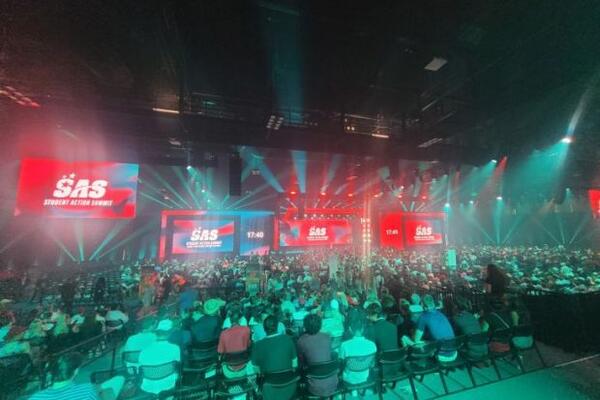
It is already 93 degrees, but temperatures are rising further outside the Tampa Convention Center—especially for the young man dressed in a dinosaur costume. Also sporting a Tom Brady Tampa Bay Buccaneers jersey, he is loudly debating immigration with another young man in a smart suit on the pavement. Across the street, a handful of protesters face off against a growing number of right-wing influencers with cameras.
Inside the building, political strategist Steve Bannon is denouncing billionaire Elon Musk as “evil” while filming a live TV broadcast. Thousands of young college students cheer when border czar Tom Homan threatens to beat up a heckler in the crowd. And a YouTuber leads the audience in a mass “Trump dance party” to the tune of YMCA.
Welcome to the Student Action Summit 2025. Organized by youth activist organization Turning Point USA (TPUSA), the three-day annual conference is billed as the premier event for conservative college students to debate ideas, network and hear from top Republicans. They include Tucker Carlson, Donald Trump Jr. and, of course, Charlie Kirk, who founded the movement as an 18-year-old college dropout.
More than 5,000 people attended this year’s event in Florida, held July 11–13, and Times Higher Education was there to learn what matters to college conservatives today, what issues are dividing this branch of the MAGA movement, and whether this youthful “red wave” can reshape U.S. electoral politics.
As a countdown clock ticks down to zero, a DJ pumps up the well-dressed young crowd—advised to style themselves after Donald Trump’s permanently besuited youngest son Barron—with Rednex’s Cotton Eye Joe and The Killers’ Mr. Brightside. Along with the big hitters, students also hear from Happy Gilmore actor Rob Schneider, founder of the Dark Web marketplace Silk Road, Ross Ulbricht, and fitness trainer Jillian Michaels across an eclectic and often bizarre three days.
Kirk’s fingerprints are all over the summit. Owing to the slightly chaotic nature of the schedule, he is often timetabled to appear in two places at the same time—particularly tricky given that, as the podcaster Dan Nunn puts it, “Charlie can’t even walk around: he’s like a rock star.”
He kicks off the summit on the vast East Hall stage by hitting some issues that Republicans of all ages can agree on—namely, religion and immigration. The 31-year-old activist and podcaster praises the audience for helping reverse decades of declining church attendance (many of them attend a service in the Convention Center on Sunday morning) and for helping TPUSA fight the “spiritual sickness throughout the West.” Talks are regularly interrupted by football-style chants of “Christ is King” or “God is great.”
Kirk also gets loud acclaim when he says that no foreigner should be allowed to own a home or get a job before a U.S. citizen, and draws an even bigger cheer when he mentions President Trump’s plans for mass deportation of illegal migrants. Even legal migration comes under fire over the convention weekend, and Homan, the former chief of Immigration and Customs Enforcement (ICE), is treated like a rock star, his frequent mentions of buzz phrases such as “send them home” chanted back to him from the floor.
Abortion is mentioned on stage, as one might expect. Riley Gaines, a former college swimmer who became an activist after finishing tied for fifth in a race with a trans woman, praised Trump as the most pro-life president in modern history. And the issue is brought up repeatedly in interviews with THE—often by young men.
Many speakers are also very keen to stress the importance of reproduction and “traditional” families. Michael Knowles, a political commentator and YouTuber, calls falling birth rates in the U.S. an “existential crisis.” He welcomes the “trad wife” trend on social media—right-wing women promoting their role as stay-at-home moms—and praises young women for rejecting the corporate rat race, “to the horror of the feminists.” A middle-aged audience member, who gets a massive round of applause when he reveals he has 12 children, wants to help convince the college generation of the “beauty of big families.”
Kirk also ploughs that furrow. He tells the audience that the real threat to the U.S. is not racism or environmentalism, but low birth rate. And he tells those listening online what they are missing out on by not being there in person. “If you want to find your future husband or wife … you should be here in Tampa, Florida, because there’s a lot of eligible bachelors and bachelorettes here.”
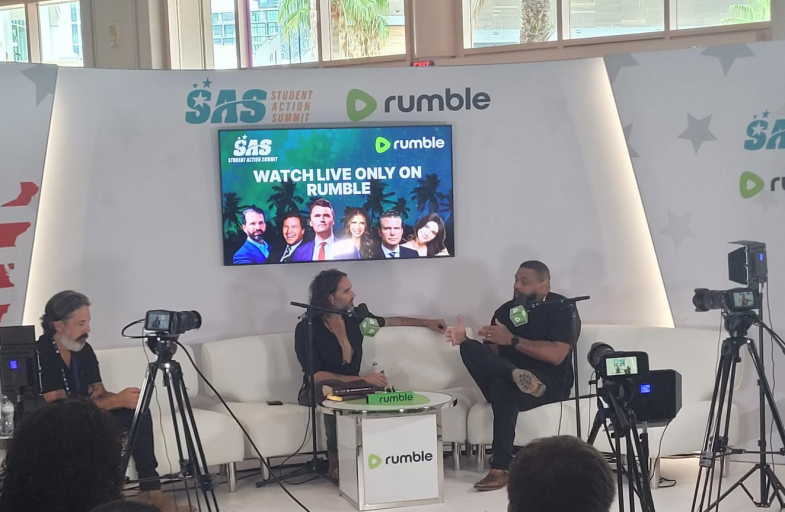
Equally, however, conservative attitudes to dating and sex are evident. Brandon Tatum, a former college football player, police officer and now online activist, advises against “hooking up with people and doing all this crazy stuff.” Brett Cooper, a child actor turned online activist, warns delegates not to party too much or waste time playing video games. And comedian Russell Brand, currently awaiting trial in the U.K. for rape, sexual assault and indecent assault (he has pleaded not guilty), also praises family values and religion while denouncing pornography and claiming that Jesus was opposed to bad government. During his strange 20-minute speech-cum-rap in front of one of the largest audiences of the weekend, Brand explains how he turned to God following a life of crack and heroin addiction, a “pursuit of carnality” and an “all-you-can-eat buffet” of hedonism.
Source: Patrick Jack
Russell Brand (center) at the Turning Point USA Student Action Summit 2025
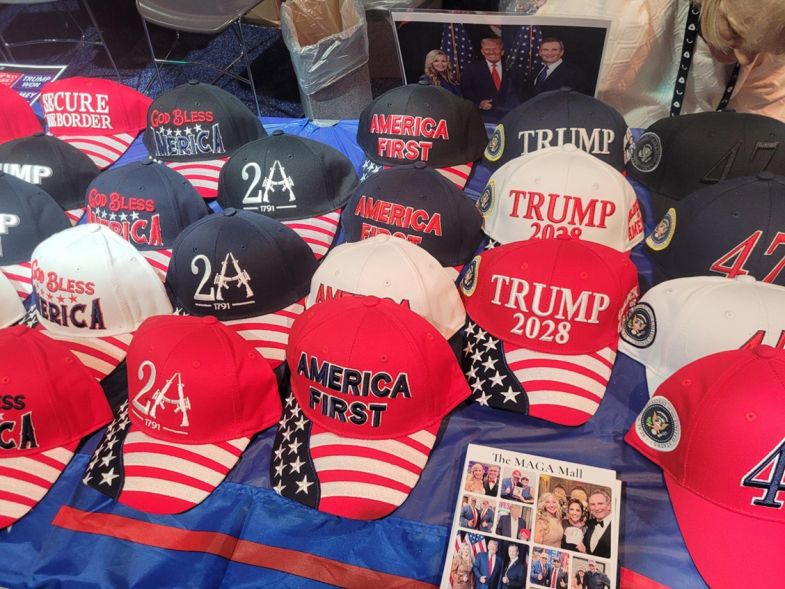
Away from the main hall lies the exhibition floor. Here, students can take selfies with political consultant Roger Stone—pardoned by Trump in 2020 after being convicted of lying to Congress, obstruction of justice and witness tampering relating to a Congressional inquiry into Russian attempts to boost Trump’s 2016 election campaign. They can also pick up free copies of a book on the “untold story behind the Vatican’s rising influence in America,” challenge their friends to a pull-up contest or play cornhole.
You can also buy just about anything—provided it has some red, white and blue on it. There’s a stall to “Make Coffee Great Again,” “Trump 2028” hats are on sale for $30 (£23), and there are even cool pads to keep your head cool under them—as well as vibration plates for “advanced whole-body vibration therapy.”
Attendees can also hear from a wide range of fringe groups. A “Blexit” stall promotes “free thinking and empowerment” at historically black colleges and universities and is dedicated to bringing “traditional American principles to urban communities.” Wilbur Sims, strategic manager of student movement at Blexit, said, “We’re trying to educate people …and get away from a victimhood mentality within the black community.”
A surprisingly large number of families, many with young children, mingle with the students, as do some retirees. Steve, a 75-year-old lifelong Republican from Florida, hopes that TPUSA can help ensure the Democrats never get back into power. But there are a few signs of a divide between the younger and older generations.
Guns, which receive very few mentions from the stage, are one. Gun ownership has, for generations, been a mainstay of right-wing identity, but two lonely young men at the National Rifle Association stall express concern that their classmates are not interested in the Second Amendment (the right to bear arms).
The other dividing line is Israel. The most prominent stall on the exhibition floor is that of the International Fellowship of Christians and Jews (IFCJ), featuring hundreds of Israeli flags. Some college students nearby pose for pictures with a giant cardboard cut-out of Israeli prime minister Benjamin Netanyahu, but when Michele Bachmann, a former member of Congress and board member of the IFCJ, begins to discuss the “unprecedented” amount of antisemitism on college campuses, the hall empties out. And during a debate on day three, Dave Smith, a comedian and regular guest on the popular Joe Rogan podcast, warns of the “tremendous” influence of Israel in U.S. politics. And in the wake of the U.S. attack on Iran during Israel’s recent 12-day assault on the country, Smith elicits cheers when he criticizes “neoconservatives” for starting foreign wars—in contravention of the isolationism typically adopted by “America First” advocates. One young man and woman express their skepticism of the U.S.–Israel alliance and are convinced that convicted sex offender Jeffrey Epstein was a Mossad agent.
Epstein may have died by suicide in 2019, but his presence is keenly felt at the convention. The event occurs amid the MAGA backlash to attorney general Pam Bondi’s comment that the sex trafficker’s “client list”—which, according to Musk, includes Donald Trump, but which right-wing figures are convinced contains prominent Hollywood stars and Democratic politicians—does not, in fact, exist. Despite saying that homes and jobs are more important, Kirk admits the Epstein issue still matters. And in conversation with him, journalist Megyn Kelly calls it a “scandal of the right’s making.” When she asks the audience how many of them think it is an important story, everyone puts their hand up.
Hours later, media personality Tucker Carlson devotes almost his entire 30-minute speech to the issue, while Bannon sees it as symptomatic of the problems with the “deep state.” Even former college athletes Gaines and Tatum devote considerable time to talking about Epstein—with vocal prompting from the crowd.
The TPUSA president at the University of Alabama believes the issue is so important for this crowd because Bondi’s decision not to publish any of the Justice Department’s files on Epstein fits in with their skeptical worldview and their concern that they are being “lied to,” he said.
That sense also permeates the MAGA view of COVID-19. Bannon is cheered when he claims the pandemic originated from a “Chinese Communist Party bioweapon dropped in Wuhan.” There are frequent references over the weekend to the supposedly nefarious “mask mandates,” cancelled proms and young adults’ lost years—for which Kirk calls for a national apology.
“Nobody likes being lied to, and [young people] lived through COVID in a way that adults did not,” according to Nunn, host of the America First and the constitutionalist Nunn Report podcast. “They got their social lives shut down, they got their schools shut down, and then they found out it was all bullshit.” Since they blamed the Democrats for that, he believes that universities became less efficient “leftist breeding grounds” when that cohort arrived on campus.
Chase, a student from Florida, says COVID was a big factor in pushing his generation to the right. “So many people were lied to during that period of time and it definitely brought to light the corruption in the Democratic Party,” he tells THE. TPUSA is important because it helps students learn that they cannot trust mainstream media and must “seek out your own truth.”
The pandemic is clearly still an issue for Owen, a student in Michigan, where Democratic governor Gretchen Whitmer was caught breaking public health protocols at a restaurant in 2021. “I don’t really think that what the left was pushing made rational sense to the youth vote at the time, and it still doesn’t make sense now,” he said. “It’s just the hypocrisy of it all—you’re telling me not to leave my house, yet you’re going out and having parties without wearing masks closer than six feet.” Source: Patrick Jack
A striking omission from the stages of a conference targeted at students is higher education itself—despite the fact that Trump’s crackdown on prominent universities’ funding and autonomy has previously been cheered by many figures on the right. When prompted, however, delegates express universal scorn for universities.
John Paul Leon, TPUSA chapter president at University of California, Berkeley, tells THE he is becoming increasingly worried by academia’s left-wing consensus and “moral superiority,” particularly around “discriminatory” diversity, equity and inclusion (DEI) measures. David Goodwin, president of the Association of Classical Christian Schools and co-author of Battle for the American Mind with defense secretary Pete Hegseth, says higher education is a “mess”; and while institutions should be free to do whatever they want, he believes that they should expect to forgo government funds if they choose to defy the administration’s policies in areas such as DEI or choice of research topics. And Owen, who attends a private college, welcomes Trump’s attacks on universities because they are “indoctrinating students with wrong ideas.” International students, particularly “military-age males,” should be sent home, he adds.
Carol Swain, a retired professor of political science and law at Vanderbilt University and one of the few academics at the event, also welcomes Trump’s fight with Harvard because universities have “lost sight of the original purpose” of the sector, which was to educate minds by exposing individuals to divergent viewpoints. “Now the Ivy League has lost some of its allure, I believe there’s an opportunity for some state colleges and universities and some universities that were considered less prestigious to rise just by doing what the Ivy League hasn’t done, which is educate and create an environment where you have free speech, are following the Constitution, creating opportunities, [and] not practicing discrimination,” she said.
As for the effects of research funding cuts on the academic strength of the U.S., Swain says most papers in recent decades have been “garbage.” The “people that have pushed the beliefs that minorities have been discriminated against … lowered the standards in certain fields, and the emphasis on lived experience as opposed to research and data … has hurt academic research.”
But Jennifer Burns, director of academics at Turning Point Education, does not believe universities are solely to blame, claiming that grade schools are failing to prepare students properly: “If you’re building a house and your foundation is sinking and cracking, then the frame of the house is going to be cracked. It’s not the fault of the carpenters who put up the beams, it’s the cement layers. [Students] are not trained in how to think, so they’re going into college at the whim of a radical college professor and they’re soaking that up.”
TPUSA advocates for a “classical Christian education,” and some attendees propose private, conservative Christian liberal arts colleges such as Hillsdale in Michigan, or New Saint Andrews in Idaho, as exemplars of what higher education should be. Lennox Kalifungwa, digital engagement officer at New Saint Andrews, expresses the view that “the only true education is a Christian education because Christianity has the exclusive when it comes to truth and freedom.”
“Woke” students and academics, meanwhile, are a reoccurring punching bag on the convention floor—particularly those with a specific hair color. Kirk, who rose to fame through viral videos debating with left-wing students, calls them “purple-haired jihadis,” Homan bemoans “people with purple hair and nose rings,” Tatum deplores “liberal non-binaries” and Trump Jr. condemns “raging libtards.”
Such critiques are also usually tied up with anti-trans and anti-gay language. Trump Jr., a long-time ally of Kirk, whose daughter, Kai, is a college-level golfer at the University of Miami, proudly boasts of having been anti-trans since 2017 and sees it as being a “losing issue” for the Democrats. One student tells THE that drag queens reading children stories cause “horrible developmental issues” and contribute to rising suicide rates. Knowles celebrates the Trump-imposed end of the “preposterous ideology” of trans people, calling it “deader than disco,” the cancellation of LGBTQ+ pride parades due to lack of attendance and pop musician Jojo Siwa’s announcement that she no longer identifies as a lesbian. “Nature is healing,” he says with a laugh.
A lone protester who interrupts Homan is called a “loser,” a “moron,” an “asshole” and someone who “sits down when he pees”—to huge chants of “U-S-A.” Homan, who says he “wake[s] up like a kid in a candy shop every day” as border czar, offers to fight the man before his speech is over.
Outside are a few more dissenters. A handful of middle-aged Floridians, who fear TPUSA is “indoctrinating the youth,” hold a sign that says “MAGA—Movement Against Genuine Academics”—perhaps in reference to Kirk’s creation of the Professor Watchlist, which lists scholars who “discriminate against conservative students and advance leftist propaganda.” They are soon joined by a rag-tag group of a few dozen young students, some dressed as characters from the dystopian TV show TheHandmaid’s Tale and others wearing the Guy Fawkes masks popularized by the hacker collective Anonymous. Vicky Tong, spokesperson for the Tampa Bay Students for a Democratic Society, says they want to show that not everyone in Florida supports the “sexist, homophobic, anti-trans, anti-immigrant” agenda of TPUSA.
Back inside the hall, speakers emphasize that while right-wingers are in the majority here, they are “outnumbered” on campus. Many express fear of being accused of sexual harassment or being cancelled for using the wrong pronoun. Kirk calls them “warriors” and praises them for putting up with threats and intimidation. “What they’re doing is one of the hardest things to do in the United States of America. They are deciding to be less popular on campus,” he says.
Source: Justin Sullivan/Getty Images
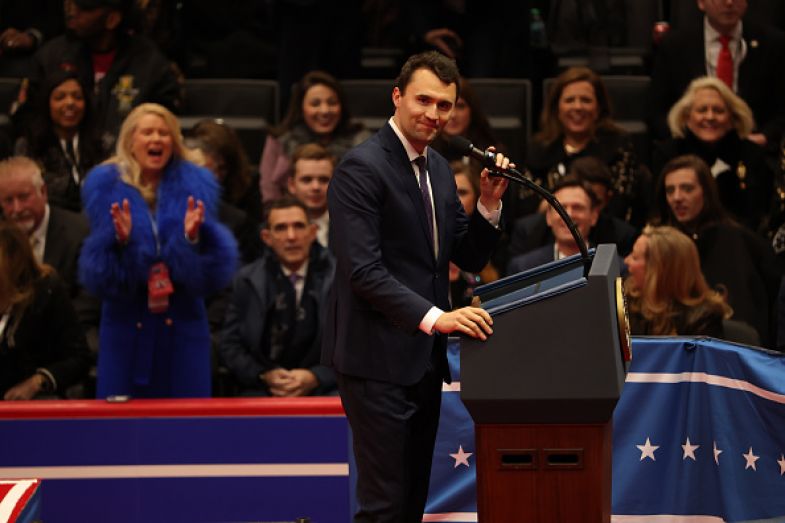
Charlie Kirk speaks at Donald Trump’s inauguration on 20 January 2025
Some of the big names can sympathize. Trump Jr. used to attend “every cool person party” in New York before his father became involved in politics and the invites dried up. “These people that I thought were friends for decades, they don’t call any more.” He encourages students to “feed off the hate,” while Kelly urges them not to be “sheep” and follow along with what their left-wing professors say just to get good grades. “Don’t call yourself a feminist because your teacher will give you pats on the head. Stand up for what you really believe in, and that’s how we spread the good word,” she said.
Fox News host Greg Gutfeld, who has come under fire for attempting to “reclaim” the word “Nazi,” complains that “left-wingers were the cool kids” when he was young. And that sense of not fitting in on campus is clearly a big reason that some of the attendees are here—many of them thanks to a TPUSA stipend (the organization is largely funded by donations). Leon, who studies in the “belly of the [progressive] beast” at Berkeley and went viral for a video where he confronts a liberal student, says he is called a fascist daily, but at TPUSA “you can find life-long friends, your forever friends, or maybe you can find your wife too.” Dylan Seiter, president of TPUSA at Texas A&M University, told students during a breakout session that “the libs want to drag us down to their level and make us seem like we’re some nasty, hateful people, but in reality, we’re not. And it’s our duty and our jobs to prove them wrong.”
Indeed, some delegates confess that they are only here to hang out and socialize, and nearby bars such as Harpoon Harry’s Crab House are packed with older students before the day’s events are even over. But this social element is not just for fun, it is also for networking. As Kirk puts it: “Marriages will happen this weekend. Lifetime friendships will happen this weekend. Careers will start this weekend.” And as well as selling “I survived college without becoming a liberal” T-shirts, the TPUSA Alumni Association is consciously attempting to replicate the college networks of Ivy League schools to help get MAGA graduates into top jobs. TPUSA also tries to persuade students to work on the “front lines” of the culture war. One recruitment video urges young people not to become doctors or lawyers, but to get a job with “real impact.”
Many speakers are convinced that they are already having an impact, crediting a “red wave” of students with delivering Trump’s landslide victory in 2024, a “shot heard around the world.” Bannon thanks them for being “the hardest core of the hardcore” and the “tip of the tip of the spear” in “winning” the 2016 and 2020 elections as well.
“This is the greatest generational realignment since Woodstock,” says Kirk. “We have never seen a generation move so quickly and so fast, and you guys are making all the liberals confused.” Accordingly, Republican Party luminaries show up in force. Michael Whatley, chair of the Republican National Committee, shakes hands on the exhibition floor and multiple members of Trump’s top team—including director of national intelligence Tulsi Gabbard and homeland security secretary Kristi Noem—deliver speeches. However, these politicians generate far less buzz than social media stars such as Gaines and Cooper.
Still, Kirk warns that Washington is taking right-wing students for granted and “messing up” a once-in-a-generation opportunity to deliver a “death blow” to the Democratic Party by failing to fully deliver on their promises—such as by publishing the Epstein list. And Swain agreed. “If these [elected] officials compromise and they prove themselves to be no different than the politicians they replaced, it’s going to be harder for [young] people to stay enthusiastic,” he said.
As one attendee puts it, conservative students have been “lurking in the shadows” for decades. Kirk has successfully dragged them out into the sunlight. The challenge he and Trump now face is one that will be familiar to the “radical left”— keeping momentum, holding the various factions together in the face of political realities, and delivering on their promises.
Day 2 of the U.S. Department of Education (ED)’s Neg Reg aimed at weaponizing Public Service Loan Forgiveness (PSLF) was… just as damning as Day 1. Here’s the recap:
Session Summary:
The session got SPICY right off the bat. ED began the day by presenting their newly revised language. Here are some key moments:
Abby Shafroth, legal aid negotiator, stated CLEARLY for the record that this Neg Reg is not about protecting PSLF; it’s about the Department of Education (ED) using it as a tool to coerce nonprofits and universities to further the Trump Administration’s own goals. The government’s response was not convincing. Watch her remarks here.
Betsy Mayotte, the negotiator representing consumers, brought more fire: “When reading the statute of PSLF, I don’t see where the Education Secretary has the authority to remove employer eligibility definition from a 501(c)(3) or government organization…but my understanding of the regulations and executive order is that they cannot be contrary to the statute. There are no ifs, ands, or buts under government or 501(c)(3).” Watch the exchange here.
In a heated discussion on ED’s proposal to exclude public service workers who provide gender-affirming care to transgender minors, Abby further flagged that no one in the room had any medical expertise, so no one had qualifications to weigh in on medical definitions like “chemical and surgical castration.”
The non-federal negotiators held a caucus to talk about large employers that fall under a single federal Employer Identification Number. They are CONCERNED that the extreme breadth of this rule could potentially cut out thousands of workers only because a subset of people work on issues disfavored by this Administration—all without any right to appeal. Negotiators plan to submit language that would allow employers to appeal a decision to revoke PSLF eligibility by ED.
Borrowers and other experts and advocates came in HOT with public commenttoday—calling out ED for using this rulemaking to unlawfully engage in viewpoint discrimination and leave borrowers drowning in debt, unable to keep food on their tables, or provide for their families.
Missing From the Table:
Today, our legal director, Winston Berkman-Breen, who was excluded from the committee (but still gave powerful public comment yesterday!) has some thoughts on what was missing from the conversation:
For two days now, negotiators have raised legitimate questions and important concerns about the Secretary of Education’s authority to disqualify certain government and 501(c)(3) employers from PSLF. And for two days now, ED’s neg reg staff—inlcuding the moderator!—have engaged in bad faith negotiations.
Jacob, ED’s attorney, asserted that the Secretary has broad authority in its administration of the PSLF program—true, but only to an extent. The Secretary cannot narrow the program beyond the basic requirements set by Congress. When pushed for specific authority, Tamy—the federal negotiator—simply declined.
It doesn’t stop there—ED representatives sidestepped, dismissed, or outright ignored negotiators’ questions and concerns. That’s because this isn’t a negotiation—it’s an exercise in gaslighting. ED is proposing action that exceeds the Secretary’s statutory authority and likely violates the U.S. Constitution—all the while telling negotiators to fall in line.
The kicker? By pushing this proposal, ED itself is engaged in an activity with “substantial illegal purpose.” Let that sink in.
Public Comment Mic Drops:
And Satra D. Taylor, a student loan borrower, Black woman, and SBPC fellow, who was also not selected by ED to negotiate, shared more thoughts during public comment:
“I am disheartened and frustrated by what I have witnessed over the last few days… It has become clear that this Administration is intent on… making college once again exclusive to white, male, and wealthy individuals. These political attacks, disguised as rulemaking, are inequitable and target communities from historically marginalized backgrounds. The PSLF program has provided a vital incentive for Americans interested in serving our country and local communities, regardless of their political affiliation. The Department’s efforts to engage in rulemaking and to change PSLF eligibility are directly related to the goal of Trump’s Executive Order and exceed the Administration’s authority…”
In 2025, much of my professional focus has been on small colleges in the United States. But as many of you know, my colleague and Edu Alliance co-founder, Dr. Senthil Nathan, and I also consult extensively in the international higher education space. Senthil, based in Abu Dhabi, UAE—where Edu Alliance was founded was asked by a close friend of ours, Chet Haskell, about how the Middle East and its students are reacting to the recent moves by the Trump Administration. Dr. Nathan shared a troubling May 29th article from The National, a UAE English language paper titled, “It’s not worth the risk”: Middle East students put US dreams on hold amid Trump visa crackdown.
The article begins with this chilling line:
“Young people in the Middle East have spoken of their fears after the US government decided to freeze overseas student interviews and plan to begin vetting their social media accounts. The directive signed by Secretary of State Marco Rubio and sent to diplomatic and consular posts halts interview appointments at US universities.”
The UAE, home to nearly 10 million people—90% of whom are expatriates—is a global crossroads. Many of their children attend top-tier international high schools and are academically prepared to study anywhere in the world. Historically, the United States has been a top choice for both undergraduate and graduate education.
But that is changing.
This new wave of student hesitation, and in many cases fear, represents a broader global shift. Today, even the most qualified international students are asking whether the United States is still a safe, welcoming, or stable destination for higher education. And their concerns are justified.
At a time when U.S. institutions are grappling with enrollment challenges—including a shrinking pool of domestic high school graduates—we are simultaneously sending signals that dissuade international students from coming. That’s not just bad policy. It’s bad economics.
According to NAFSA: Association of International Educators, international students contributed $43.8 billion to the U.S. economy during the 2023–2024 academic year and supported 378,175 jobs across the country. These students fill key seats in STEM programs, support local economies, and enrich our campuses in ways that go far beyond tuition payments.
And the stakes go beyond higher education.
A 2024 study found that 101 companies in the S&P 500 are led by foreign-born CEOs. Many of these executives earned their degrees at U.S. universities, underscoring how American higher education is not just a national asset but a global talent incubator that fuels our economy and leadership.
Here are just a few examples:
Jensen Huang: Born in Taiwan (NVIDIA) – B.S. from Oregon State, M.S. from Stanford
Elon Musk: Born in South Africa (Tesla, SpaceX) – B.A. from the University of Pennsylvania
Sundar Pichai: Born in India (Alphabet/Google) – M.S. from Stanford, MBA from Wharton
Mike Krieger: Born in Brazil (Co-founder of Instagram) B.S. and M.S. Symbolic Systems and Human-Computer Interaction, Stanford University
Satya Nadella: Born in India (Microsoft) – M.S. from the University of Wisconsin–Milwaukee, MBA from the University of Chicago
Max Levchin: Born in Ukraine (Co-founder of PayPal, Affirm), Bachelor’s in Computer Science, University of Illinois at Urbana-Champaign
Arvind Krishna: Born in India (IBM) – Ph.D. from the University of Illinois, Urbana-Champaign
Safra Catz: Born in Israel (Oracle) – Undergraduate & J.D. from University of Pennsylvania
Jane Fraser: Born in the United Kingdom (Citigroup) – MBA from Harvard Business School
Nikesh Arora: Born in India (Palo Alto Networks) – MBA from Northeastern
Jan Koum: Born in Ukraine (Co-founder of WhatsApp), Studied Computer Science (did not complete degree) at San Jose State University
These leaders represent just a fraction of the talent pipeline shaped by U.S. universities.
According to a 2023 American Immigration Council report, 44.8% of Fortune 500 companies were founded by immigrants or their children, including iconic firms like Apple, Google, and Tesla. Together, these companies generate $8.1 trillion in annual revenue and employ over 14.8 million people globally.
The Bottom Line
The American higher education brand still carries immense prestige. But prestige alone won’t carry us forward. If we continue to restrict and politicize student visas, we will lose not only potential students but also future scientists, entrepreneurs, job creators, and community leaders.
We must ask: Are our current policies serving national interests, or undermining them?
Our classrooms, campuses, corporations, and communities are stronger when they include the world’s brightest minds. Let’s not close the door on a future we have long helped build.
Dean Hoke is Managing Partner of Edu Alliance Group, a higher education consultancy. He formerly served as President/CEO of the American Association of University Administrators (AAUA). With decades of experience in higher education leadership, consulting, and institutional strategy, he brings a wealth of knowledge on international partnerships and market evaluations.
As global digital participation grows, our ability to connect emotionally may be shifting. Social media has connected people across continents, but it also reshapes how we perceive and respond to others’ emotions, especially among youth.
Empathy is the ability to understand and share another’s feelings, helping to build connections and support. It’s about stepping into someone else’s shoes, listening and making them feel understood.
While platforms like Instagram, TikTok and X offer tools for global connection, they may also be changing the way we experience empathy.
Social media’s strength lies in its speed and reach. Instant sharing allows users to engage with people from different backgrounds, participate in global conversations and discover social causes. But it also comes with downsides.
“People aren’t doing research for themselves,” says Marc Scott, the diversity, equity and community coordinator at the Tatnall School, the private high school that I attend in the U.S. state of Delaware. “They see one thing and take it for fact.”
Communicating in a two-dimensional world
That kind of surface-level engagement can harm emotional understanding. The lack of facial expressions, body language and tone — key elements of in-person conversation — makes it harder to gauge emotion online. This often leads to misunderstandings, or worse, emotional detachment.
In a world where users often post only curated highlights, online personas may appear more polished than real life. “Someone can have a large following,” Scott said. “But that’s just one person. They don’t represent the whole group.”
Tijen Pyle teaches advanced placement psychology at the Tatnall School. He pointed out how social media can amplify global polarization.
“When you’re in a group with similar ideas, you tend to feel stronger about those opinions,” he said. “Social media algorithms cater your content to your interests and you only see what you agree with.”
This selective exposure limits empathy by reducing understanding of differing perspectives. The disconnect can reinforce stereotypes and limit meaningful emotional connection.
Over exposure to media
Compounding the problem is “compassion fatigue” — when constant exposure to suffering online dulls our emotional response. Videos of crisis after crisis can overwhelm users, turning tragedy into background noise in an endless scroll.
A widely cited study published in the journal Psychiatric Science in 2013 examined the effects of exposure to media related to the 9/11 attacks and the Iraq War. The study led by Roxanne Cohen Silver, found that vicariously experienced events, such as watching graphic media images, can lead to collective trauma.
Yet not all emotional connection is lost. Online spaces have also created powerful support systems — from mental health communities to social justice movements. These spaces offer users a chance to share personal stories, uplift one another and build solidarity across borders. “It depends on how you use it,” Scott said.
Many experts agree that digital empathy must be cultivated intentionally. According to a 2025 Pew Research Center study, nearly half of U.S. teens believe that social media platforms have a mostly negative effect on people their age, a significant increase from 32% in 2022. This growing concern underscores the complex nature of online interactions, where the potential for connection coexists with the risk of unkindness and emotional detachment.
So how do we preserve empathy in a digital world? It starts with awareness. Engaging critically with content, seeking out diverse viewpoints and taking breaks from the algorithm can help. “Social media can expand your perspectives — but it can also trap you in a single mindset,” Scott said.
I initially started thinking about this topic when I was having the same conversations with different people and feeling a sense of ignorance. It wasn’t that they didn’t care — it was like they didn’t know how to care.
The way they responded to serious topics felt cold or disconnected, almost like they were watching a video instead of talking to a real person.
That made me wonder: has social media changed the way we understand and react to emotions?
Ultimately, social media isn’t inherently good or bad for empathy. It’s a tool. And like any tool, its impact depends on how we use it. If we use it thoughtfully, we can ensure empathy continues to grow, even in a world dominated by screens.
Questions to consider:
1. What is empathy and why is it important?
2. How can too much time spent on social media dull our emotional response?
2. How do you know if you have spent too much time on social media?
Dr. Vicki Patterson DavidsonCongresswoman Jasmine Crockett (D-Texas) delivered a moving speech at Tougaloo College’s commencement ceremony earlier this month. While listening to her speech, I remembered the three times someone called me the ‘N’ word – once as an elementary school student, once as a high school student, and once as a sophomore at Tougaloo College. Each time, the racial epithet was uttered by a white male.
My family was one of the first to integrate the North Pike School District in Pike County, Mississippi in the 1970s – fifteen years after Brown v. Board of Education in 1954. I knew it was ignorance that drove others to call me the ‘N’ word during the 1980s and 1990s.
My daughter experienced a similar remark while growing up in central Mississippi in the mid-2000s. A classmate told her during recess that he “did not play with Black girls.” Heartbroken, I shared two quotes and a song with her later that evening. “Nothing in the whole world is more dangerous than sincere ignorance and conscientious stupidity,” by Dr. Martin Luther King, Jr., and one by Oprah Winfrey, a native Mississippian, who told Wellesley College graduates in 1997 to “turn your wounds into wisdom.”
That evening we listened to “I’m Here” from the Broadway musical, The Color Purple – a song which resonates with so many Black girls and women across our nation. “I’m Here” would later be performed at the 2010 Kennedy Center Honors celebrating Winfrey. My daughter decided to dress like Winfrey during Black History Month that school year. My daughter had turned her wounds into wisdom.
Mirroring the courage and strength of Fannie Lou Hamer, a prominent activist who frequently visited Tougaloo College during the Civil Rights Movement, Congresswoman Crockett addressed the state of American civil rights and liberties under the Trump administration. Crockett’s commencement speech was not disturbing. Her speech, full of wisdom, rang with relevance as she stood near the historic steps of the Woodworth Chapel below the steeple bell. The cowardly threats and reactions which followed are what continue to ring with prejudice, hatred, and ignorance nearly fifty-four years after Hamer delivered her famous “Is It Too Late?” speech at Tougaloo in the summer of 1971.
Known for its educational excellence and activism in higher education, Tougaloo College is no stranger to controversy. A private, historically Black liberal arts college that has hosted and graduated prominent civil rights leaders and politicians for years, Tougaloo is the same institution that educates and prepares future physicians, scientists, lawyers, educators, and researchers who serve Mississippi and the global community.
Tougaloo College students, faculty, staff, alumni, friends, and community stand together in wisdom without fear. We are not invisible. We are not silent. We are here.
Dr. Vicki Patterson Davidson is an alumna and an Assistant Professor of Education and Chair of the Department of Education at Tougaloo College.
In 2019, the UK launched its first international education strategy – a landmark effort that set ambitious, cross-government targets for growing our international education footprint. The years since have exposed the fragility of a strategy without a built-in mechanism for review or refresh when buffeted by events. Changing geopolitics, tightening migration strategies and Covid might not individually have been expected, but exposure to global markets will always bring challenges.
The 2019 roadmap lacked clarity on whether those targets were a floor or a ceiling and what we were to do when they were reached. In their absence, policy drifted. Reactive decisions replaced proactive planning. Universities, caught in the crosswinds of shifting geopolitics and domestic migration debates, have too often been left guessing what the government’s long-term vision really is.
That’s why the International Higher Education Commission (IHEC) was formed; to fill this strategic vacuum with a coherent, forward-looking, and inclusive vision. Working across sectors – engaging university leaders, student bodies, recruiters, and policymakers – it’s been working on framework for a new UK international higher education strategy rooted in data, tempered by experience, and open to evolution.
Our personal view is that we need nothing less than a reinvention of how we plan, manage, and grow international higher education; that we must hack a way through the many things we could do, or would like to do, to get to the essential priorities – what we must do – and be brave enough to make difficult decisions.
It is clear that the government wishes the sector well, but is not going to put its hand in its pocket any time soon. Our only way forward in the short term, then, is to ask for modest help, which will provide a short-term, concrete return on investment to trade our way out of the immediate difficulties.
Our personal view is that we need nothing less than a reinvention of how we plan, manage, and grow international higher education
If we steady the ship, we can in parallel put in place a framework, acknowledging the likely ongoing volatility in geopolitics and global markets, that moves us to a more strategic and sustainable approach in the medium and longer term. This may not be elegant policy making, but it is rooted in the pragmatic reality of the changes necessary to stabilise a system so economically, socially and culturally significant.
We have shared our personal views in a number of fora over the past two years as IHEC has unfolded and reiterate them here as we anticipate the imminent publication of our final report. It is very timely now, having been delayed initially by the UK general election, in which higher education as a topic failed to appear. Then the focus of almost everyone was on the US election, and that was followed by the significant challenges in the sector that meant that policy suggestions would not have been appropriate.
Now, there is a more proactive, forward-looking context to which we hope we can contribute.
A living strategy with built-in review and flexibility
The UK needs a dynamic framework, not a static document.
Strategies must adapt to shifting global conditions, student preferences, and national needs. A ‘living’ strategy, reviewed regularly, updated transparently, and framed around multiple scenarios, not a single trajectory. Growth must be deliberate, not accidental.
Policy certainty and sustainable structures
Confidence in the UK’s offer depends in part on consistency. The Graduate Route – allowing students to work post-study – has been a cornerstone of our recent successes, but its future must be secured through clearer legal and policy underpinning in the face of continuing threats from a still-changing migration policy context.
We also need a more sustainable system that doesn’t rely solely on growth from a few key markets, but diversifies and balances recruitment in line with national capacity and ambition.
A competitive, student-centred offer
International students are not just numbers; they’re individuals with aspirations and needs. Better engagement with the ‘student voice’ is critical, as is a re-examination of how we ensure student success as they enter the workforce.
Whole-government coherence and accountability
Too often, policy is siloed across Whitehall. Education may do better than other areas, but there are key departments missing from discourse – the Home Office, the Department for Science, Innovation and Technology, among others – and they are necessary to provide coordinated oversight.
It’s also vital to reflect regional priorities and the role of devolved nations, Metro Mayors, and local authorities in shaping recruitment and integration strategies.
Strategic marketing and market diversification
The UK concentrates too heavily on a small number of international markets. We must be smarter.
Study UK does the best it can with the woefully poor levels of investment, but we must invest in data-driven, market-specific campaigns and learn from countries like Australia that tie marketing to outcomes.
Public-private partnership and institutional innovation
Strategic delivery needs strategic partners. We must deepen collaboration with sector bodies like UKCISA, NISAU and BUILA to create a more integrated system that shares responsibility across institutions, government, and industry.
We also need to support the new found enthusiasm for TNE at scale to ensure that the new initiatives are robustly founded, and better data to inform national and institutional decision making.
Reframing migration and public narrative
International students bring huge value to local economies, research, and the cultural fabric of our campuses. Yet in public discourse they too often become collateral in broader immigration debates.
We must be able to show, and more effectively communicate, that almost all students return home. A confident, positive narrative is essential, based on evidence – not emotion.
The road ahead
This is a moment for boldness and clarity. The sector stands at a crossroads. It is under unprecedented threat, but it is also brimming with opportunity. If we get it right, the UK will not only remain a top destination for international students: we will lead globally on how it integrates education with diplomacy, soft power, and innovation.


 Source: Patrick Jack
 Source: Patrick Jack
  Source: Justin Sullivan/Getty Images