

Tag: Twenty

  • Twenty Years on this Journey – Technology in Music Education

    Twenty Years on this Journey – Technology in Music Education

    This weekend, I will be in Spokane, Washington, presenting sessions at the NAfME Northwest Division Conference, speaking on ukulele, recorder, and technology (scanning), sponsored by Peripole.

    As I uploaded my session notes (so people don’t have to write furiously), I realized that my first presentation was on the Pocket PC in February 2005. That’s still six years before the iPad; and twenty years ago.

    I have seen a lot of change in that time; the dominance of the Chromebook is something I would have never predicted (I thought that Windows-based webbooks, a similar concept, would have been the device of schools), and I certainly didn’t see the impact of the iPad (which I am working on as I type this post).

    What has also surprised me is how technology in our field, music education, has been in a holding pattern, even before COVID. The deep dive into the use of devices during COVID has resulted in a push against the use of technology by parents and teachers alike, but the technological slowdown started before that.

    Currently, technology in music education is improving gradually, and options are thinning as the market cannot sustain so many products. In a world of Dorico and MuseScore (paid and free), there is little room for a legacy (i.e. outdated) application such as Finale, and as such, Finale shuts down. Expect to see more of this in the future.

    What is unclear at this time, is what the influence of AI is going to be in music education. If you haven’t taken the time to see the tools at Magic School, or to have Gemini or ChatGPT help you with writing introductions to songs at a concert, or to respond to a parent or administrator, you need to stop and try these solutions (as a starting point). And if you haven’t played with Suno or Udio, you should check these out, too. Dr. Jim Frankel (MusicFirst) is one of the music educators writing about the implications of AI and music education, and I would refer you to his thoughts on the subject.

    And as I have mentioned before, while there are a lot of people using technology in music education, the number of active music educators who blog (or vlog) and share their experiences has never been smaller. There are a few voices out there which continue to advocate in this space, such as Dr. Jim Frankel, Robby Burns, Amy Burns, and Katie Wardrobe. But many of the voices that used to speak out on the subject do so rarely—including myself, as my focus in life has changed with my move from secondary music education to elementary education, from a wider focus on technology to the topics of ukulele AND technology—and creating content for myself and others to use.

    Incidentally…I have a Dell Pocket PC (The topic of my first presentation) and need to try to figure out how to get it to work with a modern Mac or my iPad…I know if I look hard enough, I’ll find solutions.

    And if you’re in the Washington area and going to the NAfME Northwest Division Conference, by all means, please say, “Hello!”
    Source link

  • Twenty six years of enrollment at Public Research 1 Universities

    Twenty six years of enrollment at Public Research 1 Universities

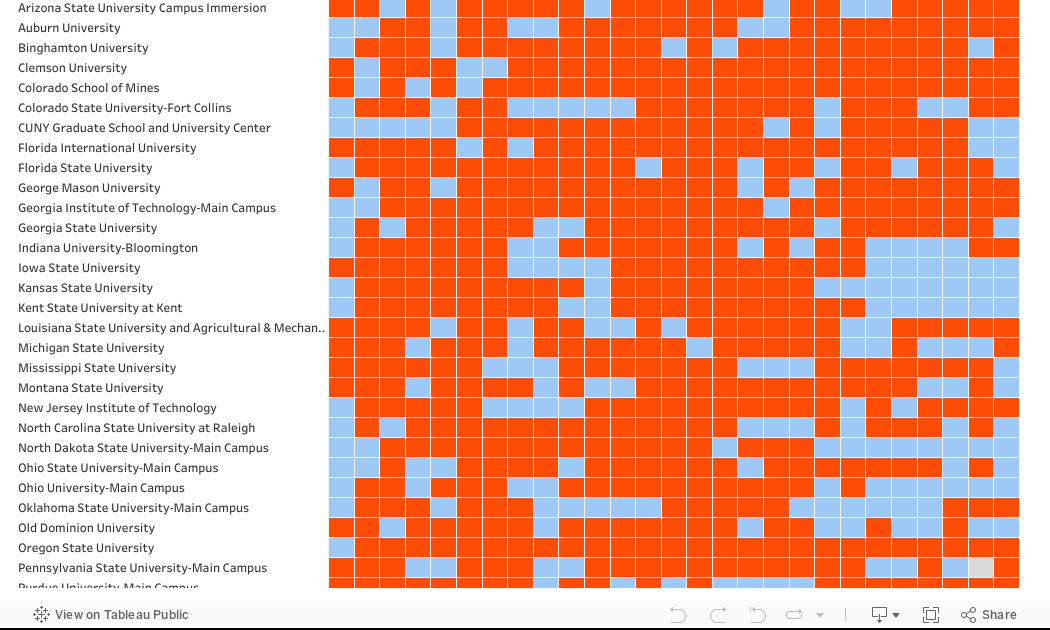
    A while ago, I made the claim that Oregon State University has the longest streak of consecutive years of fall-over-fall enrollment growth of any public, Research 1 university in America.  A few people have asked me, not exactly doubting the claim, but thinking maybe I had made a mistake, for the source of it.

    This started as a curiosity: I knew from our own internal documentation that the last time OSU (the oldest OSU…not the one in Ohio or Oklahoma) had a fall-to-fall enrollment drop was 1996, and I was curious to see if any other institution could make that claim. So I went to the IPEDS Data Center and downloaded the data. 

    It’s below.  First, a few points: My comparison group is 108 Public, four-year, Research 1 Universities as designated by the Carnegie Commission on Higher Education as of Fall, 2022, the latest IPEDS data available. The R1 designation is actually called “Doctoral Institutions: Very High Research Activity” but the nickname R1 is a holdover from prior years. The category contains those institutions who produce the highest research activity and output among American universities.

    What you can’t see here is that 2023 showed an increase (it’s not yet in IPEDS, but trust me), and that 2024 will also show an increase once our census is final.  So OSU’s record is the 26 shown, plus last year, plus this coming year, for a total of 28 years.

    There are a couple of small anomalies with the data, as there always seems to be.  First, some institutions missed a year or two in their reporting.  Even if those years had shown an increase, they were already nullified by other decreases. And Penn State has bounced around from being one institution to being several to being one again; this too does not seem to make a difference in the tally.

    The first chart here shows all years and all institutions (you’ll have to scroll down to see them all using the bar on the right.)  You’ll notice that every institution shown (other than OSU) has at least two years with a blue box after 1997, meaning a decrease.  Hover over the box for details.  Orange shows an increase from the prior year.

    The second chart shows individual enrollment data for any institution you select, using the filter at the top.  The bars are colored similarly: Orange for increase, and blue for decrease.

    If I’ve missed something or you think these data points are wrong, let me know.  If a university decided intentionally to shrink, for whatever reason, that’s interesting, but not the point of this visualization. If you want to look at just graduates or undergraduates or men or women or students of color or some other variable, I encourage you to read my posts here and here about how to download IPEDS data for yourself. 

    And as always, leave a comment below if you find something interesting.

    Source link