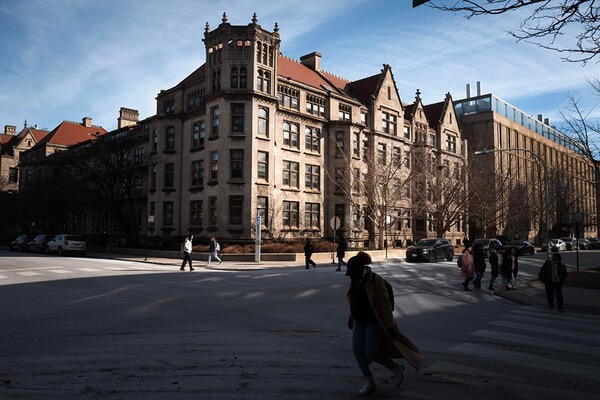
The University of Chicago’s Arts and Humanities Division is reducing how many new Ph.D. students it admits for the 2026–27 academic year across about half of its departments and completely halting Ph.D. admissions elsewhere. Multiple language programs are among those affected.
In a Tuesday email that Inside Higher Ed obtained, Arts and Humanities dean Deborah Nelson told faculty, staff and Ph.D. students, “We will accept a smaller overall Ph.D. cohort across seven departments: Art History, Cinema and Media Studies, East Asian Languages and Civilizations, English Language and Literature, Linguistics, Music (composition), and Philosophy.” The university didn’t tell Inside Higher Ed how many fewer Ph.D. students would be accepted across those departments.
“Other departments will pause admissions,” Nelson wrote.
Andrew Ollett, an associate professor of South Asian languages and civilizations, said that means no new Ph.D. students for these departments: classics, comparative literature, Germanic studies, Middle Eastern studies, Romance languages and literatures, Slavic languages and literatures, and South Asian languages and civilizations, plus the ethnomusicology and history and theory of music programs in the music department.
While the university didn’t provide an interview or respond to multiple written questions, a spokesperson did point out that the UChicago Crown Family School of Social Work, Policy and Practice is also pausing Ph.D. admissions, while the Harris School of Public Policy is pausing admissions for the Harris Ph.D., the political economy Ph.D. and the master of arts in public policy with certificate in research methods.
“A small number of PhD and master’s programs at the University of Chicago will pause admissions for the 2026–2027 academic year while divisions and schools undertake comprehensive reviews of the programs’ missions and structures,” UChicago said in a statement. It said the aim is “ensuring the highest-quality training for the next generation of scholars” and the pauses “will not affect currently enrolled students.”
UChicago, which faces debt issues, has become yet another example of well-known universities freezing or scaling back Ph.D. admissions and programs amid financial pressures and other factors. In November, before Trump retook the presidency, Boston University said it was pausing accepting new Ph.D. students in a dozen humanities and social sciences programs, including philosophy, English and history. In February, the Universities of Pennsylvania and Pittsburgh announced pauses, following other institutions.
But UChicago’s reductions for language programs also reflect a broader trend of universities scaling back foreign language education offerings. In 2023, West Virginia University became infamous in academe for its leaders’ decision to eliminate all foreign language degrees.
“It’s sad and pathetic,” Ollett said of the pause at UChicago, “because it represents the domination of one set of values, which is money, over the values that we say that we are pursuing in our lives as faculty members, as educators and as researchers.”
He argued that the university can’t say it’s committed to the humanities as a field for producing knowledge while turning away from Ph.D. programs.
Nelson’s email said, “This one-time decision applies only to the 2026–2027 academic year.” But Clifford Ando, the Robert O. Anderson Distinguished Service Professor of Classics, History and the College, questioned whether this is just a pause.
“I see no reason to think that we would resume doctoral education if we are simultaneously dismantling the curricula that sustain undergraduate training in these fields,” Ando wrote in an email sent to a classical studies Listserv. “Why would one have a doctoral program in a discipline that undergraduates can’t even study?”
Ollett also said this comes as Nelson has pushed to consolidate smaller departments. He said a big question for the coming academic year was “Do we do Ph.D. admissions if we’re not sure that our department is going to exist?”
Not Rule by Committee
Ando provided Inside Higher Ed the “charge” UChicago gave to the Arts and Humanities Languages Working Group on June 17.
“UChicago is known as a global leader in the instruction of ancient and modern languages,” the charge begins. “Language instruction and expertise is not simply a valuable object in its own right; it is an important foundation for the larger UChicago College education, for graduate education, and for the research and scholarship of our faculty.”
But it then says, “language instruction at this extraordinary scope is also expensive.” It listed several questions for the committee to explore, including:
- “Should there be a universal or suggested minimum number of students?
- “Do we need to teach every class every year?
- “Are there languages we no longer need to teach?
- “Are there opportunities for partnerships with peer institutions (with similar standards and schedules) to share language instruction?
- “How can we use technology more effectively to support and enhance language instruction?”
Ollett said, “We teach more than 50 languages in the division, which seems to be too much because the committee was asked to find ways of getting that number down.”
Tyler Williams, another associate professor in the South Asian languages and civilizations department and a member of the committee, said the committee members “unanimously declined to endorse any of the suggestions about cutting languages or outsourcing language teaching.” He said Nelson “did not wait for the committee to submit its report,” nor did she “consult with that committee before she made this decision.”
Ando also provided the charge for a separate Ph.D. Working Group, which outlined a number of “existential challenges” for Ph.D. programs. Those include significantly reduced demand for entry-level faculty, increasing costs for the university and long times to degree, which can deter students.
Additionally, the document notes that the programs are facing “heightened public skepticism about the value of what is taught in Arts & Humanities PhD programs, and how it is taught. Yet Ph.D. programs remain a critical part of the research university model, necessary to teaching, research, scholarship, and creativity.”
Among other questions, that committee was asked to explore whether there should be a minimum size for Ph.D. cohorts in order to offer a program.
Williams said that this committee indicated it wasn’t going to endorse an admissions pause, but said it should be divisionwide if it occurred.
Nelson’s email announcing the changes stressed that “this decision is not the recommendation of any committee.”
Williams said the Ph.D. admissions cuts are part of “a crisis manufactured by the university administration itself.” Ollett said he worries for the future of their field.
“We are quite unique in that there’s not a lot of South Asia area studies departments in the United States, and especially ones that train the next generation of scholars,” he said. He said he’s “already turned away prospective Ph.D. students because of this, and that’s just going to keep happening.”
He said he worries that “if we’re not doing it, no one will do it, and the field will wither and die.”