Tag: UCLA

  • Judge Restores Another Batch of Frozen Grants to UCLA

    Judge Restores Another Batch of Frozen Grants to UCLA

    A federal court order issued late Monday evening provides significant financial relief to the University of California, Los Angeles, restoring about $500 million in federal research grants amid an ongoing lawsuit with the Trump administration over alleged instances of antisemitism on campus.

    The preliminary injunction, first reported by CalMatters and Politico, is temporary. But for now it reinstates more than 500 grants from the National Institutes of Health, the Department of Defense and the Department of Labor, allowing hundreds, if not thousands, of university researchers to resume their work. That’s on top of a previous order in August from the same court that unfroze about 300 grants from the National Science Foundation.

    Between the two rulings, almost all of UCLA’s federal research grants have been restored.

    The funds were first withheld in late July, less than a week after the Justice Department accused the university of tolerating discrimination against Jewish students, faculty members and staff, in violation of federal civil rights law. The Trump administration later said UCLA could resolve the situation by paying $1.2 billion and agreeing to lengthy list of policy changes.

    But university researchers pushed back, using an existing broader lawsuit and injunction to challenge the grant freeze.

    In the end, District Judge Rita F. Lin, a Biden appointee, ruled in favor of the faculty members, saying the indefinite suspensions of grants was “likely arbitrary,” “capricious” and a violation of the Administrative Procedure Act.

    Source link

  • Week in review: UCLA and other colleges move to cut costs

    Week in review: UCLA and other colleges move to cut costs

    Most clicked story of the week:

    A federal judge struck down the U.S. Department of Education’s Feb. 14 guidance that threatened to revoke federal funding for colleges and K-12 schools that practiced diversity, equity and inclusion efforts it considers illegal. In her decision, the judge ruled that the guidance unconstitutionally put viewpoint-based restrictions on academic speech and used overly vague language about what was prohibited.

    Number of the week: 6,000+

    The number of international student visas the U.S. Department of State has revoked so far this year. The agency terminated between 200 and 300 of the visas over allegations of support for terrorism, a spokesperson said.

    Staffing and investigations at the Education Department:

    • The Education Department will reinstate over 260 laid-off Office for Civil Rights employees in small groups every other week, following a federal judge’s order. The restoration of staff will take place from Sept. 8 through Nov. 3, according to court filings.
    • Almost three-quarters of financial aid administrators reported “noticeable changes” in the Federal Student Aid office’s communications and processing speed since the massive Education Department layoffs earlier this year, according to a survey from the National Association of Student Financial Aid Administrators. 
    • Despite the decrease in staff, the department has continued to open civil rights investigations, announcing one last week at Haverford College. The agency cited allegations that the small Pennsylvania institution hadn’t done enough in response to campus antisemitism. A federal judge dismissed a lawsuit against Haverford over similar allegations earlier this year.

    Budget cuts and restructuring: 

    • The University of California, Los Angeles paused faculty hiring through spring 2026 amid increasing attacks from the Trump administration and preexisting budget shortfalls. The public university is also consolidating its information technology teams, though it did not say if the process will include layoffs.
    • The University of Louisiana at Lafayette will cut its operational and auxiliary spending by 5%, a move its interim president cast as proactive rather than reactive, KADN reported. While the university’s revenue is strong, he said, costs exceed it. 
    • Milligan University, in Tennessee, will cut six academic programs this fall to keep pace with a changing college market, the private institution’s president told WJHL. The affected programs enrolled 28 students.

    Source link

  • UCLA consolidates IT, pauses faculty hiring as Trump administration seeks $1B payment

    UCLA consolidates IT, pauses faculty hiring as Trump administration seeks $1B payment

    This audio is auto-generated. Please let us know if you have feedback.

    Dive Brief:

    • The University of California, Los Angeles has paused faculty hiring for the next academic year and is consolidating its cross-campus information technology teams as the public institution weathers financial attacks from the Trump administration on top of existing budget woes. 
    • In a community message Wednesday, two top UCLA leaders said they will “be prudent in making organizational changes, and do so in close collaboration with leaders across campus.” UCLA did not immediately answer questions Thursday about whether the IT consolidation will include layoffs.
    • The announcement follows a message late last week from Chancellor Julio Frenk, who noted the Trump administration is seeking $1 billion from the university over antisemitism allegations primarily related to a protest encampment on UCLA’s campus in 2024. 

    Dive Insight:

    In their message, UCLA Provost Darnell Hunt and Chief Financial Officer Stephen Agostini said the university was working with University of California system leaders to restore some $584 million in research funding cut off by the Trump administration. 

    “Our immediate priority is to sustain the research enterprise,” the officials said. “We are doing this via a thorough review process, grant by grant, alongside campus deans and faculty members.” 

    The funding cut followed U.S. Department of Justice allegations that UCLA broke civil rights law by not doing enough to protect Jewish and Israeli students from harassment. 

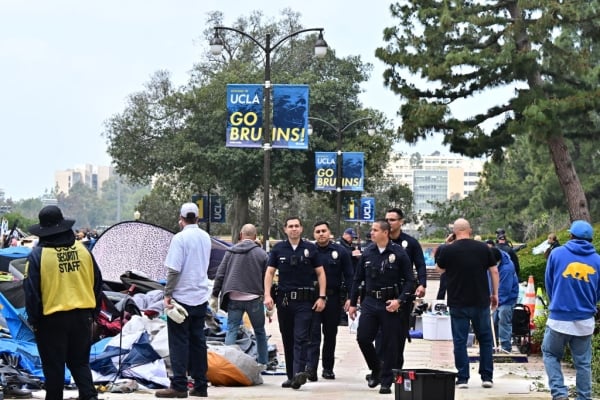
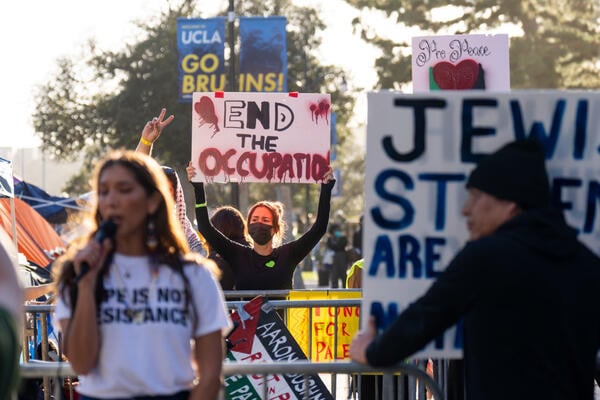
    At the center of those allegations was a spring 2024 pro-Palestinian protest encampment that UCLA leaders initially allowed to continue amid efforts to balance speech rights and campus safety. Less than a week later, they called police to break up the encampment. 

    The Justice Department has also launched a probe into whether the UC system discriminates against employees by allowing an antisemitic, hostile work environment. 

    Since Columbia University agreed to pay the federal government $221 million to settle similar allegations related to antisemitism, the Trump administration has reportedly sought payments from other high-profile colleges in its crosshairs. 

    Frenk recently panned the government’s effort to extract $1 billion from UCLA.

    “I want to be clear: The costs associated with this demand, if left to stand, would have far-reaching consequences,” Frenk said in a statement last week. “The impacts to society are very real, as it could threaten our ability to conduct life-saving and life-changing research. But the impacts to our university are just as real.”

    Last week, a federal judge ordered the National Science Foundation to restore grant funding potentially amounting to hundreds of millions of dollars. U.S. District Judge Rita Lin ruled that the cuts, made after the Justice Department announced its allegations, violated a prior court order in a lawsuit filed by UC researchers over mass grant terminations by the administration. 

    Even before the faceoff with the Trump administration, UCLA was shifting toward austerity as the wider UC system grappled with deficits. In fiscal 2024, UCLA posted an operating loss of $144.2 million, a sharp downturn from its positive operating income of $159.6 million the year before.

    Hunt and Agostini noted the university had already cut administrative unit budgets by 10%, started a hiring review process and curtailed travel spending. 

    The officials said that existing efforts to streamline and save money in the university’s operations have become a subject of “immediate and urgent focus” given the financial environment. 

    The IT reorganization is part of those efforts. The move involves consolidating teams distributed across UCLA’s campus. The goal is to “boost our cybersecurity readiness; ensure more equitable access to high-quality IT services; and free up resources to elevate teaching, research and innovation,” Hunt and Agostini said. 

    Source link

  • Federal Judge Orders NSF to Reinstate Suspended UCLA Grants

    Federal Judge Orders NSF to Reinstate Suspended UCLA Grants

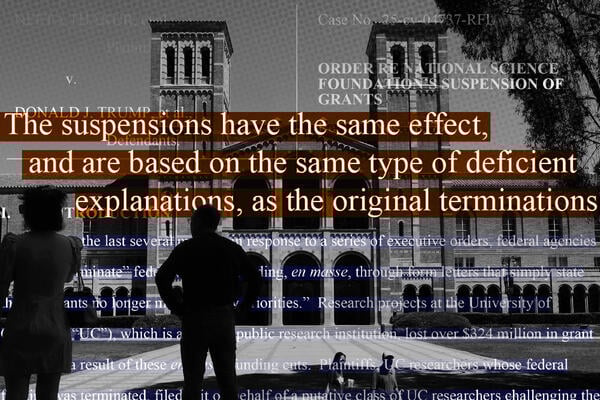
    Photo illustration by Justin Morrison/Inside Higher Ed | Genaro Molina/Los Angeles Times/Getty Images | US District Court for the Northern District of California

    The National Science Foundation restored grants it recently suspended for researchers at the University of California, Los Angeles, following a court order late Tuesday, a spokesperson for the agency said.

    The NSF and UCLA didn’t tell Inside Higher Ed how much funding had been restored, but the Los Angeles Times reported it’s roughly $81 million.

    It’s a blow to the Trump administration, which had multiple agencies cut off more than $500 million in research funds to UCLA earlier this month and, according to the UC system, demanded a $1 billion settlement payment.

    UCLA is the latest target of the Trump administration’s use of mass federal research grant suspensions to pressure prominent universities to change policies and pay restitution, ranging from tens of millions of dollars for Brown University to the billion-dollar demand of UCLA. Federal agencies justify cutting off grants by accusing targeted institutions of failing to address pro-Palestine protesters’ alleged antisemitism, and accusing universities of other transgressions, such as letting transgender women compete in women’s sports or promoting racial preferences.

    But this is the first known court order blocking one of those blanket funding freezes. Harvard University also challenged the administration’s decision to suspend more than $2.7 billion in funds, but a judge has a yet to rule in that case.

    UCLA didn’t sue, though.

    Instead, the ruling came from a lawsuit that UC researchers filed in early June against President Trump, the NSF and other federal agencies and officials that challenged previous NSF grant terminations.

    On June 23, U.S. District Court judge Rita F. Lin, of the Northern District of California, issued a preliminary injunction restoring grants that the administration terminated en masse via form letters that didn’t provide grant-specific explanations for the terminations. When the NSF recently cut off grants again, specifically to UCLA, the researchers’ attorneys alleged the agency violated the preliminary injunction.

    Lin agreed, writing in an opinion Tuesday that the new “suspensions have the same effect, and are based on the same type of deficient explanations, as the original terminations.”

    The NSF wrote in a July 30 letter justifying the new suspensions that “NSF understands that [UCLA] continues to engage in race discrimination including in its admissions process, and in other areas of student life, as well as failing to promote a research environment free of antisemitism and bias.” Two days later, the NSF sent a second letter, alleging that UCLA furthermore “engages in racism” and “endangers women by allowing men in women’s sports and private women-only spaces.”

    According to Lin, the NSF argued that its recent funding cuts “are not within the scope of the preliminary injunction because it suspended, rather than terminated, the grants.” She said the agency argued that suspensions, unlike terminations, “can be lifted once the grantee takes certain corrective actions.”

    However, Lin said the NSF had labeled these “suspensions” as “final agency decision[s] not subject to appeal.”

    “There is no listed end date for the suspensions, nor is there any path for researchers to restore funding for their project. If any curative action is actually feasible, it would need to be undertaken by UCLA,” the judge wrote. “In other words, researchers have no guarantee that funding will ever be restored and no way to take action to increase the likelihood of restoration.”

    She added that “NSF claims that it could simply turn around the day after the preliminary injunction issued, and halt funding on every grant that had been ordered reinstated, so long as that action was labeled as a ‘suspension’ rather than a ‘termination.’ This is not a reasonable interpretation of the scope of the preliminary injunction.”

    Researchers told the court that as a result of the latest suspensions, “projects are already losing talented graduate students, staff will soon be laid off, and years of federally funded work will go to waste,” Lin wrote. Researchers also said the defunded projects include “multi-year research into global heat extremes, a project to address environmental challenges in the Southwestern United States, and another to enhance veteran participation and leadership in STEM fields,” the judge added.

    A UC system spokesperson said in an email Wednesday that, “while we have not had an opportunity to review the court’s order and were not party to the suit, restoration of National Science Foundation funds is critical to research the University of California performs on behalf of California and the nation.”

    Source link

  • Judge orders NSF to restore cut funding to UCLA

    Judge orders NSF to restore cut funding to UCLA

    This audio is auto-generated. Please let us know if you have feedback.

    Dive Brief:

    • A federal judge on Tuesday ordered the National Science Foundation to restore potentially hundreds of millions of dollars in federal research grants to the University of California. 
    • Researchers at the university system in June brought a class-action lawsuit against NSF and other federal agencies over their termination of $324 million in funding, and quickly won a temporary injunction restoring the grants.
    • This week, U.S. District Judge Rita Lin concluded NSF violated that order by cutting funding to the University of California, Los Angeles in late July over allegations related to antisemitism and other concerns. An NSF spokesperson said in an email Wednesday the agency has reinstated UCLA’s funding in response to the order.

    Dive Insight:

    On June 4, several University of California researchers sued President Donald Trump and his administration over mass cuts to research funding spearheaded by the newly created Department of Government Efficiency. 

    Plaintiffs argued that the funding cuts violated key constitutional principles, including separation of powers, freedom of speech and right to due process, in addition to multiple federal statutes. 

    Before President Trump took office, federal agency grant making proceeded under the authority of Congress, which created agencies through its constitutionally assigned exclusive legislative power, and appropriated taxpayer funds for specific public purposes that the agencies were tasked to execute,” the researchers said in their complaint.

    They added that after taking office, Trump “attempted to seize direct control of federal agencies by bypassing Congress and upending the statutory and regulatory system under which federal agencies have historically and legally operated.”

    Later that month, Lin concluded that the researchers would likely win their case on its merits and issued a preliminary injunction directing the Trump administration to restore terminated funding to University of California institutions and barring agencies from cutting their funding without grant-specific explanations.

    But in late July, NSF “indefinitely suspended” numerous grants to UCLA, as attorneys for the plaintiffs noted in court filings. In the suspension notices, the agency cited allegations of widespread campus antisemitism and “illegal race-based preferences in admissions” — claims now common in the administration’s attacks on higher education. 

    The University of California system last week entered negotiations with the Trump administration in an effort to restore more than half a billion dollars in total research funding. When announcing the talks, UC President James Milliken called the UCLA cuts “a death knell for innovative work” that “do nothing to address antisemitism.”

    The funding cuts came shortly after the U.S. Department of Justice alleged UCLA had violated civil rights law by failing to adequately address antisemitism.

    The Los Angeles Times put the figure of NSF’s cut funding to UCLA specifically at $300 million. As one UCLA professor recounted in court papers filed Monday, the indefinite suspension orders had immediate and permanent effects, including stalled research and the loss of a potential graduate student worker to another project. 

    NSF argued in court that its indefinite suspensions did not violate Lin’s earlier injunction, which the agency said applied to grant terminations. But in Tuesday’s order, Lin concluded that the two terms were equivalent in practice. 

    NSF may have re-labeled its action a ‘suspension,’ but it is a distinction without a difference in this case,” Lin wrote. “After all, a terminated grant can be reinstated, just as a suspension can be ‘lifted.’ And a suspension, if it is of indefinite length, is functionally identical to a termination from the researcher’s perspective.”

    Source link

  • Trump Wants $1 Billion Payout From UCLA

    Trump Wants $1 Billion Payout From UCLA

    The Trump administration is ratcheting up pressure on the University of California, Los Angeles, and seeking a $1 billion settlement, following concessions from other institutions, CNN reported.

    University of California president James B. Milliken said in a statement Friday that “a payment of this scale would completely devastate our country’s greatest public university system as well as inflict great harm on our students and all Californians.”

    Demands for a settlement come as the federal government has accused UCLA of violating civil rights law by allegedly failing to protect students from antisemitism as pro-Palestinian protests surged on campus last spring. The National Science Foundation and other agencies have since suspended $584 million in federal research funding, according to UCLA chancellor Julio Frenk. The New York Times reported that the administration also wants UCLA to put $172 million in a fund for victims of civil rights violations.

    UC system officials announced Wednesday they would negotiate with the federal government in the hope of reaching a “voluntary resolution agreement” over the charges.

    “Our immediate goal is to see the $584 million in suspended and at-risk federal funding restored to the university as soon as possible,” Milliken wrote in a Wednesday statement, adding that cuts to federal research funding “do nothing to address antisemitism.”

    UCLA was one of several institutions whose executives were hauled before Congress over the last two years to address pro-Palestinian encampments and alleged antisemitism and harassment tied to such protests.

    Should UCLA reach a settlement with the Trump administration, it would be the first public university to do so but the third institution to strike a deal with the federal government over the course of several weeks. Last month, Columbia University reached an unprecedented settlement with the Trump administration, agreeing to changes to admissions and academic programs and paying $221 million to close investigations into alleged antisemitism and restore some frozen research funding. The deal will be overseen by a third-party resolution monitor.

    Brown University also struck a deal with the federal government in July that did not include a payout to the Trump administration, but officials did agree to provide admissions data to the federal government and bar transgender athletes from competing, among other concessions.

    Federal officials didn’t respond to a request for comment Friday.

    Source link

  • With Grant Cuts, Trump Pressures UCLA to Make Deal

    With Grant Cuts, Trump Pressures UCLA to Make Deal

    The Trump administration announced last week it was freezing federal grants for another prestigious research university. But this time, it wasn’t a private institution.

    It was the University of California, Los Angeles, and if the UC system doesn’t make a deal with the federal government, campuses across one of the nation’s largest public higher education systems might incur the administration’s further punishment. State leaders condemned the funding freeze, and faculty at UCLA are urging university administrators to fight. But the university has said little about how it plans to respond to the administration.

    The Department of Justice has been investigating the University of California system for months—looking into alleged antisemitism, alleged use of race in admissions and “potential race- and sex-based discrimination in university employment practices.” The agency’s investigations into the broader UC system are still ongoing, but last week, the DOJ told system officials it had made a finding regarding one campus and demanded a quick response.

    “The Department has concluded that UCLA’s response to the protest encampment on its campus in the spring of 2024 was deliberately indifferent to a hostile environment for Jewish and Israeli students in violation of the Equal Protection Clause and Title VI,” the letter said. (Title VI of the Civil Rights Act of 1964 prohibits universities that receive federal funding from discriminating based on shared ancestry, including antisemitism.)

    The letter didn’t specifically say what the Trump administration wants UC to do now about its alleged failure to handle a pro-Palestine encampment that ended more than a year ago, and that UCLA itself dismantled a week after its creation. The DOJ didn’t provide Inside Higher Ed further information Monday, but U.S. attorney general Pam Bondi’s news release accompanying the DOJ letter suggests the Trump administration wants significant concessions.

    “Our investigation into the University of California system has found concerning evidence of systemic anti-Semitism at UCLA that demands severe accountability from the institution,” Bondi said. “This disgusting breach of civil rights against students will not stand: DOJ will force UCLA to pay a heavy price for putting Jewish Americans at risk and continue our ongoing investigations into other campuses in the UC system.”

    Just hours before the DOJ’s announcement, UCLA had announced that it was paying $6.45 million to settle a lawsuit from Jewish students over reported antisemitism associated with the encampment. But that wasn’t enough to assuage the federal government.

    The DOJ letter said the department “seeks to enter into a voluntary resolution agreement with the university to ensure that the hostile environment is eliminated and reasonable steps are taken to prevent its recurrence.” It asked the UC officials to contact a special counsel by today if they were “interested in resolving this matter along these lines,” providing an email address and a nonfunctional nine-digit phone number for them to contact. The agency is prepared to sue by Sept. 2 “unless there is reasonable certainty that we can reach an agreement.”

    That July 29 letter wasn’t the end of it. In the week between then and today’s deadline for UC to contact the DOJ, multiple federal agencies said they’re cutting off grants to UCLA. The total amount is unclear—other media have reported numbers exceeding $300 million.

    It’s reminiscent of what happened at Columbia and Harvard Universities. But unlike with those private institutions, the Trump administration hasn’t published an overarching demand letter for how it wants UCLA to change its ways, whether in admissions, student discipline or otherwise.

    A spokesperson for the Department of Health and Human Services, which includes the National Institutes of Health, responded to Inside Higher Ed’s requests for information on how much in NIH grant funding has been canceled and why with a two-line response attributed to an unnamed HHS official: “We will not fund institutions that promote antisemitism. We will use every tool we have to ensure institutions follow the law.”

    A National Science Foundation spokesperson wrote in an email that the NSF “informed the University of California, Los Angeles that the agency is suspending awards to UCLA because they are not in alignment with current NSF priorities and/or programmatic goals.” The spokesperson didn’t specify which priorities or which goals, and his email didn’t mention antisemitism.

    The Department of Energy went beyond allegations of antisemitism in its letter to UCLA, saying that “UCLA engages in racism, in the form of illegal affirmative action” and UCLA “endangers women by allowing men in women’s sports and private women-only spaces.”

    Mia McIver, executive director of the national American Association of University Professors, said what’s happening is the “Trump administration is extending its pattern of attacking higher education faculty, staff and students more broadly outward from the Ivy League universities into the public sector.” McIver, who taught at UCLA for a decade, said the administration intends to “exercise pervasive control over colleges and universities in every region of every different sort of institution.”

    “It is the federal government using levers of power that are completely unrelated to the underlying allegations,” McIver said. “Cutting off research for diabetes, cancer, heart disease will not improve the safety of Jewish faculty and students on campus and will not address antisemitism.”

    ‘Enough Is Enough’

    What does the UC system plan to do? A spokesperson deferred comment to UCLA, which also didn’t provide interviews Monday or answer written questions. The UC system spokesperson did forward a statement Friday from system president James B. Milliken, who started in his new job Aug. 1—just after the grant freezes. 

    Milliken called “the suspension this week of a large number of research grants and contracts” at UCLA “deeply troubling,” though “not unexpected.”

    “The research at UCLA and across UC more broadly saves lives, improves national security, helps feed the world, and drives the innovation economy in California and the nation,” he said. “It is central to who we are as a teaching and learning community. UC and campus leadership have been anticipating and preparing for the kind of federal action we saw this week, and that preparation helps support our decisions now.”

    He didn’t, however, say what the decisions would be.

    Also Friday, California governor Gavin Newsom, a potential 2028 presidential candidate and an ex officio member of the UC Board of Regents, released a statement calling it “a cruel manipulation to use Jewish students’ real concerns about antisemitism on campus as an excuse to cut millions of dollars in grants that were being used to make all Americans safer and healthier.”

    “This is the action of a president who doesn’t care about students, Californians, or Americans who don’t comply with his MAGA ways,” Newsom said.

    UCLA chancellor Julio Frenk said in a video on X Friday that “we share the goal of eradicating antisemitism. It has no place on our campus or in our society.” He said his wife is the daughter of a Holocaust survivor, and his paternal grandparents left Germany in the 1930s after being “driven out of their home by an intolerable climate of antisemitism and hate.”

    “These experiences inform my own commitment to combating bigotry in all its forms, but a sweeping penalty on lifesaving research doesn’t address any alleged discrimination,” Frenk said. He said, “We have contingency plans in place,” though he didn’t elaborate.

    In a petition, the UCLA Faculty Association’s Executive Board criticized UCLA administrators for their past “anticipatory obedience” to the federal government, which it said “has not prevented Trump administration attacks.”

    “UCLA’s anticipatory obedience has put itself in a place of weakness and we must instead choose to stand up,” the association wrote. “We do not have to bend to the Trump administration’s illegitimate and bad-faith demands. UCLA is a state university, with the financial backing and moral support of the fourth-largest economy in the world.”

    The association demanded that UC “demonstrate our strength as the world’s largest university system and reject the malicious demands of the Trump administration,” adding that “each university that falters legitimates the Trump administration’s attacks on all of our institutions.”

    It called for UC to fight the administration in court, to use unrestricted endowment funds to “help keep our university’s mission intact” and to work with Newsom and state lawmakers to get financial support. The petition ended with a call for university administrators to not “sacrifice our strengths and our community, deeply nurtured and protected for over 100 years, to a deeply callous and unfair federal administration that will only ask for more.”

    Meanwhile, Faculty for Justice in Palestine at UCLA said in a statement that “Israel continues to tighten its US-enabled siege of Gaza, where the calculated denial of humanitarian assistance is causing mass starvation amid ongoing aerial bombing. The theatrics of the Trump administration, echoed by UCLA, are part of a larger attempt to cover up this genocidal catastrophe in which all of us, and our university, are complicit.”

    McIver urged the UC system not to cut deals like Columbia and Brown Universities have.

    “There are always alternatives,” she said, “and every deal that is cut makes it harder for those who are downstream of the deal to continue resisting these attacks.”

    “The Trump administration is aiming to control colleges and universities at all levels in all states, and every settlement that is reached basically contributes to that goal,” she said. “And so there has to be a point at which everyone across the country stands up and says, ‘Enough is enough, we’re not going to tolerate this extortion, you can’t hold our campuses hostage and we’re not going to take it anymore.’”

    Source link

  • National Science Foundation Suspends Grants at UCLA

    National Science Foundation Suspends Grants at UCLA

    Frederic J. Brown/AFP via Getty Images

    (This article has been updated with comment from UCLA.)

    The National Science Foundation said Thursday that it’s suspending grant awards at the University of California, Los Angeles. 

    An NSF spokesperson said that the university’s awards “are not in alignment with current NSF priorities and/or programmatic goals,” though they didn’t offer more specifics. NSF changed its priorities in April and, as a result, cut off funding to programs related to diversity, equity and inclusion and those aimed at combating misinformation

    Freelance journalist Dan Garisto wrote on BlueSky that nearly 300 grants at UCLA are now suspended. That includes a $25 million grant that supports the university’s Institute for Pure and Applied Mathematics. (In 2022, UCLA had about 450 grants from the NSF, totaling more than $350 million.)

    UCLA chancellor Julio Frenk wrote in a letter to the campus community that the freeze extended beyond NSF to include grants from the National Institutes of Health and other federal agencies.

    “This is not only a loss to the researchers who rely on critical grants,” Frenk wrote. “It is a loss for Americans across the nation whose work, health, and future depend on the groundbreaking work we do.”

    Frenk noted that UCLA was prepared for a grant freeze and has developed contingency plans. “We will do everything we can to protect the interests of faculty, students and staff—and to defend our values and principles,” he pledged.

    The Associated Press reported that the freeze affected $339 million in federal grants.

    The grant suspension comes as UCLA finds itself the Trump administration’s latest target in its growing war with higher education. Earlier this week, the university settled a lawsuit in which a group of Jewish students alleged that UCLA enabled pro-Palestinian activists to cut off Jewish students’ access to parts of campus. On the same day the settlement was announced, the Justice Department accused UCLA of violating the federal civil rights law that bars antisemitism and race-based discrimination.

    Frenk said the government claimed “antisemitism and bias as the reasons” for the freeze. But he argued that Trump’s “far-reaching penalty of defunding life-saving research does nothing to address any alleged discrimination.” 

    He added that UCLA shares the goal of eradicating antisemitism, detailing the steps the university has taken in the last year to address the issue, including establishing new policies for campus protests.

    UCLA has until Aug. 5 to respond to the DOJ’s notice of violation; DOJ officials threatened that the university would “pay a heavy price for putting Jewish Americans at risk.” The Justice Department is also investigating the admissions practices at UCLA, but that inquiry hasn’t wrapped up yet.

    Source link

  • DOJ Says UCLA Violated Jewish Students’ Civil Rights

    DOJ Says UCLA Violated Jewish Students’ Civil Rights

    The U.S. Department of Justice issued a notice to the University of California, Los Angeles, on Tuesday alleging that it violated civil rights law. The move came just hours after the university announced a $6.45 million settlement to end a lawsuit brought by Jewish students over allegations of antisemitism last year.  

    “The Department has concluded that UCLA’s response to the protest encampment on its campus in the spring of 2024 was deliberately indifferent to a hostile environment for Jewish and Israeli students in violation of the Equal Protection Clause and Title VI,” the notice read. It also said an investigation into the University of California system is ongoing.

    The message made no mention of the settlement; UCLA divided the funds between the plaintiffs and Jewish advocacy and community organizations. The settlement also said the university cannot exclude Jewish students or staff from educational facilities and opportunities “based on religious beliefs concerning the Jewish state of Israel.” (Jewish student plaintiffs argued they were barred by pro-Palestinian protesters from entering certain areas of campus.)

    According to the federal notice, UCLA now has until Aug. 5 to contact the DOJ to seek a voluntary resolution agreement “to ensure that the hostile environment is eliminated and reasonable steps are taken to prevent its recurrence.” DOJ officials said they’re prepared to file a complaint in federal district court by Sept. 2 “unless there is reasonable certainty that we can reach an agreement in this matter.”

    “Our investigation into the University of California system has found concerning evidence of systemic anti-Semitism at UCLA that demands severe accountability from the institution,” Attorney General Pamela Bondi said in a statement. “This disgusting breach of civil rights against students will not stand: DOJ will force UCLA to pay a heavy price for putting Jewish Americans at risk and continue our ongoing investigations into other campuses in the UC system.”

    Source link

  • UCLA violated civil rights law, Justice Department alleges

    UCLA violated civil rights law, Justice Department alleges

    Dive Brief: 

    • The U.S. Department of Justice alleged Tuesday that the University of California, Los Angeles violated civil rights law by failing to do enough to protect Jewish and Israeli students from harassment. 
    • The findings stem from UCLA’s approach to a pro-Palestinian encampment that students erected on the university’s campus in the spring 2024 term. UCLA officials declined to disband the encampment for nearly a week, citing the need to balance free speech protections with student and employee safety. 
    • In a letter to Michael Drake, president of the University of California system, Justice Department officials said they would seek to enter a voluntary resolution with UCLA to “ensure that the hostile environment is eliminated.”

    Dive Insight: 

    The Justice Department is also investigating the entire University of California system over similar allegations. That systemwide probe found “concerning evidence of systemic anti-Semitism at UCLA that demands severe accountability,” U.S. Attorney General Pamela Bondi said in a Tuesday statement. 

    “DOJ will force UCLA to pay a heavy price for putting Jewish Americans at risk and continue our ongoing investigations into other campuses in the UC system,” Bondi said. 

    Justice Department officials gave UCLA leaders until Aug. 5 to reach out about entering a voluntary resolution. They threatened the university with a lawsuit by Sept. 2 if they don’t believe they can strike an agreement with the institution. 

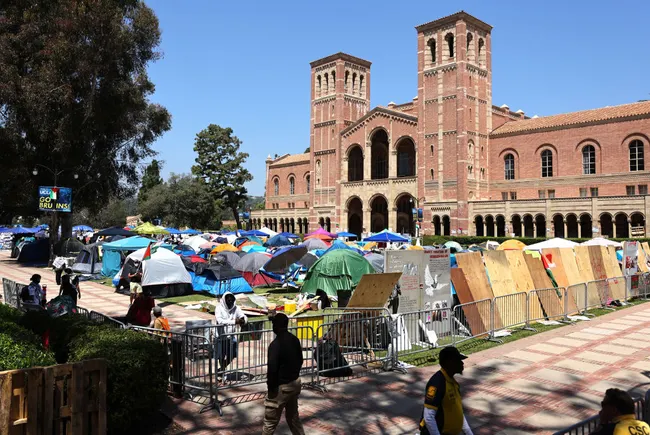
    The Justice Department investigation focused on the pro-Palestinian encampment erected on UCLA’s campus on April 25, 2024. Encampment demonstrators demanded that the university divest from companies with ties to Israel’s military. 

    On the same day it was erected, a university spokesperson told the campus community that officials were monitoring the situation to balance the “right to free expression while minimizing disruption” to the institution’s teaching and learning mission. 

    However, several days into the protest, some demonstrators formed human blockades to prevent some people on campus from moving freely throughout Royce Quad, including students wearing a Star of David or those who refused to denounce Zionism, according to an internal report from a university task force released last October. 

    The task force also found the encampment violated university rules and that the blockades disparately impacted Jewish people. 

    The Justice Department’s letter to UCLA heavily cited the university’s own task force report, as well as 11 complaints the university received alleging that encampment protesters discriminated against them based on their race, religion or national origin. 

    “UCLA’s documentation established that it did not outright ignore these complaints; however, the University took no meaningful action to eliminate the hostile environment for Jewish and Israeli students caused by the encampment until it was disbanded,” the letter states. 

    Violence broke out at the site on the night of April 30, 2024, when counterprotesters attempted to dismantle the encampment’s barricade, The New York Times reported

    The counterprotesters attacked those within the encampment, including by launching fireworks into the encampment and hitting the pro-Palestinian protesters with sticks, according to the publication. Some of the pro-Palestinian protesters also fought back.

    Police arrived hours later, though they did not immediately break up the violence. The next day, UCLA officials made the call to have police break up the encampment, resulting in over 200 arrests. 

    “In the end, the encampment on Royce Quad was both unlawful and a breach of policy,” then-UC Chancellor Gene Block said in a statement. “It led to unsafe conditions on our campus and it damaged our ability to carry out our mission. It needed to come to an end.”

    In their letter, Justice Department officials criticized university leaders, alleging they knew that protesters were “engaging in non-expressive conduct unprotected by the First Amendment” and were denying “Jewish and Israeli students access to campus resources” days before they moved to disband the encampment. 

    UCLA did not immediately respond to a request for comment. 

    The Justice Department findings come the same day the university settled a lawsuit from Jewish students and a Jewish professor, who alleged their civil rights were violated because UCLA allowed protesters to block their campus access. 

    The agency’s letter mentioned the lawsuit’s filings, though it did not refer to the settlement. 

    As part of that agreement, UCLA agreed to pay about $6 million, with the funds going directly toward the plaintiffs and their legal fees, as well as to Jewish groups and a campus initiative to combat antisemitism.

    Source link