

Tag: UConn

  • Featured Gig: eLearning Developer at UConn

    Featured Gig: eLearning Developer at UConn

    One of my goals for growing this Featured Gig series is to highlight early-career opportunities. When I saw on LinkedIn that UConn is searching for an e-learning developer, I reached out to Desmond McCaffrey, director of UConn Online, to learn more about the role.

    Q: What is the university’s mandate behind this role? How does it help align with and advance the university’s strategic priorities?

    A: The university is committed to expanding and enhancing its online and mixed-mode offerings as part of its strategic priorities. The e-learning developer 1 plays a central role in this effort by collaborating with instructional designers, faculty and staff to design and deliver high-quality courses that meet compliance requirements and research-based standards. Beyond content development, the role supports faculty growth and creates opportunities to integrate new technologies, experiment with innovative solutions and strengthen both teaching and learning. This work ensures that students benefit from inclusive, engaging and flexible educational experiences in an evolving digital environment.

    Q: Where does the role sit within the university structure? How will the person in this role engage with other units and leaders across campus?

    A: The e-learning developer is part of eCampus and UConn Online, units within the Center for Excellence in Teaching and Learning dedicated to supporting online and mixed-mode education. While the role works closely with colleagues in eCampus and CETL, it also engages with University IT Services, the University Library and faculty and staff across departments, schools and colleges. Developers contribute as members of cross-unit production teams and committees while also managing individual projects. Along the way, they collaborate on innovative pilots, explore and integrate emerging technologies, and engage with faculty and students to improve learning experiences and to help shape the university’s evolving digital learning ecosystem.

    Q: What would success look like in one year? Three years? Beyond?

    A: By the end of year one, success means moving beyond basic proficiency into advanced contribution, bringing creative solutions to course design and development, collaborating effectively across units, and helping faculty integrate best practices in accessibility and inclusion. The developer demonstrates growing confidence in evaluating and applying new technologies, employs strong communication skills, and distinguishes effective pedagogical, while building trust as a reliable partner on course and program teams.

    By three years and beyond, the e-learning developer is recognized as an innovator and campuswide contributor. They not only design inclusive, high-quality courses and learning objects but also pilot new tools and approaches, engage with faculty to improve learning experiences, and share insights through research and conference presentations. Their role evolves into mentorship and leadership, guiding projects and shaping conversations about digital learning strategy. At this stage, they are seen as a trusted resource and emerging leader who connects pedagogy, technology, and innovation to strengthen UConn’s online teaching and learning environment.

    Q: What kinds of future roles would someone who took this position be prepared for?

    A: This role provides a strong foundation for advancement into positions such as e-learning developer 2 or 3, instructional designer, faculty development specialist, or educational technology support professional, depending on the individual’s background and career goals. It also opens pathways into broader leadership roles in online education and digital learning. Along the way, developers gain hands-on experience by building courses, experimenting with new technologies, engaging with faculty and contributing to research and conference presentations—positioning them for long-term growth at the intersection of learning, technology and innovation.

    Please get in touch if you are conducting a job search at the intersection of learning, technology and organizational change. If your gig is a good fit, featuring your gig on Featured Gigs is free.
    Source link

  • UConn Med now lets students opt out of DEI pledge of allegiance

    UConn Med now lets students opt out of DEI pledge of allegiance

    Great news: UConn School of Medicine administrators are going scalpels down on the school’s attempt to forcibly transplant politics and ideology into its incoming student body. 

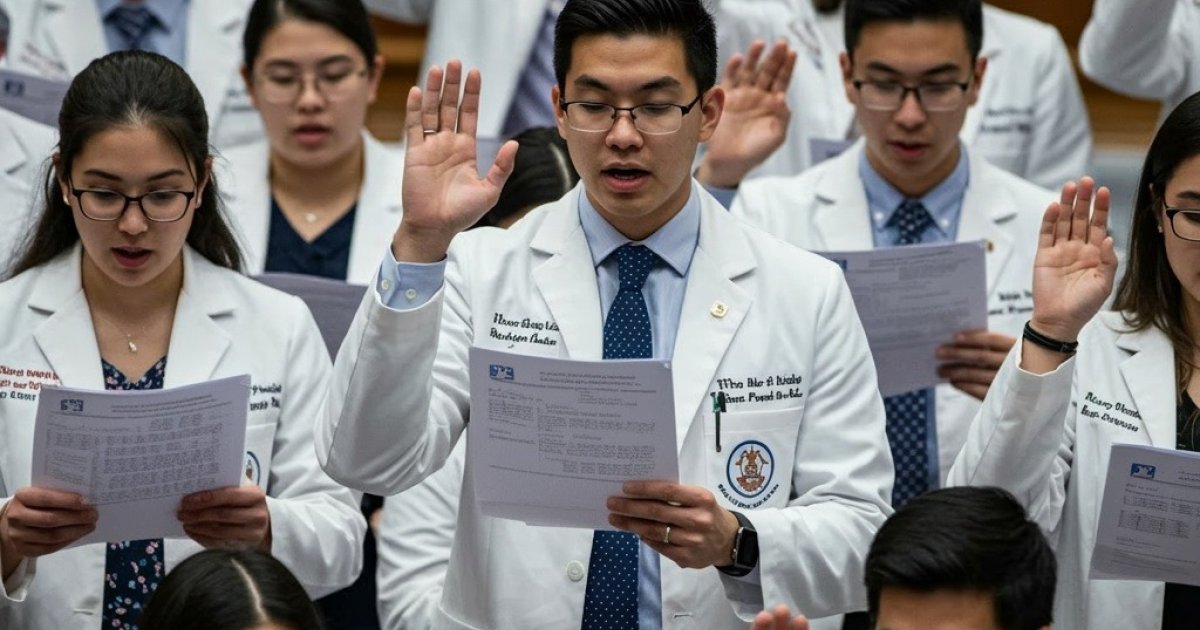
    In 2022, UConn finalized its own version of the Hippocratic Oath, which includes a promise to “actively support policies that promote social justice and specifically work to dismantle policies that perpetuate inequities, exclusion, discrimination and racism.” Most recently, UConn required the incoming class of 2028 to pledge allegiance not simply to patient care, but to support diversity, equity, and inclusion.

    In January, an admissions staff member at the medical school told FIRE that the oath is mandatory for students. That’s a problem because, as a public university, UConn is strictly bound by the First Amendment and cannot compel students to voice beliefs they do not hold. 

    Concerned about this and similar cases, FIRE wrote the UConn School of Medicine on Jan. 31, calling on the school to make clear that students have every right to refuse to pledge allegiance to DEI. 

    We got back radio silence.

    After following up via email, we finally got some good news from UConn. The school’s communications director clarified, “UConn’s medical school does not mandate nor monitor a student’s reciting of all or part of our Hippocratic Oath, nor do we discipline any student for choosing to not recite the oath or any part of it.”

    Public institutions have every right to try to address any bias that might impact medical education. But forcing med students to pledge themselves to DEI — or any other political ideology — is First Amendment malpractice. They have no more right to do so than they do to force students to pledge allegiance to a political figure, or to the American flag. 

    In the landmark 1943 case West Virginia State Board of Education v. Barnette, the Supreme Court held that students could not be forced to salute the American flag, saying, “If there is any fixed star in our constitutional constellation, it is that no official, high or petty, can prescribe what shall be orthodox in politics, nationalism, religion, or other matters of opinion or force citizens to confess by word or act their faith therein.” 

    In the medical context it gets even worse, as these nebulous commitments could become de facto professionalism standards, with students facing punishment for failing to uphold them. (After all, they took an oath!) What, exactly, must a medical student do to “support policies that promote social justice?” Presumably, that would be for UConn to determine. And if a student disagrees with UConn’s definition of “social justice” or chooses not to promote it in the prescribed way, could she be dismissed for violating her oath? 

    FIRE has repeatedly seen administrators of professional programs — including medicinedentistrylaw, and mortuary science — deploy ambiguous and arbitrarily defined “professionalism” standards to punish students for otherwise protected speech. It’s no stretch to imagine it happening here as well.

    UConn isn’t alone in making changes to its version of the Hippocratic Oath. Other prestigious medical schools, including those at Harvard, Columbia, Washington UniversityPitt Med, and the Icahn School of Medicine have adopted similarly updated oaths in recent years. However, not all schools compel students to recite such oaths. 

    When we raised concerns in 2022 about the University of Minnesota Medical School’s oath, which includes an affirmation that the school is on indigenous land and a vow to fight “white supremacy,” the university confirmed that students are not obligated to recite it. 

    We’re glad that UConn has now done the same. FIRE celebrates this surgical success, and we won’t stand by while schools try to graft ideology onto student minds.

    Source link

  • UConn faculty member allegedly used funds for personal travel

    UConn faculty member allegedly used funds for personal travel

    A University of Connecticut faculty member has been charged with first-degree larceny after allegedly using more than $58,000 of university and grant funds for personal expenses and travel, including a trip to Disney World, The Hartford Courant reported.

    Sherry Lynn Zane, who is listed on the UConn website as a professor-in-residence of women’s, gender and sexuality studies, allegedly took 19 trips, “of which 17 were identified as potentially having unreported personal travel or lacking the sufficient documentation to support the purpose of business travel,” according to a report by UConn’s director of university compliance, Kimberly Hill.

    The compliance office referred the case to UConn police after receiving an anonymous report about Zane’s travel, which allegedly included seven trips to Belfast, Ireland, where her daughter had recently moved. According to the report, she was reimbursed for some of the travel through a grant provided to UConn by the Mellon Foundation.

    “Dr. Zane expensed trips where there were no actual planned business activities and then provided information or created documentation after the fact to justify the expenses incurred by the University,” the report said. “Dr. Zane also provided misleading or false information to the University on the travel request forms she submitted for the majority of these trips. In these circumstances, Dr. Zane’s actual activities while traveling were distinctly different and off-topic from the agreed-upon purpose.”

    Zane remains on administrative leave pending the completion of the university’s disciplinary process.

    Source link