Tag: UNC

  • UNC Chapel Hill Won’t Sign Compact

    UNC Chapel Hill Won’t Sign Compact

    The University of North Carolina at Chapel Hill made clear Friday that it won’t sign the federal “Compact for Academic Excellence in Higher Education” that has been extended to all institutions after seven of the original nine universities invited rejected the offer, WRAL reported

    Last month the Trump administration floated a plan for preferential treatment on federal funding in exchange for universities overhauling admissions and hiring practices, freezing tuition for five years, capping international enrollment at 15 percent, and making various other concessions that many critics have warned will undermine academic freedom.

    UNC Chapel Hill chancellor Lee Roberts said Friday that while the university has not received a formal invitation from the Trump administration, he is not interested in the arrangement.

    “There are some parts of the compact that we are already doing and there are some parts that would be difficult or impossible,” Roberts said in a faculty council meeting, according to WRAL. “There’s no way we can sign the compact as written and we don’t plan to.”

    Invitations to the compact were initially sent to Brown University, Dartmouth College, the Massachusetts Institute of Technology, the University of Arizona, the University of Pennsylvania, the University of Southern California, the University of Texas at Austin, the University of Virginia and Vanderbilt University. All but two declined—Vanderbilt said it would provide feedback and Texas has yet to offer a public response.

    Multiple others also announced pre-emptive rejections after the initial invitation went out, including Emory University, Pennsylvania State University, Syracuse University and the University of Kansas. So far, only two institutions have announced intentions to sign the compact: New College of Florida and Valley Forge Military College in Pennsylvania.

    Source link

  • UNC Campuses Split on Whether Syllabi Are Public Documents

    UNC Campuses Split on Whether Syllabi Are Public Documents

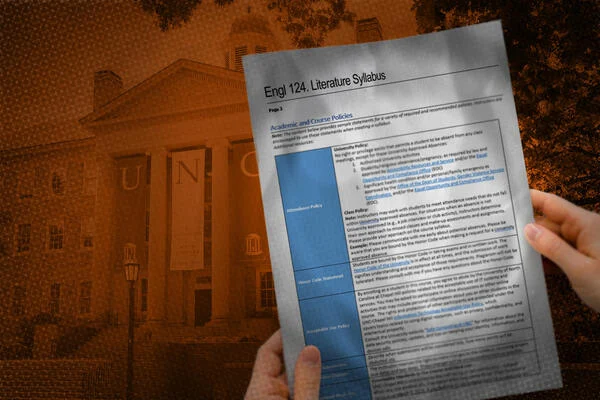
    Photo illustration by Justin Morrison/Inside Higher Ed | Liudmila Chernetska and Davizro/iStock/Getty Images

    As right-wing groups increasingly weaponize Freedom of Information Act requests to expose and dox faculty members who teach about gender, race and diversity, University of North Carolina system campuses are split over whether syllabi and other course materials should be subject to public records requests.

    In July, officials at the University of North Carolina at Chapel Hill determined that the documents are not automatically subject to such requests after the Oversight Project, founded by the conservative think tank the Heritage Foundation, requested that the university hand over any course materials from more than 70 classes that contained one of 30 words or phrases, including “gender identity,” “intersectionality,” “queer” and “sexuality.” Officials ultimately denied the request, writing, “There are no existing or responsive University records subject to disclosure under the North Carolina Public Records Act. Course materials, including but not limited to exams, lectures, assignments and syllabi, are the intellectual property of the preparer.”

    The requested materials are protected by copyright policies, a UNC Chapel Hill spokesperson told Inside Higher Ed. “The university has a longstanding practice of recognizing faculty’s intellectual property rights in course materials and does not reproduce these materials in response to public records requests without first asking for faculty consent,” they wrote in an email.

    But an hour’s drive west, at the University of North Carolina at Greensboro, officials decided just the opposite. Professors were asked to hand over their spring 2025 syllabi in response to a Freedom of Information Act request earlier this fall, said Chuck Bolton, a professor of history at UNC Greensboro and chair of the Faculty Senate. He is among dozens of faculty members who were asked to upload their syllabi into a central database.

    “The Public Records Act is inclusive in its coverage and unless there is an explicit exception, which this is not, it is covered,” UNC Greensboro spokesperson Diana Lawrence said in an email. “As a matter of public policy, transparency should take [precedence] over questions where there is doubt and we do not believe that the Federal Copyright Act provides a specific exemption or preempts what has been passed in state law.”

    Which university is interpreting the law correctly? It’s hard to know, said Hugh Stevens, an attorney who specializes in public records and FOIA law and litigation at the law firm Stevens Martin Vaughn & Tadych. There is no case law specific to this question, and the answer likely depends on how different course materials—from lecture notes to syllabi to course descriptions—are defined under the law.

    “It’s probably a matter of degree,” Stevens said. “Something that you post online for your class to read, it’s pretty hard to say those are not subject to [public records requests]. But on the other hand, the materials that you use to prepare to teach your class, but which are never published to anybody, are certainly, in my view, copyrightable and proprietary.”

    For years, UNC Greensboro put syllabi online as part of an accreditation requirement, said Jeff Jones, a history professor and head of the institution’s American Association of University Professors chapter. After the university’s website was redesigned and accreditation procedures changed, the syllabi were no longer posted.

    The UNC system doesn’t have a policy that specifies how syllabi are treated under open-records laws, leaving the decision up to individual campuses. The policy “does not discuss distribution of course materials” and “essentially covers the basic functions and procedures involved with records requests,” said UNC system spokesperson Andy Wallace.

    But the system does define copyrightable works, which include coursework produced by faculty members, Wallace added.

    Lawrence, the Greensboro spokesperson, did not respond to questions about whether the university’s records request was also from the Oversight Project and whether it has already provided the material. The FOIA request has not been made public, but Bolton, the history professor, believes it’s a narrower request than what UNC Chapel Hill received and that it is focused exclusively on syllabi.

    The opposing interpretations of the law from two universities in the same public system have left faculty confused and worried about their safety as right-wing groups rifle through course materials for any terminology they don’t like, usually related to gender identity, sexuality or race. Faculty members at Texas A&M University, the University of Houston and George Mason University, among others, have been targeted and sometimes threatened on social media for their instruction and teaching materials. Bolton said he knows of several UNC Greensboro faculty members who have been doxed.

    “Faculty have been upset and scared and freaked out about it, because there are people that seem to be [making FOIA requests] because they are trying to create gotcha moments by taking certain things out of context,” he said.

    Michael Palm, an associate professor of media and technology studies and cultural studies at UNC Chapel Hill, said in an email that while many faculty are glad Chapel Hill decided not to release the requested course materials, some expressed frustration about the lack of transparency. “We were disappointed when we learned through news reports that UNC Chapel Hill’s lawyers had decided not to respond to the requests, rather than having that decision communicated to us by administrators,” he said.

    Some professors are also concerned about how long and how vigorously the university will continue to protect faculty. “We are all concerned about the increasing political interference into our classrooms and attempts to quash our academic freedom,” said Erik Gellman, a history professor at Chapel Hill.

    Bolton, at UNC Greensboro, has similar worries.

    “This is a tough time for universities,” he said. “There are a lot of attacks coming from a lot of different directions, and that increases the anxiety and anger on behalf of the faculty, because we know that these kinds of things are not being done just because people want to find out what’s on our syllabus for intellectual reasons. They’re doing it for more nefarious reasons.”

    Source link

  • UNC Merges Information and Data Science Schools, Names New AI Vice Provost

    UNC Merges Information and Data Science Schools, Names New AI Vice Provost

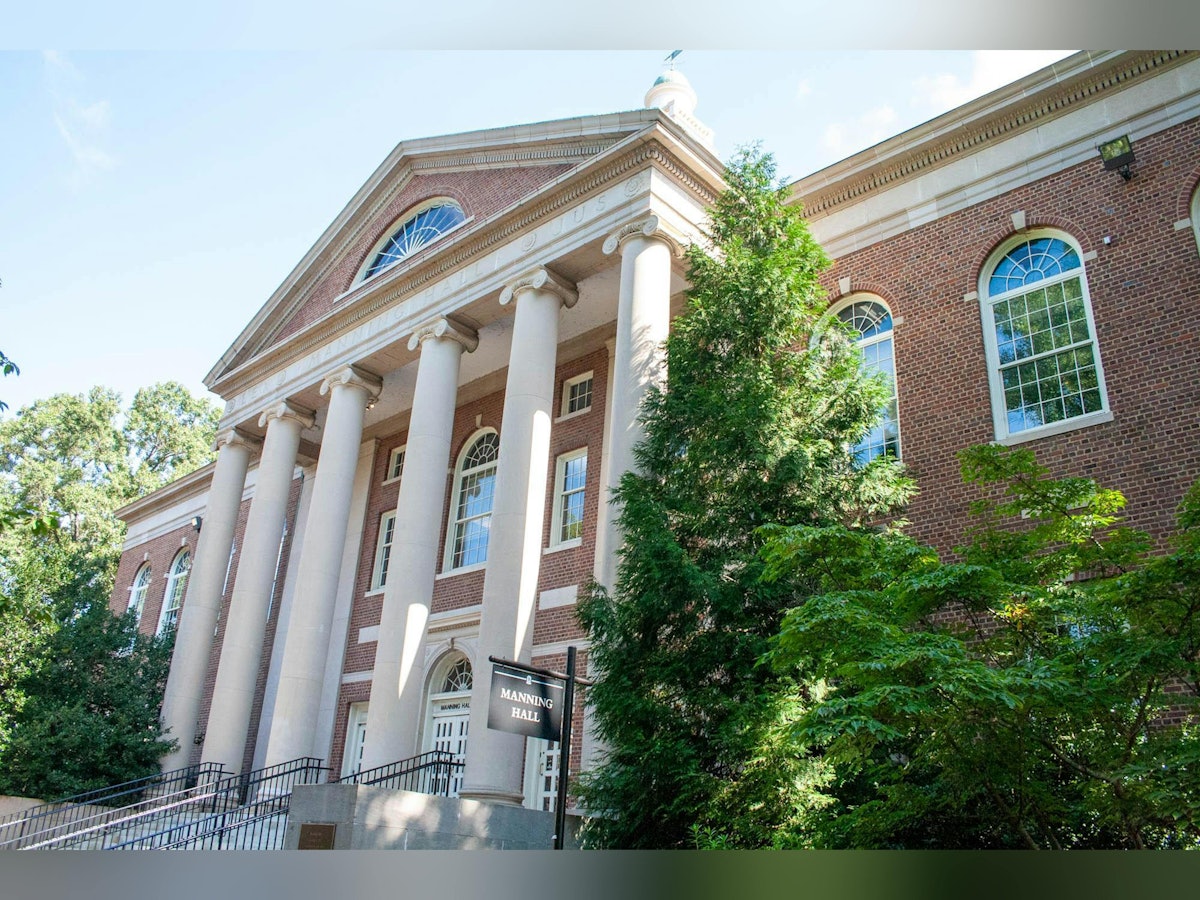
    Manning Hall at University of North Carolina Chapel HillUNCThe University of North Carolina at Chapel Hill announced last week that it will merge the School of Information and Library Science and the School of Data Science and Society into a single, yet-to-be-named institution focused on applied technology, information science and artificial intelligence.

    The merger, announced in a joint letter from Chancellor Lee H. Roberts and Interim Executive Vice Chancellor and Provost James W. Dean Jr., represents what administrators called “a bold step forward” in positioning Carolina as a national leader in data and AI education.

    Dr. Stanley Ahalt, current dean of the School of Data Science and Society, will serve as inaugural dean of the new school. Dr. Jeffrey Bardzell, dean of the School of Information and Library Science, will continue leading SILS through the transition while also assuming a newly created secondary appointment as Chief Artificial Intelligence Officer and Vice Provost for AI.

    “Information technologies, especially generative AI, are having a transformational impact,” the letter stated. “This new school is a bold step forward in our commitment to preparing students for a world increasingly shaped by data, information and artificial intelligence.”

    The AI vice provost position, which will become full-time once the new school is operational, will coordinate the university’s response to artificial intelligence across all campus units.

    “Dean Bardzell has been a key voice informing our thinking about AI campuswide,” Roberts and Dean wrote. “We are grateful to have his experience in the classroom, administration and research guiding our efforts.”

    The announcement comes as universities nationwide grapple with integrating AI into curriculum and operations. UNC joins a growing number of institutions restructuring academic units to address what administrators describe as rapid technological change.

    While the decision to merge has been finalized, administrators said that implementation plans remain under development. The university will establish a task force, advisory committee and multiple working groups to determine operational details.

    “Faculty, staff and students will be engaged throughout,” the announcement stated. Both schools will maintain current academic programs during the transition, with administrators expressing hope the merger will support enrollment growth and expanded impact.

    SILS, established in 1931, has approximately 600 students across bachelor’s, master’s and doctoral programs, with strengths in information ethics, library science and human-centered information design.

    SDSS, founded in 2019, has grown to roughly 400 students and focuses on computational methods, statistical analysis and data science applications across disciplines.

    “Both SILS and SDSS bring distinct strengths and areas of excellence to Carolina — technical expertise, humanistic inquiry and a deep understanding of the societal implications of emerging technologies,” administrators wrote.

    The letter noted that the merger is “driven by long-term possibilities” rather than budget constraints, with a focus on growth and expanding both schools’ “powerhouse academic programs.”

    University officials did not provide a timeline for completing the merger or naming the new school. They also did not specify budget details or projected enrollment targets.

    The announcement marks the latest in a series of administrative restructuring efforts at UNC-Chapel Hill, which has seen several organizational changes in recent years as it responds to shifting academic priorities and funding models.

    Source link

  • UNC Professor Accused of Advocating Political Violence Reinstated

    UNC Professor Accused of Advocating Political Violence Reinstated

    Marin Herold/iStock/Getty Images Plus

    Dwayne Dixon, a professor at the University of North Carolina at Chapel Hill, was reinstated Friday after the university performed a “thorough threat assessment,” Dean Stoyer, vice chancellor for communications and marketing, said in a statement. 

    Dixon was placed on leave Monday following allegations that he was an advocate for political violence.

    “The Carolina Behavioral Threat Assessment and Management Team consulted with the UNC System security office and with local law enforcement, undertaking a robust, swift and efficient review of all the evidence. We have found no basis to conclude that he poses a threat to University students, staff, and faculty, or has engaged in conduct that violates University policy,” Stoyer said in a statement. “As a result, the University is reinstating Professor Dixon to his faculty responsibilities, effective immediately.”

    Dixon is a teaching associate professor of Asian and Middle Eastern studies at UNC Chapel Hill, and he’s been active at counterprotests to alt-right rallies, including at the Unite the Right rally in Charlottesville, Va., in 2017. He’s also a strong advocate for gun rights and used to be a member of the Silver Spring Redneck Revolt, a chapter of the now-disbanded antifascist, antiracist, anticapitalist political group Redneck Revolt. Andrew Kolvet, a spokesperson for the late Charlie Kirk’s Turning Point USA, called for Dixon to be fired in an X post because of these affiliations.

    Source link

  • UNC Professor on Leave After Alleged Advocacy of Political Violence

    UNC Professor on Leave After Alleged Advocacy of Political Violence

    Eros Hoagland/Getty Images

    Officials at the University of North Carolina at Chapel Hill placed Professor Dwayne Dixon on leave Monday while the university investigates his “alleged advocacy of politically motivated violence,” said Dean Stoyer, UNC Chapel Hill’s vice chancellor for communications and marketing.

    Dixon, an associate professor of Asian and Middle Eastern studies, used to be a member of Silver Valley Redneck Revolt, a chapter of the antifascist, antiracist, anticapitalist political group Redneck Revolt. The group was formed in 2016 and some members, including Dixon, were present at the 2017 Unite the Right rally in Charlottesville, Va., to provide armed security and medical assistance to counterprotesters. Redneck Revolt disbanded in 2019 and has no active chapters, according to its website.

    In a 2018 interview with The Chronicle of Higher Education, Dixon described himself as an “anarchist,” and he is no stranger to blowback for his political activism and support for gun rights. He was arrested for bringing a semiautomatic rifle to a Ku Klux Klan counterprotest in Durham, N.C., in 2018—the case was later dismissed as unconstitutional on the grounds that the charges violated Dixon’s First and Second Amendment rights. He was also among 20 people who protected counterprotesters in Durham when white supremacists protested the removal of a Confederate statue in 2017. Through all these events, Dixon remained employed at UNC Chapel Hill.

    Why is Dixon in the hot seat now? The answer is convoluted, but it begins with fliers on the Georgetown University campus.

    On Sept. 24, Andrew Kolvet, a spokesperson for the late Charlie Kirk’s Turning Point USA, posted on X a photo of a flier on the Georgetown campus in Washington, D.C., that read, “Hey Fascist! Catch!”—a nod to engraving on the casing of bullets left behind by Kirk’s suspected killer—and “The only political group that celebrates when Nazis die.” The flier also included a QR code to a Google form for a potential Georgetown chapter of the John Brown Gun Club, a Redneck Revolt affiliate organization known as a “leftist gun-rights group” with multiple independent chapters, including one in the D.C. area, according to the Counter Extremism Project. It “arms itself to defend against far-right violence and often appears as a security force at protests to protect against expected far-right violence,” the CEP wrote. Google has since removed the form for violating its terms of service.

    University officials removed the fliers and reported them to the FBI. Education Secretary Linda McMahon also weighed in: “At a moment like this, Georgetown has to determine what it stands for as an institution … Allowing violent rhetoric to fester on our nation’s campuses without consequences is dangerous. It must be condemned by institutional leaders,” she wrote on X. “I am grateful to those who spoke out against this and made noise about the posters on campus—you made a difference. There is power in speaking up to reveal these hateful ideologies that have incited deadly violence.”

    Kolvet posted again, this time linking to a recent Fox News article that cited Dixon’s involvement in Redneck Revolt based on an old blog post that has since been taken down. “I posted this flyer our team spotted at Georgetown University, and now we find out professors at ‘elite’ schools are members of this group and its offshoots,” Kolvet wrote. “This professor must be immediately fired and the group/network investigated.”

    Dixon was placed on leave Monday, which will “allow the University to investigate these allegations in a manner that protects the integrity of its assessment,” UNC’s Stoyer said in his statement. “Depending upon the nature and circumstances of this activity, this conduct could be grounds for disciplinary action up to and including potential termination of employment.”

    UNC Chapel Hill officials declined to answer any other questions about Dixon and did not say whether Kolvet’s post or the Fox News article led to the investigation. Dixon did not reply to a request for comment but told the student newspaper The Daily Tarheel that he left the Silver Valley Redneck Revolt in 2018.

    A Change.org petition to reinstate Dixon is circulating and as of Wednesday evening had more than 900 signatures. In a statement Wednesday, the North Carolina chapter of the American Association of University Professors, as well as UNC Chapel Hill’s AAUP president, condemned the university’s actions and demanded Dixon be reinstated.

    “Right-wing activists are attacking Dixon for prior membership in a group that has been inactive since 2019, and are baselessly connecting him to flyers allegedly posted by a different group on a different campus outside of North Carolina. Fox News picked up the story on September 27, 2025, without verifying the existence of the flyers, and apparently this was enough for UNC’s administration to remove a professor from the classroom in the middle of the semester and bar him from campus,” the statement read. “Let’s call this what it is: UNC administrators are capitulating to a call from a right-wing group, infamous for attacking faculty, to fire a professor based on an unsubstantiated rumor.”

    Dixon joins the ranks of dozens of college and university faculty members who have been placed on leave, disciplined or fired in the weeks since Kirk was shot and killed. All of these professors have been investigated after right-wing personalities identified them on social media. Two of them—Michael Hook, who was placed on leave for social media comments he made about Kirk’s death, and Thomas Alter, who was terminated after being accused of inciting violence during a speech—have been reinstated by court orders.

    Source link

  • Former Provost Sues UNC Chapel Hill

    Former Provost Sues UNC Chapel Hill

    A former provost at the University of North Carolina at Chapel Hill accused the Board of Trustees of systematically violating open records and meetings laws on multiple occasions, including to retaliate against him, according to a lawsuit filed earlier this week.

    At the heart of the lawsuit from Chris Clemens, who resigned in April, is a delayed tenure vote.

    In March, the UNC Board of Trustees postponed a vote to grant tenure to 33 faculty members. At that meeting, held March 20, the board moved into closed session, with Clemens present, apparently to discuss individual tenure cases. Instead, trustees launched into a debate over the value of tenure, with some voicing their philosophical opposition to the practice and others arguing that they should delay such approvals for financial reasons, according to the lawsuit.

    The board eventually approved tenure for all 33 candidates in June via an email vote.

    According to the lawsuit, Clemens shared details from the meeting with other academic leaders, noting that no tenure decisions were made or individual candidates considered and that the board instead “engaged in a sweeping policy discussion about tenure’s institutional value and global costs.” Following that briefing, the Board of Trustees allegedly communicated through Signal, a private messaging application that includes a feature to automatically delete messages after they are read, to call for a vote of no confidence in Clemens. UNC leadership asked Clemens to step down shortly thereafter, according to the lawsuit.

    But even if Clemens’s suit is successful and the violations are proven to be true, the board will likely face few repercussions given past precedent.

    A Systemic Pattern

    Clemens’s lawsuit also accused Jed Atkins, director and dean of the School for Civic Life and Leadership, of relaying the former provost’s briefing to then–board chair John Preyer via Signal. (Clemens had taken issue with the hiring practices at the civic life school before stepping down.)

    The lawsuit alleges that Atkins “requires that his leadership team subscribe to a Signal group and conducts a substantial portion of official communications via Signal with auto-delete enabled not only in exchanges with trustees but as a routine practice,” in violation of state law. Atkins did not respond to a request for comment from Inside Higher Ed.

    Beyond the tenure flap, Clemens has accused the board of defying state open meetings laws on multiple occasions in an effort to “hide policy debates from public view,” according to his lawsuit.

    “Over the past four years, the Board has engaged in a pattern and practice of systematically violating the Open Meetings Law by improperly invoking closed session exemptions to shield policy and budget deliberations from public scrutiny,” the former provost alleged.

    Contacted by Inside Higher Ed, Clemens declined to comment.

    In his legal filing, Clemens cited three specific examples beyond the March tenure discussion in which he alleged the board violated open meetings laws. He specifically pointed to a closed session discussion in November 2023, when UNC discussed athletic conference realignment; further secret deliberations over athletics in May 2024 involving both conference realignment and finances; and an “emergency meeting” in December 2024 to hire a head football coach. At the December meeting, UNC Chapel Hill hired NFL legend Bill Belichick on a $10 million annual contract.

    (Responding to a separate legal complaint over the May 2024 meeting, trustees previously agreed to reaffirm their commitment to open meetings laws and pay $25,000 in attorneys’ fees.)

    “Each episode follows the same pattern: the Board invokes a statutory exemption, enters closed session, then discusses broad policy or budget matters that must be debated publicly,” the lawsuit states.

    Despite being allegedly pressured to step down, Clemens isn’t seeking a payout or his job back. Instead, he’s asking the court to prevent the board from continuing its alleged defiance of open meetings laws, to produce minutes or a transcript of the March 20 closed session and to mandate that trustees participate in training on state open meetings and public records laws.

    Responses

    Contacted by Inside Higher Ed, UNC Chapel Hill spokesperson Kevin Best wrote by email, “We’re aware of the litigation and are reviewing it closely,” but he declined to comment further given the pending nature of the case.

    The Board of Trustees released a more forceful statement Wednesday.

    “The former Provost’s baseless assault on this volunteer Board and how it conducts its business stands in stark contrast to the widely recognized excellence the University has achieved under this Board’s leadership,” chair Malcom Turner said. “His allegations are disappointing and inaccurate, not to mention a waste of taxpayer dollars, for which this former officer of the University shows no regard. His claims will not withstand scrutiny.”

    Most of the individuals named in the lawsuit either declined to comment or did not respond to media inquiries. Multiple faculty and staff members at the School of Civic Life and Leadership (none of whom are defendants in the lawsuit) also did not respond to requests for comment.

    However, one source alleged that the former provost instructed employees to use Signal and that he also used it for university business, which Inside Higher Ed confirmed via screenshots.

    Allegations that Clemens used Signal come amid an opaque investigation by outside counsel into the School of Civic Life and Leadership that was announced earlier this month. While Chapel Hill leadership has said little about the investigation, it comes after multiple resignations from faculty members in the school, some of whom have alleged it has “lost sight of its mission.”

    Dustin Sebell, a School of Civic Life and Leadership professor, told Inside Higher Ed via text message that Clemens “habitually used Signal for university business” and encouraged others to do so. To Sebell, the lawsuit seems like an effort by Clemens to sidestep the investigation.

    “By hastily filing a hypocritical lawsuit, Chris is trying to avoid investigators’ questions about his misconduct as Provost by claiming privilege pending ongoing litigation,” Sebell wrote.

    But some faculty members, such as Michael Palm—president of the UNC Chapel Hill chapter of the American Association of University Professors—expressed concern about political influence on the board.

    “Open meetings laws are important for public universities. Unfortunately, right now we don’t need them to know that the UNC [Board of Trustees] considers UNC faculty to be their enemy,” Palm wrote to Inside Higher Ed via email. “The crisis we’re in is political, not procedural.”

    Although North Carolina has historically been considered a swing state, the UNC Chapel Hill board appears to be overwhelmingly comprised of Republicans. Some have previously worked for Republican officials, while others have donated heavily to GOP candidates and causes.

    Of 14 voting members on the UNC Chapel Hill board, at least 10 have donated to conservative politicians and organizations, some contributing tens of thousands of dollars, according to a review by Inside Higher Ed. Several others have direct GOP connections, including Preyer, who previously worked for former senator Lauch Faircloth. Three other trustees previously held state office: Robert Bryan III, James Blaine II and Patrick Ballantine. All were elected as Republicans.

    Potential Consequences

    Should the allegations in the lawsuit be proven true, consequences will likely be fairly light—at least, that has been the outcome in other cases where boards allegedly violated sunshine laws.

    The Pennsylvania State Board of Trustees, for example, was required to complete training on the state’s Sunshine Act recently as part of a settlement with the news organization Spotlight PA over alleged violations of opening meetings laws related to secretive practices by the board.

    But in other cases, universities have largely escaped consequences for clandestine actions.

    Kentucky attorney general Russell Coleman has found that multiple state institutions have violated open records laws, adding up to 10 times this year alone. Coleman found that the University of Kentucky violated open records law four times and had four partial violations, while Northern Kentucky University had one violation and the University of Louisville had a partial violation. However, none of those violations resulted in punitive actions from the state.

    Last year Indiana’s public access counselor found that Indiana University’s Board of Trustees violated open meetings laws when members claimed that they were holding a private meeting to discuss litigation. But trustees also discussed IU president Pamela Whitten’s performance and a campus climate review, expanding the private meeting beyond its stated aims. A complaint from a news organization prompted scrutiny from state officials, but no punitive or corrective actions.

    UNC Chapel Hill was also previously accused of violating state open meetings laws, including in 2021 when it hired Clemens as provost, choosing to approve “Action 1” on its agenda with a vague reference to personnel matters, raising concerns that trustees violated state law via a secretive vote. Board leadership defended the vote and Clemens remained in place until April.

    This story has been updated with a statement from the UNC Chapel Hill Board of Trustees.

    Source link

  • UNC System Mandates Reports on DEI Compliance

    UNC System Mandates Reports on DEI Compliance

    The University of North Carolina System’s Board of Governors issued a memorandum requiring each of the system’s 17 campuses to develop a subcommittee to evaluate the campus’s compliance with the system’s anti-diversity, equity and inclusion policy, The Assembly reported.

    They have until Sept. 1 to show how they have complied with the policy, which cancelled previous DEI guidance and mandated neutrality from administrators on political and social issues. As a result of that policy, UNC campuses reported that they laid off dozens of staffers, moved 131 people to new positions, and redirected $16 million in DEI spending to student success and wellbeing programs.

    According to the memo, the reviews should include briefings with chancellors about employees whose jobs were changed as a result of the DEI ban.

    “These confidential reviews should compare an individual’s prior position to his or her new responsibilities, including how the employee’s performance in that role has changed, and what safeguards exist to ensure an employee’s previous responsibilities do not continue in the present role,” the memo states. “Confidential briefings from the chancellor on any disciplinary action taken against personnel should occur at this time as well.”

    The memo comes after four UNC employees were secretly filmed by a conservative nonprofit discussing circumventing DEI restrictions; three of those employees are no longer employed by their universities.

    Source link

  • UNC Chapel Hill Provost Stepping Down Amid Civic Life Strife

    UNC Chapel Hill Provost Stepping Down Amid Civic Life Strife

    The University of North Carolina at Chapel Hill’s provost is stepping down next month to return to the faculty there, a development that news articles last week suggested is tied to his disagreement with hiring practices at the School of Civic Life and Leadership, or SCiLL.

    In a statement Friday to Inside Higher Ed, Chris Clemens, the outgoing provost, said, “I made the decision to step down as provost. During my time as provost, I’ve been able to address challenges I care deeply about and make meaningful progress. However, the issues that have arisen in recent days are not ones I can solve, and I don’t feel the same passion for them.”

    His statement didn’t explain what these recent issues are, and Chapel Hill spokespeople didn’t provide further information beyond campus chancellor Lee Roberts’s April 3 announcement that Clemens had decided to step down.

    Clemens will return May 16 to being the Jaroslav Folda Distinguished Professor of Physics and Astronomy, Roberts said in that announcement. Clemens has been provost since early 2022, starting under former chancellor Kevin M. Guskiewicz, who’s now president of Michigan State University. Roberts credited Clemens with, among other things, helping establish the School of Data Science and Society, the Program for Public Discourse, and SCiLL.

    SCiLL was established after Chapel Hill’s Board of Trustees passed a resolution in January 2023 asking the campus administration to “accelerate its development” of this new school. The then–board chair called SCiLL an effort to “remedy” a shortage of “right-of-center views” on campus. Controversy quickly ensued. Faculty said they didn’t know a whole school was in development.

    The Republican-controlled State Legislature then passed a law requiring Chapel Hill to establish the school and hire 10 to 20 faculty from outside the university, plus make them eligible for tenure. It became one of many civics or civil discourse centers—critics have called them conservative centers—that Republican lawmakers and higher education leaders have established at public universities in recent years.

    In January 2025, Clemens canceled the latest SCiLL tenure-track faculty searches before reversing course days later. Articles in The Assembly and the conservative Real Clear Investigations have now implied that Clemens’s departure was connected to his involvement in the disagreements over hiring within SCiLL.

    Clemens, a self-described conservative, had been an advocate for SCiLL. The Real Clear Investigations article was titled, before the headline was changed, “In North Carolina, Academic Conservatives Have Met the Enemy and It Is … Them.”

    In his Friday statement, Clemens said, “I look forward to returning to the faculty to resume work on optical design technology, with a particular focus on applications for the SOAR telescope and astronomy. This will allow me to spend more time in the classroom—an aspect of academic life I have greatly missed.”

    Source link

  • Resignations, Disagreements With Dean Roil UNC Civics School

    Resignations, Disagreements With Dean Roil UNC Civics School

    Multiple faculty members connected with the University of North Carolina at Chapel Hill’s controversial school that had been billed as promoting civil discourse have resigned from leadership roles, citing strong disagreements with the dean who appointed them.

    One such professor went so far as to call the School of Civic Life and Leadership an “unmitigated disaster.” The recent group of resignations adds to past departures by professors who said the school’s earlier focus had shifted and narrowed under Jed Atkins, its first permanent dean. Much of the current controversy centers on Atkins’s handling of searches for new faculty.

    Atkins, who ran Duke University’s Civil Discourse Project and chaired its classical studies department before moving to UNC a year ago, defended the hiring procedures in a statement to Inside Higher Ed. He didn’t provide an interview.

    The school’s birth was mired in controversy. It’s an example of the civil discourse centers—which critics have called conservative centers—that higher education leaders and Republican state lawmakers have been establishing at public universities. For more than two years, debate over the UNC school has been tinged by accusations that its supporters are motivated by conservative politics and its opponents by leftism.

    But the recent resignation letters from the school’s former supporters suggest disagreements that resist characterization as a simple left-right divide. The criticism of the faculty search procedures involves allegations that faculty input, including from the school’s search committee and advisory board members, was disregarded.

    The university’s media relations arm said that Chapel Hill policy requires four full professors to vote in faculty hirings. The advisory board contained such professors, who predated the school’s creation. But the Chapel Hill spokespeople said that in “all faculty appointment matters, the votes of faculty are advisory to the dean,” whose recommendation eventually goes to the universitywide appointments, promotion and tenure committee that advises the provost. The provost has hiring power, though the Chapel Hill Board of Trustees must approve awarding tenure.

    Inger S. B. Brodey, an English and comparative literature professor whom Atkins chose as one of two associate deans, kicked off the recent round of resignations. She wrote to Atkins on Feb. 28 that she still believes strongly in the school’s “original mission, which, as I understand it, includes an emphasis on civil discourse across difference, preparation for citizenship and fruitful lives through studying global great books, promoting scientific literacy and assembling a diverse faculty from many disciplines.”

    However, Brodey wrote, the school “has lost sight of its mission in all these areas and is unlikely to make the lasting positive impact that I and the other inaugural faculty had hoped for. For this and other reasons, I hereby resign as associate dean.”

    Inside Higher Ed obtained the email and other documents mentioned in this story from sources who were either anonymous or whose identities are known but who requested anonymity.

    In January, before that resignation email, Brodey sent Atkins a much longer message on why she was resigning from a faculty search committee. Brodey confirmed the authenticity of both emails to Inside Higher Ed.

    “While it may be within the dean’s power to intervene at every stage of the search and add/remove names, overruling the opinions of the committee, I have never seen this power executed outside of SCiLL,” wrote Brodey, using the school’s acronym. She serves in multiple departments of Chapel Hill.

    “I don’t have any confidence that the search committee will have any actual effect on the final roster of individuals hired,” she wrote. She also said, “I don’t think this list differs in any substantial way from the list of concerns David enumerated in our last meeting, when he resigned from the search.”

    That’s a reference to David Decosimo, SCiLL’s remaining associate dean. Asked for comment, Decosimo replied in an email, “I’m on parental leave this semester, so won’t comment at this time.”

    This faculty search, which began in the fall, wasn’t small. Atkins has said it resulted in eight offers to candidates. Brodey was even more critical of the process in an email to The Daily Tar Heel, which reported earlier on her resignation. She told the student newspaper that there were “improprieties, slander, vindictiveness and manipulation” surrounding the search.

    Dustin Sebell, a SCiLL professor who chaired the search committee (the three members were him, Brodey and Decosimo), disagreed with Brodey in an email. Sebell wrote that Atkins hadn’t overruled the committee.

    “You personally recorded the names of the 20 finalists on behalf of the search committee and emailed them to me,” Sebell wrote. He said, “The committee was fully aware that we had only 16 spots for on campus interviews … it was a mathematical certainty that the dean would exercise some discretion in the selection of finalists from our list.”

    On March 7, Jon Williams, a Chapel Hill economics professor, resigned from SCiLL’s advisory board in an email to Atkins, Chapel Hill chancellor Lee Roberts, provost Chris Clemens and vice provost for faculty affairs Giselle Corbie. Williams alleged that Atkins had ignored all advice and that he felt like he was “nothing more than one of four warm bodies to achieve the dean’s shadowed objectives.”

    “There is no need for an advisory board if the dean ignores any advice that isn’t simply confirmation,” Williams wrote. “More troubling, over the last six weeks, I’ve seen incivility and dysfunction, biased and unfair processes, a complete disregard for governance, and a willingness to deceive and misrepresent that is unlike anything I’ve witnessed in my 15 years in academia.”

    Williams ended with, “I cannot see how SCiLL will emerge from this troubled beginning without new leadership.” He declined an interview with Inside Higher Ed, writing in an email, “I will confirm that I resigned and that my concerns center around” Atkins.

    He wrote in his resignation email that he still appreciates “the need for a place on campus for students to learn how to critically evaluate and debate the most challenging and controversial topics. Simply put, I’m often in a tiny minority among faculty in my views and opinions, so I appreciate how difficult students may find it to engage in open discussion.”

    Three days after Williams’s resignation from the advisory board, Fabian Heitsch, a physics and astronomy professor, followed suit with his own email to Atkins, Roberts, Clemens and Corbie. Heitsch specifically mentioned issues with personnel decisions, but he didn’t provide many specifics or respond to Inside Higher Ed’s requests for comment.

    “In my year of service on the advisory board, I have witnessed its advice on personnel decisions being ignored on three separate occasions,” Heitsch wrote. He said, “It seems as if the advisory board is being used only as a formality instead of as a body of experience and strategy.”

    Heitsch said the advisory board “is to provide formal advice to the dean and director. As I understand it, formal advice is not limited to providing the votes to confirm leadership’s decisions.” He wrote that he still supports the school’s “original mission” and that he “will gladly continue to serve as a curricular fellow.”

    Not the First Resignations

    These weren’t the first Chapel Hill faculty who—having come to the university before the school’s creation—affiliated themselves with it only to then reduce their involvement or fully withdraw after Atkins’s appointment, citing a changed direction for the school. One who stepped back last year was Matthew Kotzen, Chapel Hill’s philosophy department chair.

    But the newer resignations have come alongside stronger denunciations—at least publicly. And Kotzen himself increased his past public criticism in a statement to Inside Higher Ed.

    “The original mission of SCiLL was to model and to teach essential skills related to productive engagement with democratic civic institutions, including respectful dialogue across ideological difference,” Kotzen wrote. “Unfortunately, it has become increasingly clear that Dean Atkins is committed to none of those values.”

    Kotzen said Atkins “has an extremely narrow conception of acceptable viewpoints and approaches and has demonstrated almost no openness to feedback from others on the faculty, including those that he himself selected for their role. Dean Atkins has fostered a dysfunctional anti-intellectual culture at SCiLL that rewards hostility, dishonesty and self-righteousness in the pursuit of his ideological and personal aims. That disqualifies him from holding any leadership position at UNC.”

    Atkins told Inside Higher Ed in an email that “the advisory committee’s function in faculty searches is to help assess the merits of our finalists and to cast an advisory vote on each finalist.” He wrote, “In SCiLL’s most recent national search, our faculty rigorously evaluated our applicants’ strengths and promise.”

    “Finalists traveled to campus from three continents, gave teaching demonstrations to students, presented on their research and engaged with our faculty in more informal settings,” Atkins said. “After these campus interviews, SCiLL’s tenure-line faculty met and voted on our finalists; they recommended a strong slate of candidates for appointment.”

    Danielle Charette James, a SCiLL assistant professor, told Inside Higher Ed in an email that “our process was highly collaborative, and the candidates who received offers earned overwhelming, and in some cases unanimous, support from SCiLL’s core faculty.”

    Chapel Hill’s media relations arm emailed a statement to Inside Higher Ed saying, “SCiLL’s faculty searches honored all university rules and procedures. Applicants were advanced on the basis of merit and fit with the advertised positions. We are looking forward to welcoming an outstanding group of new faculty to campus next fall.”

    ‘Dress Rehearsal’

    Back in January 2023, Chapel Hill’s Board of Trustees passed a resolution asking the campus administration to “accelerate its development of a School of Civic Life and Leadership.” Faculty said they were caught off guard because they didn’t know a whole school was in development. David Boliek, then chair of Chapel Hill’s board, called it an effort to “remedy” a shortage of “right-of-center views” on campus. Clemens, the provost and a self-described conservative, promoted the school.

    In the fall of 2023, the Republican-controlled State Legislature passed a law that required Chapel Hill to establish the school. The campus couldn’t back out even if it desired to. Clemens had the final say in hiring Atkins as dean, at least before the Chapel Hill board signed off.

    And despite the past faculty objections, current Chapel Hill professors, including Brodey, Kotzen and Williams, affiliated with the initiative.

    But faculty aren’t the only ones critiquing the recent faculty search. Clemens, who didn’t return requests for comment for this article, at one point ordered a stop to the faculty searches.

    In a January email to Atkins, Clemens said there were financial limitations. Instead of progressing toward hiring tenure-track faculty, Clemens said, “SCiLL should initially focus on hiring teaching track professors to support large enrollments in the general education curriculum.” So, he said, he was canceling the searches.

    The provost also seemingly referenced issues beyond budgets.

    “Your search committee and voting faculty for these searches is small; smaller even than the number of people you were authorized to hire,” Clemens wrote. “Moreover, some of them have just arrived in Chapel Hill. All new teams must learn to work together, and this ‘dress rehearsal’ has hopefully been a learning experience for all.”

    He then wrote, with original emphasis included, “I want to emphasize how important it is for a School of Civic Life and Leadership to serve as a model of civic life and civil discourse. Given the intense scrutiny and attention on this school, everything you do—including faculty searches—must be exemplary, both to give the candidates confidence in SCiLL and to give the rest of the university confidence in those you hire. I will address how we can fulfill those expectations for future searches in collaboration with SCiLL leadership and with HR.”

    Clemens sent that on a Friday. But by the following Monday, he said the searches were back on after Chancellor Roberts “committed sufficient funds.”

    The criticism of Atkins continues. On Monday, Atkins accepted Williams’s resignation and rebutted his critiques. Williams responded in an email by saying he resigned to protect his reputation, “because SCiLL is currently an unmitigated disaster.”

    He accused Atkins of “hiding behind accusations that wokeness has derailed your efforts,” something Williams called “absolutely ridiculous given that you completely lost the support of folks like myself that have spent a decade battling it on campus.”

    “It’s your failure alone,” Williams wrote. “Time to own it.”

    Source link