Tag: universal

  • Universal vouchers have public schools worried about market share

    Universal vouchers have public schools worried about market share

    by Laura Pappano, The Hechinger Report
    November 6, 2025

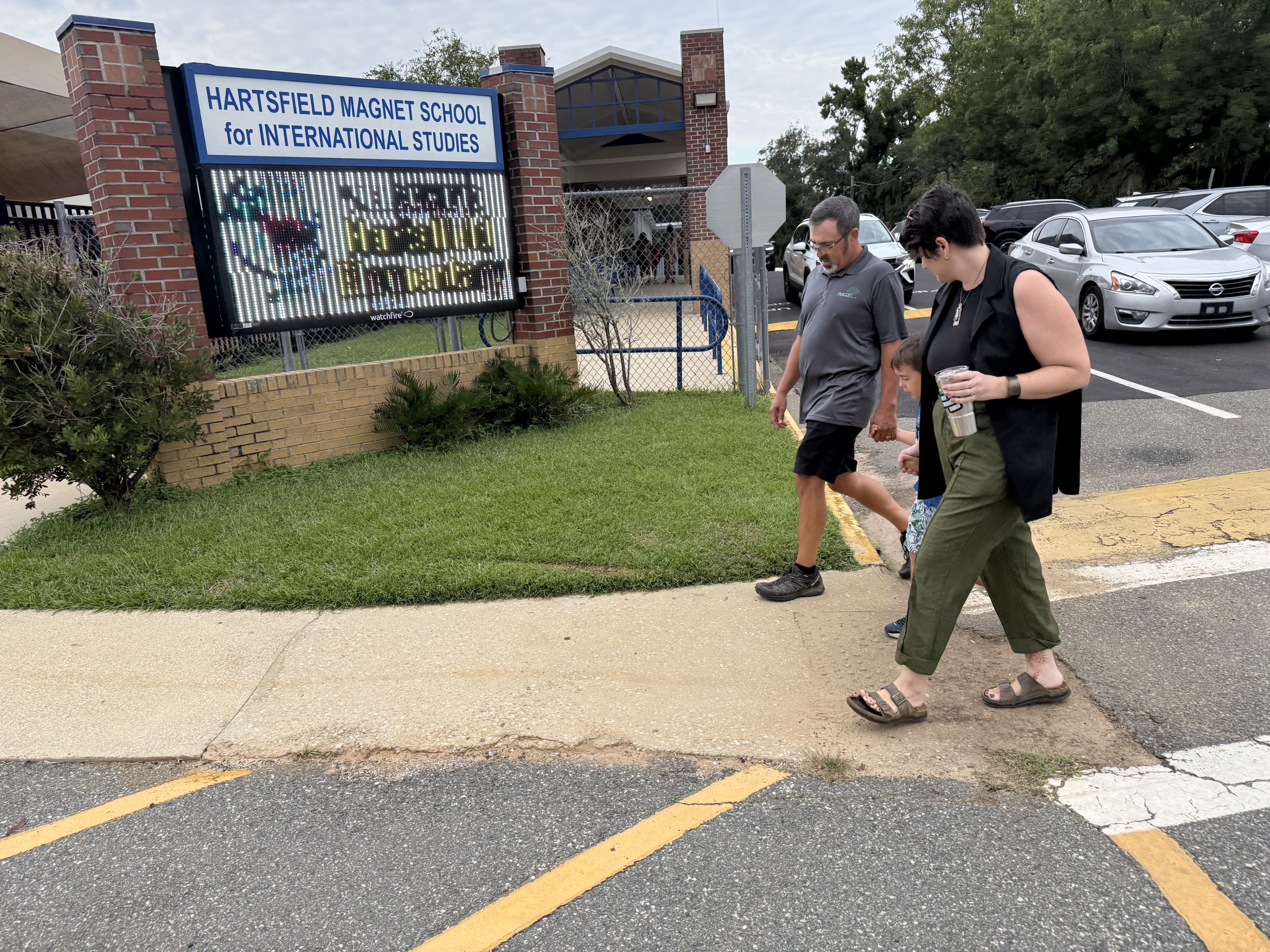
    TALLAHASSEE, Fla. — As principal of Hartsfield Elementary School in the Leon County School District, John Olson is not just the lead educator, but in this era of fast-expanding school choice, also its chief salesperson.

    He works to drum up enrollment by speaking to parent and church groups, offering private tours and giving Hartsfield parents his cell phone number. He fields calls on nights, weekends and holidays. With the building at just 61 percent capacity, Olson is frank about the hustle required: “Customer service is key.”

    It’s no secret that many public schools are in a battle for students. As school started in Florida this August, large districts, including Hillsborough, Miami-Dade and Orange, reported thousands fewer students, representing drops of more than 3 percent year over year. In Leon County, enrollment was down 8 percent from the end of last year.

    Part of the issue is the decline in the number of school-age children, both here and across the country. But there’s also the growing popularity of school choice in Florida and elsewhere — and what that means for school budgets. Leon County’s leaders anticipate cutting about $6 million next year unless the state increases its budget, which could mean reduced services for students and even school closures

    Other Florida school districts are also trimming budgets, and some have closed schools. As districts scramble for students, some are hiring consulting firms to help recruit, and also trying to sell seats in existing classes to homeschoolers. There is also the instability of students frequently switching schools — and of new charter or voucher schools that open and then shut down, or never open at all as promised. 

    Two years after the Florida Legislature expanded eligibility for school vouchers to all students, regardless of family income, nearly 500,000 kids in the state now receive vouchers worth about $8,000 each to spend on private or home education, according to Step Up For Students, the nonprofit that administers the bulk of the scholarships. And Florida’s Tax Credit Scholarship, created in 2001 to allow corporations to make contributions to private school tuition, is the model for the new federal school voucher program, passed this summer as part of Republicans’ “one big, beautiful bill.” The program, which will go into effect in 2027, lets individuals in participating states contribute up to $1,700 per year to help qualifying families pay for private school in exchange for a 1:1 tax credit.

    “We are in that next phase of public education,” said Keith Jacobs of Step Up For Students, who recruits public school districts to offer up their services and classes on its educational marketplace. “Gone are the days when a government institution or your zoned neighborhood school had the authority to assign a child to that school.”

    Related: Become a lifelong learner. Subscribe to our free weekly newsletter featuring the most important stories in education. 

    That’s a problem for Leon County Schools, which boasts a solid “B” rating from the state and five high schools in the top 20 percent of U.S. News’ national rankings. The district, located in the Florida panhandle, serves a population of around 30,000 students, 44 percent of whom are Black, 43 percent white and 6 percent Hispanic.

    “There’s just not enough money to fund two parallel programs, one for public schools and one for private schools,” said Rocky Hanna, the Leon County Schools superintendent. 

    Over the past few years, the Legislature has increased state and local funding for charter schools and created new rules to encourage more to open. (Charter schools are public schools that are independently operated; the Trump administration recently announced a $60 million increase in charter school funding this year, along with additional competitive grants.)

    But vouchers are the big disrupter. The nonprofit Florida Policy Institute projects annual voucher spending in Florida will hit $5 billion this year. In Leon County, money redirected from district school budgets to vouchers has ballooned from $3.2 million in 2020-21 to nearly $38 million this academic year, according to state and district figures. Enrollment in local charter schools has also ticked up, as has state per-pupil money directed to them, from $12 million to $15 million over that time.

    As a mark of how the landscape is shifting, Step Up For Students is now helping districts market in-person classes to homeschoolers on the group’s Amazon-like marketplace to fill seats and capture some money. Jacobs said Osceola County put its entire K-12 course catalog on the site. A year of math at a Miami elementary school? It’s $1,028.16. And just $514.08 for science, writing or P.E.

    “A student can come take a class for nine weeks, for a semester, for a year,” said Jacobs, adding that 30 districts have signed on. They are thinking, he said, “if we can’t have them full-time, we have them part-time.”

    Leon County is considering signing on, said Hanna, “to basically offer our courses à la carte.” It could be a recruitment tool, said Marcus Nicolas, vice chair of the county’s school board. “If we give them an opportunity to sniff the culture of the school and they like it, it could potentially bring that kid back full-time.”

    Related: Federal school vouchers: 10 things to know 

    Because of his shrinking budget, Hanna is looking at cuts to IT, athletics, arts, counselors, social workers and special tutors for struggling students, along with exploring school closings or consolidations

    Another challenge: With more school options, a growing number of students are leaving charters or private schools and enrolling in the district mid-year. Yet state allocations are based on October and February enrollment counts.

    Last year, 2,513 students — about 8 percent of Leon County’s district enrollment — entered after February. “Those are 2,500 students we don’t receive any money for,” Hanna said at an August school board meeting.

    Public schools do a lot well, but have been slow to share that, said Nicolas. “We got lazy, and we got complacent, and we took for granted that people would choose us because we’re the neighborhood school,” he said.

    Even as more parents choose private voucher schools, it’s not necessarily easy for them to determine if those schools are performing well. Although Florida State University evaluates the state’s Tax Credit Scholarship program, its report lags by about two years. It includes an appendix with voucher schools’ test scores, but there is no consequence for low performance. And scores cannot be compared, because even though schools must test students in grades 3 to 10, the schools pick which test to give.

    The result, said Carolyn Herrington, director of the Education Policy Center at Florida State University, who has written some of the evaluation reports, is that “the only real metric here is parent satisfaction,” which she said “is not sufficient.” 

    Yet many parents like the idea of school choice. According to a poll released last month by EdChoice, a school choice advocacy group, just over half of all Americans and 62 percent of parents broadly favor school vouchers.

    Related: Florida just expanded school vouchers — again. What does that really mean? 

    Mother Carrie Gaudio, who attended the local charter school her parents helped to found, was surprised when her son Ross visited Hartsfield Elementary, a Title I school that serves a high percentage of low-income households — and loved it.

    Before enrolling him, however, she and her husband, Ben Boyter, studied the enrollment situation. The school was under capacity, but they noticed more students coming each year.

    “We felt like if they ended up having to close a school it wouldn’t be one that’s had continual increases in enrollment,” she said, and added, “it’s a real bummer that you have to consider that, that you can’t just consider, ‘Are these people kind? Is my kid comfortable here? Do we feel safe here?’”

    Indeed, a school that a parent chooses one year may close the next.

    That’s what happened last year to Kenia Martinez. Since fall 2022, her two sons had attended a charter school run by Charter Schools USA, among the largest for-profit charter operators in the state. Last spring, she learned from a teacher that the school, Renaissance Academy, was shutting down. 

    Previously named Governor’s Charter Academy, Renaissance recently received a “D” grade, and saw enrollment fall from 420 students in 2020-21 to 220 last year. It also ran deficits, with a negative net position of $1.9 million at the end of the 2023-24 school year, according to the most recent state audit report. It closed last May.

    The school building was to re-open as Tallahassee Preparatory Academy — a private school — which was advertised on its website as a STEM school for “advanced learners” that would charge a fee, ranging from $1,500 to $3,200, in addition to the money paid through a voucher. 

    The school was to be run not by Charter Schools USA but by Discovery Science Schools, which operates several STEM charter schools in the state. The deal revealed a possible exit strategy for faltering charters: conversion to a private voucher school that gets state money, but without the requirement of state tests, grades or certified teachers — in other words, without accountability. 

    Yet as this school year began, the building remained dark. The parking lot was vacant. There was no response to the doorbell, or to emails or phone calls made to the contact information on the new school’s website. Discovery Science Schools’ phone number and email were not in service, and emails to founder Yalcin Akin and board president David Fortna went unanswered. A Charter Schools USA spokesperson, Colleen Reynolds, wrote in an email that “CUSA is not involved with the building located where the former Renaissance Academy Building stands” and did not provide additional clarification on why state audit reports indicate otherwise. 

    The Leon County School Board fiercely debated whether to sue Charter Schools USA for access to the building and its contents, which had been funded with taxpayer dollars. But school board members dropped the idea after learning that the building had a large lien, the result of how financing was crafted through Red Apple Development, the real estate arm of Charter Schools USA. Hanna was frustrated that for-profit companies benefited from taxpayer dollars — but still owned the assets.

    Related: Inside Florida’s ‘underground lab’ for far-right education policies

    When Renaissance announced it was closing, a friend of Martinez’s suggested her family apply for vouchers, which covered the full cost of attendance for her two sons at the Avant Schools of Excellence, a private Christian school with campuses in Tallahassee and Florida City. 

    The school takes vouchers (along with a school scholarship) as full payment, although its website lists tuition and fees at $22,775 per year. Martinez liked that the school is Christian, and small. None of their friends from Renaissance Academy are there. Martinez drives them 30 minutes each way, every day.

    The Tallahassee building that houses Avant was previously home to at least two charter schools. (One lasted a month.) Since the campus opened three years ago, said Donald Ravenell, who co-founded Avant with his wife, enrollment has jumped from 55 to 175.

    Ravenell, who on a recent weekday wore a red and blue tie (school colors are red, white and blue), attributed the school’s success to a focus on faith (“We talk about God all the time”) and the aim of preparing each student to be “a successful citizen and person.” 

    Like Olson at Hartsfield, he well understands this is a competitive marketplace. He wants his school to be known for offering a quality product, which he underscored by drawing a comparison to fried chicken.

    “I have nothing against Chester’s Chicken,” said Ravenell, referring to the quick-service chain sold in gas stations and rest stops. But he expects Avant to reach for more: “We want to be Chick-fil-A.”

    Contact editor Caroline Preston at 212-870-8965, via Signal at CarolineP.83 or on email at [email protected]

    This story about school vouchers was produced by The Hechinger Report, a nonprofit, independent news organization focused on inequality and innovation in education. Sign up for the Hechinger newsletter.

    This <a target=”_blank” href=”https://hechingerreport.org/universal-vouchers-have-public-schools-worried-about-something-new-market-share/”>article</a> first appeared on <a target=”_blank” href=”https://hechingerreport.org”>The Hechinger Report</a> and is republished here under a <a target=”_blank” href=”https://creativecommons.org/licenses/by-nc-nd/4.0/”>Creative Commons Attribution-NonCommercial-NoDerivatives 4.0 International License</a>.<img src=”https://i0.wp.com/hechingerreport.org/wp-content/uploads/2018/06/cropped-favicon.jpg?fit=150%2C150&amp;ssl=1″ style=”width:1em;height:1em;margin-left:10px;”>

    <img id=”republication-tracker-tool-source” src=”https://hechingerreport.org/?republication-pixel=true&post=113229&amp;ga4=G-03KPHXDF3H” style=”width:1px;height:1px;”><script> PARSELY = { autotrack: false, onload: function() { PARSELY.beacon.trackPageView({ url: “https://hechingerreport.org/universal-vouchers-have-public-schools-worried-about-something-new-market-share/”, urlref: window.location.href }); } } </script> <script id=”parsely-cfg” src=”//cdn.parsely.com/keys/hechingerreport.org/p.js”></script>
    Source link

  • Colorado’s 3rd year of Universal Pre-K Gets Off the Ground – The 74

    Colorado’s 3rd year of Universal Pre-K Gets Off the Ground – The 74


    Join our zero2eight Substack community for more discussion about the latest news in early care and education. Sign up now.

    Sign up for Chalkbeat Colorado’s free daily newsletter to get the latest reporting from us, plus curated news from other Colorado outlets, delivered to your inbox.

    The little boy clung to his mother as she carried him through the wooden half-door of the preschool classroom on Tuesday morning. Tears streamed down his face. It was going to be a tough drop-off.

    While other children finished bananas, raisin bagels, and milk, Vraja Johnson, the lead teacher, ushered the mother and son toward a cozy corner in the back of the classroom. She spoke softly in English and Spanish to the nervous preschooler. Several minutes later, when his mother had slipped away, the boy nestled into a large blue beanbag clutching Tucker the Turtle, a stuffed animal that helps preschoolers understand that it’s OK to retreat into your shell — and to come back out when you’re ready.

    It was the first day of preschool in the Otters classroom at El Nidito, a bilingual child care program at The Family Center in Fort Collins. The little boy and his 11 classmates are among 40,000 children enrolled in Colorado’s universal preschool program this year. The $349 million program offers tuition-free preschool — typically a half day — to all children in the year before kindergarten.

    Now entering its third year, Colorado’s preschool for all program has smoothed out since its rocky rollout in 2023. At the time, application system errors, glitches in the state’s preschool matching algorithm, and last-minute reductions in preschool hours for some children caused widespread confusion and frustration.

    A national early childhood group recently ranked Colorado third in the country for the share of children served by state-funded preschool. Around 70% of the state’s 4-year-olds are enrolled in the program, which generally covers about $6,000 a year in preschool costs per child.

    But wrinkles remain. The state is still fighting two lawsuits brought by religious preschools that objected to non-discrimination rules protecting LGBTQ children, families, and employees. Both suits are pending in federal appeals court. And the national early childhood group found that Colorado meets only two of 10 benchmarks meant to ensure that preschool classrooms are high quality.

    Currently, the “universal preschool” label doesn’t indicate anything about the caliber of classroom a child will join. Rather, it simply indicates the state is paying for 10 to 30 hours of class time. Of about 2,000 preschools participating in the program, some have the state’s lowest rating and meet only basic health and safety standards.

    Others, including El Nidito, which has been around for 25 years, have the state’s highest rating.

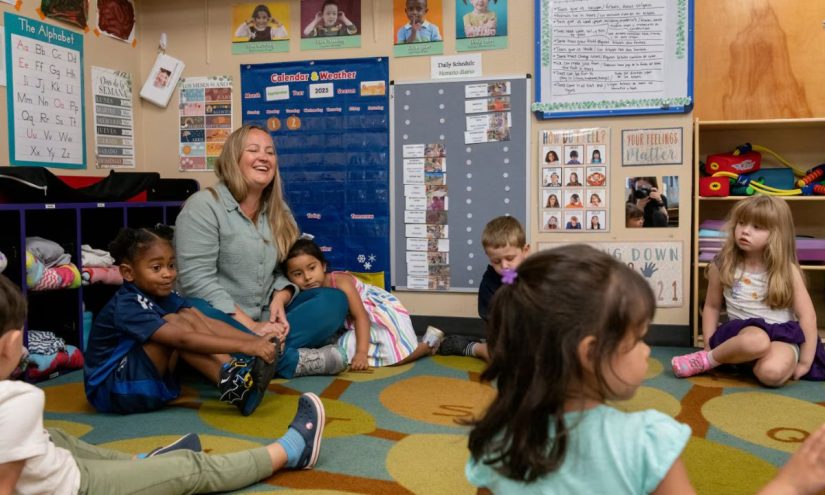
    A morning in Johnson’s classroom makes it easy to see why. She and her co-teacher, an experienced sub named Maria Chavira, are warm, cheerful, and organized. Their young charges are curious, silly, and always in motion.

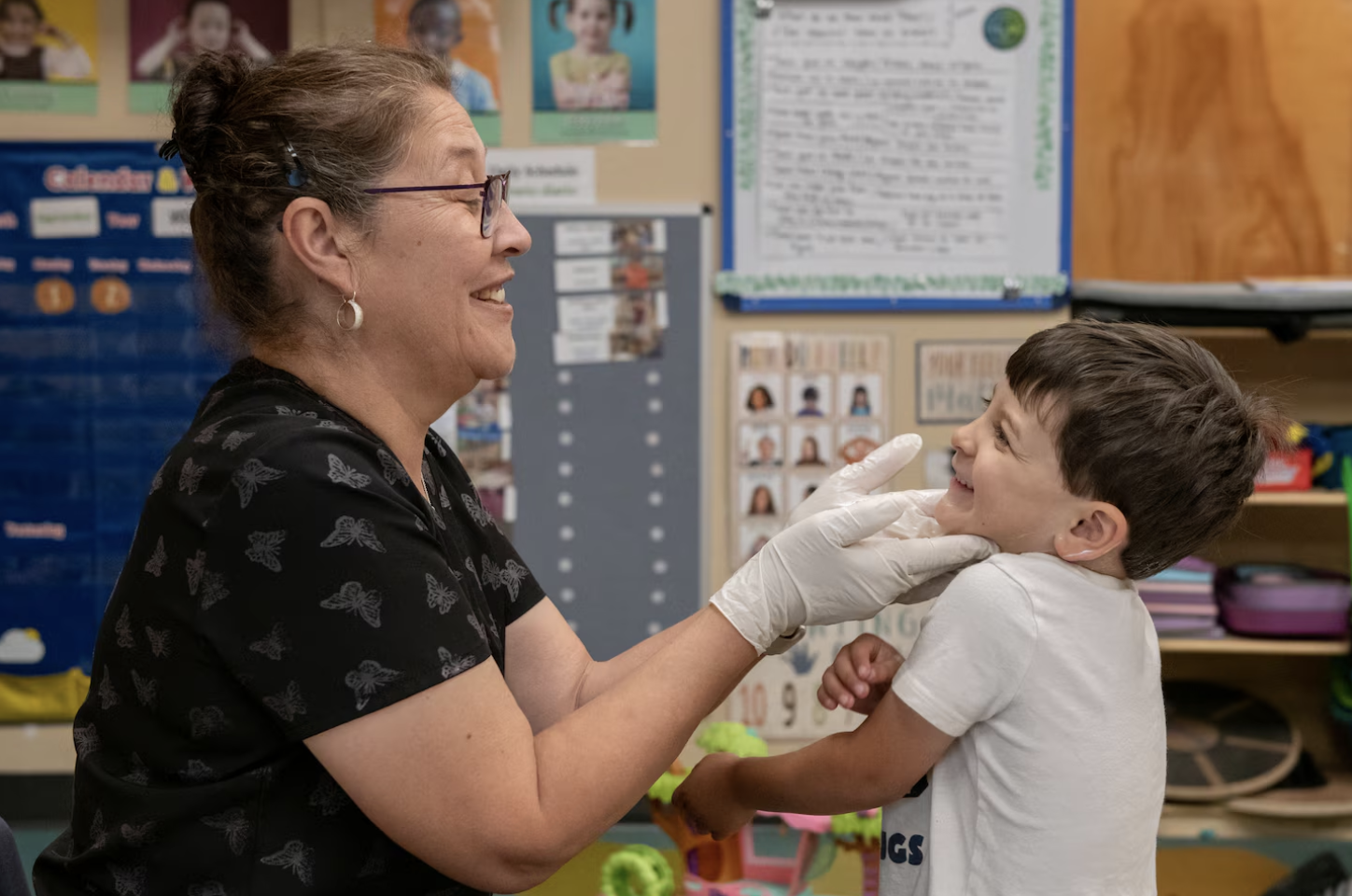
    Maria Chavira, a substitute teacher at the El Nidito child care program in Fort Collins, puts sunscreen on a preschool student before they go outside. (Rachel Woolf for Chalkbeat)

    During breakfast, two boys held bananas up to their ears like phones.

    “Ring, ring, ring. Hi, Henry,” one said as the other burst out laughing.

    Nearby at the sensory table, as one little boy poured dried pinto beans through a cardboard tube, he said, “Did you ever watch ‘Boss Baby?’ The baby is a bossssss. Babies can’t be bosses!”

    Meanwhile, the little boy who’d struggled to leave his mother was getting braver, slowly testing the waters of group play. One minute he crouched next to a little girl in front of a tree house play set. Later, he tried out bear and leopard hand puppets as the Boss Baby skeptic threw Tucker the Turtle up in the air next to him.

    Johnson, who switched from a sales and marketing career to early childhood education in 2007, seems to have a sixth sense for detecting imminent meltdowns, skirmishes, and rule-bending.

    She quickly peeled away from a conversation with a visitor when a little girl dressed in head-to-toe pink accidentally got a squiggle of red marker on her new cowboy boots.

    “Your mom can get that out. The markers are washable,” Johnson said as tears welled in the preschooler’s eyes.

    Then she averted the crisis with five words: “Do you want a hug?”

    Chalkbeat is a nonprofit news site covering educational change in public schools.


    Get stories like these delivered straight to your inbox. Sign up for The 74 Newsletter

    Source link

  • AI can be a great equalizer, but it remains out of reach for millions of Americans; the Universal Service Fund can expand access

    AI can be a great equalizer, but it remains out of reach for millions of Americans; the Universal Service Fund can expand access

    In an age defined by digital transformation, access to reliable, high-speed internet is not a luxury; it is the bedrock of opportunity. It impacts the school classroom, the doctor’s office, the town square and the job market.

    As we stand on the cusp of a workforce revolution driven by the “arrival technology” of artificial intelligence, high-speed internet access has become the critical determinant of our nation’s economic future. Yet, for millions of Americans, this essential connection remains out of reach.

    This digital divide is a persistent crisis that deepens societal inequities, and we must rally around one of the most effective tools we have to combat it: the Universal Service Fund. The USF is a long-standing national commitment built on a foundation of bipartisan support and born from the principle that every American, regardless of their location or income, deserves access to communications services.

    Without this essential program, over 54 million students, 16,000 healthcare providers and 7.5 million high-need subscribers would lose internet service that connects classrooms, rural communities (including their hospitals) and libraries to the internet.

    Related: A lot goes on in classrooms from kindergarten to high school. Keep up with our free weekly newsletter on K-12 education.

    The discussion about the future of USF has reached a critical juncture: Which communities will have access to USF, how it will be funded and whether equitable access to connectivity will continue to be a priority will soon be decided.

    Earlier this year, the Supreme Court found the USF’s infrastructure to be constitutional — and a backbone for access and opportunity in this country. Congress recently took a significant next step by relaunching a bicameral, bipartisan working group devoted to overhauling the fund. Now they are actively seeking input from stakeholders on how to best modernize this vital program for the future, and they need our input.

    I’m urging everyone who cares about digital equity to make their voices heard. The window for our input in support of this vital connectivity infrastructure is open through September 15.

    While Universal Service may appear as only a small fee on our monthly phone bills, its impact is monumental. The fund powers critical programs that form a lifeline for our nation’s most vital institutions and vulnerable populations. The USF helps thousands of schools and libraries obtain affordable internet — including the school I founded in downtown Brooklyn. For students in rural towns, the E-Rate program, funded by the USF, allows access to the same online educational resources as those available to students in major cities. In schools all over the country, the USF helps foster digital literacy, supports coding clubs and enables students to complete homework online.

    By wiring our classrooms and libraries, we are investing in the next generation of innovators.

    The coming waves of technological change — including the widespread adoption of AI — threaten to make the digital divide an unbridgeable economic chasm. Those on the wrong side of this divide experienced profound disadvantages during the pandemic. To get connected, students at my school ended up doing homework in fast-food parking lots. Entire communities lost vital connections to knowledge and opportunity when libraries closed.

    But that was just a preview of the digital struggle. This time, we have to fight to protect the future of this investment in our nation’s vital infrastructure to ensure that the rising wave of AI jobs, opportunities and tools is accessible to all.

    AI is rapidly becoming a fundamental tool for the American workforce and in the classroom. AI tools require robust bandwidth to process data, connect to cloud platforms and function effectively.

    The student of tomorrow will rely on AI as a personalized tutor that enhances teacher-led classroom instruction, explains complex concepts and supports their homework. AI will also power the future of work for farmers, mechanics and engineers.

    Related: Getting kids online by making internet affordable

    Without access to AI, entire communities and segments of the workforce will be locked out. We will create a new class of “AI have-nots,” unable to leverage the technology designed to propel our economy forward.

    The ability to participate in this new economy, to upskill and reskill for the jobs of tomorrow, is entirely dependent on the one thing the USF is designed to provide: reliable connectivity.

    The USF is also critical for rural health care by supporting providers’ internet access and making telehealth available in many communities. It makes internet service affordable for low-income households through its Lifeline program and the Connect America Fund, which promotes the construction of broadband infrastructure in rural areas.

    The USF is more than a funding mechanism; it is a statement of our values and a strategic economic necessity. It reflects our collective agreement that a child’s future shouldn’t be limited by their school’s internet connection, that a patient’s health outcome shouldn’t depend on their zip code and that every American worker deserves the ability to harness new technology for their career.

    With Congress actively debating the future of the fund, now is the time to rally. We must engage in this process, call on our policymakers to champion a modernized and sustainably funded USF and recognize it not as a cost, but as an essential investment in a prosperous, competitive and flourishing America.

    Erin Mote is the CEO and founder of InnovateEDU, a nonprofit that aims to catalyze education transformation by bridging gaps in data, policy, practice and research.

    Contact the opinion editor at [email protected].

    This story about the Universal Service Fund was produced by The Hechinger Report, a nonprofit, independent news organization focused on inequality and innovation in education. Sign up for Hechinger’s weekly newsletter.

    The Hechinger Report provides in-depth, fact-based, unbiased reporting on education that is free to all readers. But that doesn’t mean it’s free to produce. Our work keeps educators and the public informed about pressing issues at schools and on campuses throughout the country. We tell the whole story, even when the details are inconvenient. Help us keep doing that.

    Join us today.

    Source link

  • Agency Information Collection Activities; Submission to the Office of Management and Budget for Review and Approval; Comment Request; Borrower Defense to Loan Repayment Universal Forms

    Agency Information Collection Activities; Submission to the Office of Management and Budget for Review and Approval; Comment Request; Borrower Defense to Loan Repayment Universal Forms

    A Notice by the Education Department on 05/19/2025

    Department of Education[Docket No.: ED-2025-SCC-0002]

    AGENCY:

    Federal Student Aid (FSA), Department of Education (ED).

    ACTION:

    Notice.

    SUMMARY:

    In accordance with the Paperwork Reduction Act (PRA) of 1995, the Department is proposing a revision of a currently approved information collection request (ICR).

    DATES:

    Interested persons are invited to submit comments on or before June 18, 2025.

    ADDRESSES:

    Written comments and recommendations for proposed information collection requests should be submitted within 30 days of publication of this notice. Click on this link www.reginfo.gov/​public/​do/​PRAMain to access the site. Find this information collection request (ICR) by selecting “Department of Education” under “Currently Under Review,” then check the “Only Show ICR for Public Comment” checkbox. Reginfo.gov provides two links to view documents related to this information collection request. Information collection forms and instructions may be found by clicking on the “View Information Collection (IC) List” link. Supporting statements and other supporting documentation may be found by clicking on the “View Supporting Statement and Other Documents” link.

    FOR FURTHER INFORMATION CONTACT:

    For specific questions related to collection activities, please contact Carolyn Rose, 202-453-5967.

    SUPPLEMENTARY INFORMATION:

    The Department is especially interested in public comment addressing the following issues: (1) is this collection necessary to the proper functions of the Department; (2) will this information be processed and used in a timely manner; (3) is the estimate of burden accurate; (4) how might the Department enhance the quality, utility, and clarity of the information to be collected; and (5) how might the Department minimize the burden of this collection on the respondents, including through the use of information technology. Please note that written comments received in response to this notice will be considered public records.

    Title of Collection: Borrower Defense to Loan Repayment Universal Forms.

    OMB Control Number: 1845-0163.

    Type of Review: A revision of a currently approved ICR.

    Respondents/Affected Public: Individuals and Households.

    Total Estimated Number of Annual Responses: 83,750.

    Total Estimated Number of Annual Burden Hours: 217,750.

    Abstract: On April 4, 2024 the U.S. Court of Appeals of the Fifth Circuit granted a preliminary injunction against 34 CFR 685.400 et seq. (“2023 Regulation”) enjoining the rule and postponing the effective date of the regular pending final judgment in the case. The current Borrower Defense to Repayment application and related Request for Reconsideration are drafted to conform to the enjoined provisions of the 2023 Regulation. This request is to revise the currently approved information collection 1845-0163 to comply with the regulatory requirements of the borrower defense regulations that are still in effect, 34 CFR 685.206(e) (“2020 Regulation”), 34 CFR 685.222 (“2016 Regulation”), and 34 CFR 685.206(c) (“1995 Regulation”) (together, the “current regulations”). These regulatory requirements are distinct from the 2023 Regulation’s provisions. The revision is part of contingency planning in case the 2023 Regulation is permanently struck down. The Department of Education (“the Department”) is attaching an updated Borrower Defense Application and application for Request for Reconsideration. The forms will be available in paper and electronic forms on studentaid.gov and will provide borrowers with an easily accessible and clear method to provide the information necessary for the Department to review and process claim applications. Also, under the current regulations, the Department will no longer require a group application nor group reconsideration application.

    Dated: May 13, 2025.

    Brian Fu,

    Program and Management Analyst, Office of Planning, Evaluation and Policy Development.

    [FR Doc. 2025-08857 Filed 5-16-25; 8:45 am]

    BILLING CODE 4000-01-P
    Published Document: 2025-08857 (90 FR 21296)

    Source link

  • How a Republican Plan to Cut Universal Free School Meals Could Affect 12 Million Students – The 74

    How a Republican Plan to Cut Universal Free School Meals Could Affect 12 Million Students – The 74


    Get stories like this delivered straight to your inbox. Sign up for The 74 Newsletter

    Every school in Kentucky’s LaRue County provides free breakfast and lunch to any student who wants it.

    It’s been that way for a decade, ever since the federal government launched a program allowing LaRue County Schools, and thousands of other districts nationwide, to skip the paperwork asking how much families earn.

    In these communities, lots of kids already receive other kinds of assistance for low-income families. Federal officials saw a way to make the subsidized meals program more efficient: Cover meal costs based on how many children are in similar assistance programs, rather than verify every family’s income.

    But LaRue County Schools won’t be able to do that anymore if sweeping changes to social programs proposed by congressional Republicans become law. GOP lawmakers say they want to ensure only eligible families get help and that taxpayer dollars are reserved for the neediest students, so that federal subsidies for school meals remain sustainable. But by one estimate, the Republicans’ plan would affect nearly a quarter of the students in the nation’s public schools.

    Research has found that universal free school meals can boost school attendance, increase test scores, and decrease suspensions, likely because it eliminates the stigma students often associate with the free meals. Taking them away from students on a large scale could also have downstream effects on everything from families’ household budgets to local unemployment.

    Stephanie Utley, the LaRue County district’s director of child nutrition, said that inevitably, fewer kids would eat school meals, either because their families no longer qualify for free breakfast and lunch or because they cannot produce documents to verify their income.

    When fewer kids eat school meals, it’s harder for districts to cover their costs. To save money, Utley would likely swap higher-quality foods for cheaper ones, she said.

    Apples and beef from local farms would go. The high school would serve fewer salads — they’d be too labor-intensive to prep. And a popular chicken breast sandwich would become a ground chicken patty.

    Utley may have to lay off staff, too, she said, which would hurt the rural community’s economy.

    “We’re the biggest restaurant in town,” she said. “It would be a nightmare.”

    GOP school meals proposals would impact states

    Republican lawmakers are considering a trio of proposals to help offset tax cuts sought by President Donald Trump that would be “devastating” to children and schools, said Erin Hysom, the senior child nutrition policy analyst for the nonprofit Food Research & Action Center.

    One proposal would dramatically increase the share of students who need to be enrolled in aid programs — such as the Supplemental Nutrition Assistance Program and Temporary Assistance for Needy Families — for schools to be eligible to serve free meals to all kids through the Community Eligibility Provision.

    Right now, schools need to show 25% of students are enrolled in those kinds of assistance programs to participate in community eligibility. The House Republican proposal would raise the share to 60% — higher than the threshold has ever been. That would kick more than 24,000 schools off of community eligibility, and some 12 million students would no longer automatically qualify for free meals, Hysom’s organization estimated.

    Essentially, only communities where nearly every child qualifies for free or reduced-price lunch could serve free meals to all kids.

    “They’ve really moved the needle to the upper echelon of poverty,” Hysom said. “You couldn’t get any higher than that.”

    Another proposal would require all families who don’t automatically qualify for free school meals through programs like SNAP to submit documents to verify their income with their application. That would burden families and schools with time-consuming added paperwork. Schools could end up cutting staff who serve food and work on school menus to hire more people to process applications.

    Together, those changes would save $12 billion over 10 years, according to the list of proposals circulated by U.S. Rep. Jodey Arrington, the Republican chair of the House budget committee.

    A third proposal would change how families qualify for SNAP and likely make over 1 million students no longer automatically eligible for free school meals. That would increase the paperwork burden even more.

    All of that would make it more costly for states with universal free school meals to run their programs, because they rely heavily on federal reimbursement. Some states were already weighing whether they could afford to keep up free meals for all.

    These three proposals are part of a process known as budget reconciliation that GOP lawmakers are using to make long-term changes to federal spending and revenue. As of Wednesday, Congress was considering a separate, stopgap budget that would keep funding essentially flat for the Agriculture Department, which pays for the school meal program, through the end of September.

    School staff and child nutrition advocates are taking the House’s budget reconciliation proposals seriously. The Trump administration has already cut a $1 billion Agriculture Department program that helped schools buy food from local producers.

    Free school meal cutbacks would have ripple effects

    If fewer kids have access to free meals at school, more families would likely struggle to afford groceries at home. Many families who don’t qualify for free meals struggle to pay for food. This school year, a family of four qualified for free school meals if they made under $40,560 a year.

    When schools eliminated free school meals for all following the pandemic, there was a surge in unpaid school meal debt, an issue school staff say will only intensify if these proposals go through.

    Right now, schools typically have to verify the family’s income for 3% of their applications. If schools had to check income for every application, the burden would be enormous, school staff and child nutrition advocates said.

    Many families who eke out a living working multiple jobs would have a hard time gathering up all the required documents to show how much they earn. Though children can participate in the school meals program regardless of their immigration status, undocumented parents may be afraid to hand over personal documents when Trump is threatening mass deportations.

    “Eligible children are going to fall through the cracks,” Hysom said.

    Many schools are already facing financial pressures from higher-than-usual food and labor costs, a 2024 survey of nearly 1,400 school nutrition directors showed. On top of that, schools are navigating new and stricter requirements for how much salt and sugar can be in food served by schools.

    Schools have to buy most of their food from American sources, but if Trump puts certain tariffs in place for the long term, that could create new financial constraints.

    “Cost is absolutely a concern,” said Diane Pratt-Heavner, a spokesperson for the School Nutrition Association, which represents school nutrition directors and conducted the survey. “When avocados or tomatoes from Mexico become much more expensive, that will cause an increase in demand for domestic produce, and an increase in price, as well.”

    Shannon Gleave, the president of the School Nutrition Association, understands the need to make sure the school meal program runs as it should.

    In Arizona’s Glendale Elementary School District, where Gleave is the director of food and nutrition, kids can speed through the lunch line because everyone qualifies for free meals. But staff scan student ID badges to make sure each kid only takes one meal, and that children with dietary restrictions get the right food.

    Upping the verification requirements a little could work, she said. But verifying 100% of applications “is not an efficient use of time.”

    “There is no way my existing staff could do that now,” she said. “You have to figure out a way to be good stewards of resources, but also look at the amount of administrative burden that it’s going to entail.”

    This story was originally published by Chalkbeat. Chalkbeat is a nonprofit news site covering educational change in public schools. Sign up for their newsletters at ckbe.at/newsletters.


    Get stories like these delivered straight to your inbox. Sign up for The 74 Newsletter

    Source link

  • The universal language of football

    The universal language of football

    We were split into two teams scrimmaging against each other. The boys I play with are competitive so there was the usual light trash talking, jersey pulling and agile foot skills. 

    We were playing friendly rules with no corner kicks. My teammate, Gugu, was fouled in the makeshift goalie box and dramatically fell to the ground yelling for a penalty kick. 

    None of us expected the coach to listen to him, but surprisingly he gave it to our team on the condition that I take the kick. All the players lined up around the box as I prepared to shoot, choosing to aim for the bottom right corner. 

    Two things you should know: First this is in Italy and I’m an American teenager who speaks little Italian. Second, I’m the only girl on the team.

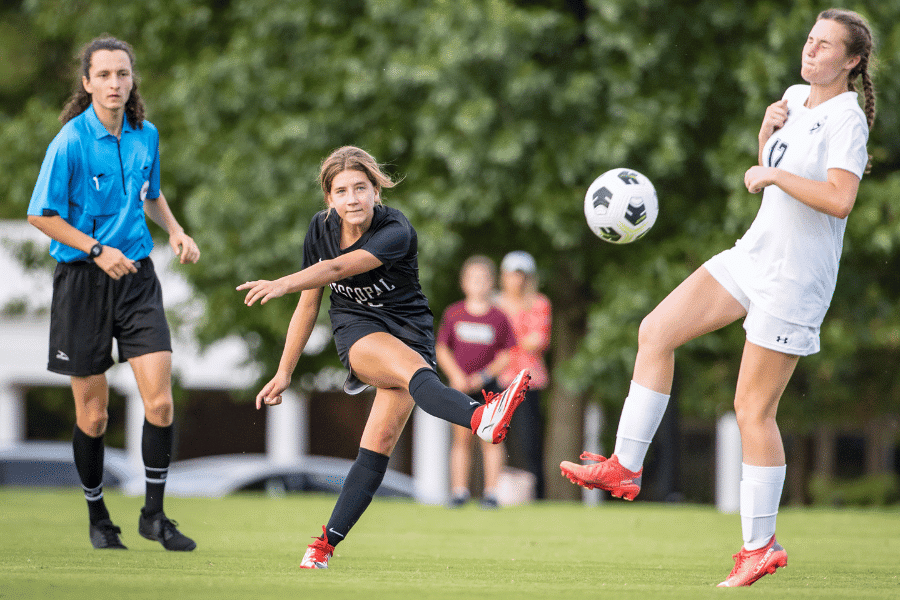
    The coach blew the whistle. I confidently ran, kicking the ball with all my strength. It went soaring over the crossbar into the fence behind. I wanted to crawl into a hole and hide. 

    A lifelong love of sports

    Sports have been a part of my life for as long as I can remember. As soon as I learned to walk, my parents introduced me to swimming (after all, 71% of earth’s surface is water). They had me learn tennis to hone my hand-eye coordination, ballet to cultivate “grace” and finally soccer to channel my boundless energy. 

    Ballet was the first to go. I was asked to leave for being too much of a distraction (it’s not my fault the class was boring and repetitive). Swimming followed when the early practices and relentless cycle of toxic comparison drained it of joy. Tennis, while never officially abandoned, became more of a casual hobby, a skill I maintained with occasional matches. 

    But soccer? Soccer was different. It endured. Not just for me, but for my siblings as well. My older brother and younger siblings all share a similar love for the sport.

    My football career began at six years old with my recreational team, Purple Thunder, where the post-game refreshments — orange slices and chocolate milk — mattered more than the outcome of the game. 

    Next came Academy, where I was paired with a “special buddy” (one of the older kids) to help me focus and follow directions. By eight, I advanced to the competitive world of travel soccer — a commitment that has defined half of my life. Over the past eight years, I’ve played on various teams, with different coaches, in several leagues and have witnessed the growing intensity of competition as more pressure is placed on each player.

    Soccer bridges divides across borders.

    Soccer has taken me across the country and around the world. I’ve played soccer in Denmark, Sweden and Germany against local girls’ teams in those countries. Soccer is now a cornerstone of my identity.

    When the external factors of my life changed as I grew and I matured, soccer remained the one constant. 

    During the pandemic, I found solace in dribbling by myself in my basement and backyard. When I moved to boarding school, leaving behind my family and home, my high school soccer team became my anchor. 

    Despite all the stress I endured through these changes, my love for the game only deepened as I experienced the unique camaraderie of a team composed of players from all over the world, united by our shared passion for soccer and desire to win. 

    I cried when my favorite coach left for another job, cried again, then confronted a different coach who left me off the roster for games. I cried when a teammate lost her brother. 

    Sports transcends the field.

    Soccer is more than a game. It’s an art, an outlet. And a team is more than just a group of players: it’s a community, a support system that celebrates your successes and lifts you up when you fall. In those eight years, I believed I had encountered every type of soccer environment imaginable — until I arrived in Italy. 

    So I could play here, the extracurricular coordinator at my study abroad school called on Gianni, a host parent who works for the local soccer club, Viterbese. 

    Equal parts nervous and excited, I met Gianni and told him about my soccer experience — travel for eight years, high school varsity for two — and what I’m looking for — consistent, high level practices to keep me in shape. 

    He suggests two teams I could play with, but both are boys’ teams, and I choose one. We decide I will go to the team’s practice on Monday and he even offers me a ride. 

    The second he leaves, my spiraling begins as my brain conjures up all the worst possible scenarios. Monday arrives and I can’t decide whether to be filled with dread or excited to finally play. 

    At the field, the boys are already huddled with the coach. Now I’ll stand out even more. I get my cleats on and join the circle, suffering through an awkward introduction with the coach, then we begin.

    It’s been four months now since that moment, and I’ve gone to every practice I could. I was nervous at first, especially after Gianni stopped coming and I was left to navigate it on my own. But during the drills on the first day, I quickly realized I’d been overthinking it. They weren’t a team of young Messis and Ronaldos, just regular teenage boys. 

    There are many ways to communicate.

    While I’d played against teams that didn’t speak English before, practicing alongside them and becoming part of their team was an entirely new experience. 

    Learning a new language is a year-long journey, and I take it one day at a time. So while I’ve built up a solid repertoire of Italian words and calcio (soccer) vocabulary, I’ve discovered other ways to communicate — through the game itself.

    Words aren’t always necessary to understand my teammates’ personalities. I can learn plenty from how they play. Whether they prefer to dribble or pass, take the shot or let someone else score, arrive early to practice, talk over the coach, yell at teammates or tug on someone’s jersey, these small choices on the field speak volumes about a person’s true character. 

    Playing soccer here has been living proof that actions truly speak louder than words and that sports have a unique ability to connect people. As a 16-year-old girl from Northern Virginia, I’ve formed a connection with 15-year-old Italian boys from a small city north of Rome. 

    It’s also a reminder that no matter how experienced or “well-versed” you think you are in a passion, there are always more opportunities to grow — if you’re willing to take the leap. I’ve embarrassed myself countless times, as I did trying to make that penalty shot after Gugu was fouled. I’ve lost the ball, missed shots, stumbled over Italian. I once even forgot my cleats. 

    But despite the awkward moments, I wouldn’t trade this experience for anything.


    Three questions to consider:

    1. How did the author manage to communicate with her teammates without knowing the language they spoke?
    2. What does the author mean by soccer being more than a sport?
    3. What sport or hobby are you passionate about and are there people who share that passion?


    Source link

  • The Ultimate Guide to Universal Design for Learning

    The Ultimate Guide to Universal Design for Learning

    Universal Design for Learning (UDL) is a framework that involves using a variety of teaching methods to respond to the needs of all your higher ed students. It is a teaching technique that provides flexibility in how instructional materials are delivered—and is ideal for supporting students of all backgrounds, cultures and abilities.

    Table of contents

    1. What is Universal Design for Learning?
    2. What are the three core tenets of Universal Design for Learning?
    3. Why should you use universal design in your online course?
    4. How can you apply universal design in your online course?
    5. Universal Design for Learning examples
    6. Questions to ask yourself when designing an accessible course
    7. The history of Universal Design for Learning
    8. Bring UDL to life with Top Hat
    9. References

    1. What is Universal Design for Learning?

    Universal Design for Learning (UDL) helps college and university educators create flexible programs that are easy to adapt to the unique needs of all students. This teaching framework involves using many techniques—in everything from course delivery to media use—to reduce barriers and reach every college student.1

    UDL guidelines are put into practice in a variety of facets, including outside of academia. For instance, you may use closed captioning when watching television. Your smartphone can read the information on a website aloud. Meanwhile, automatic doors make grocery stores more accessible. In these three scenarios, UDL helps level the playing field for everyone, regardless of ability.

    The UDL guidelines are presented as a graphic organizer, or a matrix table. Vertically, the principles are grouped under engagement, representation, and action and expression. Horizontally, the UDL principles are presented as access, build and internalize. Each guideline has corresponding checkpoints that include best practices. The graphic organizer helps viewers understand how criteria differ across the three principles. View the table below for a breakdown of the UDL guidelines.

    Provide multiple means of engagement Provide multiple means of representation Provide multiple means of action and expression
    Recruiting interest Perception Physical action
    Sustaining effort and persistence Language and symbols Expression and communication
    Self-regulation Comprehension Executive function

    2. What are the three core tenets of Universal Design for Learning?2

    • Action and expression: This learning approach involves giving students multiple ways to access information. Universal Design for Learning examples include giving students multiple ways to demonstrate that they’ve learned the material.
    • Representation: A key tenet of this approach is providing information in multiple formats. Universal Design for Learning examples include offering students videos, books or interactive demos that cover the material covered in a lecture. Students can then choose the format that best suits their needs.
    • Engagement: This approach is designed to motivate college students in a variety of ways. Universal Design for Learning examples include assigning projects that relate to a student’s background and interests. This pillar may be put into practice through gamification or discussions.

    2.1. Multiple means of action and expression

    This topic covers the ‘how’ of learning. It is also referred to as the strategic network. Each learner navigates the classroom in a different way, and they also express themselves uniquely. If someone has an executive function disorder, meaning they have trouble planning, organizing and problem solving, they will express themselves differently than someone who has a language barrier. For example, some postsecondary students are able to use written communication with ease, while others can only communicate through speech.

    2.1.1. Executive functions

    Executive functions encapsulate a human being’s highest level of skills. This ability allows learners to overcome their impulses to make long-term goals and strategies. Executive functions are limited by the individual’s working memory when executive functioning capacity is devoted to managing “lower level” skills that don’t come as naturally to a person. The individual’s capacity for executive functions can also be lowered by disabilities.

    With universal design for learning, instructors can expand a learner’s executive function by scaffolding—that is breaking up lessons into bite-sized pieces—to ensure they do not use up the learner’s working memory. Educators can help students scaffold executive skills so that they can use them more effectively. Setting goals and creating plans to reach these goals can help. Professors can also support students by helping them self-monitor their progress over time, which helps students guide their practice through the semester. It also helps learners better understand what advice to ask their instructors for.3

    2.1.2. Expression and communication

    Every learner has a different capacity for expression and communication. In addition, various types of media may support different learning styles. For example, a learner who has dyslexia may perform better at expressing their thoughts through verbal conversations versus written essays.

    Educators must provide different modalities for communication. This may involve using various types of media or tools for communication. Professors can help students become more fluent in a variety of communication modalities, which will then lend to independent learning.4

    2.1.3. Physical action

    Interactive software, textbooks and other curricular materials are recognized as Universal Design for Learning examples that can help students understand information. For instance, a postsecondary student may need a different type of workbook if they require assistive technology. These assistive technologies can help students who have disabilities. Some students could benefit from having expanded keyboards or voice-activated switches, for example.5

    With this tenet of UDL, it’s important to vary the methods for response and navigation. This involves creating an accessible learning environment that all students can thrive in. The second part of this UDL principle involves opening doors to the tools that will create equal opportunity.

    2.2. Multiple means of representation

    This topic can be considered the ‘what’ of learning. It’s also referred to as the recognition network. Every learner absorbs the information that is presented to them in a different way. While a sensory or learning disability may cause this difference, cultural differences and different personalities may also affect how the student learns.

    2.2.1. Comprehension

    The goal of education is to help learners turn information into knowledge that they can apply in their everyday lives. With Universal Design for Learning, educators should get higher ed students involved in transforming and gathering usable knowledge. Gaining usable knowledge is an active process, so students need to be involved in order for this process to work. This means students need to use skills like consumption, categorization and active memorization. They must also learn how to integrate new knowledge with their prior understanding of the subject. The best Universal Design for Learning example here involves relying on organizers such as concept maps to help students visually draw connections between learning units. Metaphors, stories and analogies are also effective in helping students see the importance and relevance of topics.

    To achieve these goals, instructors must present information in an accessible way. They should connect the information to previous experiences and offer background information as well. They can highlight relationships, patterns and information so that students can see how the information relates to their goals and other knowledge. Through breaking up lessons into digestible amounts, professors can support students as learners find meaning in their new knowledge and process the information. Finally, educators can help students apply information to new contexts.6

    2.2.2. Language, mathematical expressions and symbols

    Students interpret linguistic and non-linguistic symbols in different ways. While symbols like division signs provide clarity for some students, others do not understand specific symbols. Likewise, college students attribute different meanings to pictures or words based on their familial backgrounds and culture.

    Because of this, educators must provide alternative representations for students. They should clarify different symbols, vocabulary, mathematical notations and syntax. If there is a pattern in different equations, grammar or musical notations, they should be explicit about it. When necessary, instructors should use translations, graphics, movement, activities, simulations, images and videos to make learning active.7 Try pairing a chemistry formula with an illustration or simulation to put this principle into practice.

    2.2.3. Perception

    Provide the same information through formats that stimulate different senses—ranging from sight, hearing or touch—to make lessons perceptible to learners. This practice will help students absorb information through audio, tactile or visual means. Instructors should also give students formats that can be adjusted such as text that can be increased in size. Other examples of perception include offering alternatives for video and auditory information.8 Such examples are providing videos featuring American Sign Language (ASL) and complementing audio clips with transcripts.

    2.3. Multiple means of engagement

    Providing multiple means of engagement can be thought of as the ‘why’ of learning. It’s also referred to as the affective network. Every college student is motivated in a different way academically. Likewise, students have different learning styles. While some love spontaneity, others will only feel comfortable when there is a daily routine followed in the classroom. Additionally, some prefer to work alone or in groups.

    2.3.1. Self-regulation

    Ideally, the learning environment should support and encourage the student’s motivation. When students are in higher education, they should be encouraged to learn how to regulate their own emotions and become self-motivated. By regulating their emotions, students can better cope with changes in their environment. A Universal Design for Learning example includes asking students how they’re feeling today on a scale of 1-5 to understand their needs and any accommodations.

    Postsecondary students frequently learn how to self-regulate by observing their professors. Virtual classrooms can encourage this skill by modeling motivation and self-regulation. Then, educators can prompt students to use these abilities in real life. Instructors should discuss their expectations and help students set personal goals. They can support students as they self-assess their abilities and become more aware of their mistakes. Over time, students can learn how to develop healthy emotional responses to a variety of events.9

    2.3.2. Sustaining effort and persistence

    In order for a student to learn, they must make an effort to pay attention in class. If a student is motivated correctly, they can focus and make a sustained effort in the classroom. Each learner self-regulates in a different way, and these disparities are often due to their motivation levels. Other factors like contextual interference—a disruption in the motor learning phenomenon that affects how people learn and practice new skills—and self-regulation skills can also impact the student’s concentration. This is caused in part by the learner not seeing the value of certain goals and objectives.

    Educators can support students by providing different resources to help them learn. Students are more likely to rise to the expectations set to them, so teachers should provide the tools that students need to succeed and help them achieve a certain level of understanding. When introducing goals, instructors should also discuss why each goal matters—put into practice through detailed criteria—so that students feel motivated to achieve each objective.10

    2.3.3. Recruiting interest

    If the information does not engage the student’s interest, it is essentially inaccessible. Students must be able to absorb and process information in their minds. Each student is interested in different topics of discussion, so teachers must figure out how to gauge their interest in different ways.

    Instructors can attract the student’s interest by providing multiple choices whenever it is possible to do so. By allowing for individual choices and autonomy, educators can empower students to take control of their learning. Teachers should also connect the subject matter to experiences outside of the classroom. If university students believe the subject matter has value, they are more likely to be interested in learning it. Finally, teachers should attempt to eliminate distractions so that students have a safe space to learn new information.11

    3. Why should you use universal design in your online course?

    When using the UDL framework in an online course, you create equal opportunity for students of different backgrounds and abilities to learn the course material. If you are only teaching students in one specific way, many of your students may not be learning the information properly. Universal Design for Learning can help you make your course accessible to all types of learners.

    When using the UDL framework in an online course, you create equal opportunity for students of different backgrounds and abilities to learn the course material.

    4. How can you apply universal design in your online course?

    When using the principles of UDL in your online course, consider the course’s engagement, representation, action and expression goals. Here are four ways to put Universal Design for Learning examples to use in your class.

    4.1. Syllabus

    Your course syllabus shows college students what they will be learning in the upcoming quarter. It should give students multiple ways to engage with the content, such as through class readings, podcasts, webinars and guest lectures. The syllabus can communicate regular routines, assessment formats and expectations. It should also include the ways that students can access the course content. Consider adding headers and subheadings in your syllabus to make it accessible for screen readers. Download Top Hat’s syllabus template now, available in either Google Docs or Word format.

    4.2. Course materials

    To follow the principles of universal design, you should select an array of course materials. Instead of only using a textbook, your course can incorporate podcasts, discussion boards, essays, videos and physical activities. By changing the way students can absorb information, you can make the course information accessible to every student.

    4.3. Assessment

    While some students can take a written test without any issues, others have trouble reading written tests or turning them in. In the realm of assessment, Universal Design for Learning examples might include using video conferencing software to measure student understanding. Depending on the coursework, you could also use assessment techniques like recorded videos.

    4.4. Teaching

    In order to make your course more accessible, vary the way you teach your course. Images, graphs and textbooks are effective in helping students understand information. Some students learn better through audio tracks, so you may want to use a recorded lecture, video or podcast as well. In addition, you can teach students through discussion groups and other techniques as well.

    Top Hat’s Student Engagement toolkit is packed with templates and strategies to create accessible assessments, lesson plans and classroom discussions. Access now.

    5. Universal Design for Learning examples

    The following list includes Universal Design for Learning examples that you can use to create an equitable and accessible learning environment. You can also create other feedback, assignment and learning options that help diverse learners master the course material in your class.

    5.1. Assignment options

    Students can achieve the course’s learning objectives through a variety of assignment styles. Beyond traditional homework, students can also submit video recordings of a presentation or speech. They can alternatively create comic strips or podcasts. Another Universal Design for Learning example involves flexible assignment due dates. This policy accommodates students who may have obligations outside of class, such as work or family responsibilities, or who may need additional time due to disabilities or health issues.

    5.2. Regular feedback

    In order for students to improve, they must regularly receive detailed feedback. Formative assessments can help with this goal, where the student’s ongoing learning is monitored. These assessments also provide feedback that educators can use to improve their course delivery.

    5.3. Digital and audio text

    Textbooks are just one way that university students can learn. Audiobooks and text-to-speech programs can also help. In addition, you can use audio transcripts and videos with closed captions for students who require assistive technologies. Professors can use multiple modes of communication to convey information, including verbal instructions, written handouts, visual aids, and online resources. These specific Universal Design for Learning examples help students with diverse language abilities, learning styles, and sensory preferences to comprehend the material effectively.

    6. Questions to ask when designing an accessible course

    6.1. Multiple means of engagement

    1. Does the course encourage independent student responsibilities? In order for college students to learn, they have to be motivated and engaged. When students work independently on coursework, they feel responsible for the outcome. They also become more engaged in studying the material. Consider facilitating surveys or a student interest inventory at the start of the semester to gauge interests, hobbies and strengths. You can then use this information to tailor units of study accordingly.
    2. Can students complete at least some course content at their own pace and in any order they wish? Everyone learns at a different pace. When the course moves too quickly, students can fall behind. Over time, this can cause students to lose motivation. Letting students learn at their own pace in a blended or online course acknowledges their unique circumstances and provides them with the time they need to engage with the course material. Consider implementing an assignment ‘grace period’ to allow students to plan their schedules accordingly based on priorities.
    3. Are course learning goals and outcomes clear? When students are confused or lost, it is impossible for them to become engaged in the course material. You can remove this obstacle by clarifying your learning goals. When students know what to expect and what they need to do, they are more likely to achieve the course’s goals.

    6.2. Multiple means of representation

    1. Is the course content provided in multiple ways? With Universal Design for Learning, the goal is to help postsecondary students from all backgrounds and abilities. Students may have visual or aural impairments or have a disability. They may also come from a culture where subject matter is taught differently. Ideally, your course content should be provided through multiple techniques so that everyone has an equal opportunity to learn. Universal Design for Learning examples include complementing course readings with interviews or videos.
    2. Do learning opportunities and assignments use students’ prior knowledge? You can help students retain information by connecting it to their prior knowledge. You can show how new information relates to a previous class or personal experience. Sometimes, you can even assign students the task of reflecting on everything they have learned and how the new topics related to their personal experiences.
    3. Does the course have interactive learning activities online? If you are teaching online, ensure you have multiple ways to get students involved. Interactive activities help students feel like active participants in the learning process. Because students are more likely to learn when they are actively involved, this technique is extremely important for online learners. It ensures that students are just as motivated in their studies, even from a distance. Complement lectures or readings with simulations or other opportunities for students to apply their knowledge.

    6.3. Multiple means of action and expression

    1. Have you provided students with note taking support? There are many different disabilities that can make it difficult for students to take notes. To help your students, offer them multiple ways to take notes in class. They can use videos, audio recordings or written techniques to recall information. Some students may also benefit from making graphs or drawings of the new course material.
    2. Does the course include a variety of assessment methods? While some students can take written tests, this is not the best way to assess every student. Universal Design for Learning examples that support a flexible assessment strategy include video interviews, recordings, posters and other techniques. If you use written tests, you may need to offer support such as audio recordings of the questions and answers. Balance summative assessments with low stake formative assessments that enable students to receive more regular and timely feedback.
    3. Are college students encouraged to communicate with faculty and classmates in the course? Open communication between faculty and students—and especially on the student-student level—helps many learn and absorb new information. Ideally, instructors should offer multiple ways for students to communicate with their classmates and teachers. Universal Design for Learning examples could include using online forums, video conferences, interviews or essay feedback to host conversations with students.

    Our Teaching with Top Hat Toolkit offers videos and helpful resources to design an accessible learning community in our platform. Browse the toolkit today.

    7. The history of Universal Design for Learning

    Originally, this technique started out as an architectural concept. In architecture, universal design refers to creating designs that appeal to everyone. These designs must also comply with the Americans with Disabilities Act (ADA). Because of the ADA, many schools began using inclusive facilities and providing equal access to their courses. Originally, the idea of universal design in architecture was created by architect Ron Mace at North Carolina State University.

    In 1984, the Center for Applied Special Technology (CAST) was formed. CAST applied the original universal design guidelines to the educational space as a means of facilitating reform. Today, the CAST website houses plenty of instructional design tips and professional development strategies to make the postsecondary education experience more accessible.12

    8. Bring UDL to life with Top Hat

    Top Hat’s feature suite ensures your students have access to an equitable learning environment. Postsecondary students are able to learn from anywhere—the platform’s offline mode still lets students complete their homework assignments, even without having an Internet connection. Similarly, students can use multiple devices to engage with content stored in Top Hat. Top Hat is compatible with assistive technologies such as screen readers, plus keyboard navigation makes it simple to navigate through content.

    Outside of class time, alternative text on images in textbook readings helps students using screen readers understand the visuals alongside the text. Instructors can personalize the learning experience for individual students by customizing assignment due dates and grade weights. This ensures students have multiple ways to express their knowledge—and at a time that suits them.

    Top Hat’s accessibility features create a level playing field in your course. Learn more about what Top Hat can do for your students here.

    9. References

    • Morin, A. (n.d.). What is Universal Design for Learning (UDL)? Understood. https://www.understood.org/en/learning-thinking-differences/treatments-approaches/educational-strategies/universal-design-for-learning-what-it-is-and-how-it-works
    • CAST. (n.d.). The UDL Guidelines. http://udlguidelines.cast.org/
    • CAST. (n.d.). Executive Functions. http://udlguidelines.cast.org/action-expression/executive-functions/executive-functions
    • CAST. (n.d.). Expression & Communication. http://udlguidelines.cast.org/action-expression/expression-communication
    • CAST. (n.d.). Physical Action. http://udlguidelines.cast.org/action-expression/physical-action
    • CAST. (n.d.). Comprehension. http://udlguidelines.cast.org/representation/comprehension
    • CAST. (n.d.). Language & Symbols. http://udlguidelines.cast.org/representation/language-symbols
    • CAST. (n.d.). Perception. http://udlguidelines.cast.org/representation/perception
    • CAST. (n.d.). Self regulation. http://udlguidelines.cast.org/engagement/self-regulation
    • CAST. (n.d.). Sustaining Effort & Persistence. http://udlguidelines.cast.org/engagement/effort-persistence
    • CAST. (n.d.). Recruiting Interest. http://udlguidelines.cast.org/engagement/recruiting-interest
    • OCALI. (n.d.). History of UDL. https://www.ocali.org/project/learn_about_udl/page/udl_history

    Tagged as:

    Source link