
MBA Project Guide provides complete project guidance and MBA Project Reports for Logistics & Supply Chain Management, Business Analytics, Digital Marketing, Banking, and Finance. This includes assistance with the project synopsis, internship reports, viva support, and guidance until the project is accepted in accordance with the university guidelines.
Tag: University
-

New University of Wollongong vice-chancellor announced
Professor Lu when he won a Queensland Great award in 2013. Picture: Mark Calleja
Professor Max Lu will move to Australia to be the University of Wollongong’s (UOW) sixth vice-chancellor in May next year.
Please login below to view content or subscribe now.
Membership Login
-

Monash University owes casual academics up to $9m
Monash University is facing allegations it underpaid casual staff up to $9m. Picture: NCA Newswire/Andrew Henshaw
Monash University is facing fresh wage theft claims from casual academics, which could force the tertiary institution to pay back millions of dollars.
Please login below to view content or subscribe now.
Membership Login
-

University autonomy and government control by funding
by GR Evans
A change of government has not changed the government’s power to intrude upon the autonomy of providers of higher education, which is constrained chiefly by its being limited to the financial. Government can also issue guidance to the regulator, the Office for Students, and that guidance may be detailed. Recent exchanges give a flavour of the kind of control which politicians may seek, but this may be at odds with the current statutory framework.
As Secretary of State for Education, Gillian Keegan sent a Letter of Guidance to the Office for Students on 4 April 2024. She stated her priorities, first that ‘students pursue HE studies that enable them to progress into employment, thereby benefitting them as well as the wider economy’. She also thought it ‘important to provide students with different high-quality pathways in HE, notably through higher technical qualifications (HTQs), and degree apprenticeships’ at Levels 4 and 5. These ‘alternatives to three-year degrees’, she said, ‘provide valuable opportunities to progress up the ladder of opportunity’. As a condition of funding providers were to ‘build capacity’ with ‘eligible learners on Level 4 and 5 qualifications via a formula allocation’. The new Higher Technical Qualifications were to attract ‘an uplift within this formula for learners on HTQ courses’. ‘World leading specialist providers’ were to be encouraged and funded ‘up to a limit’ of £58.1m for FY24/25.
The change of Government in July 2024 brought a new Secretary of State in the person of Bridget Phillipson but no fresh Letter of Guidance before she spoke in the Commons in a Higher Education debate on 4 November, 2024. Recognising that many universities were in dire financial straits, she suggested that there should be ‘reform’ in exchange for a rise in tuition fees for undergraduates which had just been announced. That, she suggested, would be needed to ensure that universities would be ‘there for them to attend’ in future.
However, commentators quickly pointed out that Phillipson’s announcement that there would be a small rise in undergraduate tuition fees from £9,250 to £9,535 a year would not be anywhere near enough to fill the gap in higher education funding. The resulting risks were recognised. When the Office for Students reviewed the Financial sustainability of higher education providers in England in 2024 in May 2024 it had looked at the ‘risks relating to student recruitment’ by providers in relation to the income from their tuition fees.
Phillipson was ‘determined to reform the sector’. She called for ‘tough decisions to restore stability to higher education, to fix the foundations and to deliver change’ with a key role for Government. Ministers across Government must work together, she said, especially the Secretary for Education and the Secretary of State for Science, Innovation and Technology in order to ‘deliver a reformed and strengthened higher education system’. This would be ‘rooted in partnership’ between the DfE, the Office for Students and UK Research and Innovation’.
“… greater work around economic growth, around spin-offs and much more besides—I will be working with my right hon. Friend the Secretary of State for Science, Innovation and Technology on precisely those questions.”
In the debate it was commented that she was ‘light on the details’ of the Government’s role’. She promised those for the future, ‘To build a higher education system fit for the challenges not just of today but of tomorrow’. She undertook to publish proposals for ‘major reform’. There were some hints at what those might include. She saw benefits in providers ‘sharing support services with other universities and colleges’. Governing bodies, she said, should be asking ‘difficult strategic questions’, given the population ‘changing patterns of learning’ of their prospective students. The ‘optimistic bias’ she believed, needed to be ‘replaced by hard-headed realism’. ‘Some institutions that may need to shrink or partner, but is a price worth paying as part of a properly funded, coherent tertiary education system.’ She saw a considerable role for Government. ‘The government has started that job – it should now finish it.’
Like her predecessor she wanted ‘courses’ to provide individual students as well as the nation with ‘an economic return’. She expected providers to ‘ensure that all students get good value for money’. Other MPs speaking in the debate pressed the same link. Vikki Slade too defined economic benefit in terms of the ‘value for money’ the individual student got for the fee paid. Laura Trott was another who wanted ‘courses’ to provide individual students as well as the nation with ‘an economic return’. Shaun Davies asked for ‘a bit more detail’ on ‘the accountability’ to which ‘these university vice-chancellors’ were to be held in delivering ‘teaching contact time, helping vulnerable students and ensuring that universities play a huge part in the wider communities of the towns and cities in which they are anchor institutions’.
Government enforcement sits uncomfortably with the autonomy of higher education providers insisted on by the 2017 Higher Education and Research Act. This Act created the Office for Students as ‘a non-departmental public body’, ‘accountable to Parliament’ and receiving ‘guidance on strategic priorities from the Department for Education’. Its ‘operations are independent of government’, but its ‘guidance’ to providers as Regulator is also heavily restricted at s.2 (5) which prevents intrusion on teaching and research. That guidance may not relate to ‘particular parts of courses of study’; ‘the content of such courses’; ’the manner in which they are taught, supervised or assessed’; ‘the criteria for the selection, appointment or dismissal of academic staff, or how they are applied’; or ‘the criteria for the admission of students, or how they are applied’.
This leaves the Office for Students responsible only for monitoring the financial sustainability of higher education providers ‘to identify those that may be exposed to material financial risks’. Again its powers of enforcement are limited. If it finds such a case it ‘works with’ the provider in a manner respecting its autonomy, namely ‘to understand and assess the extent of the issues’ and seek to help.
Listed in providers’ annual Financial Statements may be a number of sources of funding to which universities may look. These chiefly aim to fund research rather than teaching and include: grants and contracts for research projects; investment income; donations and endowments. The Government has a funding relationship with Research England within UKRI (UK Research and Innovation). UKRI is another Government-funded non-departmental public body, though it is subject to some Government policy shifts in the scale of the funding it provides through the Department for Science, Innovation and Technology.
Donations and endowments may come with conditions attached by the funder, limiting them for example to named scholarships or professorships or specific new buildings. However they may provide a considerable degree of financial security which is not under Government control. The endowments of Oxford and Cambridge Universities are substantial. Those made separately for their Colleges. may be very large, partly as a result of the growth in value of land given to them centuries ago. Oxford University has endowments of £1.3 billion and its colleges taken together have endowments of £5.06 billion. Cambridge University has a published endowment of £2.47 billion, though Cambridge’s Statement for the Knowledge Exchange Framework puts ‘the university’s endowment ‘at nearly £6 billion’. Cambridge’s richest College, Trinity, declares endowments of £2.19 billion.
The big city universities created at the end of the nineteenth century are far less well-endowed. Birmingham had an endowment of £142.5 million in 2023, Bristol of £86 million. Of the twentieth and twenty-first century foundations, Oxford Brookes University notes donations and endowments of £385,000 and Anglia Ruskin University of £335,300. The private ‘alternative’ providers of higher multiplying in recent decades have tended to have a variety of business and commercial partnerships supporting their funding. Categories of funding provided by such gifting remain independent of Government interference.
The Review of Post-18 Education and Funding (May 2019) chaired by Philip Augur stated ‘Principles’ including that ‘organisations providing education and training must be accountable for the public subsidy they receive’, and that ‘Government has a responsibility to ensure that its investment in tertiary education is appropriately spent and directed’. ‘Universities must do more to raise their impact beyond their gates’, Phillipson said, so as ‘to drive the growth that this country sorely needs’ including by ‘joining with Skills England, employers and partners in further education to deliver the skills that people and businesses need’.
In the same Commons debate of 4 November Ian Roome, MP for North Devon, was confident that in his constituency ‘universities work in collaboration with FE sector institutions such as Petroc college’. Petroc College offers qualifications from Level 3 upwards, including HNCs, higher-level apprenticeships, Access to HE diplomas, foundation degrees and honours degrees (validated by the University of Plymouth) and ‘in subjects that meet the demands of industry – both locally and nationally’. Roome saw this (HC 4 November 2024) as meeting a need for ‘a viable and accessible option, particularly in rural areas such as mine, for people to access university courses?’ Phillipson took up his point, to urge such ‘collaboration between further education and higher education providers’. Shaun Davies spoke of the £300 million the Government had put into further education, ‘alongside a £300 million capital allocation’, invested in further education colleges’.
However in an article in the Guardian on 4 November 2024,Philip Augur recognised that ‘the systems used by government to finance higher and further education are very different’. ‘Universities are funded largely through fees which follow enrolments’, in the form of student loans of £9,250, now raised to £9,535. ‘Unpaid loans are written off against the Department for Education’s balance sheet’. At first that would not be visible in the full government accounts until 30 years after the loan was taken out. Government steering had become more visible following the Augur Report, with the cost of student loans being recorded ‘in the period loans are issued to students’, rather than after 30 years.
By contrast the funding of individual FE colleges is based on annual contracts from the Education and Skills Funding Agency, an executive agency of the DFE for post-18 education. They may then spend only within the terms of the contract and up to its limit. The full cost of such contracts is recorded immediately in the public accounts. This makes a flexible response to demand by FE colleges far from easy. Colleges may find they cannot afford to run even popular courses such as construction, engineering, digital, health and social care, without waiting lists for places. The HE reform Phillipson considered in return for a rise in tuition fees had no immediate place in FE.
Government funding control maintains a pragmatic but very limited means of means of giving orders to universities. This depends on regulating access to taxpayer-funded student loans. The Office for Students measures a provider’s teaching in terms of its ‘positive outcomes’. These are set out in the OfS ‘Conditions’ for its Registration, which are required to make a provider’s students eligible for loans from the Student Loans Company. Condition B3 requires that a provider’s ‘outcomes’ meet ‘numerical thresholds’ measured against ‘indicators’: whether students continue in a course after their first year of study; complete their studies and progress into managerial or professional employment.
An Independent Review of the Office for Students: Fit for the Future: Higher Education Regulation towards 2035 appeared in July 2024. The Review relies on ‘positive outcomes’ as defined by the OfS’s ‘judgement’, that ‘the outcome data for each of the indicators and split indicators are at or above the relevant numerical thresholds’. When such data are not available the OfS itself ‘otherwise judges’.
The government’s power to intrude upon the autonomy of providers of higher education continues to be constrained, but chiefly by its being limited to the financial, with many providers potentially at risk from their dependence on government permitting a level of tuition fee high enough to sustain them.
GR Evans is Emeritus Professor of Medieval Theology and Intellectual History in the University of Cambridge.
-
Public University Tuition over time
The cost of college has been a hot topic for a while now, and even though some studies suggest the net cost of college has been falling post-COVID, it’s clear that sticker prices have not been.
And because the overwhelming majority of college and university students in the US attend public institutions, that’s a good place to start the discussion.
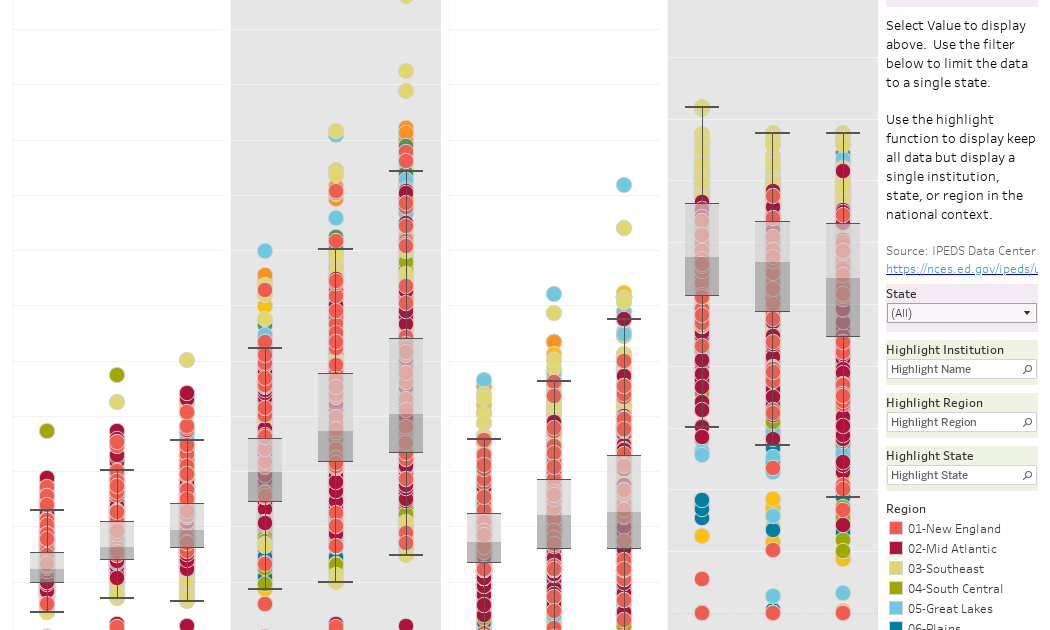
This is data from IPEDS, showing published cost about 530 public, four-year institutions that award the bachelor’s degree, excluding community colleges that have been creeping into that category over time. Each dot represents an institution, and the data are from 2009, 2016, and 2023 to show long-term trends. The dots are colored by geographic region.
The data are displayed four ways, from left to right and default to published Tuition and Fees: Resident, Nonresident, the premium nonresidents pay (in dollars), and the premium not residents pay (as a percentage of what residents pay.) You can change this to show just tuition or just fees by using the control at the top right.
You can also filter to a single state, if you wish, to get a sense of how that state things about tuition.
The green-shaded Highlight boxes at right will allow you to make either one institution, one region, or one state standout, without filtering the other data.
The data are displayed in a box-and-whisker format: The shaded boxes cover the middle 50% of the range, with the dividing line the 50th percentile. The rest of the data are mostly contained within the boundary created by the top bar and bottom bar, with outliers being shown above or below it. These are not enrollment weighted.
As always, I happy to hear what you got out of this. Leave a comment below or send me an email.
-

Indiana University Faculty Who Focus on Student Engagement Using Top Hat See 11.5% Decrease in Student Withdrawal Rate
Course withdrawals carry significant academic and financial consequences for students and universities. Studies consistently demonstrate that withdrawing from first-year courses can greatly increase a student’s risk of discontinuing their studies, reducing their likelihood of completing a degree (Akos & James, 2020).
TORONTO – October 22, 2024 – Top Hat, a leading provider of student engagement solutions for higher education, has released the first significant finding in an ongoing research initiative with Indiana University exploring the impact of student engagement leveraging Top Hat on retention and academic outcomes. The study, involving an analysis of hundreds of courses from the Spring, Summer, and Fall semesters of 2023, observed that the use of Top Hat by instructors resulted in an 11.5 percent decrease in the mean student withdrawal rate compared to similar course types without using the platform. In absolute numbers, this would equate to approximately 289 of the sampled Indiana University students continuing their course work during the 2023 academic year. The findings highlight the positive impact of integrating Top Hat into course delivery on student retention, particularly in introductory courses that often have higher drop-out rates.
The Top Hat platform empowers educators to use frequent low stakes assessments to increase student engagement during lectures through interactive polls, quizzes, and discussions. The use of frequent low stakes assessments have been shown to improve student confidence, academic outcomes and retention (Meer & Chapman, 2014). The principles of active learning can also be extended outside of class through Top Hat Pages, a content editing and personalization tool that enables instructors to create or customize their own interactive learning materials. Every interaction is captured by the platform, providing students with real-time feedback, while empowering faculty with data-driven insights they can use to identify struggling students and improve the impact of their instruction.
“Indiana University is deeply committed to the success of our students, and the findings from this research demonstrate how the thoughtful integration of instructional technologies has contributed to strengthening our undergraduate retention,” said Gina Londino-Smolar, Ed.D., Teaching Professor at IU Indianapolis. “Implementing active learning and frequent assessment, which have been shown to improve student outcomes, has been an important focus for us and our partnership with Top Hat has been instrumental in enabling us to scale these practices across our institution, ensuring a consistent, high quality learning experience for our students.”
The study’s primary objective is to evaluate the influence of Top Hat on various student outcomes, with an initial focus on withdrawal rates—a key indicator of student success. The collaborative research project, approved by the Institutional Review Board (IRB), involved analyzing data from thousands of individual courses. From the original large dataset, similar courses based on discipline and level were identified in order to equalize the sample size and undertake a more accurate analysis. After filtering the dataset, 235 unique Top Hat courses were compared against a similar set of 235 unique courses that did not use Top Hat.
Indiana University began working with Top Hat in 2017 and, based on high rates of faculty adoption, made the decision to offer the platform free of charge to all students by entering into an enterprise license agreement the following year. By addressing concerns around equity, student affordability and ensuring compliance with respect to data privacy and standards for web accessibility, adoption has increased substantially. For the 2023/2024 academic year 1,022 faculty and 51,679 students across more than 1,900 individual courses from all nine IU campuses used Top Hat to enhance learning.
“This study reinforces the importance of providing faculty with tools that make evidence-based practices, like active learning, easier to adopt,” said Maggie Leen, CEO of Top Hat. “The data speaks for itself—when instructors have access to the tools to support effective teaching methods, it can lead to stronger student engagement and higher persistence. We’re proud to be part of Indiana University’s efforts to increase on-time graduation rates for their students.”
The 2030 IU Strategic Plan has one pillar dedicated to Student Success and Opportunity with a commitment to student affordability and experience throughout their educational journey to have success in the workplace and beyond. The incorporation of Top Hat to engage students with the course content, reducing withdrawal rates, can be seen as a direct contribution to the pillar for student success.
Since its founding in 2009, Top Hat has continued to introduce new features to make proven teaching methods more accessible to instructors. Most recently, Top Hat announced the release of Ace, an AI-powered teaching and learning assistant that enables instructors to generate assessment questions and discussion prompts based on their lecture slides and course materials. As a personalized study assistant, Ace allows students to break down challenging concepts, find guidance tackling difficult homework assignments, and create on-demand practice questions they can use to prepare for high stakes assessments.
The initial findings will inform both Indiana University and Top Hat’s future strategies for enhancing student outcomes. The research initiative is currently focused on identifying patterns of usage by instructors across disciplines and their impact on student engagement and academic performance. Ongoing analysis is exploring the impact of Top Hat on the academic experience of various student populations, including historically underrepresented groups with a focus on how the platform supports equitable access to learning, improves engagement, and contributes to closing achievement gaps.
About Indiana University
Indiana University (IU) is one of the nation’s leading public research universities, with 90,000 students across 930+ academic programs, seven campuses, two regional academic centers and nine School of Medicine campuses. Since 1820, Indiana University has helped students create brighter futures while also driving innovation, from breakthroughs in DNA technology to cancer research to trailblazing cultural programs and resources. IU is home to world-class academics with the country’s largest medical school, the world’s first school of philanthropy, the top-ranked Kelley School of Business and O’Neill School of Public and Environmental Affairs, and the Luddy School of Informatics, Computing and Engineering, the nation’s first school of informatics. The university’s campuses are united by IU 2030, an aspirational vision for a bold and ambitious future focused on student success and opportunity, transformative research and creativity, and service to the state of Indiana and beyond. Learn more at iu.edu.
About Top Hat
As the leader in student engagement solutions for higher education, Top Hat enables educators to employ proven student-centered teaching practices through interactive content and tools enhanced by AI, and activities in in-person, online and hybrid classroom environments. To accelerate student impact and return on investment, the company provides a range of change management services, including faculty training and instructional design support, integration and data management services, and digital content customization. Thousands of faculty at 750 leading North American colleges and universities use Top Hat to create meaningful, engaging and accessible learning experiences for students before, during, and after class.
Contact [email protected] for media inquiries.
-
How to prepare for university – Worcester Student Life
During the summer break, it can be difficult to gauge what you should do next. I’ve put together a few tips on ways to get prepared for students who are looking to go to university for the first time or for those who are coming back!
Organise your academic materials
Before the semester begins, take some time to organize your notes, textbooks, and other academic materials. Most courses will provide a list of resources that will be used during your studies— you don’t have to buy every textbook but do read through to get a gauge for the materials you’ll need to use. You may be able to find second-hand copies or more affordable cheaper PDF versions.
If you’ve studied the subject before, it can also be helpful to review your notes and identify any gaps in your understanding. This will help you refresh your memory and get ready for more advanced study.
Plan your schedule
A well-planned schedule can make a significant difference in managing your time effectively. Start by reviewing the course catalogue and selecting your classes for the upcoming semester. Having a schedule ahead of time will make things easier over the next months and help you feel more comfortable in the busy environment of academia.
I would recommend using an online calendar (or physical one) to help span out how the months will be going ahead of time. Allocate specific times for studying, attending classes, and extracurricular activities. Remember to also leave room for socialising!
Set academic and personal goals
Setting goals can give you a clear sense of direction and motivation. Your goals should be specific, measurable, achievable, relevant, and time-bound. In other words, don’t expect too much or too little! Give yourself plenty of room to breathe and relax.
For academic goals, one of my tips would be to aim for a specific grade boundary. Assess the marks you would need to obtain through your assessments and have a clear understanding of what you would like to achieve and how to do so.
For personal goals, it can be incredibly beneficial mentally and physically to join a club, improve on your fitness or learn a new skill. It’s important to keep your mind active outside of academic studies and embrace the new, exciting environment you’ll be in.
Develop good study habits
Good study habits are crucial for academic success. Use the summer to evaluate and improve your study techniques. This can be from finding an ideal study environment to practising active learning techniques.
One of my tips would be to look back on your previous academic achievements, gauge your understanding of how you could improve and what are your strongest skills when it comes to assignments.

Familiarise yourself with campus resources
Universities offer a wealth of resources to support students. Familiarise yourself with what’s available and how to access these services. This can include using tutoring services for difficult subjects, navigating the university’s libraries, as well as research databases and study spaces.
I would recommend meeting with a Programme Advisor to discuss your course plan and career goals if you are confused over the summer about where you should be taking your career.

Budget and financial planning
Financial stability is important for reducing stress and focusing on your studies. It’s incredibly beneficial to create a budget to manage your expenses throughout the semester.
You could use a budgeting app or spreadsheet to monitor your income and expenses. This can help provide a clear view of your expectations of money and clear anxieties about the unknown.
Set up a savings account and set aside a portion of your budget for unexpected expenses. It’s impossible to see into the future and plan for every possible scenario, however with a savings account you could gain some interest on your savings and prepare for the inevitable.
Finally, I would recommend that you explore financial aid. Look into scholarships, grants, and part-time job opportunities to support your education in the summer so that when the year finally rolls around, you’re prepared and well-resourced.

Stay healthy and active
Your physical and mental health significantly impact your academic performance. Develop healthy habits over the summer to maintain your well-being during the school year.
I would recommend exercising regularly by incorporating some kind of physical activity into your everyday or weekly routine. This can be going to the gym, jogging in the mornings or practising a soothing yoga session in your room.
Eating nutritiously is also incredibly important. By focusing on a balanced diet that includes plenty of fruits, vegetables, and whole grains, you can support your body and your mind.
Finally, I would also recommend aiming for 7-9 hours of sleep per night to ensure you’re well-rested and alert.

Build a support network
Having a strong support network can help you navigate the challenges of university life. Connect with family, friends, and fellow students over the summer to ensure that your well-formed social groups are still thriving.
My tips for this would be to maintain regular contact with loved ones to keep your support network strong, either through texts, calls or hanging out face-to-face.
I would also recommend joining online communities by participating in social media groups related to your university or field of study. This can help better your understanding of the social circle you’ll be expected to join when the year starts as well as helping you meet new people.

To conclude, preparing for the academic year during the summer break can help you start the semester with confidence and a clear plan. By organizing your materials, planning your schedule, setting goals, developing study habits, familiarizing yourself with campus resources, budgeting, maintaining your health, and building a support network, you’ll be well-equipped to tackle the challenges and make the most of your university experience. Enjoy your summer, and here’s to a successful academic year ahead!
-

The Keyword Generator from the University of Louisiana at Lafayette Library
Research and Writing Tool: The Keyword Generator from the University of Louisiana at Lafayette Library
The University of Louisiana at Lafayette has an incredible tool for students and faculty writing papers. Sometimes, I have a difficult time brainstorming ideas for a particular research topic (I know that I cannot be the only person), In the past few weeks, I stumbled upon a database quick search tool from U of L Lafayette, “https://www.millennialprofessor.com/2024/04/Keyword Generator“.This is a ChatGPT prompt and it can help you develop keywords for your topic!
Basically, you place your search terms or your associated keywords and the system provides some associated terms for you.
Step 1 – I searched for “rural education”
Step 2 – The keyword generator developed these keywords for me:
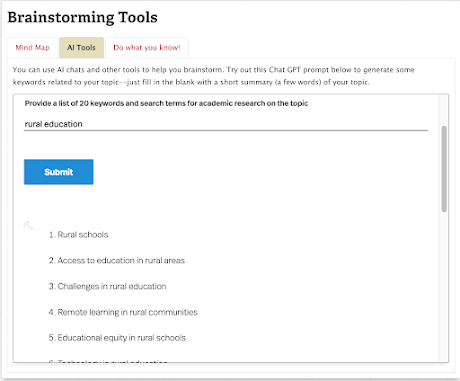
1. Rural schools
2. Access to education in rural areas
3. Challenges in rural education
4. Remote learning in rural communities
5. Educational equity in rural schools
6. Technology in rural education
7. Teacher recruitment and retention in rural areas
8. School infrastructure in rural communities
9. Dropout rates in rural schools
10. Special education in rural areas
11. Community involvement in rural education
12. Funding for rural schools
13. Curriculum development for rural schools
14. Impact of poverty on rural education
15. Student achievement in rural schools
16. Distance education in rural areas
17. Cultural diversity in rural schools
18. Professional development for rural educators
19. Government policies affecting rural education
20. Best practices in rural education.
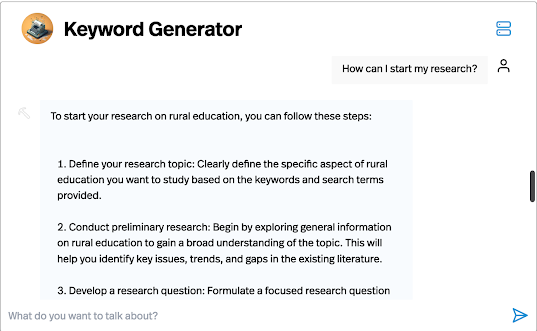
Step 3 – After you view your results, you can copy and paste the results AND you can utilize ChatGPT without having to log in!
What do you think about this tool? I will definitely use it! Thanks University of Louisiana at Lafayette!
***
Check out my book – Retaining College Students Using Technology: A Guidebook for Student Affairs and Academic Affairs Professionals.
Remember to order copies for your team as well!
Thanks for visiting!
Sincerely,
Dr. Jennifer T. Edwards
Professor of CommunicationExecutive Director of the Texas Social Media Research Institute & Rural Communication Institute

-

College & University Rankings – things to consider – The College Planner, LLC
Families that eagerly await the annual U.S. News & World Report College Edition may place too much reliance on it. They may be assuming that the complexities of college selection can be made easy by a magazine’s rankings.
Some families rely on the rankings because they seek an easy way out of the stress of college selection. Families, especially students, would be better served to put time into the hard work necessary to identify the colleges that fit them best. College rankings are among the tools that may be used to make this task less burdensome, but there are no shortcuts for College List building that wouldn’t detract from a student’s educational potential.
The College Rankings Publications
Since 1983, U.S. News & World Report (U. S. News) has published an annual College Edition that ranks American colleges in various categories. Although U. S. News is the most popular, they are not alone in this market niche. Other publications that release annual college rankings include Forbes, Princeton Review, Money, Barron’s, Kiplinger’s, College Atlas, the Economist, and the New York Times. They are all reputable, unbiased sources that base their analyses on the same data (the Common Data Set) but arrive at different rankings based on their distinctive methodologies.
The Current Rankings Controversy
The U.S. News College Edition is published annually in September. Each year, this sets off an undeserved avalanche of criticism that The Atlantic’s Derek Thompson calls a “National Carpfest.” The 2023 rankings are causing more carping than usual, mainly from law and medical schools, which aren’t our concern here. However, two undergraduate colleges, the Rhode Island School of Design and Colorado College, have stated that they will no longer cooperate with U.S. News because they feel that the rankings reinforce social inequities. Other schools have also expressed dissatisfaction with U.S. News and college rankings in general.
This mini-movement against magazine rankings has prompted speculation that colleges will abandon them. This is unlikely. By and large, rankings are useful to colleges. However, U.S. Education Department Secretary Miguel Cardona essentially called for abandonment at a recent conference. He said that colleges should:
“Stop worshiping at the false altar of U.S. News and World Report. Rankings disincentivize the wealthiest institutions from enrolling and graduating more underserved students. That’s because doing so harms their selectivity, a factor in the U.S. News formula. Colleges, not some for-profit magazine, should set the higher education agenda.”
To some, it’s incongruous that Secretary Cardona blames the magazines for the fact that college rankings are misused. His position draws attention to a common criticism of college administrations. Many institutions adopt policies and practices based on the likelihood that they will raise their position in the rankings. They are
accused of assigning a higher priority to their position in the rankings than to more important considerations.
Administrators engage in practices to manipulate their data in order to generate improved metrics for rankings calculations. Many administrators do this routinely because a rise in rank helps them justify tuition and salary increases. It is not illegal, but it is unethical. Consequences are rare, but occasionally a college gets called out for it in the media, as have Baylor and, more recently, Columbia. This is not a good look for a high prestige institution.
In their response to Secretary Cardona, U.S. News observed that colleges simply don’t like to be compared to each other by objective third-parties. They asserted that he should require colleges to be more transparent with their data, stating:
“More openness from colleges would allow prospective students and their families to make meaningful comparisons between institutions based on factors such as financial information, admissions data, and outcome statistics.”
Rankings As Perceived By Parents and Students
The rankings publications are entitled to publish anything they wish about colleges without fearing legal repercussions. They benefit from freedom of the press and are fully protected by the first amendment. Concerns arise not about the college rankings themselves but in the way that many families perceive and use them.
The main concern is that many families fail to understand that rankings can’t take into account the qualitative factors that matter most to students. Each student has their own combination of financial resources, talents, preferences, experiences, goals, and personal characteristics. Finding a student’s best-fit colleges should be the result of a subjective analysis by the student that accommodates these factors. It can’t be done properly by using only a formula-driven calculation — the methodology used by the publishers. Rankings can serve as useful information in a student’s college search — but only in a secondary role behind subjective analysis.
When purchasing a product like a car or TV, a publication that assists decision-making like Consumer Reports is a resource that can be relied upon. They conduct research, analyze, and test products. They rank them from the best-buy on down.
That choosing a college is not like buying a TV is an obvious understatement, but the magazines can only rank colleges as if they were three-dimensional products. The important non-quantifiable features can’t be validly compared in this manner.
Rankings as a Reference Source
College rankings can also serve as handy reference sources for a wide range of information about colleges. U.S. News devotes substantial effort every year to compiling and analyzing information relating to more than 3,000 colleges — about 75% of the U.S. total. All of the rankings publications generate comparisons of institutions of similar types on a level playing field! These comparisons are based on mathematical models that incorporate the factors that, in the assessment of the publishers, contribute most to the quality and value of a college education.
Understanding Rankings Methodologies
Families should decide for themselves how much credence to place on college rankings. To help make this decision, they should review a publication’s methodology. As an example, a summary of the indicators used in the U.S. News formula for undergraduate colleges and the weights assigned to them is provided below in Table A.
Table A
U.S. News Ranking Indicators & Weights
RANKING INDICATOR INDICATOR WEIGHT % GRADUATION AND RETENTION RATES 22.0 AVERAGE SIX-YEAR GRADUATION RATE 17.6 AVERAGE FIRST-YEAR STUDENT RETENTION RATE 4.4 SOCIAL MOBILITY 5.0 PELL GRANT GRADUATION RATES 2.5 PELL GRANT GRADUATION RATE COMPARED WITH ALL OTHERS 2.5 GRADUATION RATE PERFORMANCE 8.0 UNDERGRADUATE ACADEMIC REPUTATION 20.0 PEER ASSESSMENT SURVEY 20.0 FACULTY RESOURCES FOR 2021-22 ACADEMIC YEAR 20.0 CLASS SIZE INDEX 8.0 FACULTY COMPENSATION 7.0 PERCENT FACULTY WITH TERMINAL DEGREE IN THEIR FIELD 3.0 PERCENT FACULTY THAT IS FULL TIME 1.0 STUDENT-FACULTY RATIO 1.0 STUDENT SELECTIVITY FOR THE FALL 2022 ENTERING CLASS 7.0 MATH AND READING/WRITING PORTIONS OF SAT/ACT SCORES 5.0 HIGH SCHOOL CLASS STANDING IN TOP 10% 2.2 FINANCIAL RESOURCES PER STUDENT 10.0 AVERAGE ALUMNI GIVING RATE 3.0 GRADUATE INDEBTEDNESS 5.0 TOTAL 100.0 Source: U.S. News & World Report – College Edition September 2023


.png)


.png)