Tag: University

  • When AI Meets Engineering Education: Rethinking the University 

    When AI Meets Engineering Education: Rethinking the University 

    This HEPI blog was kindly authored by James Atuonwu, Assistant Professor at the New Model Institute for Technology and Engineering (NMITE). 

    Where machines of the past multiplied the strength of our hands, AI multiplies the power of our minds – drawing on the knowledge of all history, bounded only by its training data. 

    We are living through a moment of profound transition. The steam engine redefined labour, the computer redefined calculation, and now AI is redefining thought itself. Unlike earlier technologies that multiplied individual workers’ power, AI, particularly large language models (LLMs), multiplies the collective intelligence of humanity. 

    For engineering practice and universities alike, this shift is existential. 

    AI as Servant, Not Master 

    The old adage is apt: AI is a very good servant, but a very bad master

    • As a servant, AI supports engineers in simulation, design exploration, and predictive maintenance. For students, it provides on-demand access to resources, enables rapid testing of ideas, and helps them reframe problems.  
    • As a master, AI risks entrenching bias, undermining judgment, and reshaping educational systems around efficiency rather than values. 

    The challenge is not whether AI will change engineering education, but whether we can train engineers who command AI wisely, rather than being commanded by it. 

    This logic resonates with the emerging vision of Industry 5.0: a paradigm where technology is designed not to replace humans, but to collaborate with them, enhance their creativity and serve societal needs. If Industry 4.0 was about automation and efficiency, Industry 5.0 is about restoring human agency, ethics, and resilience at the heart of engineering practice. In this sense, AI in engineering education is not just a technical challenge, but a cultural one: how do we prepare engineers to thrive as co-creators with intelligent systems, rather than their servants 

    Beyond ‘AI Will Take Your Job’ 

    The phrase AI won’t take your job, but a person using AI will has become a cliché. It captures the competitive edge of AI literacy but misses the deeper truth: AI reshapes the jobs themselves.  

    In engineering practice, repetitive calculations, drafting, and coding are already being automated. What remains – and grows in importance – are those tasks requiring creativity, ethical judgment, interdisciplinary reasoning, and decision-making under uncertainty. Engineering workflows are being reorganised around AI-enabled systems, rather than human bottlenecks

    Universities, therefore, face a central question: Are we preparing students merely to compete with each other using AI, or to thrive in a world where the very structure of engineering work has changed? 

    Rethinking Assessment 

    This question leads directly to assessment – perhaps the most urgent pressure point for universities in the age of AI. 

    If LLMs can generate essays, solve textbook problems, and produce ‘good enough’ designs, then traditional forms of assessment risk becoming obsolete. Yet, this is an opportunity, not just a threat

    • Assessment must shift from recalling knowledge to demonstrating judgment. 
    • Students should be evaluated on their ability to frame problems, critique AI-generated answers, work with incomplete data, and integrate ethical, social, and environmental perspectives. 

    A further challenge lies in the generational difference in how AI is encountered. Mature scholars and professionals, who developed their intellectual depth before AI, can often lead AI, using it as a servant, because they already possess the breadth and critical capacity to judge its outputs. But students entering higher education today face a different reality: they arrive at a time when the horse has already bolted. Without prior habits of deep engagement and cognitive struggle, there is a danger that learners will be led by AI rather than leading it. 

    This is why universities cannot afford to treat AI as a mere technical add-on. They must actively design curricula and assessments that force students to wrestle with complexity, ambiguity, and values – to cultivate the intellectual independence required to keep AI in its rightful place: a servant, not a master. 

    Rediscovering Values and Ethics 

    AI forces a rediscovery of what makes us human. If algorithms can generate correct answers, then the distinctive contribution of engineers lies not only in technical mastery but in judgment grounded in values, ethics, and social responsibility

    Here the liberal arts are not a luxury, but a necessity

    • Literature and history develop narrative imagination, allowing engineers to consider the human stories behind data. 
    • Philosophy and ethics cultivate moral reasoning, helping engineers weigh competing goods. 
    • Social sciences illuminate the systems in which technologies operate, from environmental feedback loops to economic inequities. 

    In this light, AI does not diminish the need for a broad education – it intensifies it. 

    Reimagining the University 

    Yet, values alone are not enough. If universities are to remain relevant in the AI era, they must reimagine their structures of teaching, learning, and assessment. Several approaches stand out as particularly future-proof: 

    • Challenge-based learning, replacing rote lectures with inquiry-driven engagement in authentic problems. 
    • Industry and community co-designed projects, giving students opportunities to apply knowledge in practical contexts 
    • Interdisciplinary integration across engineering, business, and social perspectives. 
    • Block learning, enabling sustained immersion in complex challenges – a counterbalance to the fragmenting tendencies of AI-enabled multitasking. 
    • Professional skills and civic engagement, preparing graduates to collaborate effectively with both people and intelligent systems. 
    • Assessment through projects and portfolios, rather than traditional exams, pushing learners to demonstrate the judgment, creativity, teamwork and contextual awareness that AI can only imitate but not authentically embody. 

    These approaches anticipate what the AI era now demands of universities: to become sites of creation, collaboration, and critique, not simply repositories of content that AI can reproduce at scale. Some newer institutions, such as NMITE, have already experimented with many of these practices, offering a glimpse of how higher education can be reimagined for an AI-enabled world. 

    Closing Reflection 

    AI may be the greatest machine humanity has ever built – not because it moves steel, but because it moves minds. Yet, with that power comes a reckoning. 

    Do we let AI master our universities, eroding integrity?  
    Or do we make it serve as a co-creator, multiplier of human intelligence, and a tool for cultivating wise, ethical, creative engineers? 

    The answer will define not just the future of engineering training and practice, but the very shape of university education itself. 

    Source link

  • The Shrinking Research University Business Model

    The Shrinking Research University Business Model

    For most of the past 30 or so years, big Canadian universities have all been working off more or less the same business model: find areas where you can make big profits and use those profits to make yourself more research-intensive.

    That’s it. That’s the whole model.

    International students? Big profit centres. Professional programs? You better believe those are money-makers. Undergraduate studies – well, they might not make that much money in toto but holy moly first-year students are taken advantage of quite hideously to subsidize other activities, most notably research-intensity.

    Just to be clear, when I talk about “research-intensity”, I am not really talking about laboratories or physical infrastructure. I am talking about the entire financial superstructure that allows profs to teach 2 courses per semester and to be paid at rates which are comparable to those at (generally better-funded) large public research universities in the US. It’s about compensation, staffing complements, the whole shebang – everything that allows our institutions to compete internationally for research talent. Governments don’t pay enough, directly, for institutions to do that. So, universities have found ways to offer new products, or re-arrange the products they offer, in such a way as to support these goals of competitive hiring.

    Small universities do not have quite the same imperatives with respect to research, but this business model affects them nonetheless. To the extent that they wish to compete for staff with the research-intensive institutions, they have to pay higher salaries as well. Maybe the most extreme outcome of that arms race occurred at Laurentian, whose financial collapse was at least in part due to the university implicitly trying to align itself to U15 universities’ pay scales rather than, say, the pay scale at Lakehead (unions, which like to write ambitious pay “comparables” into institutional collective agreements, are obviously also a factor here).

    Anyways, the issue is that for one reason or another, governments have been chipping away at these various sources of profit that have been used to cross-subsidize research-intensity. The situation with international students is an obvious one, but this is happening in other ways too. Professional master’s degrees are not generating the returns they used to as private universities, both foreign and domestic, begin to compete, particularly in the business sector. (A non-trivial part of the reason that Queen’s found itself in financial difficulty last year was because its business school didn’t turn a profit for the first time in years. I don’t know the ins and outs of this, but I would be surprised if Northeastern’s aggressive push into Toronto wasn’t eating some of its executive education business). 

    Provincial governments – some of them, anyway – are also setting up colleges to compete with universities in a number of areas for undergraduate students. In Ontario, that has been going on for 20-25 years, but in other places like Nova Scotia it is just beginning. Some on the university side complain about these programs, primarily in polytechnics, being preferred by government because they are “cheap”, but they rarely get into specifics about quality. One reason college programs are often better on a per-dollar measure? The colleges aren’t building in a surplus to pay for research-intensity – this is precisely what allows them to do revolutionary things like not stuffing 300 first-year students in a single classroom.  

    In brief then: the feds have taken away a huge source of cross-subsidy. Provinces, to varying degrees (most prominently in Ontario), have been introducing competition to chip-away at other sources of surplus that allowed universities to cross-subsidize research intensity. Together, these two processes are putting the long-standing business model of big Canadian universities at risk.

    The whole issue of cross-subsidization raises two policy questions which are not often discussed in polite company – in Canada, at least. The first has to do with cross-subsidization and whether it is the correct policy or not. I suspect there is a strong majority among higher education’s interested public that think it probably is a good policy; we just don’t know for sure because the policy emerged, as so many Canadian policies do, through a process of extreme passive-aggressiveness. Institutions were mad at governments for not directly funding what they wanted to do, so they went off and did their own thing. Governments, grateful not to be harassed for money, said nothing, which institutions took for approval whereas in fact it was just (temporary) non-disapproval. 

    (I should add here – precisely because of all the passive-aggressiveness – it is not 100% clear to me the extent to which provincial governments understand the implications of introducing competition. When they allow new private or college degree programs, they likely think “we are improving options for students” not “I wonder how this might degrade the ability of institutions to conduct research”. And, of course, the reason they don’t think that is precisely because Canadians achieve everything through passive-aggression rather than open policy debates which might illuminate choices and trade-offs. Yay, us.)

    The second policy question – which we really never ever raise – is whether or not research-intensity, as it is practiced in Canadian universities, is worth subsidizing in the first place. I know, you’re all reading that in shock and horror because what is a university if it is not about research? Well, that’s a pretty partial view, and historically, a pretty recent one.  Even among the U15, there are several institutions whose commitment to being big research enterprises is less than 40 years old. And, of course, we already have plenty of universities (e.g. the Maple League) where research simply isn’t a focus – what’s to say the current balance of research-intensive to non-research-intensive universities is the correct one?

    Now add the following thought: if the country clearly doesn’t think that university research matters because the knowledge economy doesn’t matter and we should all be out there hewing wood and drawing water, and if the federal government not only chops the budget 2024 promises on research but then also cuts deeply into existing budgets, what compelling policy reason is there to keep arranging our universities the way we do?  Why not get off the cross-subsidization treadmill and think of ways of spending money on actually improving undergraduate education (which the sector always claims to be doing, but isn’t much, really).

    I am not, of course, advocating this as a course of policy. But given the way both the politics of research universities and the economics of their business models are heading, we might need to start discussing this stuff. Maybe even openly, for a change.

    Source link

  • Kirk shooter appeared to fire from roof of university student services building

    Kirk shooter appeared to fire from roof of university student services building

    The shooter who killed Turning Point USA founder Charlie Kirk Wednesday on the Utah Valley University campus appeared to fire from the roof of a university building that houses administrative offices and student advisement services.  

    The Losee Center for Student Success is a 90,000-square-foot building with a mix of campus offices and student services that underwent a $4.5 million renovation in 2009. The building is fewer than 200 yards from the outdoor amphitheater where Kirk was speaking. A video taken by an attendee captures images of what appears to be the shooter standing on the roof of the building after the shooting and running away. 

    “The rooftop to the Losee building is pretty easy to access,” a CNN reporter said in a video analysis of the shooting. “It’s connected to another building by an elevated walkway, which … is only separated from the roof by a railing.” 

    Because of the distance and accuracy of the shot, it was likely fired from a large-caliber rifle, Jim Cavanaugh, a former officer of the U.S. Bureau of Alcohol, Tobacco, Firearms and Explosives, said on MSNBC show The Beat with Ari Melber. “It does appear to be a large rifle round,” Cavanaugh said. “I would call it a .308 or a .30-06, like a deer rifle. One shot. That’s all.”

    Cavanaugh explained that “Snipers use that attack method for two reasons. One, they can’t get close … and secondly, because you want to get away. That gives you the distance to get away. You can fire the round and then egress from the scene.” 

    “Two hundred yards is not a difficult rifle shot,” Christopher O’Leary, former director of hostage recovery for the federal government, told Melber. “Most people have optics on their weapon. … With a true optic on it, 200 yards is very easy to do.”

    The university, in Orem, Utah, prohibits guns on campus to the extent allowed by state law. Utah’s Concealed Weapons Law allows people with a state concealed carry permit to be on campus with a concealed firearm, according to the campus police website.

    An estimated 3,000 people were attending the Kirk event, the first of a series of campus talks the conservative activist was scheduled to hold around the country. Kirk was shot while answering a question about mass shootings. “Do you know how many mass shootings in America there have been over the last 10 years?” an attendee asked, the CNN video analysis shows. “Counting or not counting gang violence?” Kirk responded before he was hit.   

    Local police and half a dozen campus police officers provided security at the event, but there was no screening, the CNN analysis said.  

    “Let’s be realistic,” O’Leary said on The Beat. “We’re not going to lock down a college campus for every speaker outdoors. Maybe you want to take it indoors. I think that’s all going to be assessed moving forward.”  

    Phil Lyman, a former Utah state legislator who was at the event, said on The Beat that he saw what he believed were “a lot of undercover police officers running around” after the shooting, which surprised him. “I would not have thought that [those were officers].”

    The campus is closed for the week while law enforcement officials conduct their forensic work. 

    Source link

  • Commerce Sec. Wants Half of University Patent Money

    Commerce Sec. Wants Half of University Patent Money

    Commerce Secretary Howard Lutnick told Axios he wants the federal government to get half the dollars generated from patents that universities and their researchers develop with federal funding, the outlet reported Wednesday.

    “The scientists get the patents, the universities get the patents and the funder of $50 billion, the U.S. government, you know what we get? Zero,” Lutnick says in an interview clip from the forthcoming first episode of The Axios Show.

    “I think if we fund it and they invent a patent, the United States of America taxpayer should get half the benefit,” Lutnick says, adding, “if we are paying for the research, if we’re paying for the lab, if it’s our money, the American taxpayer’s money.”

    “How do we not get our money back?” he says. “That’s insane.”

    As Axios noted in its article about the interview, the Bayh-Dole Act generally gives universities the right to own patents developed with federal funding. The Commerce Department didn’t return requests for comment Wednesday about how the Trump administration could legally get around that law.

    Kate Hudson, the Association of American Universities’ deputy vice president and counsel for government relations and public policy, said in an email that Lutnick’s idea “would completely gut universities’ ability to partner with the private sector to turn research discoveries into real-world technologies, cures, and solutions that serve the American people.”

    “The proposal would obliterate the progress that university tech transfer has enjoyed in the 45 years since the passage of the seminal Bayh-Dole Act, which facilitated new university-industry partnerships and led to an explosion of technological progress and substantial economic gains,” Hudson said. “If enacted, the proposal would stifle the U.S. innovation pipeline, with the American people, not universities, being the ultimate losers.”

    Source link

  • Right Wing Influencer Charlie Kirk Killed at Utah Valley University

    Right Wing Influencer Charlie Kirk Killed at Utah Valley University

    Charlie Kirk was shot and killed at Utah Valley University today.  The killer was not immediately caught. The Higher Education Inquirer has been covering Kirk and his organization, Turning Point USA, since 2016.  Kirk has been a polarizing force in the United States, particularly on US college campuses. HEI hopes this event will not lead to further violence. Since its inception, we have urged for peace and nonviolence.   

    Source link

  • Week in review: University of Chicago to cut $100M from its budget

    Week in review: University of Chicago to cut $100M from its budget

    Most clicked story of the week:

    The University of Chicago will move to cut $100 million from its budget, citing “profound federal policy changes” and multi-year deficits. Paul Alivisatos, president of the private institution, said that goal would require staff reductions.

    Number of the week:


    15%

    The decline in the U.S. Department of Education’s fiscal 2026 budget under a new proposal from House Republicans. The steep cut, which lawmakers paired with reduced funding for certain federal student aid programs, echoes President Donald Trump’s budget proposal. The House Appropriations Committee’s education subcommittee advanced the proposal Tuesday evening.

    The latest in the Trump administration’s battle with higher ed:

    • A federal judge Wednesday ruled in favor of Harvard University in its lawsuit against the Trump administration, concluding the federal government failed to follow proper procedures and acted arbitrarily and capriciously when it froze $2.2 billion of the university’s federal funding in April. The move also violated Harvard’s First Amendment rights, the judge ruled. 
    • George Mason University’s governing board announced it would negotiate with the Trump administration in hopes of resolving federal allegations that the public institution illegally used race and other protected characteristics in hiring and employee promotions. George Mason’s president summarily rebuked the accusation.
    • The University of California will need at least $4 billion to $5 billion to staunch the budgetary bleeding if it loses its federal funding, the system’s president told state lawmakers. The Trump administration has set its sights on the system — particularly University of California, Los Angeles, which recently had $584 million of its grants suspended.

    Federal agencies complicate life for international and undocumented students:

    • The U.S. Department of Homeland Security and the U.S. Immigration and Customs Enforcement proposed setting a four-year cap on the length of time international students can stay in the U.S. If approved, student visa holders would need to apply for extensions and undergo “regular assessments” to stay beyond that time.
    • The U.S. Department of Justice sued Illinois over its laws allowing select undocumented college students to pay in-state tuition rates and receive state-administered scholarships. That makes Illinois the fifth state the DOJ has taken action against over such policies.

    Quote of the Week:

    “The First Amendment doesn’t set when the sun goes down. University students have expressive freedom whether it’s midnight or midday, and Texas can’t just legislate those constitutional protections out of existence.”

    That was JT Morris, senior supervising attorney at the Foundation for Individual Rights and Expression, in a statement Wednesday. FIRE sued the University of Texas system on behalf of students over a new state law that directs public colleges to prohibit “any speech or expressive conduct protected by the First Amendment” on campuses from 10 p.m. to 8 a.m.

    Source link

  • Rising Above the Noise: How SIUE’s Chancellor is Transforming a University and Community

    Rising Above the Noise: How SIUE’s Chancellor is Transforming a University and Community

    The second line band’s brass instruments gleamed in the morning sun as they led nearly a thousand first-year students out of the Vadalabene Center arena. The festive New Orleans style procession wound its way across Southern Illinois University Edwardsville’s campus, past the towering Cougar statue where students would soon gather for their traditional class photo. Parents lined the walkway, some having extended their stay just to witness this moment—their children’s ceremonial entry into college life.

    Among the crowd, one mother approached Dr. James T. Minor with tears in her eyes. 

    “That’s my son,” she said, pointing to a young man adjusting his position for the photo. “This is so great. I can’t believe what you’re doing. I’m so proud of him.” 

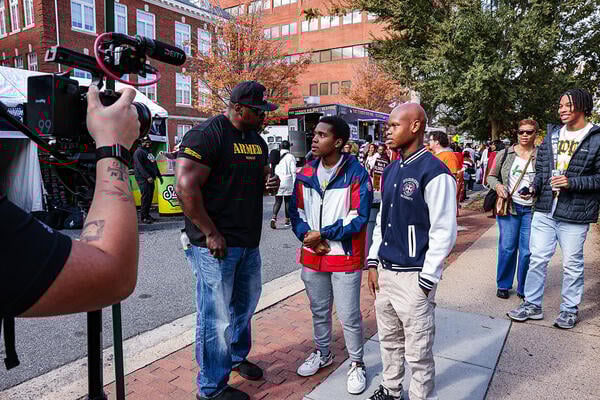
    Dr. James Minor talking to a SIUE student. For Minor, SIUE’s first African American chancellor, this moment embodied everything he hopes to achieve at the institution he has led since March 2022. 
    A Detroit native with a Ph.D. from the University of Wisconsin-Madison and a distinguished career spanning federal government, the California State University system, and scholarship in educational policy, Minor brings both academic rigor and practical experience to his transformational vision.

    “This is as close as I get to what’s truly special about university communities,” he reflects on the school’s most recent convocation. “You’ve got thousands of young people who have made a decision about their life—that they’re going to pursue a college degree—and the university has a responsibility to facilitate that.”

    But behind this celebratory scene lies a story of dramatic transformation, one that has seen SIUE emerge from serious fiscal challenges to become a model for how regional public universities can thrive in challenging times.

    A $18 Million Wake-Up Call
    When Minor arrived on campus in March 2022, he brought credentials that positioned him uniquely for the challenges ahead. As the 10th chancellor in SIUE’s history, his appointment followed distinguished service as deputy assistant secretary at the Department of Education, where he administered more than $7 billion in federal higher education programming. His most recent role as assistant vice chancellor and senior strategist at California State University—where he helped achieve the system’s highest graduation rates in history and secured hundreds of millions of dollars for graduation initiatives—prepared him for the complex work of institutional transformation. 

    But even this impressive background couldn’t ready him for what he discovered within his first 45 days: an $18 million structural deficit that had been masked by years of poor budget practices. 

    “I was giving a university budget presentation that was not particularly pleasant,” Minor recalls of those early days in his tenure. “That was not on my list of things to do in the first 100 days—to organize and understand this structural deficit, communicate it to the university community, and then lay out a plan for managing it.”

    Dr. James T. Minor at commencement.Dr. James T. Minor at commencement.The distinction between a structural deficit and a spending deficit became crucial to Minor’s communication strategy. Unlike a simple overspend that could be corrected immediately, SIUE faced a fundamental mismatch between fixed expenses and revenue. The number of people, buildings, and courses— the structural components of the budget—exceeded revenue by roughly $18 million.

    “We had available cash sources and other things that we could manipulate to cover it,” Minor explains. “We operated that way for a number of years before I arrived, but we all know that’s not sustainable.”

    The solution required what Minor calls “environmental responsiveness”— the ability of institutions to expand and contract according to changing conditions. This meant making hard choices about class sizes, graduate assistantships, and operational efficiencies that some within the university community initially resisted. 

    Fast forward to September 2025, and Minor will soon announce to the campus community that SIUE has effectively resolved its structural deficit, maintains one of the best cash positions among Illinois universities, and accomplished this transformation without spending a single dollar from its cash reserves.

    Building a Culture of Student-Centered Data
    Perhaps even more significant than the financial turnaround has been Minor’s campaign to make SIUE fluent in its own student success metrics. When he arrived, he was stunned by what he discovered during informal surveys of faculty and staff.

    “I would walk into a room and ask, ‘Who here can tell me our four-year and six-year graduation rates?’” Minor recalls. “These are people who presumably should have an idea— people who work here, not people shopping at Target or in the grocery store. I would ask about our first-to-second-year retention rate, and it wasn’t meant to embarrass people. It was to underscore the lack of awareness we had as a university community about the most important thing we do.”

    Today, when Minor walks into any room on campus, hands shoot up when he asks those same questions. “People expect the question,” he says with satisfaction. “I have promised them, I don’t care if we’re talking about the paint in the stairwell, I will start every conversation here at the university about our student outcome data.”

    Dr. James Minor meeting students on campus.Dr. James Minor meeting students on campus.This data-driven approach has yielded measurable results for the institution that boasts more than 12,000 students. First-to-second-year retention rates have increased, graduation rates have ticked up, and the university is expecting growth—a major accomplishment in today’s challenging enrollment environment.

    Dr. Robin Hughes, dean of the School of Education, Health and Human Behavior, sees Minor’s unique combination of scholarship and leadership as precisely what SIUE needed. 

    “Chancellor Minor is by far what most institutions look for and want in an organizational leader,” Hughes observes. “He is a distinguished scholar whose work focuses on the study of higher education organizations. He is also an experienced organizational leader who brings both academic insight and institutional expertise to his work. A strong advocate for students, he makes organizational decisions that positively impact their success both during their studies and beyond.”

    Dr. Jessica Harris, acting chief of staff and vice chancellor for Anti-racism, Diversity, Equity and Inclusion, chaired the search committee that brought Minor to SIUE.

    “I remember reading his cover letter and saying to my mom, ‘I think this is our next chancellor,’” Harris recalls. “Every accomplishment he talked about in his career was about how it positively impacted or transformed the experience for students. That was a consistent thread throughout his cover letter.”

    Nearly four years into his tenure, Harris sees that student-centered focus as the driving force behind institutional change.

    “One of the major shifts I’ve seen is a very clearly articulated and collective focus on student success,” she explains. “Not that it wasn’t a commitment before, but there’s a level of intentionality I didn’t see across all areas before he started. Every presentation starts with mission—this is why we’re here, these are our enrollment numbers, retention and graduation numbers. He keeps it front of mind for us.”

    Dr. Earleen Patterson, associate vice chancellor for Student Opportunities, Equity, Diversity and Inclusion, has witnessed this transformation firsthand.

    “There’s a reason I’m still here,” she says of her longevity at the university that began in 1990. “Over the course of time, I’ve seen a lot of evolution of this journey of progress toward being inclusive, toward offering opportunities to every sector of our population.”

    The results are visible in SIUE’s incoming class, which Patterson describes as having “the highest African American enrollment in the history of the university.” This fall’s freshman class includes nearly 600 Black students in the Boundless Scholars Experience alone—a comprehensive academic program designed to promote belonging, academic achievement and degree completion. At a time when voices opposing diversity, equity and inclusion efforts grow louder across the higher education landscape, SIUE has chosen to double down on its mission, letting results speak louder than rhetoric. 

    The focus on student success extends far beyond enrollment numbers. Patterson describes a comprehensive approach to retention that begins before students even attend their first class. The Boundless Scholars Experience moved students in early, gathering them with their families in the campus ballroom for what Patterson calls “real talk” about college expectations. 

    “What they saw was a room that reflected who they are,” Patterson explains. “But we let them know, come Monday, as you walk out into the university community, you may be the only one in your biology course, in your chemistry course, in your economics course. But you have a community, you have a village.” 

    This village includes strategic course placement with faculty who are particularly effective with first-year students, early warning systems that track attendance and performance, and support staff who can call students by name when they miss class. 

    “It marvels them when they come into my office, and I already know you missed chemistry on Tuesday,” Patterson says with a chuckle. “They’re like, ‘How do you know?’ I care enough to know about that—about all of these students.” 

    For Dominic Dorsey, president of the Black Faculty and Staff Association and director of the Access (Disability Services) Department, representation at the leadership level makes a tangible difference for students.

    “We’ve been blessed not just to have Dr. Minor as our first Black chancellor, but to have a chancellor that’s an actual thought leader and transformational in the truest sense of the word,” he says.

    Dorsey’s own department has seen dramatic growth, with registered students with disabilities increasing from about 650 when he arrived in 2018 to nearly 1,400 today. This growth reflects SIUE’s broader commitment to inclusive excellence that extends beyond traditional diversity metrics.

    Town-Gown Collaboration 
    The transformation at SIUE also stretches beyond campus borders through an unprecedented partnership with the city of Edwardsville. Mayor Art Risavy, a small business owner who has served as mayor for five years after a decade as an alderman, describes an intentional effort to strengthen university- city relations. 

    “Early on, when I became mayor, one of the first things we decided collectively was we wanted to work on our relations with the university,” Risavy explains. “We reached out to the chancellor, and it didn’t take long—Chancellor Minor wants to do stuff pretty quickly—before we had a meeting set up.”

    These conversations led to concrete initiatives: improved website integration between city and university, the Hashbrown Huddle breakfast meetings that bring students directly into downtown Edwardsville, and shared committee appointments that give the university voice in city governance.

    “We want to see students in our businesses, involved in our organizations,” Risavy says. “We want them to feel comfortable downtown, going through our shops and participating in our events. This is their home for four years or five or six years.” 

    The collaboration extends to shared programming, with Minor and Risavy regularly attending each other’s events, from the city’s state of the city address to SIUE’s ice cream social that draws over a thousand participants.

    Navigating Challenges with Bold Leadership 
    The success story at SIUE is unfolding against a backdrop of national political tensions around higher education, particularly concerning diversity, equity, and inclusion efforts. For leaders like Dorsey and Patterson, this context requires strategic adaptation without abandoning core values. 

    “The way that we approach the work has not changed,” Dorsey explains. “We just don’t publicize the way the work is done. Our ancestors created an underground railroad for a reason—it’s a reason why it wasn’t an above ground railroad.” 

    This approach allows SIUE to continue providing scholarships, celebration opportunities, and support systems for underrepresented students while focusing public attention on broader institutional success metrics that benefit all students. 

    Patterson emphasizes the importance of drowning out external noise. 

    “If we were to play into that distraction, we wouldn’t be able to focus on the charge that is in front of us. And these students are in front of us,” she said. 

    Doug James, immediate past president of the Staff Senate, describes an administration focused on “majoring on the major things” while maintaining awareness of smaller concerns. 

    “I think there was an appetite for honest conversation,” he says. “Let’s get in a room and talk about what are our challenges, where are we winning, what are the things we get to celebrate, and what needs our attention.” 

    Yet Harris points to concrete evidence of this collective effort.

    “You don’t see 10 percentage point increases in Black student retention without people doing work inside and outside of the classroom. We’ve hit historic fundraising goals since Chancellor Minor’s been here. He’s helping to shift our culture. He often talks about us being first and best in class.” 

    Looking ahead, Harris envisions SIUE becoming “a model regional public institution with a national reputation” within the next three to five years. The university is already approaching 80% retention for domestic students and has set an ambitious goal of 90% first-to-second-year retention—a benchmark that would distinguish SIUE among institutions of its type. 

    “In the midst of all the challenges facing higher education, all the anti-DEI efforts, all the darts being thrown at us,” Harris reflects, “we are keeping on. We’re not deterred. In fact, we are making really great progress.”

    The Price of Progress 
    Minor’s transformation of SIUE hasn’t come without resistance. As the first African American chancellor in the institution’s history, he acknowledges the complexity of his position with remarkable candor.

    “Some people think about it individually. I haven’t,” he tells me. “I’ve thought about what it means for other people and what it means for this university community with respect to our ability to move forward.”

    Quite frankly, the university community has had to adjust to new leadership and some members have experienced dissonance with the very idea that a Black man is in charge.

    “Sometimes it’s passive resistance, sometimes it’s active resistance, sometimes it’s a level of questioning and verifying before we can participate or agree to move in the right direction, and quite honestly, sometimes it’s blatant sabotage,” the chancellor admits.

    Yet Minor approaches these challenges with the same organizational theory perspective he brings to budget management and student success metrics. For him, institutional transformation requires acknowledging and managing all forms of resistance while maintaining a clear focus on the core mission.

    Still, the significance of this representation isn’t lost on the broader SIUE community, particularly among Black alumni who lived through earlier eras of the institution. Minor recalls one particularly poignant encounter with an alumna from the mid-1960s: “She came up to me, grabbed my hand and started patting my hand as any good grandmother would do, and said, ‘Baby, I’m so proud of you. It’s so wonderful to see you in this role.’ And as she was patting my hand, she leaned in and said, ‘Now, don’t you mess this up.’”

    The exchange captures the weight of expectation that comes with being a first—representing not just personal achievement, but the hopes and dreams of those who paved the way.

    “For individuals from that era, that generation, I represent their hopes and dreams for equity and equality and opportunity,” Minor reflects.

    A Model for Regional Public Universities

    The SIUE story offers lessons for similar institutions nationwide. Minor’s approach demonstrates that even universities without massive endowments can achieve significant transformation through strategic focus, data-driven decision- making, and commitment to operational efficiency.

    “Regional public institutions don’t have the margin to be inefficient,” Minor argues. “We’ve got 1960s infrastructures and boilers and aging infrastructure that we have to manage. You can’t manage that and be grossly inefficient at the same time.” 

    As SIUE prepares for its next chapter, the metrics tell a story of remarkable progress. The university maintains a strong financial position, has achieved record fundraising including the largest single gift in institutional history, and expects continued enrollment growth in a challenging market. 

    But for Minor, the real measure of success remains that moment during convocation when a parent’s pride reflects the transformative power of higher education. 

    “The idea that I get to help facilitate the environment in which young people have an opportunity to transform their life—it’s a dream job,” he says. “It’s not the title, it’s not the status, it’s not the position. It is having the opportunity to facilitate the environment in which young people have an opportunity to transform their life. 

    “I love university communities. I love the power of institutions,” he adds. “I love the idea that they could be beacons of social and economic opportunity. I love the idea that the teaching and learning environment can transform the mind, prepare people professionally in a way that changes the trajectory of their life and their children’s lives. That, to me, is powerful in its own right.”

    That transformation happens every day, every semester, every academic year at SIUE. And as the second line band plays on, leading another class of students toward their futures, the sound carries a promise—that this institution, this community, this partnership between town and gown will continue rising above the noise to focus on what matters most: changing lives through education.


    Source link

  • East Carolina University eyes $25M in cuts

    East Carolina University eyes $25M in cuts

    This audio is auto-generated. Please let us know if you have feedback.

    Dive Brief:

    • East Carolina University is looking to cut $25 million from its budget over the next three years as it wrestles with declining enrollment and a changing higher education landscape. 
    • The cuts represent about 2% of the North Carolina university’s budget. It’s aiming for $5 million in savings for the 2025-26 academic year, of which administrators have identified $4.2 million, the university said Thursday in a news release. 
    • The public institution plans to reach its three-year savings goal “through permanent reductions, academic program optimization, and organizational adjustments,” it said.

    Dive Insight:

    Over just three years between 2020 and 2023, ECU’s fall head count declined 7% to 26,785 students. 

    Many colleges have faced such enrollment woes, and the university invoked that common experience, noting “shifting demographics, including fewer graduating high school students in the years ahead.”

    However, in North Carolina, as in much of the South, the population of high school graduates is actually expected to grow. In its latest estimates, the Western Interstate Commission for Higher Education forecast a 6% increase in high school graduates in the state from 2023 to 2041.

    That said, ECU’s experience tracks with another national trend: regional public universities struggling while state flagships grow. University of North Carolina at Chapel Hill, for example, added about as many students — roughly 2,000 — as ECU lost between 2020 and 2023. 

    With growth in expenses outpacing tuition and fee revenue, the university’s operating loss in fiscal 2024 expanded by 43.2% year over year to $415.5 million.

    As it adapts, the university is looking to reallocate its resources to high-demand programs. ECU pointed to its nursing college, where it says it has a competitive pool of prospective students.

    “We have an opportunity to fuel an expansion through reinvesting resources,” the university said of its nursing programs. It’s also looking to grow its online programs. 

    Enrollment trends at ECU determine not just tuition revenue but also state funds. In its release, the institution noted that North Carolina’s state funding formula bases appropriations on the number of credit hours state residents take at a public college. 

    “Simply put, ECU could grow in total student population but see a reduction in appropriated funds because out-of-state students are not calculated in the funding model for credit hours,” the university said. 

    As ECU grapples with its budget, working groups at the university are reviewing the university’s academic programs as part of a fiscal health initiative. Provost Christopher Buddo is meeting with deans and department chairs to “discuss next steps for programs with low productivity,” ECU said in the release.

    The university is also trying to draw savings from operational and organizational restructuring. For instance, it plans to merge two libraries into one, and it is making changes to its information technology and employee-related units, including human resources.

    Source link

  • University of California would need $5B if it lost federal funding, leader says

    University of California would need $5B if it lost federal funding, leader says

    This audio is auto-generated. Please let us know if you have feedback.

    Dive Brief:

    • The University of California system’s president warned state lawmakers Wednesday that it would need at least $4 billion to $5 billion to minimize harm in the event of a major loss of federal funding
    • In a letter to state Sen. Scott Wiener, chair of California’s joint legislative budget committee, UC President James Milliken said the Trump administration’s actions “place the entire University of California system at risk,” noting there is a“distinct possibility of more to come.”
    • The federal government in August suspended $584 million in grants to the University of California, Los Angeles over antisemitism-related allegations. Milliken responded at the time that cuts “do nothing to address antisemitism.”

    Dive Insight:

    In his letter to Wiener, Milliken detailed the many ways the University of California depends on federal funding. That includes $5.7 billion in research funding and $1.9 billion in student financial aid per year. UCLA alone received over $875 million in federal grants and contracts in fiscal 2024, according to the latest system financials.

    He also described the potential impacts of losing this funding in dire terms. 

    “Classes and student services would be reduced, patients would be turned away, tens of thousands of jobs would be lost, and we would see UC’s world-renowned researchers leaving our state for other more seemingly stable opportunities in the US or abroad,” he wrote.

    Cutting off research funding, largely for scientific studies, has been the primary tool of the Trump administration when targeting colleges. Federal officials often link the cuts to allegations that colleges aren’t doing enough to respond to campus antisemitism that the administration ties to protests over Israel’s war against Hamas. 

    In some cases, the tactic has paid off for the federal government. Columbia University agreed to settle allegations by paying $221 million to the federal government in return for having most of its $400 million in suspended research grants restored. 

    The administration is also seeking $500 million from Harvard University, which has been navigating a multi-agency attack from the federal government. 

    However, a federal judge on Wednesday ruled that the Trump administration’s suspension of $2.2 billion of Harvard’s funding was unlawful. The judge in the case concluded that the evidence does not “reflect that fighting antisemitism was Defendants’ true aim in acting against Harvard.”

    On the West Coast, the U.S. Department of Justice announced in June it was investigating the UC system over “potential race- and sex-based discrimination in university employment practices.”

    Meanwhile, the administration has also demanded $1 billion from UCLA specifically. While the UC system and UCLA have negotiated with the administration, Milliken in August said the sum “would completely devastate our country’s greatest public university system as well as inflict great harm on our students and all Californians.”

    State officials have panned the administration’s demand in fiercer terms, with both Gov. Gavin Newsom and Wiener describing it as extortion. 

    In an August statement, Wiener likened the $1 billion demand to “classic mob boss behavior,” describing the administration as “threatening to illegally revoke funding — here, science funding — or take other punitive steps unless the university submits to his control, pays him off, and submits to his racist, transphobic, xenophobic dictates.”

    As it navigates the numerous financial risks at the federal level, as well as other structural financial pressures, UCLA has paused faculty hiring and is moving to consolidate its IT operations to save costs on top of past budget moves.

    In his letter to Wiener, Milliken described the current moment as “one of the gravest threats in UC’s 157-year history,” and suggested further actions from the Trump administration could be in store later. 

    In outlining the amounts the UC system would need to survive a blow to federal funding, he said that the UC system “will need the resolve and partnership of our state’s leaders.

    Source link

  • University of Kentucky Athlete Arrested After Infant Found Dead in Closet – Amid Kentucky’s Near-Total Abortion Ban

    University of Kentucky Athlete Arrested After Infant Found Dead in Closet – Amid Kentucky’s Near-Total Abortion Ban

    Lexington, KY (September 3, 2025) — A University of Kentucky student and athlete, 21-year-old Laken Ashlee Snelling—a senior member of the UK STUNT cheer team—has been arrested and charged in connection with the death of her newborn, authorities say.

    Allegations and Legal Proceedings

    Lexington police were called to a Park Avenue residence on August 27 after they discovered the unresponsive body of an infant hidden in a closet, wrapped in a towel inside a black trash bag. Snelling admitted to giving birth and attempting to conceal both the infant and evidence of the birth, according to arrest documents.

    Snelling faces three Class D felony charges:

    Each charge carries potential penalties of 1 to 5 years in prison and fines up to $10,000.

    At her first court appearance on September 2, Snelling pleaded not guilty and was released on a $100,000 bond, with the court ordering her to live under house arrest at her parents’ home in Tennessee. Her next hearing is scheduled for September 26.

    A preliminary autopsy by the Fayette County Coroner’s Office revealed that the infant was a boy, but the cause of death remains inconclusive. Officials confirmed that a thorough death investigation is ongoing.

    Context: Kentucky’s Near-Total Abortion Ban

    Kentucky currently enforces one of the nation’s most restrictive abortion laws. Since August 1, 2022, the state’s trigger law has rendered abortion completely illegal, except when necessary to prevent the pregnant individual’s death or permanent impairment of a major, life-sustaining bodily function. No exceptions are made for rape, incest, or fetal abnormalities.

    Attempts to challenge the ban have largely failed. A 2024 lawsuit disputing the near-total prohibition was voluntarily dismissed earlier this year, and the law remains firmly in place. Additionally, a constitutional amendment that would have explicitly declared that Kentucky’s state constitution does not protect abortion rights was rejected by voters in November 2022.

    Public Reaction and Additional Details

    Snelling, originally from White Pine, Tennessee, had built a public persona that included cheerleading and pageant appearances. Months earlier, she had posted on TikTok expressing a desire for motherhood—listing “having babies” among her life goals. Viral maternity-style photos—later removed from her social media—have intensified public scrutiny.

    A Broader National Context

    Snelling’s case arises within a wider national conversation about the legal and societal implications of criminal investigations following pregnancy outcomes. Since the repeal of federal protections for abortion rights, concerns have grown that miscarriages, stillbirths, or even self-managed abortions may now be subject to legal scrutiny—raising fears about reproductive autonomy and medical privacy.


    Sources

    • The Guardian: University of Kentucky athlete charged after dead infant found hidden in closet (Sept. 2, 2025)

    • People: Univ. of Kentucky STUNT Team Member Arrested After Allegedly Hiding Dead Newborn in Her Closet (Sept. 2, 2025)

    • TurnTo10: University of Kentucky athlete pleads not guilty to hiding newborn in closet (Sept. 2, 2025)

    • WWNYTV: College student pleads not guilty after dead infant found in closet (Sept. 3, 2025)

    • The Sun (UK): Laken Snelling cheerleader baby case (Sept. 2, 2025)

    • WKYT: Fayette County coroner releases autopsy results after infant found in closet (Sept. 3, 2025)

    • AP News: Kentucky abortion law lawsuit dismissed (2024)

    • Wikipedia: Abortion in Kentucky (updated 2025); 2022 Kentucky Amendment 2

    • New York Post: Kentucky cheerleader who hid newborn had listed “having babies” as life goal (Sept. 2, 2025)

    • Fox News: Kentucky athlete once posted about wanting babies (Sept. 2, 2025)

    • India Times: Viral maternity photos of Kentucky student after newborn death case (Sept. 2, 2025)

    • Vox: How abortion bans create confusion and surveillance risks (2025)

    Source link