Tag: Unveils

  • GMercyU Unveils Crime Scene House for Student Investigations

    GMercyU Unveils Crime Scene House for Student Investigations

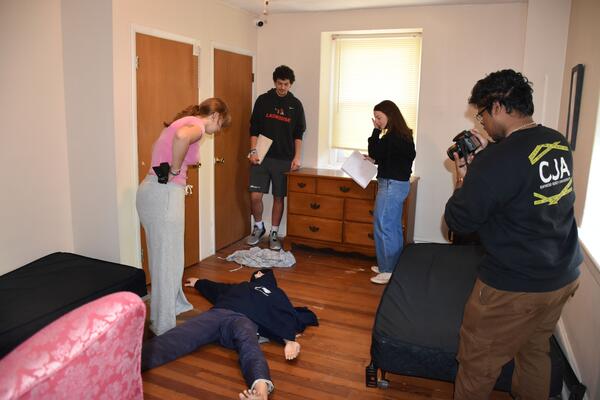
    Inside an unoccupied house, a student gingerly pushes open a creaky door and takes a wary step into a dark room—only to find the walls completely splattered with blood.

    It sounds like the cliché climax in a horror movie, but for students in the criminal justice program at Gwynedd Mercy University, it’s a regular class assignment.

    This fall, Gwynedd Mercy unveiled a new Crime Scene House, a three-story home that features various staged rooms for experiential learning in forensic science. Students now have a space for simulated criminal investigations, with each room configured to resemble a different crime scene they might encounter, including the blood spatter room.

    Gwynedd Mercy is one of a dozen-plus colleges across the country that turn houses into mock crime scenes; West Virginia University claims the title for largest hands-on training complex in the U.S., boasting four crime scene houses, a vehicle processing garage, a ballistics test center and designated grounds for excavation.

    The not-so-haunted houses are designed to give students a safe, supervised space to immerse themselves in a crime scene. Plus, it’s a great enrollment draw for students who get a thrill out of murder mysteries.

    “We’re very excited about the opportunity to have students come into our program and learn the how-to, so then they walk out of here and they say, ‘This is what I want to do,’” said Patrick McGrain, associate professor of criminal justice and the program director at Gwynedd Mercy. “It really is for the benefit of creating a more professional law enforcement community.”

    From convent to crime scene: McGrain and university leaders aspired to open a crime scene house on campus for years. In July, the dream became a reality when the Catholic university’s administrators identified an older building that used to house the Sisters of Mercy. The building was in disarray, and when McGrain was offered the opportunity to revamp it for students, he jumped at the chance.

    The Crime Scene House holds a variety of staged rooms to practice different investigations including a kitchen, a bathroom, two bedrooms and an office. In addition, the house features spaces for other simulated experiences, including an interrogation room, an evidence area to analyze fingerprints and a model “flophouse,” or a low-rent motel room used for drugs. And of course, the blood spatter room.

    “We’re going to teach students how to analyze blood splatter, the analysis of the trajectory,” McGrain said.

    Every element of the house is available for students to manipulate and investigate, even the flooring.

    “We have carpet laid down that they cut out pieces, use luminol and then take it over to the lab, well, what is it that we have?” McGrain explained. “Is it feces, it is urine, is it semen, is it blood? What is it that we’re looking at and what do you think happened in this room?”

    Faculty can track students’ progress solving the investigations through cameras mounted in each of the rooms.

    While the home at times may resemble an escape room, with CCTV cameras and a mystery to solve, “the only person locked in is the one who’s been kidnapped, and that’s been planned, and it’s a dummy,” McGrain said.

    The university allocated a small budget for furniture, but a significant number of items came directly from campus community members, who donated household items or clothing.

    “I even had two students who found a couch on the side of the road, grabbed it, put it in their trunk and brought it in,” McGrain said. “It is now the couch that sits in the living room.”

    Because the house is designed to be ransacked and torn up by “criminals,” the university also keeps backup furniture and wall decor.

    “If we want to break something, if we need to tear something, we do,” McGrain said. “The hands-on learning knows no limits.”

    Experiential learning: Other academic programs, including nursing, psychology and social work, have simulation labs integrated into the curriculum to allow students to practice their skills. In the same way, the house gives criminal justice students a chance to gain career skills.

    Before the Crime Scene House was established, Gwynedd Mercy faculty would set up a classroom to resemble the crime scene.

    “It’s not nearly as detailed,” McGrain said. “You don’t have the furniture. You don’t have the fake drugs or guns.”

    The facility has also served as a resource for law enforcement to train new detectives on how to use tech tools, such as digital photography and indoor drones.

    Jerome Mathew, a junior criminal justice student, said having the Crime Scene House is a game-changer—especially for getting incoming students amped about studying criminal justice.

    “They were really thrilled about seeing all the different fake drugs, money, different rooms, the cameras and how monitored everything was,” Mathew said.

    Gwynedd Mercy has plans to grow the criminal science major and launch a forensic science minor. The Crime Scene House will be an integral piece of that, McGrain said. “We’re expecting to see a spike in applications and a spike in admissions.”

    Source link

  • Top Hat Unveils AI-Powered Content Enhancer to Fuel Title II Accessibility Compliance

    Top Hat Unveils AI-Powered Content Enhancer to Fuel Title II Accessibility Compliance

    New capabilities in Top Hat Ace enable educators to quickly and easily transform static course materials into accessible, interactive content.

    TORONTO – October 28, 2025 – Top Hat, the leader in student engagement solutions for higher education, today announced the launch of a powerful new accessibility tool in its AI-powered assistant, Ace. Ace Content Enhancer gives faculty the ability to upload existing course materials into Top Hat and receive actionable guidance to meet WCAG 2.1 AA accessibility standards with minimal effort.

    Following the U.S. Department of Justice’s 2024 Title II ruling, public colleges and universities must ensure all digital content meets WCAG 2.1 AA standards as early as April 2026, depending on institution size. But for most professors, the path to compliance is anything but clear. The rules are highly technical, and without dedicated time or training, it can be challenging to ensure materials are fully compliant. Ace Content Enhancer removes this burden by scanning materials in Top Hat in seconds, identifying issues, and providing recommendations to help content meet the standards for accessibility outlined under Title II.

    “We’re helping educators meet this moment by simplifying compliance and making it easier to create learning experiences that serve all students,” said Maggie Leen, CEO of Top Hat. “More than meeting a mandate, this is an opportunity to create content that’s more engaging, and ultimately more effective in supporting student success.”

    A faster, simpler path to compliant courseware

    With Ace’s AI-powered Content Enhancer, faculty can:

    • Scan materials for accessibility issues instantly. Uploaded or existing content in Top Hat is analyzed in seconds, with specific accessibility concerns in text and images flagged for quick review.
    • Remediate with ease. Recommendations and features like auto-generated alt-text remove guesswork and save time.
    • Improve clarity for all learners. Suggested tone helps make content easier to understand and more effective.
    • Make content more relevant. Use Ace to generate real-world examples tailored to students’ interests, academic goals, or backgrounds to boost engagement.
    • Reinforce learning through practice. Ace will suggest interactive, low-stakes questions to deepen understanding and support active learning.

    “Educators retain full control of their content, while Ace eliminates the guesswork, making accessibility improvements fast, intuitive, and aligned with instructional goals,” said Hong Bui, Chief Product Officer at Top Hat. “We’re providing a guided path forward so that accessibility doesn’t come at the expense of interactivity, creativity, or sound pedagogy.”

    The launch of Ace Content Enhancer reflects Top Hat’s broader commitment to accessibility. It builds on existing capabilities—like automatic transcription of slide content—and reinforces the company’s focus on ensuring all student-facing tools and experiences, across web and mobile, meet WCAG 2.1 AA standards, including readings, assessments, and interactive content.

    About Top Hat

    As the leader in student engagement solutions for higher education, Top Hat enables educators to employ evidence-based teaching practices through interactive content, tools, and activities in in-person, online and hybrid classroom environments. Thousands of faculty at more than 1,500 North American colleges and universities use Top Hat to create personalized, engaging and accessible learning experiences for students before, during, and after class. To learn more, please visit tophat.com.

    Source link

  • State Department Unveils Student and Exchange Visitor Visa Social Media Vetting Guidance – CUPA-HR

    State Department Unveils Student and Exchange Visitor Visa Social Media Vetting Guidance – CUPA-HR

    by CUPA-HR | June 24, 2025

    On June 18, the Department of State issued a cable to all U.S. diplomatic and consular posts formally expanding the screening and vetting process for applicants of F, M and J (FMJ) nonimmigrant visas. The State Department guidance resumes FMJ appointment scheduling after a previous announcement from the agency paused all student visa interviews as they prepared for the new social media screening and vetting guidance.

    Background

    At the end of May, the State Department announced that U.S. embassies and consular sections were pausing new student visa interviews as they awaited further guidance on new social media screening and vetting requirements. CUPA-HR joined the American Council on Education and other higher education associations on a letter to Secretary of State Marco Rubio requesting the agency quickly implement the new vetting measures to ensure new student visas could be efficiently processed before the 2025-2026 academic year. No further guidance was publicly announced between the announced pausing of student visa interviews and the cable sent out to all diplomatic and consular posts.

    New Screening and Vetting Guidance

    The cable directs consular sections to resume scheduling FMJ appointments after implementing the new vetting procedures. The guidance requires officers to conduct “a comprehensive and thorough vetting of all FMJ applicants, including online presence, to identify applicants who bear hostile attitudes toward our citizens, culture, government, institutions, or founding principles; who advocate for, aid, or support designated foreign terrorists and other threats to U.S. national security; or who perpetrate unlawful antisemitic harassment or violence.” The posts are directed to implement the new guidance within five business days.

    As explained in the cable, consular officers are directed to conduct intake and interviews in accordance with standard procedures, but once an FMJ applicant is otherwise eligible for the requested nonimmigrant status, officers must temporarily refuse the case under Section 221(g) of the Immigration and Nationality Act (INA). After refusing the case, officers must request the applicant set all social media accounts to “public,” after which the officer must examine “the applicant’s entire online presence — not just social media activity — using any appropriate search engines or other online resources.”

    The new vetting procedures could limit the consular officers’ ability to process student visa applications quickly and efficiently as the cable also mentions that consular sections should “consider the effect of this guidance on workload” when resuming the scheduling of FMJ appointments. Even with these concerns, the cable does request expedited appointments for certain FMJs, including J-1 physicians and F-1 students seeking to study at U.S. institutions where the international student body constitutes 15 percent or less of the total student population.

    While much of the advocacy from interested stakeholders on this issue revolves around students, individuals seeking J-1 visas to participate in cultural and educational exchange programs to conduct research or teach at institutions could be subject to an enhanced level of scrutiny. CUPA-HR will continue to monitor for updates related to the FMJ vetting processes.


    Source link

  • Education Department unveils guidance to make switching accreditors easier

    Education Department unveils guidance to make switching accreditors easier

    This audio is auto-generated. Please let us know if you have feedback.

    The U.S. Department of Education unveiled guidance Thursday intended to make it easier for colleges to change accreditors and lifted a pause on its review of applications for new accrediting agencies. 

    The guidance comes a week after President Donald Trump signed an executive order to reshape the accreditation system and make it easier for new agencies to come onto the scene. 

    Trump’s order also took aim at accreditor criteria related to diversity, equity and inclusion and directed U.S. Education Secretary Linda McMahon to ensure colleges prioritize “intellectual diversity” among their faculty — a mandate that raised concerns about academic freedom among some higher education experts. 

    “President Trump’s Executive Order and our actions today will ensure this Department no longer stands as a gatekeeper to block aspiring innovators from becoming new accreditors nor will this Department unnecessarily micromanage an institution’s choice of accreditor,” McMahon said in a Thursday statement. 

    The Education Department also revoked guidance issued in 2022 that outlined a more rigorous review process for colleges to switch accreditors. The Biden-era guidance said the department would review whether a college wanted to change accreditors to lessen oversight and if moving to a new agency would strengthen its institutional quality, among other factors. 

    At the time, the Biden administration said the guidance sought to ensure colleges weren’t attempting to evade oversight from their current accreditor by switching to a new one. 

    The Trump administration’s new guidance, however, says the agency will reestablish “a simple process that will remove unnecessary requirements and barriers to institutional innovation.” Under the policy, colleges must submit a two-page form to serve as documentation of their prior accreditation, as well as “materials demonstrating reasonable cause” for changing or adding an accreditor. 

    The form includes a checklist of reasons institutions may seek to switch accreditors, along with a section requiring colleges to certify that they have not had their accreditation withdrawn or faced accreditor sanctions in the past two years. Colleges must also attach their most recent letter renewing their accreditation. 

    Wesley Whistle, project director for student success and affordability at New America, a left-leaning think tank, criticized the new process, arguing that making it easier to switch accreditors could lead institutions to move to agencies with less rigorous standards. 

    “This new guidance says all they have to do is fill out this checklist and provide them [with] their most recent letter of reaffirmation,” Whistle said. “That letter could be almost a decade old.”

    Moreover, that letter wouldn’t indicate if a college is currently under investigation by its accreditor, Whistle said. 

    “Just because an institution may not be on probation today, they could still be under investigation,” Whistle added. 

    The Education Department also said it will have 30 days to approve an application to switch accreditors. If not, the change will be automatically granted unless a college failed to meet the eligibility requirements. 

    Whistle described the policy as a “30-day rubber stamp.” 

    “It’s irresponsible,” Whistle said. “There’s nearly 6,000 colleges and universities that are eligible for Title IV aid, so conducting even a modest review takes time and expertise.”

    The Trump administration’s new guidance also permits colleges to switch to new accreditors if required by state law. Other recognized reasons include seeking an accreditor that better aligns with a college’s religious mission, changing the types of academic programs offered or objecting to current accreditation standards, including DEI requirements. 

    Source link

  • Liaison Unveils New Intelligent Names Degree Intent Scores, Enhancing Predictive Power and Reach 

    Liaison Unveils New Intelligent Names Degree Intent Scores, Enhancing Predictive Power and Reach 

    Liaison, a leader in education technology and data-driven solutions, is excited to announce the release of its 2025 Intelligent Names Degree Intent Scores. These advanced scores represent a transformative leap in identifying adult learners nationwide with the highest potential for pursuing a degree. 

    The 2025 Degree Intent Scores are powered by cutting-edge data science, advanced modeling techniques, and insights from a national survey conducted in late 2024. Combined with responses from Liaison’s extensive consumer database of over 260 million Americans, this enhanced model offers unparalleled precision and reach into the adult learners market. 

    Recent testing using a national dataset of graduate program applicants showed a 20% improvement in predicting applicant activity within the highest intent band when comparing the new intent scores to the original. Similarly, an analysis of a national dataset of bachelor’s degree seekers found that Liaison’s Bachelor’s Degree Intent model accurately identified 91% of degree seekers under the age of 25 in the top two quintiles. These findings underscore the model’s remarkable accuracy, effectiveness, and value for higher education institutions. 

    “The 2025 Degree Intent Scores mark a major milestone in our mission to connect educational institutions with adult learners who are ready to take the next step in their academic journeys,” said Dr. Mark Voortman, Chief Data Scientist at Liaison. “By leveraging large-scale data and state-of-the-art modeling techniques, we’ve significantly enhanced our ability to help institutions identify adult learners most likely to pursue degree opportunities in the near future.” 

    The updated scoring model empowers colleges, universities, and other education providers with deeper, data-driven insights to refine recruitment strategies, enhance student engagement, and achieve enrollment goals more effectively. 

    Learn more about Intelligent Names here.

    Source link