Tag: Update

  • New Jersey Weighs Biggest Update of Charter School Rules in 30 Years – The 74

    New Jersey Weighs Biggest Update of Charter School Rules in 30 Years – The 74


    Get stories like this delivered straight to your inbox. Sign up for The 74 Newsletter

    Senate lawmakers on Monday advanced legislation that would launch the most comprehensive overhaul of New Jersey’s regulation of charter schools in 30 years.

    The bill advanced by the Senate Education Committee on Monday would outright ban for-profit charter schools, require them to post a range of documents online, and impose residency requirements for some charter school trustees.

    “We have not looked at charter schools as a whole legislatively in this committee since the 1990s, so this is an opportunity where we’re trying to do that,” said Sen. Vin Gopal (D-Monmouth), the panel’s chair and the bill’s prime sponsor.

    The bill comes as New Jersey charter schools have faced scrutiny after reporting revealed top officials were paid far more than their counterparts at traditional public schools, including, among others, a Newark charter school CEO who was paid nearly $800,000 in 2024.

    The proposal, which Gopal said was the product of a year of negotiations, would require charter schools to post user-friendly budgets that include the compensation paid to charter school leaders and school business administrators. They must also post existing contracts.

    Charters would be required to post meeting notices, annual reports, board members’ identities, and facility locations online. Some critics have charged that charter schools routinely fail to provide notice of their public meetings.

    The legislation would also require the state to create a dedicated charter school transparency website to host plain language budgets, 990 disclosure forms filed with the IRS, contracts with charter management organizations, and a list of charter schools on probation, among other things.

    It would also ban fully virtual charter schools.

    “We support the bills as a step forward in holding all public schools in our state accountable for fiscal and transparency requirements that will ultimately best serve our students,” said Debbie Bradley, director of government relations for the New Jersey Principals and Supervisors Association.

    The two sides remained at odds over the membership of charter school boards.

    Charter critics argued residency for those positions — which, unlike traditional public school boards, are largely appointed rather than elected — should mirror those imposed on regular public schools.

    In New Jersey, school board members must live in the district they serve. That’s not the case for charter schools, whose trustees face no residency or qualification limits under existing law.

    The bill would only impose a residency requirement on one-third of a charter school’s trustees, and rather than forcing them to live in the district, the bill would require charter trustees to live in the school’s county or within 30 miles of the school.

    That language was criticized by statewide teachers union the New Jersey Education Association, which has called existing law governing charter schools outdated and flawed.

    “School board representation should remain primarily local, and when we mean local, we don’t mean within a 30-mile radius. A 30-mile radius of Newark could include Maplewood, South Orange, communities that don’t necessarily represent what Newark looks like as a community,” said Deb Cornavaca, the union’s director of government relations.

    Charter school supporters said their boards need flexibility because their leadership has broader responsibilities than counterparts in traditional public schools.

    “Running a charter is a little different than running a traditional district. You need experience in school finance. You need to fundraise a bunch of money on the front end because you’re not getting paid on the front end,” said New Jersey Charter School Association President Harry Lee, adding they also needed familiarity with real estate and community experience.

    Amendments removed provisions that would have required charter school board members to be approved by the state commissioner of education, though the commissioner retains sole power over whether to allow the formation of a new charter, a power that gives the commissioner some veto power over a charter’s board.

    Gopal acknowledged the 30-mile residency rule was a sticking point and said legislators would discuss it before the measure comes before the Senate Budget Committee. Earlier, he warned the bill was likely to see more changes as it moved through the Legislature.

    Some argued enrollment in charter schools should be more limited by geography, arguing that out-of-district enrollments that are common at New Jersey charters could place financial strain on the students’ former district.

    Most per-pupil state and local funding follows students who enroll in charter schools, even if their departure does not actually decrease the original district’s expenses because, for example, those schools still require the same number of teachers and administrators.

    Charter operators said that would make New Jersey a national outlier and argued that a separate provision that would bar new charter schools when there are empty seats in existing area charters should come out of the bill.

    “It could be read as a moratorium on charters, so we want to revisit that provision,” Lee said.

    Such vacancies could exist for various reasons, they argued, including student age distributions.

    Alongside that measure, the panel approved separate legislation that would bar charter schools from setting criteria to enroll students, ban them from imposing other requirements on a student randomly selected to attend, and place new limits on how such schools can enroll children from outside their district.

    That bill would also bar charter schools from encouraging students to break with the district. Some opponents have charged that charter schools push out low-performing students to boost their metrics.

    The committee approved the bills in unanimous votes, though Sens. Owen Henry (R-Ocean) and Kristin Corrado (R-Passaic) abstained from votes on both bills, saying they are broadly supportive but need more time to review amendments.

    New Jersey Monitor is part of States Newsroom, a nonprofit news network supported by grants and a coalition of donors as a 501c(3) public charity. New Jersey Monitor maintains editorial independence. Contact Editor Terrence T. McDonald for questions: [email protected].


    Did you use this article in your work?

    We’d love to hear how The 74’s reporting is helping educators, researchers, and policymakers. Tell us how

    Source link

  • Higher Education Inquirer : Choosing the Right College as a Veteran: An Update for 2025

    Higher Education Inquirer : Choosing the Right College as a Veteran: An Update for 2025

    In 2018, Military Times published a guide titled “8 Tips to Help Vets Pick the Right College.” While the intent was good, the higher education landscape has shifted dramatically since then — and not for the better. For-profit colleges have collapsed and rebranded, public universities are raising tuition while cutting services, and predatory practices continue to target veterans with GI Bill benefits.

    Meanwhile, agencies like the Department of Defense (DOD) and the Department of Veterans Affairs (VA) — tasked with protecting veterans — have too often failed in their oversight. Investigations have revealed FOIA stonewalling, regulatory rollbacks, and a revolving door between government and industry. Veterans are left to navigate a minefield of deceptive recruiting, inflated job-placement claims, and programs that leave them indebted and underemployed.

    Here’s what veterans need to know in 2025.


    1. Don’t Trust the Branding

    Colleges love to advertise themselves as “military friendly.” This phrase is meaningless. It’s often nothing more than a marketing slogan used to lure GI Bill dollars. The fact that a school has a veterans’ center or flags on campus tells you little about program quality, affordability, or long-term value.


    2. Look at the Numbers, Not the Sales Pitch

    Use College Scorecard and IPEDS data to examine:

    • Graduation and completion rates

    • Typical debt after leaving school

    • Loan default and repayment statistics

    • Earnings of graduates in your intended field

    If a school avoids publishing these numbers or makes them hard to find, that’s a red flag.


    3. Understand the Limits of Oversight

    The VA’s GI Bill Comparison Tool and DOD “oversight” portals may look official, but they are incomplete and sometimes misleading. The VA has even restored access to schools after proven misconduct under political pressure. DOD contracts with shady for-profit providers continue despite documented abuse.

    Oversight agencies are not independent referees — too often, they are captured regulators.


    4. Seek Independent Evidence

    Avoid relying on large, national veteran nonprofits. Many of these organizations accept funding from schools, corporate partners, or government agencies with vested interests.

    Instead, veterans should:

    • Check state attorney general enforcement actions and FTC press releases.

    • Read independent investigative journalism (such as the Higher Education Inquirer or Project on Predatory Student Lending).

    • Ask tough questions of alumni — especially those who dropped out or ended up in debt.


    5. Watch Out for Job Placement Claims

    Schools often boast of “high job placement rates” without clarifying what that means. Some count temporary or part-time work unrelated to your field. If a program promises guaranteed employment, demand written proof.


    6. Don’t Chase Prestige

    Big-name universities are not automatically better. Some elite schools partner with for-profit online program managers (OPMs) that deliver low-quality, high-cost programs to veterans and working adults. Prestige branding doesn’t guarantee fair treatment.


    7. Weigh Community Colleges and Public Options

    Community colleges can be a safer starting point, offering affordable tuition, transferable credits, and practical programs. Some state universities provide strong veteran support at the local level, even when national oversight is weak.


    8. Build and Rely on Grassroots Networks

    Large veteran organizations at the national level often fail to protect veterans from predatory colleges. Veterans are better served by:

    • Local veteran groups that are independent and community-based

    • Direct peer networks of fellow veterans who have attended the schools you’re considering

    • Public libraries, grassroots councils, and smaller veteran meetups not tied to corporate or political funding

    • Sharing experiences through independent media when official channels fail


    Protect Yourself, Protect Others

    Veterans have long been targeted by predatory colleges because their GI Bill benefits represent guaranteed federal money. DOD, VA, and large national veteran groups have too often enabled this exploitation.

    The best defense is independent evidence, grassroots testimony, and investigative journalism. By asking hard questions, demanding transparency, and supporting one another at the local level, veterans can avoid the traps that continue to ensnare far too many.

    For those who have been targeted and preyed upon, please consider joining the Facebook group, Restore GI Bill for Veterans.  


    Sources:

    Source link

  • Later Wake-Up Call for Inside Higher Ed’s Daily News Update

    Later Wake-Up Call for Inside Higher Ed’s Daily News Update

    Loyal Inside Higher Ed readers who wake up to our daily newsletter will soon have an easier time finding each day’s edition in their crowded inboxes. 

    Starting Tuesday, Sept. 2, the Daily News Update will arrive between 5:30 and 6:00 a.m. Eastern, several hours later than the current 3:15 a.m. This may upset the morning routines of the handful of souls on the East Coast who rise before the sun, but for most readers, we hope this change means our newsletter is there at the top of your inbox when you log in, ready to inform your day.  

    Thank you for waking up with Inside Higher Ed

    Source link

  • a summer 2025 update (Bryan Alexander)

    a summer 2025 update (Bryan Alexander)

    Greetings from early July. I’m back home in northern Virginia where the heat is blazing and the humidity sopping.  Weather.com thinks it “feels like 102° F” and I agree.  The cats also agree, because they retreated elegantly inside to air conditioning after a brief outside stroll.

    I wrote “back home” because my wife and I spent last week celebrating our 32nd anniversary in Canada (here’s one snapshot).  Afterwards I was hoping to get back into the swing of things, blogging, Substacking, vlogging various topics already under way, but things have been advancing at such a manic pace that I have to leap in in a hurry.

    Case in point: after blogging about campus closures, cuts, and mergers last month more closures and cuts (albeit no mergers) have appeared in just the past few weeks.  In this post you’ll see a list of these, with links to supporting news stories and official documents.  Alas, this has become a tradition on this site.  (From last year: March 1March 20March 28AprilMayJuneJulySeptemberNovember. From this year: FebruaryJune.) My book on peak higher education is now in the editing process; hopefully by the time it appears the topic won’t be simply historical.

    Today we’ll touch on one closure, then focus on cuts, with a few reflections at the end.

    1. Closing colleges and universities

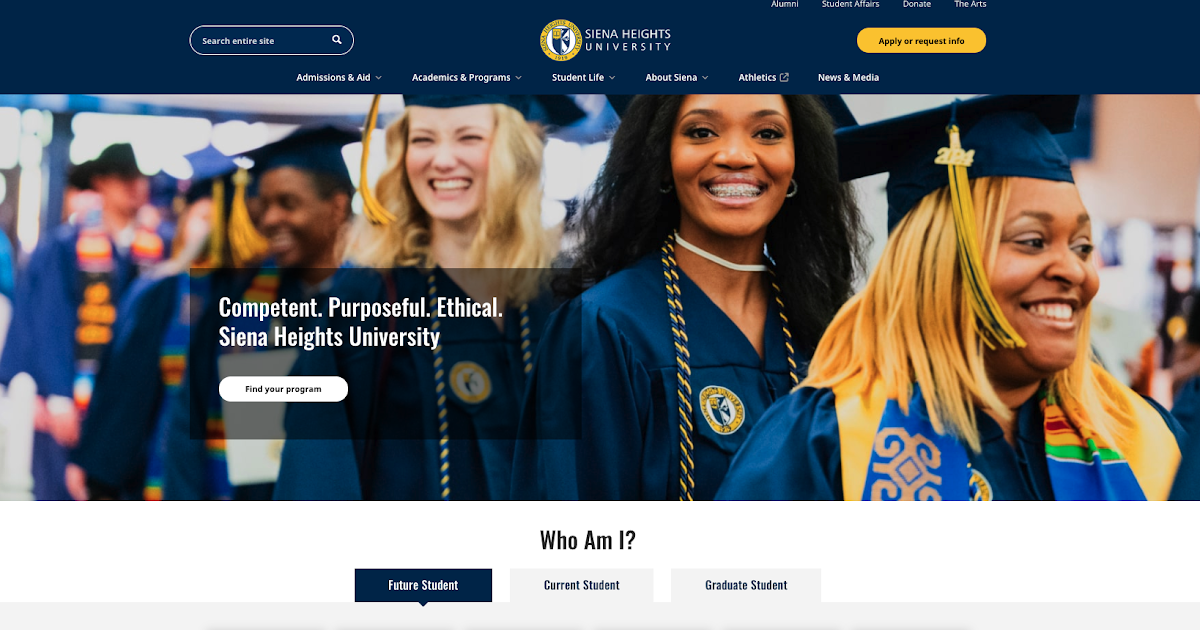
    In Michigan Siena Heights University (Catholic) will close after the upcoming academic year.  The reasons: “the financial situation, operational challenges, and long-term sustainability,” according to the official statement.  A local account concurs, “citing rising costs and stiffer competition for new students.”

    The official website doesn’t reflect this on its front page.

    2. Program and staffing cuts

    Also in Michigan, Concordia University (Lutheran) is shutting down most of its Ann Arbor campus programs. A much smaller set of offerings is what’s next:

    Starting June 2025, the private Lutheran institution will offer just nine programs — all in medical-related fields — on its physical campus. That’s down from 53 campus programs the university currently lists on its website. It will offer another seven online programs, mostly in education fields, which is down from more than 60 currently.

    Also nearby, Michigan State University (public, research) announced its intention to cut faculty and staff positions this year.  The drivers: inflation boosting costs, especially in health care; Trump administration research funding cuts; possible state support cuts; potential international student reduction.

    Brown University (research; Rhode Island) is planning to cut an unspecified number of staff this summer.  Furthermore, “[a]dditional measures include scaling back capital spending and adjusting graduate admissions levels after limiting budget growth for doctoral programs earlier this year.”  The reasons here are financial, but based on the Trump administration’s cuts to federal research funding, not enrollment problems.

    The Indiana Commission for Higher Education announced shutting down a huge sweep of academic programs across that state’s public universities.  More than 400 degrees will end, with 75 ended outright and 333 “merged or consolidated” with other programs.  The whole list is staggering.  There’s a lot of detail in that Indiana plan, from defining student minima to establishing various options for campuses, appealing closures to timelines for revving up new degrees.  It’s unclear how many faculty and/or staff cuts will follow.

    Columbia College Chicago (private, arts focused) laid off twenty full-time professors.  The school is facing enrollment declines and financial problems. Nearly all of these faculty member are – were – tenure track, which makes this another example of the queen sacrifice.

    University of California-Santa Cruz (public, research) is terminating its German and Persian language programs, laying off their instructors.  This sounds part of a broader effort to cut costs against a deficit, a deficit caused by “rising labor costs and constrained student enrollment growth,” according to officials.

    Boston University (private, research) announced it would lay off 120 staff members as part of a budget-cutting strategy. BU will also close 120 open staff positions and “around 20 positions will undergo a change in schedule” (I’m not sure what that means – shift from full time to part?).    The reasons: Trump administration cuts and uncertainty, plus the longstanding issues of “rising inflation, changing demographics, declining graduate enrollment, and the need to adapt to new technologies.”

    The president of Temple University (public, research, Pennsylvania) discussed job cuts as part of a 5% budget cut.  Reasons include lower enrollment which led to “a structural deficit [for which] university reserves were used to cover expenses.”

    Champlain College (Vermont) is closing some low-enrolling majors. The avowed goal is to
    “design a new ‘career-focused’ curriculum for the fall of 2026 ‘that is focused on and driven by employer needs and student interests.’”

    The accounting program, for instance, saw its enrollment decline from 60 students in 2015 to 20 in February 2024, according to documents from the school’s Academic Affairs Committee. The law program, similarly, had little student interest, Hernandez said, and had only three students apply in the fall of 2023, while the data analytics program had only two applications.

    At the same time the school is facing serious challenges.  Enrollment has sunk from 4,778 students in 2016 to 3,200 last year.  The college ran deficits in some reason years and a federal audit criticized the amount of debt it carries.  This year “the college’s bond rating was lowered, and its outlook downgraded to ‘negative’ by S&P Global Ratings.”

    Lake Champlain sky 2017

    Looking across the lake from Burlington, near Champlain’s campus back in 2017: a cheery image to balance sad stories.

    A small but symbolic cut is under way at Albright College (private, liberal arts, Pennsylvania), whose president decided to sell their art college at auction.  “It includes pieces by Karel Appel, Romare Bearden, Robert Colescott, Bridget Riley, Leon Golub, Jasper Johns, Jacob Lawrence, Marisol, Gordon Parks, Jesús Rafael Soto and Frederick Eversley, among others.”

    Why do this?  according to the administration, it was a question of relative value:

    “We needed to stop the bleeding,” says James Gaddy, vice-president for administration at Albright, noting that over the past two years the college has experienced shortfalls of $20m. Calling himself and the college’s president Debra Townsley, both of whom were hired last year, “turn-around specialists”, Gaddy claimed that Albright’s 2,300-object art collection was “not core to our mission” as an educational institution and was costing the college more than the art is worth.

    “The value of the artworks is not extraordinary,” he says, estimating the total value of the pieces consigned to Pook & Pook at $200,000, but claimed that the cost of maintaining the collection was high and that the cost of staffing the art gallery where the objects were displayed and (mostly) stored was “more than half a million dollars” a year.

    Albright College art collection auction screenshot

    A screenshot of some of the auction lots.

    3 Budget crises, programs cut, not laying off people yet

    Cornell University is preparing staff cuts in the wake of Trump administration research funding reductions.

    The University of Minnesota’s administration agreed to a 7.5% cut across its units, along with a tuition increase.  The president cited frozen state support and rising costs.

    New York University (NYU) announced a 3% budget cut.  So far this is about “emphasizing cuts to such functions as travel, events, meals, and additional other-than-personal-service (OTPS) items.” NYU will keep on not hiring new administrators and is encouraging some administrators and tenured professors to retire.

    Yale University paused ten ongoing construction projects because of concerns about cuts to federal monies.

    Reflections

    Many of these stories reflect trends I’ve been observing for a while.  Declining enrollment is a major problem for most institutions. The strategy of cutting jobs to balance a budget remains one at least some leaders find useful. The humanities tend to suffer more cuts than others (scroll down the Indiana pdf for a sample). Depending on the state, state governments can increase budget problems or alter academic program offerings.

    The second Trump administration’s campaign against higher education is drawing blood, as we can see from universities citing the federal research cuts in their budgets and personnel decisions. Note that this is before the One Big Beautiful Bill Act’s provisions take hold, from capping student aid to increasing endowment taxes. And this is also before whatever decrease will appear with international student enrollment this fall. (Here’s my video series on Trump vs higher ed; new episode is in the pipeline.)

    Note the number of elite institutions in today’s post.  In the past I’ve been told that the closures, mergers, and cuts primarily hit low-ranked and marginal institutions, which was sometimes true. But now we’re seeing top tier universities enacting budget cuts, thanks to the Trump administration.

    Let me close by reminding everyone that these are human stories. Program cuts hurt students’ course of student. Budget cuts impact instructors and staff of all kinds. When we see the statistics pile up we can lose sight of the personal reality.  My heart goes out to everyone injured by these institutional moves.

    Finally, I’d like to invite anyone with information on a college or university’s plans to close, merge, or cut to share them with me, either as comments on this post, as notes on social media, or by contacting me privately here.  I write these posts based largely on public, open intelligence (news reports, investigations, roundups) but also through tips, since higher education sometimes has issues with transparency.  We need better information on these events.

    (thanks to Will Emerson, Karl Hakkarainen, Kristen NyhtCristián Opazo, Peter Shea, Jason Siko, George Station, Nancy Smyth, Ed Webb, and Andrew Zubiri for supplying links and feedback)

    This article first appeared at bryanalexander.org


    Source link

  • 5 Steps to Update Assignments to Foster Critical Thinking and Authentic Learning in an AI Age – Faculty Focus

    5 Steps to Update Assignments to Foster Critical Thinking and Authentic Learning in an AI Age – Faculty Focus

    Source link

  • DOD Fails to Update Postsecondary Education Complaint System

    DOD Fails to Update Postsecondary Education Complaint System

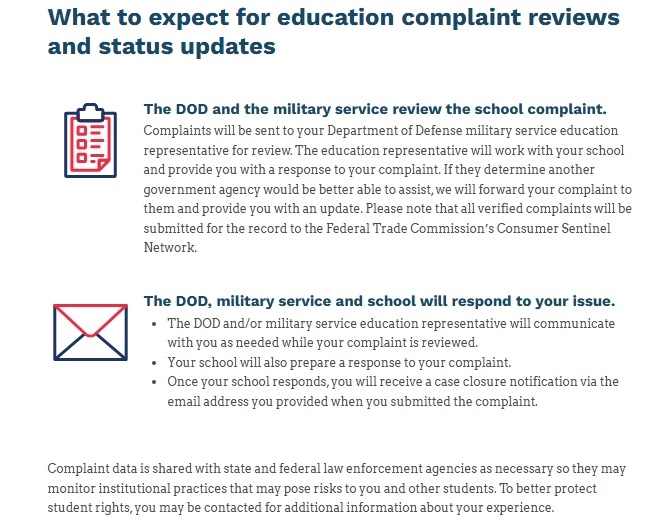
    Is the US Department of Defense (DOD) actually handling complaints from service members and their spouses who are using DOD Tuition Assistance and MyTAA (the education program for spouses)? It’s difficult to tell, and it’s unlikely that they’ll tell us. 

    DD Form 2961 is used for servicemembers and their spouses to make complaints about schools. And it appears up to date.  And on their website, DOD still claims to help consumers work with schools about their complaints. 

    But information about the US Department of Defense Postsecondary Education Complaint System (PECS), the system that handles the complaints, has not been updated in about a decade. Here’s a screenshot from May 25, 2025.  

    What we do know is that DOD VOL ED and the DOD FOIA team have stonewalled us for eight years to get important information about their oversight. We also know that DOD VOL ED has allowed bad actor schools to violate DOD policies as they prey upon those who serve.  Over the years we have notified a number of media outlets about these issues but few if any have shown interest. 

    Source link

  • Incremental Change or System Overhaul? An Update on Higher Ed Reform in NZ with Roger Smyth

    Incremental Change or System Overhaul? An Update on Higher Ed Reform in NZ with Roger Smyth

    In some countries, higher education policy just seems to sit still for decades. In others, hyperactivity is a more normal state. Today we’re looking at the 2020s poster child for higher education hyperactivity. It’s not the usual suspects, the UK or Australia, it’s little New Zealand where we’re making our fourth stop on this podcast in just over two and a half years.

    When last we were in Wellington, we talked to Chris Whelan from Universities New Zealand about university underfunding the consequences of losing international students, and something called the University Advisory Group, which was supposed to set the national system on a new course along with a research advisory group who weirdly was made up of exactly the same people only following a different mandate.

    Since then, while these groups were noodling on how best to steer the system, the government made two big table flipping moves. One musing about creating a new type of institution, which was neither a university nor a college, and nobody knew what they were talking about, and the other simply deciding it wasn’t going to fund any more research in the social sciences and humanities through its research granting system. Fun times.

    Anyways, with all this excitement, we figured it was worth going back to the Tasman Sea to check in with one of our regular correspondents, Roger Smyth. He’s a former senior New Zealand public servant and now a consultant based in Canterbury. He’s got all the skinny for us. And so, over to Roger.


    The World of Higher Education Podcast
    Episode 3.32 | Incremental Change or System Overhaul? An Update on Higher Ed Reform in NZ with Roger Smyth

    Transcript

    Alex Usher (AU): Roger, the last time we did a show about New Zealand, we had Chris Whelan from Universities New Zealand on, and we talked a lot about the University Advisory Group process. How far along is that work, and what are people in the sector saying about it? What’s the view at this stage? Is there still interest and momentum behind the process, or has it stalled out a little?

    Roger Smyth (RS): Okay, so the advisory group submitted an interim report late last year, and it’s scheduled to submit its final report this month. I understand that the report has now been submitted, but nothing has been published yet. Neither the interim report nor the final report, nor any of the dozens of submissions made in response to the UAG’s questions, have been released publicly.

    In these sorts of cases, the report usually isn’t published until the government has had a chance to make its initial decisions on some of the high-level questions—and that could still be a little way off.

    Of course, as you implied, Alex, there are rumors. And in some of the face-to-face consultations, the UAG has given a bit of a steer as to where it was heading. For instance, it’s pretty clear that in their interim report, they were proposing a machinery of government change—a reorganization of some of the government agencies in higher education, such as the Tertiary Education Commission, the Ministry of Education, and the policy unit responsible for research and innovation. But we won’t know that for sure until the report comes out.

    One of the big challenges the advisory group would have faced is that the government is committed to returning to a financial surplus in the 2027–28 fiscal year. That’s a significant challenge, with major demands on the budget. So the advisory group would have been instructed to make their proposals fiscally neutral, and that’s a big constraint on what they could recommend.

    My main view on this whole process is that it was never really clear what problem the University Advisory Group was set up to solve—apart from a general instruction to look for improvement and to make the system work better. One of the most distinctive features of the New Zealand system is its homogeneity. That has a lot of positives—it means that wherever you go, you’re guaranteed a reasonable level of quality. But it also has the downside that there isn’t really any outstanding, world-leading university.

    AU: Let me stop you there, because alongside the University Advisory Group, there’s also been a commission on research—on research and science—a review going on at the same time. Why did that happen in parallel rather than together?

    RS: Yeah, I think that’s an important point. The first thing is that the two advisory groups were actually chaired by the same person—Peter Gluckman, a distinguished medical scientist and academic—and they began operating at roughly the same time.

    You can see there was a desire to think about knowledge transfer opportunities within universities and how they contribute to the broader economy and the wider science system.

    The Science Advisory Group has now completed its report. It’s been submitted, and the government has published its initial decisions. This is an area where the review proposed a very substantial overhaul of the machinery of government. They proposed creating a super ministry for higher education, science, technology, and innovation.

    The government, however, did not accept that proposal. Most governments are a bit wary of major machinery-of-government reshuffles unless there’s a very strong rationale. These kinds of changes often involve a settling-in period where the system can lose its way, as people jockey for position and the focus shifts away from the core goals the system is meant to achieve.

    Instead, the review also proposed merging the seven non-university research institutes into a single public research organization. The government opted for a partial reorganization, establishing three public research organizations—focused on the bioeconomy, earth sciences, and health and forensic science. They’re also creating a new organization to cover advanced technology fields like AI, synthetic biology, aerospace, and quantum tech. So that’s probably a reasonable foundation for advancing the science system.

    AU: But of course, before they even got to that point—before the advisory group had reported—the government unilaterally made a change to what’s called the Marsden Fund. That’s sort of like our combination of the social sciences, humanities, and natural science councils. And it effectively nuked the humanities and social sciences, as I understand it. They basically said, “We’re not going to fund those anymore.” Why did the government do that? Why undercut your own report before it even comes out?

    RS: Yeah, this was definitely a decision that caused a lot of pushback and consternation—real ill feeling in universities and across the broader community.

    Most of the government’s research funding is directed toward major national strategic priorities, so it tends to go to areas like health, the hard sciences, engineering, agriculture—things like that. The Marsden Fund was one of the few avenues where humanities researchers could secure external funding, outside of what universities provide internally.

    I think part of this decision reflects the government’s desire to place greater focus on the hard sciences. If you look at the Marsden Fund trends, the social sciences and humanities panel had been gaining a slightly larger share of the funding in recent years, which naturally came at the expense of the hard sciences. So in some sense, this was a declaration that the government wants to reorient support toward areas seen as having greater economic impact.

    That said, the main driver was probably to send a message. But in doing so, it sent a very negative signal to the humanities community. Even researchers in the now-favored areas were concerned about the loss of this funding stream—particularly given that social science research can produce huge social value.

    AU: This tension between favored STEM subjects and less-favored fields like the social sciences, humanities, and business is also playing out in discussions around the government’s funding model. My understanding is that in New Zealand, the funding model essentially funds places. So, the government allocates a certain number of places to each institution. Now we’re projecting that there will be more enrollments than there are funded places, and the government would like to provide a bit of additional funding for STEM subjects, but not for others. We’re very familiar with this in Canada—it’s exactly what’s happening in Ontario right now. I’m curious how you think that will play out in New Zealand?

    RS: Okay, well, just to give a bit of context on the financial situation of the universities: like most Anglophone countries with a heavy reliance on the international student market, COVID hit New Zealand universities hard. In 2021, the impact was cushioned by a surge in domestic enrollments. The labor market was weak due to the pandemic, so more people turned to study, and universities did okay financially.

    But in 2022, following government stimulus measures, the labor market recovered and became more robust. Domestic enrollments fell sharply, and the international student market still hadn’t bounced back. That made 2022 the worst financial year ever for the universities. Six of the eight were in deficit, and one was just breaking even.

    In 2023, when finances were still tight, there was a lot of concern about university viability. The government stepped in with a short-term funding rate boost—not an increase in the number of places, but an increase in the dollars per place.

    Then there was a small increase in funding again last year. But the broader funding review never happened. The government changed, and that process was superseded by the UAG process we discussed earlier.

    And that process, as we said, is likely to avoid anything that would seriously impact the government’s bottom line. So, the universities have been in a tough situation.

    But now, the international market is starting to recover. It’s been slower than in the other countries we compete with, but in EFTS terms—equivalent full-time students—2024 saw an 11% increase in international enrollments. It’s still below pre-pandemic levels, but the trend is positive. And that matters because each international student generates about 60% more revenue than a domestic student.

    Right now, we’re in the middle of the financial reporting season. Five of the universities have reported for 2024. One reported a small deficit on its core business, but it was much lower than expected and offset by a surplus on its wider trading operations.

    So, it’s still tough—marginal—but not as gloomy as it was a couple of years ago.

    Even though there’s still pressure, and enrollments may be shifting toward more expensive fields, financially speaking, the worst appears to be over. The system is beginning to grow again.

    And on the point about STEM versus other fields—it’s worth remembering this is a system driven by student choice. The government doesn’t have much influence over where students choose to go. So, no matter how the government might want to steer things, it can’t really control those choices under the current policy environment. So, I’d say that the universities are managing through this.

    AU: Roger, I want to get into something I read recently—there was a fascinating article where the government, or at least the minister, was musing about the idea of creating a new type of tertiary institution. Something that’s not quite a university and not quite a polytechnic.But before I ask you about that, I think we need to give our listeners a bit of background on polytechnics in New Zealand.

    Your system merged all the polytechnics into one big national institution just before COVID, right? That was Te Pūkenga. Why do that? What was the point of one national institution? It’s a big country—two islands, 15 campuses. That’s a lot to bring together. What was the thinking behind that?

    RS: These reforms had two separate sources.

    First, we talked earlier about the financial challenges in the university sector, but the polytechnics were facing a real financial crisis. They’d been growing for years and carried high fixed costs, with relatively small student numbers spread across multiple campuses.

    Between 2012 and 2019, domestic enrollments dropped by about 25%. By 2019, nearly all the polytechnics were running deficits, and the sector’s collective deficit was quite substantial. So something clearly had to be done.

    Second, the government looked at what had been done in Australia. In New South Wales, for example, they merged all the TAFE institutions into a single statewide TAFE. It worked reasonably well there, and in Queensland as well.

    So they decided to follow a similar path and merge all 16 institutions—along with all work-based training—into a single national organization. That was the rationale behind the creation of Te Pūkenga.

    AU: What about the un-merger? So, a few years later you get a new government—the National government—and they’re going to undo the whole thing. Was that because it was, as you said, a machinery-of-government issue? Or was it more about a shift in how the government views vocational education?

    RS: I think it was both.

    Let’s look at both sides. First, the merger didn’t go well. There were some good aspects to the reforms. For instance, they set up six Workforce Development Councils to set standards for training and take a forward-looking view of labor market needs in specific fields. That was a positive.

    The idea of reintegrating polytechnic and work-based training into one coherent trades training system was also a good one. But the merger was very poorly executed.

    Costs blew out, and after three years they still hadn’t settled on a functioning operating model. There was almost no progress on the actual integration of work-based and polytechnic-based training. The initial chief executive didn’t work out and had to go.

    So that was one rationale for reconsidering—or unpicking—the merger.

    But the second reason was political. The incoming minister in 2023 had previously been a very successful chief executive of one of the polytechnics that was merged into the national institution.

    She was deeply committed to undoing the merger and restoring control to regions and local communities. So, the government came in with a clear policy to do this, and she got the ministry, and things got moving quickly.

    But, of course, life’s not that simple. No one wanted to go back to a system everyone agreed had serious problems. So how do you reconcile those two positions?

    After two years of back and forth, we’re now getting close to the new model. Those six Workforce Development Councils—the best part of the previous reform—are being disbanded and replaced with smaller organizations focused mainly on setting standards.

    The polytechnics, which remained as divisions within the larger organization, have all gone through what are called ruthless efficiency reviews to determine what could be dropped or changed to make them financially viable.

    We haven’t seen the full results of those yet, but some institutions will likely be deemed viable and split off as standalone, autonomous polytechnics. These will focus partly on trade training, but also on foundation education and some degree-level programs. Those will become autonomous institutions.

    But for those polytechnics that aren’t viable in the long term, they’ll be required to join a federation anchored by the Open Polytechnic, which delivers programs online. The idea is that those institutions can draw on the federation’s expertise and infrastructure to complement their face-to-face delivery with online components.

    AU: So I don’t want to ask you what’s going to happen, but I do want to ask when it’s going to happen—because there are a whole bunch of moving parts here, and you’ve got an election coming up. Is there enough time for the government to unwind all of this before the next election? Because I know, for example, with the Universities Accord process in Australia, the report came out well before the election, and even then, they couldn’t get everything done before voting day. So, what’s the pace of decision-making here?

    RS: The first thing is that if we look at the University Advisory Group, we should see the results of that fairly soon. I’d expect it within a couple of months—possibly even sooner. It might come out all at once, or it could follow the science review model, where there were high-level interim decisions released first.

    My sense of the brief given to the UAG is that we’re not going to see truly transformational change—nothing on the scale of the three big reviews we’ve had in the past: 1961, 1989–90, and 2002–03.

    So I’d expect incremental change rather than sweeping reform. And because of that, I think the university review will largely settle before the election.

    In contrast, the un-merging of Te Pūkenga and the broader vocational education reforms will take longer.

    Under the new arrangements, there will be greater integration between workplace and institutional training. Polytechnics and private providers will be allowed to act as arrangers and supervisors of work-based training.

    But implementing that integration will take time. There’s a two-year transition period, starting in 2026—which is the election year. So the un-merging process will only be partly complete when voters go to the polls.

    That said, I think this process will continue to play out slowly over time. Hopefully, it results in something positive.

    Despite everything—despite what will have been six years of turbulence and ongoing uncertainty—I do believe the sector will move forward with reasonable operating models.

    AU: May you live in interesting times. Roger, thanks so much for joining us today.

    RS: Thank you very much, Alex.

    AU: And that just leaves me to thank our excellent producers, Tiffany MacLennan and Sam Pufek—and you, our listeners, viewers, and readers—for joining us. If you have any questions or comments about today’s episode, or suggestions for future ones, don’t hesitate to get in touch with us at [email protected]. Run—don’t walk—to our YouTube page and subscribe. That way, you’ll never miss an episode of The World of Higher Education.

    Join us next week when our guest will be David Lloyd. He’s the remarkable individual who serves as both the Vice Chancellor of the University of South Australia and the co–Vice Chancellor of the University of Adelaide. How does he manage it? Those two institutions are on the brink of what’s likely the biggest institutional shakeup in Australian higher education since the Dawkins reforms of 1988. He’ll be here to talk about the merger, how it came about, and what the future looks like. Until then—bye for now.

    *This podcast transcript was generated using an AI transcription service with limited editing. Please forgive any errors made through this service. Please note, the views and opinions expressed in each episode are those of the individual contributors, and do not necessarily reflect those of the podcast host and team, or our sponsors.

    This episode is sponsored by KnowMeQ. ArchieCPL is the first AI-enabled tool that massively streamlines credit for prior learning evaluation. Toronto based KnowMeQ makes ethical AI tools that boost and bottom line, achieving new efficiencies in higher ed and workforce upskilling. 

    Source link

  • HOELT update sees tender value slashed

    HOELT update sees tender value slashed

    In 2024, The PIE News reported that the UK Home Office is engaging with the market about proposals to build a new Secure English Language Testing model for an estimated £1.13 billion, known as the Home Office Language Test (HOELT).

    At the time, the government set out that it would be engaging with the market about tendering for the deal, which would be split into two parts; developing the Home Office-branded test and the facilitation of the tests around the world.

    In an update on April 10 this year, it was revealed that the total value of the tender has been reduced to £680m.

    The tender sets out estimated contract dates of August 2026 to August 2031, with a possible extension to August 2034. The estimated “publication date of tender notice” is August 1, 2025, while the deadline for participation in this third round of engagement is May 1, 2025.

    It is noted that one of the primary purposes of the latest round is to “confirm the level of interest in the delivery of the service under a single contract”.

    Michael Goodine, SELT expert and owner of Test Resources in South Korea, commented: “This suggests that the Home Office may be seeking a single supplier to both develop and deliver the test… The original plan was for those aspects to be handled by separate suppliers. Or at least separate contracts.”

    “This sort of change could narrow the range of acceptable suppliers. Not everyone can do both of these things, of course,” Goodine wrote in his blog.

    The PIE contacted the Home Office for comment on the changes, but it declined to respond.

    Source link

  • Higher Education Inquirer : MEDIA ADVISORY UPDATE: ‘Hands Off!’ March at San Diego Civic Center, April 5 Noon

    Higher Education Inquirer : MEDIA ADVISORY UPDATE: ‘Hands Off!’ March at San Diego Civic Center, April 5 Noon

    SAN DIEGO, CA — Community members will gather at the San Diego Civic Center Plaza for
    a “Hands Off!” march on April 5 to protest DOGE and the Trump
    administration’s attack on programs and services used by San Diego
    residents. The local march will coincide with a nationwide day of
    demonstrations expected to be attended by hundreds of thousands

    Organizers
    describe the event as a collective response to policies impacting our
    community. “San Diegans who are veterans, who are postal workers and
    teachers, who rely on Social Security, Medicaid or Medicare, and who are
    horrified at the Trump-Musk billionaire takeover of our government are
    coming together to protest the Trump Administration’s attacks on the
    rights and services they depend upon, many of them for survival” said
    Angela Benson, a member of the organizing coalition.

    Event Details:

    • What:
      Over 10,000 San Diegans expected to peacefully demand “HANDS OFF!”
      their rights and services in one of over 1,000 HANDS OFF! events
      scheduled nationwide on April 5

    • Who: Coalition of San Diego Pro-Democracy Groups

    • When: Saturday, April 5, noon, 1 mile march to leave approximately 12:15 PM

    • Where: March starts at Civic Center Plaza Fountain by 1200 Third St., ends at Hall of Justice at 330 W Broadway

    • Transportation: Participants are encouraged to take public transit to the event

    Planning group:

    • Change Begins With ME

    • CBFD Indivisible

    • Indivisible49

    • Indivisible North San Diego County

    • Democratic Club of Carlsbad and Oceanside

    • Encinitas and North Coast Democratic Club

    • SanDiego350

    • Swing Left/Take Action San Diego

    • Activist San Diego

    • 50501 San Diego

    Media Opportunities:

    • The following representatives will be available day-of the march for interviews.
      If interested, please coordinate with Richard (770-653-6138) prior to
      the event, and plan to arrive at the location marked below by 11:30 AM
      Pacific

      • Representatives

        • Sara Jacobs – House of Representatives, CA-51 district

        • Scott Peters – House of Representatives, CA-50 district

        • Chris Ward – California State Assemblymember, 78 district

        • Stephen Whitburn – San Diego Councilmember

        • Reverend Madison Shockley II – Pilgrim United Church of Christ

        • Yusef Miller – Executive Director of North County Equity & Justice Coalition

        • Brigette Browning – Executive Secretary San Diego and Imperial Counties Labor Council and President, Unite Here!

        • Crystal Irving – President, Service Employees International Union (SEIU)

        • Andy Kopp – Veteran

        • Patrick Saunders – Veteran

        • Phil Petrie – SanDiego350, Climate Activist

      • Recommended Schedule

        • 11:30 AM – 11:40 AM: Representative introductions – Group/cause they’re representing, why they’re marching

        • 11:40 AM – 12:05 PM: Representatives break off, available for interview by Press

        • 12:05 PM – 12:15 PM: Representatives move to beginning of march

        • 12:15 PM: March begins

        • 12:15 PM – 2:00 PM: March to Hall of Justice

        • 2:00 PM: March ends at Hall of Justice, participants may disperse or continue to federal plaza

    Source link