

Charlie Kirk was shot and killed at Utah Valley University today. The killer was not immediately caught. The Higher Education Inquirer has been covering Kirk and his organization, Turning Point USA, since 2016. Kirk has been a polarizing force in the United States, particularly on US college campuses. HEI hopes this event will not lead to further violence. Since its inception, we have urged for peace and nonviolence.
Tag: Utah
-

Turning Point USA Founder Kirk Killed at Utah Valley U
Charlie Kirk, the young founder of Turning Point USA, a campus-focused conservative organization that rose to general prominence on the right, died Wednesday after he was shot during one of his group’s events at Utah Valley University in Orem.
Kirk, 31, leaves behind a wife and two children. He first rose to prominence in 2012 after creating Turning Point and speaking out about the need to reform higher education. In recent years, he became a close ally of Donald Trump.
Kirk died doing what he had become known and drawn protests for: visiting college campuses and sharing his right-wing views. He was at Utah Valley kicking off Turning Point’s The American Comeback Tour, which planned at least 10 stops on college campuses across the country. Some had urged the university to cancel his appearance. More than 3,000 people attended the event, Utah officials said.
Kirk, wearing a white shirt that said “freedom,” handed out red Make America Great Again hats and then sat under his signature “Prove Me Wrong” tent in the courtyard in the middle of campus to take questions from the audience. According to The Deseret News, Kirk had said there were “too many” mass shooters who were transgender and then fielded another question on the issue when he was shot.
“I want to be very clear this is a political assassination,” said Utah governor Spencer Cox at a press conference Wednesday evening.
Matthew Boedy, author of a forthcoming book on Kirk and head of the Georgia state conference of the American Association of University Professors, said Kirk’s death “could be compared to the second assassination [attempt] on President Trump. Assassination attempts—you would think they would unite us, but as we’ve seen, they have divided us even more so.”
Kirk’s group galvanized conservative activism on campuses nationwide and fueled criticisms of higher ed that are now shared by the White House and the Republicans who control Congress. As higher ed itself became a national political issue, Kirk transcended from a campus presence to a national conservative figure, speaking at the Republican National Conventions in 2020 and 2024, the Conservative Political Action Conference, and on other big stages. He had more than 5.4 million followers on X, where right-leaning profiles are prominent.
Turning Point’s website claims to have “a presence on over 3,500 high school and college campuses nationwide, over 250,000 student members, and over 450 full- and part-time staff all across the country.” And the group’s own events drew national political figures: Donald Trump Jr., Tucker Carlson, Steve Bannon, Tulsi Gabbard, Kristi Noem and others attended the Student Action Summit in July, Times Higher Education reported. Among other things, Kirk said at the event in Tampa, Fla., that no foreigners should be allowed to own homes or get jobs before U.S. citizens.
“This is the greatest generational realignment since Woodstock,” Kirk said. “We have never seen a generation move so quickly and so fast, and you guys are making all the liberals confused.”
Kirk expanded on his views in several books, which include Campus Battlefield: How Conservatives Can WIN the Battle on Campus and Why It Matters and The College Scam: How America’s Universities Are Bankrupting and Brainwashing Away the Future of America’s Youth.
In a statement on X Wednesday, Turning Point confirmed his death and said, “May he be received into the merciful arms of our loving Savior, who suffered and died for Charlie.” Leading Republicans and Democrats issued statements mourning his passing, which President Trump announced himself on Truth Social.
“The Great, and even Legendary, Charlie Kirk, is dead,” Trump wrote. “No one understood or had the Heart of the Youth in the United States of America better than Charlie. He was loved and admired by ALL, especially me, and now, he is no longer with us.”
Trump ordered U.S. flags to be lowered to half-staff.
Former president Obama posted on X that “we don’t yet know what motivated the person who shot and killed Charlie Kirk, but this kind of despicable violence has no place in our democracy. Michelle and I will be praying for Charlie’s family tonight, especially his wife Erika and their two young children.”
Education Secretary Linda McMahon called Kirk “a friend and an invaluable adviser” in a social media post.
“He loved America with every part of his being,” she added. “My heart is broken for his family and friends who loved him, and for the millions of young Americans whom he inspired.”
California governor Gavin Newsom, a potential Democratic presidential candidate who had Kirk on his podcast earlier this year, posted, “The attack on Charlie Kirk is disgusting, vile, and reprehensible. In the United States of America, we must reject political violence in EVERY form.”
Local, state and federal law enforcement are investigating the shooting.
Utah Valley closed campus and canceled classes until Sept. 14. Authorities searched the grounds for the shooter, and officials said in the evening that a person of interest was in custody.
Ellen Treanor, a university spokesperson, said Kirk was shot around 12:15 p.m. local time Wednesday, and that police believe the shot came from the Losee Center, about 200 yards away.
Treanor said Kirk’s private security took him immediately to a hospital, where he underwent surgery.
University police quickly arrested a person, who was later released when the officers determined he wasn’t the shooter, said Scott Trotter, another university spokesperson. The Utah governor’s office, the FBI and other agencies are coordinating with the university police department in investigating, Trotter said. (Utah law allows individuals to carry firearms on campuses.)
UVU officials said in a statement that they were “shocked and saddened” by Kirk’s death.
“We firmly believe that UVU is a place to share ideas and to debate openly and respectfully,” the statement said. “Any attempt to infringe on those rights has no place here.”
At the Wednesday press conference, Jeff Long, the UVU police chief, said that what happened was a “police chief’s nightmare.” Six officers were working the event alongside Kirk’s security team.
“You try to get your bases covered, and unfortunately, today, we didn’t,” he said. “Because of that, we have this tragic incident.”
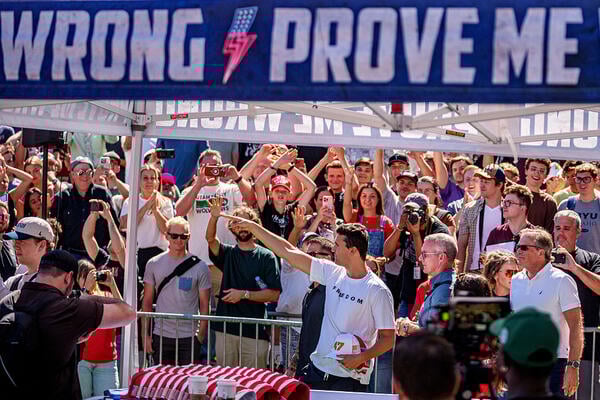
Charlie Kirk was kicking off his “American Comeback Tour” at Utah Valley University.
Photo by Trent Nelson/The Salt Lake Tribune/Getty Images
Turning Point, headquartered in Phoenix, has been at the center of several controversies over the years. About a decade ago, it launched its Professor Watchlist, which has resulted in academics being the targets of vitriol and threats for their alleged views. Last year, two Turning Point workers admitted to charges from an October 2023 incident in which they followed and filmed a queer Arizona State University instructor on campus, with one of them eventually pushing the instructor face-first onto the concrete.
Boedy said Wednesday that Kirk was the most influential person who doesn’t work in the White House.
“He has made Turning Point into an indispensable organization for conservative causes,” he said. “He’s become the new face of Christian nationalism, which is a growing trend in America. And of course, he has, I would say, changed college campuses.”
He added that campus events like Wednesday’s were his “bread and butter.”
“He is very smart,” he said. “He was one of the pioneers of the ‘prove me wrong’ mantra.”
-
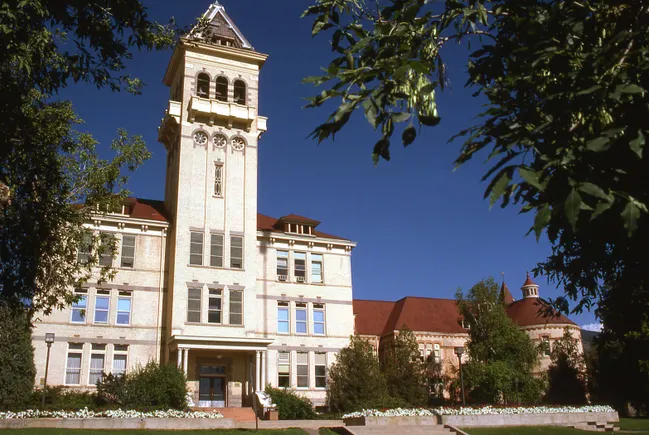
Utah State University to face state audit amid concerns about former leader’s spending
Dive Brief:
- Utah State University will undergo a state audit following an initial review that found “concerns about USU’s governance, leadership, and culture of policy noncompliance.”
- At a Tuesday meeting, the state Legislature’s audit subcommittee voted unanimously to conduct a deeper review of the university, which will look at governance and procurement processes, particularly in the president’s office.
- The review comes amid reporting that Elizabeth Cantwell, the university’s former president, spent heavily on office remodeling and transportation during her tenure before departing earlier this year.
Dive Insight:
State legislative auditors raised issues with both spending practices and oversight controls at the highest levels of Utah State.
Under the heading of “leadership concerns,” they pointed to institutional purchase card transactions that “significantly increased” during the past two years compared to the preceding half decade.
Those increases occurred during the tenure of Cantwell, who was appointed president in 2023 and stepped down unexpectedly earlier this year to serve as president of Washington State University.
Alan Smith, dean of Utah State’s college of education and human services, is serving as interim president while the institution searches for a permanent leader.
This March, shortly after the announcement of Cantwell’s departure, Cache Valley Daily obtained public records of heavy spending during her tenure. The report noted a $285,000 office remodel that included more than $184,000 in furniture costs, over $800 in spending on mirrors and a $750 bidet toilet.
It also detailed several vehicles Cantwell used for transportation during her time at Utah State, including a new Toyota SUV and a $30,000 electric vehicle.
Auditors flagged purchase card spending during the past two years that “may be concerning due to the nature of the purchases, the dollar amounts involved, and the level of oversight.”
They also noted “issues with the amount spent on presidential motor vehicle assets in the last two years being almost triple the amount for the five years before.”
The review also raised concerns about how Utah State’s leaders acquired goods and services from third parties. Specifically, they found that some executive staff committed the university to contracts over $52,000 — and up to $430,000 — before completing the purchasing process.
Their report recommended a review of procurement policies, controls over open purchase orders, and spending and assets in the Utah State president’s office, as well as an evaluation of whether “governance and leadership at USU have the appropriate structure, tools, processes, culture, structure, and personnel in place to ensure success.”
On Tuesday, state lawmakers on the audit subcommittee called for a deep investigation of the university’s spending.
“I love Utah State. It’s a big part of my district, it employs a lot of people in my district,” one member told audit staff during the meeting. “But I have serious concerns about what is happening at Utah State right now, and so whatever latitude you feel that you need, I like to be part of authorizing that — as deep as you can go.”
Tessa White, chair of the university’s trustee board, voiced support for the state audit at the meeting.
“We welcome the audit,” White said. “There are areas that we are aware of and taking aggressive steps to remedy. We hope that by the time that your audit is done, we will have a whole list of things completed that will give you greater confidence in the school.”
Procurement policies and processes have come under fire at other public institutions as politicians and auditors home in on their spending practices.
Early this year, Gov. Michelle Lujan Grisham called for Western New Mexico University’s entire board of regents to resign after an auditing report surfaced spending by leadership that showed “a concerning lack of compliance with established university policies.”
A state audit late last year of the Connecticut State Colleges and Universities system found several financial transactions that violated institutional policies or lacked adequate documentation. That included some $19,000 in spending on food over two years by Chancellor Terrence Cheng.
In 2024, a state audit of University of Maryland Global Campus raised issues with leadership oversight of a spinoff nonprofit, pointing to — among other issues — a $25.7 million IT project that ended without a viable product.
-
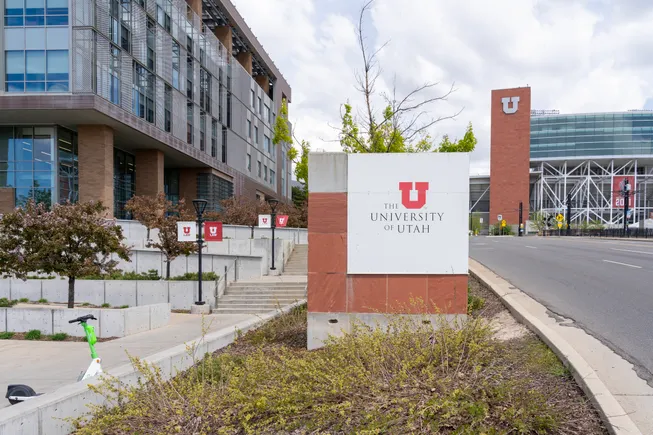
University of Utah board moves to cut 81 academic programs
Dive Brief:
- The University of Utah’s trustee board approved plans Tuesday to discontinue 81 courses and degree programs in response to a new state law ordering public colleges to cut funding for certain academic offerings and administrative functions and invest in high-demand fields.
- The programs up for elimination range from a bachelor’s in chemistry teaching to a Ph.D. in theater. Most of them are graduate programs, and about one-quarter are in the university’s humanities college. The programs can be discontinued once the Utah System of Higher Education and state lawmakers sign off on the plan, according to a Tuesday announcement from the university.
- Each of the programs graduated at most one student over the past eight years, Richard Preiss, president of the university’s Academic Senate, said in a July 22 letter to the board. Students in affected programs will either be given pathways to complete their studies or referred to “academically appropriate alternatives,” the university said.
Dive Insight:
Earlier this year, Utah lawmakers cut 10% from the instruction budgets for each of the state’s eight public colleges, The Salt Lake Tribune reported. The cuts amounted to $60.5 million, with University of Utah facing the largest budget reduction of $19.6 million.
To reclaim the funding, the legislation orders colleges to craft three-year plans for cutting certain academic programs and administrative expenses and redirecting the money to high-demand programs.
In guidance released earlier this year, the Utah System of Higher Education said the funds could be reinvested in programs that meet the state’s workforce needs, lead to high-wage careers, teach students “durable skills” such as critical thinking and problem-solving, or focus on services to increase student retention.
The law came on the heels of a 2024 legislative audit that said the state’s public universities were losing students to “private non-traditional” colleges, such as Western Governors University, a large online institution. The audit also found that university leaders largely weren’t able to calculate program-level data about costs, enrollment and completion rates.
“Because institutions currently lack metrics required to calculate program-level efficiencies — including returns on investment — presidents are unable to fully understand the degree to which programs maximize their use of student and taxpayer resources,” the audit stated.
The University of Utah submitted a draft of its three-year plan to the state’s higher education board in May.
Under the plan, the university said it would cut $7.5 million from its fiscal 2026 budget— including reductions in academic support services and administrative costs — and reallocate that money to instruction aligned with the state’s workforce needs.
The university said it plans to devote more money to instruction in engineering, artificial intelligence, nursing, biotechnology and behavioral health, as well as to provide more support for general education about civic engagement.
Utah lawmakers aren’t the only ones ordering public colleges to shed certain programs. Six of Indiana’s public institutions are moving to either cut or consolidate over 400 programs to comply with a new state law aiming to end academic offerings that award low numbers of degrees.
The impacted programs account for 19% of all degree offerings at Indiana’s public colleges.
-
U of Utah Plans to Ax 81 Offerings, Citing New State Law
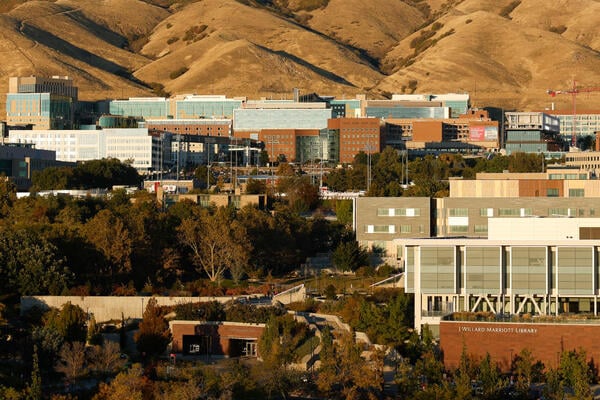
The University of Utah is cutting 81 offerings in response to state budget reductions and a new law.
Aaron M. Sprecher/Getty Images
The University of Utah plans to eliminate 81 academic programs and minors—a step that administrators attribute to a new state law that called for “strategic reinvestment” after lawmakers slashed funding to public colleges and universities.
The Republican-controlled Utah Legislature passed House Bill 265 this spring. Lawmakers cut 10 percent of institutions’ state-funded instructional budgets, but the law said they could earn back the money by cutting programs and positions and instead funding “strategic reinvestment.” Institutions’ reinvestment plans must be based on enrollment, completion rates, job placement, wages, program-level costs and local and statewide workforce demands.
Other Utah universities detailed their planned cuts in the spring, but this is the first glimpse at how the state’s flagship will respond to the new law.
The planned cuts at the University of Utah include Ph.D.s in chemical physics, physiology, experimental pathology and in theater; master’s degrees in ballet, modern dance, marketing, audiology and applied mechanics; bachelor’s degrees in chemistry teaching, Russian teaching and German teaching; certificates in public administration, veterans’ studies and computational bioimaging; various minors; and more.
Richard Preiss, president of the university’s Academic Senate, said his body’s Executive Committee reviewed the list of programs. He said that, except for one that the committee persuaded the administration to remove from the list, none had graduated more than one student in the past eight years, according to the university’s data. But a university spokesperson said that “some had zero or one, but some had up to a dozen students. Our threshold to identify inactive or low-enrollment courses was 15.”
Preiss said that while the selection process was accelerated, faculty had enough time to give meaningful input.
“These were relatively easy cuts to make and they were relatively painless,” Preiss said. “I anticipate that more painful ones are on the horizon.”
-

U of Utah Urges Compliance After State Restricts Pride Flags
A University of Utah lawyer last week urged faculty to comply with the state’s new prohibition on the “prominent“ display of pride flags and other flags on campus, The Salt Lake Tribune reported.
Deputy general counsel Robert Payne urged faculty in a meeting not to “be a lightning rod to the Legislature” and said state lawmakers “have a lot of power over us,” the newspaper reported. Payne also suggested that if employees tried to get around the law by hanging pride posters instead of flags, legislators might “come back with something worse,” the Tribune reported.
Utah’s Republican-controlled Legislature passed House Bill 77 last month, and Gov. Spencer J. Cox, a Republican, let it become law without signing or vetoing it. When it takes effect May 7, it will ban government entities, including public colleges and universities, from displaying flags on government property “in a prominent location.” Some flags are exempted, such as the U.S. flag and the prisoner of war/missing in action flags.
Trevor Lee, a Republican Utah House member and HB 77’s chief sponsor, told Inside Higher Ed he didn’t file the legislation specifically to ban pride flags. But “that’s just been the biggest, biggest issue of any political flag,” he said. “I mean, it’s not even close.”
Lee said the flags go beyond representing inclusivity. He said, “It’s a sex flag. It tells everyone what sexual ideology you believe in.”
The University of Utah has released guidance online saying the law generally bans pride flags, Juneteenth flags and others from prominent locations. The guidance notes exemptions, including that students and employees can “wear or carry a flag as a personal expression of free speech,” and that employees can decorate their offices with flags “so long as they are not easily visible outside of their personal space (e.g., posted in an office window).”
Payne said the university hasn’t yet decided how it will enforce the flag ban, according to the Tribune. The university’s guidance says, “Flags may also be used as decorations in connection with a brief cultural celebration hosted by the university within a university building,” but can’t be up for more than a week. It’s unclear whether pride will be considered a cultural celebration.
-
FIRE-supported Utah legislation secures students’ rights to freely associate on campus
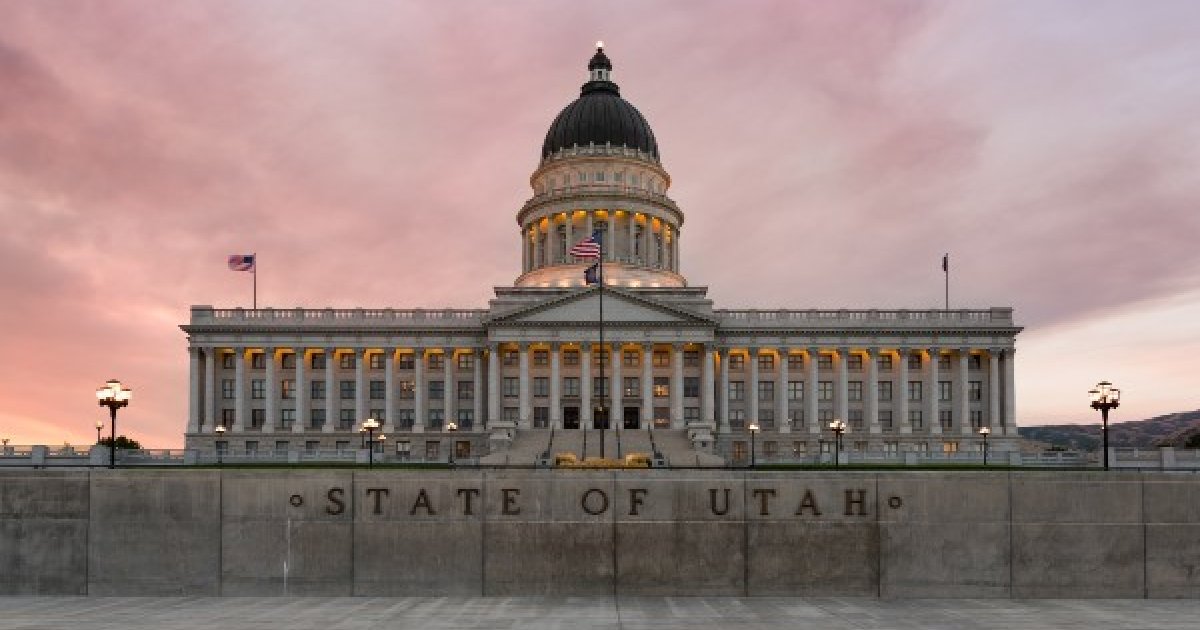
Yesterday, Utah Gov. Spencer Cox signed into law HB 390, a bill that will strengthen students’ freedom of association at the state’s public colleges and universities. Sponsored by Rep. Karianne Lisonbee and Sen. Keven Stratton, the bill ensures that religious, political, and ideological student organizations can set their own membership and leadership requirements without interference from campus administrators.
The First Amendment guarantees citizens the right to freely associate with others who share their beliefs — and to not associate with those who don’t. FIRE has consistently opposed policies that force student groups to eliminate belief-based membership criteria to gain official recognition by their college.
After all, the members of a group naturally shape its direction, and allowing individuals who fundamentally oppose its mission to vote or hold leadership positions can undermine the group’s very purpose. It makes little sense, for example, to force a Muslim student group to let atheists become voting members or for an environmentalist student group that raises awareness about the threats of climate change to allow climate change skeptics to hold office.
As we noted in our letter to Utah’s Senate Education Committee, the right to associate freely extends to students at public universities and to the student organizations they form. The Supreme Court has repeatedly upheld this principle, affirming in Healy v. James that public colleges cannot deny official recognition to student organizations solely based on their beliefs or associations. Similarly, in Widmar v. Vincent, the Court ruled that a public university violated the First Amendment by denying a religious student group access to campus facilities because of its religious beliefs.
Despite these clear precedents, the Supreme Court ruled in Christian Legal Society v. Martinez that universities can implement “all-comers” policies, meaning student organizations must accept any student who wants to join as a member or leader, even if that student openly opposes the group’s core principles. Following the ruling, FIRE President and CEO Greg Lukianoff reaffirmed our commitment to freedom of association, saying, “FIRE will continue to defend the rights of expressive campus organizations to unite around shared beliefs and uphold the principle that College Democrats can be Democrats, College Atheists can be atheists, and College Christians can be Christians.”
Although Martinez found that all-comers policies are constitutionally permissible when applied uniformly, institutions with such policies have frequently enforced them selectively. For example, some religious organizations have been forced to accept members and leaders who do not share their faith, while secular groups have been allowed to set their own membership and leadership requirements without administrative intervention. This selective enforcement constitutes viewpoint discrimination, undermining the very protections that the First Amendment guarantees.
HB 390 ensures that Utah’s public universities cannot single out student groups for holding firm to their beliefs. The bill states:
An institution may not deny any benefit or privilege that is available to any student organization, or discriminate against, a religious, political, or ideological student organization:
-
because such student organization is religious, political, or ideological;
-
on the basis of protected expressive activity engaged in by the student organization or the student organization’s members; or
-
based on a requirement that a leader of the student organization:
-
affirm or adhere to the sincerely held beliefs of the student organization;
-
comply with a standard of conduct the student organization establishes; or
-
further the mission, purpose, or standards of conduct of the student organization, as these are defined by the student organization.
-
With the enactment of this bill into law, Utah joins a growing number of states strengthening First Amendment protections for belief-based organizations on campus.
FIRE applauds Rep. Lisonbee and Sen. Stratton, the Utah Legislature, and Gov. Cox for standing up for students’ rights and ensuring true freedom of association in higher education.
-
-
A new Utah law has caused the University of Utah to severely limit DEI initiatives on campus, in a case study of what might happen in other states
SALT LAKE CITY — Nineteen-year-old Nevaeh Parker spent the fall semester at the University of Utah trying to figure out how to lead a student group that had been undercut overnight by matters far beyond student control.
Parker, the president of the Black Student Union, feared that a new Utah law banning diversity, equity and inclusion efforts at public colleges had sent a message to students from historically marginalized groups that they aren’t valued on campus. So this spring, while juggling 18 credit hours, an internship, a role in student government and waiting tables at a local cafe, she is doing everything in her power to change that message.
Because the university cut off support for the BSU — as well as groups for Asian American and for Pacific Islander students — Parker is organizing the BSU’s monthly meetings on a bare-bones budget that comes from student government funding for hundreds of clubs. She often drives to pick up the meeting’s pizza to avoid wasting those precious dollars on delivery fees. And she’s helping organize large community events that can help Black, Asian and Latino students build relationships with each other and connect with people working in Salt Lake City for mentorship and professional networking opportunities.
Nineteen-year-old University of Utah student Nevaeh Parker is working hard to keep the Black Student Union going after the organization lost financial support. Credit: Image provided by Duncan Allen “Sometimes that means I’m sacrificing my grades, my personal time, my family,” Parker, a sophomore, said. “It makes it harder to succeed and achieve the things I want to achieve.”
But she’s dedicated to keeping the BSU going because it means so much to her fellow Black students. She said several of her peers have told her they don’t feel they have a place on campus and are considering transferring or dropping out.
Utah’s law arose from a conservative view that DEI initiatives promote different treatment of students based on race, ethnicity, gender or sexuality. House Bill 261, known as “Equal Opportunity Initiatives,” which took effect last July, broadly banished DEI efforts and prohibited institutions or their representatives speaking about related topics at public colleges and government agencies. Violators risk losing state funding.
Now President Donald Trump has set out to squelch DEI work across the federal government and in schools, colleges and businesses everywhere, through DEI-related executive orders and a recent “Dear Colleague” letter. As more states decide to banish DEI, Utah’s campus may represent what’s to come nationwide.
Related: Interested in more news about colleges and universities? Subscribe to our free biweekly higher education newsletter.
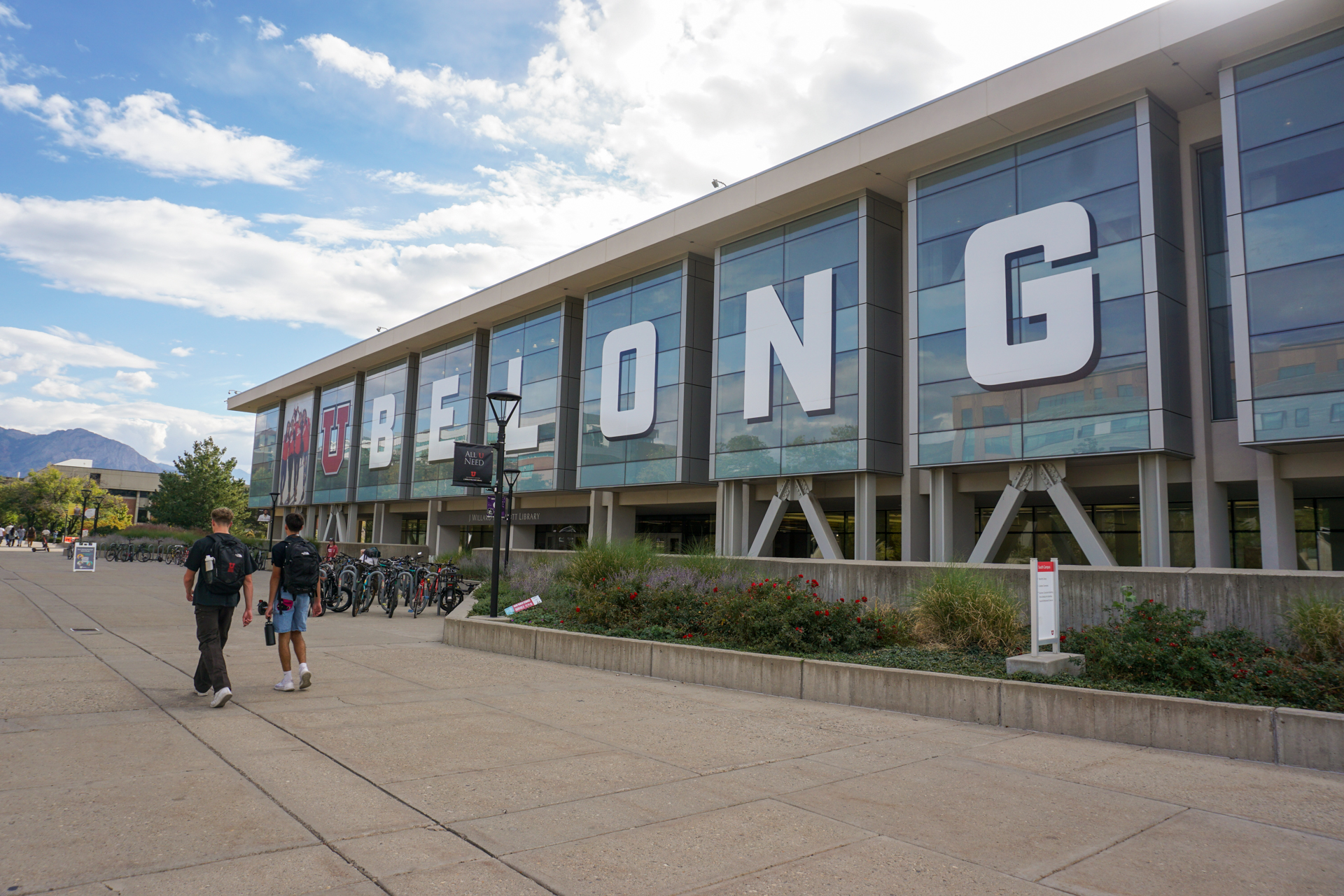
Because of the new state law, the university last year closed the Black Cultural Center, the Center for Equity and Student Belonging, the LGBT Resource Center and the Women’s Resource Center – in addition to making funding cuts to the student affinity groups.
In place of these centers, the university opened a new Center for Community and Cultural Engagement, to offer programming for education, celebration and awareness of different identity and cultural groups, and a new Center for Student Access and Resources, to offer practical support services like counseling to all students, regardless of identity.
For many students, the changes may have gone unnoticed. Utah’s undergraduate population is about 63 percent white. Black students are about 1 percent, Asian students about 8 percent and Hispanic students about 14 percent of the student body. Gender identity and sexuality among students is not tracked.
For others, however, the university’s racial composition makes the support of the centers that were eliminated that much more significant.
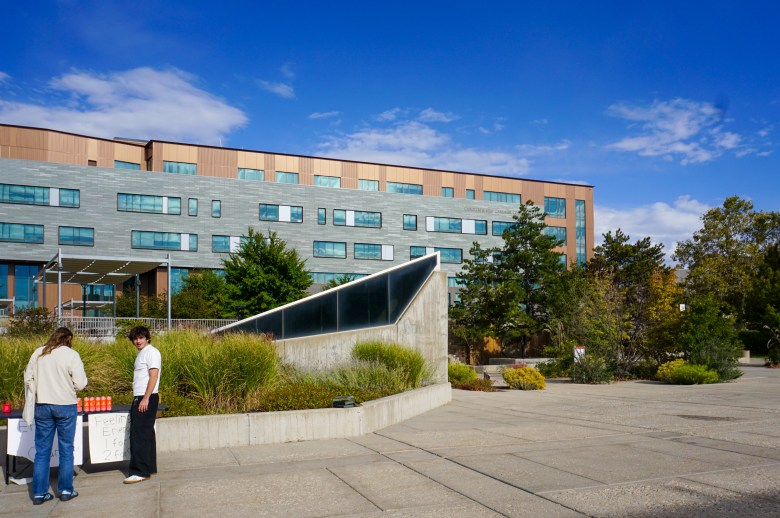
In response to a new state law that broadly banned diversity, equity and inclusion efforts, the University of Utah closed its Center for Equity and Student Belonging, the Black Cultural Center, the Women’s Resource Center and the LGBT Resource Center. Credit: Olivia Sanchez/The Hechinger Report Some — like Parker — have worked to replace what was lost. For example, a group of queer and transgender students formed a student-run Pride Center, with support from the local Utah Pride Center. A few days a week, they set up camp in a study room in the library. They bring in pride flags, informational fliers and rainbow stickers to distribute around the room, and sit at a big table in case other students come looking for a space to study or spend time with friends.
Lori McDonald, the university’s vice president of student affairs, said so far, her staff has not seen as many students spending time in the two new centers as they did when that space was the Women’s Resource Center and the LGBT Resource Center, for example.
“I still hear from students who are grieving the loss of the centers that they felt such ownership of and comfort with,” McDonald said. “I expected that there would still be frustration with the situation, but yet still carrying on and finding new things.”
One of the Utah bill’s co-sponsors was Katy Hall, a Republican state representative. In an email, she said she wanted to ensure that support services were available to all students and that barriers to academic success were removed.
“My aim was to take the politics out of it and move forward with helping students and Utahns to focus on equal treatment under the law for all,” Hall said. “Long term, I hope that students who benefitted from these centers in the past know that the expectation is that they will still be able to receive services and support that they need.”
The law allows Utah colleges to operate cultural centers, so long as they offer only “cultural education, celebration, engagement, and awareness to provide opportunities for all students to learn with and from one another,” according to guidance from the Utah System of Higher Education.
Given the anti-DEI orders coming from the White House and the mandate from the Department of Education earlier this month calling for the elimination of any racial preferences, McDonald said, “This does seem to be a time that higher education will receive more direction on what can and cannot be done.”
But because the University of Utah has already had to make so many changes, she thinks that the university will be able to carry on with the centers and programs it now offers for all students.
Related: Facing legal threats, colleges back off race-based programs
Research has shown that a sense of belonging at college contributes to improved engagement in class and campus activities and to retaining students until they graduate.
“When we take away critical supports that we know have been so instrumental in student engagement and retention, we are not delivering on our promise to ensure student success,” said Royel M. Johnson, director of the national assessment of collegiate campus climates at the University of Southern California Race and Equity Center.
Creating an equitable and inclusive environment requires recognizing that there is no one-size-fits-all approach to supporting students, said Paulette Granberry Russell, president of the National Association of Diversity Officers in Higher Education. A student who grew up poor may not have had the same opportunities in preparing for college as a student from a wealthy or middle-class family. Students from some minority groups or those who are the first in their family to go to college may not understand how to get the support they need.
“This should not be a situation where our students arrive on campus and are expected to sink or swim,” she said.
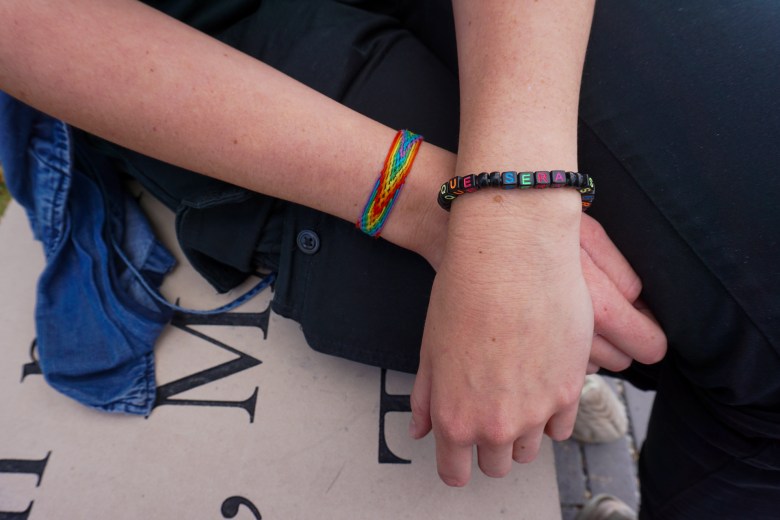
Student Andy Whipple wears a beaded bracelet made at a “Fab Friday” event hosted by the LGBT Resource Center at the University of Utah. The LGBT Resource Center was closed recently to comply with a new state law that limits diversity, equity and inclusion work. Credit: Olivia Sanchez/The Hechinger Report Kirstin Maanum is the director of the new Center for Student Access and Resources; it administers scholarships and guidance previously offered by the now-closed centers. She formerly served as the director of the Women’s Resource Center.
“Students have worked really hard to figure out where their place is and try to get connected,” Maanum said. “It’s on us to be telling students what we offer and even in some cases, what we don’t, and connecting them to places that do offer what they’re looking for.”
That has been difficult, she said, because the changeover happened so quickly, even though some staffers from the closed centers were reassigned to the new centers. (Others were reassigned elsewhere.)
“It was a heavy lift,” Maanum said. “We didn’t really get a chance to pause until this fall. We did a retreat at the end of October and it was the first time I felt like we were able to really reflect on how things were going and essentially do some grief work and team building.”
Before the new state law, the cultural, social and political activities of various student affinity groups used to be financed by the university — up to $11,000 per group per year — but that money was eliminated because it came from the Center for Equity and Student Belonging, which closed. The groups could have retained some financial support from the university if they agreed to avoid speaking about certain topics considered political and to explicitly welcome all students, not just those who shared their race, ethnicity or other personal identity characteristics, according to McDonald. Otherwise, the student groups are left to fundraise and petition the student government for funding alongside hundreds of other clubs.
Related: Tracking Trump — a week-by-week look at his actions on education
Parker said the restrictions on speech felt impossible for the BSU, which often discusses racism and the way bias and discrimination affect students. She said, “Those things are not political, those things are real, and they impact the way students are able to perform on campus.”
She added: “I feel as though me living in this black body automatically makes myself and my existence here political, I feel like it makes my existence here debatable and questioned. I feel like every single day I’m having to prove myself extra.”
In October, she and other leaders of the Black Student Union decided to forgo being sponsored by the university, which had enabled traditional activities such as roller skating nights, a Jollof rice cook-off (which was a chance to engage with different cultures, students said) and speaker forums.
Alex Tokita, a senior who is the president of the Asian American Student Association, said his group did the same. To maintain their relationship with the university by complying with the law, Tokita said, was “bonkers.”
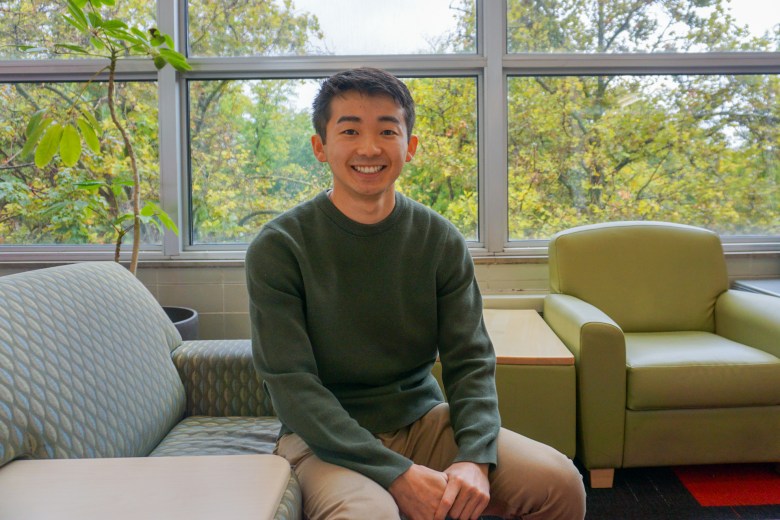
Alex Tokita, a senior at the University of Utah, is the president of the Asian American Student Association. The organization chose to forgo university sponsorship because it did not want to comply with a new state law that restricts speech on certain topics. Credit: Olivia Sanchez/The Hechinger Report Tokita said it doesn’t make sense for the university to host events in observation of historical figures and moments that represent the struggle of marginalized people without being able to discuss things like racial privilege or implicit bias.
“It’s frustrating to me that we can have an MLK Jr. Day, but we can’t talk about implicit bias,” Tokita said. “We can’t talk about critical race theory, bias, implicit bias.”
As a student, Tokita can use these words and discuss these concepts. But he couldn’t if he were speaking on behalf of a university-sponsored organization.
LeiLoni Allan-McLaughlin, of the new Center for Community and Cultural Engagement, said that some students believe they must comply with the law even if they are not representing the university or participating in sponsored groups.
“We’ve been having to continually inform them, ‘Yes, you can use those words. We cannot,’” Allan-McLaughlin said. “That’s been a roadblock for our office and for the students, because these are things that they’re studying so they need to use those words in their research, but also to advocate for each other and themselves.”
Related: Cutting race-based scholarships blocks path to college, students say
Last fall, Allan-McLaughlin’s center hosted an event around the time of National Coming Out Day, in October, with a screening of “Paris Is Burning,” a film about trans women and drag queens in New York City in the 1980s. Afterward, two staff members led a discussion with the students who attended. They prefaced the discussion with a disclaimer, saying that they were not speaking on behalf of the university.
Center staffers also set up an interactive exhibit in honor of National Coming Out Day, where students could write their experiences on colorful notecards and pin them on a bulletin board; created an altar for students to observe Día de los Muertos, in early November, and held an event to celebrate indigenous art. So far this semester, the center has hosted several events in observance of Martin Luther King Jr. Day and Black History Month, including an educational panel, a march and a pop-up library event.
Such events may add value to the campus experience overall, but students from groups that aren’t well represented on campus argue that those events do not make up for the loss of dedicated spaces to spend time with other students of similar backgrounds.
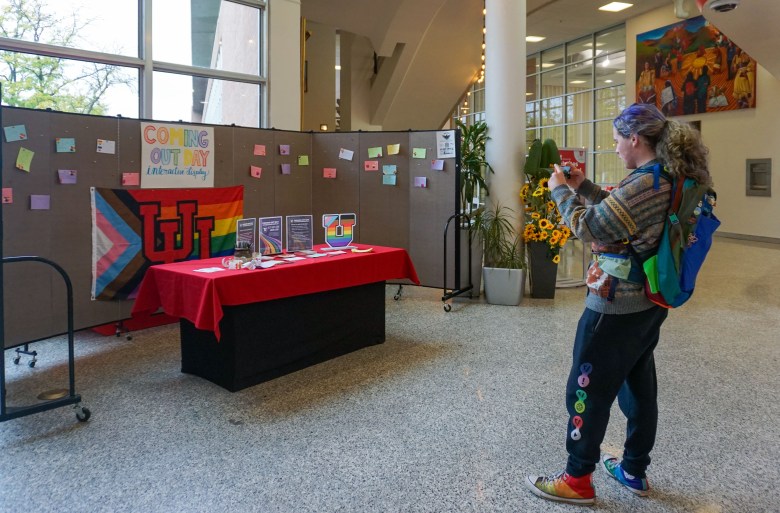
Sophomore Juniper Nilsson looks at a National Coming Out Day exhibit in the student union at the University of Utah. The exhibit was set up by the new Center for Community and Cultural Engagement. Credit: Olivia Sanchez/The Hechinger Report For Taylor White, a recent graduate with a degree in psychology, connecting with fellow Black students through BSU events was, “honestly, the biggest relief of my life.” At the Black Cultural Center, she said, students could talk about what it was like to be the only Black person in their classes or to be Black in other predominantly white spaces. She said without the support of other Black students, she’s not sure she would have been able to finish her degree.
Nnenna Eke-Ukoh, a 2024 graduate who is now pursuing a master’s in higher educational leadership at nearby Weber State University, said it feels like the new Center for Community and Cultural Engagement at her alma mater is “lumping all the people of color together.”
“We’re not all the same,” Eke-Ukoh said, “and we have all different struggles, and so it’s not going to be helpful.”
Contact staff writer Olivia Sanchez at 212-678-8402 or [email protected].
This story about campus DEI initiatives was produced by The Hechinger Report, a nonprofit, independent news organization focused on inequality and innovation in education. Sign up for the Hechinger newsletter.