With the cost of a college degree rising, more young people are considering alternative forms of postsecondary education.
Data from ECMC Group found that fewer high school students today (52 percent) are considering attending a four-year college compared to their peers in 2020 (71 percent), and a number are weighing community college or career and technical education instead (25 percent). Nearly half of respondents to ECMC’s survey said their ideal post–high school education should last three years or fewer.
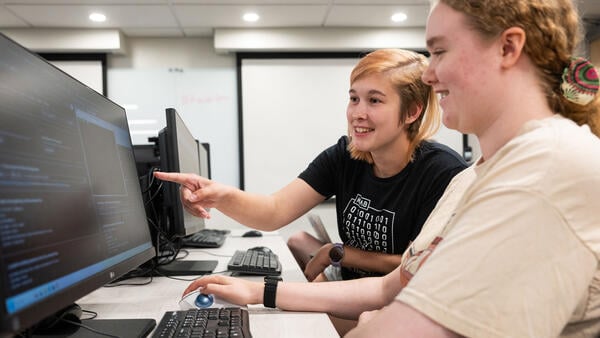
A new offering from Champlain College in Vermont allows high school students to earn a certificate in cybersecurity before graduation, providing both career exploration and workforce development. The 12-credit certificate equips students with college-ready skills and a pathway to an evolving career.
The background: The new program, CyberStart, builds on Champlain’s Virtual Gap Program, launched in summer 2020, which allows traditional-aged college students to complete 15 weeks of classes and an internship course remotely before formally enrolling.
In Vermont, high school students can participate in two college-level courses at no cost. But statewide trends show the students most likely to engage in dual enrollment live in larger towns, have access to a college campus or are enrolled at a high school with an integrated dual-enrollment program, said Adam Goldstein, program director of CyberStart and academic director of the Leahy Center for Digital Forensics and Cybersecurity at Champlain. Most of the programs available to rural high school students consisted of asynchronous courses.
“We saw a need for something in the middle, where students had the ability to be remote, but to have that synchronous element where they were meeting with other students and working directly with faculty members,” Goldstein said.
Survey Says
A 2023 report from the American Council on Education found that 41 percent of high school seniors said the pandemic changed their thinking on their choice of future career, and one in four students changed their view on what college major to pursue.
How it works: CyberStart is a partnership between Champlain and cybersecurity group NuHarbor Security, designed to give high school students a peek into that work. Champlain also offers certificates for a working adult population, but CyberStart is modeled a little differently, relying on NuHarbor to identify which skills students need to be successful in an entry-level position.
All Vermont high school juniors and seniors are eligible to participate if they meet dual-enrollment requirements.
The program consists of 12 credits over four courses: two introductory courses and two internship experiences. The first internship course is led by Champlain faculty and includes other college students at the Leahy Center. The second is orchestrated by NuHarbor and has students work alongside cyber professionals, finessing their workplace skills.
Courses take place synchronously with a Champlain instructor and follow a flipped classroom model, requiring students to complete readings or lectures prior to meeting and reserving class time for active learning, activities and collaboration among students. Courses are supported by a current student who serves as a mentor.
A digital focus: CyberStart’s curriculum is built for someone with no prior experience, making it an accessible pathway for students with an interest in STEM. It also provides introductory college courses for students still exploring their career ambitions.
“We feel that almost anybody in any discipline they want to go into could benefit from a cybersecurity class,” Goldstein said. “Regardless of where they head into the digital age, having an understanding of cybersecurity is a really, really critical skill set.”
According to the Boys and Girls Club of America’s fall 2024 Youth Right Now survey, over half of high school students are interested in taking science-related courses after they graduate (57 percent), and 48 percent are interested in a STEM-related job in the future.
Champlain’s program is intentionally structured as an on-ramp for students who want to launch into a career or postsecondary education, allowing them to build professional skills in an emerging field or kick-start their college education. Students who complete the certificate are also given conditional acceptance to Champlain, and high-performing students may be eligible for scholarships.
“I think it can open up students’ eyes to the possibilities that maybe they weren’t initially thinking of, whether it is a workforce track and thinking about future training and experience or thinking about college and how that can ultimately have a very valuable return on investment,” Goldstein said.
The initiative also provides students, particularly those in rural areas, with greater insight into career opportunities available to them in the region or remotely.
State of play: Since launching the program in 2024, Champlain has established relationships with dozens of teachers and high schools across the state, Goldstein said. CyberStart is also available at Vermont’s centers for technology education.
Some students in the program’s first cohort have continued into a second year or transitioned into a STEM discipline in higher education after graduating high school; many have chosen to pursue cybersecurity.
The success of CyberStart may provide a model for similar programs in other fields, Goldstein said, such as computer science and data or digital humanities.
Get more content like this directly to your inbox. Subscribe here.