Tag: VICTORY

  • VICTORY! 5th Circuit blocks West Texas A&M’s unconstitutional drag ban

    VICTORY! 5th Circuit blocks West Texas A&M’s unconstitutional drag ban

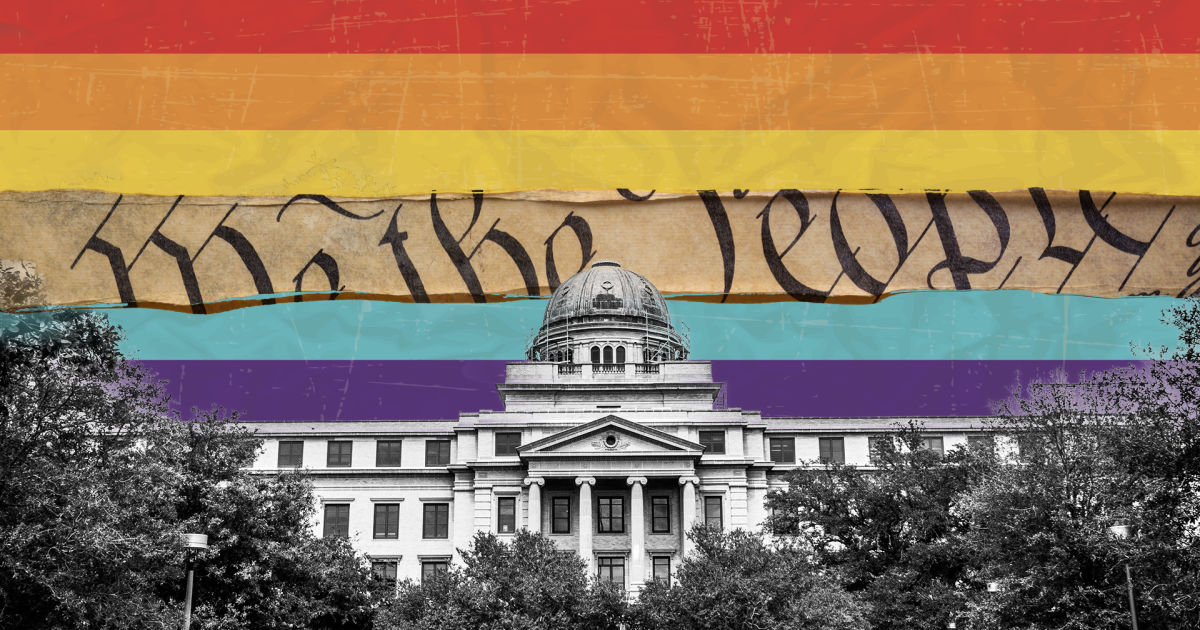
    NEW ORLEANS, Aug. 18, 2025 — In a victory for student expression on campus, the U.S. Court of Appeals for the Fifth Circuit today overruled a lower court to halt an unconstitutional ban on student drag performances at West Texas A&M University.

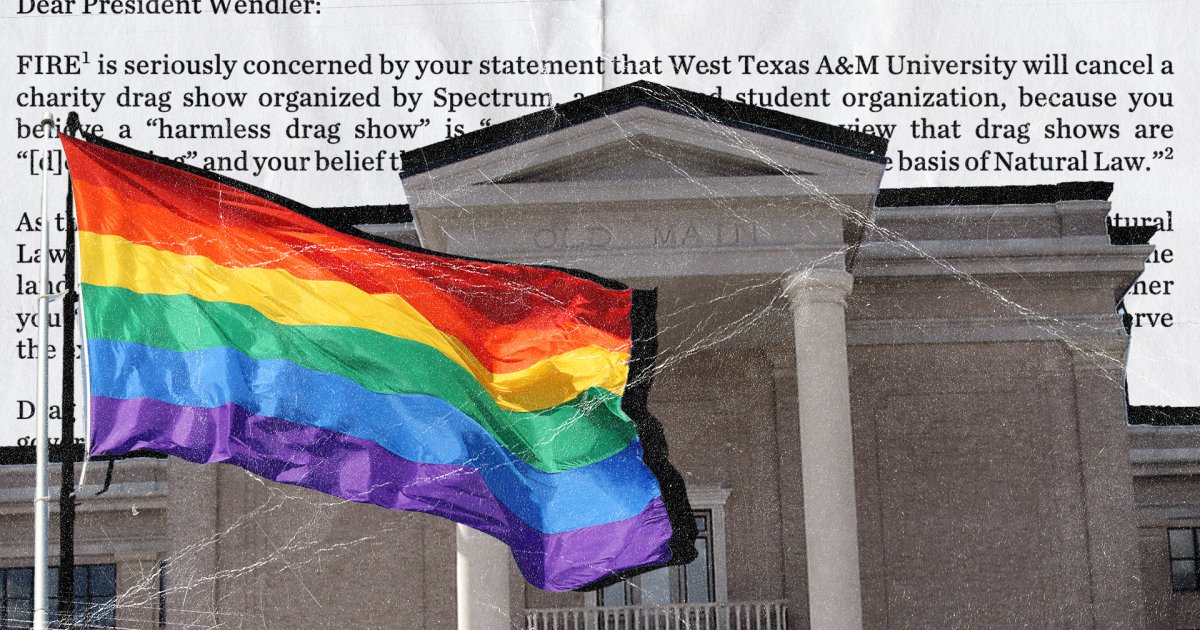
    In March 2023, West Texas A&M President Walter Wendler announced that he was unilaterally canceling a planned campus drag show hosted by LGBTQ+ organization Spectrum WT to raise money for suicide prevention. In a campus-wide email, Wendler said that he was canceling the event because he believes it offends and demeans women.

    As a public official at a state university, the First Amendment bars Wendler from censoring a performance based on nothing more than his personal disapproval. But astonishingly, Wendler admitted he was canceling the show even though “the law of the land appears to require” him to allow it.

    The Foundation for Individual Rights and Expression quickly jumped into action, filing a lawsuit against Wendler and West Texas A&M on behalf of Spectrum WT, its president Bear Bright, and vice president Marcus Stovall. FIRE’s lawsuit seeks to halt Wendler’s unlawful censorship and obtain damages for violating the students’ clearly established First Amendment rights.

    In September 2023, the district court denied FIRE’s motion for a preliminary injunction. While the case made its way through the courts, Wendler canceled a second drag show planned by Spectrum WT in March 2024.

    Today’s ruling from the Fifth Circuit overturns the district court’s ruling and places a temporary hold on Wendler’s enforcement of his illegal directive, allowing Spectrum WT and any other student organization to put on drag shows while litigation continues.

    The majority opinion from Judge Leslie H. Southwick found a substantial likelihood that Spectrum WT’s First Amendment claims would prevail on the merits.

    “Because theatrical performances plainly involve expressive conduct within the protection of the First Amendment, and because we find the plaintiffs’ drag show is protected expression,” the Fifth Circuit held Wendler’s censorship failed to pass constitutional muster. 

    “FIRE is pleased that the Fifth Circuit has halted President Wendler’s unconstitutional censorship and restored the First Amendment at West Texas A&M,” said FIRE Supervising Senior Attorney JT Morris. “This is a victory not just for Spectrum WT, but for any public university students at risk of being silenced by campus censors.”


    The Foundation for Individual Rights and Expression (FIRE) is a nonpartisan, nonprofit organization dedicated to defending and sustaining the individual rights of all Americans to free speech and free thought — the most essential qualities of liberty. FIRE educates Americans about the importance of these inalienable rights, promotes a culture of respect for these rights, and provides the means to preserve them.

    CONTACT:

    Alex Griswold, Communications Campaign Manager, FIRE: 215-717-3473; [email protected]

    Source link

  • VICTORY: New York high school to strengthen First Amendment protections following FIRE lawsuit

    VICTORY: New York high school to strengthen First Amendment protections following FIRE lawsuit

    CHAPPAQUA, NY, June 25, 2025 — The Foundation for Individual Rights and Expression agreed to drop its First Amendment lawsuit against Chappaqua Central School District after the district’s board of education adopted a robust First Amendment regulation that will protect the constitutional free speech rights of its students.

    FIRE sued the district in 2024 on behalf of O.J., an LGBTQ+ student suspended for violating the district’s “hate speech” definition in its code of conduct because he used the words “faggot” and “twink” in a rap song recorded in his friend’s home after school. In the song, O.J. rapped the refrain, “faggot, fart, balls.” The song also included another person’s lyrics, which contained violent imagery. After O.J.’s friend uploaded the song to a music-sharing website, the school received three complaints and promptly suspended the student.

    “In the Supreme Court’s decision in Mahanoy Area School District v. B.L., the Court held that students’ off-campus, nondisruptive speech is protected by the First Amendment,” said FIRE attorney Colin McDonell. “That is true even when the speech receives criticism.”

    In communications with the district, O.J.’s father cited Mahanoy and argued the school could not punish his son for his off-campus speech because it did not disrupt the educational environment. When this proved unsuccessful, O.J.’s father reached out to FIRE for assistance. On April 15, 2024, FIRE sued the district on behalf of O.J. and his father in the federal district court for the Southern District of New York.

    After commencement of the lawsuit, FIRE and the district worked together to craft a First Amendment regulation that would protect its students’ rights to express themselves both on and off school campus, consistent with and reconciled with Mahanoy and the New York State Dignity for All Students Act and its regulations. The district’s insurer also agreed to pay $70,000 to FIRE, encompassing attorneys’ fees, and the district removed the disciplinary action based on the song from the student’s file.

    “With its adoption of a First Amendment regulation, the board of education has affirmed the rights of its students to engage in protected speech on and off campus,” said FIRE Senior Attorney Greg H. Greubel. “We’re pleased that we could work with the board to avoid further litigation and turn this situation into a positive outcome for our client and all students in the district.”


    The Foundation for Individual Rights and Expression (FIRE) is a nonpartisan, nonprofit organization dedicated to defending and sustaining the individual rights of all Americans to free speech and free thought — the most essential qualities of liberty. FIRE educates Americans about the importance of these inalienable rights, promotes a culture of respect for these rights, and provides the means to preserve them.

    CONTACT:

    Karl de Vries, Director of Media Relations, FIRE: 215-717-3473; [email protected]

    Source link

  • Sector ambivalent after Labor’s landslide election victory

    Sector ambivalent after Labor’s landslide election victory

    • Anthony Albanese has secured a second term for the ruling Labor party, beating out the Coalition to win Australia’s federal election.
    • His win has attracted mixed views from key stakeholders, with some welcoming Albanese’s return and others warning that the sector may have no more trump cards to play.
    • It follows pledges from both Labor and the Coalition to increase the price of student visas.

    The Labor party stormed its way to victory after a battle against the Peter Dutton-led Coalition, with both sides making controversial election promises to vastly increase student visa fee fees as immigration continues to dominate political discourse in Australia.

    The international education sector is still catching its breath as it takes in the result after months of hostile rhetoric from both parties – with each having promised crushing de facto caps on overseas students as tensions rise over Australia’s housing crisis and growing anger about mass immigration.

    But early reactions from sector leaders indicate mixed feelings over Albanese’s second term.

    Chief executive officer of the International Education Association of Australia (IEAA) Phil Honeywood said the result was “hopefully the best outcome” for the sector. He pointed out that the Labor government “has at least proactively proactively consulted” with stakeholders before announcing major policy changes – no matter how unwelcome they are.

    Now that Labor has been returned with a large majority, the hope is that it will be electorally confident enough to not target international students as the cause of the rent crisis
    Phil Honeywood, IEAA

    In contrast, he noted, the Coalition did not speak to any key stakeholders before unveiling its “draconian policy framework for our sector” – hardline proposals including a cap on new international student arrivals at a scant 240,000 per year and steep visa fee hikes.

    “Now that Labor has been returned with a large majority, the hope is that it will be electorally confident enough to not target international students as the cause of the rent crisis,” he remarked.

    On the other hand, Lexis English managing director Ian Pratt predicted that Labor’s election win would “give little comfort to an under-siege international education sector”.

    “An emboldened education minister Jason Clare is likely to take advantage of a newly compliant Senate to re-introduce the deeply flawed ESOS Amendment Bill – the  ‘capping legislation’ rejected in the previous term,” he said. 

    And he warned that with Labour expected to increase its majority, “industry peak bodies will have few levers to pull”. 

    “Initial focus will be on promoting small, sensible reforms, and likely to involve a push for a lower-fee ‘short-term’ student visa, catering for ELICOS and study abroad enrolments that do not generally contribute to net overseas migration figures,” he predicted.

    “There is also likely to be a push for a more transparent visa assessment process and a sensible approach to capping. Whether the returning government will feel any need to engage more positively with the sector remains to be seen.”

    The Labor party has repeatedly made attacks on the international education sector in recent months, first moving to cap new international student numbers to 270,000 under the thwarted ESOS Bill and then proposing a new Ministerial Direction tying individual caps to specific institutions after the Coalition blocked ESOS in a dramatic Senate battle.

    The party drew criticism from the sector last week after it made a last-minute pledge to increase student visa fees to AUD$2,000, up from the current AUD$1,600, drawing ire from some stakeholders for making the promise after early voting had already commenced.

    This is a developing story. Please check back for updates over the coming days…

    Source link

  • VICTORY! Tenn. town buries unconstitutional ordinance used to punish holiday skeleton display

    VICTORY! Tenn. town buries unconstitutional ordinance used to punish holiday skeleton display

    GERMANTOWN, Tenn., April 29, 2025 — After a federal lawsuit, the town of Germantown, Tennessee, has sent to the graveyard an ordinance that was used to fine a resident for using giant skeletons in a Christmas lawn display.

    Alexis Luttrell received a citation and court summons from the Memphis suburb in January for keeping up decorative skeletons after Halloween and repurposing them for Election Day and Christmas. In February, the Foundation for Individual Rights and Expression filed a federal lawsuit seeking to have the citation thrown out and Germantown’s unconstitutional holiday ordinance overturned on First Amendment grounds. FIRE also committed to defending Alexis against the charges in municipal court.

    Germantown voluntarily dismissed the municipal charges against Alexis a month later, but FIRE’s federal lawsuit against the ordinance remained pending before the U.S. District Court for the Western District of Tennessee. But last night, the Board of Mayor and Aldermen voted to repeal the ordinance entirely, and Germantown agreed to a $24,999 settlement in exchange for dismissing the lawsuit.

    “Not only am I no longer at risk of being fined for my skeletons, the unconstitutional ordinance is now dead and buried,” Alexis said. “Today is a victory for anyone who has ever been censored by a government official and chose to fight back.”

    The ghastly affair began in October 2024, when Alexis purchased a large decorative skeleton and skeleton dog for Halloween. She later kept the skeletons up and dressed them with Election Day signs in November and then Santa-themed attire in December.

    COURTESY PHOTOS OF ALEXIS AND HER SKELETON DISPLAYS

    Perplexingly, this was illegal under Germantown Ordinance 11-33, which required that holiday decorations “shall be removed within a reasonable period of time, not to exceed 30 days.” In Germantown officials’ view, Alexis’s skeletons weren’t “really” Christmas decorations, but an unsanctioned Halloween display. In December, the town sent Alexis a warning that she violated the ordinance, and followed up with a citation and summons when the skeletons were still up in January.

    Germantown’s ordinance wasn’t just an exercise in misguided micromanagement, it violated the Constitution. Under the First Amendment, Americans are free to put up holiday decorations on their property whenever they like, not just in a government-approved period of time. And by demanding the Santa-themed skeletons come down — even if one has a dark sense of humor, or happens to like Tim Burton movies — the city engaged in viewpoint discrimination about what constitutes an “acceptable” Christmas display.

    “Germantown’s leaders deserve a lot of credit for quickly repealing its holiday ordinance after FIRE’s lawsuit,” FIRE Attorney Colin McDonell said. “Instead of digging in and wasting time and taxpayer dollars defending an unconstitutional ordinance, they boned up on the First Amendment and did the right thing.”

    Alexis’ skeletons have remained in her yard and she’s continued to dress them up with different outfits and decorations for new holidays. Since February, they’ve been dressed in Valentine’s Day, St. Patrick’s Day, and Easter garb, and Pride Month and Juneteenth are coming up soon.

    “Alexis and all the residents of Germantown can now celebrate the holidays of their choice on their own property without worrying their creativity will get them fined,” said McDonell. “And that’s how it should be in a free country.”


    The Foundation for Individual Rights and Expression (FIRE) is a nonpartisan, nonprofit organization dedicated to defending and sustaining the individual rights of all Americans to free speech and free thought — the most essential qualities of liberty. FIRE educates Americans about the importance of these inalienable rights, promotes a culture of respect for these rights, and provides the means to preserve them.

    CONTACT:

    Alex Griswold, Communications Campaign Manager, FIRE: 215-717-3473; [email protected]

    Source link

  • Federal Court Blocks Education Department’s Diversity Directive, Marking Victory for Academic Freedom Advocates

    Federal Court Blocks Education Department’s Diversity Directive, Marking Victory for Academic Freedom Advocates


    A federal judge in New Hampshire delivered a significant legal victory Thursday for proponents of diversity, equity, and inclusion (DEI) programs in education by granting a preliminary injunction against the U.S. Department of Education’s controversial February “Dear Colleague” letter that critics had denounced as an unprecedented attempt to restrict DEI initiatives nationwide.

    The ruling temporarily blocks the Education Department from enforcing its February 14, 2025, directive against the plaintiffs, their members, and affiliated organizations while litigation continues. The court determined the directive potentially contradicts established legal protections for academic freedom and may violate constitutional rights by imposing vague restrictions on curriculum and programming.

    The February directive had sent shockwaves through higher education institutions across the country, with many administrators and faculty expressing concern that their diversity programs could trigger federal funding cutoffs. According to court documents, some educators reported feeling targeted by what they characterized as a “witch hunt” that put their jobs and teaching credentials at risk.

    “Today’s ruling allows educators and schools to continue to be guided by what’s best for students, not by the threat of illegal restrictions and punishment,” said National Education Association President Becky Pringle in a statement following the decision. She further criticized the directive as part of broader “politically motivated attacks” designed to “stifle speech and erase critical lessons” in public education.

    The coalition of plaintiffs who filed the lawsuit on March 5 includes the National Education Association (NEA), NEA-New Hampshire, the American Civil Liberties Union (ACLU), ACLU of New Hampshire, ACLU of Massachusetts, and the Center for Black Educator Development.

    Sharif El-Mekki, CEO and founder of the Center for Black Educator Development, emphasized the significance of the ruling beyond its immediate legal implications. “While this interim agreement does not confirm the Department’s motives, we believe it should mark the beginning of a permanent withdrawal from the assault on teaching and learning,” he said. “The Department’s attempt to punish schools for acknowledging diversity, equity and inclusion is not only unconstitutional, but it’s also extremely dangerous — and functions as a direct misalignment with what we know to be just and future forward.”

    Education legal experts note that the case represents a critical battleground in the ongoing national debate about how issues of race, identity, and structural inequality should be addressed in educational settings. The preliminary injunction suggests the court found merit in the plaintiffs’ arguments that the Education Department overstepped its authority and potentially violated First Amendment protections.

    Sarah Hinger, deputy director of the ACLU Racial Justice Program, called the ruling “a victory for students, educators, and the fundamental principles of academic freedom,” adding that “every student deserves an education that reflects the full diversity of our society, free from political interference.”

    The lawsuit challenges the directive on multiple legal grounds, including violations of due process and First Amendment rights, limitations on academic freedom, and exceeding the department’s legal mandate by dictating curriculum content. The plaintiffs argue that the directive created a chilling effect on legitimate educational activities while imposing vague standards that left educators uncertain about compliance requirements.

    Gilles Bissonnette, legal director of the ACLU of New Hampshire, emphasized the importance of the ruling for educational inclusivity. “The court’s ruling today is a victory for academic freedom, the free speech rights of educators, and for New Hampshire students who have a right to an inclusive education free from censorship,” he said. “Every student, both in the Granite State and across the country, deserves to feel seen, heard, and connected in school – and that can’t happen when classroom censorship laws and policies are allowed to stand.”

    The injunction comes at a time when many colleges and universities have been reassessing their diversity initiatives amid increased public scrutiny and policy debates. Higher education institutions have expressed particular concern about maintaining both compliance with federal regulations and their commitments to creating inclusive learning environments.

    The Department of Education has not issued a public response to the court’s decision. The case will now proceed to further litigation as the court considers whether to permanently block the directive.

    Source link

  • Victory in Virginia! Gov. Youngkin defends free speech by vetoing bill on ‘altered’ political media

    Victory in Virginia! Gov. Youngkin defends free speech by vetoing bill on ‘altered’ political media

    If you were planning to post an edited photo online of a Virginia political candidate during the next election, you might’ve been in trouble. 

    After FIRE’s opposition and outreach on this bill, Gov. Glenn Youngkin just prevented that from happening by vetoing HB 2479. 

    The Virginia General Assembly passed HB 2479 to suppress “altered” and AI-generated depictions of candidates — enforced with threats of fines and even jail time — unless a conspicuous disclaimer was added. Instead of trusting the public to decide what’s true, false, or credible, HB 2479 would have violated the free speech rights of Virginians to make the government into the arbiter of truth. 

    This bill would’ve made it illegal for virtually any Virginian to sponsor an “electioneering communication” that contains “altered” or AI-generated images or audio recordings of identifiable candidates running for elected office. This included messages appearing in print, TV, radio, or online platforms within 60 days of an election. 

    Not only would it have included traditional paid campaign ads, but anyone’s speech expressing support for or against a candidate that involves the exchange of something of value and appears in a paper, a broadcast, or is promoted online for a fee. This could include using an AI tool that requires a paid license or even posting on a social media platform using a paid premium account that many platforms offer to extend the content’s visibility and reach.

    What “altered” means is anyone’s guess — but the government would be the decider.  Any edit that created a “fundamentally different impression” of the photo or video could count, meaning it could have covered even simple edits like cropping a photo. If an image of a candidate was cropped to fit onto a page, an aggrieved candidate could sue and argue that the crop created a “fundamentally different impression” from the original if the portion cropped out removed some kind of context — such as part of the background or another person.

    And every speaker was covered, not just mud-slinging political opponents. Suppose a small business owner buys space in a newspaper to highlight how a mayor running for reelection failed to address public safety concerns outside her shop. If she includes a slightly edited and unflattering image of the mayor, she could have been sued — even if the content is not misleading (or even relevant).

    The disclaimer requirement wouldn’t have solved the bill’s problems, and in fact created new ones. The First Amendment protects both your right to speak your mind and to hold your tongue, but disclaimers force you to utter government-mandated speech.   Even worse, the disclaimer here could have actually misled voters into thinking that someone is spreading falsehoods — even if the ad was factually accurate — simply because edited or AI-generated material was included. 

    Lawmakers certainly need to protect the electoral process, but this bill would have done the opposite, and it restricted far more speech than necessary to prevent true voter deception. It therefore was unlikely to withstand judicial scrutiny. 

    The better, constitutional way to fight falsehoods that arise during campaigns is to let candidates fight speech with more speech. If an ad is misleading or outright wrong, candidates can and should point it out. Should any depictions of candidates rise to the level of being actually defamatory, Virginia already has laws to address it. Otherwise, the First Amendment protects our right to use expressive tools like AI to enhance political communication.

    Our system of government hinges on the freedom to freely express our opinions about candidates for public office. We commend Youngkin for his veto, which will help preserve the First Amendment rights of Virginians and ensure a vibrant, open political discourse.

    Source link

  • VICTORY: Federal court blocks Texas A&M’s unconstitutional drag ban

    VICTORY: Federal court blocks Texas A&M’s unconstitutional drag ban

    HOUSTON, March 24, 2025 —  A federal judge today upheld the First Amendment rights of a Texas A&M student group by blocking an attempt by officials to prohibit the group’s upcoming drag show on the College Station campus.

    In her ruling, Judge Lee H. Rosenthal of the U.S. District Court for the Southern District of Texas held that a student organization, the Texas A&M Queer Empowerment Council, was likely to succeed in showing the drag ban violated the First Amendment. The court held that drag is theatrical expression protected by the First Amendment and that the university’s justifications for prohibiting the student-funded, student-organized “Draggieland” performance fell short. Draggieland will now take place as planned on Thursday evening.

    “In recent years, the commitment to free speech on campuses has been both challenging and challenged,” ruled Judge Rosenthal. “There have been efforts from all sides of the political spectrum to disrupt or prevent students, faculty, and others from expressing opinions and speech that are deemed, or actually are, offensive or wrong. But the law requires the recognition and application of speech rights and guardrails that preserve and protect all our treasured First Amendment rights.”

    “Today is a resounding victory for the First Amendment at public universities in Texas,” said Adam Steinbaugh, an attorney with the Foundation for Individual Rights and Expression, who argued last week at the district court. “The court reaffirmed that state university officials cannot block student expression they claim is offensive. State officials should stop trying to score political points at the expense of students’ First Amendment rights.”

    Every year since 2020, students at Texas A&M University-College Station have held “Draggieland” (a combination of “Drag” and “Aggieland”) on campus. But in February, citing a recent executive order issued by President Donald Trump on “gender ideology,” the Texas A&M University System Board of Regents abruptly voted to ban drag performances across all 11 campuses, claiming drag was “offensive” and “inconsistent with” the “core values of its universities, including the value of respect for others.”

    That vote canceled Draggieland’s March 27 performance, which the Queer Empowerment Council plans and hosts in a campus theatre open to all student groups. But the regents’ edict clearly violated the First Amendment, which does not allow public university officials to censor student performances based on nothing more than their personal dislike of its content or perceived ideology. 

    FIRE sued on the Queer Empowerment Council’s behalf earlier this month seeking to have the ban overturned on First Amendment grounds, and filed a motion for an injunction that would allow the show to go on while the case made its way through the courts.

    “We’re overjoyed with today’s decision,” said the Queer Empowerment Council. “This is another display of the resilience of queer joy, as that is an unstoppable force despite those that wish to see it destroyed. While this fight isn’t over, we are going to appreciate the joy we get to bring by putting on the best show that we can do.”

    “Texas A&M, like any public university, has the utmost duty to respect the First Amendment rights of students,” said FIRE Supervising Senior Attorney JT Morris. “As public officials, they can’t banish speech from campus just because it offends them, any more than they could shut down a political rally or a Christmas pageant.” 


    The Foundation for Individual Rights and Expression (FIRE) is a nonpartisan, nonprofit organization dedicated to defending and sustaining the individual rights of all Americans to free speech and free thought—the most essential qualities of liberty. FIRE recognizes that colleges and universities play a vital role in preserving free thought within a free society. To this end, we place a special emphasis on defending the individual rights of students and faculty members on our nation’s campuses, including freedom of speech, freedom of association, due process, legal equality, religious liberty, and sanctity of conscience.

    CONTACT:

    Alex Griswold, Communications Campaign Manager, FIRE: 215-717-3473; [email protected]

    Source link

  • VICTORY! 9th Circuit rules in favor of professor punished for criticizing college for lowering academic standards

    VICTORY! 9th Circuit rules in favor of professor punished for criticizing college for lowering academic standards

    SAN FRANCISCO, March 10, 2025 — Today, the U.S. Court of Appeals for the Ninth Circuit ruled in favor of Lars Jensen, a math professor unconstitutionally punished for criticizing what he believed was his college’s decision to water down its math standards.

    Reversing a federal district court, the Ninth Circuit held Jensen suffered wrongful dismissal of his claims against Truckee Meadows Community College in Reno, Nevada, and that he should have his day in court to prove college administrators violated his First Amendment rights. The court also held Jensen’s right to speak out about the math standards was so clearly established that the administrators were not entitled to dismissal on qualified immunity grounds.

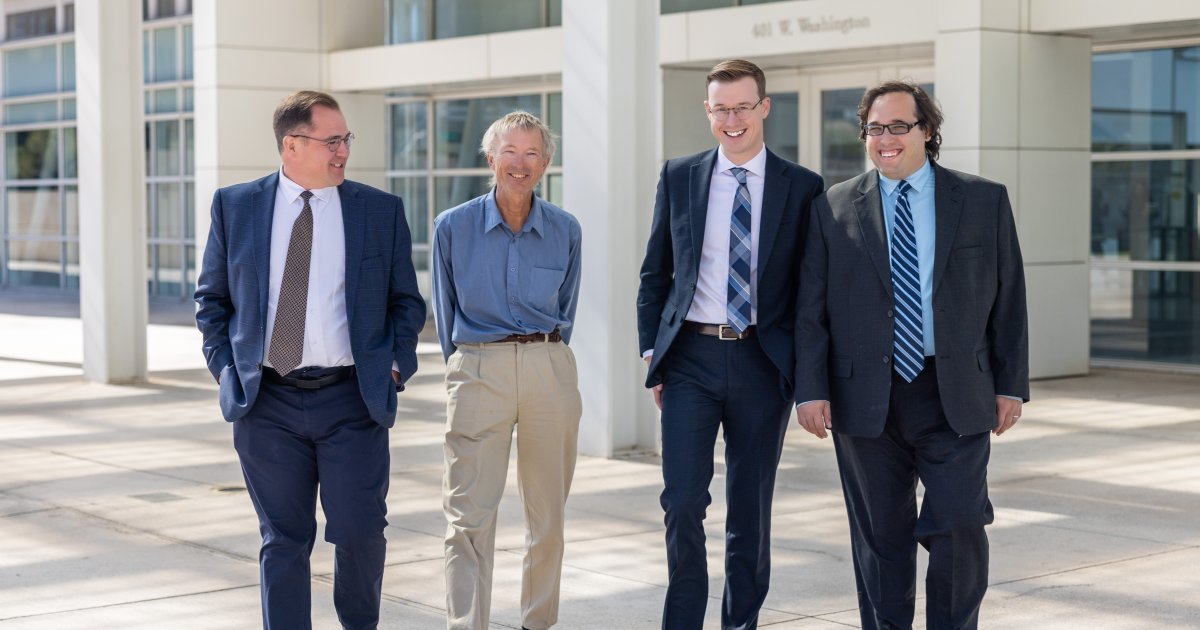
    “This decision is a major victory for the free speech rights of academics,” said Foundation for Individual Rights and Expression attorney Daniel Ortner, who argued the case before a Ninth Circuit panel in November 2024. “This decision will protect professors from investigation or threats of termination for their speech, and promote accountability for administrators who violate the First Amendment.”

    The dispute began in 2020, when Jensen planned to comment at a TMCC conference about what he perceived to be diminishing academic standards at the college. After administrators prohibited Jensen from sharing his views at a Q&A session, he printed out his planned comments critiquing the college for allowing for “a student graduating from college” while only being “ready for middle school math,” and handed them out to his colleagues during the break. TMCC Dean Julie Ellsworth told Jensen not to circulate his fliers during the break, but he continued to do so without interrupting the session.

    Ellsworth then accused Jensen of “disobeying” her and warned him he had “made an error” defying her. Following through on her veiled threats, Ellsworth sent Jensen an official reprimand. Over the next two performance reviews, Jensen’s department chair suggested he receive an “excellent” rating, but Ellsworth retaliated by giving him “unsatisfactory” ratings for “insubordination.” As a result, Jensen automatically had to undergo review for possible termination.

    “The college’s actions tarnished my reputation and chilled my speech,” said Jensen. “The Ninth Circuit’s decision vindicates my First Amendment rights and allows me to have my day in court.” 

    COURTESY PHOTOS OF PROFESSOR JENSEN AND HIS ATTORNEYS

    TMCC might have fired Jensen if not for the speedy intervention of FIRE, which wrote a letter objecting that the administrators were violating the First Amendment, which protects faculty at public colleges in commenting as citizens on matters of public concern. TMCC announced that Jensen would not be fired, but the damage to his First Amendment rights was already done, especially with the negative performance evaluations remaining on his file.

    Jensen sued Ellsworth and other TMCC administrators in 2022, arguing the college’s retaliatory actions violated his First Amendment rights as well as his right to due process and equal protection. A district court dismissed the case in 2023. 

    The Ninth Circuit ruled today that the district court erred in dismissing Jensen’s First Amendment claim, because his speech about the college’s academic standards involved a matter of public concern related to scholarship or teaching, and thus receives First Amendment protection. 

    The Court also held the university’s retaliatory actions were likely to chill Jensen’s speech, and that a university’s “interest in punishing a disobedient employee for speaking in violation of their supervisor’s orders cannot automatically trump the employee’s interest in speaking.” The Court warned, in fact, that if an employer could fire an employee solely for refusing to obey an order to stop speaking, a university could unconstitutionally enjoy “carte blanche to stifle legitimate speech.”

    The Court further held the district court erred when it held that claims against the college administrators were barred by qualified immunity, a doctrine that requires plaintiffs to show a government official violated their “clearly established right” before they can hold those officials accountable for damages. The Ninth Circuit held that at the time Jensen spoke out, “it was clearly established that a professor has a right to speak about a school’s curriculum without being reprimanded, given negative performance reviews, and put through an investigation and termination hearing.”

    The ruling remands the case back to the District Court of Nevada, where Jensen’s First Amendment claims can proceed. He may also choose to amend his other claims as necessary to proceed alongside them. Jensen is also represented by Nevada attorney John Nolan, who brought the lawsuit and wrote the briefs filed with the Ninth Circuit. 


    The Foundation for Individual Rights and Expression (FIRE) is a nonpartisan, nonprofit organization dedicated to defending and sustaining the individual rights of all Americans to free speech and free thought — the most essential qualities of liberty. FIRE educates Americans about the importance of these inalienable rights, promotes a culture of respect for these rights, and provides the means to preserve them.

    CONTACT:

    Alex Griswold, Communications Campaign Manager, FIRE: 215-717-3473; [email protected]

    Source link

  • VICTORY! Charges dropped against TN woman cited for using skeletons in Christmas decorations

    VICTORY! Charges dropped against TN woman cited for using skeletons in Christmas decorations

    GERMANTOWN, Tenn., March 10, 2025 —Less than a month after the Foundation for Individual Rights and Expression filed a First Amendment lawsuit against Germantown, Tennessee, the city has voluntarily dismissed charges against its resident Alexis Luttrell for keeping skeletons in her yard after Halloween.

    “We are thrilled that Alexis will no longer have to stand trial because government officials disapproved of her decorative skeletons,” said FIRE attorney Colin McDonell. “Punishing Alexis for her choice of expressing holiday cheer would have been a bone-chilling restriction on her First Amendment rights.”

    “I’m beyond pleased that I’m no longer on trial for nothing more than decorating my yard in a way that City Hall didn’t like,” said Alexis. “That these charges were ever brought in the first place was utterly surreal, but I’m glad that they’re dead and buried — and my skeletons aren’t.”

    Alexis set up a decorative skeleton and skeleton dog in her front yard to celebrate Halloween last year, and then redressed them for Election Day and Christmas as well. But in December, a Germantown code officer left a notice that said that she had violated Ordinance 11-33, which says that yard decorations “shall not be installed or placed more than 45 days before the date of the holiday” and must be removed within “30 days, following the date of the holiday.”

    On Jan. 6, she received a citation from the Memphis suburb saying she was still in violation and that she would have to appear before a local judge. If found guilty, she would have been subject to fines and a court order prohibiting skeletons in her holiday displays.

    All this violated Alexis’s First Amendment rights. Americans have the right to put up skeletal decorations in September, October, November, December —- whenever they want. And by refusing to acknowledge Alexis’s Christmas-themed skeletons as Christmas decorations, the city engaged in viewpoint discrimination by enforcing an arbitrary and narrow idea of the “right” way to celebrate Christmas.

    COURTESY PHOTOS OF ALEXIS AND HER HOLIDAY DISPLAYS

    FIRE jumped into action, agreeing to represent Alexis in Germantown municipal court and filing a federal lawsuit seeking to overturn the Germantown ordinance on First Amendment grounds.

    “The Holiday Decorations Ordinance violates the First Amendment,” the civil rights complaint read. “It is a content-based and viewpoint-discriminatory restriction on speech. It is not narrowly tailored to a compelling government interest. And it is unconstitutionally vague, allowing government officials to arbitrarily punish holiday expression based on their subjective beliefs.”

    Alexis’s municipal court date was originally scheduled for Feb. 13, but it was postponed for a month after FIRE filed the federal lawsuit. But ahead of the March 13 hearing, the city’s attorneys dropped the charges, meaning Alexis is no longer at immediate risk of being punished for exorcising — er, exercising her rights.

    FIRE’s federal lawsuit challenging Germantown’s ordinance is still pending, but with charges dropped, Alexis’s skeletons will stay up and dressed to the nines as the lawsuit progresses through the courts. Alexis has continued dressing the skeletons to celebrate every new holiday season. Last month, it was Valentine’s Day, now they’re dressed for St. Patrick’s Day, and Easter and Pride Month displays are set to follow.

    “Holidays come and go, but the First Amendment is here year-round,” said McDonell. “We look forward to seeing all the ways Alexis will express herself for the holidays this year, without government interference.” 


    The Foundation for Individual Rights and Expression (FIRE) is a nonpartisan, nonprofit organization dedicated to defending and sustaining the individual rights of all Americans to free speech and free thought — the most essential qualities of liberty. FIRE educates Americans about the importance of these inalienable rights, promotes a culture of respect for these rights, and provides the means to preserve them.

    CONTACT:

    Alex Griswold, Communications Campaign Manager, FIRE: 215-717-3473; [email protected]
    Source link

  • VICTORY! Charges dropped against Tenn. woman cited for using skeletons in Christmas decorations

    VICTORY! Charges dropped against Tenn. woman cited for using skeletons in Christmas decorations

    GERMANTOWN, Tenn., March 10, 2025 —Less than a month after the Foundation for Individual Rights and Expression filed a First Amendment lawsuit against Germantown, Tennessee, the city has voluntarily dismissed charges against its resident Alexis Luttrell for keeping skeletons in her yard after Halloween.

    “We are thrilled that Alexis will no longer have to stand trial because government officials disapproved of her decorative skeletons,” said FIRE attorney Colin McDonell. “Punishing Alexis for her choice of expressing holiday cheer would have been a bone-chilling restriction on her First Amendment rights.”

    “I’m beyond pleased that I’m no longer on trial for nothing more than decorating my yard in a way that City Hall didn’t like,” said Alexis. “That these charges were ever brought in the first place was utterly surreal, but I’m glad that they’re dead and buried — and my skeletons aren’t.”

    Alexis set up a decorative skeleton and skeleton dog in her front yard to celebrate Halloween last year, and then redressed them for Election Day and Christmas as well. But in December, a Germantown code officer left a notice that said that she had violated Ordinance 11-33, which says that yard decorations “shall not be installed or placed more than 45 days before the date of the holiday” and must be removed within “30 days, following the date of the holiday.”

    On Jan. 6, she received a citation from the Memphis suburb saying she was still in violation and that she would have to appear before a local judge. If found guilty, she would have been subject to fines and a court order prohibiting skeletons in her holiday displays.

    All this violated Alexis’s First Amendment rights. Americans have the right to put up skeletal decorations in September, October, November, December —- whenever they want. And by refusing to acknowledge Alexis’s Christmas-themed skeletons as Christmas decorations, the city engaged in viewpoint discrimination by enforcing an arbitrary and narrow idea of the “right” way to celebrate Christmas.

    COURTESY PHOTOS OF ALEXIS AND HER HOLIDAY DISPLAYS

    FIRE jumped into action, agreeing to represent Alexis in Germantown municipal court and filing a federal lawsuit seeking to overturn the Germantown ordinance on First Amendment grounds.

    “The Holiday Decorations Ordinance violates the First Amendment,” the civil rights complaint read. “It is a content-based and viewpoint-discriminatory restriction on speech. It is not narrowly tailored to a compelling government interest. And it is unconstitutionally vague, allowing government officials to arbitrarily punish holiday expression based on their subjective beliefs.”

    Alexis’s municipal court date was originally scheduled for Feb. 13, but it was postponed for a month after FIRE filed the federal lawsuit. But ahead of the March 13 hearing, the city’s attorneys dropped the charges, meaning Alexis is no longer at immediate risk of being punished for exorcising — er, exercising her rights.

    FIRE’s federal lawsuit challenging Germantown’s ordinance is still pending, but with charges dropped, Alexis’s skeletons will stay up and dressed to the nines as the lawsuit progresses through the courts. Alexis has continued dressing the skeletons to celebrate every new holiday season. Last month, it was Valentine’s Day, now they’re dressed for St. Patrick’s Day, and Easter and Pride Month displays are set to follow.

    “Holidays come and go, but the First Amendment is here year-round,” said McDonell. “We look forward to seeing all the ways Alexis will express herself for the holidays this year, without government interference.” 


    The Foundation for Individual Rights and Expression (FIRE) is a nonpartisan, nonprofit organization dedicated to defending and sustaining the individual rights of all Americans to free speech and free thought — the most essential qualities of liberty. FIRE educates Americans about the importance of these inalienable rights, promotes a culture of respect for these rights, and provides the means to preserve them.

    CONTACT:

    Alex Griswold, Communications Campaign Manager, FIRE: 215-717-3473; [email protected]
    Source link