Tag: Video

  • Cosmetologists can’t shoot a gun? FIRE ‘blasts’ tech college for punishing student over target practice video

    Cosmetologists can’t shoot a gun? FIRE ‘blasts’ tech college for punishing student over target practice video

    Language can be complicated. According to Merriam-Webster, the verb “blast” has as many as 15 different meanings — “to play loudly,” “to hit a golf ball out of a sand trap with explosive force,” “to injure by or as if by the action of wind.”

    Recently, the word has added another definition to the list. Namely, “to attack vigorously” with criticism, as in, “to blast someone online” or “to put someone on blast.” This usage has becomecommon expression.

    That’s what Leigha Lemoine, a student at Horry-Georgetown Technical College, meant when she posted in a private Snapchat group that a non-student who had insulted her needed to get “blasted.” 

    But HGTC’s administration didn’t see it that way. When some students claimed they felt uncomfortable with Lemoine’s post, the college summoned her to a meeting. Lemoine explained that the post was not a threat of physical harm, but rather a simple expression of her belief that the person who had insulted her should be criticized for doing so. The school’s administrators agreed and concluded there was nothing threatening in her words.

    But two days later, things took a turn. Administrators discovered a video on social media of Lemoine firing a handgun at a target. The video was recorded off campus a year prior to the discovery, and had no connection to the “blasted” comment, but because she had not disclosed the video’s existence (why would she be required to?), the college decided to suspend her until the 2025 fall semester. Adding insult to injury, HGTC indicated she Lemoine would be on disciplinary probation when she returned. 

    Screenshots of Leigha Lemoine’s video on social media.

    HGTC administrators claim Lemoine’s post caused “a significant amount of apprehension related to the presence and use of guns.” 

    “In today’s climate, your failure to disclose the existence of the video, in conjunction with group [sic] text message on Snapchat where you used the term ‘blasted,’ causes concern about your ability to remain in the current Cosmetology cohort,” the college added.

    Never mind the context of the gun video, which had nothing to do with campus or the person she said needed to get “blasted.” HGTC was determined to jeopardize Lemoine’s future over one Snapchat message and an unrelated video. 

    Colleges and universities would do well to take Lemoine’s case as a reminder to safeguard the expressive freedoms associated with humor and hyperbolic statements. Because make no mistake, FIRE will continue to blast the ones that don’t.
    FIRE wrote to HGTC on Lemoine’s behalf on Oct. 7, 2024, urging the college to reverse its disciplinary action against Lemoine. We pointed out the absurdity of taking Lemoine’s “blasted” comment as an unprotected “true threat” and urged the college to rescind her suspension. Lemoine showed no serious intent to commit unlawful violence with her comment urging others to criticize an individual, and tying the gun video to the comment was both nonsensical and deeply unjust. 

    But HGTC attempted to blow FIRE off and plowed forward with its discipline. So we brought in the big guns — FIRE Legal Network member David Ashley at Le Clercq Law Firm took on the case, filing an emergency motion for a temporary restraining order. On Dec. 17, a South Carolina federal district court ordered HGTC to allow her to return to classes immediately while the case works its way through the courts

    Jokes and hyperbole are protected speech

    Colleges and universities must take genuine threats of violence on campus seriously. That sometimes requires investigations and quick institutional action to ensure campus safety. But HGTC’s treatment of Lemoine is the latest in a long line of colleges misusing the “true threats” standard to punish clearly protected speech — remarks or commentary that are meant as jokes, hyperbole, or otherwise unreasonable to treat as though they are sincere. 

    Take over-excited rhetoric about sports. In 2022, Meredith Miller, a student at the University of Utah, posted on social media that she would detonate the nuclear reactor on campus (a low-power educational model with a microwave-sized core that one professor said “can’t possibly melt down or pose any risk”) if the football team lost its game. Campus police arrested her, and the Salt Lake County District Attorney’s Office charged her with making a terroristic threat

    The office eventually dropped the charge, but the university tried doubling down by suspending her for two years. It was only after intervention from FIRE and an outside attorney that the university relented. But that it took such significant outside pressure — especially over a harmless joke that was entirely in line with the kind of hyperbolic rhetoric one expects in sports commentary — reveals how dramatically the university overreacted.

    Political rhetoric is often targeted as well. In 2020, Babson College professor Asheen Phansey found himself in hot water after posting a satirical remark on Facebook. After President Trump tweeted a threat that he might bomb 52 Iranian cultural sites, Phansey jokingly suggested that Iran’s leadership should publicly identify a list of American cultural heritage sites it wanted to bomb, including the “Mall of America” and the “Kardashian residence.” Despite FIRE’s intervention, Babson College’s leadership suspended Phansey and then fired him less than a day later. 

    Or consider an incident in which Louisiana State University fired a graduate instructor who left a heated, profanity-laced voicemail for a state senator in which he criticized the senator’s voting record on trans rights. The senator reported the voicemail to the police, who investigated and ultimately identified the instructor. The police closed the case after concluding that the instructor had not broken the law. You’re supposed to be allowed to be rude to elected officials. LSU nevertheless fired him.

    More examples of universities misusing the true threats standard run the political gamut: A Fordham student was suspended for a post commemorating the anniversary of the Tianneman Square massacre; a professor posted on social media in support of a police officer who attacked a journalist and was placed on leave; an adjunct instructor wished for President Trump’s assassination and had his hiring revoked; another professor posted on Facebook supporting Antifa, was placed on leave, and then sued his college. Too often, the university discipline is made more egregious by the fact that administrators continue to use the idea of “threatening” speech to punish clearly protected expression even after local police departments conclude that the statements in question were not actually threatening.

    What is a true threat?

    Under the First Amendment, a true threat is defined as a statement where “the speaker means to communicate a serious expression of an intent to commit an act of unlawful violence to a particular individual or group of individuals.” 

    That eliminates the vast majority of threatening speech you hear each day, and for good reason. One of the foundational cases for the true threat standard is Watts v. U.S., in which the Supreme Court ruled that a man’s remark about his potential draft into the military — “If they ever make me carry a rifle, the first man I want to get in my sights is LBJ” — constituted political hyperbole, not a true threat. The Court held that such statements are protected by the First Amendment. And rightfully so: Political speech is where the protection of the First Amendment is “at its zenith.” An overbroad definition of threatening statements would lead to the punishment of political advocacy. Look no further than controversies in the last year and a half over calls for genocide to see how wide swathes of speech would become punishable if the standard for true threats was lower. 

    Colleges and universities would do well to take Lemoine’s case as a reminder to safeguard the expressive freedoms associated with humor and hyperbolic statements. Because make no mistake, FIRE will continue to blast the ones that don’t.
    Source link

  • China’s censorship goes global — from secret police stations to video games

    China’s censorship goes global — from secret police stations to video games

    Last year, FIRE launched the Free Speech Dispatch, a regular series covering new and continuing censorship trends and challenges around the world. Our goal is to help readers better understand the global context of free expression. The previous entry covered Australia’s ban on teen social media, South Korea’s martial law decree, and more. Want to make sure you don’t miss an update? Sign up for our newsletter

    China’s censorship in the news — and in the U.S.

    • Late last month, a New York man pleaded guilty in Brooklyn Federal Court to his role in running a secret Chinese government police station in Manhattan. The Chinese government is accused of setting up over a hundred such stations worldwide and using them to surveil, threaten, and silence dissidents outside its borders. His prosecution is the latest in a series of Department of Justice efforts to combat foreign governments’ targeting their critics within U.S. borders.
    • On a related note, President Joe Biden established a “China Censorship Monitor and Action Group” in December. The group’s mission is to “monitor and address the effects of any efforts by the PRC to censor or intimidate, in the United States or in any of its possessions or territories, any United States person, including a United States company that conducts business in the PRC, exercising its freedom of speech.”
    • If you’re a gamer, you might be excited about the popular new video game “Marvel Rivals.” But you may be disappointed to learn that the game comes with some strings attached — namely, users cannot make political statements that the Chinese Communist Party dislikes. The game, created by Marvel and Chinese developer NetEase, blocks users from typing phrases in the chat function including “Tiananmen Square,” “free Taiwan,” “free Hong Kong,” “free Tibet,” and “Taiwan is a country.” What is allowed? Negative commentary about Taiwan. 

    On a somber anniversary, a glimmer of hope for blasphemers

    Sign reading Je Suis Charlie at a memorial for the victims of the Charlie Hebdo magazine terror attacks in 2015. (conejota / Shutterstock.com)

    Jan. 7 marked the tenth anniversary of the Charlie Hebdo attacks, in which cartoonists and staff from satirical French magazine Charlie Hebdo were killed by gunmen over the magazine’s depictions of the Prophet Muhammad. The magazine commemorated the date with a contest for the “funniest and meanest” depictions of God. 

    As I wrote about the anniversary, we have failed to protect blasphemers since the killings and, in some ways, the legal realities are getting even worse for those accused of transgressing against deities. But there are a couple of bright spots in the wake of the commemoration. 


    WATCH: UK to create blasphemy laws?

    A BBC report released on the anniversary itself announced that Nigerian humanist Mubarak Bala was set free from prison after a nearly five year legal battle. Bala was initially sentenced to 24 years in prison for blasphemous Facebook posts. His sentence was reduced last year, and although he has now been released, he is not exactly free. Bala is in hiding in a safe house, due to concerns that he will be attacked by vigilantes or mobs.

    And, now, Spain is looking to set a good example, with the Socialist party’s introduction of a bill that would, among other things, repeal the country’s blasphemy law that hands out fines to offenders. This law “rarely achieves convictions and yet it is constantly used by extremist and fundamentalist organisations to persecute artists, activists (and) elected representatives, subjecting them to costly criminal proceedings,” the party’s spokesperson said. 

    The legislation was prompted by a lawsuit “brought by Abogados Cristianos (Christian Lawyers) against comedienne Lalachus after she, in a state television appearance during New Year’s Eve celebrations, brandished an image of Jesus on which the head of the cow mascot for a popular TV program had been superimposed.”

    The latest in speech rulings and regulations

    From the UK to Germany to Singapore: Police are watching what you post

    Blog

    Police detained a pro-Palestinian activist in London under the UK’s Terrorism Act for, as the arresting officer put it, “making a hate speech.”


    Read More

    • Lithuania’s Constitutional Court ruled as unconstitutional a provision in the country’s Law on the Protection of Minors from Negative Effects of Public Information, which stated that information about non-traditional families was harmful to minors and could be restricted.
    • Irish media regulator Coimisiún na Meán released a decision last month warning Meta to take “specific measures” to reduce the “dissemination of terrorist content” on Facebook and report its progress. The nature of the “terrorist content” remains unclear.
    • The UK’s Investigatory Powers Tribunal issued a ruling finding that an “undercover surveillance operation” by the Police Service of Northern Ireland and Metropolitan Police to identify journalists’ sources was “disproportionate” and “undermined” media protections
    • Albania announced a one-year ban on TikTok, with the country’s prime minister blaming the app for violence among young people, including the recent stabbing death of a 14-year-old. (The Supreme Court is deliberating the TikTok ban here in the United States, a ban FIRE opposes as a First Amendment violation.)
    • On Christmas Day, Vietnam enacted a new decree requiring social media users to verify their identity, a tool that’s ripe for abuse in a country known for its crusade to silence online government critics.

    Maker of infamous Pegasus spyware loses to WhatsApp in California court 

    NSO Group Technologies is an Israeli cyber-intelligence firm known for its proprietary spyware Pegasus

    NSO Group Technologies is a cyber-intelligence firm known for its proprietary spyware Pegasus. (poetra / Shutterstock.com)

    Meta’s WhatsApp won a major victory in the U.S. District Court for the Northern District of California against the NSO Group, an Israel-based spyware company. The NSO Group was accused of exploiting WhatsApp to install its infamous Pegasus spyware program into over a thousand phones. 

    Pegasus, sold to governments around the world by NSO Group, became the center of blockbuster reporting in recent years over its use to target human rights activists and journalists — and the wife of Jamal Khashoggi, the U.S. based journalist who was brutally murdered in the Saudi consulate in 2018.

    Deepening repression continues into 2025

    The new year unfortunately doesn’t mean an end to repressive trends around the world, some of which have been building for years or even decades. 

    • Hong Kong is once again attempting to punish its exiled pro-democracy activists. Late last month, Hong Kong police offered large rewards for information assisting in the arrest of activists now in the UK and Canada who are accused of national security law violations. Then the city’s government canceled the passports of seven activist “absconders,” including some based in the U.S. “You will become a discarded soldier, you will have no identity,” Secretary for Security Chris Tang said at a press conference. “After I cancelled your passport, you cannot go anywhere.” And early this week, police raided a pollster’s home and office over claims he assisted a “wanted person who has absconded overseas.”
    • Meanwhile, critics are still being punished regularly within Hong Kong. A 19-year-old student is battling charges that he insulted China’s national anthem by turning his back while it played at a World Cup qualifier. He pleaded not guilty this month.
    • A teenage girl spent the holidays in pre-trial detention in St. Petersburg, Russia, after being detained on charges of “public calls for committing terrorist activities or public justification of terrorism.” The 16-year-old allegedly put on her school’s bulletin board flyers celebrating “Heroes of Russia” — Russian troops who defected to fight for Ukraine. 
    • It’s difficult to imagine any more ways the Taliban could dream up to suppress the expression and presence of women of Afghanistan, but they found another. A government spokesman announced that existing buildings and new construction would be required to obscure or eliminate windows showing “the courtyard, kitchen, neighbour’s well and other places usually used by women,” as the sight of them could “lead to obscene acts.” 
    • Human rights lawyer Arnon Nampa, whose repeat and unjust prosecutions I’ve discussed in previous Dispatch entries, has once again been sentenced to prison for his commentary about Thailand’s monarchy. This time he’s been sentenced to nearly three years in prison over an anti-monarchy Harry Potter-themed 2020 protest. In total, that puts him at almost 19 years in prison.
    • Apple and Google pulled VPNs from their app stores in India in response to an order from the Indian Ministry of Home Affairs, an act that “marks the first significant implementation of India’s 2022 regulatory framework governing VPN apps.” These regulations require VPN providers to keep for five years records of users’ names and identifying information.
    • A Uyghur woman was sentenced to 17 years in prison for engaging in “illegal underground religious activity” by teaching about Islam to her sons and neighbor.
    • Kenya’s president claimed for months that allegations of forced disappearances of activists connected to a youth protest movement were “fake news” but now appears to admit the government’s responsibility and promises an end to the kidnappings. “What has been said about abductions, we will stop them so Kenyan youth can live in peace, but they should have discipline and be polite so that we can build Kenya together,” president William Ruto said last month.
    • This month, Vietnamese lawyer Tran Dinh Trien went on trial for “infringing upon the interests of the state” in three Facebook posts criticizing the chief justice of the Supreme People’s Court of Vietnam. He’s potentially facing up to seven years in prison.
    • And last week, María Corina Machado, opposition leader against Venezuelan President Nicolás Maduro, was “violently intercepted” and arrested after exiting a protest in Caracas. Machado had previously been in hiding from an arrest warrant issued against her. She’s since been released but her team alleges that she “was forced to record several videos” before being set free.

    Recently unbanned Satanic Verses is popular in India’s bookstores — for now

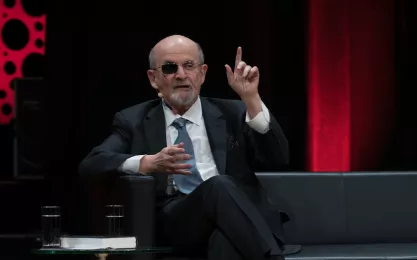
    Salman Rushdie speaks at the 75th Frankfurt Book Fair in October 2023

    Salman Rushdie, author of “The Satanic Verses” speaks at the 75th Frankfurt Book Fair on Oct. 21, 2023.

    In November, I noted that India’s ban on Salman Rushdie’s controversial bestseller “The Satanic Verses” was ending for an absurd reason: No one could find the decades-old order from customs authorities banning its import. 

    The book is now available in the country’s shops and appears to be a hit. One store manager said he was selling out of copies, despite the book’s higher-than-average cost. But not everyone is thrilled by its popularity. Groups calling for a reinstatement of the ban include the Forum Against Blasphemy and the All India Muslim Jamaat, whose president said, “No Muslim can tolerate seeing this hateful book on any bookstore shelf.”

    Source link

  • Higher Ed Without Borders Now Available on Audio and Video – Edu Alliance Journal

    Higher Ed Without Borders Now Available on Audio and Video – Edu Alliance Journal

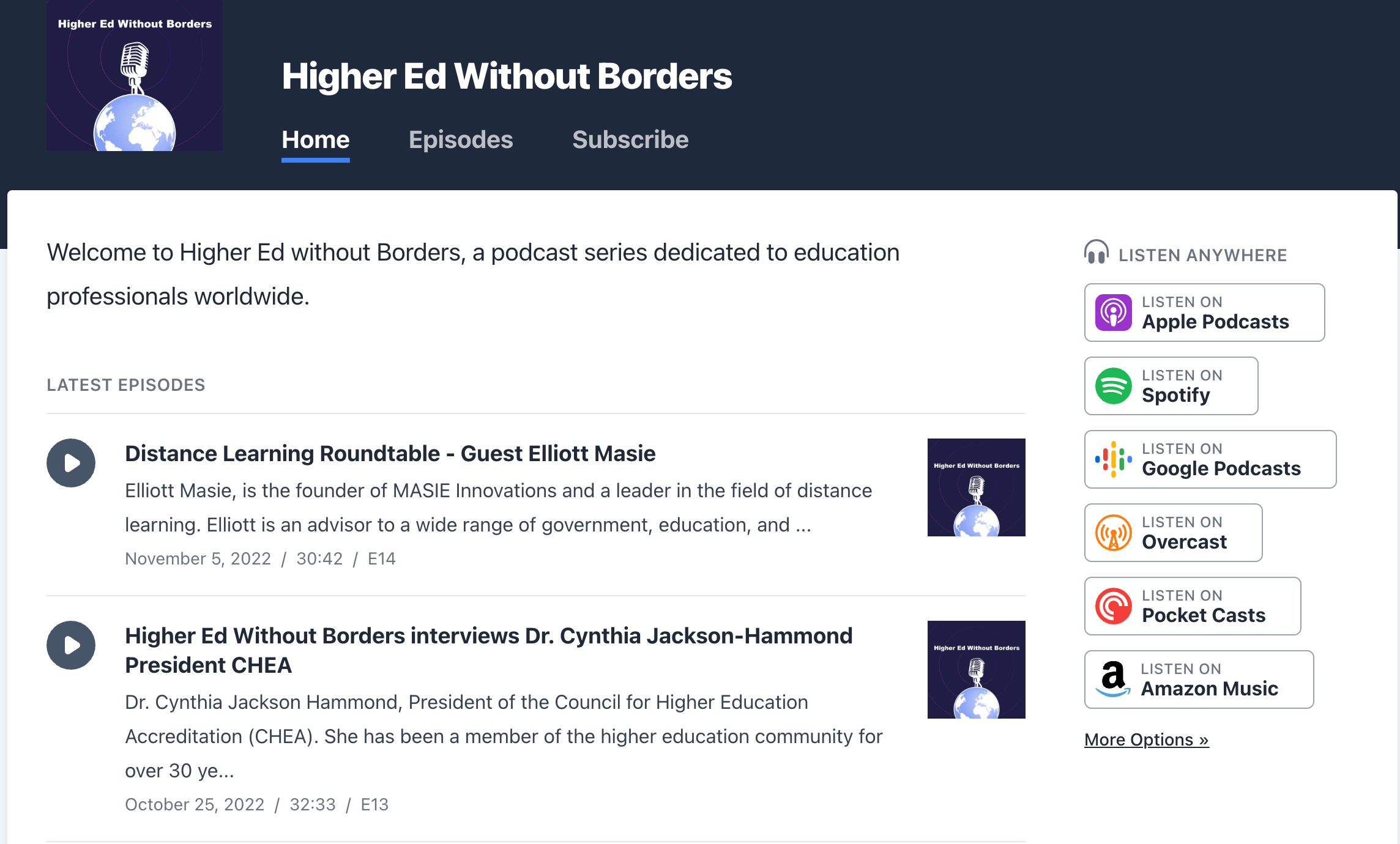
    As we enter the holiday season, we recommend you tune in to  Higher Ed Without Borders. We now have the 2022 audio podcast season available, including 14 complete episodes. In addition, we have created five video highlight programs on our YouTube Channel. The series is a production of Edu Alliance.

    Also, we are proud to announce that in December and January, five new episodes are being produced.  Our last episode for the 2022 season will be with Dr. Chris Howard, Executive Vice President and COO of Arizona State University.

    In January 2023, Dean Hoke and Tom Davisson will co-host a four-part mini-series titled Small College America. Scheduled guests will be:
    Dr. Barry Ryan, President of Woodbury University, California
    Ryan Smith, President, University of Rio Grande, Ohio
    Dr. Stefanie Niles, President of Cottey College, Missouri
    Dr. Janelle Vanasse, President of Alaska Pacific University, Alaska  

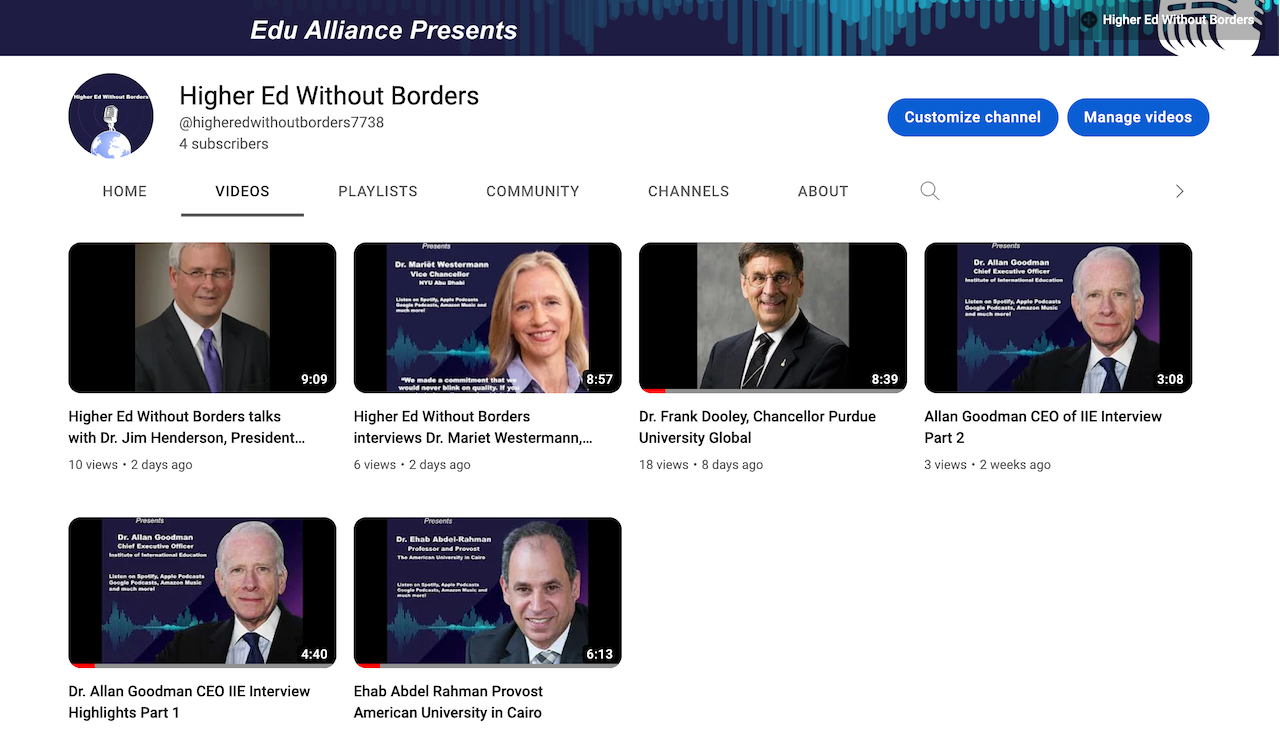
    The YouTube series currently has 6 video highlights, with more to come. They include:
    Dr. Ehab Abdel Rahman, Provost of The American University in Cairo
    Dr. Allan Goodman, Chief Executive Officer of the Institute of International Education Part 1
    Dr. Allan Goodman, Chief Executive Officer of the Institute of International Education Part 2
    Dr. Jim Henderson, President of the University of Louisiana System
    Dr. Mariët Westermann, Vice-Chancellor of New York University, Abu Dhabi
    Dr. Frank Dooley, Chancellor of Purdue University Global

    Guest for the 2022 season includes:
    Elliott Masie, founder of MASIE Innovations 
    Dr. Cynthia Jackson Hammond, President of the Council for Higher Education Accreditation
    Dr. Peter Wells. Chief of the Section for Higher Education at UNESCO, Paris
    Dr. Samantha Alvis, Senior Advisor for Higher Education for USAID 
    Dr. Matthew Wilson, Dean, and President of Temple University Japan Campus
    Dr. Tarek Sobh, President of Lawrence Technological University
    Dr. Tony Chan, President of King Abdullah University of Science and Technology in Saudi Arabia 
    Dr. Gil Latz, Vice Provost for Global Strategies and International Affairs, The Ohio State University
    Dr. Mariët Westermann, Vice-Chancellor of New York University, Abu Dhabi
    Dr. Jim Henderson, President of the University of Louisiana System
    Dr. Allan Goodman, Chief Executive Officer of the Institute of International Education
    Dr. Frank Dooley, Chancellor of Purdue University Global
    Dr. Ehab Abdel Rahman, Provost of The American University in Cairo

    Feel free to let us know if you have any questions or comments. Happy Holiday Season to you and your loved ones.

    Dean Hoke and Dr. Senthil Nathan
    Edu Alliance Group and Co-Hosts of Higher Ed Without Borders
    [email protected]
    [email protected]

    Source link