We often watch videos to learn. Open a YouTube video on the left and Google Keep or Docs on the right. You can type your notes while the video plays. You do not have to minimize the video or switch tabs to write down a thought.
The Translation Station
For students needing language support, open the student text on the left and Google Translate on the right. You can copy a phrase you do not understand and paste it into the translator. You can write your feedback in English and translate it to the student’s home language quickly.
The Collaborative Command Center
Group work can get messy. Have students open their group project rubric on the left and their shared presentation on the right. They can check their work against the criteria as they build. This keeps the collaboration focused on the learning goals.
The Parent Communication Hub
Accuracy matters when emailing parents. Open your student information system on the left and your email on the right. You can reference specific data points like attendance or grades while you type. This ensures your communication is clear and fact based.
The Research Compare And Contrast
Deepen analysis skills with this strategy. Ask students to open two different articles about the same topic. Put one on the left and one on the right. Have them highlight differences in the reporting. The visual proximity makes it easier to spot bias or conflicting details.
The Digital Textbook Reader
Students often struggle to answer questions based on a text. Have them open their digital textbook on the left and their assignment document on the right. They can refer back to the text to find evidence for their answers without losing their place in the assignment.
Student Engagement Strategy
Students struggle with digital organization. They often have too many tabs open and get distracted. Teach them to use Split View to create a focused workspace.
Tell them to open their reading assignment on the left and their response journal on the right. This visual setup signals to their brain that it is time to work. It reduces the temptation to open unrelated tabs because the screen feels full. You give them a tool to manage their own attention.
The University of California system recently made waves by announcing a commitment “to fully decarbonize no later than 2045.” Unlike many “carbon neutrality” or “net zero” plans that rely heavily on carbon offsets, the UC system plans to cut emissions from campus electricity and fossil fuel use by at least 90 percent from 2019 levels and to balance residual emissions by investing in projects to remove carbon dioxide from the atmosphere.
This win for the climate did not come easy: As activists from UC San Diego relate, they spent years building a coalition across campuses. Such success marks the UC system as a leader in American higher education, well ahead of other prestigious research universities with offset-heavy carbon neutrality plans—and well ahead of Purdue University, where we teach, which has no declared plans for decarbonization.
Here, we wish to discuss our experiences advocating for a climate action plan at Purdue, where among our peer institutions we are decidedly a laggard, not a leader, in the climate space. We hope that detailing our frustrating lack of success provides a sober counternarrative to the success story of the UC system. Furthermore, we hope that knowing about our efforts may help others who are similarly involved in advocating for climate action at campuses in red states.
Purdue’s Climate Story So Far
A public, land-grant university in north-central Indiana, Purdue enrolls more than 44,000 undergraduates and almost 14,000 graduate and professional students. Purdue frequently touts itself as a world leader in innovation of all sorts, from artificial intelligence to biomedical research, even highlighting research on sustainability. Due to its size, the energy-intensive nature of its research activities and its location in a climate that sees both cold winters and hot, humid summers, Purdue’s campus emits as much climate pollution as a small city—439,000 metric tons per year of carbon dioxide equivalent as of 2023, the latest year for which official estimates are available.
The Purdue community cares about sustainability: Classes in a wide range of majors feature considerable discussion of sustainability, and researchers across campus study the causes of and potential solutions for climate change. Purdue has won awards and recognition for low-hanging fruit, such as from Tree Campus USA and Bee Campus USA. Purdue also touts being named one of the most sustainable campuses by QS, although when one looks under the hood, such rankings give remarkably little weight to emissions reductions on campus. In the Association for the Advancement of Sustainability in Higher Education’s more rigorous reporting system, Purdue scored zero out of four on clean and renewable energy and 1.08 out of eight on greenhouse gas emissions.
Purdue faces unique decarbonization challenges. Our university’s administration ultimately answers to the Indiana state government, which has recently canceled the state’s climate action planning and enables most counties to restrict renewable energy development. Electricity in Indiana has the highest carbon intensity of any state other than three major coal producers—Kentucky, West Virginia and Wyoming—and entails almost four times higher greenhouse gas emissions per unit of energy than electricity in California. Duke Energy, the utility that serves Purdue, is the fourth largest lobby in Indiana.
While these challenges may seem daunting, progress on climate is possible even in Indiana. In 2023, our colleagues at Indiana University launched a plan promising carbon neutrality by 2040. They aim to get there by modest changes, such as improving energy efficiency in buildings and implementing renewable energy on campus. Purdue has also made progress—which we applaud—mainly by transitioning its combined heat and power plant from coal to natural gas. In 2023, Purdue estimated that its emissions were 27 percent lower than their coal-heavy 2011 level. But this only represents a small start to the actions needed for Purdue to live up to its obligations to students, staff, faculty, the community and, ultimately, the planet.
Community Will and Administrative Inaction
Many Purdue community members want substantial climate action. In 2020, more than 2,000 Purdue students signed a petition calling for Purdue to develop a climate action plan and create a universitywide, stand-alone sustainability office. The university’s president at the time, Mitch Daniels—Indiana’s former Republican governor and a noted climate change skeptic—dismissed the petition.
In the fall of 2022, students and faculty formed the Purdue Climate Action Collective (PCAC), aimed at pressuring the university to develop a climate action plan and to be transparent in reporting emissions. In the spring of 2023, the Purdue Student Government, the Graduate Student Government and the University Senate each passed resolutions calling on the university to commit to a climate action plan. The Senate resolution also called upon Purdue to join the Greater Lafayette Climate Action Plan, developed by the surrounding county and cities. Once again, Purdue ignored these calls.
Since then, PCAC has mounted numerous protests, spoken at student events, peppered campus with signs, reached out to the administration and attended Board of Trustees meetings to express our concerns. Our board is entirely appointed by the governor of Indiana. PCAC has also launched a new petition, now at 1,600 signatures.
Despite the Purdue community’s advocacy for climate action, our new president, Mung Chiang, has authorized no comprehensive, campuswide climate action plan. The nearest thing is the Campus Planning, Architecture and Sustainability office’s Sustainability Master Plan for 2020–25, which aims to reduce Purdue’s emissions from electricity and fossil fuel use 50 percent below 2011 levels by 2025 and to pursue 500 kilowatts of renewable energy. While we applaud these near-term goals, and the incomplete but significant progress toward achieving them, decarbonizing Purdue will require making a long-term plan to outgrow natural gas and Duke Energy’s carbon-intensive electricity.
On this topic, the Purdue administration told the University Senate in 2024 that “Purdue has a climate action plan consisting of two parts,” referring senators to the Sustainability Master Plan and to a joint study with Duke Energy on the feasibility of a small modular nuclear reactor (SMR) for the campus. While nuclear might play a role in Purdue’s energy future, SMRs are an unproven technology and should not be used as an excuse to delay the decarbonization of our campus.
The SMR study’s 2023 report states, “whether SMRs will be an economic option for Duke Energy Indiana’s customers is unknown given current technology, timing and cost uncertainty.” The report cites a likely cost range of $1.1 to $2.25 billion (for context, Purdue’s endowment currently totals $4.1 billion) and discusses design technologies that may only become “commercially viable in 2035–2040.” A responsible climate action plan could certainly include nuclear energy down the road, if it proves successful, but the urgency of the climate crisis demands that institutions address their greenhouse gas emissions now.
Possible Paths Forward
Preliminary studies of decarbonization at Purdue suggest that climate action is feasible and affordable. Today, Purdue could take a number of proven, cost-effective actions, such as improving the efficiency of its building operations (for example, by using software to avoid heating or cooling unoccupied spaces), or increasing parking fees and investing the proceeds in infrastructure and incentives for buses and electric vehicle charging. In the next five to 10 years, Purdue could electrify its vehicle fleet and arrange power-purchase agreements with clean electricity generators in the area, as has been done successfully at places like the University of Michigan and the University of Minnesota.
Long-term pathways to deep emission reductions remain uncertain, especially when considering Scope 3 emissions (emissions that are indirectly generated by university activities, such as employee commuting and flying), but Purdue has options and plenty of experts eager to investigate them. Inclusive and transparent processes for climate action planning would draw upon Purdue community expertise to identify, evaluate and select climate action pathways. But for any of this to happen, our administration must first acknowledge the need for climate action on campus.
Our experience at Purdue has affirmed that fighting for climate action on public red-state campuses is an uphill battle. We know that change must come from both above and below. Students, faculty and staff concerned about the future of our planet must continue to raise their voices and add to the pressure the university feels. Administrators more inclined toward shared governance—or toward maintaining a livable climate for the future generations that Purdue aims to serve—must also add their voices to the mix. As Purdue begins to act on climate, its passionate community of activists and innovators will be there to support implementation and to celebrate accomplishments along the way.
Although we have much to learn from the success of places like UC, places like Purdue need a different set of tools and approaches. For those at similarly recalcitrant universities, we hope this message reminds them that institutions won’t take these steps without great pressure. But given the dire warnings about the future of our planet, the importance of local climate action as congressional Republicans and the Trump administration have repealed most federal support for climate action, and the important role of universities as thought leaders, we remain convinced that this is a fight worth having.
Kevin Kircher, an assistant professor of mechanical engineering and, by courtesy, electrical and computer engineering at Purdue University, studies clean energy technologies and has worked on campus decarbonization projects at Cornell University and the Massachusetts Institute of Technology.
Writing can be hard, equal parts heavy lifting and drudgery. No wonder so many students are turning to the time-saving allure of ChatGPT, which can crank out entire papers in seconds. It rescues them from procrastination jams and dreaded all-nighters, magically freeing up more time for other pursuits, like, say … doomscrolling.
Of course, no one learns to be a better writer when someone else (or some AI bot) is doing the work for them. The question is whether chatbots can morph into decent writing teachers or coaches that students actually want to consult to improve their writing, and not just use for shortcuts.
Maybe.
Jennifer Meyer, an assistant professor at the University of Vienna in Austria, has been studying how AI bots can be used to improve student writing for several years. In an interview, she explained why she is cautious about the ability of AI to make us better writers andis still testing how to use the new technology effectively.
All in the timing
Meyer says that just because ChatGPT is available 24/7 doesn’t mean students should consult it at the start of the writing process. Instead, Meyer believes that students would generally learn more if they wrote a first draft on their own.
That’s when AI could be most helpful, she thinks. With some prompting, a chatbot could provide immediate writing feedback targeted to each students’ needs. One student might need to practice writing shorter sentences. Another might be struggling with story structure and outlining. AI could theoretically meetan entire classroom’s individual needsfaster than a human teacher.
Related: Our free weekly newsletter alerts you to what research says about schools and classrooms.
In Meyer’s experiments, she inserted AI only after the first draft was done as part of the revision process. In a study published in 2024, she randomly assigned 200 German high school students to receive AI feedback after writing a draft of an essay in English. Their revised essays were stronger than those of 250students who were also told to revise, but didn’t get help from AI.
In surveys, those with AI feedback also said they felt more motivated to rewrite than those who didn’t get feedback. That motivation is critical. Often students aren’t in the mood to rewrite, and without revisions, students can’t become better writers.
Meyer doesn’t consider her experiment proof that AI is a great writing teacher. She didn’t compare it with how student writing improved after human feedback. Her experiment compared only AI feedback with no feedback.
Most importantly, one dose of AI writing feedback wasn’t enough to elevate students’ writing skills. On a second, fresh essay topic, the students who had previously received AI feedback didn’t write any better than the students who hadn’t been helped by AI.
It’s unclear how many rounds of AI feedback it would take to boost a student’s writing skills more permanently, not just help revise the essay at hand.
And Meyer doesn’t know whether a student would want to keep discussing writing with an AI bot over and over again. Maybe students were willing to engage with it in this experiment because it was a novelty, but could soon tire of it. That’s next on Meyer’s research agenda.
A viral MIT study
A much smaller MIT study published earlier this year echoes Meyer’s theory. “Your Brain on ChatGPT” went viral because it seemed to say that using ChatGPT to help write an essay made students’ brains less engaged. Researchers found that students who wrote an essay without any online tools had stronger brain connectivity and activity than students who used AI or consulted Google to search for source materials. (Using Google while writing wasn’t nearly as bad for the brain as AI.)
Although those results made headlines, there was more to the experiment. The students who initially wrote an essay on their own were later given ChatGPT to help improve their essays. That switch to ChatGPT boosted brain activity, in contrast to what the neuroscientists found during the initial writing process.
These studies add to the evidence that delaying AI a bit, after some initial thinking and drafting, could be a sweet spot in learning. That’s something researchers need to test more.
Still, Meyer remains concerned about giving AI tools to very weak writers and to young children who haven’t developed basic writing skills. “This could be a real problem,” said Meyer. “It could be detrimental to use these tools too early.”
Cheating your way to learning?
Meyer doesn’t think it’s always a bad idea for students to ask ChatGPT to do the writing for them.
Just as young artists learn to paint by copying masterpieces in museums, students might learn to write better by copying good writing. (The late great New Yorker editor John Bennet taught Jill to write this way. He called it “copy work” and he encouraged his journalism students to do it every week by copying longhand the words of legendary writers, not AI.)
Meyer suggests that students ask ChatGPT to write a sample essay that meets their teacher’s assignment and grading criteria. The next step is key. If students pretend it’s their own piece and submit it, that’s cheating. They’ve also offloaded cognitive work to technology and haven’t learned anything.
But the AI essay can be an effective teaching tool, in theory, if students study the arguments, organizational structure, sentence construction and vocabulary before writing a new draft in their own words. Ideally, the next assignment should be better if students have learned through that analysis andinternalized the style and techniques of the model essay, Meyer said.
“My hypothesis would be as long as there’s cognitive effort with it, as long as there’s a lot of time on task and like critical thinking about the output, then it should be fine,” said Meyer.
Reconsidering praise
Everyone likes a compliment. But too much praise can drown learning just as too much water can keep flowers from blooming.
ChatGPT has a tendency to pour the praise on thick and often begins with banal flattery, like “Great job!” even when a student’s writing needs a lot of work. In Meyer’s test of whether AI feedback can improve students’ writing, she intentionally told ChatGPT not to start with praise and instead go straight to constructive criticism.
Her parsimonious approach to praise was inspired by a 2023 writing study about what motivates students to revise. The study found that when teachers started off with general praise, students were left with the false impression that their work was already good enough so they didn’t put in the extra effort to rewrite.
In Meyer’s experiment, the praise-free feedback was effective in getting students to revise and improve their essays. But she didn’t set up a direct competition between the two approaches — praise-free vs. praise-full — so we don’t know for sure which is more effective when students are interacting with AI.
Being stingy with praise rubs real teachers the wrong way. After Meyer removed praise from the feedback, teachers told her they wanted to restore it. “They wondered about why the feedback was so negative,” Meyer said. “That’s not how they would do it.”
Meyer and other researchers may one day solve the puzzle of how to turn AI chatbots into great writing coaches. But whether students will have the willpower or desire to forgo an instantly written essay is another matter. As long as ChatGPT continues to allow students to take the easy way out, it’s human nature to do so.
Shirley Liu is a graduate student in education at Northwestern University. Liu reported and wrote this story along with The Hechinger Report’s Jill Barshay.
The Hechinger Report provides in-depth, fact-based, unbiased reporting on education that is free to all readers. But that doesn’t mean it’s free to produce. Our work keeps educators and the public informed about pressing issues at schools and on campuses throughout the country. We tell the whole story, even when the details are inconvenient. Help us keep doing that.
Last week, news emerged of State Department plans to cut FY25 funding for 22 study abroad programs, rendering the programs cancelled in an unprecedented slashing of funding already approved by Congress.
“We were completely blindsided by the whole thing,” said a federal employee of the Bureau of Educational and Cultural Affairs (ECA), speaking anonymously to The PIE News.
Rather than informing ECA staff, news of the cancelled funds was sent to state department regional bureau officials, they explained, eventually spreading throughout the study abroad community over social media and by word of mouth.
“We put our heart and soul into implementing these programs… for lots of people to find out about the cuts through a list shared on LinkedIn was deeply troubling,” said the employee.
While the decision to cancel the grants came from higher up, the emails were sent by a “non-political” ECA leader. Over a week has passed and ECA staff are yet to receive any official announcement from the administration.
Upon receiving the news, the study abroad community quickly galvanised, with a campaign by the Alliance for International Exchange which has seen at least 13,500 letters sent to Congress as of August 21.
“I do think the campaigns are going to be helpful… from where I sit within the ECA, we need these campaigns, our livelihoods depend on these campaigns,” said the source.
“My fear is that there’s nothing at this point that would stop the current administration from doing this again in FY26… I would say they’re laying the groundwork for that to be possible for that to have happen again,” they added.
Currently, the cancelled funds relate to fiscal year 2025, which ends on September 30, though many of the programs are forward funded, meaning that they were waiting on the FY25 funds to support the 2026 calendar year.
“For FY25, I’m not sure how we come back from this,” said the ECA staff member. “Even if everything came back online today, we would still have a paperwork issue of trying to get everything done before the September 30 deadline.”
As such, the campaigns are fighting for the long-term survival of study abroad, amid “real fears” of programs unable to reopen in the following year.
“If we allow the Office for Management and Budget (OMB) to cut these congressionally appropriated FY25 awards, it will give them license to do it again and again, effectively eliminating exchange programs,” stated the Alliance.
Though ECA staff were not privy to high level conversations between ECA official Darren Beattie and State Department leadership, a notable difference this year was the presence of OMB, “who have never ever been involved in this process previously”, said the employee.
What’s more, experts have questioned the legality of the cuts, with stakeholders highlighting that the cancellation of funding already approved by Congress is “unconstitutional”.
This is one of the primary messages of the campaign, which the ECA source said they hoped would “set the stage” for FY26 to ensure that Congress decides.
We put our heart and soul into implementing these programs… for lots of people to find out about the cuts through a list shared on LinkedIn was deeply troubling
ECA employee
“We are letting the administration and Congress know that these programs have a valuable impact and that they could meet administrative priorities if they decided to use them the way they’re meant to be used,” they added.
After a slate of State Department layoffs last month, ECA staff are thought to be safe from job losses caused by the cuts, though staff furloughs are widely expected among program implementers, with whole organisations at risk of going under.
More broadly, employees are concerned about the “dire” consequences for US diplomacy and soft power.
“All the people that work on exchange programs that I have ever encountered had an international experience that changed our lives,” said the employee. “From a policy perspective, that’s the definition of soft power, and the consequence of not having those connections for even a year are dire.”
“I have every reason to believe that this administration is doing this with other aspects of the federal government, and we just don’t know that it’s going on.”
“ECA has this large alumni network that is passionate, and we can make our voices heard by Congress,” they said. “But my biggest fear is that if ECA doesn’t come out on top then it’s going to have a greater impact on other grants in other industries that don’t have a voice as loud as ours.”
Other than being deemed as a “lower funding priority in the current fiscal environment”, no rationale has been provided for which programs got the axe, with the ECA employee particularly surprised by the cancellation of the Young African Leaders Initiative (YALI).
Established in 2010, YALI had the support of the Trump administration, with the employee deeming it “one of the best US programs for the African continent”.
As for the remaining initiatives, including the state department’s flagship Fulbright Scholarship, nothing is off the table.
“Fulbright carries the weight of more protections than most,” said the ECA employee: “That being said, I think alumni need to pay attention. I don’t think anything is out of the realm.”
The State Department did not immediately reply to The PIE’srequest for comment.
Last weekend, I completed my third 12-hour ultramarathon, finally achieving my goal of logging 50 miles (51.3 miles, to be exact!). For the past two years, I’ve finished the same course with exactly 47.5 miles each time. This year’s personal best felt both within reach and incredibly distant during my training. Reaching it required not just physical preparation, but strategic thinking and flexibility.
Leading up to the race, as I fine-tuned my training plan, adjusted my fueling strategy and mapped out rest intervals, I was struck by how much this preparation mirrors the leadership challenges in higher education today. Just as I could not control the weather on race day or predict which mile would test my resolve, today’s college and university leaders cannot anticipate every funding cut, technological disruption or student crisis that will demand our immediate attention and creative response.
The parallels run deep. Both ultrarunning and higher education leadership require what I’ve come to recognize as “adaptive preparation”—the ability to plan meticulously while remaining nimble enough to pivot when circumstances change.
Scenario Planning on the Trail and in the Boardroom
During my ultramarathon training, I spend considerable time visualizing different race-day scenarios. What if temperatures soar beyond those forecasted? What if my nutrition strategy fails at mile 30? What if an injury forces me to completely restructure my pacing? These aren’t pessimistic exercises—they’re strategic preparations that allow me to respond rather than react when challenges arise.
Higher education leaders must engage in similar scenario planning, particularly as we navigate an increasingly volatile landscape. Will federal funding for essential student support programs face cuts? How will evolving AI capabilities reshape our academic programs, student support services and the ways we engage with donors?
Just as I map out multiple fueling stations and gear adjustments, we must develop multiple contingency plans for our institutions. The leader who only prepares for the best-case scenario—whether on a 50-mile trail or in a strategic planning meeting—will find themselves unprepared when reality delivers its inevitable surprises.
The Creativity of Endurance
People often assume ultrarunning is about grinding through pain with sheer determination. While mental toughness matters, the most successful ultrarunners are creative problem-solvers. When your planned nutrition strategy isn’t working at mile 25, you don’t quit—you improvise. When equipment fails, you find workarounds.
This creative problem-solving has become essential for higher education leaders. Traditional approaches to student retention and institutional sustainability aren’t sufficient in our current environment. We need leaders who can think like ultrarunners: methodical in preparation, creative in execution and resilient in the face of setbacks.
Consider how institutions have had to reinvent student support services in response to changing needs. At Holyoke Community College, our foundation exemplifies this adaptive creativity. Rather than limiting support to traditional scholarships, the HCC Foundation distributed more than $5.5 million this past year across an innovative spectrum of student and institutional needs: a six-week faculty training program on trauma-informed practices, a menstrual equity initiative ensuring feminine products are available in high-traffic restrooms, funding for student travel to leadership development conferences and essential equipment for theater, science labs and our radio station. Like that runner who creatively problem-solves when their original strategy isn’t working, our foundation recognized that supporting today’s students requires addressing the full ecosystem of their educational experience, not just the financial barriers.
The Collaborative Nature of Solitary Pursuits
Ultrarunning appears to be the ultimate individual challenge, but successful runners know better. Every long training run depends on a network of support: the running group that motivates you through dark winter mornings, the crew that will meet you at aid stations, the community that shares advice and encouragement. Even in the loneliest miles of a race, you’re drawing on collective wisdom and support.
Higher education leadership, despite its often-isolating responsibilities, must embrace this same collaborative spirit. The challenges facing our institutions—from enrollment pressures to mental health crises to technological disruption—are too complex for any single leader to solve alone. We need cross-functional teams that can respond as dynamically as an ultrarunner adjusting strategy midrace.
The most effective higher education leaders I know have built networks that extend far beyond their campus boundaries. They’re learning from peers at other institutions, collaborating with community partners and drawing insights from sectors beyond academia. Like ultrarunners who study the strategies of athletes in other endurance sports, these leaders understand that innovation often comes from unexpected sources.
Training for the Unknown
As I prepared for my 50-mile goal, I knew that no amount of training can eliminate uncertainty. Weather patterns can shift, my body might respond differently than expected and race-day dynamics will present challenges I hadn’t anticipated. The certainty of uncertainty is precisely why my training needed to be comprehensive and adaptable.
The same principle applies to higher education leadership. We cannot predict every challenge our institutions will face, but we can develop the skills and mindsets necessary to respond effectively. This means building diverse teams, fostering cultures of innovation and maintaining the kind of institutional fitness that allows for quick pivots when circumstances demand them.
The leaders who will guide higher education through its current transformation are those who understand that preparation and flexibility aren’t opposing forces—they’re complementary strengths. Like ultrarunners who train obsessively while remaining ready to throw out their race plan if conditions change, effective leaders combine rigorous planning with adaptive execution.
The question, on race day or in our day-to-day work, isn’t whether we’ll face unexpected obstacles. The question is whether we’ve developed the endurance, creativity and collaborative spirit necessary to navigate them successfully. In both arenas, the longest distances are covered not by those who avoid challenges, but by those who have learned to run through them.
Amanda E. Sbriscia, Ed.D., is vice president for institutional advancement and executive director of the HCC Foundation at Holyoke Community College.
A Black History Month event, canceled. A lab working to fight hunger, shuttered. Student visas revoked, then reinstated, uncertain for how long. Opportunities for students pursuing science careers, fading.
The first six months of the Trump administration have brought a hailstorm of changes to the nation’s colleges and universities. While the president’s faceoffs with Harvard and Columbia have generated the most attention, students on campuses throughout the country are noticing the effects of the administration’s cuts to scientific and medical research, clampdown on any efforts promoting diversity equity and inclusion (DEI), newly aggressive policies for students with loan debt, revoking of visas for international students and more.
Many of the administration’s actions are being challenged in court, but they are influencing the way students interact with each other, what support they can get from their institutions — and even whether they feel safe in this nation.
The Hechinger Report traveled to campuses around the country to look at what these changes mean for students. Reporters visited universities in four states — California, Illinois, Louisiana and Texas — to understand this new era for higher education.
Related: Interested in more news about colleges and universities? Subscribe to our free biweekly higher education newsletter.
Louisiana State University
BATON ROUGE, La. — Last fall, Louisiana State University student A’shawna Smith had an idea for a new campus group to educate students about their legal rights and broader problems in the criminal justice system. Smith, a sociology major, had spent the prior summer interning at a law firm and noticed how many clients didn’t know their rights after an arrest.
Smith, now a rising senior, called it The Injustice Reform and soon recruited classmates and a campus adviser. They wrote a mission statement and trained as student group leaders. On Feb. 20, LSU’s student government, which awards money to campus groups that comes from student fees, gave them $1,200; Smith and her classmates planned to use the award to recruit members and organize events.
At Louisiana State University, in Baton Rouge, students say actions taken by the school’s administration in response to the federal crackdown on diversity, equity and inclusion are changing the campus culture and harming the operations of student government. Credit: Tyler Kaufman/AP Photo
But on April 8, Injustice Reform’s treasurer received a text message from Cortney Greavis, LSU’s student government adviser. She said LSU was rescinding the money: The group’s mission statement ran afoul of new federal and state restrictions on DEI. Its mission mentions racial disparities and police brutality, but the organizers were never told which words violated the rules. Smith and fellow leaders started chipping in their own money to keep the group going: $10 here and there, whatever they could afford, said Bella Porché, a rising senior on the group’s executive board.
Canceling awards to student groups is one way students say administrators at LSU, the state’s flagship university, have restricted what they can do and say since the U.S. Department of Education wrote to schools and colleges nationwide on Valentine’s Day. The letter described DEI efforts — designed to rectify current and historic discrimination — as discriminatory and threatened schools with the loss of federal money unless they ended the consideration of race in admissions, financial aid, housing, training and other practices.
Since the letter, discussion of DEI on campus “has become an anti-gay, anti-Black sort of conversation,” said Emma Miller, a rising senior and elected student senator. “People who are minorities don’t feel safe anymore, don’t feel represented, don’t feel seen, because DEI is being wiped away and their university is not saying anything.”
In a March 7 report, the university detailed dozens of changes made to comply with the letter’s demands. For example, it ended any preference granted to students from historically underrepresented groups for certain privately funded scholarships; opened membership in school-funded student organizations — like a women-in-business group — to all; and canceled activities perceived to emphasize race, even a fitness class kicking off Black History Month.
Student government leaders say the restrictions hinder their ability to operate. Rising junior Tyhlar Holliway, a member of the student government’s Black Caucus, said school administrators essentially shut down the caucus’ proposal that the student government issue a statement after the Department of Education letter in support of DEI programs and initiatives.
LSU public relations staff did not respond to interview requests or to an emailed list of questions, and the school’s civil rights and Title IX division director declined to speak.
Miller said administrators have told student leaders that all their proposed legislation must be reviewed by the school’s general counsel for compliance with the March 7 guidelines. The administration, for example, blocked a student government bill to fund a Black hair care event designed to help students prepare for career and professional opportunities, said senior Paris Holman, a student government member. “We have conferences and interviews and need to know how to take care of our hair,” said Holman, who is Black.
Students have also tailored the language of other bills to avoid the appearance of support for DEI. Holman said that in one case the student senate changed the language in a bill funding an end-of-year event for a minority student organization to remove any reference to the organization as serving minority students.
The school also overrode student government decisions about which groups, like A’shawna Smith’s, could be funded by student fees. In February, the student government voted to provide $641 to help a pre-med student, who is Black, attend a student medical education conference, in part so she could share what she’d learn with other pre-med students. A few weeks later, she received an email from Greavis, the student government adviser, saying she wouldn’t be able to attend with university funds because that money could no longer be used for “DEI-related events, initiatives, programs, or travel.” Greavis didn’t respond to requests for an interview.
The email didn’t specify why the medical conference crossed the line. But the sponsoring organization’s mission statement notes its commitment to “supporting current and future underrepresented minority medical students,” and a conference plenary speaker was scheduled to address the “enduring case for DEI in medicine.” Fewer than 6 percent of doctors are Black and research has shown improved health outcomes for Black patients who are seen by physicians of the same race.
“It doesn’t feel like a democracy,” said Holman of serving in student government at this moment.
She and other students say the university’s actions are starting to change the broader culture at LSU, which serves nearly 40,000 undergraduate and graduate students on its campus of Italian Renaissance buildings shaded by magnolias and Southern live oaks. About 60 percent of students are white and 18 percent are Black, according to federal data.
Mila Fair, a rising sophomore journalism major and a reporter for the campus TV station, said students tell her they’re afraid to join protests, in part because of LSU’s new anti-DEI rules and the national crackdown on student demonstrations. Those who do attend are often afraid to go on camera with her, she said.
Professor Andrew Sluyter of Louisiana State University. The university purged hundreds of webpages referencing DEI-related content, including a press release announcing a prestigious fellowship he’d won that mentioned “higher education’s racial inequities.” Credit: Steven Yoder for The Hechinger Report
Latin American studies professor Andrew Sluyter said administrators normally listen to the student government — even more than to the faculty government — but now worry about students getting the school into “political hot water.” He had his own run-in with the DEI ban: As part of a February effort to scrub school websites of diversity references, in which the university purged hundreds of webpages referencing DEI-related content, LSU deleted a 2022 press release announcing a prestigious fellowship he’d won that mentioned “higher education’s racial inequities.”
Students recognize the pressure LSU is under from the federal government, but they want administrators to stand up for them, said graduate student Alicia Cerquone, a student senator. “We want some sort of communication from the university that shows commitment to its community, that they have our backs and they’ll protect students,” she said.
— Steven Yoder
The University of California, Berkeley
BERKELEY, Calif. — Since early April, Rayne Xue, a junior at the University of California, Berkeley, has watched with trepidation as the Trump administration has taken one step after another to limit international students’ access to American higher education.
First came the abrupt cancellation, then reinstatement, of visas for 23 Berkeley students and recent graduates. Then the government cut off Harvard’s ability to enroll international students — a move since blocked by a federal judge — raising fears that something similar could happen at Berkeley. And late last month, as this year’s graduates were celebrating their recent commencements, Secretary of State Marco Rubio paused interviews for all new student visas and announced he would “aggressively revoke” those of Chinese students.
About 16 percent of University of California, Berkeley, students come from outside the United States. Credit: Eric Risberg/AP Photo
Xue, who is from Beijing and won a student senate seat this past spring on a platform of supporting international students, said the administration’s actions strike at a critical part of campus life at Berkeley.
“College is the opportunity of a lifetime to unlearn prejudices and embrace new perspectives, neither of which is possible without a student body that comes from a wide range of geographic and cultural backgrounds,” she said.
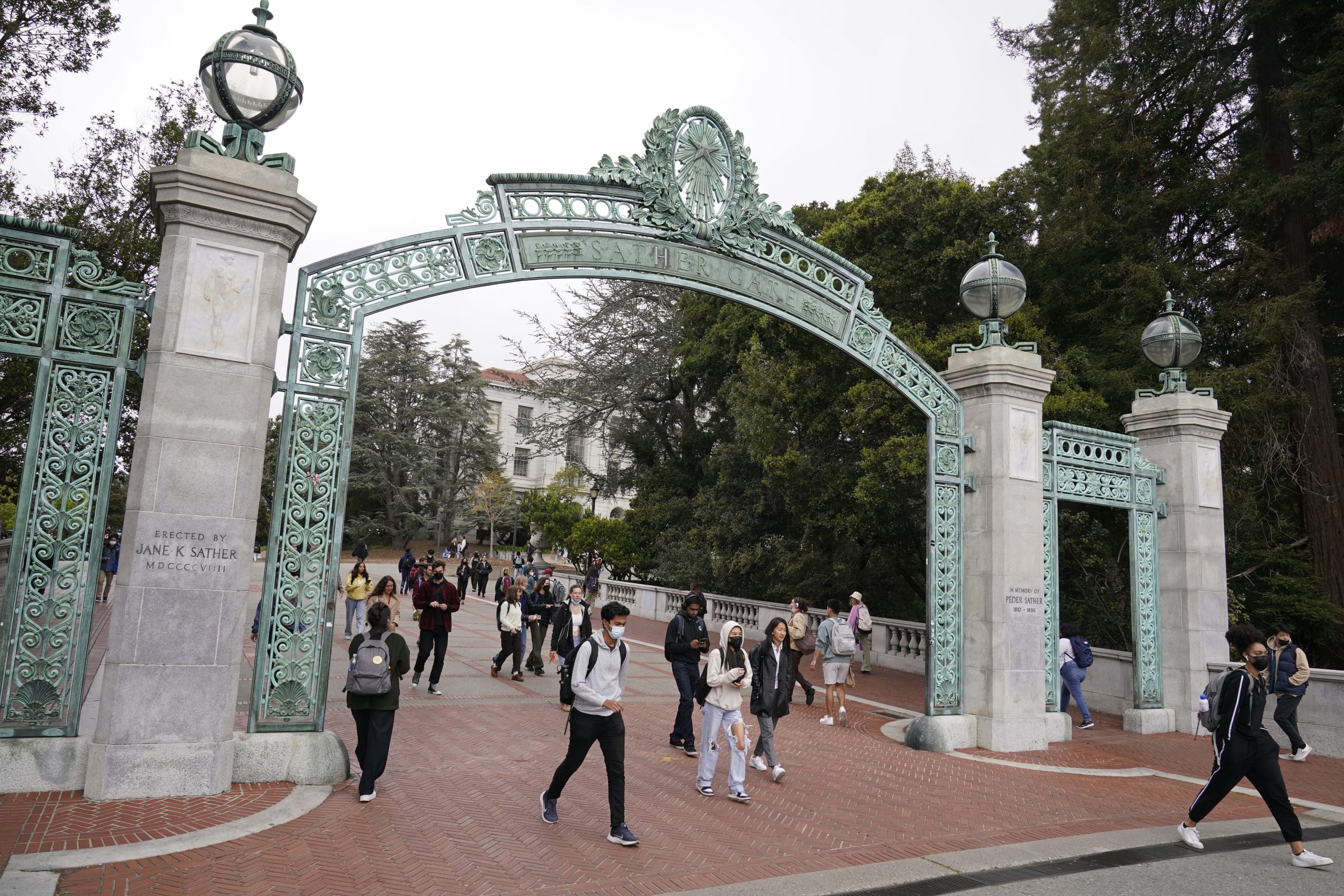
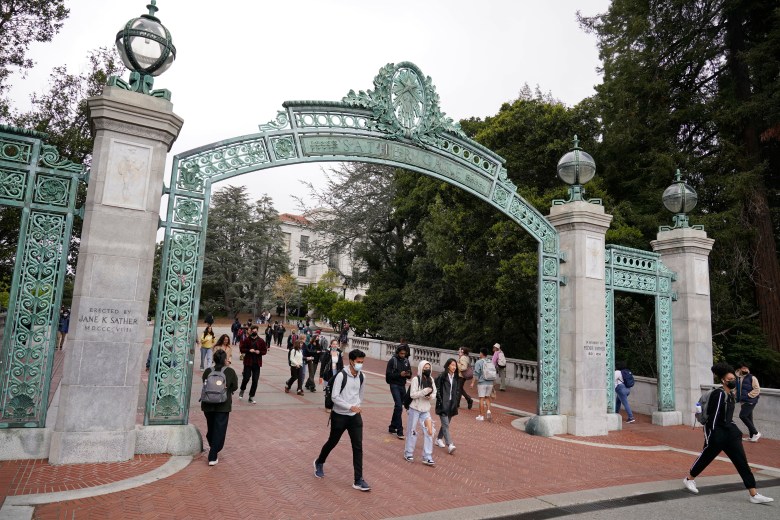
About 16 percent of UC Berkeley’s more than 45,000 students come from outside the United States to study at the crown jewel of California’s public research university system, where creeks run through campus beneath cooling redwoods and parking spaces are set aside for Nobel laureates. China, India, South Korea and Canada send the biggest numbers. International students pay higher tuition than California residents, boosting the university’s coffers and subsidizing some of their peers. Many of them conduct cutting-edge research in fields like computer science, engineering and chemistry.
Now the Trump administration’s immigration crackdown, magnified by the yanking of billions in federal research dollars, has international students worried about their future on campus. Many are changing their behavior to avoid scrutiny: Some canceled travel plans and many said they avoid walking near any campus protests in fear of being photographed.
“It’s difficult for international students to feel secure when they cannot anticipate what the administration might charge against them next — or whether they might be unfairly targeted,” said one global studies major who asked not to be identified for fear of attracting retaliation.
Tomba Morreau, a rising junior from the Netherlands studying sociology, said he stopped posting about politics on social media — just in case.
That kind of self-censorship troubles Paul Fine, co-chair of the Berkeley Faculty Association, which represents about a fifth of the university’s tenure-track faculty.
Federal policies are “creating this culture of fear where people start to censor themselves and try to stay under the radar and not show up in their full selves, whether for academic work or activism,” he said.
International students in Fine’s classes told him they wanted to attend a recent protest against federal threats to higher education but were afraid of the consequences, he said. Others told him they were skipping academic conferences outside the United States that they otherwise would have attended.
“Berkeley really prides ourselves on being an intellectual hub that convenes people from all over the world to work on the most important problems,” Fine said. Now that identity is at risk, he said, especially as actual and threatened cuts to grants make it harder for faculty to hire international graduate students and postdocs.
Most poignant, he said, was hearing from demoralized Chinese students who left a repressive government to come to the United States only to see attacks on academic freedom replicated here.
We want to hear from you.
Are you a student, professor, staff or faculty member? Our journalists want to know how the Trump administration is affecting higher education and life on your college campus.
Xue said she hopes the crisis facing universities would draw attention to the challenges international students face, including limited financial aid and the stereotype that all of them are wealthy. With her colleagues in student government, she is lobbying for Berkeley to spend more on the international office, which provides one-on-one advising on visa issues and employment.
For Lily Liu, a Chinese computer scientist, 2025 was shaping up to be a year of milestones. She graduated with a doctorate last month, has a job lined up at a leading artificial intelligence company and is engaged to be married in November.
But the Trump administration’s changing policies toward international scholars have complicated celebrations for Liu, who’s in a federal program that extends her visa for up to a year beyond graduation so she can gain work experience here. She canceled summer travel plans with her family, concerned she might not be let back into the country. And she’s considering moving her wedding to the United States from China, even though many of her relatives wouldn’t be able to attend.
“For international students, every policy affects us a lot,” she said. So Liu is careful. After the publication of her thesis was delayed, she visited Berkeley’s international office to make sure the setback wouldn’t affect her work permit. Her fiancé has a green card, which should theoretically mean his immigration status is more stable. But these days, she said, who knows?
— Felicia Mello
The University of Texas at San Antonio
SAN ANTONIO, Texas — Growing up here, Reina Saldivar had always loved science — all she wanted to watch on TV was “Animal Planet.” Yet until she applied on a whim to a program for aspiring researchers after her first year at the University of Texas at San Antonio, she assumed she would spend her life as a lab technician, running cultures.
The program, Maximizing Access to Research Careers, or MARC, was started by the National Institutes of Health decades ago at colleges around the country to prepare students, especially those from historically underrepresented backgrounds, for livelihoods in the biomedical sciences.
Saldivar got in. And through the program, she spent much of her time on campus in a university lab, helping develop a carrier molecule for a new Lyme disease vaccine. Now Saldivar, who graduated this spring, plans to eventually return to academia for a doctorate.
“What MARC taught me was that my dreams aren’t out of reach,” she said.
Saldivar is among hundreds who’ve participated in the MARC program since its 1980 founding at the University of Texas at San Antonio. She may also be among the last. In April, the university’s MARC program director, Edwin Barea-Rodriguez, opened his email inbox to find a form letter terminating the initiative and advising against recruiting more cohorts.
The letter cited “changes in NIH/HHS [Health and Human Services] priorities.” In recent months, the Trump administration has canceled at least half a dozen programs meant to train scholars and diversify the sciences as part of an effort to root out what the president labels illegal DEI.
In a statement to The Hechinger Report, NIH said that it “is committed to restoring the agency to its tradition of upholding gold-standard, evidence-based science” and is reviewing grants to make sure the agency is “addressing the United States chronic disease epidemic.”
With MARC ending, Barea-Rodriguez is searching for a way to continue supporting current participants until they graduate next academic year. Without access to federal money, however, the young scientists are anxious about their futures — and that of public health in general.
“It took years to be where we are now,” said Barea-Rodriguez, who said he was not speaking on behalf of his university, “and in a hundred days everything was destroyed.”
UTSA’s sprawling campus sits on the northwest edge of San Antonio, far from tourist sites like the Alamo and the River Walk. Forty-four percent of the nearly 31,000 undergraduate students are the first in their families to attend college; more than 61 percent identify as Hispanic or Latino. The university was one of the first nationwide to earn Department of Education recognition as a Hispanic-serving institution, a designation for colleges where at least a quarter of full-time undergraduates are Hispanic.
When Barea-Rodriguez arrived to teach at the school in 1995, many locals considered it a glorified community college, he said. But in the three decades since, the investments NIH made through MARC and other federal programs have helped it become a top-tier research university. That provided students like Saldivar with access to world-class opportunities close to home and fostered talent that propelled the economy in San Antonio and beyond.
The Trump administration has quickly upended much of that infrastructure, not only by terminating career pipeline programs for scholars, but also by pulling more than $8.2 million in National Science Foundation money from UTSA.
One of those canceled grants paid for student researchers and the development of new technologies to improve equity in math education and better serve elementary school kids from underrepresented backgrounds in a city that is about 64 percent Hispanic. Another aimed to provide science, technology, engineering and math programming to bilingual and low-income communities.
UTSA administrators did not respond to requests for comment about how federal funding freezes and cuts are affecting the university. Nationwide, more than 1,600 NSF grants have been axed since January.
In San Antonio, undergraduates said MARC and other now-dead programs helped prepare them for academic and professional careers that might have otherwise been elusive. Speaking in a lab remodeled and furnished with NIH money, where leftover notes and diagrams on glass erase boards showed the research questions students had been noodling, they described how the programs taught them about drafting an abstract, honing public speaking and writing skills, networking, putting together a résumé and applying for summer research positions, travel scholarships and graduate opportunities.
“All of the achievements that I’ve collected have pretty much been, like, a direct result of the program,” said Seth Fremin, a senior biochemistry major who transferred to UTSA from community college and has co-authored five articles in major journals, with more in the pipeline. After graduation, he will start a fully funded doctoral program at the University of Pittsburgh to continue his research on better understanding chemical reactions.
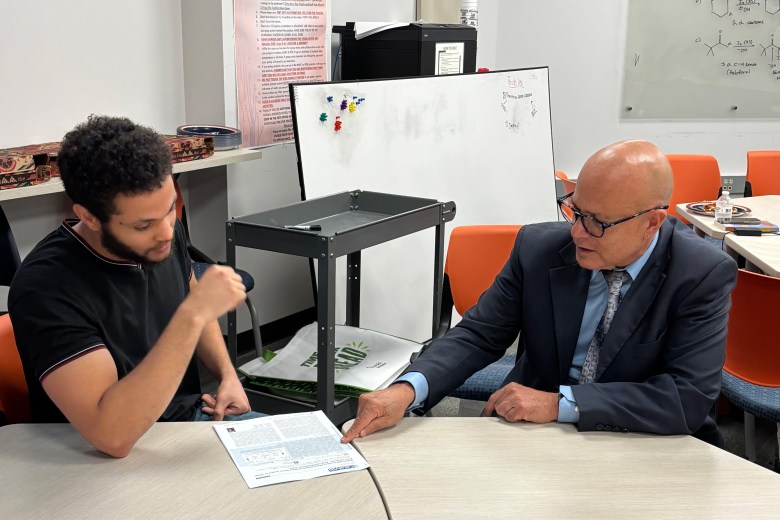
Seth Fremin, a senior biochemistry major at the University of Texas at San Antonio, with Edwin Barea-Rodriguez. Credit: Alexandra Villareal for The Hechinger Report
Similarly, Elizabeth Negron, a rising senior, is spending this summer at the Massachusetts Institute of Technology, researching skin microbiomes to see if certain bacteria predispose some people to cancers.
“It’s weird when you meet students who didn’t get into these programs,” Negron said, referring to MARC. “They haven’t gone to conferences. They haven’t done research. They haven’t been able to mentor students. … It’s very strange to acknowledge what life would have been without it. I don’t know if I could say I’d be as successful as I am now.”
With money for MARC erased, Negron said she will probably need a job once she returns to campus in the fall so she can afford day-to-day expenses. Before, research was her job.
“Without MARC,” she said, “it becomes a question of can I at least cover my tuition and my very basic needs.”
— Alexandra Villarreal
The University of Illinois Urbana-Champaign
CHAMPAIGN, Ill. — When Peter Goldsmith received notice in late January that his Soybean Innovation Lab at the University of Illinois would soon lose all of its funding, he had no idea it was coming. Suddenly Goldsmith, the lab’s director, had to tell his 30 employees they would soon be out of a job and tell research partners across Africa that operations would come to a halt. The lab didn’t even have money to water its soybean fields in Africa.
One employee, Julia Paniago, was in Malawi when she got the news. “We came back the next day,” she said of her team, “and it was a lot of uncertainty. And a lot of people cried.”
The University of Illinois’ Soybean Innovation Lab (SIL) was part of a network of 17 labs at universities across the country, all working on research related to food production and reducing global hunger, and all funded through the U.S. Agency for International Development — until the Trump administration shut down USAID.
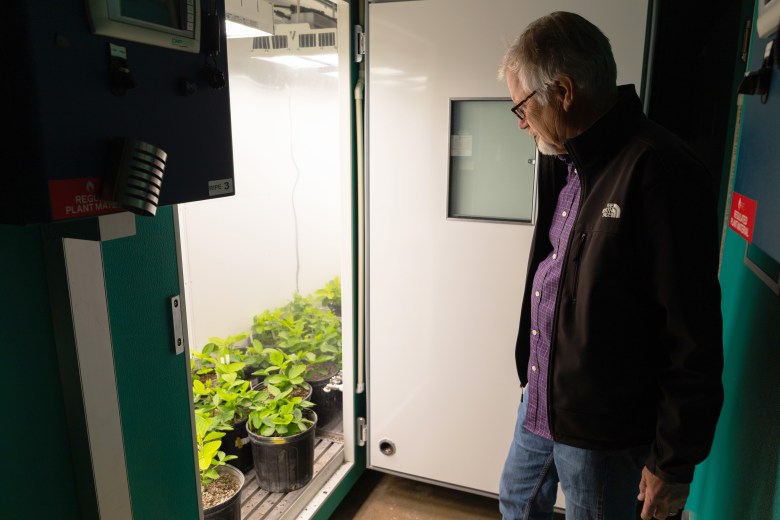
Brian Diers is former deputy director of the University of Illinois’ Soybean Innovation Lab. The lab lost its funding because of cuts to the U.S. Agency for International Development. Credit: Miles MacClure for The Hechinger Report
Soybeans — which provide both oil and high-protein food — aren’t yet commonly grown in Malawi. SIL researchers have been working toward two related goals: helping local farmers increase soybean production and ameliorate malnutrition and generating enough interest in the crop there that a new export market will open for American farmers.
The lab’s researchers work in soybean breeding, economics and mechanical research as well as education. They hope to show that soybean production in Africa is worth further investment so that eventually the private sector will come in after them.
“The people who work at SIL, they like being right at the frontier of change,” Goldsmith said. “It’s high-risk work — that’s what the universities do, that’s what scientific research is about.”
UI, the state’s flagship with a sprawling campus spread between the cities of Urbana and Champaign, is noted for its research work, especially agricultural research.
Labs and researchers across the university lost funding in cuts made by the Trump administration; more than $25 million from agencies including NIH, NSF and the National Endowment for the Humanities was cut, Melissa Edwards, associate vice chancellor for research and innovation, said, a total of 59 grants amounting to 3.6 percent of their overall federal grant portfolio.
Annette Donnelly, who just received her doctorate in education, is among those affected. Her research focuses on educating malnourished children in Africa and developing courses to help Africans learn how to process soybeans into oil.
In April, SIL was handed a lifeline — an anonymous $1 million gift that will keep the lab running through April 2026. The donation wasn’t enough for Goldsmith to rehire all of his employees; SIL’s annual operating budget before the USAID cuts was $3.3 million (and would have kept things running through 2027). But, he said, the money will allow SIL to continue its research in the Lower Shire Valley in Malawi, a project he hopes will attract future donors to fund the lab’s work.
The April donation saved Donnelly’s job, but her priorities shifted. “We’re doing research,” she said, “but we’re also doing a lot of proposal writing. It has taken on a much greater priority.”
Donnelly hopes to attract more funding so she can resume research she had started in western Kenya, demonstrating that introducing soy into children’s diets increased their protein intake by up to 65 percent, she said.
The impact that funding cuts will have on researchers at the soybean lab pales in comparison to the impact on their partners in Africa, Donnelly emphasized. There, she said, the cuts mean processors will likely slow production, limiting their ability to deliver soy products. “The consequences there are much bigger,” she said.
The Soybean Innovation Lab was funded through the Feed the Future initiative, a program to help partner countries develop better agricultural practices that began under the Obama administration in 2010. All 17 Feed the Future innovation labs funded through USAID lost funding, except for the one at Kansas State University, which studies heat-tolerant wheat.
The soybean lab’s office is housed on a quiet edge of the Illinois campus in a building once occupied by the university’s veterinary medicine program. Across the street, rows of greenhouses are home to the Crop Science Department’s experiments.
There, Brian Diers is breeding soybean varieties that resist soybean rust, a disease that’s been an obstacle to ramping up soybean production across sub-Saharan Africa. A professor emeritus who is retired, Diers works part-time at SIL to assist with soybean breeding. The April donation wasn’t enough to cover his work. Now he volunteers his time.
“ If we can help African agriculture take off and become more productive, that’s eventually going to help their economies and then provide more opportunities for American farmers to export to Africa,” he said.
Goldsmith drew an analogy between his lab’s work and the state of American agriculture in the 1930s. As the Dust Bowl swept through the Great Plains, Monsanto or another company could have stepped in to help combat it, but didn’t. Public land-grant universities did.
“That’s where the innovation comes from, from the public land grants in the U.S.,” Goldsmith said. “And now the public land grants still work in U.S. agriculture but also in the developing world.”
Commercial soybean producers hesitate to dip their toes into unproven markets, he said, so it’s SIL’s job to demonstrate that a viable market exists. “That was our secret sauce, in that lots of commercial players liked the products, the technologies we had, and wanted to move into the soybean space, but it wasn’t a profitable market,” Goldsmith said of the African soybean market.
Diers said federal funding cuts imperil not just the development of commerce and global food production but the next generation of scientists as well.
“We could potentially lose a generation of scientists who won’t go into science because there’s no funding right now,” he said.
— Miles MacClure
Contact editor Lawrie Mifflin at [email protected] or 212-678-4078. Contact editor Caroline Preston at 212-870-8965, via Signal at CarolineP.83 or on email at [email protected].
The Hechinger Report provides in-depth, fact-based, unbiased reporting on education that is free to all readers. But that doesn’t mean it’s free to produce. Our work keeps educators and the public informed about pressing issues at schools and on campuses throughout the country. We tell the whole story, even when the details are inconvenient. Help us keep doing that.
As 8,000 delegates gathered in San Diego for the opening plenary of NAFSA 2025, the sector was hit with the news that the Trump administration was halting the scheduling of student visa interviews as it prepared to expand its social media vetting of prospective students.
Then, on day two of the conference – as friends and colleagues filtered out of the convention centre to drinks receptions across the city – they were rocked by more bad news. This time, that the State Department would “aggressively revoke” visas for Chinese students and enhance scrutiny of future visa applicants.
The unexpected, inflammatory announcements alarmed delegates and immediately set the agenda for discussions across the four-day event.
Concern circulated about the characteristically broad scope and vague language of the announcements – which colleagues have come to expect from the administration. But while all of this could have quite reasonably created panic and confusion, in fact, there was an air of focus and unity.
For Brett Blacker, Duolingo’s managing director for Australia and New Zealand, the conference acted “a bit like a group therapy session”. Colleagues from across the globe were simply grateful to be together to process the rapidly changing policy environment and devise strategies for the future.
And while the deliberately disorientating barrage of attacks from the Trump administration demand that stakeholders are continuously adapting and reacting, attendees were also urged to take the long view.
“When the roots are deep, there is no reason to fear the wind,” said NAFSA CEO Fanta Aw, telling colleagues to pursue partnerships “not for prestige, but for shared progress”.
Aw extended a special welcome to NAFSA’s international participants – comprising 45% of attendees – whose very presence she said amounted to “an act of hope”.
While xenophobia disguised as nationalism and the politicisation of international students is by no means limited to the US, many of the conference’s most fruitful discussions came from cross-border comparisons.
Rather than remain despondent, NAFSA delegates have taken to LinkedIn with realism and pragmatism, laced with just a little bit of hope
These were most stark when examining student mobility in the ‘big four’ study destinations, with several sessions highlighting the relative attractiveness of the UK amid visa challenges in Canada and Australia, not to mention extreme volatility in the US.
Elsewhere, discussions highlighted the rise of the ‘Asian decade’ and the increasing pull of destinations such as Ireland and Germany, with a sense of the sector at a tipping point as the dominance of traditional destinations and models is increasingly questioned.
This sense of unity continued as colleagues were united over the frustrating lack of detail about the latest policies from the White House. As the conference continued, attendees received no clarity from government about the length of the visa interview freeze, despite the initial cable indicating it would only last several days.
Ten days later, students remain unable to book visa appointments, and the administration has stayed similarly silent on the scope or character of its “aggressive” Chinese visa revocations. It’s a maddening state of affairs, stemming from an increasingly unpredictable administration that seems unable to see that peevish, retaliatory policies made in the spur of the moment are having real-world effects on institutions and students alike.
Sadly, the onslaught shows no sligns of slowing down. Since the close of NAFSA 2025, the Trump administration has barred prospective international students in 19 countries from studying in the US.
And it has also attempted, once again, to strip students around the world of the right to study at America’s oldest institution, signing a proclamation to suspend Harvard’s international enrolments, which has since been temporarily blocked by a federal court.
As uncertainty prevails across much of the sector, emotions are understandably high. But rather than remain despondent, NAFSA delegates have taken to LinkedIn with realism and pragmatism, laced with just a little bit of hope.
As attendees heard from Intead’s Ben Waxman in the final session of the final day in the furthest away room: ““Now is not the time to get angry, now is the time to get focussed”.
Sarra Jenkins is Director of Future Pathways at Loughborough Grammar School.
HEPI’s recent report, One Step Beyond, offers an excellent analysis of an important topic – how ready are students for higher education? The findings are in many ways heartening, with students surveyed at university saying they wanted more PSHE (personal, social, health and economic) education around, for example, finance and life skills, more careers education and more academic skills. I say it is heartening as, while these areas are all incredibly important, they are not always areas students recognise the importance of while at school.
Of course, each student’s experience is unique. Their needs, background, and context will shape their readiness for higher education. But what are the challenges for schools within these findings?
Careers Education
One Step Beyond identifies that 44% of students would have liked more support with careers pathways, and recommends a one-to-one interview at 16 with a careers expert. This recommendation is also included in the Gatsby Benchmarks, so what’s the challenge? There are two resulting issues here. Firstly, there is a dearth of careers advisers in the UK. The Labour Government pledged to recruit 1,000 new careers advisers, which would be welcomed. However, training takes time and resources, and careers advisers are poorly paid within the education sector for what is a Level 6/7 role. Therefore, schools may be forced to outsource the provision of such interviews, at a notable cost.
The second issue is the question of whether one interview is enough. As teenagers research their possible options, differing pathways open and interests evolve. Often, when I ask students who had experienced a one-off, one-to-one interview about its usefulness, their responses were very mixed. I am fortunate in being able to meet students regularly and build up a relationship with them, which allows for deeper and more meaningful guidance. One interview is better than none, but having trusted adults who the students know can allow for more open and honest conversations.
Life Skills
The report also identified that students wanted more ‘life skills’. A Children’s Commissioner report into PSHE identified that a majority of 16-17-year-olds had received lessons in staying safe online, puberty, healthy eating, drugs and alcohol, emotional wellbeing, mental health, relationships and staying safe. Like the HEPI report, however, it also identified learning about finances as an area for improvement. To be clear, this is also included in the PSHE Association’s Programme of Study for Key Stage 1-5 PSHE.
The challenge can be in delivery here. The HEPI report identifies a focus on the ‘knowledge-rich’ curriculum under Gove. This can lower the profile for lessons like PSHE, especially if schools are strapped for time. Similarly, the PSHE Association identify the importance of lessons being ‘planned and taught by trained, knowledgeable and engaged specialists’. However, teachers are trained firstly in their subject. Whilst they may be required to deliver PSHE, and hopefully supported in doing so, it may well not be an area of expertise.
Additionally, the Govian reforms and the introduction of measures like the Progress 8, plus academic entry requirements to higher education, place a heavy emphasis on grades. This can become a focus for schools, teachers, parents and students alike. However, ‘life skills’ are not – and arguably should not be! – assessed in a similar manner. Perhaps more so than academic subjects, students are also likely to have a hugely varied background in ‘life skills’. So the need for considerable differentiation in a subject that can lack the profile it deserves can make engagement a challenge.
Academic Skills
The HEPI report references a high volume of assessments resulting in ‘teaching to the test’, perhaps at the expense of academic skills such as academic writing and independent inquiry. However, Leora Cruddas was right to point out in the webinar on the report that skills do not exist without knowledge domains. Indeed, even if one was doing little more than ‘teaching to the test’, to do so, a teacher would be engaging with academic skills.
My own subject of Politics has three key assessment objectives that are assessed – knowledge and understanding, analysis and logical chains of reasoning, and evaluation and substantiated judgments. These skills are academic skills, and we use the vehicle of A Level Politics for students to engage within them. Issues can occur however when students silo this knowledge. Despite, for example, similar assessment objectives occurring in A Level English, my colleague and I routinely lament students’ ability to use their skills in an inter-disciplinary manner. This is a similar problem noted in the transition from university to work.
If it is therefore necessary to have knowledge domains in order to be able to develop skill attributes, one way in which we can highlight this to students is by interrogating the assessment objectives. I often say to my own students, ‘I wouldn’t send you on to a rugby field without knowing the rules, why would I send you into an exam without knowing the rules?’. In this case, the rules are the assessment objectives, and I want my students not to be able to blindly carry them out, but to know what analysis or evaluation is and what it looks like in academic writing.
This is more challenging for skills not assessed; oracy and independent study are not assessment objectives in many subjects and therefore embedding the teaching of these skills is harder. Hopefully, this is something that may be seen in the upcoming curriculum review.
Conclusion
The HEPI report raises many important issues; if students are to thrive in higher education, they need good advice along the way and a malleable set of skills to give them the confidence to succeed in their initial stages. Hopefully, some of these issues will be addressed in the upcoming curriculum review. Ideally however, they need to include methods of resourcing and engagement to run alongside reviewed content for the widest impact in schools.
Through the annual Student Academic Experience Survey (SAES), HEPI and Advance HE collect data on the experiences and attitudes of care-experienced students. We are in a constant process of iterating and improving the SAES, and in 2024, a close reading of our data from previous years suggested a higher number of respondents than expected were saying they had experience of care. To make sure we were capturing the right students, we refined the question as follows:
Have you been in care? Select yes if you’ve ever lived in public care or as a looked-after child, including:
with foster carers under local authority care
in a residential children’s home
being ‘looked after at home’ under a supervision order
living with friends or relatives in kinship care
Note: This does not refer to time spent in boarding schools, working in a care or healthcare setting, or if you are a carer yourself.
In 2024, nearly 900 of the roughly 10,300 respondents to the SAES – still quite a high number, but significantly fewer than the previous year – said they had experience of care. What do the data say about their experiences in higher education? (Note that the margin of error for any subset will be higher than the margin for the whole survey sample, which is around 1%.)
On subject choices, care-experienced students in the SAES were somewhat more likely to be studying Medicine and Dentistry and subjects allied to Medicine, which is consistent with sector-level data. They were also more likely to be studying Engineering and less likely to be studying Business, Social Studies and creative subjects.
In addition to the challenges faced by having experienced care, these students were also less likely to come from the highest quintiles of participation in higher education (POLAR) than other students and more likely to have a disability (45%, compared to 30% of other students) but less often described themselves as first in family (25%, compared to 32% of other students).
This probably informs many of their responses throughout the survey. For example, like other students taking courses like these, care-experienced students have more contact hours and do more hours of independent work (a total of 41.5 hours) than students without experience of care (36 hours on average). Likewise, more than half of care-experienced students use AI at least once a week, compared with less than a third (30%) of other students. This is as expected, given that saving time is a primary reason students use AI tools.
Perhaps surprisingly, care-experienced students report higher scores on wellbeing measures, like happiness and life satisfaction. (For example, they average 7.08 out of 10 for whether the things they do are worthwhile, compared to 6.74 for other students.) However, they also report higher rates of anxiety and loneliness than students without experience of care, averaging 5.29 out of 10 for feeling anxious compared with 4.48 for other students.
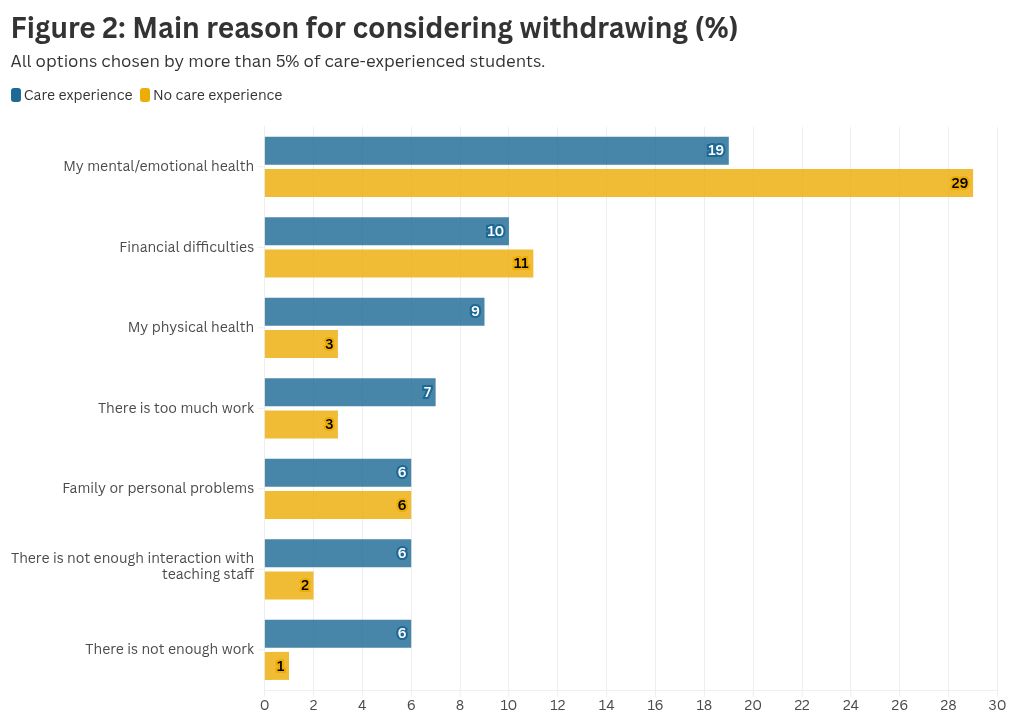
Care-experienced students are more likely to have considered withdrawing: 38% compared with 24% of all students. When asked for their main reason why, they cite mental health as the primary challenge, but at a lower rate than students without experience of care. Instead, they were more likely to mention workload – either a higher or lower volume than expected – or their physical health.
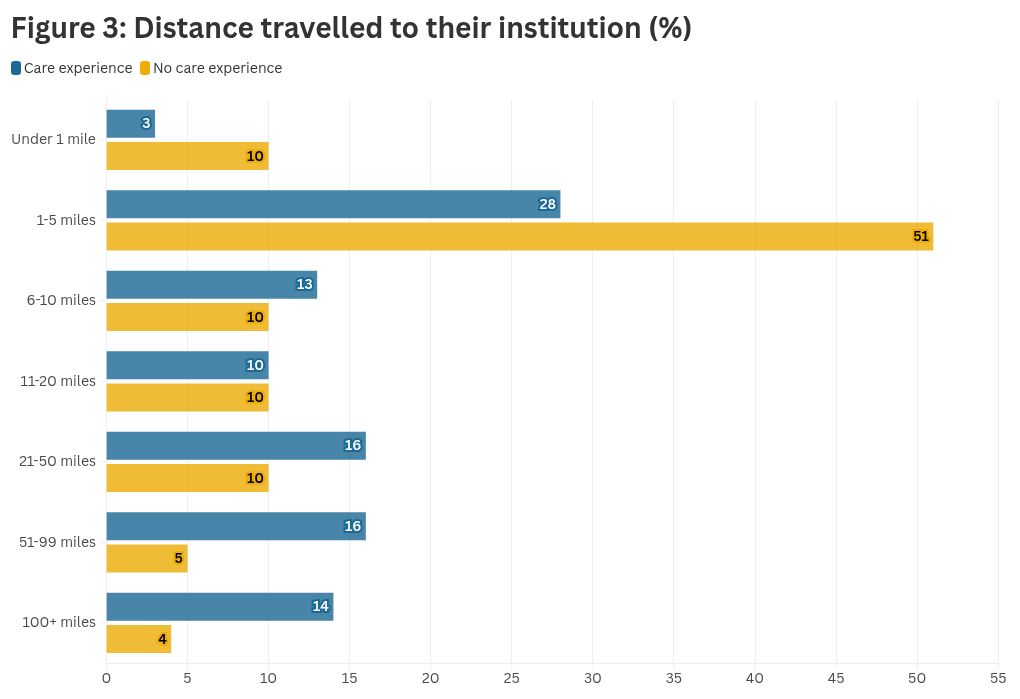
These data also suggest that care-experienced students face an altogether more challenging context. Some 58% of care-experienced students say they travel 10 miles or more to get to university, compared with only 31% without experience of care travelling the same distance. This may be because the benefits some care-experienced students get can be contingent on living within a particular local authority. Care-experienced students reported living alone or with family at higher rates than other students.
Additionally, care-experienced students may need to remain at home to provide for family members at higher rates. Almost all care-experienced students (80%) do some paid work during term-time, compared with 55% of other students. This is most often to supplement their income. But more than one-third of care-experienced students (35%) work to support friends or family financially.
A third (33%) say the cost-of-living crisis has affected them ‘a lot’, compared with 27% of other students. Care-experienced students are also nearly twice as likely to depend on scholarships or bursaries to cover their costs, which could also show that such funds are being effectively targeted towards students who need them.
In summary, care-experienced students are more likely to take certain Health and Science subjects, live further from their institution, are more likely to be working to support their families and are affected more by cost-of-living difficulties. These challenging findings help to explain why care-experienced students withdraw from higher education at higher rates.
Clearly there is more that institutions and government can do to support this group of students. The TASO report recommends, for example, working closely with local authorities to ensure care-experienced students have reliable access to accommodation, both during and outside of term-time. And as Paige Mackenzie wrote for us in 2022, the holidays can be a ‘really lonely time’ for care-experienced and estranged students and it helps when staff reach out.
Note: this is a short version of a paper which has just appeared in issue 72:4 the Canadian Tax Journal. How short? I’m trying for under 1000 words. Let’s see how I do.
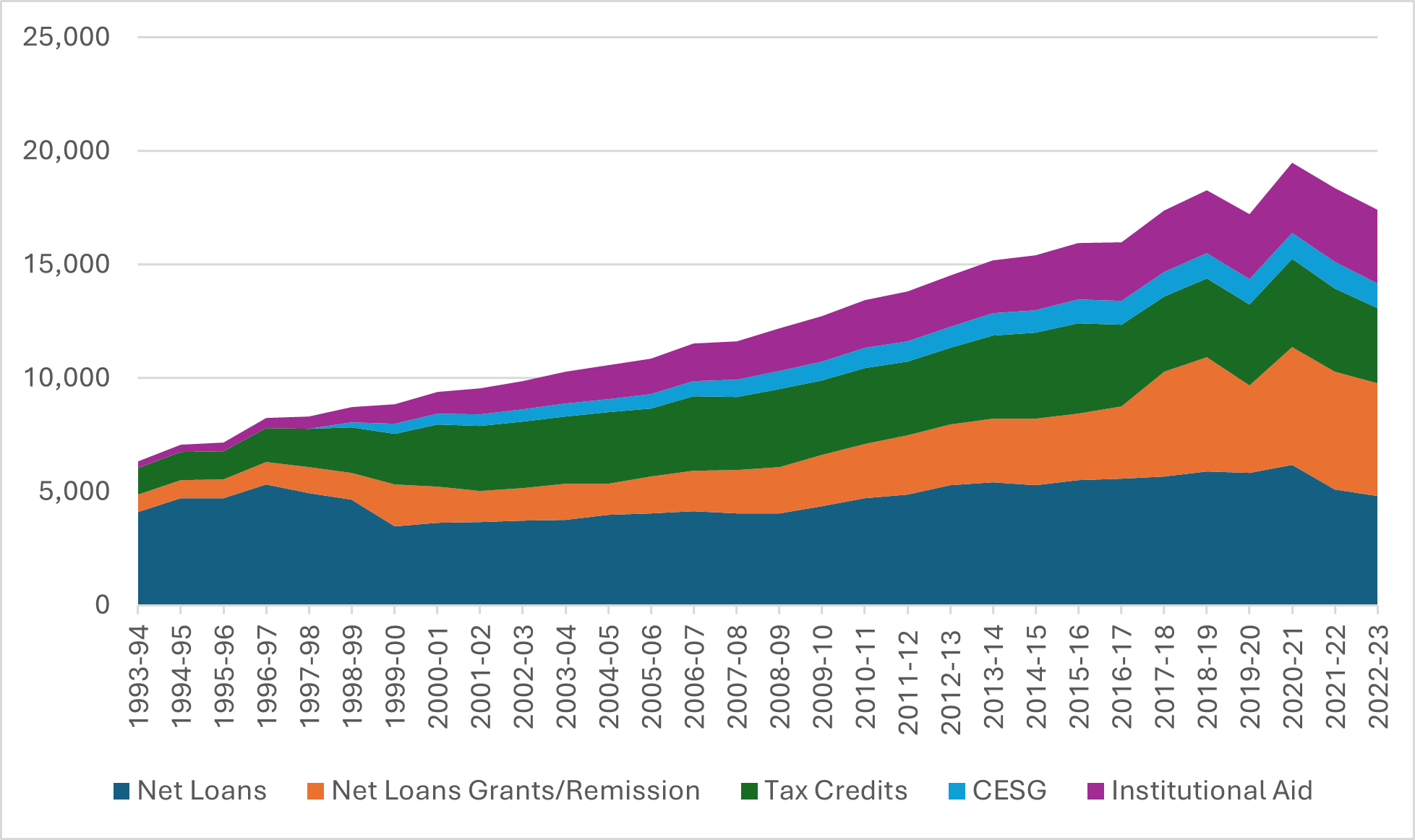
Canadian student aid programs existed in scattered forms since just after World War I but became a “national program” when the Dominion-Canadian Student Aid Program (DCSAP) was created in 1939. Under this program, the Government of Canada provided block cash grants to provinces who administered their own scholarship programs which provided aid based on some combination of need and merit. The actual details of the program varied significantly from one province to another; at the time, the government of Canada did not place much importance on “national programs” with common elements.
In 1964, this DCSAP was replaced by the Canada Student Loans Program (CSLP)—recently re-named the Canada Student Financial Assistance Program (CSFAP). This has always been a joint federal-provincial enterprise. But where the earlier program was a block grant, this program would be a single national entity run more or less consistently across all provinces, albeit with provincial governments still in place as responsible administrative agencies able to supplement the plan as they wished. Some provinces would opt out of this program and received compensation to run their own solo programs (Quebec at the program’s birth, the Northwest Territories in 1984 and Nunavut in 1999). The others, for the most part, built grant programs that kicked in once a student had exhausted their Canada Student Loan eligibility.
Meanwhile, a complimentary student aid program grew up in the tax system, mainly because it was a way to give money to students that didn’t involve negotiations with provinces. Tuition fees plus a monthly education amount were made into a tax deduction in 1961 and then converted to a tax credit in 1987. Registered Education Savings Plans (RESPs), which are basically tax-free growth savings accounts, showed up in 1971.
Although the CSLP was made somewhat more generous over time in order to keep up with rising student costs, program rules went largely unchanged between 1964 and 1993. Then, during the extremely short Kim Campbell government, a new system came into being. The federal government decided to make loans much larger, but also to force provinces in participating provinces to start cost-sharing in a different manner—basically, they had to step up from a student’s first dollar of need instead of just taking students with high need. Since this was the era of stupidly high deficits, provinces responded to these additional responsibilities by cutting the generosity of their programs, transforming from pure grants to forgivable loans. For the rest of the decade, student debt rose—in some cases quite quickly: in total loans issued doubled between 1993 and 1997.
And then, everything went into reverse.
In a series of federal budgets between 1996 and 2000, billions of dollars were thrown into grants, tax credits and a new program called “Canada Education Savings Grants,” which were a form of matching grant for contributions to RESPs. Grants and total aid rose; loans issued fell by a third, mainly between 1997 and 2001 (a recovering economy helped quite a bit). Tax expenditures soared, which due to a rule change allowing tax credits to be carried forward meant either students got to keep more of their work income or got to reduce their taxes once they started working.
Since this period of rapid change at the turn of the century, student aid has doubled in real terms. And nearly all of that has been an increase in non-repayable aid. Institutional scholarships? Tripled. Education scholarships? Quadrupled. Loans? They are up, too, but there the story is a bit more complicated.
Figure 1: Student Aid by Source, Canada, 1993-94 to 2022-23, in thousands of constant $2022
For the period from about 2000 to 2015, all forms of aid were increasing at about inflation plus 3%. Then, in 2016, we entered another period of rapid change. The Governments of Canada and Ontario eliminated a bunch of tax credits and re-invested the money into grants. Briefly, this led to targeted free tuition in Ontario, before the Ford government took an axe to the system. Then, COVID hit and the CSFAP doubled grants. Briefly, in 2020-21, total student aid exceeded $23 billion/year (the figure above does not include the $4 billion per year paid out through the Canada Emergency Student Benefit), with less than 30% of it made up of loans.
One important thing to understand about all this is that while the system became much larger and much less loan-based, something else was going on, too. It was becoming much more federal. Over the past three decades, provincial outlays have risen about 30% in real terms; meanwhile, federal ones have quadrupled. In the early 1990s, the system was about 45-55 federal-provincial; now, it’s about 70-30 federal. It’s a stunning example of “uploading” of responsibilities in an area of shared-jurisdiction.
Figure 2: Government Student Aid by Source, Figure 1: Student Aid by Source, Canada, 1993-94 to 2022-23, in thousands of constant $2022
So there you go: a century of Canadian student aid in less than 850 words. Hope you enjoyed it.