This audio is auto-generated. Please let us know if you have feedback.
Federal Republican lawmakers on Tuesday suggested that increasing students’ access and participation in sports could help stem school and gun violence, as Democrats pushed back on whether that’s a viable solution. The disagreement came on the heels of a fatal mass shooting at Brown University that occurred on the eve of Sandy Hook Elementary School massacre’s 13th anniversary.
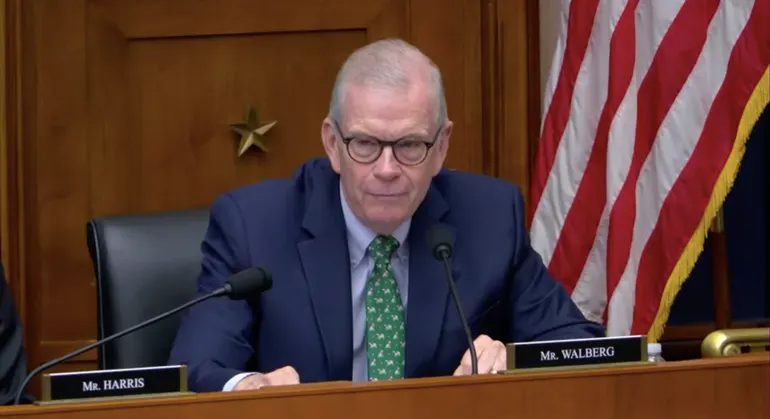
“This is a hearing on school safety,” said House Education and Workforce Committee Chair Tim Walberg, R-Mich. Walberg spoke during a hearing titled “Benched: The Crisis in American Youth Sports and Its Cost to Our Future,” held by the subcommittee on Early Childhood, Elementary and Secondary Education Subcommittee. Walberg chairs the full committee.
“If we did this right again, we would have less violence in schools,” Walberg said. “These are the types of things that will change [the] perspective of kids and what they do in life itself. So this is a hearing on gun violence.”
While Democrats and witnesses agreed that access and affordability are barriers to youth sports participation,they disagreed with Republicans over its potential to address school shootings. Studies have shown that youth sports participation is linked to better attendance, graduation rates, and academic performance.
“As important as sports participation is for kids, there is a much more pressing crisis at hand that the majority needs to recognize,” said subcommittee ranking member Rep. Suzanne Bonamici, D-Ore. “We know what happened over the weekend.”
Saturday’s shooting at Brown University killed two students and injured nine others. In K-12, there have been 230 school shootings in 2025 as of Dec 16, according to the K-12 School Shooting Database, which tracks anytime a weapon is brandished with intent to harm on school grounds.
That number puts this year on track to fall well below last year’s 330 school shootings. Last year became the first year since 2020 that school shootings hadn’t broken a record high. Still, however, the 330 school shootings recorded in 2024 marked the second-highest number since 1966 and fell only 19 below the all-time high of 349 recorded in 2023.
“This subcommittee has held several hearings this year, but we have not had a single hearing related to gun violence,” nor has the committee marked up a bill this year on school gun violence, said Bonamici. “We can talk about the other issues as much as we want — reading, math, CTE, screentime, student privacy, sports. None of that matters if children are shot and killed.”
Witnesses at the hearing, however, stressed that better access to school sports could help improve student mental health, academics and outcomes. They reported anecdotes of students being less likely to engage in violence or commit crimes when after-school time is filled with sports activities.
“If you can calm yourself down when you’re in an anxious state, you’re a better athlete. If you can calm your anger down when you’re hypercompetitive, you’re a better athlete,” said Steve Boyle, co-founder and executive director of 2-4-1 Care, Inc., a nonprofit organization that partners with school districts to provide sports opportunities.
John O’Sullivan, another witness and founder and CEO of the Changing the Game Project, said, “We have to keep as many kids as possible, as long as possible, in the best environment possible. ” His organization advocates for parents and coaches to become better participants in kids’ sports.
Democrats remained doubtful and pushed for a hearing specifically on gun violence.
“While sports are important for school safety, we have to have a hearing on this committee to address school shootings and the safety of our children in American schools,” said Rep. Jahana Hayes, D-Conn. “I know that my constituents expect something more than to just normalize school shootings and teach our children how to shelter in place.”
Hayes and other lawmakers on Sept. 12 sent a letter to Walberg and full committee ranking member Bobby Scott, D-Va., seeking a hearing before the end of the year on school shootings, and she said she received a response saying her concerns were “noted.” The letter was sent in wake of shootings at a Catholic school in Minnesota and a Colorado high school.
“We need meaningful action to keep our students, teachers, and schools safe and a plan to address the underlying causes of gun violence,” the letter said. “This Committee has the ability to bring together experts and individuals with firsthand experience to help develop federal legislation that implements school security upgrades, invests in mental health services, creates evidence-based crisis and threat assessments, and fosters a positive and trusting school environment.”
The subcommittee has no hearings currently scheduled on gun violence or school safety, according to its calendar.
Congress in 2022 passed theBipartisan Safer Communities Act in the wake of the Uvalde, Texas, mass shooting, the first significant gun safety legislation that also included school-based mental health measures in nearly three decades.
The funding provided to district mental health programs by that legislation, however, was put on pause and in many cases revoked by the Trump administration as it reviewed grants for potential diversity, equity and inclusion initiatives. The administration revoked about $1 billion in grants related to mental health earlier this year as a result, according to court documents.
Last week, the administration distributed a lesser amount — $208 million — to recipients who applied under a new grant application with updated requirements. These grants limit funding to the training of school psychologists only, instead of also funding school counselors and social workers, who often provide student mental health supports.
Nine out of ten undergrads believe that “words can be violence”
Differences in views becoming more stark between liberal and conservative students
PHILADELPHIA, Dec. 2, 2025 — Ninety one percent of undergraduate students believe that words can be violence, according to a new poll by the Foundation for Individual Rights and Expression and College Pulse.
The survey’s findings are especially startling coming in the wake of Charlie Kirk’s assassination — an extreme and tragic example of the sharp difference between words and violence.
“When people start thinking that words can be violence, violence becomes an acceptable response to words,” said FIRE Chief Research Advisor Sean Stevens. “Even after the murder of Charlie Kirk at a speaking event, college students think that someone’s words can be a threat. This is antithetical to a free and open society, where words are the best alternative to political violence.”
The new 21-question poll, conducted between Oct. 3-31 by FIRE and College Pulse, assessed free speech on campus in the wake of Kirk’s assassination at Utah Valley University on Sept. 10 and asked undergraduates about their comfort level with a number of controversial topics. The survey of 2,028 undergrads included an oversample of 204 students at Utah Valley, and has a margin of error of +/- 2%.
Half of students surveyed say that because of what happened to Kirk, they are now less comfortable attending or hosting controversial public events on their campus, and one in five say they are less comfortable attending class.
Other findings show stark differences between students at Utah Valley and other schools, as well as widening rifts between liberal and conservative students:
When asked whether the country is headed in the right or wrong direction for people’s ability to freely express their views, 84% of Utah Valley students said “wrong direction,” significantly higher than the 73% reported by students at other schools.
Moderate and conservative students across the country became significantly less likely to say that shouting down a speaker, blocking entry to an event, or using violence to stop a campus speech are acceptable actions. In contrast, liberal students’ support for these tactics held steady, or even increased slightly.
Among moderate and conservative students, opposition to controversial speakers generally declined. Opposition among liberal students, on the other hand, either held steady or increased for all of the controversial speakers compared to the spring.
The gaps between conservative and liberal students may be widening, but some concerns transcend politics. A majority of students of all persuasions (53%) say that political violence is a problem among all groups, considerably more than the 35% of Americans who recently said this in FIRE’s October National Speech Index.
“Students want to feel safe, and the killing of Charlie Kirk naturally eroded their sense of safety,” said Stevens. “What we want students to recognize is that the safest environment is one in which people can speak their minds without fear of censorship or violence.”
The Foundation for Individual Rights and Expression (FIRE) is a nonpartisan, nonprofit organization dedicated to defending and sustaining the individual rights of all Americans to free speech and free thought — the most essential qualities of liberty. FIRE educates Americans about the importance of these inalienable rights, promotes a culture of respect for these rights, and provides the means to preserve them.
The ambush shooting of two National Guardsmen near the White House on November 27, 2025, by Rahmanullah Lakanwal, a 29-year-old Afghan national, is the latest in a growing wave of politically motivated violence that has engulfed the United States since 2024. Lakanwal opened fire on uniformed service members stationed for heightened security, wounding both. Federal authorities are investigating whether ideological motives drove the attack, which comes against a backdrop of escalating domestic and international tensions. This ambush cannot be understood in isolation. It is part of a larger pattern of domestic political violence that has claimed lives across ideological lines.
Conservative activist Charlie Kirk was assassinated at Utah Valley University during a campus event in September 2025. Minnesota state representative Mary Carlson and her husband were murdered in their home by a man impersonating law enforcement, while a state senator and spouse were injured in the same spree. Governor Josh Shapiro survived an arson attack on his residence earlier this year. Even Donald Trump was the target of an assassination attempt in July 2024. Added to this grim tally are incidents such as the 2025 Manhattan mass shooting, in which young professionals, including two Jewish women, Julia Hyman and Wesley LePatner, were killed, and the Luigi Mangione case, in which a former student allegedly killed a corporate executive in New York. Together, these incidents reveal a nation in which lethal violence increasingly intersects with politics, identity, and ideology.
The domestic escalation of violence cannot be separated from broader structures of oppression. Migrants and asylum seekers face detention, family separation, and deportation under the authority of ICE, often in conditions described as inhumane, creating fear and vulnerability among refugee communities. Routine encounters with law enforcement disproportionately harm Black, Indigenous, Latinx, and other marginalized communities. Excessive force and lethal policing add to communal distrust, reinforcing perceptions that violence is a sanctioned tool of the state. Political rhetoric compounds the problem. President Trump and other political leaders have repeatedly framed immigrants, political opponents, and even students as threats to national security, implicitly legitimizing aggressive responses and providing fodder for extremist actors.
The domestic situation is further complicated by U.S. foreign policy, which has often contributed to global instability while modeling the use of violence as an instrument of governance. In Palestine, military aid to Israel coincides with attacks on civilians and infrastructure that human-rights organizations describe as ethnic cleansing or genocide. In Venezuela, U.S. sanctions, threats, and proxy operations have intensified humanitarian crises and political instability. Complicity with the governments of the UAE, Saudi Arabia, and Russia enables human-rights abuses abroad while emboldening domestic actors who mimic state-sanctioned violence. These global policies reverberate at home, influencing public discourse, shaping extremist narratives, and creating a climate in which political and ideological violence is increasingly normalized.
Higher education sits at the nexus of these domestic and global pressures. Universities and colleges are not merely observers; they are active participants and, in some cases, victims. The assassination of Charlie Kirk on a campus underscores that institutions of learning are no longer insulated from lethal political conflict. Alumni, recent graduates, and professionals—such as the victims of the Manhattan shooting—are affected even after leaving school, revealing how closely academic networks intersect with broader societal risks. International and refugee students, particularly from Afghan and Middle Eastern communities, face heightened anxiety due to restrictive immigration policies, anti-immigrant rhetoric, and the real threat of violence. Faculty teaching topics related to immigration, race, U.S. foreign policy, or genocide are increasingly targeted by harassment, threats, and institutional pressures that suppress academic freedom. The cumulative stress of political violence, systemic oppression, and global conflicts creates trauma that universities must address comprehensively, both for students and faculty.
Higher education cannot prevent every act of violence, nor can it resolve the nation’s deep political fractures. But it can model ethical and civic engagement, defending inquiry and speech without succumbing to fear or political pressure. It can extend support to vulnerable communities, promote critical thinking about the domestic roots of political violence and the consequences of U.S. foreign policy, and foster ethical reflection that counters the normalization of aggression. Silence or passivity risks complicity. Universities must recognize that the threats affecting campuses, alumni, and students are interconnected with broader systems of power and oppression, both domestic and global.
From the White House ambush to Charlie Kirk’s assassination, from the Minnesota legislators’ murders to the Manhattan mass shooting, from Luigi Mangione’s high-profile killing to systemic violence enforced through ICE and police overreach, and amid the influence of incendiary political rhetoric and U.S. complicity in violence abroad, the United States is experiencing an unprecedented convergence of domestic and international pressures. Higher education sits at the center of these converging forces, and how it responds will shape not only campus safety and academic freedom but also the broader civic health of the nation. The challenge is immense: to uphold democratic values, protect communities, and educate students in a society increasingly defined by fear, extremism, and violence.
Sources
Reuters. “FBI probes gunman’s motives in ambush shooting of Guardsmen near White House.” The Guardian. Coverage on suspect identification and political reaction. AP News. Statements by national leaders following attacks. Washington Post. Analysis of domestic violent extremism and political violence trends. People Magazine. Reporting on Minnesota legislator assassination. NBC/AP. Statements by Gov. Josh Shapiro after Charlie Kirk’s killing. Utah Valley University and local ABC/Fox affiliates on the Kirk shooting. Jewish Journal, ABC7NY. Coverage of Manhattan mass shooting and Jewish victims. Reuters. Luigi Mangione case and court proceedings. Human Rights Watch / Amnesty International reports on Palestine, Venezuela, UAE, Saudi Arabia, and Russia. Brookings Institute. Analysis of political violence and domestic extremism. CSIS. “Domestic Extremism and Political Violence in the United States.”
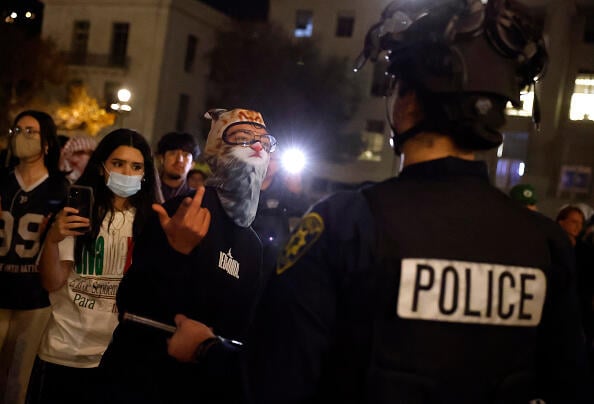
Four people were arrested at a Nov. 10 protest at UC Berkeley over an event for Turning Point USA.
Justin Sullivan/Getty Images
The Department of Education is reviewing potential violations of the Clery Act at the University of California, Berkeley following violence at a campus protest.
Fights broke out and four people were arrested at a Nov. 10 protest against an event for Turning Point USA, the conservative student group founded by Charlie Kirk, Cal Matters reported. The organization has received newfound attention after Kirk was shot and killed while speaking at Utah Valley University in September, exactly two months before the event at UC Berkeley.
The Department of Education announced the launch of the investigation Tuesday.
“Just two months after Turning Point USA founder Charlie Kirk was brutally assassinated on a college campus, UC Berkeley allowed a protest of a Turning Point USA event on its grounds to turn unruly and violent, jeopardizing the safety of its students and staff. Accordingly, the Department is conducting a review of UC Berkeley to ensure that it has the procedures in place to uphold its legal obligation to maintain campus safety and security,” U.S. Secretary of Education Linda McMahon said in a statement.
ED also accused the university of having “a history of violating the Clery Act” in a news release announcing the investigation, citing a $2.4 million fine and settlement agreement in 2020 for UC Berkeley’s failure to properly classify 1,125 crimes on campus and insufficient record keeping.
The Department of Justice previously announced a probe into the university earlier this month, claiming that “Antifa,” a decentralized, left-wing movement was involved in the Nov. 10 protests.
UC Berkeley spokesperson Dan Mogulof told Inside Higher Ed by email that the university “has an unwavering commitment to abide by the laws, rules and policies that are applicable to the university” and “will continue to cooperate with governmental inquires and investigations.”
Mogulof added that the university provided public reports about two violent crimes that occurred Nov. 10: a fistfight over an attempted robbery and someone being hit by a thrown object. He also highlighted efforts by administrators “to support the First Amendment rights of all by deploying a large number of police officers from multiple jurisdictions, and a large number of contracted private security personnel” and closing off parts of campus on the day of the protest.
The investigation comes as the Trump administration has clashed with the University of California system in recent months as it sought to cut off federal research funding over alleged antisemitism and how administrators handled pro-Palestinian campus protests in spring 2024. The federal government has also demanded the University of California, Los Angeles, agree to a $1.2 billion fine and make a number of changes in response to the administration’s concerns.
A federal judge recently ruled against the federal government and its “blanket policy of denying any future grants” to UCLA and determined that the Trump administration can’t demand payouts from University of California member institutions as it conducts civil rights investigations.
With so much of our national conversation taking place online, there’s an almost reflexive tendency to search for online causes — and online solutions — when tragedy strikes in the physical world. The murder of Charlie Kirk was no exception. Almost immediately, many (some in good faith, and others decidedly less so) began to postulate about the role played by online rhetoric and polarization.
Taking the stage at Utah Valley University to discuss political violence last week, Sens. Mark Kelly and John Curtis shared the view that social media platforms are fueling “radicalization” and violence through their content-recommendation algorithms. And they previewed their proposed solution: a bill that would strip platforms of Section 230 protections whenever their algorithms “amplify content that caused harm.”
This week, the senators unveiled the Algorithm Accountability Act. In a nutshell, the bill would require social media platforms to “exercise reasonable care” to prevent their algorithms from contributing to foreseeable bodily injury or death, whether the user is the victim or the perpetrator. A platform that fails to do so would lose Section 230’s critical protection against being treated as the publisher of user-generated content — and injured parties could sue the platform for violating this “duty of care.”
The debate over algorithmic content recommendation has been going on for years. Lower courts have almost universally held that Section 230 immunizes social media platforms from lawsuits claiming that algorithmic recommendation of harmful content contributed to terrorist attacks, mass shootings, and racist attacks. When faced with the question in 2023, the Supreme Court declined to rule on the scope of Section 230 — opting instead to hold the claims of algorithmic aiding and abetting at issue would not survive either way.
Forcing social media platforms to do the dirty work of censorship on pain of expensive litigation and expansive liability is no less offensive to the First Amendment than a direct government speech regulation.
But there’s an important question that usually gets lost in the heated debate over Section 230: Would such lawsuits be viable even if they could be brought?
In a Wall Street Journal op-ed making the case for his bill, Sen. Curtis wrote, “We hold pharmaceutical companies accountable when their products cause injury. There is no reason Big Tech should be treated differently.”
At first blush, this argument has an instinctive appeal. But it ultimately dooms itself because there is a reason to treat social media platforms differently. That reason is the First Amendment, which enshrines a constitutional right to free speech — a protection not shared by prescription drugs.
Perhaps anticipating this point, Sen. Curtis argues that the Algorithm Accountability Act poses no threat to free speech: “Free speech means you can say what you want in the digital town square. Social-media companies host that town square, but algorithms rearrange it.” But free speech doesn’t only protect users’ right to post online free of government censorship; it also protects the editorial decisions of those that host those posts — including algorithmic “rearranging,” to use the senator’s phrase. As the Supreme Court recently affirmed in Moody v. NetChoice:
When the platforms use their Standards and Guidelines to decide which third-party content those feeds will display, or how the display will be ordered and organized, they are making expressive choices. And because that is true, they receive First Amendment protection.
The “rearranging” of speech is just as protected as the speech itself, as when a newspaper decides which stories to print on the front page and which letters to the editor to publish. That is no less true for social media platforms. In fact, the term “content-recommendation algorithm” itself points to its expressive nature. Recommending something is a message — “I think you would find this interesting.”
The Moody Court also acknowledged the expressive nature of arranging online content (emphasis added): “Deciding on the third-party speech that will be included in or excluded from a compilation — and then organizing and presenting the included items — is expressive activity of its own.” Similarly, while dismissing exactly the kind of case the Algorithm Accountability Act would enable, the U.S. Court of Appeals for the Fourth Circuit held this past February: “Facebook’s decision[s] to recommend certain third-party content to specific users . . . are traditional editorial functions of publishers, notwithstanding the various methods they use in performing” them.
The NO FAKES Act is a real threat to free expression
In Congress, the “NO FAKES” bill claims to promise deepfake fixes, but their restrictions on expression would chill news, history, art, and everyday speech.
So the First Amendment is at least implicated when Congress institutes “accountability” for a platform’s arrangement and presentation of user-generated content, unlike with pharmaceutical safety regulations. But does it prohibit Congress from imposing the kind of liability the Algorithm Accountability Act creates?
Yes. Two well-established principles explain why.
First: As the Supreme Court has repeatedlymade clear, imposing civil liability for protected speech raises serious First Amendment concerns.
Second: Except for the exceedingly narrow category of incitement — where the speaker intended to spur imminent unlawful action by saying something that was likely to cause such action — the First Amendment demands that we hold the wrongdoer accountable for their own conduct, not the people whose words they may have encountered along the way.
The U.S. Court of Appeals for the Fifth Circuit concisely explained why these principles preclude liability for “negligently” conveying “harmful” ideas:
If the shield of the first amendment can be eliminated by providing after publication that an article discussing a dangerous idea negligently helped bring about a real injury simply because the idea can be identified as ‘bad,’ all free speech becomes threatened.
In other words, faced with a broad, unmeetable duty to anticipate and prevent ideas from causing harm, media would be chilled into publishing, broadcasting, or distributing only the safest and most anodyne material to avoid the risk of unpredictable liability.
For this reason, courts have — for nearly a century — steadfastly refused to impose a duty of care to prevent harms from speech. A few noteworthy examples are illustrative:
Dismissing a lawsuit alleging that CBS’ television programming desensitized a child to violence and led him to shoot and kill his elderly neighbor, one federal court wrote of the duty of care sought by the plaintiffs:
The impositions pregnant in such a standard are awesome to consider . . . Indeed, it is implicit in the plaintiffs’ demand for a new duty standard, that such a claim should exist for an untoward reaction on the part of any ‘susceptible’ person. The imposition of such a generally undefined and undefinable duty would be an unconstitutional exercise by this Court in any event.
In a case brought by the victim of a gruesome attack alleging that NBC knew of studies on child violence putting them on notice that some viewers might imitate violence portrayed on screen, the court ruled:
[T]he chilling effect of permitting negligence actions for a television broadcast is obvious. . . . The deterrent effect of subjecting [them] to negligence liability because of their programming choices would lead to self-censorship which would dampen the vigor and limit the variety of public debate.
Affirming dismissal of a lawsuit alleging that Ozzy Osbourne’s Suicide Solution caused a minor to kill himself, the court noted the profound chilling effect such liability would cause:
[I]t is simply not acceptable to a free and democratic society to impose a duty upon performing artists to limit and restrict the dissemination of ideas in artistic speech which may adversely affect emotionally troubled individuals. Such a burden would quickly have the effect of reducing and limiting artistic expression to only the broadest standard of taste and acceptance and the lowest level of offense, provocation and controversy.
When the family of a teacher killed in a school shooting sued makers and distributors of violent video games and movies, the court rejected the premise of the suit:
Given the First Amendment values at stake, the magnitude of the burden that Plaintiffs seek to impose on the Video Game and Movie Defendants is daunting. Furthermore, the practical consequences of such liability are unworkable. Plaintiffs would essentially obligate these Defendants, indeed all speakers, to anticipate and prevent the idiosyncratic, violent reactions of unidentified, vulnerable individuals to their creative works.
In his op-ed, Sen. Curtis wrote, “The problem isn’t what users say, but how algorithms shape and weaponize it.” But the “problem” this bill seeks to remedy very much is what users say. A content recommendation algorithm in isolation can’t cause any harm; it’s the recommendation of certain kinds of content (e.g., radicalizing, polarizing, etc.) that the bill seeks to stymie.
And that content is overwhelmingly protected by the First Amendment, regardless of whether the posts might, individually or in the aggregate, cause an individual to commit violence. When the City of Indianapolis created remedies for people who viewed pornography, the U.S. Court of Appeals for the Seventh Circuit rejected the municipality’s justification that pornography “perpetuate[s] subordination” and leads to cognizable societal and personal harms:
[T]his simply demonstrates the power of pornography as speech. All of these unhappy effects depend on mental intermediation. Pornography affects how people see the world, their fellows, and social relations. If pornography is what pornography does, so is other speech.
[ . . . ]
Racial bigotry, anti-semitism, violence on television, reporters’ biases — these and many more influence the culture and shape our socialization. None is directly answerable by more speech, unless that speech too finds its place in the popular culture. Yet all is protected as speech, however insidious. Any other answer leaves the government in control of all of the institutions of culture, the great censor and director of which thoughts are good for us.
And that’s why the Algorithm Accountability Act also threatens users’ expressive rights. There’s simply no reliable way to predict whether any given post might, somewhere down the line, factor into someone else’s independent decision to commit violence — especially at the scale of modern social media. Faced with liability for guessing wrong, platforms will effectively have two realistic choices: aggressively re-engineer their algorithms to bury anything that could possibly be deemed divisive (and therefore risky), or — far more likely — simply ban all such content entirely. Either road leads to the same place: a shrunken public square where whole neighborhoods of protected speech have been bulldozed.
WATCH VIDEO: A warning label on social media? | So to Speak: The Free Speech Podcast
“What a State may not constitutionally bring about by means of a criminal statute,” the Supreme Court famously wrote in New York Times v. Sullivan, “is likewise beyond the reach of its civil law.” Forcing social media platforms to do the dirty work of censorship on pain of expensive litigation and expansive liability is no less offensive to the First Amendment than a direct government speech regulation.
Political violence is a real and pressing problem. But history has already taught us that trying to scrub away every potential downstream harm of speech is a dead end. And a system of free speech requires us to abstain from the temptation of trying in the first place.
University officials found “no basis” that Dixon posed a threat or violated university policy.
Marin Herold/iStock/Getty Images Plus
Dwayne Dixon, a professor at the University of North Carolina at Chapel Hill, was reinstated Friday after the university performed a “thorough threat assessment,” Dean Stoyer, vice chancellor for communications and marketing, said in a statement.
“The Carolina Behavioral Threat Assessment and Management Team consulted with the UNC System security office and with local law enforcement, undertaking a robust, swift and efficient review of all the evidence. We have found no basis to conclude that he poses a threat to University students, staff, and faculty, or has engaged in conduct that violates University policy,” Stoyer said in a statement. “As a result, the University is reinstating Professor Dixon to his faculty responsibilities, effective immediately.”
Dixon is a teaching associate professor of Asian and Middle Eastern studies at UNC Chapel Hill, and he’s been active at counterprotests to alt-right rallies, including at the Unite the Right rally in Charlottesville, Va., in 2017. He’s also a strong advocate for gun rights and used to be a member of the Silver Spring Redneck Revolt, a chapter of the now-disbanded antifascist, antiracist, anticapitalist political group Redneck Revolt. Andrew Kolvet, a spokesperson for the late Charlie Kirk’s Turning Point USA, called for Dixon to be fired in an X post because of these affiliations.
Dixon has faced blowback for his political activism before and remained in his role at UNC.
Eros Hoagland/Getty Images
Officials at the University of North Carolina at Chapel Hill placed Professor Dwayne Dixon on leave Monday while the university investigates his “alleged advocacy of politically motivated violence,” said Dean Stoyer, UNC Chapel Hill’s vice chancellor for communications and marketing.
Dixon, an associate professor of Asian and Middle Eastern studies, used to be a member of Silver Valley Redneck Revolt, a chapter of the antifascist, antiracist, anticapitalist political group Redneck Revolt. The group was formed in 2016 and some members, including Dixon, were present at the 2017 Unite the Right rally in Charlottesville, Va., to provide armed security and medical assistance to counterprotesters. Redneck Revolt disbanded in 2019 and has no active chapters, according to its website.
In a 2018 interview with The Chronicle of Higher Education, Dixon described himself as an “anarchist,” and he is no stranger to blowback for his political activism and support for gun rights. He was arrested for bringing a semiautomatic rifle to a Ku Klux Klan counterprotest in Durham, N.C., in 2018—the case was later dismissed as unconstitutional on the grounds that the charges violated Dixon’s First and Second Amendment rights. He was also among 20 people who protected counterprotesters in Durham when white supremacists protested the removal of a Confederate statue in 2017. Through all these events, Dixon remained employed at UNC Chapel Hill.
Why is Dixon in the hot seat now? The answer is convoluted, but it begins with fliers on the Georgetown University campus.
On Sept. 24, Andrew Kolvet, a spokesperson for the late Charlie Kirk’s Turning Point USA, posted on X a photo of a flier on the Georgetown campus in Washington, D.C., that read, “Hey Fascist! Catch!”—a nod to engraving on the casing of bullets left behind by Kirk’s suspected killer—and “The only political group that celebrates when Nazis die.” The flier also included a QR code to a Google form for a potential Georgetown chapter of the John Brown Gun Club, a Redneck Revolt affiliate organization known as a “leftist gun-rights group” with multiple independent chapters, including one in the D.C. area, according to the Counter Extremism Project. It “arms itself to defend against far-right violence and often appears as a security force at protests to protect against expected far-right violence,” the CEP wrote. Google has since removed the form for violating its terms of service.
University officials removed the fliers and reported them to the FBI. Education Secretary Linda McMahon also weighed in: “At a moment like this, Georgetown has to determine what it stands for as an institution … Allowing violent rhetoric to fester on our nation’s campuses without consequences is dangerous. It must be condemned by institutional leaders,” she wrote on X. “I am grateful to those who spoke out against this and made noise about the posters on campus—you made a difference. There is power in speaking up to reveal these hateful ideologies that have incited deadly violence.”
Kolvet posted again, this time linking to a recent Fox News article that cited Dixon’s involvement in Redneck Revolt based on an old blog post that has since been taken down. “I posted this flyer our team spotted at Georgetown University, and now we find out professors at ‘elite’ schools are members of this group and its offshoots,” Kolvet wrote. “This professor must be immediately fired and the group/network investigated.”
Dixon was placed on leave Monday, which will “allow the University to investigate these allegations in a manner that protects the integrity of its assessment,” UNC’s Stoyer said in his statement. “Depending upon the nature and circumstances of this activity, this conduct could be grounds for disciplinary action up to and including potential termination of employment.”
UNC Chapel Hill officials declined to answer any other questions about Dixon and did not say whether Kolvet’s post or the Fox News article led to the investigation. Dixon did not reply to a request for comment but told the student newspaper The Daily Tarheel that he left the Silver Valley Redneck Revolt in 2018.
A Change.org petition to reinstate Dixon is circulating and as of Wednesday evening had more than 900 signatures. In a statement Wednesday, the North Carolina chapter of the American Association of University Professors, as well as UNC Chapel Hill’s AAUP president, condemned the university’s actions and demanded Dixon be reinstated.
“Right-wing activists are attacking Dixon for prior membership in a group that has been inactive since 2019, and are baselessly connecting him to flyers allegedly posted by a different group on a different campus outside of North Carolina. Fox News picked up the story on September 27, 2025, without verifying the existence of the flyers, and apparently this was enough for UNC’s administration to remove a professor from the classroom in the middle of the semester and bar him from campus,” the statement read. “Let’s call this what it is: UNC administrators are capitulating to a call from a right-wing group, infamous for attacking faculty, to fire a professor based on an unsubstantiated rumor.”
Dixon joins the ranks of dozens of college and university faculty members who have been placed on leave, disciplined or fired in the weeks since Kirk was shot and killed. All of these professors have been investigated after right-wing personalities identified them on social media. Two of them—Michael Hook, who was placed on leave for social media comments he made about Kirk’s death, and Thomas Alter, who was terminated after being accused of inciting violence during a speech—have been reinstated by court orders.
On Sept. 10, a public lecture at Utah Valley University became the site of a nightmare when the political commentator Charlie Kirk was killed before thousands of students. Whatever one thinks of Kirk’s politics, the trauma endured by those young witnesses will last far longer than the news cycle. For adolescents, such moments do not fade when the cameras leave. They etch themselves into the brain—literally. Witnessing violence, even indirectly, negatively impacts brain development.
At the University of Southern California’s Center for Affective Neuroscience, Development, Learning and Education (CANDLE), our colleagues recently studied how violence exposure shapes young people. Again and again, the evidence is stark: When adolescents witness or hear about violence in their communities, their developing brains bear the burden. The anterior cingulate cortex—a region critical for processing stress and pain, emotional regulation, motivation, learning, and social connection—has a greater decrease in gray-matter volume in adolescents exposed to more community violence. This pattern of gray-matter volume decrease has been seen in ground troops deployed to war and in people affected by post-traumatic stress disorder. It has been linked to anxiety, depression and difficulty sustaining attention.
Yet neuroscience also points to a path forward. Our newest research, published this year in the Journal of Research on Adolescence, offers a striking counterpoint: Adolescents are not passive victims of their environments. They have within them the capacity to buffer these harms, within themselves and within society. That capacity is what we call transcendent thinking.
Transcendent thinking is the ability to move beyond the immediate details of an event and consider the complexities that characterize a diverse society, to explore perspectives that differ or conflict with one’s own and to contemplate the bigger picture: What does this mean for me, for my community, for justice and fairness? When teenagers reflect in these ways, they are not escaping reality but engaging it more deeply. They are searching for meaning, considering multiple perspectives and placing their experience in a larger human story. This, in turn, helps them imagine how things might be different, and how they might contribute to the change.
In our study of 55 urban adolescents, those who more frequently engaged in transcendent reflection about social issues showed a greater increase in gray-matter volume in the anterior cingulate cortex two years later—the very brain region seen to be most vulnerable to violence exposure. In other words, transcendent thinking didn’t erase the negative effects, but it appeared to give young people’s brains some scaffolding to adapt and heal.
This has profound implications for how we respond to political and community violence. The instinct, understandably, is to shield young people from harsh realities. But shielding won’t work. Adolescents are already encountering violence—whether on the street, online or in lecture halls. What they need are the tools to make sense of it, to weave their experiences into narratives of purpose and agency rather than despair. And for this, they need curiosity about the experiences of others and safe opportunities to think across difference.
Fortunately, transcendent thinking is not rarefied or inaccessible. It is something every young person can do and likely already does spontaneously. The challenge is to nurture it deliberately and thoughtfully. Schools and colleges can make space for students to grapple with complex social issues and to connect classroom learning with ethical and civic questions. Families and communities can invite adolescents into intergenerational storytelling, where young people see how others have wrestled with hardship and injustice. Education that emphasizes civic reasoning and dialogue can strengthen not only academic outcomes but also neurological resilience and long-term well-being.
This is both a scientific and a civic imperative. Neuroscience is showing us that meaning making changes the brain. We need support for educators to find ways to translate that science into daily practices that help young people transform tragedy into purpose. Our vision is to illuminate the capacities that empower adolescents to question their and others’ beliefs, to engage across difference, to imagine futures and work to create the world they want to live in.
The tragedy at Utah Valley University underscores how high the stakes have become. America’s young people are coming of age amid rising polarization and public acts of violence. We cannot protect them or shield them from it, but we can equip them to counter its developmental impacts.
Transcendent thinking is not a cure-all. But it is a proven developmental asset that can buffer the effects of witnessing community violence on the brain. It is also a civic skill we urgently need: the ability to see beyond the present conflicts and tragedies to the larger questions of justice, community and meaning.
If we want to safeguard both adolescent development and democratic life, we must equip schools, colleges, families and communities with the tools to cultivate transcendent thinking.
Mary Helen Immordino-Yang is the Fahmy and Donna Attallah Professor of Humanistic Psychology and a professor of education, psychology and neuroscience at the University of Southern California and founding director of the USC Center for Affective Neuroscience, Development, Learning and Education.
The sickening assassination of Charlie Kirk at a campus speech this week has brought attention to worrying trends in political violence and the public’s stated support for it.
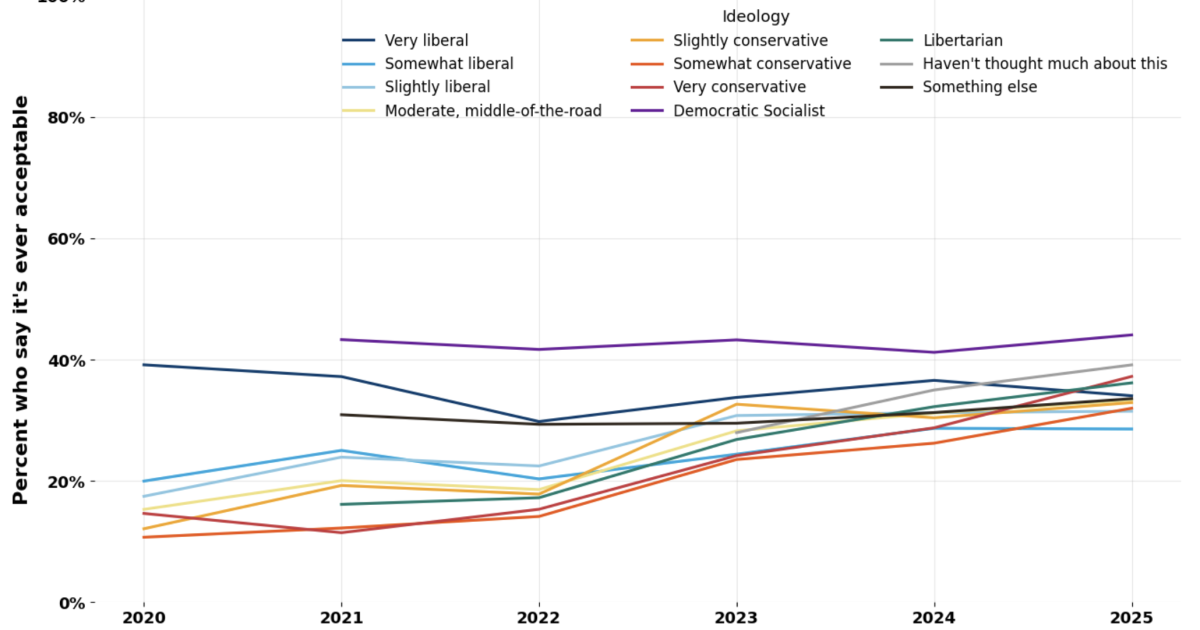
According to FIRE’s annual College Free Speech Rankings survey, in 2020, the national average showed about 1 in 5 students said it was ever acceptable to use violence to stop a speaker. That number has since risen to a disturbing 1 in 3 students.
While we have seen no evidence that Kirk’s shooter is a student, there’s no doubt that the 50% increase in this level of support for political violence among college students over the last 5 years has broad implications for the future of the country.
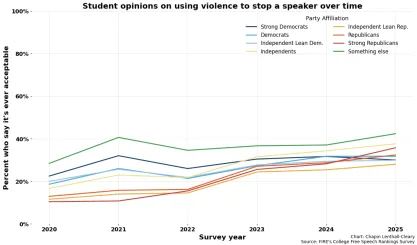
When we subdivide by party affiliation, we see a more complete story, but the trends are roughly the same.
Students who identify as “Strong Democrats” are one of the few groups that haven’t markedly increased in support for using violence to stop a speaker, but only because they started at a higher rate of acceptance. Once the second most accepting of violence, they are now the second least accepting, thanks to a rise in acceptance by other groups. In other words, they didn’t get better — everyone else got worse. But consistently the worst group of all remains those who identify as “Something else.”
The portions of “Strong Republicans” and “Republicans” who accept the use of violence to stop a speaker have more than tripled in four years. Even acceptance among “Independents” has more than doubled. To give you a sense of how bad things have gotten, the group that currently accepts violence the least, Republican-leaning independents, would have ranked alongside those who accepted it the most back in 2020.
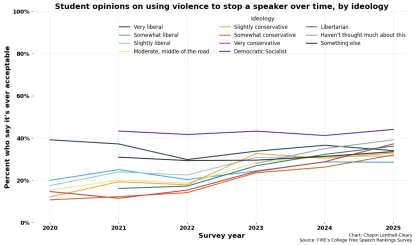
Now let’s take a closer look at the problem by switching from party affiliation to examining specific ideologies:
Those students who are the furthest to the left have been the most accepting of violence for as long as we’ve asked the question. That includes very liberal and democratic socialist students. But a rising tide of acceptance of violence has raised all boats. Now, regardless of party or ideology, students across the board are more open to violence as a way to shut down a speaker. What was once an extreme and fringe opinion has become normalized.
Where do we go from here? Violence is antithetical to free speech, and political violence is wholly incompatible with — and toxic to — democracy. As FIRE Executive Vice President Nico Perrino put it, it is a cancer in our body politic. Hopefully, the horrific image of the assassination of a young father, in front of his family, during a campus speech will show students who say they support violence what that actually looks like in practice.
The great innovation of free speech is that we settle disputes with words and arguments, not violence. Too many have turned away from this principle. For the sake of all Americans, we must return to it.
Texas State University fired a professor Wednesday after he was accused of inciting violence during a speech at a socialist conference, The Texas Tribune reported.
In a video posted on X, associate professor of history Thomas Alter can be seen giving a speech over Zoom to attendees of the Revolutionary Socialism Conference. “Without organization, how can anyone expect to overthrow the most bloodthirsty, profit-driven mad organization in the history of the world—that of the U.S. government,” he said in the clip, which was circulated online by a YouTuber who infiltrated and recorded the event.
Texas State president Kelly Damphousse said in a statement Wednesday that the university reviewed the comments, which he said “amounted to serious professional and personal misconduct.”
“As a result, I have determined that his actions are incompatible with their responsibilities as a faculty member at Texas State University,” he added. “Effective immediately, his employment with Texas State University has been terminated.”
The video clip shared on social media was spliced and cut together. In the full version of his speech, which is posted on YouTube, Alter discusses the various tactics of different socialist groups.
“Another strain of anarchism gaining ground recently is that of insurrectionary anarchism,” Alter said in his speech. “Primarily coming out of those that were involved in the Cop City protest. These groups, individuals have grown rightfully frustrated with symbolic protests that do not disrupt the normal functioning of government and business. They call for more direct action and shutting down the military-industrial complex and preventing ICE from kidnapping members of their communities. Many insurrectionary anarchists are serving jail time, lost jobs and face expulsion from school. They have truly put their bodies on the line. While their actions are laudable, it should be asked, what purpose do they serve? As anarchists, these insurrectionists explicitly reject the formation of a revolutionary party capable of leading the working class to power. Without organization, how can anyone expect to overthrow the most bloodthirsty, profit-driven mad organization in the history of the world—that of the U.S. government.”
Alter didn’t respond to a request for comment from Inside Higher Ed.
He is the second Texas professor to be fired from their post this week. On Tuesday, Texas A&M officials fired Melissa McCoul, a senior lecturer, and removed two faculty members from their administrative roles after a student complained that the material McCoul taught in a summer course violated President Donald Trump’s executive orders.