Tag: violence

  • What’s in HE gender-based violence code – Campus Review

    What’s in HE gender-based violence code – Campus Review

    The National Higher Education Code to Prevent and Respond to Gender-based Violence passed through Parliament on Monday.

    Please login below to view content or subscribe now.

    Membership Login

    Source link

  • In Quran burning conviction, UK judge uses violence against defendant as evidence of his guilt

    In Quran burning conviction, UK judge uses violence against defendant as evidence of his guilt

    Last year, FIRE launched the Free Speech Dispatch, a regular series covering new and continuing censorship trends and challenges around the world. Our goal is to help readers better understand the global context of free expression. Want to make sure you don’t miss an update? Sign up for our newsletter.


    Return of blasphemy prosecutions feared in the UK 

    On June 2, four months after West London resident Moussa Kadri attacked Kurdish-Armenian asylum seeker Hamit Coskun for burning a Quran, Westminster Magistrates’ Court found Coskun guilty of a religiously aggravated public order offence and fined him £240 ($323). 

    Coskun ignited a new round of debate over blasphemy in the UK after burning a Quran outside London’s Turkish consulate and yelling “Fuck Islam” and “Islam is a religion of terrorism,” which he has since repeatedly claimed was a protest against “the Islamist government of Erdoğan,” Turkey’s president. In response, Kadri attacked him with a knife, knocked him to the ground, and kicked him while he was down.

    But there’s a particularly disturbing element to this case. Namely, the judge’s justification for the conviction. The “disorderly” nature of Coskun’s protest, the judge said, “is no better illustrated than by the fact that it led to serious public disorder involving him being assaulted by two different people.” 

    That’s right, a man’s violent attack on another was cited as evidence of the victim’s guilt.

    The UK was not alone in making blasphemy news in recent weeks. In Bangladesh, a 23-year-old was arrested under the country’s Cyber Security Act for “insulting” the Prophet Muhammad on Facebook. An Iranian court upheld a death sentence on blasphemy charges for the musician Tataloo. And Sweden may be facing yet another Quran burning controversy, but appears to be allowing it to proceed — for now.

    Political speech in the crosshairs around the world

    • Mayor Gilles Platret of French city Chalon-sur-Saone banned display of Palestine’s flag in the city this month as well as “all pro-Palestine demonstrations.”
    • Hungary delayed a vote on a bill that would allow punishment including bans on organizations judged to “threaten the sovereignty of Hungary by using foreign funding to influence public life.”
    • Istanbul prosecutors — continuing Turkey’s crusade against imprisoned Istanbul Mayor Ekrem Imamoglu, a rival of President Recep Tayyip Erdoğan — banned use of Imamoglu’s image and audio recordings.
    • Israeli Education Minister Yoav Kisch threatened to revoke funding to universities where students have held Nakba rallies. “Academia is not a platform for incitement under the guise of freedom of expression,” he wrote.
    • Kneecap member Liam Óg Ó hAnnaidh has been charged with a terrorism offense by the UK Metropolitan Police for displaying a flag supporting Hezbollah at a concert in London last year.
    • The lese-majeste case against American academic Paul Chambers, accused of insulting Thailand’s monarchy, has officially been dropped. Chambers will return to the U.S.
    • Malaysian police are investigating a queer sexual health workshop for “causing disharmony, disunity, or feelings of enmity, hatred or ill-will, or prejudicing the maintenance of harmony or unity, on grounds of religion.”
    • Georgian Dream, the ruling party of Georgia, says it’s taking action against “the filthiest phrases and insults” made against its party members from a so-called “externally funded hate speech campaign.”
    • Ashoka University professor Ali Khan Mahmudabad was arrested for social media posts about India’s tensions with Pakistan, including one about “those who are mindlessly advocating for war.”

    Eight year sentence for Brazilian comedian 

    A São Paulo state criminal court sentenced comedian Leo Lins to a whopping eight years and three months in prison for “practicing” or “inciting” racism and religious prejudice as well as for his comments about disabilities. The charges stemmed from a viral 2022 set in which Lins mocked “Black and Indigenous people, obese people, elderly people, gay people, Jews, northeastern Brazilians, evangelicals, disabled people and those with HIV.”

    “When there is a confrontation between the fundamental precept of liberty of expression and the principles of human dignity and judicial equality, the latter should win out,” the judge said of Lins’ sentencing. Lins intends to appeal.

    Free press under attack from Saudi Arabia to El Salvador to Samoa 

    • On June 14, Saudi Arabia executed journalist Turki Al-Jasser on treason and terrorism charges. Al-Jasser’s supporters claim the charges were in retaliation for the journalist’s criticism of Saudi royals. The Committee to Protect Journalists says the international community’s failure to act after Jamal Khashoggi’s murder “emboldened de facto ruler Crown Prince Mohammed bin Salman to continue his persecution of the press.”

      Jamal Khashoggi’s fiancé Hatice Cengiz looks at his photo as Nihad Awad of CAIR speaks about the murder during a demonstration at the Saudi Embassy, Washington DC, October 2021
    • Staff of an investigative news outlet in El Salvador, El Faro, fled the country in expectation of criminal charges after reporting that President Nayib Bukele’s party “paid gangs a quarter of a million dollars during his 2014 mayoral race for their help getting him votes in communities they controlled.”
    • An Argentinian investigative journalist is accusing the country’s intelligence services of approving a plan that would “allow agents to gather intelligence on journalists, economists, academics and other critics of President Javier Milei and his government.” The government denied the allegation “but acknowledged the existence of the document.”
    • A Kenyan author was arrested after President William Ruto’s daughter accused him of impersonation for writing a book about her without her permission.
    • Samoan journalist Lagi Keresoma was charged under a criminal defamation law over her article about a former police officer’s legal challenges. Press freedom advocates are pushing for the repeal of the criminal defamation statute, rightfully warning of its limits on journalists’ rights.
    • London BBC staff are raising the alarm over the Iranian government’s efforts to intimidate them within the UK, citing a “sharp and deeply troubling escalation” in Iran’s years-long campaign against them. Metropolitan Police said at least 20 people in London have been the target of violence and threats by Iran in recent years.

    The latest news in tech: Porn, bans, and Telegram

    • Six of Brazil’s 11 Supreme Court justices voted in favor of holding tech companies responsible for “illegal” third party content posted to their platforms but specifics on the enforcement and other details are still forthcoming. “We must, as a court, move in the direction of freedom with responsibility and regulated freedom, which is the only true freedom,” one judge said.
    • President Emmanuel Macron has committed to banning social media for children under 15, citing a recent murder in the country. “Platforms have the ability to verify age. Let’s do it,” he said.
    • And Pornhub warned it will no longer be available in France over recent age verification legislation.
    • Porn is a focus of government action in Tanzania, too. Information minister Jerry Silaa announced a block on the platform X over the presence of porn on the site, material he said is contrary to Tanzania’s “laws, culture, customs, and traditions.”
    • Vietnam ordered a block on Telegram, citing “anti-state” material available on the app and legal authority prohibiting “taking advantage of telecommunications activities to oppose the state.”
    • Transparency reports show that in the early months of 2025, Telegram handed law enforcement data on 22,777 users, a major jump from previous disclosures. 

    China’s censorship looks to the past — and abroad

    Unsurprisingly, the 36th anniversary of the Tiananmen Square massacre brought another wave of censorship in Hong Kong, which in previous years was home to mass demonstrations commemorating the date. But now even silent protests are criminalized, and self-censorship has soared. Police made some arrests, including “a man holding an electric candle, a man standing silently in the rain, and two women, including a girl holding flowers and dressed in a school uniform.” 

    Censorship of the Tiananmen anniversary is widespread online, too. Media outlet ABC obtained authorities’ 230-page Tiananmen censorship guide “used by frontline content censors to train artificial intelligence tools to moderate vast amounts of content.” A similar memo warned, “Delete first. Review later.”

    A candlelight vigil outside the Chinese consulate general in Los Angeles to mark the 36th anniversary of the crackdown on the pro-democracy protests in Beijing's Tiananmen Square, June 2025

    A candlelight vigil outside the Chinese consulate general in Los Angeles to mark the 36th anniversary of the crackdown on the pro-democracy protests in Beijing’s Tiananmen Square, June 2025

    Amidst the censorship surrounding June 4, other national security-related threats emerged in Hong Kong. Joshua Wong, a pro-democracy activist already serving a nearly five-year prison sentence, was hit with new charges — while beyond bars. This month, he was charged with “conspiring to collude with foreign forces” for allegedly encouraging other nations to impose sanctions on Hong Kong in 2020. And the city’s police are warning residents that they too may face national security charges if they download “secessionist” mobile game Reversed Front: Bonfire, which allows users to play as targeted groups rising against the Chinese Communist Party. Even just recommending the game could qualify as “incitement to secession.”

    Censorship of disfavored political speech isn’t just a problem within China and Hong Kong — critics of the Chinese government face repression on a global scale. At Book World Prague, a Czech book fair, Chinese officials unsuccessfully pressured organizers to remove the Taiwanese flag from a publisher’s booth as well as censor a catalog that mentioned involvement by Taiwan’s Ministry of Culture. And here in the United States, two men, one from China and the other from the UK, are accused of stalking a U.S.-based man in an effort to prevent him from protesting Xi Jinping’s 2023 visit to California.

    Source link

  • Schools are surveilling kids to prevent gun violence or suicide. The lack of privacy comes at a cost

    Schools are surveilling kids to prevent gun violence or suicide. The lack of privacy comes at a cost

    The Education Reporting Collaborative, a coalition of eight newsrooms, is investigating the unintended consequences of AI-powered surveillance at schools. Members of the Collaborative are AL.com, The Associated Press, The Christian Science Monitor, The Dallas Morning News, The Hechinger Report, Idaho Education News, The Post and Courier in South Carolina, and The Seattle Times.

    One student asked a search engine, “Why does my boyfriend hit me?” Another threatened suicide in an email to an unrequited love. A gay teen opened up in an online diary about struggles with homophobic parents, writing they just wanted to be themselves.

    In each case and thousands of others, surveillance software powered by artificial intelligence immediately alerted Vancouver Public Schools staff in Washington state.

    Vancouver and many other districts around the country have turned to technology to monitor school-issued devices 24/7 for any signs of danger as they grapple with a student mental health crisis and the threat of shootings.

    The goal is to keep children safe, but these tools raise serious questions about privacy and security – as proven when Seattle Times and Associated Press reporters inadvertently received access to almost 3,500 sensitive, unredacted student documents through a records request about the district’s surveillance technology.

    The released documents show students use these laptops for more than just schoolwork; they are coping with angst in their personal lives.

    Tim Reiland, 42, center, the parent of daughter Zoe Reiland, 17, right, and Anakin Reiland, 15, photographed in Clinton, Miss., Monday, March 10, 2025, said he had no idea their previous schools, in Oklahoma, were using surveillance technology to monitor the students. (AP Photo/Rogelio V. Solis)

    Students wrote about depression, heartbreak, suicide, addiction, bullying and eating disorders. There are poems, college essays and excerpts from role-play sessions with AI chatbots.

    Vancouver school staff and anyone else with links to the files could read everything. Firewalls or passwords didn’t protect the documents, and student names were not redacted, which cybersecurity experts warned was a massive security risk.

    The monitoring tools often helped counselors reach out to students who might have otherwise struggled in silence. But the Vancouver case is a stark reminder of surveillance technology’s unintended consequences in American schools.

    In some cases, the technology has outed LGBTQ+ children and eroded trust between students and school staff, while failing to keep schools completely safe.

    Gaggle, the company that developed the software that tracks Vancouver schools students’ online activity, believes not monitoring children is like letting them loose on “a digital playground without fences or recess monitors,” CEO and founder Jeff Patterson said.

    Related: A lot goes on in classrooms from kindergarten to high school. Keep up with our free weekly newsletter on K-12 education.

    Roughly 1,500 school districts nationwide use Gaggle’s software to track the online activity of approximately 6 million students. It’s one of many companies, like GoGuardian and Securly, that promise to keep kids safe through AI-assisted web surveillance.

    The technology has been in high demand since the pandemic, when nearly every child received a school-issued tablet or laptop. According to a U.S. Senate investigation, over 7,000 schools or districts used GoGuardian’s surveillance products in 2021.

    Vancouver schools apologized for releasing the documents. Still, the district emphasizes Gaggle is necessary to protect students’ well-being.

    “I don’t think we could ever put a price on protecting students,” said Andy Meyer, principal of Vancouver’s Skyview High School. “Anytime we learn of something like that and we can intervene, we feel that is very positive.”

    Dacia Foster, a parent in the district, commended the efforts to keep students safe but worries about privacy violations.

    “That’s not good at all,” Foster said after learning the district inadvertently released the records. “But what are my options? What do I do? Pull my kid out of school?”

    Foster says she’d be upset if her daughter’s private information was compromised.

    “At the same time,” she said, “I would like to avoid a school shooting or suicide.”

    Related: Ed tech companies promise results, but their claims are often based on shoddy research

    Gaggle uses a machine learning algorithm to scan what students search or write online via a school-issued laptop or tablet 24 hours a day, or whenever they log into their school account on a personal device. The latest contract Vancouver signed, in summer 2024, shows a price of $328,036 for three school years – approximately the cost of employing one extra counselor.

    The algorithm detects potential indicators of problems like bullying, self-harm, suicide or school violence and then sends a screenshot to human reviewers. If Gaggle employees confirm the issue might be serious, the company alerts the school. In cases of imminent danger, Gaggle calls school officials directly. In rare instances where no one answers, Gaggle may contact law enforcement for a welfare check.

    A Vancouver school counselor who requested anonymity out of fear of retaliation said they receive three or four student Gaggle alerts per month. In about half the cases, the district contacts parents immediately.

    “A lot of times, families don’t know. We open that door for that help,” the counselor said. Gaggle is “good for catching suicide and self-harm, but students find a workaround once they know they are getting flagged.”

    Related: Have you had experience with school surveillance tech? Tell us about it

    Seattle Times and AP reporters saw what kind of writing set off Gaggle’s alerts after requesting information about the type of content flagged. Gaggle saved screenshots of activity that set off each alert, and school officials accidentally provided links to them, not realizing they weren’t protected by a password.

    After learning about the records inadvertently released to reporters, Gaggle updated its system. Now, after 72 hours, only those logged into a Gaggle account can view the screenshots. Gaggle said this feature was already in the works but had not yet been rolled out to every customer.

    The company says the links must be accessible without a login during those 72 hours so emergency contacts—who often receive these alerts late at night on their phones—can respond quickly.

    In Vancouver, the monitoring technology flagged more than 1,000 documents for suicide and nearly 800 for threats of violence. While many alerts were serious, many others turned out to be false alarms, like a student essay about the importance of consent or a goofy chat between friends.

    Foster’s daughter Bryn, a Vancouver School of Arts and Academics sophomore, was one such false alarm. She was called into the principal’s office after writing a short story featuring a scene with mildly violent imagery.

    “I’m glad they’re being safe about it, but I also think it can be a bit much,” Bryn said.

    School officials maintain alerts are warranted even in less severe cases or false alarms, ensuring potential issues are addressed promptly.

    “It allows me the opportunity to meet with a student I maybe haven’t met before and build that relationship,” said Chele Pierce, a Skyview High School counselor.

    Related: Students work harder when they think they are being watched

    Between October 2023 and October 2024, nearly 2,200 students, about 10% of the district’s enrollment, were the subject of a Gaggle alert. At the Vancouver School of Arts and Academics, where Bryn is a student, about 1 in 4 students had communications that triggered a Gaggle alert.

    While schools continue to use surveillance technology, its long-term effects on student safety are unclear. There’s no independent research showing it measurably lowers student suicide rates or reduces violence.

    A 2023 RAND study found only “scant evidence” of either benefits or risks from AI surveillance, concluding: “No research to date has comprehensively examined how these programs affect youth suicide prevention.”

    “If you don’t have the right number of mental health counselors, issuing more alerts is not actually going to improve suicide prevention,” said report co-author Benjamin Boudreaux, an AI ethics researcher.

    In the screenshots released by Vancouver schools, at least six students were potentially outed to school officials after writing about being gay, trans or struggling with gender dysphoria.

    LGBTQ+ students are more likely than their peers to suffer from depression and suicidal thoughts, and turn to the internet for support.

    “We know that gay youth, especially those in more isolated environments, absolutely use the internet as a life preserver,” said Katy Pearce, a University of Washington professor who researches technology in authoritarian states.

    In one screenshot, a Vancouver high schooler wrote in a Google survey form they’d been subject to trans slurs and racist bullying. Who created this survey is unclear, but the person behind it had falsely promised confidentiality: “I am not a mandated reporter, please tell me the whole truth.”

    When North Carolina’s Durham Public Schools piloted Gaggle in 2021, surveys showed most staff members found it helpful.

    But community members raised concerns. An LGBTQ+ advocate reported to the Board of Education that a Gaggle alert about self-harm had led to a student being outed to their family, who were not supportive.

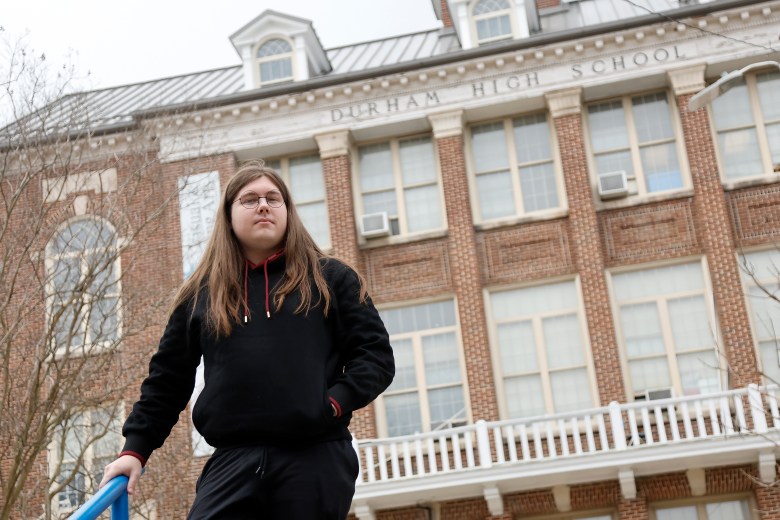
    Glenn Thompson, a Durham School of the Arts graduate, poses in front of the school in Durham, N.C., Monday, March 10, 2025. (AP Photo/Karl DeBlaker)

    Glenn Thompson, a Durham School of the Arts graduate, spoke up at a board meeting during his senior year. One of his teachers promised a student confidentiality for an assignment related to mental health. A classmate was then “blindsided” when Gaggle alerted school officials about something private they’d disclosed. Thompson said no one in the class, including the teacher, knew the school was piloting Gaggle.

    “You can’t just (surveil) people and not tell them. That’s a horrible breach of security and trust,” said Thompson, now a college student, in an interview.

    After hearing about these experiences, the Durham Board of Education voted to stop using Gaggle in 2023. The district ultimately decided it was not worth the risk of outing students or eroding relationships with adults.

    Related: School ed tech money mostly gets wasted. One state has a solution

    The debate over privacy and security is complicated, and parents are often unaware it’s even an issue. Pearce, the University of Washington professor, doesn’t remember reading about Securly, the surveillance software Seattle Public Schools uses, when she signed the district’s responsible use form before her son received a school laptop.

    Even when families learn about school surveillance, they may be unable to opt out. Owasso Public Schools in Oklahoma has used Gaggle since 2016 to monitor students outside of class.

    For years, Tim Reiland, the parent of two teenagers, had no idea the district was using Gaggle. He found out only after asking if his daughter could bring her personal laptop to school instead of being forced to use a district one because of privacy concerns.

    The district refused Reiland’s request.

    When his daughter, Zoe, found out about Gaggle, she says she felt so “freaked out” that she stopped Googling anything personal on her Chromebook, even questions about her menstrual period. She didn’t want to get called into the office for “searching up lady parts.”

    “I was too scared to be curious,” she said.

    School officials say they don’t track metrics measuring the technology’s efficacy but believe it has saved lives.

    Yet technology alone doesn’t create a safe space for all students. In 2024, a nonbinary teenager at Owasso High School named Nex Benedict died by suicide after relentless bullying from classmates. A subsequent U.S. Department of Education Office for Civil Rights investigation found the district responded with “deliberate indifference” to some families’ reports of sexual harassment, mainly in the form of homophobic bullying.

    During the 2023-24 school year, the Owasso schools received close to 1,000 Gaggle alerts, including 168 alerts for harassment and 281 for suicide.

    When asked why bullying remained a problem despite surveillance, Russell Thornton, the district’s executive director of technology responded: “This is one tool used by administrators. Obviously, one tool is not going to solve the world’s problems and bullying.”

    Related: Schools prove soft targets for hackers

    Despite the risks, surveillance technology can help teachers intervene before a tragedy.

    A middle school student in the Seattle-area Highline School District who was potentially being trafficked used Gaggle to communicate with campus staff, said former superintendent Susan Enfield.

    “They knew that the staff member was reading what they were writing,” Enfield said. “It was, in essence, that student’s way of asking for help.”

    Still, developmental psychology research shows it is vital for teens to have private spaces online to explore their thoughts and seek support.

    “The idea that kids are constantly under surveillance by adults — I think that would make it hard to develop a private life, a space to make mistakes, a space to go through hard feelings without adults jumping in,” said Boudreaux, the AI ethics researcher.

    Gaggle’s Patterson says school-issued devices are not the appropriate place for unlimited self-exploration. If that exploration takes a dark turn, such as making a threat, “the school’s going to be held liable,” he said. “If you’re looking for that open free expression, it really can’t happen on the school system’s computers.”

    Claire Bryan is an education reporter for The Seattle Times. Sharon Lurye is an education data reporter for The Associated Press.

    Contact Hechinger managing editor Caroline Preston at 212-870-8965, on Signal at CarolineP.83 or via email at [email protected].

    This story about AI-powered surveillance at schools was produced by the Education Reporting Collaborative, a coalition of eight newsrooms that includes AL.com, The Associated Press, The Christian Science Monitor, The Dallas Morning News, The Hechinger Report, Idaho Education News, The Post and Courier in South Carolina, and The Seattle Times.

    The Hechinger Report provides in-depth, fact-based, unbiased reporting on education that is free to all readers. But that doesn’t mean it’s free to produce. Our work keeps educators and the public informed about pressing issues at schools and on campuses throughout the country. We tell the whole story, even when the details are inconvenient. Help us keep doing that.

    Join us today.

    Source link

  • Americans overwhelmingly support free speech — but 10% endorse calls to violence

    Americans overwhelmingly support free speech — but 10% endorse calls to violence

    Over 80% of Americans across party lines agree that exercising free speech involves dealing with disagreements — but that this should never lead to calls for violence.

    That’s according to a new survey by YouGov, highlighting that the American people understand the realities of free expression and the importance of civil discourse.

    But not all the data are encouraging.

    Though eight in 10 respondents said we should discourage calls to violence, about one in 10 said they weren’t sure — and another one in 10 actually disagreed.

    Also, roughly 78% of Americans believe freedom of speech doesn’t include freedom from consequences — including 76% of Republicans, up 16 points from 2022, and 86% of Democrats. That said, it’s difficult to know what to make of this without knowing whether respondents took “consequences” as referring to the court of public opinion or the iron fist of the state. After all, people have every right to judge each other for the things they say but the government cannot punish speech based on viewpoint.

    Reflecting recent findings by FIRE’s National Speech Index, the survey also reveals that 54% of respondents agree that the government is the biggest threat to free speech, up from 45% in YouGov’s 2022 survey. While Republican sentiment on this question has fallen over that period from 69% to 60%, Democrats have gone from 28% to 48%. 

    Even with the nine-point drop among Republicans and 20-point increase among Democrats, the former remain far more likely to view the government as the main threat to free speech. 

    On the other hand, the NSI found that 67% of conservatives and 83% of very conservative Americans have “a lot” or total confidence in President Donald Trump to protect their First Amendment rights, compared to only 11% of liberals and 12% of very liberal Americans. 

    But here’s a spot of good news. That same 2022 survey found that just below one-third of Americans believed limiting speech for some can expand free speech for all, including 24% of Republicans and a whopping 40% of Democrats. This year, however, while the figure for Republicans only fell by 2 percentage points, the percentage for Democrats dropped by an encouraging 12 points. 

    Still, compared to Republicans and the general population, Democrats are significantly more censorial when it comes to this question. 

    In line with this, the NSI results showed that 52% of conservatives but only 45% of liberals agree that “the First Amendment goes too far in the rights it guarantees.” Though here again, more information would be helpful in order to understand what specific limitations to free speech Democrats and Republicans have in mind. 

    As the Charlie Hebdo cartoonist Laurent Sourisseau has said, “When you have something to say, there is always someone somewhere with a very good reason to stop you from saying it.” 

    But of course, that doesn’t mean they should.

    Source link

  • Reauthorization of Violence Against Women Act Signed Into Law – CUPA-HR

    Reauthorization of Violence Against Women Act Signed Into Law – CUPA-HR

    by CUPA-HR | April 12, 2022

    On March 15, President Biden signed into law the Violence Against Women Act (VAWA) Reauthorization Act of 2022. The legislation reauthorizes all current VAWA grant programs through 2027 and was included in the omnibus appropriations package, which provided $1.5 trillion to fund the federal government for fiscal year 2022.

    Several of the VAWA Reauthorization Act’s provisions will specifically impact higher education institutions. The bill:

    • requires colleges and universities to conduct campus climate surveys of students to track their experiences of sexual violence on campus;
    • expands and provides additional funding for the Rape Prevention and Education Grant Program and other existing campus grants designed to provide comprehensive prevention education for students;
    • establishes a pilot program that provides funding to colleges and universities (among other entities) to create programs on restorative practices to prevent and address sexual violence;
    • requires the Secretary of Health and Human Services to create a demonstration grant program for colleges and universities to provide comprehensive forensic training to train healthcare providers on forensic assessments and trauma-informed care to survivors of sexual violence; and
    • requires the Government Accountability Office to examine the relationships between victims of sexual violence and their ability to repay their student loans.

    Of particular concern for higher ed institutions is the survey to track student experiences of sexual violence on campus. Conducting the survey could create challenges for the institutions as well as for the Department of Education charged with developing it. Additionally, some institutions are already conducting similar surveys on their campuses, creating a risk of duplicated efforts. This will be a complex undertaking for both the department and higher ed institutions.

    CUPA-HR will update members on any additional information on the implementation of the VAWA Reauthorization Act as it is released.


    Source link

  • House Passes Bills to Protect Older Job Applicants and Strengthen Domestic Violence Prevention and Survivor Support Services – CUPA-HR

    House Passes Bills to Protect Older Job Applicants and Strengthen Domestic Violence Prevention and Survivor Support Services – CUPA-HR

    by CUPA-HR | November 9, 2021

    On October 26 and November 4, 2021, the House of Representatives passed H.R. 2119, the Family Violence Prevention and Services Improvement Act of 2021, and H.R. 3992, the Protect Older Job Applicants (POJA) Act of 2021, respectively. Both bills passed by a close bipartisan vote — the former by a vote of 228-200 and the latter 224-200 — and are supported by President Biden.

    POJA Act

    As originally written, the POJA Act amends the Age Discrimination in Employment Act of 1967 (ADEA) to extend the prohibition of limiting, segregating or classifying by employers of employees to job applicants. The bill comes after recent rulings in the Seventh and Eleventh Circuit Courts of Appeals that allow employers to use facially neutral hiring practices, which some have accused of being discriminatory against older workers. As such, the POJA Act amends the ADEA to make clear that the disparate impact provision in the original statute protects older “applicants for employment” in addition to those already employed.

    Before the final vote on the bill, the House also adopted an amendment to the POJA Act that would require the Equal Employment Opportunity Commission to conduct a study on the number of job applicants impacted by age discrimination in the job application process and issue recommendations on addressing age discrimination in the job application process.

    Family Violence Prevention and Services Improvement Act

    The Family Violence Prevention and Services Improvement Act amends the Family Violence Prevention and Services Act to reauthorize and increase funding for programs focused on preventing family and domestic violence and protecting survivors. One provision addressing higher education authorizes the Secretary of Health and Human Services to now include institutions of higher education among the entities eligible for departmental grants to “conduct domestic violence, dating violence and family violence research or evaluation.”

    Both the Family Violence Prevention and Services Improvement Act and the POJA Act now face the Senate where passage is uncertain as both require significant support from Republicans to bypass the sixty-vote filibuster threshold.

    CUPA-HR will keep members apprised of any actions or votes taken by the Senate on these bills.


    Source link