Tag: visa

  • IRCC adds officer decision notes to visa refusals

    IRCC adds officer decision notes to visa refusals

    Announcing the news on July 29, Immigration, Refugees and Citizenship Canada (IRCC) said the move supported its “commitment to… transparency” and, in theory, has been hailed as welcome news for prospective students, institutions and representatives.  

    “This is a welcome step that many of us in the sector have long advocated, however how it is actually implemented remains to be seen,” director of global engagement at the University of British Columbia, Philipp Reichert, told The PIE News.  

    The move is intended to provide greater transparency and clarity in IRCC’s decision-making, giving applicants a better understanding of the reasons for their visa refusal, and reducing the need to submit Access to Information Requests (ATIR) or file Judicial Reviews challenging visa decisions.  

    And yet, “the real test will be whether these officer decision notes provide meaningful detail, rather than generic statement, to support informed reapplications”, said Reichert.  

    Given the frustration of applicants and representatives who previously received template refusal letters, Canadian immigration lawyer Will Tao said it was “largely justifiable” that colleagues had generally reacted positively to the news.  

    However, heeding caution, Tao raised concerns “that having letters which provide only the summary of the final decision, the ‘last entry notes’ so to speak, may not move us forward very much”.

    Just two days into the new policy, early examples of IRCC decision notes are already circulating among educators and immigration lawyers, with Reichert calling them “disappointingly brief and surface-level”. 

    Stakeholders have stressed that the policy will only be effective if decision notes meaningfully explain how an officer reached their conclusion. “Transparency without clarity risks being a missed opportunity,” warned Reichert. 

    In the policy’s early phase, decision notes are being provided with visa refusal letters for study permits, work permits, visitor visas and extensions, with more application types to be added over time.

    The change comes amid rising sector concerns over the falling study permit approval rate which dropped from 60% in 2023 to 48% in 2024, meaning half of all prospective international students were denied entry to Canadian institutions last year.  

    What’s more, the declining approval rate comes as the pool of applicants is shrinking due to the federal cap on international students – a trend that has surprised some stakeholders who had expected the applicant pool to have become stronger.  

    As approval rates have fallen, a growing number of international students are relying on information requests to obtain basic information about the reasons for refusal, as well as appealing the decision through judicial reviews.  

    If implemented correctly, clear officer decision notes could reduce the number of ATIP requests and judicial reviews by addressing some of the uncertainty that drives these decisions.  

    Superficial or templated notes are unlikely to make a significant difference to JR volumes

    Philipp Reichert, University of British Columbia

    Not only would this make for a fairer process, but it would also lower the administrative burden and costs on the IRCC system and “create a smoother experience for everyone involved”, noted Reichert.  

    “However, this will depend heavily on the quality of the information provided. Superficial or templated notes are unlikely to make a significant difference to Judicial Review volumes,” said Reichert.  

    Based on initial examples, Tao said the notes so far had provided “merely the same boilerplate language” except without the disclosure of the use of Chinook (the IRCC’s software system), triage and timestamp information, which, he warned, would make it difficult to uncover bulk decision-making.  

    At the same time, commentators have highlighted that it is still “early days”, with Tao suggesting that the use of tools including IRCC GPT could drive more case-specific refusal reasons over time. 

    Notably, the change comes as the IRCC is planning to de-platform its case management system (GCMS) altogether, meaning that the officer notes could be all that applicants can access in the new Digital Platform Modernisation, ‘DPM 3’, due to be rolled out across IRCC’s temporary resident visa program next year.  

    Though until that happens: “my clients will likely still need to file ATIPs and also judicial review decisions telling the court full reasons were not received,” said Tao.  

    Source link

  • Visa Processing Delays Could Cost U.S. Universities $7 Billion and 60,000 Jobs This Fall

    Visa Processing Delays Could Cost U.S. Universities $7 Billion and 60,000 Jobs This Fall

    Recent disruptions to student visa processing could trigger a 30-40% decline in new international student enrollment this fall, potentially costing the U.S. economy $7 billion and more than 60,000 jobs, according to a new analysis by NAFSA: Association of International Educators and JB International.

    The preliminary projections, based on SEVIS and State Department data, paint a stark picture for higher education institutions that have come to rely heavily on international students for both revenue and academic diversity. The analysis predicts an overall 15% drop in international enrollment for the 2025-26 academic year, which would reverse years of steady growth in this critical sector.

    “This analysis, the first to calculate the potential economic impact of fewer international students on cities and towns across the country, should serve as a clarion call to the State Department that it must act,” said Dr. Fanta Aw, executive director and CEO of NAFSA. “The immediate economic losses projected here are just the tip of the iceberg.”

    The projected decline stems from a confluence of policy changes and administrative challenges that have created significant barriers for prospective international students:

    Visa Interview Suspension: Between May 27 and June 18, 2025, student visa interviews were paused during the peak issuance season—precisely when students needed to secure visas for fall enrollment. When interviews resumed on June 18, consulates received a directive to implement new social media vetting protocols within five days, but with minimal guidance.

    Appointment Bottlenecks: Reports indicate limited or no visa appointment availability in key countries including India, China, Nigeria, and Japan. India and China alone represent the top two sources of international students to the United States, while Nigeria ranks seventh and Japan 13th among sending countries.

    Declining Visa Issuance: F-1 student visa issuance dropped 12% from January to April 2025 and plummeted 22% in May 2025 compared to the same period in 2024. While June 2025 data has not been published, the analysis suggests a possible 80-90% decrease based on the identified disruptions.

    Travel Restrictions: A June 4, 2025 executive order imposed restrictions on nationals from 19 countries, with reports suggesting another 36 countries could be added. These restrictions alone threaten $3 billion in annual economic contributions and more than 25,000 American jobs.

    The economic implications extend far beyond university campuses. International students contributed $46.1 billion to the U.S. economy in 2024-25 and supported nearly 400,000 jobs across various sectors including housing, dining, retail, and transportation.

    The projected 15% enrollment decline would reduce international student economic contributions to $39.2 billion in 2025-26, down from an expected $46.1 billion. This represents not just a loss to individual institutions, but to entire communities that have built economic ecosystems around international education.

    “Without significant recovery in visa issuance in July and August, up to 150,000 fewer students may arrive this fall,” the report warns, highlighting the narrow window remaining for policy corrections.

    Beyond immediate economic impacts, education leaders worry about long-term consequences for American higher education’s global competitiveness. International students contribute to research innovation, provide diverse perspectives in classrooms, and often remain in the United States after graduation, filling critical roles in STEM fields and other high-demand sectors.

    The timing is particularly concerning given increased competition from other English-speaking countries like Canada, Australia, and the United Kingdom, which have positioned themselves as more welcoming alternatives for international students.

    To mitigate what NAFSA calls a “devastating outcome,” the organization is urging Congress to direct the State Department to take two immediate actions:

    1. Provide expedited visa appointments and processing for all F-1 and M-1 students and J-1 exchange visitor visa applicants
    2. Exempt F and M students as well as J exchange visitors from current travel restrictions affecting nationals from 19 countries, while maintaining required background checks and vetting

    The report argues that these policy changes could help institutions avoid the projected enrollment cliff and preserve the economic benefits that international students bring to American communities.

    For institutions planning fall enrollment, the report suggests the need for contingency planning and advocacy efforts to address visa processing challenges. With the traditional summer months representing the final opportunity for students to secure visas for fall enrollment, time is running short for policy interventions.


    Source link

  • the reality of the US student visa system

    the reality of the US student visa system

    Min, a student from Bangladesh, remembers his excitement after learning he had been accepted into a US university. It meant he would be learning from some the world’s leading medical experts in healthcare – learning skills he hopes to use to improve the healthcare system in his home country.

    Min, who asked not to use his name due to the enhanced US screening policies, was recently granted a visa and is due to start his freshman year this fall.

    The road to get there, however, was not a smooth one. Following the State Department’s three-week worldwide pause on interviews in June, and the implementation of enhanced screening policies, many of Min’s peers had their interview appointments delayed.

    It took Min three months to secure his required interview at the embassy for his student visa. He said the software used to schedule the interview kept crashing and the embassy had limited appointment times, checking multiple times a day for openings. 

    While Min saw his visa approved, several of his friends had their student visas denied at the end of their interview, he said, leading some of them to apply for universities in other countries. Most often, it’s another English-speaking country, since that’s the most common secondary language for Bangladeshi students, he said.

    “In recent, years, a lot of my friends have applied to Australia, because for the US, there are more uncertainties,” Min said.

    The student visa application process has come into the spotlight recently. That’s because of the Trump administration’s changes to how visa officers review students’ social media activity. Some visa applicants have expressed concerns that the policies could lead to an increase in visa denials.

    However, education nonprofits have for years raised alarms about high rates of visa denials and long interview wait times – warning it could hinder the global competitiveness of US higher education.  

    Visa denials differ for world regions

    The US State Department rejected over 650,000 student visa applications worldwide from 2018 through 2022. Students from developing nations in South Asia and Africa have their visas rejected at much higher rates compared to those from wealthier countries. 

    That’s according to a study that looked at eight years’ data – authored by The Presidents’ Alliance and Shorelight student support company. The report shines a light on experiences of students from Asia and Africa, who struggle with long wait times to schedule visa interviews.

    For European students who apply to study in the US, getting denied entry is rare – fewer than 8% in 2023, according to the study. That’s a stark difference from Africa, where 61% of students were denied a visa that year, not including South Africa and some neighbouring countries with very low denial rates. For South Asia, including Nepal, between 36% and 55% students have their visas denied each year.

    The world’s population of young, smart minds is exploding out of sub-Saharan Africa

    Carly O’Keefe, Monroe Community College, Rochester

    Rajika Bhandari, a senior advisor with the Presidents’ Alliance who led the study, said the findings reflect patterns that college administrators have noticed for decades.

    “From the campus perspective, these students have been fully vetted and deemed worthy of being offered admission,” said Bhandari, once a US international student herself. “Yet they’re facing this final barrier.”

    A visa officer decides whether to grant a student entry after interviewing them at an embassy or consulate. One goal of the interview, lasting several minutes at most, is to assess whether the student is likely to return to their homeland after graduating.

    If the student can’t demonstrate strong homeland connections – such as through owning property, having a job lined up after graduation, or strong family ties – it can be grounds for denial. The visa officer will also review documents showing the student’s eligibility to study internationally, including financial statements showing the student can afford college.

    Many students, Bhandari said, have expressed concerns to college leaders that they’ve met every requirement but are still denied – leaving them bewildered. Visa officers rarely share the specific reason for the denial with applicants. 

    “You may go back a second time and be denied yet again because you don’t know what it is that you need to fix,” Bhandari said.

    The State Department didn’t directly respond to a request for comment but has said in the past that it’s committed to a fair visa review process. The department said that applications, especially from Africa, have skyrocketed in the past few years and “a commensurate increase in denials is expected.” 

    According to the department, more visas were issued to African students in 2023 than ever before, with Nigerian students granted the highest share. However, the visa denial rate for African students grew that year by three percentage points, according to the study, while the denial rate for European and South American students dropped. 

    The State Department doesn’t publish data on visa denials but does disclose how many student visas are issued for each country every month. So far this year, the number of F-1 visas issued for Nigerian students is 23% less compared to this time last year, based on data published through May. For Bangladeshi students, like Min, the number of visas issued is about the same as last year.

    Experience with getting a visa denied

    Sooraj Sahani, entering his sophomore year at Texas State, knows how confusing and emotional it can be to have a visa denied. He had his visa denied on the first try, before applying again and getting it approved three weeks before the start of freshman year in fall of 2024.

    In his village in the plains of Nepal, Sahani fed his fascination for physics by taking online classes from some of the world’s top experts. He aspired to be like the professors who mentored him virtually through the World Science Scholars program, a nonprofit based in New York City. That’s why Sahani decided he wanted to study at a US university, determined to become a theoretical physics researcher.

    When he learned that Texas State was offering him a full undergraduate scholarship, he thought he was on track to fulfil his dream. His scholarship meant the US couldn’t deny his student visa for financial reasons, Sahani said. But he still ran into issues.

    When Sahani tried last summer to book a visa interview appointment for the US embassy in Kathmandu, Nepal, all the slots were full for weeks. Instead, he traveled to New Delhi for an interview with a visa officer. Sahani said that, at the end of the roughly one-minute interview, the officer told him he wasn’t eligible for a visa without any explanation.

    Students can wait up to nine months for a US visa interview in Dhaka, Bangladesh

    US State Department data

    “With a very sad face, I had to come back from India. It took me some time to tell myself that, OK, it happens. I’m not giving up,” he said.

    After getting his visa denied, Sahani scheduled his second visa interview appointment at the embassy in Kathmandu. To secure a slot, he repeatedly woke up in the middle of the night to check online for appointments.

    “I woke up at 2am, 3am, 4am, just to see if there was a visa slot. We have a lot of students applying for the US but we just have one embassy,” he said.

    Since releasing its study, the Presidents’ Alliance and other education nonprofits have met with State Department leaders about improving visa processing. The department says it’s made progress in lowering wait times worldwide by hiring more staff and giving visa officers the authority to waive some interviews

    However, some countries still have too few embassies or staff members to keep up with the high number of students, Bhandari said. For the embassy in Dhaka, Bangladesh, it’s currently a nine month wait time for a student visa interview, according to the department’s website.

    Academic loss and economic loss”

    Higher education leaders warn that if visa issues persist, they’ll hinder the US’s global competitiveness. In January NAFSA wrote a letter to the incoming Trump administration calling for action to make visa processing times more predictable. The letter also advocates for creating a pathway for international students to become permanent residents after graduation, which, according to Bhandari, may help to address visa denials.

    If students can choose to live and work in the US after graduation, they wouldn’t have to prove their intentions to return to their home country – a source of many denials. In April, Congress introduced the Keep STEM Talent Act with bipartisan support, aiming to create this kind of “dual intent” pathway for international students pursuing science, technology, or maths degrees. Most of the 1.1 million international students who came to the US last academic year chose STEM fields.

    The high rate of visa denial for African students is both an academic loss and an economic loss, said Carly O’Keefe, the designated school official for international student enrolment at Monroe Community College in Rochester, NY.

    Like many other states, college enrolment in New York has been declining. New York’s comptroller warns that 2025 could mark the start of an “enrolment cliff” – a sharp decline in applications reflecting the steady decline in US births since a historic high in 2007. Several colleges in the state have closed in recent years due to low enrolment. 

    Meanwhile, Africa’s young population is increasing. By 2050, Nigeria is expected to become the world’s third most populous country, behind only India and China. Africa isn’t just full of college-aged youth, O’Keefe said, but also innovation led by youth. As technology is becoming more available in Africa, the number of youth-led startups is booming. 

    “The world’s population of young, smart minds is exploding out of sub-Saharan Africa,” she said. “Just think of the brain power and the potential talent in the world.”

    Last fall, MCC welcomed about 90 international students, the most since 2018, from 30 countries. However, as with most colleges that host international students, the number enrolled was fewer than the number who planned to come because of visa denials. Colleges across the US, O’Keefe said, are missing out on talent because of the denials.

    “We’re potentially missing out on very qualified students enrolling at our colleges and universities across the country that could be doing amazing academic work,” she said.

    Source link

  • NZ’s new study visa rules strike chord with Australian sector

    NZ’s new study visa rules strike chord with Australian sector

    The New Zealand government announced earlier this week that, from November, Immigration New Zealand (INZ) will increase permitted work hours for study visa holders, extend work rights to all tertiary students on exchange or study abroad programs. It may also introduce a short-term work visa of up to six months for graduates not eligible for a post-study work visa.

    While the relaxations are a key part of New Zealand’s push to boost international student numbers by over 40% by 2034, INZ has also clarified that students who change their education provider or lower their study level will need to apply for a new visa, rather than simply requesting a variation of conditions on their existing one.

    The mandate has struck a chord with Australia’s international education sector, where some individuals and associations have been calling for an overhaul of the study visa system, specifically on linking study visas to the institution of initial enrolment.

    Commenting on New Zealand’s recent changes, Ravi Lochan Singh, managing director, Global Reach, wrote in a LinkedIn post that instead of banning agent commissions for onshore student transfers to address attrition, Australia could “just copy” the neighbouring country’s approach. 

    “Australia is currently facing a significant issue where students use higher ranked or low-risk universities (as categorised by Home Affairs) to secure their student visas easily and then after the first semester of studies, the students get moved to private colleges offering higher education degrees,” Singh told The PIE News. 

    According to Singh, while such moves, often made by Indian or Nepali students with the help of onshore immigration agents, may be genuine, they “waste” the efforts of offshore education agents and universities that initially recruited the students.

    “Some policy makers feel that students have a right to choose the correct education provider and if they feel that what they desire as a customer can be met at private colleges, they should be allowed to move,” stated Singh. 

    “However, we also have the situation where students have demonstrated their available funds through an education loan which is issued in the name of a particular university,” he added. If the student does move institutions, the education loan is not valid as a demonstration of funds and thus the argument that the students should be asked to apply for a fresh student visa.”

    According to Singh, many international students, particularly from South Asia, who arrive in Australia on education loans often find themselves without “available” or “accessible” funds when they switch providers and are required to show new financial evidence.

    It would appear that three modern advanced economies who have championed consumer protections and who have established international study destinations believe this measure is not contrary to ‘consumer choice’
    Gareth Lewis, Western Sydney University

    Moreover, a recent report by Allianz Partners Australia revealed that over 61% of international students found daily life in the country “significantly more expensive than expected”, with more than a quarter considering withdrawing from their studies due to financial woes. 

    “While we are discussing attrition and student movements once the student is onshore, we also need to acknowledge that university fees have been increasing and students are beginning to question ROI. Thus there is an argument for more student visa grants for higher education degrees at TAFE and private providers,” said Singh. 

    “The fees of such programs is much lower to what is charged at the universities. If this happens, the students who are more price sensitive will join the TAFE and private providers right in the beginning and universities will have only those students who can afford the degree and likely to complete them at the university itself.”

    While Australia’s Ministerial Direction 111, which replaced MD 107, provides immigration case officers stricter guidance on assessing the Genuine Student requirement, and introduces a two-tier visa processing system that prioritises institutions with strong compliance records and low visa risks, it influences the decision-making process, not the entire visa mechanism unlike New Zealand’s recent move. 

    However, New Zealand is not the only model Australia could look to, according to stakeholders.

    A recent submission by the Association of Australian Education Representatives in India (AAERI) to the ministers for education and home affairs in Australia pointed to examples from the UK and Canada, where students must obtain a new Confirmation of Acceptance for Studies (CAS) and a new study permit, respectively, if they wish to change institutions.

    “Australia’s recent reforms, such as closing the concurrent CoE loophole and requiring CoEs for onshore visa applications, are steps in a similar direction but do not go far enough to address the core issue of unethical student poaching, misuse of student visa and provider switching,” stated AAERI in its submission in May to the Labor government. 

    After New Zealand’s changes were announced, regional director, Western Sydney University, Gareth Lewis also echoed a similar opinion on Australia’s reluctance to do what New Zealand, the UK, and Canada have done. 

    “It would appear that three modern advanced economies who have championed consumer protections and who have established international study destinations believe this measure is not contrary to ‘consumer choice’,” read Lewis’s LinkedIn post

    “Unfortunately Australia believes it is. This needs to change.” 

    Find out more about how Australia can improve its visa system at The PIE Live Asia Pacific 2025 on July 30, during the session “Visa status: MD111 and MD106 mapping – is the current visa system working?”, which will explore the impact of current visa policies on HE, VET, and ELICOS sectors, covering genuine student assessments, onshore switching, and ways to improve the operating environment. Check out more details here – PLAP 2025 agenda.

    Source link

  • F-1, J-1 Student Visa Issuances Dropped in May

    F-1, J-1 Student Visa Issuances Dropped in May

    The U.S. Department of State issued 12,689 fewer F-1 visas in May 2025 compared to the May before, which could forecast a decline in international students able to attend U.S. universities this fall.

    Recently published data from the State Department shows a 22 percent drop in F-1 visas issued across the world and a 13 percent decline in J-1 visas.

    While visa issuances can help predict international student enrollment trends, they don’t tell the full story, said Rachel Banks, senior director for public policy and legislative strategy at NAFSA, the association of international educators. Still, the trend line isn’t positive.

    “We’re not really going to know until we get through September to know everyone who arrives, to know what the enrollment really looks like,” Banks said. “But it’s certainly not encouraging.”

    Over the past few months, President Donald Trump has cracked down on international students via arrests, travel bans and revocations of legal status. Those moves and other executive orders could affect the number of F-1 and J-1 visas issued.

    In May, the administration said it would revoke visas from Chinese nationals who have ties to the Chinese Communist Party. The number of Chinese nationals issued a F-1 visa in May declined by 15 percent (or about 2,578 students). The State Department also paused visa interviews in late May while the agency developed a policy to screen international students’ social media profiles. Interviews resumed in June once the policy was in place.

    The interview pause may have contributed to but cannot fully explain the decline in visa issuances, said Finn Reynolds, head of market research at Lawfully, a legal tech start-up focused on immigration.

    The State Department doesn’t publish the number of visa applications or interviews it engages in, which means the decline could be tied to a decreased demand or slower processing by the department, Reynolds added. A May 27 survey by Study Portal found student interest in studying in the U.S. has dropped to its lowest point since COVID-19, with fewer students interested in U.S. programs and instead considering other English-speaking nations such as the U.K. or Australia.

    Additionally, the State Department doesn’t share daily visa issuance numbers, meaning the drop could be tied solely to the pause in the final week of May, Banks said. The connection, over all, is unclear.

    The data also points to the effect of travel restrictions on students from certain nations. The Trump administration banned visitors from 12 countries and implement heightened restrictions for seven other countries in June. The May numbers show a nearly 150 percent decline in F-1 visa issuances (or 451 visas) and a 105 percent decline in J-1 issuances (157 visas) to citizens from the impacted nations, even before the ban took place.

    One factor not reflected in the data is the number of students returning to their institutions who already hold visas. Students don’t need to receive a new visa if they remain in the U.S.; they only need one when traveling in and out of the country. Given the disruption to Student Exchange and Visitor Information System statuses in April, many students chose to remain in the U.S. over their summer break, Banks said.

    Reynolds expects to see a further drop in visa issuances for June and July, because social media vetting procedures result in fewer appointment slots.

    Students in China, Ghana, India, Japan, Niger and Nigeria have had the most trouble getting appointments, according to NAFSA members.

    “We’re halfway through July, and there’s still students who are struggling to get an appointment; that’s troubling,” Banks said.

    Future policies could also bottleneck the visa pipeline for international students. A proposed rule at the Office of Management and Budget would end duration-of-stay policies and instead implement a fixed date for how long students can remain in country on their visa.

    “We’re very concerned that if that were to go through, that sort of adds to further disruptions and hurdles that students have to jump over, that then gives students more reason to say, ‘You know, this seems like a hassle, this seems like I’m not welcome, I’m going to find another opportunity to pursue,’” Banks said.

    Enrollment Declines Loom

    Colleges and universities are already anticipating declines in their international student populations. The Institute of International Education found that 40 percent of institutions projected declines in their undergraduate population of international students, and 49 percent anticipated a drop in graduate student populations.

    A NAFSA survey of about 150 members institutions this summer found 78 percent of institutions predict a decline in both undergrad and graduate international students.

    Each year, institutions enroll 1.1 million international students, about 6 percent of all college students in the U.S.

    Calculations by The Financial Times, published last week, found that a decline of even 10 percent in international student enrollment would cost U.S. colleges and universities $3 billion in revenue. A significant portion of this loss would be in tuition revenue; a 10 percent drop would result in a $900 million decrease in tuition dollars.

    Source link

  • State Department Unveils Student and Exchange Visitor Visa Social Media Vetting Guidance – CUPA-HR

    State Department Unveils Student and Exchange Visitor Visa Social Media Vetting Guidance – CUPA-HR

    by CUPA-HR | June 24, 2025

    On June 18, the Department of State issued a cable to all U.S. diplomatic and consular posts formally expanding the screening and vetting process for applicants of F, M and J (FMJ) nonimmigrant visas. The State Department guidance resumes FMJ appointment scheduling after a previous announcement from the agency paused all student visa interviews as they prepared for the new social media screening and vetting guidance.

    Background

    At the end of May, the State Department announced that U.S. embassies and consular sections were pausing new student visa interviews as they awaited further guidance on new social media screening and vetting requirements. CUPA-HR joined the American Council on Education and other higher education associations on a letter to Secretary of State Marco Rubio requesting the agency quickly implement the new vetting measures to ensure new student visas could be efficiently processed before the 2025-2026 academic year. No further guidance was publicly announced between the announced pausing of student visa interviews and the cable sent out to all diplomatic and consular posts.

    New Screening and Vetting Guidance

    The cable directs consular sections to resume scheduling FMJ appointments after implementing the new vetting procedures. The guidance requires officers to conduct “a comprehensive and thorough vetting of all FMJ applicants, including online presence, to identify applicants who bear hostile attitudes toward our citizens, culture, government, institutions, or founding principles; who advocate for, aid, or support designated foreign terrorists and other threats to U.S. national security; or who perpetrate unlawful antisemitic harassment or violence.” The posts are directed to implement the new guidance within five business days.

    As explained in the cable, consular officers are directed to conduct intake and interviews in accordance with standard procedures, but once an FMJ applicant is otherwise eligible for the requested nonimmigrant status, officers must temporarily refuse the case under Section 221(g) of the Immigration and Nationality Act (INA). After refusing the case, officers must request the applicant set all social media accounts to “public,” after which the officer must examine “the applicant’s entire online presence — not just social media activity — using any appropriate search engines or other online resources.”

    The new vetting procedures could limit the consular officers’ ability to process student visa applications quickly and efficiently as the cable also mentions that consular sections should “consider the effect of this guidance on workload” when resuming the scheduling of FMJ appointments. Even with these concerns, the cable does request expedited appointments for certain FMJs, including J-1 physicians and F-1 students seeking to study at U.S. institutions where the international student body constitutes 15 percent or less of the total student population.

    While much of the advocacy from interested stakeholders on this issue revolves around students, individuals seeking J-1 visas to participate in cultural and educational exchange programs to conduct research or teach at institutions could be subject to an enhanced level of scrutiny. CUPA-HR will continue to monitor for updates related to the FMJ vetting processes.


    Source link

  • Second Straight Quarter of Stabilised International Student Demand for a UK Study Visa

    Second Straight Quarter of Stabilised International Student Demand for a UK Study Visa

    The latest UK study visa application data, released in late May, shows that demand from main applicants recovered in calendar Q1 2025 (January through March). Applications from this cohort increased by 32% over Q1 2024 levels.[1] This is an encouraging signal of sector recovery, as applications in Q4 2024 were up 9% over Q4 2023, suggesting renewed student confidence in the UK as a study destination.

    UK Study Visa Applications and Issuances Up For Main Applicants in Q1 2025

    Nearly 47,000 main applicants submitted a UK study visa application in Q1 2025. This represents a 32% increase over Q1 2024:

    These gains build on the year-on-year growth seen in Q4 2024, suggesting that the UK international education sector is experiencing a broader rebound and stabilisation, rather than a one-off peak in Q4.

    Still, Q1 has historically made up just 8% to 10% of total annual applications from main applicants. With the bulk of applications and issuances typically occurring in Q3, the sector still has work to do to sustain renewed student confidence. Attention is especially important around addressing concerns and dispelling misconceptions stemming from the 2025 Immigration White Paper—a topic we will explore further below.

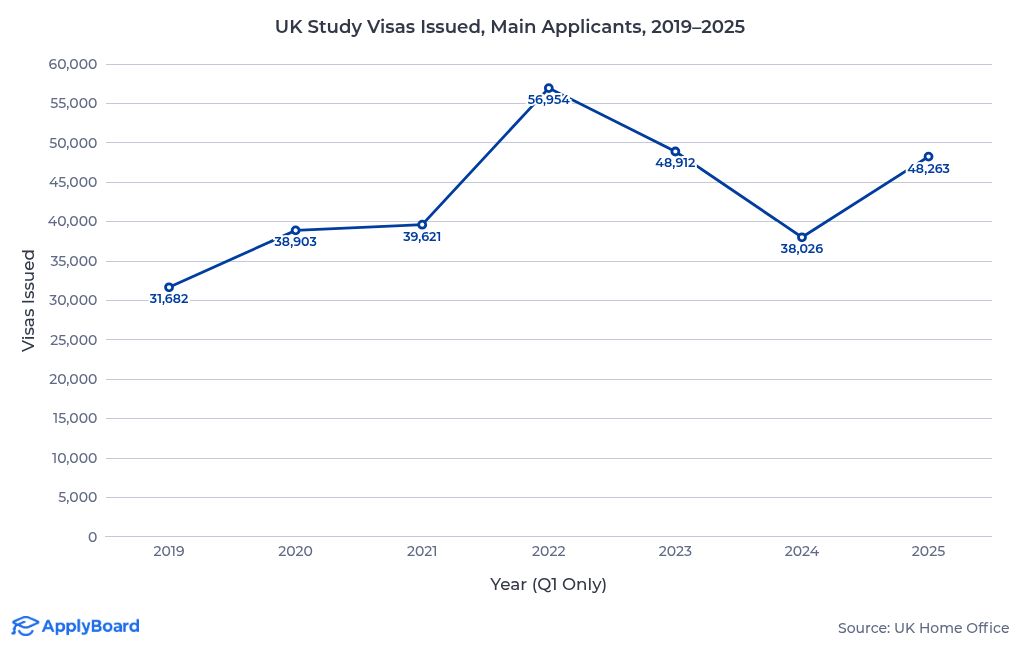
    As with applications, main applicant student visa issuances likewise rose in Q1 2025:

    chart visualization

    Over 48,000 international students were issued a study visa in Q1 2025, representing a growth of 27% over Q1 2024. The issuance rate in both of these quarters was 88%, meaning the increased number of issued visas reflects stronger demand rather than changes in approval rates.

    That said, tuition fees, visa charges, and the NHS surcharge have all risen in recent years, driving up the overall cost of studying in the UK. The White Paper’s proposed 6% levy on international tuition fee income risks adding to that burden, especially as institutions may need to pass the new financial pressures onto students. 83.5% of respondents in a recent survey cited cost of study as a top priority when choosing a destination, highlighting the potential impact of additional cost pressures. The Government’s own analysis projects an immediate drop of 14,000 international students, with a sustained decline of around half that figure over time.

    Also, due to the raised Basic Compliance Assessment (BCA) thresholds proposed in the 2025 White Paper, institutions will likely need to enhance their vetting processes moving forward before issuing confirmation of acceptance of studies. Likewise, institutions may look to diversify within lower-risk countries to minimise exposure to visa refusals.

    Where Did Demand Stabilise in Q1 2025?

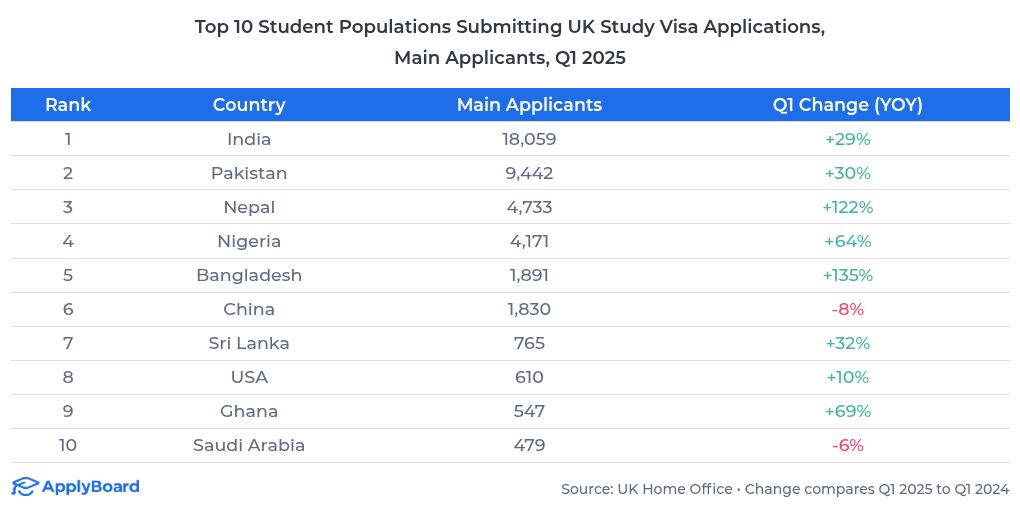
    A closer look at what made Q1 2025 a strong quarter reveals that the uptick in study visa applications was not limited to a handful of markets. Instead, demand recovered across a broad range of source countries. Of the 22 countries with 100 or more main applicants, 14 saw year-on-year growth—an encouraging sign that renewed student interest in the UK is present across multiple regions.

    table visualization

    India accounted for over 18,000 main applicant study visa submissions in Q1 2025, marking a 29% increase from the same period last year and making it the UK’s top source market that quarter. This recovery is particularly promising given that Indian student demand had softened across all four major English-speaking destinations in the latter half of 2023 and throughout 2024.

    This momentum may be bolstered by recent developments in the UK–India relationship. In May, the UK and India signed a long-anticipated Free Trade Agreement that, while not directly altering student visa policy, introduced mutual recognition of academic qualifications and greater clarity around post-study employment pathways. These developments could reinforce the UK’s appeal among Indian students, as long-term career prospects form an important part of prospective students’ decision-making process.

    Elsewhere, the 64% jump in Nigerian applications marks an encouraging recovery. Nigeria faces unprecedented economic challenges, and was also arguably the most affected by the UK’s dependant visa restrictions. However, Nigeria was among several countries, along with Pakistan and Sri Lanka, two other drivers of sustained demand this past quarter, where nationals may face increased scrutiny due to past asylum claim rates. This added layer of caution from UK authorities could temper future demand from these markets, especially if students perceive a higher risk of visa refusal or changing entry conditions despite their qualifications.

    What Student Populations Drove the Upward Visa Issuance Trend in Q1 2025?

    Issuance trends offer additional insight into which student populations are successfully converting interest into study visas. These trends help us understand short-term momentum and assess key markets’ longer-term enrolment potential.

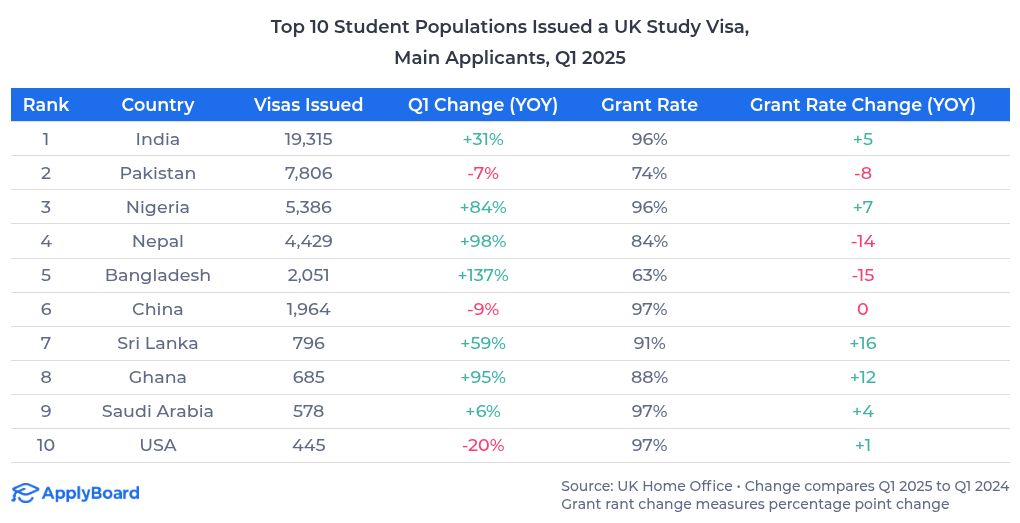
    table visualization

    The 19,300 Indian students issued a main applicant study visa in Q1 2025 represented a 31% increase over Q1 2024. Their grant rate also rose to 96%, an increase of five percentage points which is especially significant given the scale of the incoming Indian student population.

    Several other markets also demonstrated notable growth in UK study visa issuances this past quarter. The number of visas issued to main applicants from Nigeria increased by 84% compared to Q1 2024, with the grant rate rising by seven percentage points to 96%. Similarly, Sri Lanka and Ghana saw significant increases in visa issuances, with grant rates improving to 91% and 88%, respectively. These trends may reflect successful adjustments to new UK visa requirements and effective outreach efforts by institutions in these countries.

    Conversely, main applicants from Pakistan experienced a 7% decline in student visa issuances. Their 74% grant rate represents a year-on-year drop of eight percentage points. Nepalese and Bangladeshi main applicants also saw grant rates decline in Q1 2025—down 14 and 15 percentage points respectively—though issuances doubled for both student populations.

    Sustaining Momentum in the UK’s International Student Recovery

    Strong Q1 2025 results are a welcome sign for the UK’s international education sector, especially as they build on the encouraging Q4 2024. Together, these quarters point to a potential turning point in student sentiment, possibly signalling a broader recovery in demand if institutions and the wider international education community remain aligned, and if geopolitical relationships remain relatively cooperative.

    However, that stability is not guaranteed. With the release of the 2025 Immigration White Paper, institutions must proactively clarify recent policy changes and dispel myths that may deter prospective students.

    Two areas of particular concern within the White Paper are the proposed reduction of the Graduate Route’s duration from two years to 18 months, and the proposed 6% levy. These changes could impact the UK’s competitiveness in attracting international students, as post-study work opportunities are a significant factor in students’ decision-making processes. Moving forward, it will; be critical for institutions to emphasise that this post-study work pathway remains accessible for all eligible students and is a key differentiator for the UK in an increasingly competitive global landscape.


    [1] All data courtesy of the UK Home Office, unless otherwise stated. All timeframes in this article are by calendar year (January–December).

    Source link

  • US study visa applicants told to make social media accounts ‘public’ amid vetting crackdown

    US study visa applicants told to make social media accounts ‘public’ amid vetting crackdown

    • New social media privacy requirements come just as US government lifts four week-long study visa interview freeze, leading to fears of a backlog.
    • Concerns of added complications where consular officers responsible for social media vetting do not speak the applicant’s language.
    • Policy extends even to those who have been issued US visas in the past.

    In an update sent to consulates last week, the US government has advised that all those applying for F, M or J nonimmigrant visas are “requested” to make their social media accounts available to view by anybody so that their identity can be verified and they can be thoroughly vetted before entering the country.

    Immigration experts have criticised the move because of the huge additional workload it will place on immigration officers, meaning that visa issuance is likely to slow down considerably.

    US immigration lawyer James Hollis said he “almost [felt] bad” for consular officers.

    “It’s going to grind processing to a halt and will likely result in increased wait times for all nonimmigrant visas, let alone the student and exchange visitor applicants,” the business immigration specialist at the McEntee Law Group warned – noting that there are added complications where applicants were posting on social media in their own local language if officers do not understand what they have written.

    It appears that the new policy will be mandatory from June 25 onwards, and all applicants will be vetted in this way even if they have been issued a US visa in the past.

    It’s going to grind processing to a halt and will likely result in increased wait times for all nonimmigrant visas, let alone the student and exchange visitor applicants
    James Hollis, McEntee Law Group

    Consulates are advised that they should consider whether active social media privacy settings “reflect evasiveness or otherwise call into question the applicant’s credibility”.

    Officers have been told to reject a visa application in cases where the applicant has:

    • expressed “hostile attitudes” toward the US in terms of its citizens, culture, government, institutions, or founding principles;
    • advocated for or supported “designated foreign terrorists and other threats to US national security”;
    • shown or supported anti-semitism;
    • even if they have otherwise proven they are not an immigration risk;
    • and are not already ineligible for a visa (ie does not post a risk to US national security).

    In these cases, the US can deny entry on national security or foreign policy grounds.

    The US has asked visa applicants to provide social media information on their application forms for the past five years – including all social media names or handles of every platform they have used over the past five years. Failing to include this information could lead to an applicant’s visa being denied and being ineligible for future visas.

    It comes after a tumultuous few weeks for prospective international students eyeing a place at US institutions. After stretching a study visa interview freeze into its fourth week – despite assurances that the pause would be quick – officials last week resumed interviews with additional social media vetting for applicants.

    US stakeholders have repeatedly expressed concerns that the Trump administration’s extreme social media crackdown could inflict untold damage upon the country’s international education sector.

    Source link

  • State Department Screening Visa Applicants’ Social Media

    State Department Screening Visa Applicants’ Social Media

    John McDonnell/Getty Images

    The U.S. State Department is rolling out sweeping new rules for vetting student visa applicants using their social media presence, according to Politico.

    The new process will include screening for “any indications of hostility towards the citizens, culture, government, institutions or founding principles of the United States,” according to an internal State Department cable. 

    Department officials will also look for posts that signal “advocacy for, aid or support for foreign terrorists and other threats to national security” and “support for antisemitic harassment or violence,” specifically citing support for Hamas—a charge commonly levied against student protesters advocating for Palestinian rights—as grounds for rejection. The cable also directs officials to cull applicants who “demonstrate a history of political activism.”

    The news comes a few weeks after Secretary of State Marco Rubio paused all student visa interviews in order to implement a new screening policy focusing on students’ online activity. The Associated Press reported that the department rescinded the pause, but applicants who don’t allow the government to review their social media accounts could be rejected.

    The cable is the Trump administration’s latest effort to curtail the flow of international students to the U.S., as tens of thousands of foreign students await approval of their visas after months of delays and with only weeks until the start of the fall semester. 

    State Department spokespeople did not respond to a list of questions from Inside Higher Ed in time for publication. 

    Source link

  • AAERI seeks visa overhaul for Australia’s student system

    AAERI seeks visa overhaul for Australia’s student system

    The Association of Australian Education Representatives in India (AAERI), in a submission to the Minister for Home Affairs and the Minister for Education, has urged the Labor government to link student visas to the institution of initial enrolment.

    The association, established in October 1996 to uphold the credibility of education agents recruiting students for Australian institutions, proposed that any change in course or institution should require a new visa application, with the existing visa automatically cancelled upon such a change.

    “This proposed reform means that a student’s visa would be directly linked to the education provider (institution) listed in their initial Confirmation of Enrolment (CoE) at the time of visa approval. The student would be required to remain enrolled at that institution,” read a statement by AAERI.  

    The association expalined that if a student wishes to change their course or education provider, they must obtain a new CoE from the new institution, apply for a fresh student visa, and once again demonstrate that they meet all Genuine Student requirements.

    “Such a measure will strengthen the integrity of Australia’s student visa program, reduce exploitation in the education sector, improve compliance with Genuine Student (GS) criteria, and safeguard Australia’s reputation as a provider of high-quality international education,” it added. 

    “Additionally, this reform will support ethical education agents and reputable institutions by discouraging course-hopping and misuse of the student visa system, thereby enhancing student retention and sector stability.”

    Such a measure will strengthen the integrity of Australia’s student visa program, reduce exploitation in the education sector, improve compliance with Genuine Student (GS) criteria, and safeguard Australia’s reputation as a provider of high-quality international education.
    AAERI

    Based on AAERI’s submission, such a policy would align with Condition 8516, which requires students to remain enrolled in a registered course at the same level or higher than the one for which their visa was originally granted.

    As per reports, education loan applications from India, one of Australia’s biggest student markets, have quadrupled since the Covid pandemic, with the number of loan-seeking students expected to rise further.

    With many students relying on Indian public and private banks for education loans, changes in their courses in Australia have often led to their original loans being considered void, placing many at significant financial risk.

    “Based on our communication with several Indian banks, if a student changes their course or education provider after arriving in Australia, their loan arrangements may need to be reassessed, taking into account new course fees, institution credibility, and repayment ability,” stated AAERI. 

    “The original loan is void and stands suspended. This poses significant financial risks for students and impacts their compliance with visa conditions.”

    According to AAERI, the problem is also prevalent among Nepali students, with nearly 60,000 currently studying in Australia. 

    The association also highlighted examples from other study destinations that Australia can learn from in implementing the proposed framework. 

    While New Zealand allows course or provider changes but may require a variation of conditions or a new visa, especially for pathway visa holders or when moving to lower-level courses, in the UK, the student visa system is closely tied to licensed sponsors through the Confirmation of Acceptance for Studies, so changing institutions generally requires a new CAS and immigration permission.

    In Canada, stricter rules have been implemented requiring international students to be enrolled at the Designated Learning Institution named on their study permit, and to change institutions, students must apply for and obtain a new study permit, emphasising the importance of linking visas to specific institutions.

    “Australia’s recent reforms, such as closing the concurrent CoE loophole and requiring CoEs for onshore visa applications, are steps in a similar direction but do not go far enough to address the core issue of unethical student poaching, misuse of student visa and provider switching,” stated AAERI. 

    AAERI’s call for action comes at a time when the return of the Labour government is viewed as “offering little comfort to an international education sector already under-siege”, as highlighted in a recent article by Ian Pratt, managing director of Lexis English, for The PIE News.

    In Anthony Albanese’s second term, the Prime Minister established a new role – assistant minister for international education – and appointed Victorian MP Julian Hill.

    “It’s important that students who come here get a quality education… This sector is complex and Julian Hill is someone who’s been involved as a local member as well, and I think he’ll be a very good appointment,” Albanese stated at a press conference this week. 

    Source link