Tag: visa

  • US study visa applicants told to make social media accounts ‘public’ amid vetting crackdown

    US study visa applicants told to make social media accounts ‘public’ amid vetting crackdown

    • New social media privacy requirements come just as US government lifts four week-long study visa interview freeze, leading to fears of a backlog.
    • Concerns of added complications where consular officers responsible for social media vetting do not speak the applicant’s language.
    • Policy extends even to those who have been issued US visas in the past.

    In an update sent to consulates last week, the US government has advised that all those applying for F, M or J nonimmigrant visas are “requested” to make their social media accounts available to view by anybody so that their identity can be verified and they can be thoroughly vetted before entering the country.

    Immigration experts have criticised the move because of the huge additional workload it will place on immigration officers, meaning that visa issuance is likely to slow down considerably.

    US immigration lawyer James Hollis said he “almost [felt] bad” for consular officers.

    “It’s going to grind processing to a halt and will likely result in increased wait times for all nonimmigrant visas, let alone the student and exchange visitor applicants,” the business immigration specialist at the McEntee Law Group warned – noting that there are added complications where applicants were posting on social media in their own local language if officers do not understand what they have written.

    It appears that the new policy will be mandatory from June 25 onwards, and all applicants will be vetted in this way even if they have been issued a US visa in the past.

    It’s going to grind processing to a halt and will likely result in increased wait times for all nonimmigrant visas, let alone the student and exchange visitor applicants
    James Hollis, McEntee Law Group

    Consulates are advised that they should consider whether active social media privacy settings “reflect evasiveness or otherwise call into question the applicant’s credibility”.

    Officers have been told to reject a visa application in cases where the applicant has:

    • expressed “hostile attitudes” toward the US in terms of its citizens, culture, government, institutions, or founding principles;
    • advocated for or supported “designated foreign terrorists and other threats to US national security”;
    • shown or supported anti-semitism;
    • even if they have otherwise proven they are not an immigration risk;
    • and are not already ineligible for a visa (ie does not post a risk to US national security).

    In these cases, the US can deny entry on national security or foreign policy grounds.

    The US has asked visa applicants to provide social media information on their application forms for the past five years – including all social media names or handles of every platform they have used over the past five years. Failing to include this information could lead to an applicant’s visa being denied and being ineligible for future visas.

    It comes after a tumultuous few weeks for prospective international students eyeing a place at US institutions. After stretching a study visa interview freeze into its fourth week – despite assurances that the pause would be quick – officials last week resumed interviews with additional social media vetting for applicants.

    US stakeholders have repeatedly expressed concerns that the Trump administration’s extreme social media crackdown could inflict untold damage upon the country’s international education sector.

    Source link

  • State Department Screening Visa Applicants’ Social Media

    State Department Screening Visa Applicants’ Social Media

    John McDonnell/Getty Images

    The U.S. State Department is rolling out sweeping new rules for vetting student visa applicants using their social media presence, according to Politico.

    The new process will include screening for “any indications of hostility towards the citizens, culture, government, institutions or founding principles of the United States,” according to an internal State Department cable. 

    Department officials will also look for posts that signal “advocacy for, aid or support for foreign terrorists and other threats to national security” and “support for antisemitic harassment or violence,” specifically citing support for Hamas—a charge commonly levied against student protesters advocating for Palestinian rights—as grounds for rejection. The cable also directs officials to cull applicants who “demonstrate a history of political activism.”

    The news comes a few weeks after Secretary of State Marco Rubio paused all student visa interviews in order to implement a new screening policy focusing on students’ online activity. The Associated Press reported that the department rescinded the pause, but applicants who don’t allow the government to review their social media accounts could be rejected.

    The cable is the Trump administration’s latest effort to curtail the flow of international students to the U.S., as tens of thousands of foreign students await approval of their visas after months of delays and with only weeks until the start of the fall semester. 

    State Department spokespeople did not respond to a list of questions from Inside Higher Ed in time for publication. 

    Source link

  • AAERI seeks visa overhaul for Australia’s student system

    AAERI seeks visa overhaul for Australia’s student system

    The Association of Australian Education Representatives in India (AAERI), in a submission to the Minister for Home Affairs and the Minister for Education, has urged the Labor government to link student visas to the institution of initial enrolment.

    The association, established in October 1996 to uphold the credibility of education agents recruiting students for Australian institutions, proposed that any change in course or institution should require a new visa application, with the existing visa automatically cancelled upon such a change.

    “This proposed reform means that a student’s visa would be directly linked to the education provider (institution) listed in their initial Confirmation of Enrolment (CoE) at the time of visa approval. The student would be required to remain enrolled at that institution,” read a statement by AAERI.  

    The association expalined that if a student wishes to change their course or education provider, they must obtain a new CoE from the new institution, apply for a fresh student visa, and once again demonstrate that they meet all Genuine Student requirements.

    “Such a measure will strengthen the integrity of Australia’s student visa program, reduce exploitation in the education sector, improve compliance with Genuine Student (GS) criteria, and safeguard Australia’s reputation as a provider of high-quality international education,” it added. 

    “Additionally, this reform will support ethical education agents and reputable institutions by discouraging course-hopping and misuse of the student visa system, thereby enhancing student retention and sector stability.”

    Such a measure will strengthen the integrity of Australia’s student visa program, reduce exploitation in the education sector, improve compliance with Genuine Student (GS) criteria, and safeguard Australia’s reputation as a provider of high-quality international education.
    AAERI

    Based on AAERI’s submission, such a policy would align with Condition 8516, which requires students to remain enrolled in a registered course at the same level or higher than the one for which their visa was originally granted.

    As per reports, education loan applications from India, one of Australia’s biggest student markets, have quadrupled since the Covid pandemic, with the number of loan-seeking students expected to rise further.

    With many students relying on Indian public and private banks for education loans, changes in their courses in Australia have often led to their original loans being considered void, placing many at significant financial risk.

    “Based on our communication with several Indian banks, if a student changes their course or education provider after arriving in Australia, their loan arrangements may need to be reassessed, taking into account new course fees, institution credibility, and repayment ability,” stated AAERI. 

    “The original loan is void and stands suspended. This poses significant financial risks for students and impacts their compliance with visa conditions.”

    According to AAERI, the problem is also prevalent among Nepali students, with nearly 60,000 currently studying in Australia. 

    The association also highlighted examples from other study destinations that Australia can learn from in implementing the proposed framework. 

    While New Zealand allows course or provider changes but may require a variation of conditions or a new visa, especially for pathway visa holders or when moving to lower-level courses, in the UK, the student visa system is closely tied to licensed sponsors through the Confirmation of Acceptance for Studies, so changing institutions generally requires a new CAS and immigration permission.

    In Canada, stricter rules have been implemented requiring international students to be enrolled at the Designated Learning Institution named on their study permit, and to change institutions, students must apply for and obtain a new study permit, emphasising the importance of linking visas to specific institutions.

    “Australia’s recent reforms, such as closing the concurrent CoE loophole and requiring CoEs for onshore visa applications, are steps in a similar direction but do not go far enough to address the core issue of unethical student poaching, misuse of student visa and provider switching,” stated AAERI. 

    AAERI’s call for action comes at a time when the return of the Labour government is viewed as “offering little comfort to an international education sector already under-siege”, as highlighted in a recent article by Ian Pratt, managing director of Lexis English, for The PIE News.

    In Anthony Albanese’s second term, the Prime Minister established a new role – assistant minister for international education – and appointed Victorian MP Julian Hill.

    “It’s important that students who come here get a quality education… This sector is complex and Julian Hill is someone who’s been involved as a local member as well, and I think he’ll be a very good appointment,” Albanese stated at a press conference this week. 

    Source link

  • What’s next for students after Trump’s visa reversals?

    What’s next for students after Trump’s visa reversals?

    One of the realities of the Trump administration is that decisions with vast domestic and global consequences can be implemented and reversed at the drop of a hat. This has been the case with international trade. President Trump has imposed steep tariffs on other countries only to relent when the market takes a turn. It’s also been the case with staffing. Trump defended national security adviser Mike Waltz when it was revealed he accidentally added a journalist to an app chat about a military strike in Yemen. Weeks later, Trump removed Waltz and gave him another job.

    This is also true for student visas. Trump has upended the academic world with his threats to Harvard and other universities, and the arrests of students for pro-Palestinian protests. Harvard was even forced to hand over information about international students to federal officials. 

    Trump has also cracked down on student visas. The Trump administration revoked more than 1,800 visas earlier this year, and many students went into hiding after the news broke. Federal officials restored roughly 1,200 visas after significant public pressure. 

    International students can expect more erratic decisions as the Trump administration moves past its first 100 days. These changes could cause significant stress and anxiety to both intentional students and administrators. I’ve designed a primer for both international students and administrators on what to expect as we move forward and how to prepare for a time when change is the only certainty.

    Unpredictability Will Become The Norm: In the past, there was a defined process for becoming an international student. Students’ expectations have been upended in just a few months. This will make life difficult for universities and their staff; many international students, particularly those interested in medicine, may choose not to come to the United States due to these changes. This will have ripple effects across the academic world; research and innovation could stall without an infusion of the best and brightest; American companies could lose a pipeline to strong potential hires, and scientific and medical breakthroughs will decline.

    International students can expect more erratic decisions as the Trump administration moves past its first 100 days

    Shaun Carver, International House, UC Berkeley

    Threats to Higher Education Will Upend Academic Life: Federal funding freezes are now a reality for higher education, particularly at schools with robust diversity, equity, and inclusion (DEI) initiatives. The administration just froze $1 billion for Cornell and $790 million for Northwestern. These support cuts will make American universities less attractive to global talent. 

    Preparing to Study in America Will Look Different: Moving to a different country has always been challenging. Students need to navigate a new culture, learn a different language, and handle tasks that are challenging for domestic students, such as finding housing and making social connections.  

    Students will now need to factor in other challenges, such as potential threats to their visa status, the risk of arrest or deportation for speaking their mind, and also distrust in a culturally divided country. International students should be aware of their legal rights before coming to the United States. Administrators should be prepared to support them and provide them with relevant legal resources.

    STEM Could Be Hit Hard: In the past, federal regulators targeted humanities departments, perceiving them as liberal. Science, technology, or medicine were seen as essential to society and global status, and were shielded from scrutiny. The Trump administration had added science and technology disciplines to its target list and reduced grants for critical research. 

    Roughly 16% of Harvard’s total revenue comes from sponsored support, including grants and federal funding. But 53% of the revenue for the School of Public Health, 35% of the revenue for the School of Medicine, and 37% of the revenue for Engineering and Applied Sciences come from federal grants. Many of the funding cuts are for STEM research programs, including those related to artificial intelligence (AI). The administration is also slashing science-related funding at other schools. In addition to possible brain drain at universities, these changes could affect America’s ability to compete, keep pace with other countries that are embracing AI, maintain its populace’s health, and more.

    The Big Picture: 

    It’s a tenuous time for both university administrators and international students. Despite these difficulties, American universities remain among the best in the world, and many have deep financial resources. Schools are getting creative; Harvard’s staff has agreed to a pay cut to support the university. 

    The best thing international students and administrators can do is ensure they are prepared, closely monitor changes and developments, and finally encourage those in power to make changes. Transparent and consistent policies, along with stronger protections, are needed now to restore confidence among international students and maintain US leadership in global education.

    Source link

  • Labor hikes visa application fee to $2000, Dutton’s is $2500+ – Campus Review

    Labor hikes visa application fee to $2000, Dutton’s is $2500+ – Campus Review

    Labor will cut back on outside consultants and hike visa fees for foreign students to cover the extra cost of spending in the March budget.

    Please login below to view content or subscribe now.

    Membership Login

    Source link

  • Higher Ed Wins a SEVIS Battle, Not the Visa War

    Higher Ed Wins a SEVIS Battle, Not the Visa War

    International students, colleges and advocates caught a break Friday after weeks of confusion and disruptions. After thousands of students had learned their Student and Exchange Visitor Program (SEVIS) status was revoked, they were relieved to hear that Immigrations and Customs Enforcement was restoring students’ statuses nationwide.

    “I was in class when the news broke, and there was a sense of relief,” said Chris. R Glass, a professor at Boston University’s Center for International Higher Education. “But it’s not the kind of relief that things are getting better, just that they’re not getting worse.”

    The Trump administration’s reversal was a key win in dozens of lawsuits across the country that argued that eliminating thousands of students’ SEVIS records without notice was unconstitutional. But threats against international students still loom large, experts say. The most pressing question: will this happen again?

    In its notice to a federal judge, the administration did not say that it was finished eliminating students’ SEVIS records, just that “ICE will not modify [a] record solely based on the NCIC [National Crime Information Center] finding that resulted in the recent SEVIS record termination,” according to the court filing. And ICE is working a policy framework for terminating SEVIS records.

    Reactivating students’ records doesn’t erase questions about the genesis of “this unlawful policy,” said Miriam Feldblum, co-founder, president and CEO of the Presidents’ Alliance on Higher Education and Immigration. “We need to understand why it happened and what is the policy structure.”

    The Presidents’ Alliance filed a lawsuit Thursday night, challenging the SEVIS record terminations, arguing that students “were stripped of valid status without warning, individualized explanation, and an opportunity to respond,” and that the government’s actions harmed member institutions’ ability to attract, retain and serve international students. The Presidents’ Alliance asks the court to enjoin DHS from future terminations affecting students at member institutions.

    “We are gratified to see this change of directions to restore records,” Feldblum said. “That does not erase the need for national, systemic litigation.”

    The Trump administration’s decision to reinstate student visas also does not negate the legal grounds for cases to continue, said Elora Mukherjee, Director of the Columbia Law School Immigrant Rights Center. Federal courts have the power to enjoin the executive branch on an issue that’s capable of repetition to stop the harm from occurring in the future, which in this case would be another sweeping removal of students’ legal standings, she added.

    The Presidents’ Alliance hopes to learn more about the administration’s intentions, policy structure and plans through its lawsuit, Feldblum said.

    Advocates for international students emphasized that while students may have regained legal standing to study and work in the U.S., the change in their status can have greater effects on their immigration status.

    The federal government said it would restore terminated SEVIS records, but some students had their visas revoked, said Fanta Aw, CEO and executive director of NAFSA, the association of international educators. Students will have to visit an embassy to receive their visa, facing long wait-times, and there’s no guarantee that they’ll be able to regain it.

    For those who didn’t lose their visas, terminations can have serious implications for students’ continuity of time in the U.S., Aw said. The stated reason for SEVIS termination and notation in their records can similarly have negative long-term consequences, Feldblum said.

    On campuses, administrators and students are still confused about what comes next, but there’s a clear feeling of relief, Feldblum and Aw said.

    As of Friday, Inside Higher Ed identified over 1,840 students and recent graduates from more than 280 colleges and universities who have reported SEVIS record shifts.

    Most institutions didn’t receive notification when students’ records changed initially, and they’re not getting notice when they’re reauthorized, Aw said. Just like with revocations, staff are checking SEVIS regularly to see if there’s been a status change.

    A few colleges—including Harvard University, Rice University, Stanford University, Tufts University, the University of Nebraska-Lincoln and the University of California, Berkeley—reported that some of their impacted students have had visas or SEVIS statuses restored. Some students still have terminated records.

    The slow restoration is possibly tied to the tedious nature of the work, Aw said, as federal workers have to manually restore each student’s status.

    NAFSA is starting to track visa restorations and will report numbers on Monday, Aw said, including the number of restorations and institution type.

    The Presidents’ Alliance will be in touch with member institutions to provide updated guidance on how to proceed, Feldblum said.

    This reversal doesn’t eliminate the harm the policy caused, experts noted. Students who left the country based on communication from the Trump administration or their own colleges and universities will possibly face challenges returning. Others were told to stop attending class, working or conducting research. With restored SEVIS records, students will be able to resume those activities, but it doesn’t fix everything.

    Over the past month, international students have experienced high levels of anxiety and stress and a lack of psychological safety, which can impact their personal well-being and retention in higher education.

    “You can’t get that time back, that lack of sleep back, that anxiety back,” Aw said. “Trust is broken for students that this is a system that is fair and consistent and transparent. I don’t have to tell you how hard it is to rebuild that.”

    Tonight, at least, some students can get a good night’s sleep, Aw said.

    Source link

  • More Schools Report Visa Revocations and Student Detentions

    More Schools Report Visa Revocations and Student Detentions

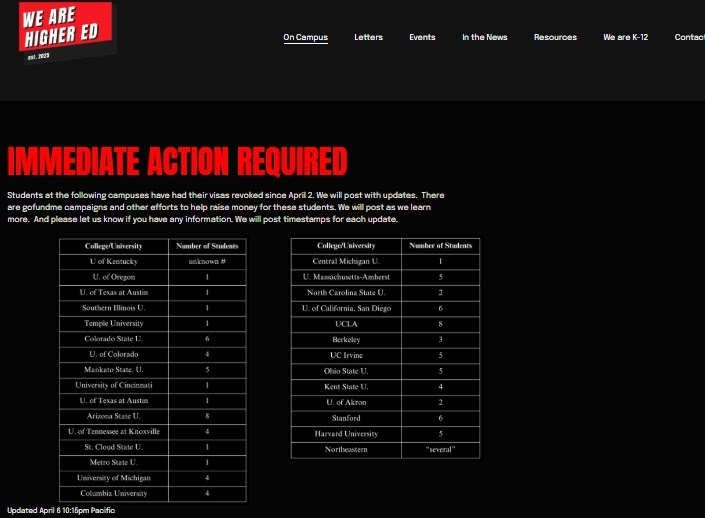
     Reports have surfaced of a significant increase in the number of international student visas being revoked and students being detained across various universities in the United States. This follows heightened immigration scrutiny, particularly under the administration of Donald Trump. According to Senator Marco Rubio, more than 300 international student visas have been pulled in recent months, primarily targeting students involved in political activism or minor infractions. WeAreHigherEd has named 30 schools where students’ visas have been revoked. 

    Campus Abductions — We Are Higher Ed

    Key Universities Affected

    • University of California System (UCLA, UC San Diego, UC Berkeley):
      Universities within the University of California system, which hosts a large international student population, have reported multiple visa cancellations. These revocations have affected students involved in pro-Palestinian protests, political activism, or perceived violations of U.S. immigration policies. For instance, the University of California has seen as many as 20 students affected in recent weeks.

    • Columbia University:
      At Columbia University, the case of Mahmoud Khalil, a student activist, has gained significant media attention. Khalil, who was detained and faced deportation, exemplifies the growing concerns over student rights and the growing impact of politically charged visa revocations.

    • Tufts University:
      Tufts University is currently battling the Trump administration over the case of Rümeysa Öztürk, a Turkish graduate student whose visa was revoked. Her detention and the ensuing legal battles highlight the growing tensions between academic freedom and government policy. Tufts and its student body are advocating for Öztürk’s release and seeking clarification on the legal processes involved.

    • University of Minnesota:
      At the University of Minnesota, one international graduate student was detained as part of an ongoing federal crackdown on visa violations. The U.S. Immigration and Customs Enforcement (ICE) actions continue to raise concerns over the rights of international students to remain in the country, especially as visa renewals and compliance checks become more stringent.

    • Arizona State University:
      Arizona State University has also reported incidents of international students having their visas revoked without prior notice. These revocations have affected students from various countries, creating uncertainty within the international student community at the university.

    • Cornell University:
      At Cornell University, international students have similarly faced unexpected visa cancellations. This has raised concerns about the ability of universities to adequately support their international student populations, as students are left to navigate the complexities of visa status without sufficient notice or explanation.

    • North Carolina State University:
      North Carolina State University is another institution where international students have had their visas revoked without notice. The university has expressed concern over the lack of clarity from immigration authorities, which has left students in a precarious situation.

    • University of Oregon:
      The University of Oregon has experienced several cases of international students having their visas revoked. This has been particularly troubling for students who were actively pursuing their education in the U.S. and now face the prospect of deportation or being forced to leave the country unexpectedly.

    • University of Texas:
      At the University of Texas, international students have faced visa issues, with several reports of revocations and detentions, affecting students who are working toward completing their degrees. This has sparked protests and advocacy efforts from both students and university administration, seeking more transparency in the process.

    • University of Colorado:
      The University of Colorado has similarly reported instances of international student visa revocations, particularly affecting those involved in political activism. The university has been working to support students impacted by these actions, although many are left in limbo regarding their ability to continue their studies.

    • University of Michigan:
      The University of Michigan has also been impacted by a wave of visa revocations. Similar to other institutions, students involved in political protests or activism have found themselves under scrutiny, facing the risk of detention or deportation. Students, faculty, and staff are pushing for clearer policies and legal protections to support international students, who are increasingly at risk due to the political environment.

    The Broader Implications

    These incidents of visa revocation and detentions are seen as part of a broader trend of increasing immigration enforcement under the Trump administration. Critics argue that these actions infringe upon students’ rights, potentially violating freedom of speech and academic freedom. International students, especially those participating in protests or political discourse, have found themselves at risk of being detained or deported, with little prior notice or transparency regarding the reasons for such actions.

    Moreover, the economic impact of these actions is significant. In 2023, a record 253,355 student visa applications were denied, representing a 36% refusal rate. This has major implications not only for the affected students but also for U.S. universities that rely heavily on international students for tuition revenue. The financial loss could be as much as $7.6 billion in tuition fees and living expenses, further emphasizing the broader consequences of these policies.

    Legal and Administrative Responses

    Many universities are rallying behind their international student populations, with advocacy efforts from institutions like Tufts University and Columbia University. These universities have criticized the abruptness of the visa cancellations and detentions, calling for more transparency and due process.

    However, despite these efforts, the political climate surrounding U.S. immigration remains volatile, and it is unclear whether policy changes will result in more lenient or more restrictive measures for international students.

    Conclusion

    These stories underscore the fragile position of international students in the U.S. today. With incidents of detentions and visa revocations increasing, students face significant challenges navigating the complexities of U.S. immigration law, particularly those involved in political or activist circles. University administrations and students alike continue to call for clearer policies, protections for international student rights, and more transparent practices to avoid the unintended consequences of politically motivated visa actions.

    This issue remains ongoing, with much at stake for both 

    Source link

  • How Trump Is Wreaking Havoc on the Student Visa System

    How Trump Is Wreaking Havoc on the Student Visa System

    Last week, an international student adviser at a small regional college logged on to a private forum for international enrollment and admissions professionals, seeking advice on “something strange” she’d noticed.

    She had run a report on her Student Exchange and Visitor Information System database, where international student records are stored, after seeing troubling reports of foreign student deportations. When she got the results back, she found that a number of her students had had their legal residency status terminated without her knowledge.

    This is the third installment in an Inside Higher Ed series on international students under Trump. Read the first and second here.

    In the days since, nearly 100 other international student service professionals have piled onto the discussion thread to share similar stories: They trawled through SEVIS only to find unexpected visa revocations and had to quickly decide how to notify affected students.

    Inside Higher Ed obtained access to the forum but is keeping it and the identity of the officials posting there anonymous to ensure the privacy of the participants.

    Most of the officials on the forum reported an even more troubling detail: Students weren’t just having their visas revoked; they were losing their student status altogether.

    When international students have their entry visas revoked, they almost always retain their legal residency status in SEVIS, according to immigration lawyers. They can stay in the country as long as they remain enrolled in courses and must reapply for a new visa if they leave. Now, as the Trump administration revokes hundreds of student visas each week, federal immigration officials also seem to be terminating students’ SEVIS status—paving the way for arrest and deportation.

    One forum member asked how it was possible that Immigration and Customs Enforcement could alter SEVIS status on their own; they’d never seen it done before and thought it might be a mistake.

    “I’m just wondering if we have any recourse to request corrections,” they wrote. “Trying to think creatively (and maybe desperately) at this point.”

    University officials and immigration experts who spoke with Inside Higher Ed both on the record and on background echoed the concerns of the forum participants. They said the Trump administration is playing fast and loose with the visa system and that its tactics are severely limiting universities’ options to help students who may be targeted by ICE.

    The officials on the forum said affected students were almost all Middle Eastern—Turkish, Kuwaiti, Saudi, Iranian—or from majority-Muslim countries like Malaysia, Indonesia and Bangladesh. Some said they’d received letters with unusually forceful wording, demanding they turn over student records under threat of federal investigation. Many fretted over how to advise affected students without running afoul of immigration authorities themselves.

    They all worried about how best to protect students while adjusting to a visa system that appeared to be changing overnight into something unrecognizable.

    “Most of us are not practicing immigration attorneys (and haven’t needed to be),” one university official wrote. “We’re in a strange new world where little from past practice seems to apply.”

    ‘Strange New World’

    Some students have had their visas revoked due to criminal records, but many university officials report only minor infractions like traffic violations, some of them adjudicated years ago. Those without a criminal record are having their visas revoked largely under a specific clause in the Immigration and Nationality Act that gives the secretary of state personal power to determine if a student’s continued presence “would have potentially serious adverse foreign policy consequences.”

    That 35-year-old clause has almost never been invoked until now. In an amicus brief supporting a lawsuit filed by detained Columbia graduate Mahmoud Khalil, a group of immigration lawyers says they scoured court records and legal documents for precedents of the foreign policy risk clause being used to revoke student visas. Out of 11.7 million cases, they found it had been used only 15 times before this year and had only resulted in deportation four times.

    In an email to Inside Higher Ed, a State Department spokesperson confirmed that the “revocation of [a] student visa lead[s] to termination of their students status,” and that it’s up to ICE agents whether to notify universities of the change. They added that they don’t provide statistics on visa revocations, but that the “process is ongoing and the number of revocations is dynamic.”

    “The State Department revokes visas every day in order to secure America’s borders and keep our communities safe—and will continue to do so,” the spokesperson wrote.

    Clay Harmon, director of AIRC: The Association of International Enrollment Management, said he’s heard reports of abrupt visa revocations from members across the country, and that it’s disrupting international student service offices tasked with helping manage student visas.

    “Folks in the visa system are already strapped to meet current mandates,” he said. “Adding this arbitrary element into what has always been a very well-regulated system causes an undue and unfair burden on institutions.”

    Visa Vigilance

    Many international student support officials said they’ve recently made a habit of checking SEVIS daily for new terminations, especially after last week’s ramping up in international student deportations blindsided some college officials.

    When Tufts University doctoral student Rumeysa Ozturk was detained by ICE agents last week, not only were university officials unaware that her visa had been revoked, but her file in SEVIS still said she was “in good immigration standing,” according to a court motion filed by the university Wednesday night. Ozturk’s SEVIS file was only updated to reflect a termination of her status at 7:32 p.m., hours after she was abducted from the street outside her residence; university officials did not receive an email from ICE about the change in her status until 10:30 the next evening.

    A spokesperson for Minnesota State University at Mankato, where a student was detained by ICE agents last Friday, told Inside Higher Ed Wednesday that they hadn’t received any communication from immigration officials about the student whatsoever. And at the University of Minnesota’s flagship campus, a computer system did not show that Turkish graduate student Dogukan Gunaydin’s visa was revoked until several hours after he was taken into custody, according to a lawsuit Gunaydin filed Sunday.

    One university international affairs official, who asked to remain anonymous in order to speak freely about his experience, said he decided to check SEVIS last week after reading Secretary of State Marco Rubio’s announcement that the department had revoked 300 student visas last month. He was shocked to find that one of his students had not just their visa but also their legal status to remain in the country revoked, on the grounds they might be a foreign policy risk.

    The official, who has been working in the field for more than 40 years, said he’d never seen immigration services revoke a student’s SEVIS status before.

    “We usually check SEVIS once a semester … we don’t usually have to check statuses because we’re the ones who would change them,” the official said. “Now we are making a point to check thoroughly, every day. It’s the only way to protect our students.”

    The student had not been notified of their status termination before the university reached out and “had absolutely no idea” what could have precipitated the decision. They hadn’t participated in any campus protests or written op-eds and were hardly politically active. The only criminal infraction they remembered was running a stoplight.

    Stephen Yale-Loehr, a retired Cornell law professor who specializes in immigration law and student visas, said leaving university officials in the dark about changes to visa status “makes it difficult for colleges to advise their international students.”

    “The system works on communication going both ways between immigration officials and institutions,” he said. “The government doing things in secret makes it hard for both students and universities to know whether they are complying.”

    There’s a lot at stake in compliance for universities: The Trump administration has threatened to use the Student Exchange and Visitor Program, which normally investigates universities for visa fraud, to decertify colleges it believes have been harboring students they determine are threats to national security, according to an Axios report. Decertification would bar colleges from enrolling any international students at all.

    Harmon of AIRC said the political weaponization of SEVP would be unprecedented.

    “Their primary concern has been to verify that institutions are offering bona fide educational services and aren’t just diploma mills,” he said. “I’ve never heard of a fully accredited, reputable institution being subjected to some kind of investigation outside of the standard recertification process.”

    One student adviser wrote on the forum that they received a letter from the Department of Homeland Security demanding a number of international students’ records and threatening to revoke the college’s visa certification “without any chance of appeal” if they did not provide the records within five business days. Another said they’d gotten the same letter, but their deadline was just three business days.

    Some college officials say fear and caution make it hard to do all they can to help students.

    “Having to be so careful around actually protecting the student’s physical safety just feels … not good enough, frankly,” one adviser wrote. “It’s just very painful to have to tread so lightly when there is so much more at stake for them.”

    Scott Pollock, a veteran immigration lawyer who specializes in international educators and student visas, said that’s part of the Trump administration’s strategy.

    “The administration has been sowing terror in the hearts of international students. Now that’s spreading to school officials as well,” he said. “It’s all part of this revenge-driven policy.”

    This past week several international students who received visa revocations decided to leave the country voluntarily. Two Saudi students at North Carolina State University fled this week, as did a student at Temple University and a graduate student at Cornell University who is suing the Trump administration.

    Many more likely did the same without fanfare—including the anonymous university official’s student, who hopes to apply for re-entry as soon as they can.

    “It was not an easy decision for the student, and it was not an easy decision for us to help them make,” the official said. “But they thought it would be the least risky thing to do and give them the greatest opportunity to finish their degree, which was their priority.”

    “I really hope to see them back on campus in the fall.”

    Source link

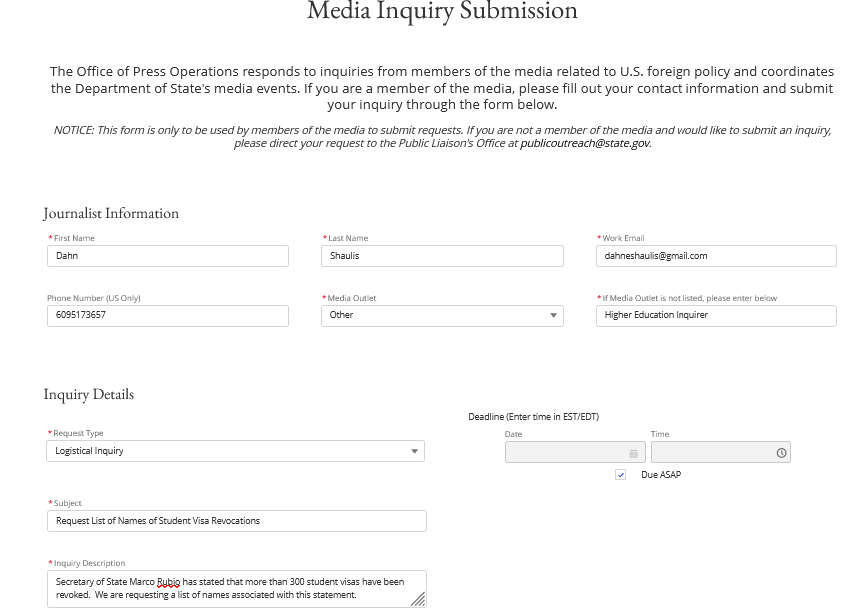
  • Higher Education Inquirer Asks State Department for List of Student Visa Revocations

    Higher Education Inquirer Asks State Department for List of Student Visa Revocations

    The Higher Education Inquirer (HEI) has requested a list of more than 300 students who have had their visas revoked.  The State Department has acknowledged receipt.  We hope other media outlets will follow suit.  At this point, we only know of a handful of these cases.  We will keep the public informed as this story develops. 


    Source link

  • Student visa numbers hit record despite Australian clampdown

    Student visa numbers hit record despite Australian clampdown

    Student visa issuances reached record levels in Australia late last year, suggesting that 12 months of policy upheaval have failed to suppress international education flows ahead of a federal election likely to be fought on migration.

    Visa grants to would-be university students applying from overseas reached an all-time high of almost 17,000 in November, the latest month for which Department of Home Affairs statistics are available.

    Monthly issuances have been at or near record levels since mid-2024, well exceeding pre-pandemic tallies and driving a surge in overall foreign student numbers. Higher education typically accounts for two-thirds or more of student visa recipients.

    The figures show that student flows have weathered some 10 separate policy changes unleashed to dampen overseas enrollments since December 2023. They include increased financial capacity requirements on applicants, a doubling of visa fees and a chaotic reprioritization of visa processing that has been blamed for soaring delays and refusals.

    The opposition Liberal Party, which is due to contest a general election by mid-May, has repeatedly berated the Labor government over student volumes since Australia’s post-pandemic reopening of its borders. The surge in student numbers, initially spurred by policies enacted by the opposition when it was in government, has been blamed for housing shortages.

    Liberal leader Peter Dutton promised “stricter caps on foreign students to relieve stress on city rental markets” during an election campaign rally on Jan. 12.

    While treasurer Jim Chalmers has attributed Australia’s lofty migrant tally to low departures rather than high arrivals, the latest statistics suggest both are contributing. And the figures do not include record numbers of applicants fighting to have their visa rejections overturned.

    The Sydney Morning Herald reported that the backlog of international students contesting their visa refusals in the Administrative Appeals Tribunal had doubled in five months to exceed 20,000 for the first time, and that two-thirds of visa rejections were being overturned by the tribunal.

    Meanwhile, overseas students are pursuing strategies to extend their time in Australia, including starting new courses or applying for asylum. Immigration expert Abul Rizvi said the tally of onshore student visa applicants had blown out to more than 100,000.

    Home Affairs data provided to a Senate inquiry in October showed that a long-term monthly average of about 300 asylum applications from overseas students had increased to about 450 since mid-2024, reaching 516 by August—the highest figure in at least five years, and probably since the 1989 Tiananmen Square massacre.

    Student visa grants could also increase following the late-December replacement of the controversial ministerial direction 107, which slowed down the processing of many visa applications, with ministerial direction 111.

    International education consultant Dirk Mulder said opinion on the new arrangements was divided, with some operators saying visa processing had sped up while others complained that it was slower than a year ago.

    Both camps expressed concern about the likelihood of further policy changes and the fate of institutions that had reached their “thresholds”—80 percent of the formerly announced international student caps, the trigger point for slower visa processing.

    One worry was that agents might stop referring students to universities and colleges in this position. “There is a large amount of angst as to how recruitment partners will work amongst institutions when they hit their 80 percent threshold,” Mulder wrote on his Koala news site.

    Source link