Tag: visas

  • Trump administration proposes 4-year cap on international student visas

    Trump administration proposes 4-year cap on international student visas

    This audio is auto-generated. Please let us know if you have feedback.

    Dive Brief:

    • The Trump administration on Thursday proposed capping the length of time international students can stay in the U.S. at four years, regardless of the length of their studies, per a plan published in the Federal Register
    • International student visas, known as F visas, typically allows them to stay in the U.S. for as long as it takes to finish their programs. Bachelor’s and master’s degrees are typically designed to be completed in four years or less, but many Ph.D. programs tend to run longer.
    • The new rule would also affect J visas, which cover certain international students, as well as short-term college instructors and researchers. If finalized, holders of both types of visas would need to apply for extensions and undergo “regular assessments” by the U.S. Department of Homeland Security to stay in the country after four years.

    Dive Insight:

    Restricting the flow of noncitizens into the U.S. — international students included — is not a new focus for the Trump administration. During the last year of President Donald Trump’s first term, the agencies proposed the same cap on F and J visas. The Biden administration withdrew the proposal the following year.

    DHS and U.S. Immigration and Customs Enforcement argued Thursday that neither program gives federal authorities enough oversight over how long visa holders remain in the country.

    In the proposed rule, the agencies alleged that the lack of a fixed end date for F and J visas incentivizes fraud, and DHS said it has identified “many examples of students and exchange visitors staying for decades.” As of April, over 2,100 international students who first entered the country between 2000 and 2010 still hold an active F visa, DHS said.

    That’s a tiny share of the total number of international students the U.S. hosts. In 2023 alone, more than 1.6 million people entered the U.S. through F visas, according to DHS data. Over 500,000 people entered via J visas that year.

    A DHS spokesperson on Wednesday accused international students of “posing safety risks” and “disadvantaging U.S. citizens” — and accused past administrations of allowing them to stay in the country “virtually indefinitely.”

    “This new proposed rule would end that abuse once and for all by limiting the amount of time certain visa holders are allowed to remain in the U.S., easing the burden on the federal government to properly oversee foreign students and their history,” the spokesperson said in a statement.

    The proposal would also prohibit graduate students on F-1 visas from transferring to other institutions or “changing educational objectives,” along with adding similar restrictions for first-year students.

    Student advocates quickly panned the Trump administration’s plan, saying it would increase bureaucratic backlogs, deter international students from attending U.S. colleges and harm the country’s advancement. 

    Fanta Aw, CEO and executive director of NAFSA: Association of International Educators, said Wednesday that the change would also give federal agencies oversight over decisions that “have long been the domain of academia.”

    “This proposal will only increase the degree of government oversight without any evidence that the changes would solve any of the real problems that exist in our outdated immigration system,” Aw said in a statement.

    Aw also decried the proposal as a poorly considered draft that represents a “dangerous overreach by government into academia.”

    “These changes will only serve to force aspiring students and scholars into a sea of administrative delays at best, and at worst, into unlawful presence status — leaving them vulnerable to punitive actions through no fault of their own,” she said.

    Miriam Feldblum, president and CEO of the Presidents’ Alliance on Higher Education and Immigration, called the proposed rule an “unnecessary and counterproductive action.”

    She emphasized the increased paperwork and bureaucratic hurdles it would require of international students.

    “The rule would force them to regularly and unnecessarily submit additional applications to be able to stay in the country and fulfill requirements of their academic programs, imposing significant burdens on students, colleges and universities, and federal agencies alike,” Feldblum said in a Wednesday statement.

    Both Feldblum and Aw noted that international students are already one of the most closely monitored groups in the U.S.

    The DHS spokesperson on Wednesday also alleged that international students cost an “untold amount of taxpayer money.”

    Yet foreign students are often a financial boon for colleges — especially tuition-dependent ones — as they are more likely than U.S. residents to pay an institution’s full sticker price.

    In 2023, international college students contributed more than $50 billion to the U.S. economy, according to the U.S. Department of Commerce. 

    The proposal from DHS and ICE is open for public comment through Sept. 29.

    Source link

  • 6,000 Student Visas Revoked

    6,000 Student Visas Revoked

    Photo illustration by Justin Morrison/Inside Higher Ed | gradisca and Uladzimir Zuyeu/iStock/Getty Images

    The State Department has revoked 6,000 student visas so far this year, Fox News reported along with The Washington Post.

    Of that group, 4,000 were revoked due to crimes, including assault, driving under the influence and burglary. However, a department spokesperson told the Post that the students whose visas had been revoked “either faced arrest or charges,” but the spokesperson didn’t specify whether they were convicted.

    The spokesperson also said that between 200 and 300 visas were revoked due to “support for terrorism.” President Donald Trump has previously labeled pro-Palestinian student protesters as terrorist sympathizers and has targeted international students over their pro-Palestinian activism.

    The Post article does not address whether these students will have to stop their studies and leave the U.S. A visa—the stamp that permits an individual to enter the U.S.—is different from one’s nonimmigrant status, which refers to whether they are lawfully in the country, something immigration experts stressed amid a slew of student visa revocations in March and April.

    Source link

  • State Department has revoked over 6,000 student visas this year

    State Department has revoked over 6,000 student visas this year

    This audio is auto-generated. Please let us know if you have feedback.

    Dive Brief: 

    • The U.S. Department of State has so far revoked over 6,000 international student visas in 2025 over allegations that the students had overstayed their visas or broken laws, an agency spokesperson said via email Tuesday. 
    • The spokesperson attributed about 4,000 of the visa revocations to law violations, such as alleged support for terrorism, assault, driving under the influence, and burglary. 
    • The Trump administration’s attacks on international students have contributed uncertainty to the higher education landscape. International enrollment could plummet by 150,000 students this fall, which would amount to a 15% overall decline, according to a recent analysis from NAFSA: Association of International Educators. 

    Dive Insight: 

    The State Department’s news, which was first reported by Fox News, suggests that the Trump administration is continuing to use an arsenal of tactics against international students, including revoking their visas over claims they support terrorist groups. 

    Those allegations have been at the heart of several high-profile cases where the Trump administration has sought to deport international students or green card holders. The U.S. Department of Homeland Security, for instance, claimed that Tufts University doctoral student Rümeysa Öztürk had engaged in activities “in support of Hamas” when the administration detained her and sought her deportation in March. 

    However, the State Department had determined days before she was detained that the government lacked evidence that she had made public statements in support of a terrorist group, The Washington Post reported in April. 

    In a May court ruling, a federal judge said the only specific reason DHS cited to justify Öztürk’s detention was her co-byline on a student newspaper op-ed. The piece criticized Tufts’ administration over its response to student government resolutions for the institution to divest from Israel and “acknowledge the Palestinian genocide.”

    Öztürk, who has not been charged with a crime, was released in May while her case proceeds. 

    The State Department spokesperson said the agency has revoked roughly 200 to 300 student visas over terrorism-related claims. The spokesperson said the actions were taken under a section of the Immigration and Nationality Act that bars people from receiving visas if they have engaged in or support terrorist activities. 

    The spokesperson did not immediately reply to questions asking for further details about the terrorism-related allegations or whether the students who faced visa revocations were convicted of the alleged crimes. 

    The Foundation for Individual Rights and Expression filed a lawsuit against the Trump administration earlier this month over its use of the Immigration and Nationality Act to attempt to deport student visa holders. The complaint alleges that the federal government has infringed on students’ First Amendment and due process rights by using the statute to target their speech. 

    The Trump administration has taken other actions to tighten international student enrollment as well. For one, a State Department policy announced June 18 requires student visa applicants to make their social media accounts public so government agents can review them.

    Consular officers have been asked to review the profiles for “hostile attitudes” toward the U.S. — a vague mandate that “creates significant discretionary power in visa determinations that will no doubt lead to inconsistencies in implementation,” according to a June post from NAFSA.

    Source link

  • “Fix issue with Indian student visas”

    “Fix issue with Indian student visas”

    As student visa backlogs continue to plague US embassies around the world and the start of the fall semester looms, a bipartisan group of 14 lawmakers have urged the US state department to resolve issues with Indian student visas.  

    “As members of Congress who represent research universities, we are concerned by reports from our constituent universities about Indian students who have been unable to obtain visas to continue their education in the United States,” they urged Rubio. 

    Indian students, the largest group of international students in the US, contribute $9 billion annually to the US economy, added the lawmakers, led by Democratic congresswoman Deborah Ross of North Carolina.  

    In a letter sent to the State Department on July 24, the group said they had seen “first-hand” how the contributions of Indian students to science and research “keep our nation competitive”. 

    “We are dismayed at the possibility that many of these bright young individuals may be blocked… from continuing their education and research in the United States,” they continued.  

    Thirteen of the letter’s 14 signatories are member of the Democratic party, with Nebraska representative Don Bacon the only Republican to join the efforts.  

    With classes starting in just over a month, thousands of students… are at risk of missing the start of the academic year

    The letter follows a near four-week suspension of student visa appointments by the state department that began during the peak season for visa processing, causing continued backlogs that remain nearly one month on from the lifting of the freeze. 

    Though backlogs are impacting students across the globe, the congresspeople raised particular concerns about delays at Indian embassies, with the Indian mission website still carrying a warning that the scheduling of visa appointments this summer cannot be guaranteed.   

    The Indian Ministry of External Affairs (MEA) is understood to have taken the matter up with the US Embassy in New Delhi as well as the US State Department, with news of the delays being widely circulated by Indian media.  

    As previously reported by The PIE News, some Indian education consultancies are expecting 80% declines in student levels going to the US, reporting that students are “refreshing their portal everyday” in search of appointments.  

    The largest source market to the US, visa issuance to Indian students saw a notable drop this May, falling by 41% compared to the same period in 2025, with stakeholders fearing that June data will reveal a worsening picture as the full impact of the visa pause takes hold.  

    Across the board, May 2024 data showed a 22% year-on-year reduction in the number of F-1 visas issued. Exchange visitor visas were also down 13%.  

    Appealing to Rubio, the congresspeople emphasised the integral contributions of Indian students to research universities in the US, as well as the wider value of educational exchange: “vital to encouraging collaboration between our nations”.  

    Advocacy efforts are also stepping up in the sector, led by the US for Success Coalition, a national alliance of more than 50 organisations spanning business, education and innovation.  

    “This delay and the resulting backlogs couldn’t have come at a worse time,” said Jill Welch, spokesperson for the coalition. 

    “With classes starting in just over a month, thousands of students – particularly from high-demand countries like India – are at risk of missing the start of the academic year,” Welch said.  

    The coalition highlighted the widespread consequences of the visa backlogs. If students are barred from entering the US, it could jeopardise the country’s position as the leading destination for global talent, with ripple effects touching local economies and long-term implications for scientific research. 

    “When we close doors – intentionally or by bureaucratic delay – we send a clear message to the world: that the US may longer be the destination of choice for the best and brightest,” it said. “That is not just a lost opportunity; it is a strategic risk”.  

    The alliance has called on the State Department to immediately “surge” resources to process new and returning international student visas and ensure there is interview capacity in high-demand countries.  

    Referring to Rubio’s new rules around social media vetting, it called on the department to prioritise both security and efficiency, “so that screening processes do not become barriers to opportunity”. 

    “For every three international students, one US job is created or sustained,” said the coalition, citing their annual economic contribution of nearly $44bn annually.  

    What’s more, “they are ambassadors of democracy and American values creating allyship between the United States and other countries,” they said, highlighting the value of people-to-people exchanges in ensuring the country’s national security. 

    The increasingly challenging visa policy landscape is already having an impact on student interest, with young people increasingly turning to other destinations, namely the UK.  

    Sector leaders are calling for “immediate action” to prevent the worst damages while there is still time before the full extent of declines become clear in September.  

    Source link

  • Week in review: Trump administration targets Chinese student visas

    Week in review: Trump administration targets Chinese student visas

    Most clicked-on story from last week: 

    House Republicans passed — by one vote — a massive spending bill backed by President Donald Trump with heavy implications for higher education. Among other proposals, it would raise and expand the endowment tax, introduce a risk-sharing program that would put colleges on the hook for unpaid student debt, nix subsidized loans and narrow eligibility for Pell Grants. Many expect the Senate to make changes to the bill.

    Number of the week


    7

    That’s how many regional branch campuses Pennsylvania State University is set to close after a 25-8 vote by its trustee board. The plan will pare down the university’s commonwealth campuses to 13 to cope with demographic declines and budget pressure. Detractors said the decision was made too hastily, ignored some campuses’ recent progress and could hurt the state’s rural areas.

    Trump administration updates:

    • The Trump administration aims to “aggressively revoke visas for Chinese students” while ramping up scrutiny and changing criteria for student visa applications from China and Hong Kong, U.S. Secretary of State Marco Rubio said Wednesday. With nearly 278,000 students from China studying in the U.S. during the 2023-24 academic year, the move could have a steep impact on U.S. colleges.
    • Sixteen states sued the National Science Foundation over the agency’s 15% cap on indirect research costs and its mass termination of grants related to diversity, equity and other topics. The states’ colleges “will not be able to maintain essential research infrastructure and will be forced to significantly scale back or halt research, abandon numerous projects, and lay off staff,” plaintiffs said in their complaint. 
    • The Trump administration plans to cut Harvard University’s remaining federal contracts, amounting to about $100 million. An official with the U.S. General Services Administration cited what he alleged was “Harvard’s lack of commitment to nondiscrimination and our national values and priorities.” The salvo is the latest in the federal government’s escalating battle with the Ivy League institution. 

    Texas legislators look to tighten control of colleges:

    • The Texas House approved a bill that would give the state’s regents — who are appointed by the governor — the power to recommend required courses at public colleges and to reject courses deemed too biased or ideological. Regents would also gain approval authority over the hiring of administrators. 
    • Another bill approved by the House would limit where and how students can protest on campuses. The Texas House and Senate are working to resolve their differences over the bill, according to The Texas Tribune. 

    Quote of the week:

    There’s a bit of anxiousness among accreditors and institutions and state legislators because of the uncertainty. Is it that they are intentionally being vague or general until they can work out all of the nuances of the policies that they want to implement? I can tell you, less is not more in this situation.”

    That’s Cynthia Jackson Hammond, president of the Council for Higher Education Accreditation, on the effects of Trump’s executive order on college accreditation.

    Source link

  • Australia poised to poach students, academics as Trump “aggressively revokes” Chinese visas – Campus Review

    Australia poised to poach students, academics as Trump “aggressively revokes” Chinese visas – Campus Review

    The future of Australians studying at American universities is in limbo after the Trump administration ordered a pause on new student visa approvals and is actively cancelling Chinese student visas.

    Please login below to view content or subscribe now.

    Membership Login

    Source link

  • After a Dip in 2024, are UK International Student Visas Poised to Return to their Previous Peak?

    After a Dip in 2024, are UK International Student Visas Poised to Return to their Previous Peak?

    Policy changes in 2024 reshaped the UK’s international education landscape, leading to significant shifts in student mobility. The Sunak government’s restrictions on student dependents immediately impacted applicants from key source markets where family migration is a priority. At the same time, rising fees and uncertainty around the Graduate Route (now resolved) added further pressure that dampened demand.

    Main Applicant Demand Declined by 12% in 2024

    The UK has long been a leading destination for international students, with visa applications peaking in 2022 at nearly half a million main applicant submissions. This high point was partly driven by post-pandemic disruptions to global student mobility. Applications dipped slightly in 2023 as demand stabilised and the Sunak administration’s rhetoric signalled a less welcoming environment for non-EU students. By 2024, application volumes saw a sharp decline:

    More than 423,000 sponsored study visas for main applicant international students were processed in 2024. This represents a 12% decline from the previous year and a 15% drop from the 2022 high-point. While this drop was more mild than student visa decreases seen in other destinations in 2024, it still accounts for nearly 60,000 fewer processed applications in a single year.

    Withdrawn applications further reflect softened student demand, likely influenced by policy changes. Nearly 6,600 prospective students withdrew their application in 2024, a 127% increase from the previous year. This followed a sharp rise in Q4 2023, when withdrawals spiked to 2,000—366% higher than Q4 2022. In short, after a wave of unwelcoming messaging from the Sunak administration in mid-to-late 2023, fewer international students applied, and withdrawals hit record highs.

    However, there are signs of possibly renewed student confidence. Nearly 63,000 UK study visa main applications were processed in Q4 2024. This represents a growth of 9% over Q4 2023.

    Demand Fell Most Sharply in Markets Where Students Commonly Travel With Family

    The most significant drops in UK study visa demand in 2024 came from countries where international students often apply with dependants:

    table visualization

    Main applicant numbers fell in 2024 across seven of the ten countries with the highest ratios of dependants to main students, underscoring the impact of the new restrictions. Yet not all high-dependant markets followed this trend. Applications from Nepal rose sharply, increasing by 61%, while volumes from Pakistan and Bangladesh held steady.

    Does this mean concerns about the new policy were overstated since not all high-ratio student populations saw declines? Not quite. The seven countries that experienced declining interest—Nigeria, Sri Lanka, Ghana, Iran, Afghanistan, Saudi Arabia, and India—accounted for seven of the eight largest main applicant declines last year, with Russia (-21%) slightly surpassing Saudi Arabia.

    Where Did Student Demand for a UK Study Visa Remain Resilient in 2024?

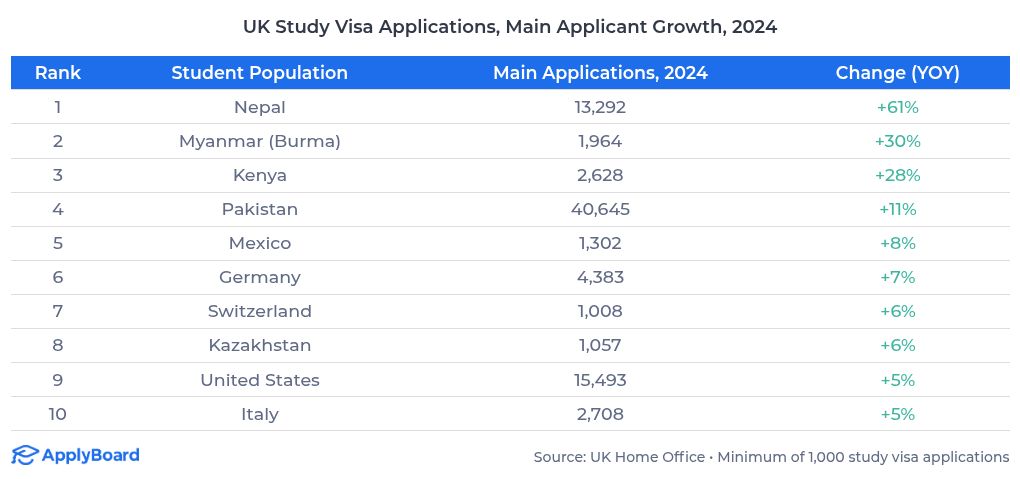
    Beyond these declines, which student populations showed increased demand in 2024? The table below highlights the top 10 student populations that saw growth in 2024:

    table visualization

    Nepal and Pakistan emerged as notable exceptions to the broader decline among countries with high dependant-to-student ratios—not just for bucking the trend, but for the scale of their growth. Nepal saw the sharpest year-over-year increase of any market in 2024, with main applicant volumes surging by 61%. Pakistan followed closely behind, ranking fourth overall with an 11% rise. Their resilience suggests that factors beyond dependant policies—such as economic conditions, domestic education capacity, and long-term aspirations for post-study work—continue to shape student decision-making.

    Beyond Nepal and Pakistan, growth was more geographically dispersed in 2024. Kenya and Myanmar (Burma) recorded some of the largest increases, signaling rising demand from parts of both Africa and Southeast Asia. Several European countries, including Germany, Switzerland, and Italy, also posted moderate gains. Meanwhile, the presence of Mexico and Kazakhstan among the top 10 growth markets highlights the increasingly global nature of student mobility to the UK.

    Just beyond the top 10, Kuwait and Turkey also recorded notable increases in main applicant volumes. As institutions navigate a shifting recruitment landscape, both countries may present important opportunities for future engagement and growth.

    Looking Ahead

    The UK’s international education sector faced considerable challenges in 2024, with policy changes reshaping student mobility patterns. At this stage—and despite calls from some in the sector—we don’t anticipate imminent steps to reverse the dependent policy, nor do we think it’s likely that the Government will opt to take international students out of the net migration figures. That said, we’ve already seen a much more positive message coming from the Government towards international students and we expect this to be sustained and reflected in the launch of the new International Education Strategy.

    It’s also important to note that the UK was not the only destination to experience softened student interest in 2024, as international education sectors in Canada, the US, and Australia all faced declines. Encouragingly for the UK, many institutions reported higher enrolments in this year’s January intake than in the same time last year, indicating positive momentum. Now is the time to build on that progress.

    To sustain this momentum, UK institutions will need to actively re-engage prospective students and rebuild confidence in key markets. Clear communication around post-study work opportunities, financial aid, and student support will be essential to reassuring applicants. At the same time, growing interest from countries such as Kenya, Myanmar, Kuwait, and Mexico presents an opportunity to strengthen recruitment efforts and establish a more diverse student base.

    Source link

  • List of Schools Where Student Visas Have Been Revoked Increases to 46. Arizona State Tops List.

    List of Schools Where Student Visas Have Been Revoked Increases to 46. Arizona State Tops List.

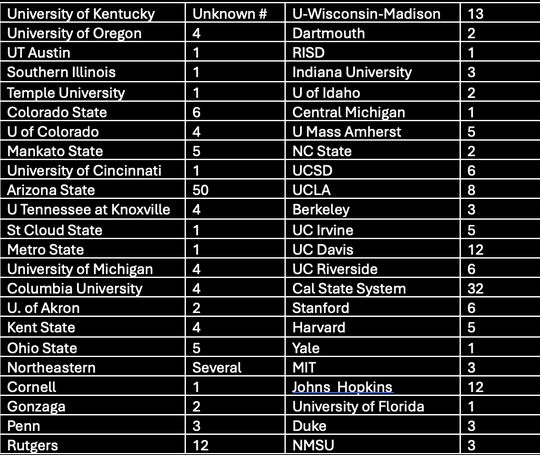
    According to WeAreHigherEd.org, there are now 46 schools where student visas have been revoked.  Arizona State tops the list at 50, followed by the University of Wisconsin-Madision (13), UC Davis (12), Rutgers (12), and Johns Hopkins (12) . The website includes profiles of a number of those students who have been detained. If you know of someone who has been abducted, you can report it here.

    Source link

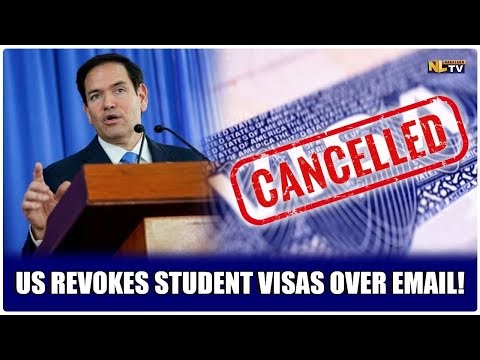
  • VISAS REVOKED OVER SOCIAL MEDIA POSTS! (NLTV)

    VISAS REVOKED OVER SOCIAL MEDIA POSTS! (NLTV)


    Hundreds of international students in the US have received emails from the Department of State (DOS) instructing them to self-deport after their F-1 visas were revoked due to campus activism or social media posts. This crackdown targets not just those who physically participated in activism, but also those who shared or liked ‘anti-national’ posts. Some Indian students may also be affected.
    The US Secretary of State, Marco Rubio, confirmed the visa revocations, stating that over 300 visas had been revoked for “anti-national activities.” He also launched an AI-powered app, “Catch and Revoke,” to identify and cancel visas of students supporting designated terrorist groups like Hamas. New student visa applications are also under scrutiny, with applicants potentially being denied entry.
    The email sent to affected students warns them to self-deport, stating their visas were revoked under Section 221(i) of the Immigration and Nationality Act. It also informs students that staying in the US without lawful status could lead to fines, detention, or deportation, and they would need to apply for a new visa to return in the future.

    Source link

  • Trump Administration Revokes 300 Student Visas, More to Come

    Trump Administration Revokes 300 Student Visas, More to Come

    The Trump administration has revoked more than 300 international students’ visas in the past three weeks, according to reporting from Axios

    Yesterday two Ph.D. students with revoked visas were detained by immigration agents and now await deportation: an Iranian student at the University of Alabama and a Turkish student at Tufts University in Massachusetts. 

    The Tufts student, Rumesya Ozturk, was abducted by plainclothes ICE agents on the street. At a press conference Thursday, U.S. secretary of state Marco Rubio said that any international student whose visa was revoked could be forcefully deported in such a manner. 

    “Once you’ve lost your visa, you’re no longer legally in the United States,” he said. “If you come to the U.S. as a visitor and create a ruckus for us, we don’t want it.”

    Axios also reported that the administration has discussed using a small arm of the Immigration and Customs Enforcement office to strip colleges they deem to be “pro-Hamas” of their ability to enroll international students.

    “You can have so many bad apples in one place that it leads to decertification of the school,” an unnamed White House official told Axios. “I don’t think we’re at that point yet. But it is not an empty threat.”

    The Student and Exchange Visitor Program normally investigates student visa fraud and international student recruiting practices, sometimes withdrawing colleges’ certification to enroll foreign students if there’s evidence that students are primarily enrolling as a pretext to reside and work in the U.S. instead of earn a degree. 

    Now, the SEVP may be tasked with a very different mandate: punishing colleges that have been the site of large pro-Palestine protests. 

    “What you’re going to see in the not-too-distant future is the universities … not doing anything to stop these demonstrations in support of Hamas … we can stop approving student visas for them,” a senior Justice Department official told Axios. “That’s one of their biggest cash cows, foreign students. That’s a meaningful source of revenue.” 

    Source link