Tag: vote

  • Kentucky lawmakers vote to ban DEI spending at public colleges

    Kentucky lawmakers vote to ban DEI spending at public colleges

    This audio is auto-generated. Please let us know if you have feedback.

    Dive Brief:

    • Kentucky lawmakers passed a bill Thursday that would prohibit public colleges from using any funds for diversity, equity and inclusion efforts, sending the bill to the governor’s desk. 
    • The state Senate passed the bill in a 32-6 vote Wednesday night, largely along party lines. House lawmakers gave the bill their final approval Thursday morning, according to local media. If signed into law, public colleges would have until the end of June to eliminate all DEI positions and offices.
    • Democrat Gov. Andy Beshear, who has previously opposed efforts to limit DEI at public colleges, said Thursday that he intends to closely review the bill but appeared skeptical. “We certainly don’t want to impact the flexibility of our universities” to recruit and retain diverse student bodies, he said. However, Republican lawmakers have a veto-proof legislative supermajority.

    Dive Insight:

    In addition to the ban on DEI spending, the bill seeks to limit the classes that colleges could require students to take. It would prohibit courses designed primarily “to indoctrinate participants with a discriminatory concept” and bar the Council on Postsecondary Education, Kentucky’s higher education coordinating board, from approving degree programs that require students to take such classes.

    The bill defines discriminatory concepts as those justifying or promoting “differential treatment or benefits conferred to individuals on the basis of religion, race, sex, color, or national origin.”

    The bill would also prohibit colleges from using diversity statements — descriptions of one’s experiences with and commitment to diverse student populations. And it would bar colleges from requiring employees or students to undergo diversity training.

    The legislation would exempt DEI training and programs required by federal and state law.

    Additionally, the bill requires state colleges to undergo audits every four years to prove they did not spend funds on DEI.

    State Sen. Stephen West, a Republican, said Wednesday that the legislation had been “fully vetted” and that every college that would be affected by the bill had the opportunity to submit input.

    In support of the bill, West, the chair of the Senate education committee, cited the U.S. Supreme Court’s 2023 decision banning race-conscious admissions practices.

    While the court’s ruling exclusively addressed admissions, West applied it to higher education more broadly — an interpretation also adopted by the U.S. Department of Education, and one that is becoming increasingly popular among conservative critics of DEI.

    Similarly, West raised a common criticism of college DEI — alleging that it holds White students responsible for a past in which they did not play a role. 

    He cited his youngest son during Wednesday’s hearing. “He’s responsible for himself and should not be made to feel less than, and this applies to every student, no matter what your race, creed, national origin, sex,” West said.

    Democratic State Sen. Keturah Herron pushed back against West’s argument.

    “I know that you said that you are not responsible for the sins of the past, and you’re not,” Herron told West on Wednesday. “You’re not responsible for the things that have happened to my mother or my life experiences either. However, you are responsible, and we are responsible — this whole body is responsible — for what we do today moving forward.”

    Student and faculty groups have also opposed the bill, saying it would eliminate grants and programs that are crucial to the success of students from underrepresented backgrounds.

    But even with Beshear’s anticipated veto, some Kentucky college leaders have been operating under the assumption that HB 4 — or a bill like it — would become law this year.

    The University of Kentucky dissolved its DEI center in August, with Northern Kentucky University doing the same shortly thereafter.

    At the time, Eli Capilouto, president of the University of Kentucky, said lawmakers signaled their intent to restrict diversity efforts, forcing his institution to prepare.

    “Kentucky legislators have made clear to me in our conversations that they are exploring these issues again as they prepare for the 2025 legislative session,” he said. “If we are to be a campus for everyone, we must demonstrate to ourselves and to those who support and invest in us our commitment to the idea that everyone belongs — both in what we say and in what we do.”

    Source link

  • Senate vote finalizes Linda McMahon as education secretary

    Senate vote finalizes Linda McMahon as education secretary

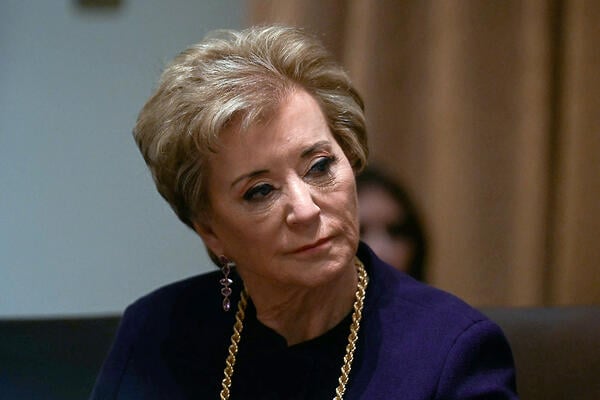
    Linda McMahon was narrowly confirmed along party lines as President Trump’s secretary of education in a 51-to-45 Senate vote late Monday afternoon and sworn in shortly after at the Department of Education building.

    All eyes are now on the White House as educators, policy experts and advocates anxiously wait to see if Trump will sign a controversial but highly anticipated executive order to abolish the very department McMahon has been confirmed to lead.

    The president and his allies have promoted the idea of dismantling the 45-year-old agency since the early days of his campaign for a second term, saying the department has grown too big and interferes in matters best left to local and state authorities.

    But the idea isn’t entirely new, nor would it be easy to implement. It would require legislative support, as the department’s existence is written into statute. Shuttering it would require a majority vote in both houses of Congress.

    “We can expect there to be a bit of a panic when the order comes out,” Emmanual Guillory, senior director of government relations at the American Council on Education, told Inside Higher Ed.

    It remains unclear to observers what mechanisms the Trump administration would use to close the department, however.

    “This will all depend on what dismantling the department truly means,” Guillory said. “I believe that the executive order would be somewhat broad, like we’ve seen [in the case of the diversity, equity and inclusion orders], and it will give the department the opportunity to refine the details.”

    Still, Trump has continued to promote the concept, and red states across the country have backed it. Chatter about the executive order began circling just days after he took office in January, and the plans were confirmed by multiple news sources in early February, though specifics were still unclear.

    Since the plans were leaked, Trump himself has publicly confirmed his intention to dismantle the department, although he did not disclose specific details on how he would do so.

    Guillory believes that much like when Republicans have tried to get rid of the department in the past, they will lack the congressional votes needed to officially do so. But Trump could keep the skeleton of the department and move its core functions elsewhere, he said.

    “Our thinking, because we’ve seen this before, is that likely a lot of the functionality of the department would get placed at other agencies, but we would be curious as to what functions would be terminated entirely,” he said. “That would cause the most concern for our members … Will those things simply be moved to another agency, or will some of those things not?”

    There are certain functions that are protected by the Higher Education Act of 1965, Guillory said. “The department legally would not necessarily be able to just terminate student aid programs, for example.” But he still worries the transition of oversight from one department to another may not be seamless.

    Shortly before the vote began on Monday, the Senate minority leader, Chuck Schumer of New York, made the Democrats’ stance on McMahon’s nomination clear.

    “Before colleagues vote on Linda McMahon’s nomination for secretary of education, they should remember a vote for Mrs. McMahon is a vote for draconian cuts to education … That’s why I am so proud that every Democrat will vote no,” he said.

    Other democratic lawmakers warned during floor comments on Thursday that McMahon’s confirmation, and the major department-level changes she’s backed, could risk the future of the department.

    Senator Gary Peters of Michigan said the country needs a secretary of education “who values and respects public education.”

    “Instead of working to protect funding,” he said, “she’s blatantly supported efforts to dismantle our education system.”

    For more background on what senators have said about McMahon, check out Inside Higher Ed’s live blog from her confirmation hearing, or read the five key takeaways.

    Senator Alex Padilla of California noted the cuts that have already been made to more than 100 departmental research contracts and countless nonpartisan career staff members.

    “They’re making it clear that this is just the beginning,” he said. “We could talk about Linda McMahon’s qualifications, or frankly lack thereof, but I’m not shocked, because President Trump isn’t looking for someone with the background or commitment to public education in America. He’s looking for someone to destroy it.”

    Although no Republicans commented Thursday, they voted unanimously to confirm McMahon in Monday’s vote (Republican senators Shelley Moore Capito of West Virginia and Cynthia Lummis of Wyoming were not present for the vote. Two Democrats were also absent). The majority leader, Senator John Thune of South Dakota, spoke in support of McMahon before the final confirmation.

    “Mrs. McMahon is an accomplished businesswoman and public servant,” he said. “I’m glad that Mrs. McMahon plans to work in a way that empowers those closest to the student, because they are in the best position to do what’s right for that student … I look forward to working with Mrs. McMahon to limit bureaucracy, empower state governments and let good teachers do what they’re best at.”

    Top Agenda Items

    Guillory expects McMahon to pick up accreditation policies as one of the first issues up for discussion.

    He also is expecting the new secretary to prioritize rethinking and potentially amending the financial value transparency and gainful-employment rule, a policy initiated by the Biden administration to better hold higher ed institutions accountable for students’ outcomes. A lawsuit was filed against the regulation in 2023, but federal judgment has been put on pause to allow the new administration’s Education Department to determine its position on the policy.

    It still remains unclear whether Trump will try to protect the gainful-employment rule or repeal it and drop the case, but Guillory has been encouraged by the line of communication between the department and higher ed leaders on the topic.

    “They’ve been really good about listening to and hearing from our members directly on some of the issues that they’ve experienced while they were reporting [financial transparency data] and they are really trying to get feedback on how can we make this better,” he said.

    Other topics of focus for McMahon will likely include expanded details on Trump’s enforcement of Title IX; his diversity, equity and inclusion orders; and the freeze of applications to income-driven repayment plans for student loans, Guillory said.


    Source link

  • Denied vote on pro-BDS resolution, MLA members protest

    Denied vote on pro-BDS resolution, MLA members protest

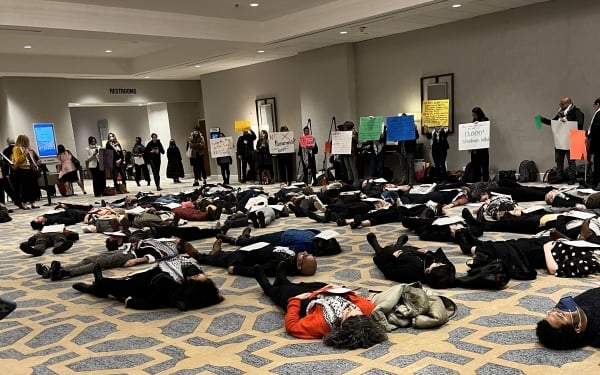
    A “die-in” protest at the MLA annual convention before Saturday’s Delegate Assembly meeting.

    As the Modern Language Association Delegate Assembly was beginning its meeting Saturday in New Orleans, audience members stood inside the hotel ballroom and chanted, “The more they try to silence us the louder we will be!” a video posted online shows. 

    The protesters, who made up a large number of the meeting’s attendees, read out a resolution endorsing the international boycott, divestment and sanctions movement against Israeli policy—the very resolution that the MLA’s elected Executive Council had blocked from going to the Delegate Assembly and the association’s full membership for a vote. Then the demonstrators walked out of the meeting. 

    It was one of multiple protests at this weekend’s annual MLA conference aimed at the Executive Council’s fall decision to reject the resolution without letting members vote on it.

    That resolution—like one that American Historical Association conference attendees overwhelmingly passed Jan. 5—also would have accused Israel of “scholasticide,” or the intentional eradication of an education system. But the AHA resolution didn’t endorse the BDS movement.  

    The demonstrations at the two conventions are the latest examples of scholarly associations and their members debating whether they should say anything as an organization about the ongoing war in Gaza at a time when politicians and people both inside and outside academe are criticizing scholars and institutions for expressing opinions on current events.  

    Anthony Alessandrini, an English professor at the City University of New York’s Kingsborough Community College, said he led a call and response demonstration. A few shouts of “Shame!” rang out.

    “Sometimes, this is what democracy looks like!” the demonstrators chanted in unison during the call and response. They raised hands or fists in the air, and some held signs that Alessandrini said bore the names of Palestinian academics killed in Gaza since October 2023. Protesters held a large banner that read, “MLA is Complicit in Genocide.”

    As they were walking out of the ballroom, protesters chanted “Free free Palestine!” and “You don’t have quorum!”—the minimum required numbers of attendees to conduct official business at a meeting. However, the MLA said quorum was maintained and the meeting continued.  

    The MLA Executive Council, an elected body, released a lengthy statement last month explaining its October decision to shoot down the resolution. The Council said it was concerned about “substantial” revenue loss if members endorsed the BDS movement, saying legal restrictions in many states on partnering with BDS-supporting organizations would end the MLA’s ability to contract with numerous colleges and universities and their libraries. It added that “some private institutions and major library consortia” also have such prohibitions.

    “Fully two-thirds of the operating budget of the MLA comes from sales of resources to universities and libraries, including the MLA International Bibliography,” the Council said.

    Dana Williams, president of the Executive Council and a professor of African-American literature at Howard University, told Inside Higher Ed Saturday that “the primary reason” for the council’s decision “was fiduciary.” But she also mentioned concerns about dividing the membership over endorsing the BDS movement, noting that “collegiality was one of many things that we were considering.”

    The Council’s statement in December suggested MLA members consider something short of endorsing the BDS movement. “Could not a motion calling for a statement protesting scholasticide in Gaza, while not focusing on BDS, be a powerful expression of solidarity?” it said.

    The fallout from the Executive Council’s decision included the resignation of two of its roughly 15 members, who were nearing the end of their terms. One was Esther Allen, a professor at the City University of New York’s Graduate Center and Baruch College.

    “The really don’t feel comfortable with any kind of member activism, they really don’t want it at all on any subject,” Allen told Inside Higher Ed.

    Williams said she supports members’ right to protest. “The association is the membership, we want to reiterate,” she said. What the members who walked out missed “was the one-hour open discussion [during the meeting] that … was really fruitful, thoughtful engagement with those delegates who were present that will inform the actions of the council going forward,” she added. The MLA didn’t provide a remote option for watching the meeting.

    The Council continues to believe that rejecting the resolution “was the right decision that would allow the association to continue to do its really important work to serve the members,” she said. “We had the benefit of a council that is bold enough and courageous enough to make very hard decisions.”

    MLA Members for Justice in Palestine is circulating a pledge for members to promise not to renew their memberships in protest. Alessandrini noted some other scholarly groups have endorsed the BDS movement.

    “My sort of forecast is a lot of people are going to move from organizations like the MLA and, I would add, the AHA [American Historical Association] if they don’t sort of endorse the will of the members—and towards the many organizations that have in fact taken the right stand,” he said. 

    Source link