Tag: Voting

  • Student Voting Advocates Say 2025 Brought “Trepidation”

    Student Voting Advocates Say 2025 Brought “Trepidation”

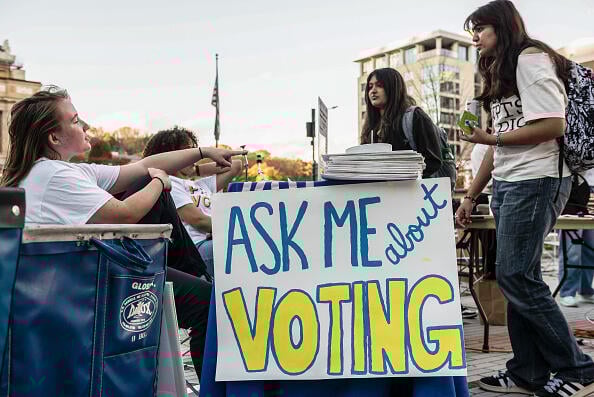
    Though 2025 featured few major elections, campus voter outreach organizations were still hard at work getting students interested in the electoral process and, in some cases, making them aware of local races. But some student voting advocates said that an increasingly fraught political environment and attacks on diversity, equity and inclusion have made campus outreach especially challenging this year.

    Clarissa Unger, co-founder and executive director of the Students Learn Students Vote Coalition, said in an interview that those challenges were a key theme of the annual National Student Vote Summit, held earlier this month at the University of Maryland.

    As part of the coalition’s goal of engaging 100 percent of student voters, SLSV and its campus partners have historically targeted specific demographic groups to ensure that their voter outreach message extends to all communities. But some organizations, including SLSV, have reported that the closure of campus diversity offices and crackdowns on cultural events and student organizations have made achieving that goal increasingly difficult.

    “If our partners are on campuses that have had restrictions around DEI activities, we’ve been just trying to support them in different ways that allow them to reach all students on their campuses,” said Unger. “In some cases, that might mean switching from working with some specific campus groups to trying to integrate voter registration into class registration processes or things like that.”

    These new challenges didn’t come out of nowhere. In some states, DEI offices, which sometimes partner with voter outreach organizations, have been under attack for multiple years now. Beyond that, some states have passed restrictive voting laws in recent years that could negatively impact college students; they include legislation that limits where and when individuals can vote, adds new identification requirements, restricts voter registration organizations, and more.

    The Trump administration added yet another roadblock for student voter outreach this summer when it announced, just weeks before the fall semester began for most institutions, that work-study funds could not be put toward jobs involving “partisan or nonpartisan voter registration, voter assistance at a polling place or through a voter hotline, or serving as a poll worker.” The move disrupted civic engagement offices on numerous campuses that rely on work-study students.

    These changes concern student voting advocates, who argue not only that it’s important for every citizen to exercise their right to vote, but also that voting in college is vital because it helps get students in the habit of voting for the rest of their lives.

    Wariness of Civic Engagement

    Sudhanshu Kaushik, executive director of the North American Association of Indian Students, has advocated for “cultural microtargeting” as a strategy for voter engagement, which he defined in a blog post as “the use of knowledge of cultural identities and culture-specific values, traditions, references, and language to tailor public messaging and boost civic engagement.” In the run-up to the 2024 election, that included tabling at a Diwali celebration and providing voting information in seven different languages.

    This year, though, he said this work was significantly more difficult because leaders of affinity groups are nervous about hosting cultural events, often out of fear that their institutions may face backlash from lawmakers and lose funding.

    “All identity-focused groups have been really, really wary about what they can and can’t be celebrating. ‘Can I celebrate Diwali? Can I celebrate Holi?’” he said. “I don’t think state governments or the federal government is out to stop Diwali celebrations; that’s not at all what the intent is. But I think when you’re a student, when you’re in a club, and you’re doing this—a lot of these people are careful in terms of what the impact might be.”

    That chilling effect is being felt by LGBTQ+ students as well, according to Isaac James, founder of the LGBTQ+ youth voter outreach organization OutVote. OutVote worked to mobilize LGBTQ+ voters in both Virginia and New Jersey during their recent gubernatorial elections.

    “There were multiple different communities … who expressed concern, fear and trepidation around engaging in the democratic process because of the anti-LGBTQ rhetoric that is being passed down through the federal government and state governments across the country,” he said. He cited anti-transgender advertisements from candidates in both states that “contributed to a culture of fear around the civic activity of young LGBTQ voters who felt directly targeted by that rhetoric, specifically young trans voters.”

    Naomi Barbour, vice chair and LGBTQIA+ representative for the student advisory board of the Campus Vote Project, the student voting arm of the voting rights nonprofit the Fair Elections Center, also noted that voter ID laws can negatively impact trans student voters, who might feel uneasy presenting an ID that lists a gender that doesn’t reflect how they identify.

    Some international students, alarmed by the Trump administration’s attacks on them, have also become wary of interacting with student voter outreach organizations, noted Kaushik, who presented on cultural microtargeting at the student voting summit. Historically, voter outreach organizations have tried to include those who can’t vote in their work in other ways, such as teaching them about the political processes in the U.S. or inviting them to do outreach work themselves.

    Alicia Vallette, the chair of the student advisory board for the Campus Vote Project, said that she sees that fear not as a simple side effect of today’s hostile political environment, but rather as a goal.

    “We’ve heard that students are wary of getting involved in nonpartisan political work and civic engagement work based on the current environment. A lot of this charged rhetoric is designed to foster fear and apprehension and to try to foster disengagement in the system itself,” she said.

    That’s why the Campus Vote Project and other voter outreach organizations now must work harder than ever to ensure students aren’t afraid to vote and engage in politics, she said. At the SLSV conference, Campus Vote Project advisory board members led an exercise to help other student organizers figure out how to reach students who aren’t already civically engaged; the organization is also advocating against the SAVE Act, federal legislation that aims to require proof of citizenship to vote. As the countdown to the 2026 midterms begins, student voting advocates continue to brainstorm ways to “combat apprehension and disengagement on campus,” Vallette said.

    Source link

  • What If We Ranked Colleges on Voting Rates?

    What If We Ranked Colleges on Voting Rates?

    Rating colleges against each other is a tricky enterprise on a good day. For community colleges it’s particularly vexed, given how intensely local they are and the simple fact that most of them don’t compete with each other. If, say, a community college in Illinois or Arizona does something terrific, I don’t feel threatened by it; our students in Pennsylvania aren’t going to move there in large numbers based on ratings.

    Still, the lure of lists is powerful. The new Carnegie classifications, as outlined by Inside Higher Ed, rate community colleges largely by the subsequent earnings of their students compared to local labor markets. The article outlines one key objection based on economic geography: In some parts of the country, the median wages and cost of living are so high that even students coming out of very successful vocational programs will struggle economically at first.

    It’s similar to the objection I noted a few years ago to the “social mobility” ratings that Washington Monthly offered, in which colleges were graded based on how many quartiles of income their students jumped. To score really well on that metric, you’d better have most of your students start in the bottom quartile. A college located in an area with more students in the second quartile simply couldn’t compete, no matter how well it did its job.

    The measurement error in this case is more well-meaning than in many others, but it’s still an error. And I’m still unconvinced that it adequately captures the value of students who transfer, whether with a degree or just with a bunch of classes.

    Presumably, those objections could be incorporated into a more refined effort. But even the objections implicitly concede that the only relevant scale on which to measure education is income. Postcollege income matters, of course, but it’s not the only thing that matters. If it were, we would stop training early-childhood teachers and social workers immediately.

    Part of the attraction of measuring income is that it’s quantifiable. Even I sometimes get twitchy when academics refer to the “ineffable” benefits of something; it can be hard to disentangle idealism from wishful thinking. But some noneconomic benefits of higher education are relatively easy to quantify in the short term.

    What if we measured colleges on the voting rates of new graduates?

    Voting is quantifiable, at least for now. It’s a basic form of adult civic engagement. It doesn’t rely on economic cycles that can wreak havoc with starting salaries. And we know from decades of political science that on average, people who vote are more knowledgeable about politics and social issues than people who don’t. (Contrary to popular myth, people who consistently vote a party line are more informed on average than ticket-splitters, but that’s another article.)

    Voting rates also wouldn’t be distorted by the low earnings of students who transferred and are in their junior or senior years of college when surveyed. Yes, voting rates are higher in presidential years, but presidential years happen at the same time for every college in the country, so they wouldn’t affect comparisons between institutions.

    If we took postgraduation voting rates seriously, colleges would be incentivized to improve the civic literacy and involvement of their students. That strikes me as an excellent outcome. That’s especially true for community colleges, given that their student bodies are much more representative of America than the elite selective universities.

    Community colleges train, yes, but they also educate. Why not educate for democracy? And why not support—with funding and publicity—the colleges that do a particularly good job of that?

    Source link

  • US students are voting with their feet – and global universities are ready

    US students are voting with their feet – and global universities are ready

    A record number of American students are applying to UK universities, with applications up nearly 14% over last year. The shift reflects something deeper than academic preference. It’s a response to uncertainty – political, cultural, and institutional – within the US higher education system.

    Students are assessing the climate as carefully as the curriculum, and for many, overseas options are starting to look more stable, more supportive, and more aligned with their values.

    For years, US institutions have concentrated on drawing international students into their classrooms and research labs. These efforts have been crucial to advancing STEM research, sustaining graduate-level enrolment, and feeding innovation pipelines. That trend continues, but the story is evolving.

    An outbound shift is now underway, with a growing number of American students pursuing degrees abroad. They’re no longer just participating in short-term exchanges or postgraduate fellowships, they’re committing to full undergraduate and master’s programs in other countries.

    This change matters – and it signals both a loss of tuition revenue and a weakening of domestic confidence in US higher education itself.

    Global competitors are moving decisively

    Universities in the UK, Canada, Australia, Germany, and the Netherlands have responded to this moment with strategy and urgency. They’ve expanded international recruitment offices, developed targeted campaigns for US students, and aligned their degree programs with global employment pathways.

    Tuition transparency, faster visa timelines, and the option to work post-graduation are all part of a larger value proposition. These countries have positioned themselves as predictable, inclusive, and serious about talent retention.

    When American students earn degrees abroad, they begin forming professional relationships, research collaborations, and employment ties in other countries

    The messaging stands in sharp contrast to the environment many students perceive at home in the US, where they’re regrettably familiar with ongoing threats to federal research funding, campus free speech tensions, and anti-immigrant rhetoric. Legislative actions in some states, such as restrictions on DEI programs or faculty tenure, further complicate the picture for students who see higher education as a place of openness and critical inquiry.

    Even where the academic offering remains strong, the broader social climate is giving students pause. Many now fear that attending university in the US could come with limitations on expression, uncertainty around institutional support, or even diminished international credibility. These concerns are pushing more prospective students, both international and domestic, to weigh their options with increasing care.

    The landscape is becoming borderless

    Higher education is no longer a domestically bounded experience. Today’s students are growing up in a digital-first world where comparison is constant and information is immediate. They can browse course catalogs from universities in five countries before lunch.

    They’re watching lectures on TikTok from professors in London, Melbourne, and Berlin. They’re discussing housing, scholarships, and career prospects with peers on Reddit, Discord, and WhatsApp. The idea of applying to college abroad no longer feels radical or risky – it feels strategic.

    At the same time, the financial argument for international study has grown stronger. In the UK and parts of Europe, undergraduate degrees often take three years instead of four. Tuition is fixed, predictable, and, in some cases, lower than the out-of-state rates at US public universities.

    Students can begin building global networks immediately, with exposure to cross-cultural collaboration built into the experience. That combination of efficiency, affordability, and international orientation is hard to ignore.

    Consequences will extend beyond enrollment trends

    If this shift continues, the implications go well beyond enrolment figures. When American students earn degrees abroad, they begin forming professional relationships, research collaborations, and employment ties in other countries. That international experience can strengthen global literacy, which is good in theory, but it may also weaken long-term institutional connections to the US – particularly if graduates choose to live, work, and innovate elsewhere.

    This becomes especially relevant in sectors where talent mobility drives economic growth. If a critical mass of globally minded US students pursue AI, climate tech, public health, or diplomacy degrees abroad and then launch their careers overseas, the domestic pipeline for advanced skills and leadership becomes harder to sustain. These are early signs of a broader trend, and we should treat them with urgency.

    The same applies to the soft power of US education. For decades, American universities have served as platforms for international exchange, not only bringing foreign students in, but equipping domestic students to become global ambassadors. If that dynamic begins to fade, so does the country’s influence in shaping global norms around research, ethics, and innovation.

    Prioritising stability and trust 

    Reversing this trend will require more than competitive admissions packages. US institutions – and the policymakers who shape their environment – must work to restore trust. That means safeguarding academic freedom, ensuring transparent financial support structures, and publicly affirming the value of international engagement.

    Students are listening closely. They are attuned to leadership choices and the broader societal signals surrounding higher education. If they sense instability or retreat, they will continue to look abroad.

    Universities also need to communicate more effectively with prospective students about their long-term value. That includes articulating what makes a US education distinctive, and doing so without leaning solely on prestige or nostalgia. There must be a renewed emphasis on civic purpose, global relevance, and practical opportunity. The next generation is looking for clarity, meaning, and alignment between their educational investment and the world they hope to shape.

    The US can lead again, if it chooses to

    The United States still possesses unmatched institutional capacity in research, innovation, and cultural reach. But influence is not a static asset. It depends on the willingness to adapt and lead with principle. The current wave of outbound student mobility should not be dismissed as an anomaly. It’s a signal. How US higher education responds – at both the institutional and national levels – will determine whether it remains a magnet for talent or becomes just one option among many.

    Source link

  • ED Clamps Down on Student Voting Work

    ED Clamps Down on Student Voting Work

    Aaron Jackendoff/SOPA Images/LightRocket via Getty Images

    The Department of Education released guidance Tuesday discouraging colleges from using Federal Work-Study funds to pay students to work on voter registration efforts and other activities it deems political.

    The department announced the change to work study provisions in a Dear Colleague letter signed by acting assistant ED secretary Christopher McCaghren.

    “Jobs involving partisan or nonpartisan voter registration, voter assistance at a polling place or through a voter hotline, or serving as a poll worker—whether this takes place on or off campus—involve political activity because these activities support the process of voting which is a quintessential political activity whereby voters formally support partisan or nonpartisan political candidates by casting ballots,” McCaghren wrote. 

    He emphasized in the letter that ED “encourages institutions to employ students in jobs that align with real-world work experience related to a student’s course of study whenever possible.” 

    Education Secretary Linda McMahon echoed that sentiment in a Tuesday social media post, writing that the department is “done funding political activism on college campuses!” She added, “Under the Trump Administration, taxpayer dollars will be used to prepare students for the workforce.”

    McCaghren’s letter also warned colleges about “aiding and abetting voter fraud.” 

    While institutions are required to make a “good faith effort to distribute voter registration forms to students,” they should refrain from distributing such materials to students they believe are ineligible to vote in state or federal elections, according to the letter.

    The move comes as President Donald Trump has announced plans to overhaul how elections are conducted before the upcoming midterms next year, including barring certain voting machines and mail-in voting, though he does not have the authority to make such changes.

    Source link