Tag: Wait

  • Widening participation cold spots: why we can’t afford to wait until they turn 16

    Widening participation cold spots: why we can’t afford to wait until they turn 16

    This blog was kindly authored by Dr Emily Magrath, Director of Programme Development and Impact at IntoUniversity.

    After fielding a flurry of questions from the classroom of 7 and 8 year olds – ‘what is my favourite colour?’, ‘Is this a university?’, ‘Do staff sleep in the building at night?’ – we settle together to explore the question: ‘what is a career?’ Today, this looks like high-vis jackets and hard hats for civil engineers to plan the needed infrastructure for a town; paleontologists codifying discovered fossils; and foley artists creating a soundscape for a forest epic. The students identify the skills they have used and tell me their many ambitions – the room includes possible footballers, doctors, engineers, nurses, lawyers, fashion designers, a taxi driver (like his dad) and a mathematician. This is a starting point, one which gives them years to think about their future possibilities and, more importantly, to build the knowledge and skills to make them future realities. 

    The potential for talent is everywhere

    Geography has become a primary driver of inequality in the UK. Despite initiatives to widen access to university and despite increases in higher education progression rates, areas remain where progression rates and education outcomes remain persistently and stubbornly low. As recently articulated by Alan Francis OBE, Chair of the Social Mobility Commission, this continues to ‘waste talent and limit potential’ across the UK. 

    Mounting evidence is stark in emphasising the particular challenges of these areas, so-called cold spots, which are, in reality, places systematically starved of opportunity with intersecting barriers: geographical isolation; lack of or expensive transport options; lack of teacher quality; and a lack of graduate jobs. Young people from disadvantaged backgrounds who want to pursue higher education in these locations face hard choices, often commuting to university, struggling to pursue their chosen career in their local area or having to leave it behind. It is not a surprise then to see the UPP Foundation’s inquiry on Higher Education attitudes in Doncaster this year determining that for many young people university is seen as a “bad bet.”

    In the face of these challenging intersections, starting widening participation work at 16 or 17, (or even 14 or 15) is too late. Interventions beginning at these points ultimately have failed many students in these regions – approaches must be anchored from primary age. 

    Why start at primary age?

    It is clear that students from disadvantaged backgrounds face additional educational barriers. Their starting point often shows significant gaps to more advantaged peers, and without intervention, these can become entrenched well before secondary school. In 2023, the Education Policy Institute estimated the disadvantage learning gap at age 5 to be 4.6 months. This was wider than it had been prior to the pandemic. Furthermore, in some areas of deprivation, 50% of young people begin school with delayed language development.

    There are no easy solutions, but earlier intervention is essential for building learning progress, fostering positive educational experiences and supporting students to acquire necessary qualifications for progression to higher education. 

    I would like to study accounting. I want to be rich and I love maths. I would like to study at Oxford university because it’s one of the best universities 

    Year 6 student, IntoUniversity

    Alongside academic development, the implicit and explicit messaging young people hear is key. Young people are full of aspirations, but they need to hear not only how to connect these to actual pathways, but also that they can achieve them. Otherwise, their beliefs can become fixed – often in early teenage years – that university is not for ‘people like them’.

    An antidote to this is to start conversations early and normalise university spaces. I have seen powerful examples of how sustained work can make a difference: a widening participation officer telling 10 and 11 year olds that the local university was “their university,’ they were welcome to ask questions and find out what happened there; seeing toddlers at ease climbing over benches in a lecture theatre at a family learning day; and the 18 year old who told me they just assumed they would go to the city’s university because ‘you took me there every year since I was little’. 

    Building place based ecosystems

    Just after the pandemic, I met a father photographing his son in a graduation gown and mortar board at one of our primary graduation trips to a university – the culmination of a programme where students have imagined a university future for themselves. He proudly showed me photos of his older children in previous years (fortuitously aged so that none had missed out during the pandemic). This engagement with the university was a touchstone for each child and for the family.

    The children go through the programme in Year 4, 5 and 6, and so they know it’s coming, and their siblings know it’s coming. They have an aspiration, and they know about what’s next. It’s a clear message for our school. Education is a journey, it continues in Secondary school and beyond and opens up opportunities. Because it is built into our curriculum, university feels like an entitlement for them. It is available for them.

    Primary School Headteacher about IntoUniversity primary school programme

    The recent Ruskin Institute for Social Equality’s report on coastal cold spots this year similarly emphasised geography’s critical role in higher education access. It showed that, accounting for similar backgrounds, young people can experience as much as a fivefold difference in their likelihood of progressing to HE based on where they live. The report argued that a move away from ‘collaborative, place-based, cross-sector approach’ to one emphasising individual universities’ targets has not served these areas well. 

    Consistent, long-term, sustained work from an early age is the only path forward when countering the entrenched challenges of cold spot areas. These are not challenges that can be solved by one intervention, one school, one charity or one university. Young people in these places need ecosystems of sustained support and opportunities available from an early age. That is how we can shift the dial on persistently low progression rates and ensure equitable access to higher education for all young people, regardless of where they live. 

    Source link

  • Don’t Wait for Permission to Write for the Public

    Don’t Wait for Permission to Write for the Public

    Welcome to the first installment of my monthly column, “The Public Scholar,” in which I invite academics and other experts to step forward—thoughtfully, clearly and with purpose—to help shape public conversations that matter. In this space, I’ll offer practical, field-tested strategies for turning academic expertise into public impact, including how to know if an idea is op-ed–worthy, how to turn a classroom anecdote into publishable prose, how to know when it’s time to query a literary agent about your book idea and more.

    I’m Susan D’Agostino, a mathematician whose stories have been published in The Atlantic, the BBC, Scientific American, The Washington Post, The Financial Times, Wired, Quanta and other leading publications. (You may recall that I wrote with some frequency about math and technology for Inside Higher Ed a couple of years ago.) My last book, How to Free Your Inner Mathematician (Oxford University Press, 2020), won the Mathematical Association of America’s Euler Book Prize for an exceptionally well-written book with a positive impact on the public’s view of math. My next book, How Math Will Save Your Life, to be published by W. W. Norton, makes the case for harnessing mathematical thinking in the face of personal and global crises.

    But none of that came easily or automatically. A decade ago, I was a tenured mathematics professor who had spent years honing proofs and lectures. Yet amid lagging public math literacy, I felt an unshakable urge to reach beyond the walls of academia and write for the public. Still, I hesitated. Was my voice or expertise welcome outside of peer-reviewed journals? Did I have the authority to write for readers I could not picture in a seminar room? Did I even know how?

    That transition—from academic to public scholar—was bumpy. I made mistakes. I received more rejections than I care to count. (Stay tuned for a future column about all those rejections!) I had to unlearn some academic habits and relearn how to communicate with clarity for broad audiences. But step by step, I found my way.

    You don’t need to leave higher ed to write for the public. And you certainly don’t need permission. Academia often trains scholars to seek approval—through grants, press offices and peer-reviewed publications. But the reality is that institutional support often follows after a scholar gains visibility. You already have the credentials to write for the public in your area of expertise. Now you need the courage and practical tips for doing so.

    Maybe you’re a historian who sees how your field illuminates today’s political divides. Or a scientist concerned about climate change, misinformation or public health. Or an artist reflecting on what the arts can—and do—offer society. Or a literary scholar exploring how stories shape our moral imaginations. Or an educator with hard-won insights into what learning looks like in today’s classrooms. If you feel the tug to engage beyond campus gates, this column is for you.

    Many academics assume that public writing takes time away from scholarship. But making your work accessible to a wide audience forces you to think harder, not less. How can you distill the central argument of your research so that an intelligent friend with no training in your field can understand? Why should they care? Honing translation skills is an art. Your goal is to show up with clarity and generosity.

    As a bonus, crafting the occasional op-ed can energize your research and teaching—not distract from it. You can clarify your ideas and receive real-time feedback on your argument and may even attract collaborators. Public writing can also be personally restorative. It reconnects you with the real-world questions that made you fall for your field. Your op-ed may even catch the eye of a literary agent or editor who’s interested in discussing book ideas. Also, your willingness to be a novice again may offer credibility among students, as that’s what many are wrestling with in your classroom.

    When I began writing in public-facing newspapers and magazines, I felt newly connected to issues that mattered beyond academia. While campus conversations are vital and intellectually rich, I found that engaging the broader public offered a different kind of clarity and urgency—to respond to a moment unfolding in real time and to make research relevant to people’s lives.

    Scholars across disciplines have watched with rising unease as the Trump administration has terminated research grants, dismissed government scientists without cause and wielded funding as a cudgel against universities. In this atmosphere, it can be tempting to self-censor or to wait for more hospitable times.

    But the cost of silence must be weighed against the consequences of inaction. Public conversations—about health care, history, science, democracy, libraries, public art and education—unfold every day, with or without scholars who can offer nuance, evidence and context.

    “Opinions are most malleable before they are fully formed,” wrote Lisa Fazio, a psychology professor at Vanderbilt whose federal grant for misinformation research was terminated. “We must not shy away from the spotlight.”

    Fazio’s warning is especially resonant now, as academics face mounting pressure from funding threats to political scrutiny. These pressures are real, and they are unevenly distributed. As University of Washington computer scientist Kate Starbird, also a target for her work on misinformation, told Science magazine, “I never had the option of keeping my head down.”

    And yet: Sharing knowledge, humanizing data and contextualizing history are profound acts of public service in consequential times. The OpEd Project puts it plainly: “If you say things of consequence, there may be consequences. The alternative is to be inconsequential.”

    Here’s some good news: Editors at newspapers and magazines want academic voices in the mix, and they’re often willing collaborators in helping your ideas rise above the noise. Editors want assurance that you are trained in your area of expertise, but they are less concerned with titles or tenure than your academic colleagues. Whether you’re a graduate student, an adjunct, new on the tenure track or a full professor, what matters is your voice, your argument and your ability to meet the moment.

    Ready to begin? Here are a few prompts to spark your first (or next) op-ed:

    • What’s one thing people misunderstand about your field, and why does it matter?
    • What recent news headline made you think, “If only they understood this about my field …?”
    • What conversation is already happening in the news, online or in your community that your research can help reframe, complicate or clarify?
    • What’s one counterintuitive idea from your work that could shift how people think?
    • Has your research or teaching ever changed how you see the world, and could it do the same for others?
    • Where is your field falling short in meeting a public need, and what would it take to change that?

    You don’t need to have all the answers. Often, a strong op-ed starts with one sharp insight, thoughtfully delivered and timed to the news cycle.

    Try drafting a few notes in your phone during your commute, between classes or even while multitasking in that faculty meeting (I won’t tell). Write as if you’re talking to a smart, curious friend. Make it clear, specific and real. Proofread like your reputation depends on it, because for the editor you’re pitching, it does. Make it short, too! Aim for 800 words max.

    And if you’d like more help along the way, sign up for my monthly newsletter. You’ll get notice of each new article in “The Public Scholar,” practical writing tips, behind-the-scenes insights from my work and inspiration from other academics finding their voice in public spaces. Your expertise is hard-won. What might happen if you shared what you know more broadly?

    Susan D’Agostino is a mathematician whose stories have been published in The Atlantic, the BBC, Scientific American, The Washington Post, Wired, The Financial Times, Quanta and other leading publications. Her last book, How to Free Your Inner Mathematician (Oxford University Press, 2020) won the Mathematical Association of America’s Euler Book Prize for an exceptionally well-written book with a positive impact on the public’s view of math. Her next book, How Math Will Save Your Life, will be published by W. W. Norton. She has been a journalism fellow at Oxford University’s Reuters Institute, Columbia University’s Graduate School of Journalism and the Mila-Quebec AI Institute. For notice of each new article in Susan’s Inside Higher Ed column, “The Public Scholar,” practical writing tips, behind-the-scenes insights from her work and inspiration from other academics finding their voice in public spaces, sign up for her free, monthly newsletter here.

    Source link

  • Why Teachers Can’t Afford to Wait on the Sidelines

    Why Teachers Can’t Afford to Wait on the Sidelines

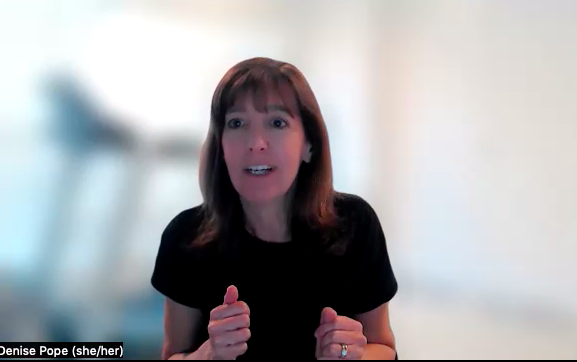
    Tired of talking about AI? That’s too bad. The technology remains the most impactful force in education. The challenge becomes avoiding all the Claptrap. Thankfully, that’s where Denise Pope, Co-Founder of Challenge Success at the Stanford Graduate School of Education, comes in.

    I had the chance to explore the current AI state-of-play from her perspective. One striking disparity I haven’t heard talked about: While AI usage among students has skyrocketed—from 25% to 60% at the middle school level and 45% to 75% at the high school level over just two school years—only 32% of teachers report using AI for academic purposes.

    This gap has created what Denise describes as an educational “La La Land,” where students are experimenting with AI tools while many schools lack clear policies or guidance. The absence of structured approaches is breeding anxiety among both educators and students, who are left wondering when and how AI should appropriately be used in academic settings.

    Click through to hear how Denise believes this issue can be addressed:

    Kevin Hogan
    Latest posts by Kevin Hogan (see all)

    Source link