Tag: warn

  • Democrats warn feds against selling student loans to private market

    Democrats warn feds against selling student loans to private market

    This audio is auto-generated. Please let us know if you have feedback.

    Dive Brief:

    • Over 40 Democratic lawmakers have called on the Trump administration to abandon reported talks about the possibility of selling off a chunk of the federal government’s $1.6 million student loan portfolio to the private market.
    • In a Sunday letter to U.S. Education Secretary Linda McMahon and Treasury Secretary Scott Bessent, the federal lawmakers warned transferring student debt ownership to the private sector could strip borrowers of legal protections and violate the law if the loans are sold at a loss to taxpayers.
    • “The federal government cannot simply eliminate its legal obligations to borrowers,” the members of Congress said. “Federal law requires that the protections guaranteed in the original terms of a borrower’s loan must be honored even if the Department of Education proceeds with a sale.”

    Dive Insight:

    The letter from Democrats — signed by U.S. Sens. Elizabeth Warren, Richard Blumenthal and Ron Wyden, among others — follows an October report from Politico about talks in the Trump administration that centered on a partial sale of the government’s student loans. 

    According to Politico, senior officials in the U.S. departments of Education and Treasury have recently discussed selling high-performing student loan debt to the private sector. 

    The administration has also broached the possibility with finance executives, among them potential buyers of the loans, and is considering bringing in consultants or banks to review the portfolio, the news outlet reported.

    In addition to calling for the Trump administration to cease any talks, the lawmakers requested detailed information on any potential plan and the names of those who have participated in any discussions. The Education and Treasury departments did not respond to requests for comment by publication time on Tuesday. 

    The Education Department’s Federal Student Aid office oversees the loan portfolio and contracts out servicing to private entities. Student loan receivables represent one of the largest assets on the nation’s balance sheet. 

    A 1998 law allows the government to sell student loan assets — so long as it is done at no cost to the government — which could be why no such sale has taken place to date. The Sunday letter said the first Trump administration mulled the possibility but never pursued it, pointing to Wall Street Journal reporting that the agency hired the consultancy McKinsey & Co. at the time to review the portfolio..

    The Democratic lawmakers and others have argued the no-cost provision means the government could not sell the loans for less than what it would collect if it kept them on the public balance sheet. 

    In 2024, FSA estimated the net value of the government’s student loan portfolio at about $1.1 trillion. However, a 2025 analysis from the Project on Predatory Student Lending argues this figure “is almost certainly wrong,” based on data and assumptions that “have proven wildly off-base.”

    That figure represents the government’s own valuation of the loan portfolio. In the case of a sale, the relevant figure would be the price a private sector buyer would be willing to pay. 

    The student lending project said the government has several advantages as a lender over private companies, including unlimited time to collect, the ability to withhold federal payments such as tax refunds to offset loan defaults, and immunity from legal liability for loan servicing failures. All of that means student loans are likely worth more to the government than to the private sector, according to PPSL. 

    Along with a potential loss to taxpayers, the Democratic lawmakers warned of the possible impact to student borrowers from transferring loan assets. 

    “By selling parts of the federal student loan portfolio, the Trump Administration may seek to unlawfully strip borrowers of their legally guaranteed protections,” they wrote. 

    The lawmakers pointed to protections such as income-driven repayment, public service loan forgiveness, disability and death discharges, and debt relief for those determined to have been defrauded by predatory colleges. 

    “Private lenders typically do not guarantee these kinds of borrower rights,” they wrote. “Profits would likely come at the expense of the borrower via fewer protections and less generous benefits. However, the federal government cannot simply eliminate its legal obligations to borrowers.”

    PPSL argued in its analysis that removing provisions for borrowers could make the loan portfolio more valuable to private buyers, but those loan provisions in contracts with the federal government represent property protected by the Fifth Amendment. 

    “Any law stripping repayment rights or other favorable terms from student loan contracts would potentially trigger an obligation to compensate student loan borrowers for the loss of those terms,” the organization said.

    Source link

  • Advocates warn of risks to higher ed data if Education Department is shuttered

    Advocates warn of risks to higher ed data if Education Department is shuttered

    by Jill Barshay, The Hechinger Report
    November 10, 2025

    Even with the government shut down, lots of people are thinking about how to reimagine federal education research. Public comments on how to reform the Institute of Education Sciences (IES), the Education Department’s research and statistics arm, were due on Oct. 15. A total of 434 suggestions were submitted, but no one can read them because the department isn’t allowed to post them publicly until the government reopens. (We know the number because the comment entry page has an automatic counter.)

    A complex numbers game 

    There’s broad agreement across the political spectrum that federal education statistics are essential. Even many critics of the Department of Education want its data collection efforts to survive — just somewhere else. Some have suggested moving the National Center for Education Statistics (NCES) to another agency, such as the Commerce Department, where the U.S. Census Bureau is housed.

    But Diane Cheng, vice president of policy at the Institute for Higher Education Policy, a nonprofit organization that advocates for increasing college access and improving graduation rates, warns that shifting NCES risks the quality and usefulness of higher education data. Any move would have to be done carefully, planning for future interagency coordination, she said.

    “Many of the federal data collections combine data from different sources within ED,” Cheng said, referring to the Education Department. “It has worked well to have everyone within the same agency.”

    Related: Our free weekly newsletter alerts you to what research says about schools and classrooms.

    She points to the College Scorecard, the website that lets families compare colleges by cost, student loan debt, graduation rates, and post-college earnings. It merges several data sources, including the Integrated Postsecondary Education Data System (IPEDS), run by NCES, and the National Student Loan Data System, housed in the Office of Federal Student Aid. Several other higher ed data collections on student aid and students’ pathways through college also merge data collected at the statistical unit with student aid figures. Splitting those across different agencies could make such collaboration far more difficult.

    “If those data are split across multiple federal agencies,” Cheng said, “there would likely be more bureaucratic hurdles required to combine the data.”

    Information sharing across federal agencies is notoriously cumbersome, the very problem that led to the creation of the Department of Homeland Security after 9/11.

    Hiring and $4.5 million in fresh research grants

    Even as the Trump administration publicly insists it intends to shutter the Department of Education, it is quietly rebuilding small parts of it behind the scenes.

    In September, the department posted eight new jobs to replace fired staff who oversaw the National Assessment of Educational Progress (NAEP), the biennial test of American students’ achievement. In November, it advertised four more openings for statisticians inside the Federal Student Aid Office. Still, nothing is expected to be quick or smooth. The government shutdown stalled hiring for the NAEP jobs, and now a new Trump administration directive to form hiring committees by Nov. 17 to approve and fill open positions may further delay these hires.

    At the same time, the demolition continues. Less than two weeks after the Oct. 1 government shutdown, 466 additional Education Department employees were terminated — on top of the roughly 2,000 lost since March 2025 through firings and voluntary departures. (The department employed about 4,000 at the start of the Trump administration.) A federal judge temporarily blocked these latest layoffs on Oct. 15.

    Related: Education Department takes a preliminary step toward revamping its research and statistics arm

    There are also other small new signs of life. On Sept. 30 — just before the shutdown — the department quietly awarded nine new research and development grants totaling $4.5 million. The grants, listed on the department’s website, are part of a new initiative called, “From Seedlings to Scale Grants Program” (S2S), launched by the Biden administration in August 2024 to test whether the Defense Department’s DARPA-style innovation model could work in education. DARPA, the Defense Advanced Research Projects Agency, invests in new technologies for national security. Its most celebrated project became the basis for the internet. 

    Each new project, mostly focused on AI-driven personalized learning, received $500,000 to produce early evidence of effectiveness. Recipients include universities, research organizations and ed tech firms. Projects that show promise could be eligible for future funding to scale up with more students.

    According to a person familiar with the program who spoke on background, the nine projects had been selected before President Donald Trump took office, but the formal awards were delayed amid the department’s upheaval. The Institute of Education Sciences — which lost roughly 90 percent of its staff — was one of the hardest hit divisions.

    Granted, $4.5 million is a rounding error compared with IES’s official annual budget of $800 million. Still, these are believed to be the first new federal education research grants of the Trump era and a faint signal that Washington may not be abandoning education innovation altogether.

    Contact staff writer Jill Barshay at 212-678-3595, jillbarshay.35 on Signal, or [email protected].

    This story about risks to federal education data was produced by The Hechinger Report, a nonprofit, independent news organization focused on inequality and innovation in education. Sign up for Proof Points and other Hechinger newsletters.

    This <a target=”_blank” href=”https://hechingerreport.org/proof-points-risks-higher-ed-data/”>article</a> first appeared on <a target=”_blank” href=”https://hechingerreport.org”>The Hechinger Report</a> and is republished here under a <a target=”_blank” href=”https://creativecommons.org/licenses/by-nc-nd/4.0/”>Creative Commons Attribution-NonCommercial-NoDerivatives 4.0 International License</a>.<img src=”https://i0.wp.com/hechingerreport.org/wp-content/uploads/2018/06/cropped-favicon.jpg?fit=150%2C150&amp;ssl=1″ style=”width:1em;height:1em;margin-left:10px;”>

    <img id=”republication-tracker-tool-source” src=”https://hechingerreport.org/?republication-pixel=true&post=113283&amp;ga4=G-03KPHXDF3H” style=”width:1px;height:1px;”><script> PARSELY = { autotrack: false, onload: function() { PARSELY.beacon.trackPageView({ url: “https://hechingerreport.org/proof-points-risks-higher-ed-data/”, urlref: window.location.href }); } } </script> <script id=”parsely-cfg” src=”//cdn.parsely.com/keys/hechingerreport.org/p.js”></script>

    Source link

  • ‘End of an era’: Experts warn research executive order could stifle scientific innovation

    ‘End of an era’: Experts warn research executive order could stifle scientific innovation

    An executive order that gives political appointees new oversight for the types of federal grants that are approved could undercut the foundation of scientific research in the U.S., research and higher education experts say. 

    President Donald Trump’s order, signed Aug. 7, directs political appointees at federal agencies to review grant awards to ensure they align with the administration’s “priorities and the national interest.

    These appointees are to avoid giving funding to several types of projects, including those that recognize sex beyond a male-female binary or initiatives that promote “anti-American values,” though the order doesn’t define what those values are.   

    The order effectively codifies the Trump administration’s moves to deny or suddenly terminate research grants that aren’t in line with its priorities, such as projects related to climate change, mRNA research, and diversity, equity and inclusion.

    The executive order’s mandates mark a big departure from norms before the second Trump administration. Previously, career experts provided oversight rather than political appointees and peer review was the core way to evaluate projects.

    Not surprisingly, the move has brought backlash from some quarters.

    The executive order runs counter to the core principle of funding projects based on scientific merit — an idea that has driven science policy in the U.S. since World War II, said Toby Smith, senior vice president for government relations and public policy at the Association of American Universities. 

    “It gives the authority to do what has been happening, which is to overrule peer-review through changes and political priorities,” said Smith. “This is really circumventing peer review in a way that’s not going to advance U.S. science and not be healthy for our country.”

    That could stifle scientific innovation. Trump’s order could prompt scientists to discard their research ideas, not enter the scientific research field or go to another country to complete their work, research experts say. 

    Ultimately, these policies could cause the U.S. to fall from being one of the top countries for scientific research to one near the bottom, said Michael Lubell, a physics professor at the City College of New York.

    “This is the end of an era,” said Lubell. “Even if things settle out, the damage has already been done.”

    A new approach to research oversight

    Under the order, senior political appointees or their designees will review new federal awards as well as ongoingl grants and terminate those that don’t align with the administration’s priorities.

    This policy is a far cry from the research and development strategy developed by Franklin D. Roosevelt’s administration at the end of World War II. Vannevar Bush, who headed the U.S. Office of Scientific Research and Development at the time, decided the U.S. needed a robust national program to fund research that would leave scientists to do their work free from political pressure. 

    Bush’s strategy involved some government oversight over research projects, but it tended to defer to the science community to decide which projects were most promising, Lubell said. 

    “That kind of approach has worked extremely well,” said Lubell. “We have had strong economic growth. We’re the No. 1 military in the world, our work in the scientific field, whether it’s medicine, or IT — we’re right at the forefront.”

    But Trump administration officials, through executive orders and in public hearings, have dismissed some federal research as misleading or unreliable — and portrayed the American scientific enterprise as one in crisis. 

    The Aug. 7 order cited a 2024 report from the U.S. Senate Commerce, Science, and Transportation Committee, led by its then-ranking member and current chairman, Sen. Ted Cruz, R-Texas, that alleged more than a quarter of National Science Foundation spending supported DEI and other “left-wing ideological crusades.” House Democrats, in a report released in April, characterized Cruz’s report as “a sloppy mess” that used flawed methodology and “McCarthyistic tactics.”

    Source link

  • As EPA pulls back, advocates warn it’s schoolchildren who face the steepest risks

    As EPA pulls back, advocates warn it’s schoolchildren who face the steepest risks

    This story was produced by Floodlight and republished with permission. 

    President Donald Trump and his administration have called it the “Great American Comeback.” But environmental advocates say the U.S. Environmental Protection Agency’s reversing course on enforcing air and water pollution laws is more of a throwback — one that will exacerbate health risks for children who live and study in the shadows of petrochemical facilities. 

    The American Lung Association has found that children face special risks from air pollution because their airways are smaller and still developing and because they breathe more rapidly and inhale more air relative to their size than do adults.

    Environmental lawyers say Trump and EPA Administrator Lee Zeldin’s slashing of federal protections against toxic emissions could lead to increased exposure to dangerous pollutants for kids living in fenceline communities.

    Community advocates like Kaitlyn Joshua, who was born and raised in the southeast corridor of Louisiana dubbed “Cancer Alley,” say they are horrified about what EPA’s deregulation push will mean for the future generation.  

    “That is not an exaggeration; we feel like we are suffocating without the cover and the oversight of the EPA,” Joshua said. “Without that, what can we really do? How can we really save ourselves? How can we really save our communities?” 

    Kaitlyn Joshua is a native of the southeast corridor of Louisiana dubbed “Cancer Alley,” and has spent the last few years leading the fight against a hydrogen and ammonia facility being built within 2,000 feet of an elementary school in Ascension Parish. Joshua says she is ‘horrified’ about the recent deregulation measures the U.S. Environmental Protection Agency recently announced for the petrochemical industry.
    Credit: Claire Bangser/Floodlight

    Ashley Gaignard knows how hard it is to keep kids safe when pollution is all around. 

    When Gaignard’s son was in elementary school, a doctor restricted him from daily recess, saying the emissions from an ammonia facility located within 2 miles of his playground could be exacerbating a pre-existing lung condition, triggering his severe asthma attacks. 

    “I had asthma as a kid growing up, and my grandfather had asthma, so I just figured it was hereditary; he was going to suffer with asthma,” said Gaignard, who was born and raised in Louisiana’s Ascension Parish, also located within Cancer Alley. She’s now chief executive officer of the community advocacy group she created, Rural Roots Louisiana

    “I just never knew until the doctor said, ‘Okay, we have to think about what he is breathing, and what’s causing him to flare up the minute he’s outside’,” she said. 

    Gaignard said the further her son got away from that school, as he moved through the parish’s educational system, the less severe his attacks were. She said he’s now an adult living in Fresno, California — and no longer suffers from asthma.

    Related: How colleges can become ‘living labs’ for fighting climate change

    Zeldin sent shockwaves throughout the environmental justice sector on March 12 when he announced that the EPA was rolling back many of the federal regulations that were put in place under the administration of Joe Biden — many built around environmental justice and mitigating climate change. 

    Those included strengthening the Clean Air Act by implementing more stringent controls on toxic air emissions and increased air quality monitoring in communities near industrial facilities. The new standards were expected to reduce 6,000 tons of air toxins annually and reduce the emissions related to cancer risks in these communities in Texas, Louisiana, Delaware, New Jersey, the Ohio River Valley and elsewhere. 

    A new memo from the Office of Enforcement and Compliance Assurance, which serves as the law enforcement arm of the EPA — circulated the same day as Zeldin’s announcement — states that environmental justice considerations would no longer factor into the federal agency’s oversight of facilities in Black and brown communities. 

    Zeldin said the goal was “driving a dagger straight into the heart of the climate change religion.”

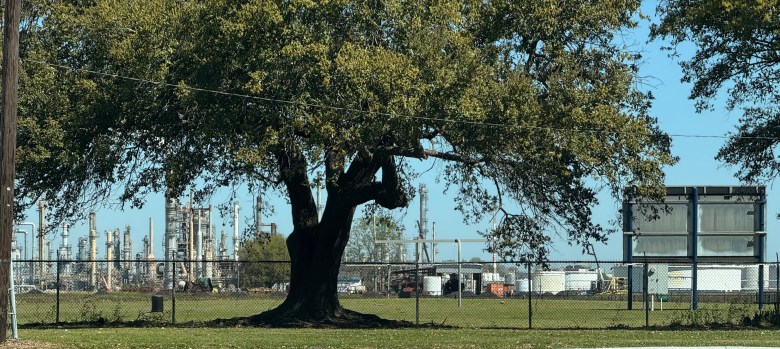
    Port Allen Middle School sits in the shadow of the Placid petrochemical refinery in West Baton Rouge Parish, La. A 2016 report found nearly one in 10 children in the U.S. attends one of the 12,000 schools located within 1 mile of a chemical facility, which for environmental advocates highlights the danger of the recently announced rollbacks of air and water pollution regulations by the U.S. Environmental Protection Agency. Credit: Terry L. Jones / Floodlight

    That means the EPA will no longer target, investigate or address noncompliance issues at facilities emitting cancer-causing chemicals such as benzene, ethylene oxide and formaldehyde in the places already overburdened with hazardous pollution. 

    “While enforcement and compliance assurance can continue to focus on areas with the highest levels of (hazardous air pollutants) affecting human health,” the memo reads, “…to ensure consistency with the President’s Executive Orders, they will no longer focus exclusively on communities selected by the regions as being ‘already highly burdened with pollution impacts.’”

    The agency also will not implement any enforcement and compliance actions that could shut down energy production or power generation “absent an imminent and substantial threat to human health.” 

    In is prepared video statement about the EPA’s deregulation measures, Zeldin said, “The agency is committed to fulfilling President Trump’s promise to unleash American energy, lower cost of living for Americans, revitalize the American auto industry, restore the rule of law, and give power back to states to make their own decisions. ”

    Related: How Trump is disrupting efforts by schools and colleges to combat climate change

    Top officials with the nonprofit environmental advocacy group Earthjustice recently said there is no way for the Trump administration to reconcile what it’s calling “the greatest day of deregulation” in EPA’s history with protecting public health. 

    Patrice Simms, vice president of litigation for healthy communities for Earthjustice, went a step further pointing out during a press briefing that the reason EPA exists is to protect the public from toxic air pollution. 

    “The law demands that EPA control these pollutants, and demands that EPA protect families and communities,” Simms said. “And these impacts on these communities most heavily land on the shoulders of children. Children are more susceptible to the harms from pollutants, and these pollutants are often happening right in the backyards of our schools, of our neighborhoods and our playgrounds.”

    A 2016 report published by the Center for Effective Government found that nearly one in 10 children in the country attends one of the 12,000 schools located within 1 mile of a chemical facility. These children are disproportionately children of color living in low-income areas, the report found. 

    For the past several years, Joshua has been leading the opposition to a hydrogen and ammonia facility being built within 2,000 feet of an elementary school in Ascension Parish. Air Products plans to start commercial operation in 2028 where an estimated 600,000 metric tons of hydrogen will be produced annually from methane gas.

    The $7 billion project has been touted as a clean energy solution because the company intends to use technology to collect its carbon dioxide emissions, and then transport them through pipelines to be stored under a recreational lake 37 miles away. 

    Carbon capture technology has been controversial, with skeptics highlighting the possibilities for earthquakes, groundwater contamination and CO2 leaking back into the atmosphere through abandoned and unplugged oil and gas wells or pipeline breaches. Pipeline ruptures in the past have also led to communities having to evacuate their homes. 

    Related: When a hurricane washes away a region’s child care system

    Joshua said these communities need more federal regulation and oversight — not less.

    “We had a community meeting … for our Ascension Parish residents, and the sentiment and the theme on that call was very much like ‘Kaitlyn, there is nothing we can do.’ Like, we just had to literally lie down and take this,” Joshua said. “We had to kind of challenge people and put them in the space, in time, of a civil rights movement. We have to get creative about how we’re going to organize around it and be our own version of EPA.”

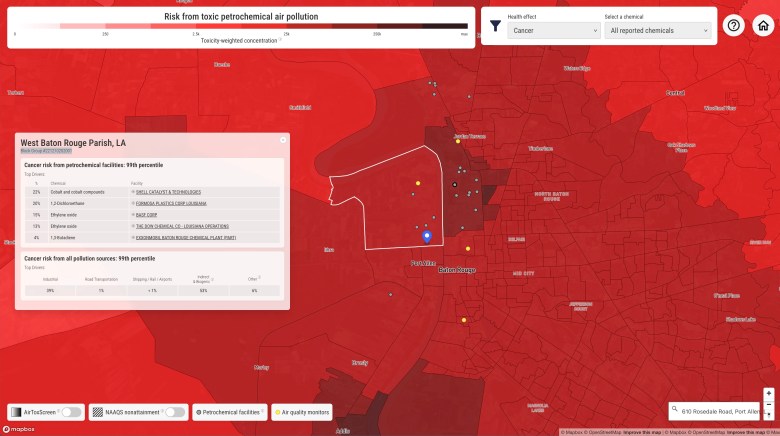
    This screenshot from CLEAR Collaborative’s Petroleum Pollution Map models health risks from hazardous air pollution from petrochemical facilities around West Baton Rouge Parish near Port Allen Middle School. The map uses U.S. Environmental Protection Agency data analyzed by the Environmental Defense Fund. Environmental advocates have sounded the alarm on the dangers of the EPA’s rollback of air and water regulations for children in fenceline communities. Credit: Provided by The Environmental Defense Fund

    Sarah Vogel, senior vice president of health communities with the Environmental Defense Fund, said the move toward deregulation comes as the U.S. Department of Justice announced on March 7 that it was dropping the federal lawsuit the Biden administration lodged against Denka’s Performance Elastomer plant in Louisiana. That plant had been accused of worsening cancer risks for the residents in the surrounding majority-Black community. 

    The DOJ said its decision was tied to Trump’s moves to dismantle all federal programs tied to diversity, equity and inclusion.

    “What they’re trying to do is just completely deregulate everything for oil and gas and petrochemical facilities, just absolutely take the lid off,” Vogel said. “We have long known that children are uniquely susceptible to air pollution and toxic chemicals. Like they’re huge, huge impacts. It’s why what they are doing is so devastating and cruel in my mind.”

    Floodlight, which produced this story, is a nonprofit newsroom that investigates the powers stalling climate action.

    The Hechinger Report provides in-depth, fact-based, unbiased reporting on education that is free to all readers. But that doesn’t mean it’s free to produce. Our work keeps educators and the public informed about pressing issues at schools and on campuses throughout the country. We tell the whole story, even when the details are inconvenient. Help us keep doing that.

    Join us today.

    Source link

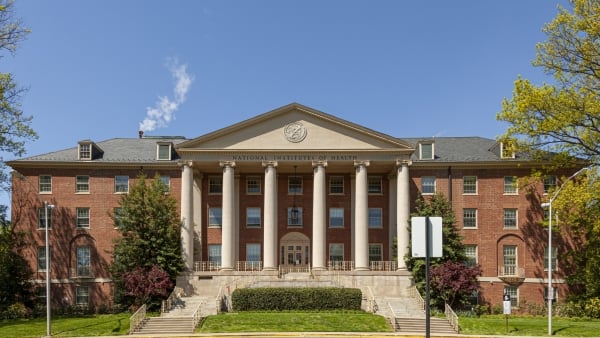
  • Higher ed leaders warn of dire consequences after NIH cut

    Higher ed leaders warn of dire consequences after NIH cut

    In a move that sparked swift outrage from the higher education sector, the National Institutes of Health announced late Friday that it is dramatically cutting funding for grant recipients’ “indirect costs” of conducting medical research at universities, including hazardous waste disposal, utilities and patient safety. 

    “It is difficult to overstate what a catastrophe this will be for the US research and education systems, (particularly) in biomedical fields,” Carl Bergstrom, a biology professor at the University of Washington, posted on Bluesky. “It is deliberate and wanton devastation entirely out of scale with any concern about DEI activities on campuses. The goal is destroy US universities.”

    Effective Monday, the NIH is planning to cap funding of indirect costs at 15 percent of all grants, down from the average of 27 to 28 percent. The change means that colleges and universities are on the hook for millions of dollars. They’ll likely have to cut their budgets or reduce research activities to make up the difference.

    Republicans and President Trump have long sought to limit funding for indirect costs. The latest proposal is similar to a recommendation included in Project 2025, a conservative playbook for the second Trump administration that the president has disavowed. Project 2025 authors said the cap would “reduce federal taxpayer subsidization of leftist agendas.”

    Historically, universities have been able to negotiate reimbursement rates for those indirect costs, with institutional reimbursements averaging nearly 28 percent. Some of the nation’s leading research institutions, including Harvard, Yale and Johns Hopkins Universities, receive reimbursements of more than 60 percent. NIH said in a social media post that it expects to save $4 billion from the change; an Inside Higher Ed analysis of fiscal year 2024 grant data shows that colleges would lose about $4.3 billion in NIH reimbursements if indirect costs were capped at 15 percent.

    Previously, if a college or university received a $5 million grant, they could also be reimbursed up to $1.4 million to pay for related costs, such as renting space for a lab. Under this new policy, that will be capped at $750,000.

    “The United States should have the best medical research in the world,” the NIH said in its announcement. “It is accordingly vital to ensure that as many funds as possible go towards direct scientific research costs rather than administrative overhead.”

    While the NIH said it has the authority to cap indirect costs, Senator Patty Murray, a Democrat from Washington, said on social media Friday that the proposal is illegal.

    “It will mean shuttering labs across the country, layoffs in red & blue states, & derailing lifesaving research on everything from cancer to opioid addiction,” Murray wrote.

    Cuts to ‘Life-Saving’ Research

    While the NIH is casting indirect costs as a burden, Association of American Universities President Barbara R. Snyder said in a statement that they are “real and necessary costs of conducting the groundbreaking research that has led to countless breakthroughs in the past decades.”

    A $4 billion cut to reimbursements for NIH grants, she added, “is quite simply a cut to the life-saving medical research that helps countless American families.”

    NIH has worked feverishly in recent weeks to comply with President Trump’s executive orders to eliminate all support for diversity, equity and inclusion and “gender ideology.” Grant reviews stopped for two weeks, alarming researchers who rely on federal funding, and some scientists worried about the future of their funding under the agency.

    But researchers and their advocates say an abrupt $4 billion cut to NIH funding—which has not been approved by Congress—has dire implications for the future of the United State’s scientific research enterprise and will undermine the NIH’s stated goal of producing superior medical research.  

    “Cuts to reimbursement of these costs are cuts to medical research and represent the federal government stepping back from commitments it has made to world-leading researchers,” Mark Becker, president of the Association of Public Land Grant Universities, said in a statement. “This action will slow advances for millions of patients who desperately need critical breakthroughs and imperil the U.S.’s position as the world leader in biomedical innovation.”

    The NIH is the largest federal funding source for research universities, and has supported breakthroughs in medical technology and treatments for diseases like cancer and Alzheimer’s. 

    Ted Mitchell, president of the American Council on Education, said the decision was “short-sighted, naive, and dangerous.”

    “It will be celebrated wildly by our competitors, who will see this for what it is—a surrender of U.S. supremacy in medical research,” Mitchell said. “It is a self-inflicted wound that, if not reversed, will have dire consequences on U.S. jobs, global competitiveness, and the future growth of a skilled workforce.”


    Source link