Tag: Ways

  • 5 powerful ways to link STEM lessons to real-world applications

    5 powerful ways to link STEM lessons to real-world applications

    Key points:

    “Why are we learning this?”

    This is a question every educator has faced before. To be fair, it’s a valid question. Students are naturally curious, and it’s normal for them to wonder about the knowledge that they’re acquiring. The real issue is how we, as educators, choose to respond to them.

    In my experience, teachers have two standard replies to this question:

    1. They’ll try to explain the subject in detail, which results in a long-winded answer that confuses their students and doesn’t satisfy them.
    2. They’ll argue that the information is important because it’s on an upcoming test, which typically leaves students feeling frustrated and disengaged.

    Either way, the result is the same: Students lose all legitimacy in the lesson and they’re unable to connect with the content.

    If we want our students to engage with the material in a way that’s memorable, meaningful, and fun, then we need to help them discover why it is important. Teachers can accomplish this by introducing real-world connections into the lesson, which reveal how the information that students acquire can be practically applied to real-world problems.

    Without building these connections between the concepts our students learn and real-world applications, students lose interest in what they are learning. Using the strategies below, you can start to build student investment into your classroom content.

    The everyday enigma

    Use everyday items that operate with mystery and frame your lesson around them. Your students’ curiosity will drive them to learn more about the object and how it functions. This allows students to see that the small concepts they are learning are leading to the understanding of an object that they interact with daily. When choosing an item, pick one that is familiar and one that has multiple STEM elements. For example, you could use a copper wire to discuss electrical currents, a piece of an automobile to explore chemistry and combustion, or shark teeth when teaching about animal adaptations and food chains.  

    Interest intersect

    Connect your students’ personal hobbies to the subject matter. For instance, if you have a student who is really passionate about soccer, try having them create a mini poster that connects the sport to the concepts learned in class. This gets them to think creatively about the purpose of content. This strategy has the additional benefit of helping teachers learn more about their students, creating opportunities to build communication and rapport.

    Get an expert

    Invite professionals (scientists, engineers, etc.) to talk with your class. This gives students a first-hand account of how the concepts they are learning can be applied to different careers. If you’re teaching chemistry, consider inviting a nurse or doctor to share how this subject applies to human health. If you’re teaching math, a local architect can expound on how angles and equations literally shape the homes in which students live. Not only does this provide a real-world example of students, but it helps schools connect with their community, creating vital relationships in the process.           

    Problem to progress

    Create an engineering investigation based on a local, real-world problem. For instance, I once knew a music teacher who was frustrated because pencils would regularly fall off his music stands. I challenged my 5th grade students to create a solution using the engineering design process. Not only did they succeed, but the experience allowed my students to see the real-world results of the inventions they created. When students understand that their work can make a tangible difference, it completely changes their relationship with the material.  

    Project-based learning

    Project-based learning is driven by inquiry and student ownership. This allows students to make contributions to the real world through hands-on investigations. What makes these inquiry-focused lessons so useful is that students are the driving force behind them. They choose how to approach the information, what questions to pursue, and what solutions they want to test. This makes the learning intensely personal while taking advantage of students’ natural curiosity, creativity, and critical-thinking skills. If you need a little help getting started, consider using one of these Blue Apple projects from Inquiry Outpost.

    By linking our STEM lessons to real-world experiences, teachers can provide a meaningful answer to the age-old question of, “Why are we learning this?” We can equip our students with the skills to not only navigate everyday challenges but also create positive change within their own communities. So, let’s empower young learners to see the relevance of STEM in their lives, and lay a strong learning foundation that will support them well beyond the classroom.

    Latest posts by eSchool Media Contributors (see all)

    Source link

  • 3 ways to break down silos between general and special education

    3 ways to break down silos between general and special education

    This audio is auto-generated. Please let us know if you have feedback.

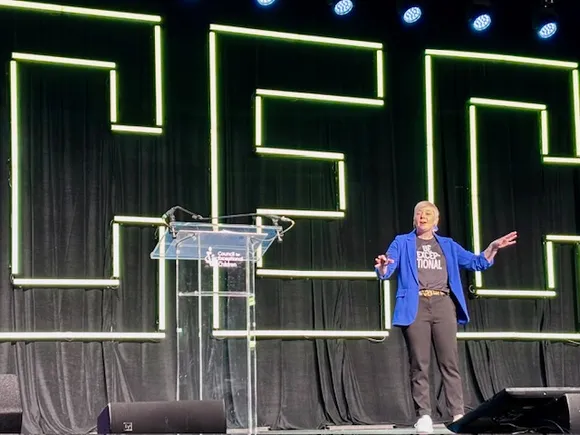
    BALTIMORE — When educators operate with separate goals and don’t engage in authentic collaboration, it creates friction and can ultimately hurt student progress, said Casey Watts, an educator and team leadership expert, in the opening keynote address at the Council for Exceptional Children’s annual convention on Wednesday.

    “I believe that people deserve to be part of collaborative teams that move forward, make an impact together and leave them feeling empowered, inspired and essential,” said Watts, who is also a pre-K-5 instructional coach at Hudson Independent School District in Lufkin, Texas.

    When educators and administrators are siloed, there can be an “us versus them” mentality, she said. “I believe that when we function in silos as educators, we unintentionally create silos in our students.” 

    To dismantle barriers between general and special educators and between teachers and administrators, Watts recommends three core concepts: 

    Have an ‘elevator pitch’

    Maintaining a strong sense of identity and purpose in your work can help eliminate ambiguities and assumptions others have of your role at school, Casey said. This goes for all educators in the school, including special education teachers, general education teachers, counselors, administrators and others.

    To ensure clarity, educators should work on their “elevator pitch,” or a brief summary of their role in the school. “When you create an elevator pitch, what you are essentially doing is pulling people in to become the main character of the story, and you are addressing their pain points, and you’re giving them new narratives for your position, which in essence, is bridging the gaps that exist between us as adults in education,” Watts said.

    In developing their elevator pitches, educators should think about how their role serves others in the school building and the skills they offer to educators and students.

    Engage in authentic collaboration

    Authentic collaboration is easier said than done, Watts said. And some “faux collaborations” can seem promising — such as an offer to share resources and materials — but really don’t break down barriers among educators.

    True collaboration takes courage and vulnerability and can include difficult conversations. It also means using everyone’s strengths and listening to all voices, she said.

    Establishing protocols where each person in the school community is a contributor can help break down silos, Watts said.

    Bring clarity to goals

    When everyone is on the same path, they know where the team is headed and how to get there. But when goals are unclear or the path is uncertain, people can get off track or operate independently, Watts said.

    When that happens, teachers go into their classrooms, close the door and vow to do what’s best for their students. But that can lead to unintentional gaps in student learning.

    “As I work with teams in districts across the nation, I hear so often leaders say ‘our teachers just won’t get on board,’” Watts said. “On the flip side of that, I’m hearing from teachers and staff who are saying the opposite: ‘We just never know what’s going on.’ There are two different narratives at play.”

    A lack of clarity creates unproductive confusion, Watts said. As a result, educators and administrators might lack confidence and feel defeated, frustrated and distrustful, she said.

    Setting out clear goals will boost confidence and capacity in educators, resulting in a collective efficacy, Watts said. That, in turn, will have “a significant impact on student learning,” she said.

    Source link

  • Three Ways Faculty Are Using AI to Lighten Their Professional Load

    Three Ways Faculty Are Using AI to Lighten Their Professional Load

    Reading Time: 4 minutes

    Our most recent research into the working lives of faculty gave us some interesting takeaways about higher education’s relationship with AI. While every faculty member’s thoughts about AI differ and no two experiences are the same, the general trend we’ve seen is that faculty have moved from fear to acceptance. A good deal of faculty were initially concerned about AI’s arrival on campus. This concern was amplified by a perceived rise in AI-enabled cheating and plagiarism among students. Despite that, many faculty have come to accept that AI is here to stay. Some have developed working strategies to ensure that they and their students know the boundaries of AI usage in the classroom.

    Early-adopting educators aren’t just navigating around AI. They have embraced and integrated it into their working lives. Some have learned to use AI tools to save time and make their working lives easier. In fact, over half of instructors reported that they wanted to use AI for administrative tasks and 10% were already doing so. (Find the highlights here.) As more faculty are seeing the potential in AI, that number has likely risen. So, in what ways are faculty already using AI to lighten the load of professional life? Here are three use-cases we learned about from education professionals:

    1. AI to jumpstart ideas and conversations

    “Give me a list of 10 German pop songs that contain irregular verbs.”

    “Summarize the five most contentious legal battles happening in U.S. media law today.”

    “Create a set of flashcards that review the diagnostic procedure and standard treatment protocol for asthma.”

    The possibilities (and the prompts!) are endless. AI is well-placed to assist with idea generation, conversation-starters and lesson materials for educators on any topic. It’s worth noting that AI tends to prove most helpful as a starting point for teaching and learning fodder, rather than for providing fully-baked responses and ideas. Those who expect the latter may be disappointed, as the quality of AI results can vary widely depending on the topic. Educators can and should, of course, always be the final determinants and reviewers of the accuracy of anything shared in class.

    1. AI to differentiate instruction

    Faculty have told us that they spend a hefty proportion (around 28%) of their time on course preparation. Differentiating instruction for the various learning styles and levels in any given class constitutes a big part of that prep work. A particular lesson may land well with a struggling student, but might feel monotonous for an advanced student who has already mastered the material. To that end, some faculty are using AI to readily differentiate lesson plans. For example, an English literature instructor might enter a prompt like, “I need two versions of a lesson plan about ‘The Canterbury Tales;’ one for fluent English speakers and one for emergent English speakers.” This simple step can save faculty hours of manual lesson plan differentiation.

    An instructor in Kansas shared with Cengage their plans to let AI help in this area, “I plan to use AI to evaluate students’ knowledge levels and learning abilities and create personalized training content. For example, AI will assess all the students at the beginning of the semester and divide them into ‘math-strong’ and ‘math-weak’ groups based on their mathematical aptitude, and then automatically assign math-related materials, readings and lecture notes to help the ‘math-weak’ students.”

    When used in this way, AI can be a powerful tool that gives students of all backgrounds an equal edge in understanding and retaining difficult information.

    1. AI to provide feedback

    Reviewing the work of dozens or hundreds of students and finding common threads and weak spots is tedious work, and seems an obvious area for a little algorithmic assistance.

    Again, faculty should remain in control of the feedback they provide to students. After all, students fully expect faculty members to review and critique their work authentically. However, using AI to more deeply understand areas where a student’s logic may be consistently flawed, or types of work on which they repeatedly make mistakes, can be a game-changer, both for educators and students.

    An instructor in Iowa told Cengage, “I don’t want to automate my feedback completely, but having AI suggest areas of exigence in students’ work, or supply me with feedback options based on my own past feedback, could be useful.”

    Some faculty may even choose to have students ask AI for feedback themselves as part of a critical thinking or review exercise. Ethan and Lilach Mollick of the Wharton School of the University of Pennsylvania share in an Harvard Business Publishing Education article, “Though AI-generated feedback cannot replicate the grounded knowledge that teachers have about their students, it can be given quickly and at scale and it can help students consider their work from an outside perspective. Students can then evaluate the feedback, decide what they want to incorporate, and continue to iterate on their drafts.”

    AI is not a “fix-all” for the administrative side of higher education. However, many faculty members are gaining an advantage and getting some time back by using it as something of a virtual assistant.


    Are you using AI in the classroom?

    In a future piece, we’ll share 3 more ways in which faculty are using AI to make their working lives easier. In the meantime, you can fully explore our research here:


    Source link

  • Eleven Ways to Shine Online – Faculty Focus

    Eleven Ways to Shine Online – Faculty Focus

    Source link

  • Six ways to build trust between college presidents and students

    Six ways to build trust between college presidents and students

    A May 2024 Student Voice survey found 28 percent of college students say they have “not much trust” in their president and other executive-level officials, which was 18 percentage points higher than students’ distrust in professors and 13 percentage points higher than their trust in academic department leaders.

    An additional 19 percent of students said they were not sure if they trust their president, for a total of 52 percent of students indicating they have at least some trust in their campus executives.

    Students at private nonprofit institutions were mostly likely to say they did not have much trust in their president (48 percent) compared to their public four-year peers (30 percent) or those at two-year institutions (18 percent).

    “Trust is in very short supply on campuses. We do not see deeply trusting environments on campus very quickly,” said Emma Jones, executive vice president and owner of higher education consulting group Credo, in a Jan. 29 webinar by the Constructive Dialogue Institute. “By and large, I find campus leaders to have incredibly trustworthy behavior … but they are not trusted in their environments.”

    Institutional leaders can employ a variety of strategies and tactics to gain greater trust.

    Creating a foundation: A 2024 report from the American Council on Education found presidents are in agreement that trust building is a key competency for being a campus leader. Presidents told researchers they need to be present with their constituents, create opportunities for various stakeholders to share their views on issues related to the institution and surround themselves with diverse voices, according to the report.

    In the webinar, experts shared what they believe helps build trust between executive-level administrators and the students they serve.

    • Demonstrate care. Humanity is a key factor in trust, in which a person recognizes the uniqueness of each person and builds relationships with them, Jones explained. During this present age, it is particularly important for campus leaders to see and acknowledge people for their humanity.
    • Watch your tone. Generic or trite messages that convey a lack of empathy do not build trust among community members, said Darrell P. Wheeler, president of the State University of New York at New Paltz. Instead, having transparent and authentic communication, even when the answer is “I don’t know,” can help build trust in a nebulous period of time, Jones said.
    • Engage in listening. “People want you to be compassionate, but they really want to have their own space at times to be able to express where they are [and] not for you to overshadow it by talking about yourself in that moment,” Wheeler said during the webinar.
    • Create space to speak with students. Attending events to listen to students’ concerns or having opportunities for students to engage in meetings can show attentive care, Victoria Nguyen, a teaching fellow at Harvard’s Graduate School of Education, told Inside Higher Ed.
    • Foster healthy discourse. While presidents should strive to be trusted among their community members, too much trust can be just as destructive as too much distrust, Hiram Chodosh, president of Claremont McKenna College in California, said in the webinar.
    • Trust yourself. Earning trust requires self-trust, Chodosh said, so presidents should also seek to cultivate their own trustworthiness.

    Presidential Engagement: College presidents can step outside their offices and better engage with learners. Here are three paths they are taking.

    1. Being visible on campus. Creating opportunities for informal conversation can address students’ perceptions of the president and assist in trust building. Some presidents navigate campus in a golf cart to allow for less structured interactions with students. The University of South Alabama president participates in recruitment trips with high schoolers, introducing himself early.
    2. Hosting office hours. Wheeler of SUNY New Paltz hosts presidential office hours for students once a month in which they can sit down for coffee and chat with him. Students can sign up with a QR code and discuss whatever they feel called to share. At King’s University in Ontario, the dean of students hosts drop-in visits across campus, as well.
    3. Give students a peek behind the curtain. Often, colleges will invite students to participate as a trustee or a board member, giving them a voice and seat at the table. Hood College allows one student to be president for a day and engage in ceremonial duties and meetings the president would typically hold.

    We bet your colleague would like this article, too. Send them this link to subscribe to our weekday newsletter on Student Success.

    Source link

  • Five ways the Education Department impacts higher ed

    Five ways the Education Department impacts higher ed

    Republicans’ long-sought goal of shuttering the Education Department got a boost this week as several media outlets reported the Trump administration was finalizing plans for an executive order to wind down the agency.

    Trump added to the speculation, telling reporters Tuesday he wanted his education secretary nominee, Linda McMahon, to put herself out of a job. Then, on Wednesday, House Speaker Mike Johnson, a Louisiana Republican, said getting rid of the department is “an idea whose time has come.”

    The specifics and timing of the executive order are still unclear, though media reports say the directive could instruct department officials to shut down some programs not directly approved by Congress or come up with a plan to move functions to other departments in the federal government. At the very least, the Trump administration wants to see a much smaller version of the department, particularly because only Congress can actually eliminate the agency.

    More than 4,000 people currently work for the department, which was created in 1979. In fiscal year 2024, the department had a $80 billion discretionary budget. Its spending makes up just over 2 percent of the federal budget.

    Some conservative think tanks have been planning for the department’s demise for years. Most recently, Project 2025, a policy manual for the second Trump administration, detailed how to dismantle the agency—from which offices to shutter to which ones to move.

    While those plans delve into all the department’s functions, much of the recent commentary about why the agency could go revolves about its role in K-12 education, largely ignoring how shutting it down could affect higher education.

    But the federal government is deeply embedded in higher education, thanks to the billions it sends to colleges and universities each year. Unwinding the department would be complex and likely disruptive for colleges and the students they serve.

    “That’s not something our community could handle at this point in time,” said Karen McCarthy, vice president of public policy and federal relations at the National Association of Student Financial Aid Administrators, on an episode of the organization’s podcast this week. “From our perspective, it’s highly unlikely that such a transition would be quick or smooth.”

    As talks ramp up about the department’s future, here are the five key roles the department plays in higher education—and what could happen to them if the agency is shuttered.

    Doles Out Billions in Grants and Loans

    The department’s wide-ranging role in federal financial aid is one of its most important functions for higher education. The botched rollout of the 2024–25 federal aid application showed just how critical the system is to colleges and students.

    Each year, the Education Department issues about $100 billion in student loans and doles out more than $30 billion in Pell Grants to more than six million low-income students. More than 5,000 colleges and universities are eligible for federal financial aid.

    The department’s Office of Federal Student Aid manages the government’s $1.7 trillion student loan portfolio, oversees contractors who service those loans, carries out many of the regulations related to higher education and holds colleges accountable. Under the Biden administration, for example, FSA issued $61.7 million in fines and cut off aid to 35 colleges for violating federal law and rules.

    The Trump administration hasn’t said what would happen to federal financial aid programs, or to the more than 1,600 employees who work for the Office of Federal Student Aid, if the department goes away. But some conservative plans recommend moving the whole system to the Treasury Department.

    Proponents argue that moving the system to the Treasury makes sense given that the department already deals with money and lending. Additionally, they say the switch shouldn’t be too disruptive or leave students and colleges worse off. Critics of that plan disagree and question whether the Treasury has the capacity to administer the federal student aid program.

    Enforces Students’ Civil Rights

    While federal financial aid is key to helping students access college, the department’s Office for Civil Rights helps to ensure they are protected from discrimination once on campus.

    The OCR can have a direct impact on students and colleges through investigations of complaints or guidance that prompts institutions to change their policies or rethink their civil rights offices. Colleges watch the agency’s actions closely to avoid running afoul of federal law.

    In recent years, the office has seen a record number of complaints from students who allege violations of their civil rights, though the agency has struggled to keep up with the growing caseload. Biden administration officials pleaded with Congress last spring for more funding to hire 86 employees who could investigate complaints. As of last March, 557 employees worked for OCR, according to department budget documents.

    The office received 22,687 complaints in fiscal year 2024, and the Biden administration projected that number to grow to nearly 24,000 in 2025. Most of the complaints in the past year related to sex-based discrimination, while 37 percent alleged discrimination based on disability. In many cases, seeking help from the federal office can be a last resort for students.

    Project 2025 recommended moving OCR to the Justice Department and limiting enforcement to litigation.

    Manages Grant Programs

    The Education Department sends millions of dollars appropriated by Congress to colleges and universities that help to support student success, childcare on campus and other priorities for lawmakers.

    In fiscal 2024, Congress allocated $3.3 billion toward higher education programs. That includes a $400 million fund to directly support historically Black colleges and universities as well as a $229 million grant program for Hispanic-serving institutions.

    The department also spends about $2.14 billion on Federal Work-Study and supplemental grants to directly support low-income students.

    Some institutions rely on federal support to stay open. For instance, Gallaudet University, a school for the Deaf in Washington, D.C., gets its own line item in the federal budget. The university was created by Congress and received $167.3 million in fiscal 2024, which was about 65 percent of Gallaudet’s annual revenues, Forbes reported this week.

    Trump sent a shock wave through higher ed last week when his administration threatened to freeze all federal grants and loans. College administrators and lobbyists representing them warned of devastating consequences if that source of funding was turned off.

    While a federal judge blocked the freeze from taking effect, the Education Department is reviewing many of the grant programs for compliance with Trump’s recent executive orders that target diversity, equity and inclusion. That review could threaten to shut off some of the programs, though technically only Congress has that authority.

    Gathers Data on Students and Institutions

    Researchers and policymakers rely on reams of data that the Education Department collects about students and institutions in order to better understand higher ed. As some federal databases have gone dark in recent weeks, some advocates and researchers have worried about the future and security of the department’s data.

    From annual surveys conducted by the National Center for Education Statistics to the National Student Loan Data System, the data offers insights into student enrollment, graduation rates, earnings, student lending and more. In 2015, the department made that data more accessible when it launched the College Scorecard.

    The future of those databases is unclear if the department goes away. Project 2025 and other analysts have recommended moving the National Center for Education Statistics to other agencies—the Bureau of Labor Statistics, perhaps, or the Department of Commerce’s Census Bureau.

    But few proposals suggest getting rid of the data-collection responsibilities altogether. In fact, Project 2025 declares that the federal government’s only role in education policy should be “that of a statistics-gathering agency that disseminates information to the states.”

    Oversees Colleges and Universities

    The federal government works with states and accreditors to oversee colleges and universities—a three-pronged system referred to as the triad. Getting rid of the Education Department would throw the triad into flux. That would likely mean less red tape for colleges but fewer protections for students.

    The department recognizes accreditors who in turn recognize colleges. Institutions can only access federal financial aid if they are accredited by a department-recognized accrediting agency and have the necessary approval from state authorizing agencies.

    The Biden administration sought to require accreditors to set benchmarks for student achievement and give states more authority over distance education. Neither of those proposals moved forward, but the push shows the federal government’s role in overseeing other members of the triad in addition to colleges.

    Project 2025 proposed to remove accreditors from the triad or give states more authority to authorize accreditors, breaking the federal government’s hold over the process.

    Source link

  • We need new ways to protect academic freedom (opinion)

    We need new ways to protect academic freedom (opinion)

    Katherine Franke, formerly a law professor at Columbia University, is just the latest of many academics who have found themselves in hot water because of something they said outside the classroom. Others have been fired or resigned under pressure for what they posted online or said in other off-campus venues.

    In each of those cases, the “offending party” invoked academic freedom or freedom of speech as a defense to pressures brought on them, or procedures initiated against them, by university administrators. The traditional discourse of academic freedom or free speech on campus has focused on threats from inside the academy of the kind that led Franke and others to leave their positions.

    Today, threats to academic freedom and free speech are being mounted from the outside by governments or advocacy groups intent on policing colleges and universities and exposing what they see as a suffocating orthodoxy. As Darrell M. West wrote in 2022, “In recent years, we have seen a number of cases where political leaders upset about criticism have challenged professors and sought to intimidate them into silence.”

    We have seen this act before, and the record of universities is not pretty.

    During the 1940s and 1950s, an anticommunist crusade swept the nation, and universities were prime targets. In that period, “faculty and staff at institutions of higher learning across the country experienced increased scrutiny from college administrators and trustees, as well as Congress and the FBI, for their speech, their academic work, and their political activities.”

    And many universities put up no resistance.

    Today, some believe, as Nina Jankowicz puts it, that we are entering “an era of real censorship the likes of which the United States has never seen. How will universities respond?”

    If academic freedom and freedom of expression are to be meaningful, colleges and universities must not only resist the temptation to punish or purge people whose speech they and others may find offensive; they must provide new protections against external threats, especially when it comes to extramural speech by members of their faculties.

    They must become active protectors and allies of faculty who are targeted.

    As has long been recognized, academic freedom and free speech are not identical. In 2007, Rachel Levinson, then the AAUP senior counsel, wrote, “It can … be difficult to explain the distinction between ‘academic freedom’ and ‘free speech rights under the First Amendment’—two related but analytically distinct legal concepts.”

    Levinson explained, “Academic freedom … addresses rights within the educational contexts of teaching, learning, and research both in and outside the classroom.” Free speech requires that there be no regulation of expression on “all sorts of topics and in all sorts of settings.”

    Ten years after Levinson, Stanley Fish made a splash when he argued, “Freedom of speech is not an academic value.” As Fish explained, “Accuracy of speech is an academic value … [because of] the goal of academic inquiry: getting a matter of fact right.” Free speech, in contrast, means “something like a Hyde Park corner or a town-hall meeting where people take turns offering their opinions on pressing social matters.”

    But as Keith Whittington observes, the boundaries that Levinson and Fish think can be drawn between academic freedom and free speech are not always recognized, even by organizations like the AAUP. “In its foundational 1915 Declaration of Principles on Academic Freedom and Academic Tenure,” Whittington writes, “the AAUP asserted that academic freedom consists of three elements: freedom of research, freedom of teaching, and ‘freedom of extramural utterance and action.’”

    In 1940, Whittington explains, “the organization reemphasized its position that ‘when they speak or write as citizens,’ professors ‘should be free from institutional censorship or discipline.’”

    Like the AAUP, Whittington opposes “institutional censorship” for extramural speech. That is crucially important.

    But in the era in which academics now live and work, is it enough?

    We know that academics report a decrease in their sense of academic freedom. A fall 2024 survey by Inside Higher Ed found that 49 percent of professors experienced a decline over the prior year in their sense of academic freedom as it pertains to extramural speech.

    To foster academic freedom and free speech on campus or in the world beyond the campus, colleges and universities need to move from merely tolerating the expression of unpopular ideas to a more affirmative stance in which they take responsibility for fostering it. It is not enough to tell faculty that the university will respect academic freedom and free expression if they are afraid to exercise those very rights.

    Faculty may be fearful that saying the “wrong” thing will result in being ostracized or shunned. John Stuart Mill, one of the great advocates for free expression, warned about what he called “the tyranny of the prevailing opinion and feeling.” That tyranny could chill the expression of unpopular ideas.

    In 1952, during the McCarthy era, Supreme Court justice Felix Frankfurter also worried about efforts to intimidate academics that had “an unmistakable tendency to chill that free play of the spirit which all teachers ought especially to cultivate and practice.”

    Beyond the campus, faculty may rightly fear that if they say things that offend powerful people or government officials, they will be quickly caught up in an online frenzy or will be targeted. If they think their academic institutions will not have their back, they may choose the safety of silence over the risk of saying what they think.

    Whittington gets it right when he argues that “Colleges and universities should encourage faculty to bring their expertise to bear on matters of public concern and express their informed judgments to public audiences when doing so might be relevant to ongoing public debates.” The public interest is served when we “design institutions and practices that facilitate the diffusion of that knowledge.”

    Those institutions and practices need to be adapted to the political environment in which we live. That is why it is so important that colleges and universities examine their policies and practices and develop new ways of supporting their faculty if extramural speech gets them in trouble. This may mean providing financial resources as well as making public statements in defense of those faculty members.

    Colleges and universities should also consider making their legal counsel available to offer advice and representation and using whatever political influence they wield on behalf of a faculty member who is under attack.

    Without those things, academics may be “free from” the kind of university action that led Franke to leave Columbia but still not be “free to” use their academic freedom and right of free expression for the benefit of their students, their professions and the society at large.

    Austin Sarat is the William Nelson Cromwell Professor of Jurisprudence and Political Science at Amherst College.

    Source link

  • Four ways to help students return from a leave of absence

    Four ways to help students return from a leave of absence

    Some students may need to take a leave of absence for their mental health before returning to an institution. Here’s how the institution can help.

    Brothers91/E+/Getty Images

    In the past few years, more students have shared the toll their mental health can take on their academic pursuits. Recent surveys of students who left higher education prior to completing a credential or degree reveal that mental health challenges or stress are primary reasons why they discontinue their education.

    Some learners opt to take a pause, withdrawing from the university for a semester or longer to prioritize their health and wellness.

    To promote student completion and success, institutions can consider formal procedures and initiatives targeted toward easing the transition of re-enrollment after a voluntary mental health leave of absence.

    The background: Colleges have historically offered students the opportunity to temporarily unenroll to address health conditions, but only more recently has that definition expanded to include students’ mental health.

    At some institutions, students who withdrew found it difficult to return. Other institutions prioritized risk mitigation versus student success and pushed learners to withdraw rather than providing solutions.

    “Such policies and practices actually discourage students—not just the student with a mental health condition, but all others—from seeking help,” according to a 2021 report from Boston University and the Ruderman Family Foundation.

    A recent survey from the Princeton Review found 43 percent of colleges and universities now have an official support program in place for students returning from mental health leave of absence.

    However, there is little consistency in policies and practices regarding medical or psychiatric leaves of absence, according to the BU report: “Students are often left to confusing, conflicting information and sometimes, discriminatory policies and practices that make a return to higher education difficult.”

    State policymakers have worked to expand the conditions included in leave-of-absence policies at institutions to recognize mental health difficulties.

    In May 2024, Maryland passed legislation that expanded formal health withdrawal policies at public institutions to include mental health. The legislation also requires institutions to provide partial refunds for students who withdraw for physical or mental health reasons in the middle of the term.

    A 2022 bill introduced to the New York State Legislature would require university systems to review enrollment and re-enrollment policies for students who take extended mental health leaves.

    Students Taking Action

    Active Minds, a youth-led mental health advocacy group, developed a guide for students who are advocating for improved leave-of-absence policies at their institution.

    How to help: Some of the ways institutions assist learners are through:

    • Outlining the return process. The University of Southern California offers a step-by-step outline of the different offices a student must contact to re-enroll. Stanford University also created a Returning to Stanford booklet to answer frequently asked questions.
    • Consolidating resources. Many learners are unaware of the full scope of resources available at the institution. A centralized website, such as this one at Cornell University, can help students during their transition back to campus.
    • Providing coaching services for returners. Institutions, themselves or in partnership with outside organizations, can deliver intentional coaching for skill development and resource coordination to re-enroll learners.
    • Connecting students with peers. Supportive communities can help reconnect students to the institution and affirm their commitments to healthy habits, like engaging in social activities or demonstrating good study behaviors. Georgetown University offers a special support group, Back on the Hilltop, for learners who are returning from a leave of absence or who have recently transferred.

    Do you know of a wellness intervention that might help others encourage student success? Tell us about it.

    Source link

  • 5 Ways to Advocate for Your Students During The U.S. Election

    5 Ways to Advocate for Your Students During The U.S. Election

    Election Day in the U.S. is just around the corner. On top of carrying multiple academic and employment responsibilities, some students will also be voting for the first time. Others, such as those from marginalized or historically underrepresented populations, may be overwhelmed with what the election results could mean for them. In the lead up to Election Day, a healthy dose of empathy will be essential in ensuring students have a chance to fulfill their civic duty—and the opportunity to consider its consequences.

    Being flexible with due dates, considering students’ wellbeing and ensuring learners are armed with the resources needed to vote are the most important things you can do as Election Day nears. Read on to learn how professors advocated for their students during the 2020 election—and how you can do the same.

    Consider making November 4 and 5 free of assignments (or even classes)

    Exams can cause some students a great deal of stress and anxiety. Lillian Horin, Biological and Biomedical Sciences PhD student at Harvard University, urges educators to keep BIPOC students in mind when scheduling high-stakes tests.

    Consider swapping your exams or problem sets (Psets) with a trip to the ballot box. Jacob Light, Economics PhD student at Stanford University, writes that this simple gesture may allow students to exercise their civic duty.

    Other students like Anna-Sophia Boguraev, Bioengineering PhD student at Harvard Medical School and MIT, say that TAs have the power to amplify student concerns and requests—none of which should be ignored.

    If your assignments can’t wait, build in flexibility and timeliness

    Self-paced learning can allow students to visit the polls and complete coursework at a time that works for them—so says Jesse Fox, Associate Professor of Communication at Ohio State University.

    Election Day can also be a good opportunity to let students catch their breath in your course. Give students a chance to study and review material that they haven’t had a chance to look over, suggests Scott Grunow, Instructor in English and Religious Studies at the University of Illinois at Chicago.

    Should your institutions provide little leeway in your assessment choices, at least incorporate real-time events into your discussions. Derek Bruff, Associate Director, Center for Teaching Excellence at the University of Virginia, notes that relating course content to the election can help students see the value of what they’re learning.

    Real-time political events and policy proposals can make for discipline-specific conversations. This also allows students to apply what they’ve learned in your class to the real world, as Andrea Gomez Cervantes, Assistant Professor in the Department of Sociology at Wake Forest University, proposes.

    Mobilize your students to show up at the polls

    Gen Z students are motivated to vote. In the 2018 midterm elections, the student turnout rate increased by 20 percent compared to the 2014 midterms.1 Ensure students are equipped with the resources to vote as soon as possible, writes Wendy Christensen, Sociology Professor at William Paterson University.

    Similarly, ask students about their voting plans. Consider working with your class to ensure they know where to go on November 5, suggests Margaret Boyle, Associate Professor of Romance Languages and Literatures at Bowdoin College.

    Ensure your voter registration information and resources appeal to all students, regardless of what political party they support. Meghan Novisky, Assistant Professor of Criminology at Cleveland State University, emphasizes the importance of using non-partisan guidelines.

    Some scholars like Sara Wheeler-Smith, Associate Professor of Management at Manhattan College, even plan to offer a grading incentive for visiting the polls.

    Incorporate guest lectures and learn from your colleagues

    Navigating election week with students in mind might be an unfamiliar undertaking. Consider leaning on faculty at your institution for support, writes Heather Mayer, Director of Educational Technology at Everett Community College.

    Some students may be undecided voters, while others may have missed the presidential debates. Incorporate forms of debate in your classroom—with the support of scholars from other institutions, as Yujin Jung, Political Sciences PhD student at the University of Missouri, plans to do.

    Keep in mind the importance of mental and physical health

    Check-ins with students have gained new meaning in the midst of an election. Andrea Kelley, Sociology Professor at the University of Michigan, tends to her students’ socioemotional needs before assigning readings and lectures.

    Election Day can come with a range of emotions for many students. Cate Denial, Distinguished Professor of American History, Chair of the History department, and Director of the Bright Institute at Knox College, removes the expectation for students to pay attention and participate in class.

    References

    1. Thomas, N. et al. (2018). Democracy Counts 2018: Increased Student and Institutional Engagement. Tufts University. https://idhe.tufts.edu/sites/default/files/DemocracyCounts2018.pdf

    Tagged as:


    Source link

  • Bloom’s Revised Taxonomy: 3 Ways To Reshape The Pyramid

    Bloom’s Revised Taxonomy: 3 Ways To Reshape The Pyramid

    Bloom’s Taxonomy is probably the most widespread and enduringly popular model in education. It was created in 1956 by Dr. Benjamin Bloom and colleagues at the Board of Examinations, University of Chicago. In 2001, the pyramid was revised by Lorin Anderson, a student of Bloom’s, resulting in Bloom’s Revised Taxonomy.

    Bloom’s Revised Taxonomy focuses on learning outcomes. The framework demands that very first thing that instructors need to think about is what students have to know by the end of the course. Learning objectives need actions to get to them. And Bloom’s Revised Taxonomy is hierarchical, requiring your students to achieve each level in succession—in order to understand a concept, you must remember it; to apply a concept you must first understand it, and so on.

    There’s no doubt that this way of classifying educational objectives has been extremely useful to millions of teachers over the years. But for those who might not have had conclusively positive results evaluating Bloom’s Revised Taxonomy or incorporating it into instruction, it’s worth considering some more ways to think outside the pyramid to improve teaching and learning. Here are three things you could bear in mind when using Bloom’s Revised Taxonomy in your lesson planning.

    1. Cultivate judgment rather than transmit information

    The instructional strategies behind Bloom’s Revised Taxonomy require educators to begin with “lower order” tasks, arguing that students need to master these first. This means we front-load our courses with information: information that can be recalled, defined, identified or another objective in the lowest layer of the pyramid.

    But constructivist theories of learning—and our own classroom experiences—tell us that learning does not happen through information transference alone. A learner is an not empty vessel into which we pour definitions. He or she is not going to truly understand something without interpreting it, questioning it, or relating to it.

    So when designing your course, try to incorporate ways to strengthen and take advantage of their faculties of judgment.

    What would it mean to cultivate judgment during a course? Start by doing. Engage your students to take action in some relevant way—through a lab experiment, for example, or by field research. Another way to do this is role-play. When I taught history, we started out by taking on the identities of various countries, coming to decisions supported by research and analysis. The historical facts—and there were many—were all taught in this context. In this way, facts are put into the service of learning, rather than becoming an initial goal in themselves.

    2. Start, rather than end, with creativity

    As educator Shelley Wright has pointed out, Bloom’s Revised Taxonomy gives the impression there’s a “scarcity of creativity.”1 Only those strong enough or talented enough to work their way up to the summit of the pyramid can be creative. The truth is that everybody is naturally creative—just think of a seven year-old at play—except that this way of being in the world is often squelched or squandered. Ken Robinson, for instance, has strongly argued that creativity is typically “educated out” of us.2

    What could it mean to start with creativity? Have your students create on day one. (OK, maybe day two or three.) Wright explains how this works for her media studies class. Instead of beginning by laying out design principles and the history of media, she gets the students to make an advert mockup. Then they compare their mockups to published adverts. Wright helps them analyze differences and introduces, through student-facilitated research, the major principles and concepts of design that help them explain their own creation and those of others.

    A create-first approach could work just as well in courses that are theory-rich and fact-heavy such as philosophy, literature, or science. In environmental science, for example, ask students to propose a solution to deforestation or ocean acidification. Then, starting from their contributions, explore the principles, factors, concepts, contingencies at play, including the ones that were omitted. Have students compare their solutions to others’. Get them to elicit the principle involved, the recent literature in the area, and articulate and fully describe the concepts and the facts.

    3. Promote awareness instead of entrenching hierarchy

    The stratification of Bloom’s Revised Taxonomy into “lower” and “higher” order objectives sets up a value proposition. It leads educators to think that certain kinds of learning necessarily reflect superior kinds of cognition.

    But as Roland Case argues, tasks at every level of Bloom’s Revised Taxonomy can be performed thoughtfully or thoughtlessly.3 It is possible to defend a position in a completely superficial way. It is possible to propose a plan that lacks good judgment or analysis. It is possible to create something without building from a base of relevant knowledge. Indeed, that is why it’s necessary to practice and develop judgment, critical thinking skills and creative problem-solving.

    When Anderson and Krathwohl revised Bloom’s Taxonomy, they accounted for this with a second scale for assessment called The Knowledge Dimension, which lies as another dimension or axis to the cognitive domain. One should assess each of the revised categories (Remember, Understand, Apply, Analyze, Evaluate, Create) according to whether factual, conceptual, procedural or metacognitive knowledge is demonstrated.

    If no category is higher or lower than any other, then leveling makes no sense. With proper consideration for The Knowledge Dimension, we are far from a pyramid… and always have been! But who knew? As Leslie Wilson points out, “what most educators are given in training is a simple chart listing levels and related accompanying verbs.”4

    Bloom’s Taxonomy revised: A pyramid alternative

    And so, if we want to engage students’ creativity, cultivate judgment and make sure that each stage of learning is fully developed and attuned to the right outcome, then organizing anew the existing structure of Bloom’s Revised Taxonomy could go a very long way. Instead of a pyramid, how about a mandala?

    Bloom's Taxonomy in a Mandala or Rose format. CC-BY-SA 3.0 K. Aainsqatsi

    Strange things happen when we feel beholden to a structure. If lesson planning with Bloom’s Revised Taxonomy hasn’t been working for you or your class, rethink the background on how it should be applied. Reconsider the way you’re assessing student learning. Break down the hierarchy and rebuild.

    Illustration credits: CC-BY 2.0 Vanderbilt University; CC-BY-SA 3.0 K. Aqinsqatsi.

    Related stories
    Bloom’s verbs and how to apply them to questions

    Get a set of online teaching resources to help you develop effective teaching practices and foster active learning within your classrooms.

    Download your free Top Hat Toolkit Here:

    References

    1. Wright, S. (2012, May 15). Flipping Bloom’s Taxonomy [Blog post]. Retrieved from https://plpnetwork.com/2012/05/15/flipping-blooms-taxonomy/
    2. Parker, Q. (2018, October 3). The Possibilities of an Agile Classroom: Sir Ken Robinson [Blog post]. Retrieved from https://tophat.com/blog/sir-ken-robinson-qa/
    3. Case, R. Unfortunate Consequences of Bloom’s Taxonomy. Retrieved from https://tc2.ca/uploads/PDFs/Critical%20Discussions/unfortunate_consequences_blooms_taxonomy.pdf
    4. Wilson, L. O. (2017, January 20). Understanding the New Version of Bloom’s Taxonomy. [Blog post] https://thesecondprinciple.com/teaching-essentials/beyond-bloom-cognitive-taxonomy-revised/

    Tagged as:

    Source link