Tag: Weaving

  • Network Weaving as an Antidote to Imposter Syndrome – Teaching in Higher Ed

    Network Weaving as an Antidote to Imposter Syndrome – Teaching in Higher Ed

    I’ve been traveling this week, so got a bit behind on my reflections on Harold Jarche’s Personal Knowledge Mastery (PKM) workshop. The other thing that is a bit frustrating, is that I haven’t been disciplined about my typical sensemaking habits and practices and seem to have lost the notes I took on a video he shared about something new to me: network weaving. At some point, maybe my reflections will resurface (my digital inboxes are overflowing, at the moment, and search seems no use to me if I can’t even find the haystack that the needle may be hiding in with those notes). That’s all just to say, I’m all over the place right now.

    Network Weaving

    I stubbornly don’t want to rewatch the video at this exact moment. I’m sitting in an airport, next to an outlet with all my devices happily charging until it is time to get on my first of two flights for the day. To say that I am a person with battery anxiety is an understatement. Here’s what I remember about watching Networks: Weaving People, Ideas and Projects, though, mixed with the connections I found with other ideas I’ve encountered in the past.

    June Holley describes network weaving as connecting people, ideas, and projects. Hearing her describe the generosity and intentionality involved in network weaving had me reflecting on Coaching for Leaders Episode 279 with Tom Henschel: How to Grow Your Professional Network. Prior to listening to that conversation between Dave and Tom, I had thought about networking more as something I was never very good at, but tolerated, since I knew it was necessary in most professions.

    Tom described different types of networking and it was then that I realized I actually loved it and did it all the time; just that I hadn’t thought of what I enjoy doing falling under the category of networking. I enjoy meeting someone new and then identifying who else I know that is into the same stuff that they’re into. I think what Tom was describing is a lot like June Holley’s description of network weaving. Jarche shares this short Network Weaving 101 article from Valdis Krebs, which describes how this process is all about “closing triangles.” Krebs writes:

    A triangle exists between three people in a social network. An “open triangle” exists where one person knows two other people who are not yet connected to each other — X knows Y and X knows Z, but Y and Z do not know each other. A network weaver (X) may see an opportunity or possibility from making a connection between two currently unconnected people (Y and Z). A “closed triangle” exists when all three people know each other: X-Y, X-Z, Y-Z.

    This makes so much sense to me, instantly. Some of the other content that Jarche has shared has been challenging for me to take in (which I appreciate, as he’s stretching me and helping me grow). But this one, I feel like I get on a more instinctive level. Like I’ve been doing something for much of my life, without having a word for it, yet experiencing such joy each time it happens.

    Imposter Syndrome

    I’m also realizing that one of the ways I try to calm my nerves when preparing to do a keynote or workshop may very well be embodied by the idea of network weaving. The lizard part of my brain starts to tell myself that I have nothing to offer (this gets exasperated by being in a hotel room in an unfamiliar city, after sitting too long on airplanes all day). One of the best listener emails I ever received came from Itamar Kastner in Scotland. He said that he knows I’m a fan of music and thought I might enjoy Grace Petrie, and English Folk singer-song writer “in the protest singer tradition of Billy Bragg and Woody Guthrie,” he explained over email. Yes, indeed, Itamar was spot on in recommending Grace Petrie’s Nobody Knows That I’m a Fraud:

    To thwart the less sophisticated parts of my brain that make me wonder what I’m doing in a hotel room, preparing for the next day’s adventures, I work to shift my focus away from how I am feeling and what I might like people to experience in the session with me. I even try to shrink it down more than a bunch of nameless faces and think about a single person and where they may be struggling and potentially feeling alone or like a failure in some way. What sorts of imposter syndrome symptoms might otherwise be relieved through my vulnerability in not having everything figured out, yet learning out loud, anyway? How might that posture provide fertile ground for others to do the same?

    The second half of how I can calm my nerves is to remember that my job isn’t to talk about what I do in my own teaching, necessarily. Rather, I get to share these incredible stories and point people back to the source of inspiration that I’ve found through the podcast across all these years. This feels very much like what I now understand to be a form of collective network weaving (as in connecting many people to new ideas, people, and projects. The last eleven and a half years, I’ve been fortunate to get to talk to people from all over the world who love teaching and learning (just like me). The stories within those conversations are limitless sources of hope, practice, and feelings of solidarity.

    Jackie Shay offers the final piece of the puzzle for unraveling those feelings of insecurity that can be present for so many of us, by the way. I realize that last sentence mixed at least two metaphors at once, but give me a break. I’m sitting in an airport, remember? 😂 On Episode 571: Overcoming Imposter Syndrome Through Joyful Curiosity, Jackie asks:

    Why can’t we recognize that these different types of intelligences have just as much value as intellectual intelligence?

    I’m not supposed to ever be even close to the smartest person in the room. Not even close. But curiosity and connection? Those are two pursuits I’ve enjoyed my whole life and are forms of intelligence to be valued and cultivated in ourselves and others. As we prepare to share our sensemaking process with others, how about we stop trying to out-perform the imaginary room of intelligent people we’ll be talking at and start working on creating conversations that spark imagination?

    Jackie Shay is tremendously good at getting people curious and engaged. I remember so vividly talking to Jackie about my memories of camping with my family in Joshua Tree as a little girl and getting swept away in all the specifics that flooded into my mind. Then, I felt like I should pull back and joked about revealing a bigger focus on capitalism than I had hoped for a conversation about nature/science. My brother and I used to have a whole economy we had built out of the various elements in the desert back then, like the quartz crystals and different types of plants.

    Jackie laughed with me, but also let me know that sorting and categorizing things (as we had done with the different elements there in the desert) was actually a big part of science. We were doing science, even though I didn’t have a word for that at the time (and clearly didn’t in my embarrassment feeling like no one wanted to hear about my childhood memories until she pointed out to me that we had been doing science, without realizing it). I recalled Alexis Pierce Caudell recommending Categories We Live By: How We Classify Everyone and Everything, by Gregory L. Murphy on Episode 527. While I wish I had finished reading it by now, but it sits in the virtual pile of books I’ve started but have yet to complete. It’s not a science book, though, well… except maybe the varieties related to library science and information technology. I obviously need to read the book before I should be commenting on what it is and isn’t. Sigh.

    Two young kids about the age of six and eight stand in front of hills in the background and stone structures in the foreground. The stones make up the shape of walls and other structures.

    I don’t think at all that this picture of my brother and I was actually taken in Joshua Tree. I’m going to have to see if I can find one in the photo albums I haven’t quite gotten to scanning yet. But it reminds me of our imaginative life that we had when our family would take trips together.

    Closing Triangles

    As Valdis Krebs described, network weaving is all about closing triangles. At the keynote I gave for the ETOM conference today, I didn’t exactly close a triangle. However, I got to spend some time with a couple of past Teaching in Higher Ed podcast guests. Christina Moore discussed Inclusive Practices Through Digital Accessibility on Episode 293 and Mobile-Mindful Teaching and Learning on Episode 456. VaNessa Thompson helped us discover How to Engage on Social Media on Episode 416.
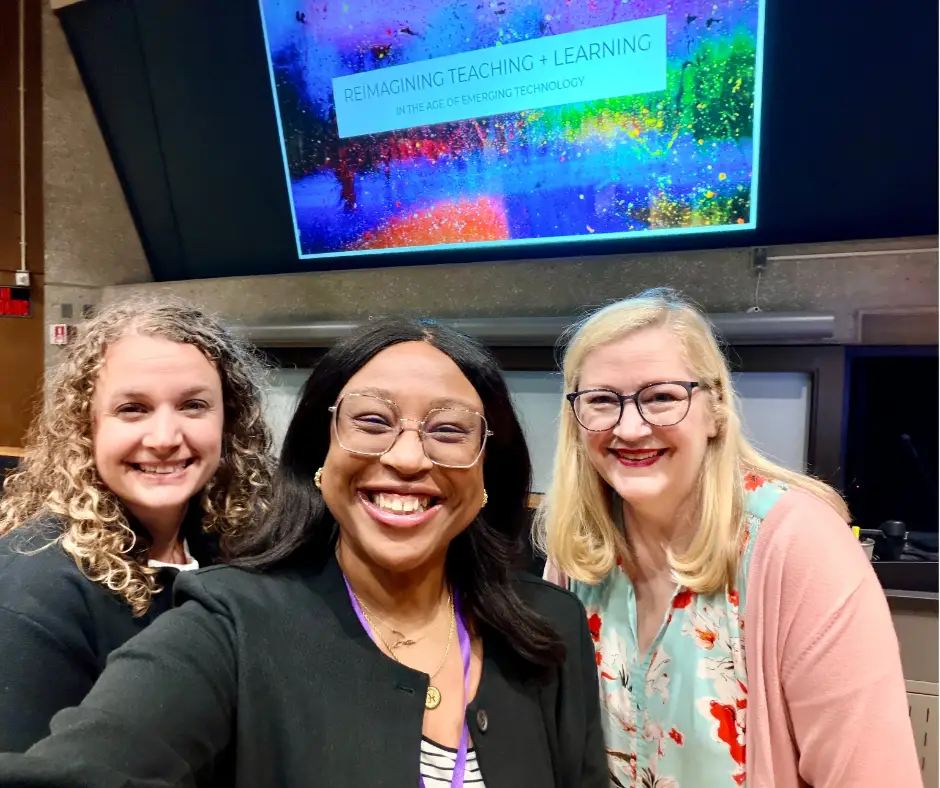
    Three women stand at the front of a large lecture hall in front of a colorful presentation slide

    VaNessa and Christina already know each other and I know them. Still, this memory we now share tightens the bond between us and now creates a triangular relationship between the three of us. Again, not necessarily closing triangles here. But certainly doing something new with going from one-on-one relationships and now having this shared triangle to remember and potentially strengthen in the future.


    PS. My talk was aligned with the conference theme (innovation). I had some fun with alliteration and divided the talk into: 1) innovation 2) imagination and 3) imitation (which was kinda like curation, but I just couldn’t break the alliteration streak I was on there). In my reading for the topic of connectors, I just saw a quick reference in Beth Kanter’s piece that Jarche shared about how helpful network weaving can be when we’re “stumbling through the fog of innovation.” I like that phrase “fog of innovation” and only wish I had come across it before today’s keynote. 🤦‍♀️🫠

    Source link

  • Weaving digital citizenship into edtech innovation

    Weaving digital citizenship into edtech innovation

    Key points:

    What happens when over 100 passionate educators converge in Chicago to celebrate two decades of educational innovation? A few weeks ago, I had the thrilling opportunity to immerse myself in the 20th anniversary of the Discovery Educator Network (the DEN), a week-long journey that reignited my passion for transforming classrooms.

    From sunrise to past sunset, my days at Loyola University were a whirlwind of learning, laughter, and relentless exploration. Living the dorm life, forging new connections, and rekindling old friendships, we collectively dove deep into the future of learning, creating experiences that went far beyond the typical professional development.

    As an inaugural DEN member, the professional learning community supported by Discovery Education, I was incredibly excited to return 20 years after its founding to guide a small group of educators through the bountiful innovations of the DEN Summer Institute (DENSI). Think scavenger hunts, enlightening workshops, and collaborative creations–every moment was packed with cutting-edge ideas and practical strategies for weaving technology seamlessly into our teaching, ensuring our students are truly future-ready.

    During my time at DENSI, I learned a lot of new tips and tricks that I will pass on to the educators I collaborate with. From AI’s potential to the various new ways to work together online, participants in this unique event learned a number of ways to weave digital citizenship into edtech innovation. I’ve narrowed them down to five core concepts; each a powerful step toward building future-ready classrooms and fostering truly responsible digital citizens.

    Use of artificial intelligence

    Technology integration: When modeling responsible AI use, key technology tools could include generative platforms like Gemini, NotebookLM, Magic School AI, and Brisk, acting as ‘thought partners’ for brainstorming, summarizing, and drafting. Integration also covers AI grammar/spell-checkers, data visualization tools, and feedback tools for refining writing, presenting information, and self-assessment, enhancing digital content interaction and production.

    Learning & application: Teaching students to ethically use AI is key. This involves modeling critical evaluation of AI content for bias and inaccuracies. For instance, providing students with an AI summary of a historical event to fact-check with credible sources. Students learn to apply AI as a thought partner, boosting creativity and collaboration, not replacing their own thinking. Fact-checking and integrating their unique voices are essential. An English class could use AI to brainstorm plot ideas, but students develop characters and write the narrative. Application includes using AI for writing refinement and data exploration, fostering understanding of AI’s academic capabilities and limitations.

    Connection to digital citizenship: This example predominantly connects to digital citizenship. Teaching responsible AI use promotes intellectual honesty and information literacy. Students can grasp ethical considerations like plagiarism and proper attribution. The “red, yellow, green” stoplight method provides a framework for AI use, teaching students when to use AI as a collaborator, editor, or thought partner–or not at all.This approach cultivates critical thinking and empowers students to navigate the digital landscape with integrity, preparing them as responsible digital citizens understanding AI’s implications.

    Digital communication

    Technology integration: Creating digital communication norms should focus on clarity with visuals like infographics, screenshots, and video clips. Canva is a key tool for a visual “Digital Communication Agreement” defining online interaction expectations. Include student voice by the integration and use of pictures and graphics to illustrate behaviors and potentially collaborative presentation / polling tools for student involvement in norm-setting.

    Learning & application: Establishing clear online interaction norms is the focus of digital communication. Applying clear principles teaches the importance of visuals and setting communication goals. Creating a visual “Digital Communication Agreement” with Canva is a practical application where students define respectful online language and netiquette. An elementary class might design a virtual classroom rules poster, showing chat emojis and explaining “think before you post.” Using screenshots and “SMART goals” for online discussions reinforces learning, teaching constructive feedback and respectful debate. In a middle school science discussion board, the teacher could model a respectful response like “I understand your point, but I’m wondering if…” This helps students apply effective digital communication principles.

    Connection to digital citizenship: This example fosters respectful communication, empathy, and understanding of online social norms. By creating and adhering to a “Digital Communication Agreement,” students develop responsibility for online interactions. Emphasizing respectful language and netiquette cultivates empathy and awareness of their words’ impact. This prepares them as considerate digital citizens, contributing positively to inclusive online communities.

    Content curation

    Technology integration: For understanding digital footprints, one primary tool is Google Drive when used as a digital folder to curate students’ content. The “Tech Toolbox” concept implies interaction with various digital platforms where online presence exists. Use of many tools to curate content allows students to leave traces on a range of technologies forming their collective digital footprint.

    Learning & application: This centers on educating students about their online presence’s permanence and nature. Teaching them to curate digital content in a structured way, like using a Google Drive folder, is key. A student could create a “Digital Portfolio” in Google Drive with online projects, proud social media posts, and reflections on their public identity. By collecting and reviewing online artifacts, students visualize their current “digital footprint.” The classroom “listening tour” encourages critical self-reflection, prompting students to think about why they share online and how to be intentional about their online identity. This might involve students reviewing anonymized social media profiles, discussing the impression given to future employers.

    Connection to digital citizenship: This example cultivates awareness of online permanence, privacy, responsible self-presentation, and reputation management. Understanding lasting digital traces empowers students to make informed decisions. The reflection process encourages the consideration of their footprint’s impact, fostering ownership and accountability for online behavior. This helps them become mindful, capable digital citizens.

    Promoting media literacy

    Technology integration: One way to promote media literacy is by using “Paperslides” for engaging content creation, leveraging cameras and simple video recording. This concept gained popularity at the beginning of the DEN through Dr. Lodge McCammon. Dr. Lodge’s popular 1-Take Paperslide Video strategy is to “hit record, present your material, then hit stop, and your product is done” style of video creation is something that anyone can start using tomorrow. Integration uses real-life examples (likely digital media) to share a variety of topics for any audience. Additionally, to apply “Pay Full Attention” in a digital context implies online viewing platforms and communication tools for modeling digital eye contact and verbal cues.

    Learning & application: Integrating critical media consumption with engaging content creation is the focus. Students learn to leverage “Paperslides” or another video creation method to explain topics or present research, moving beyond passive consumption. For a history project, students could create “Paperslides” explaining World War II causes, sourcing information and depicting events. Learning involves using real-life examples to discern credible online sources, understanding misinformation and bias. A lesson might show a satirical news article, guiding students to verify sources and claims through their storyboard portion. Applying “Pay Full Attention” teaches active, critical viewing, minimizing distractions. During a class viewing of an educational video, students could pause to discuss presenter credentials or unsupported claims, mimicking active listening. This fosters practical media literacy in creating and consuming digital content.

    Connection to digital citizenship: This example enhances media literacy, critical online information evaluation, and understanding persuasive techniques. Learning to create and critically consume content makes students informed, responsible digital participants. They identify and question sources, essential for navigating a digital information-saturated world. This empowers them as discerning digital citizens, contributing thoughtfully to online content.

    Collaborative problem-solving

    Technology integration: For practicing digital empathy and support, key tools are collaborative online documents like Google Docs and Google Slides. Integration extends to online discussion forums (Google Classroom, Flip) for empathetic dialogue, and project management tools (Trello, Asana) for transparent organization. 

    Learning & application: This focuses on developing effective collaborative skills and empathetic communication in digital spaces. Students learn to work together on shared documents, applying a “Co-Teacher or Model Lessons” approach where they “co-teach” each other new tools or concepts. In a group science experiment, students might use a shared Google Doc to plan methodology, with one “co-teaching” data table insertion from Google Sheets. They practice constructive feedback and model active listening in digital settings, using chat for clarification or emojis for feelings. The “red, yellow, green” policy provides a clear framework for online group work, teaching when to seek help, proceed cautiously, or move forward confidently. For a research project, “red” means needing a group huddle, “yellow” is proceeding with caution, and “green” is ready for review.

    Connection to digital citizenship: This example is central to digital citizenship, developing empathy, respectful collaboration, and responsible problem-solving in digital environments. Structured online group work teaches how to navigate disagreements and offers supportive feedback. Emphasis on active listening and empathetic responses helps internalize civility, preparing students as considerate digital citizens contributing positively to online communities.

    These examples offer a powerful roadmap for cultivating essential digital citizenship skills and preparing all learners to be future-ready. The collective impact of thoughtfully utilizing these or similar approaches , or even grab and go resources from programs such as Discovery Education’s Digital Citizenship Initiative, can provide the foundation for a strong academic and empathetic school year, empowering educators and students alike to navigate the digital world with confidence, integrity, and a deep understanding of their role as responsible digital citizens.

    In addition, this event reminded me of the power of professional learning communities.  Every educator needs and deserves a supportive community that will share ideas, push their thinking, and support their professional development. One of my long-standing communities is the Discovery Educator Network (which is currently accepting applications for membership). 

    Latest posts by eSchool Media Contributors (see all)

    Source link