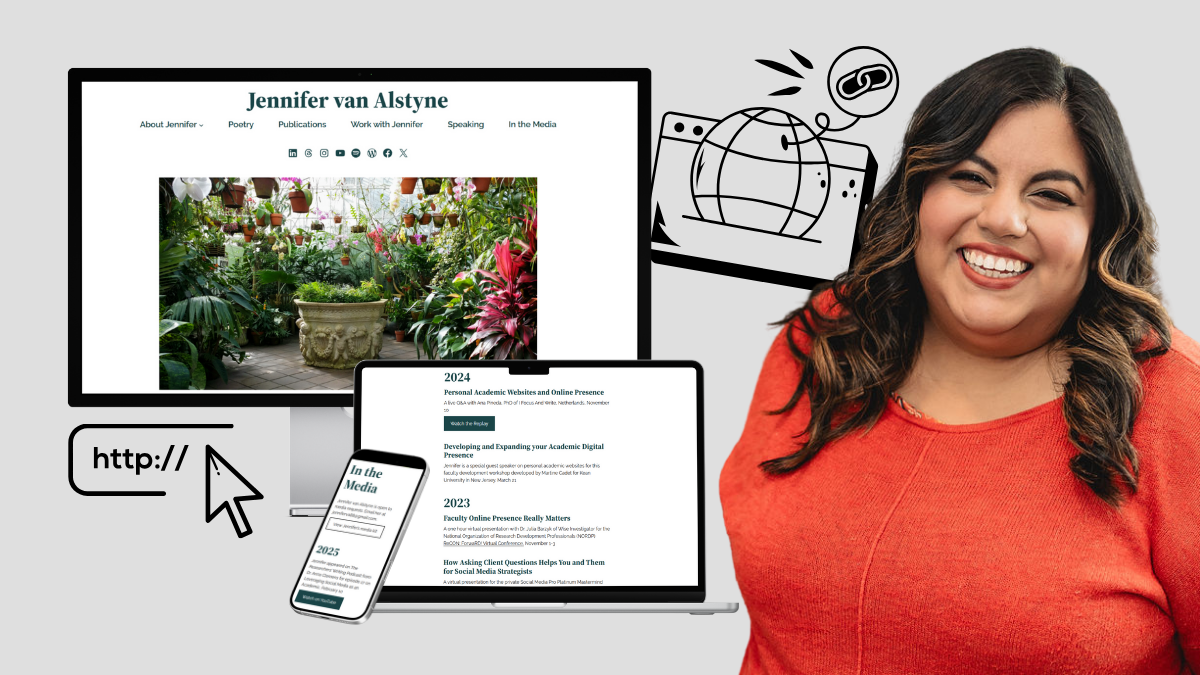
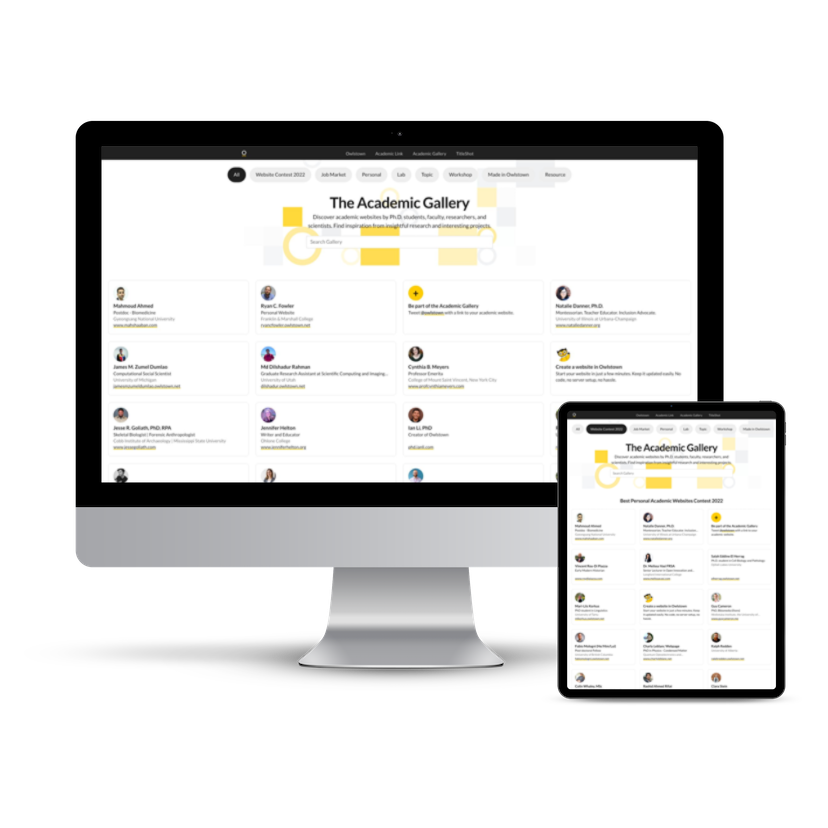
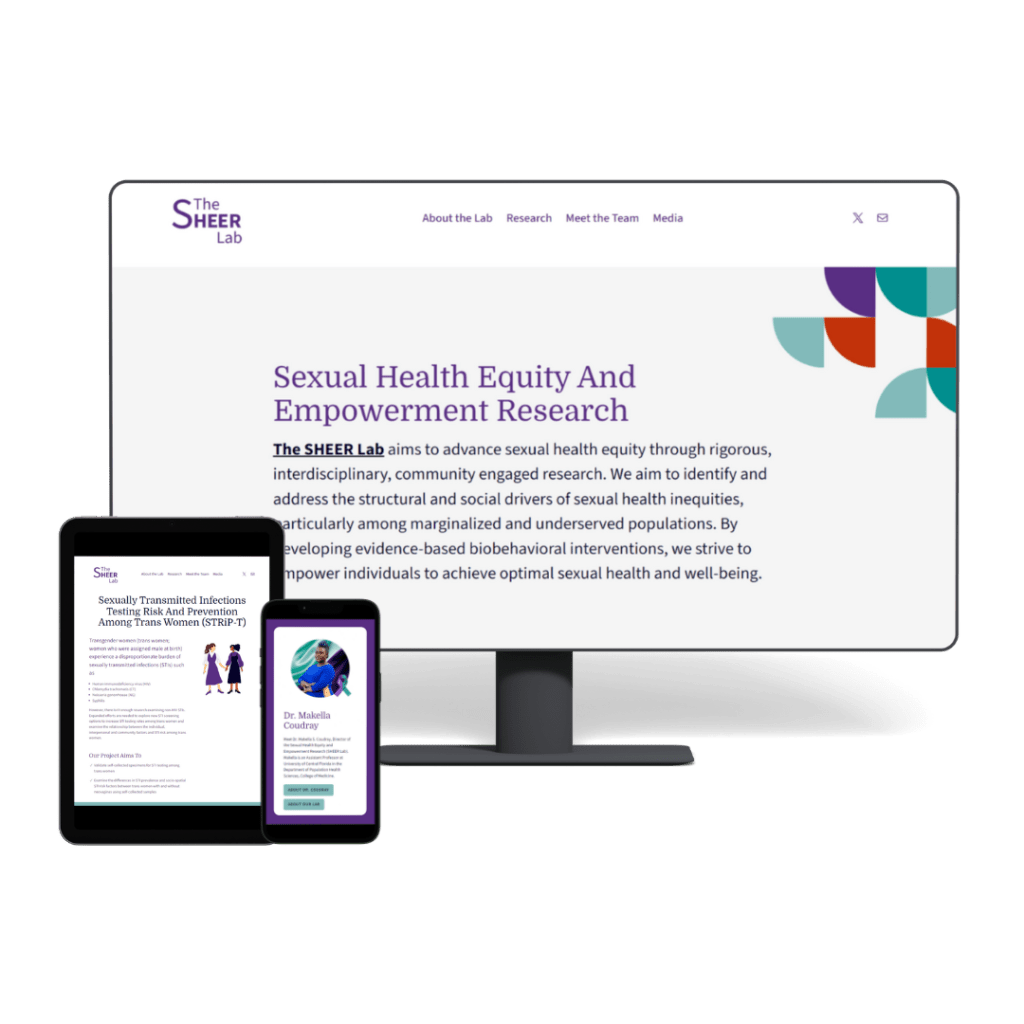
Congratulations to the winners of the 2025 Best Personal Academic Websites Contest hosted by Jennifer van Alstyne, Brittany Trinh, and Ian Li. This contest celebrates great examples of academic websites from people in Higher Education.
About the Awards
Congratulations to this year’s award winning academic websites!
Hi there, I’m Jennifer van Alstyne. This is our 3rd Best Personal Academic Websites Contest. This page celebrates the 2025 award winners. We hope their websites help inspire people around the world to create space for themselves online. Please share these award winning websites with a friend you think should have a website too.
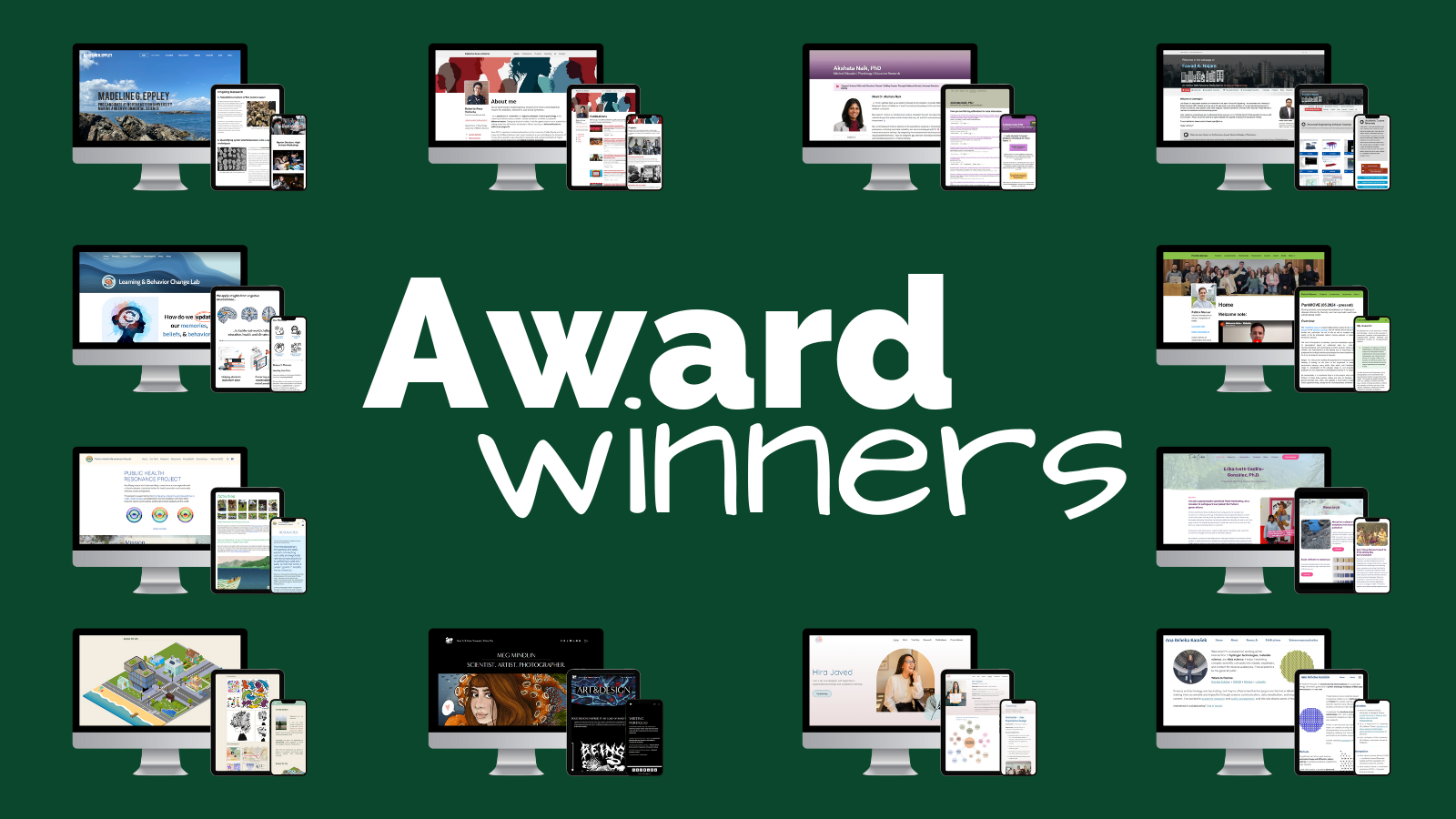
There are 12 award winners in this year’s contest. In a year we’ve had more entries than ever before, these academic website stood out. Each of the award winners in this year’s contest received a perfect score from the judges.
While their websites may grow and change with them over time, these award winning academic websites deserve to be celebrated for the work they’re already doing to share their story. Thank you.
Best wishes, Your Contest Co-Hosts
Jennifer van Alstyne of The Social Academic
Brittany Trinh of the Beyond Your Science Podcast
Ian Li, PhD of Owlstown
What you’ll find on this page
Check out the award winning websites
Read what inspired people to create their website
Find what the judges thought
Resources to help you create a website of your own
Subscribe for when the contest re-opens in 2026
Thank you for participating in this year’s contest
To each person who entered their website into the Contest, thank you. Thank you for creating that space for yourself online. Thank you for being open to sharing it with people. I’m so glad your website is in the world.
Would you like feedback from the judges on your website? We’re happy to share our thoughts with you if you’d find it helpful. Each person who entered the 2025 contest can request feedback from the judges. Email Jennifer van Alstyne at [email protected]
The Best Personal Academic Websites Contest was open for entries from April 22, 2025 and closed on August 15, 2025. It will reopen for entries in 2026.
Want to hear about next year’s contest? Subscribe to The Social Academic.
Overall Best Personal Academic Website Award
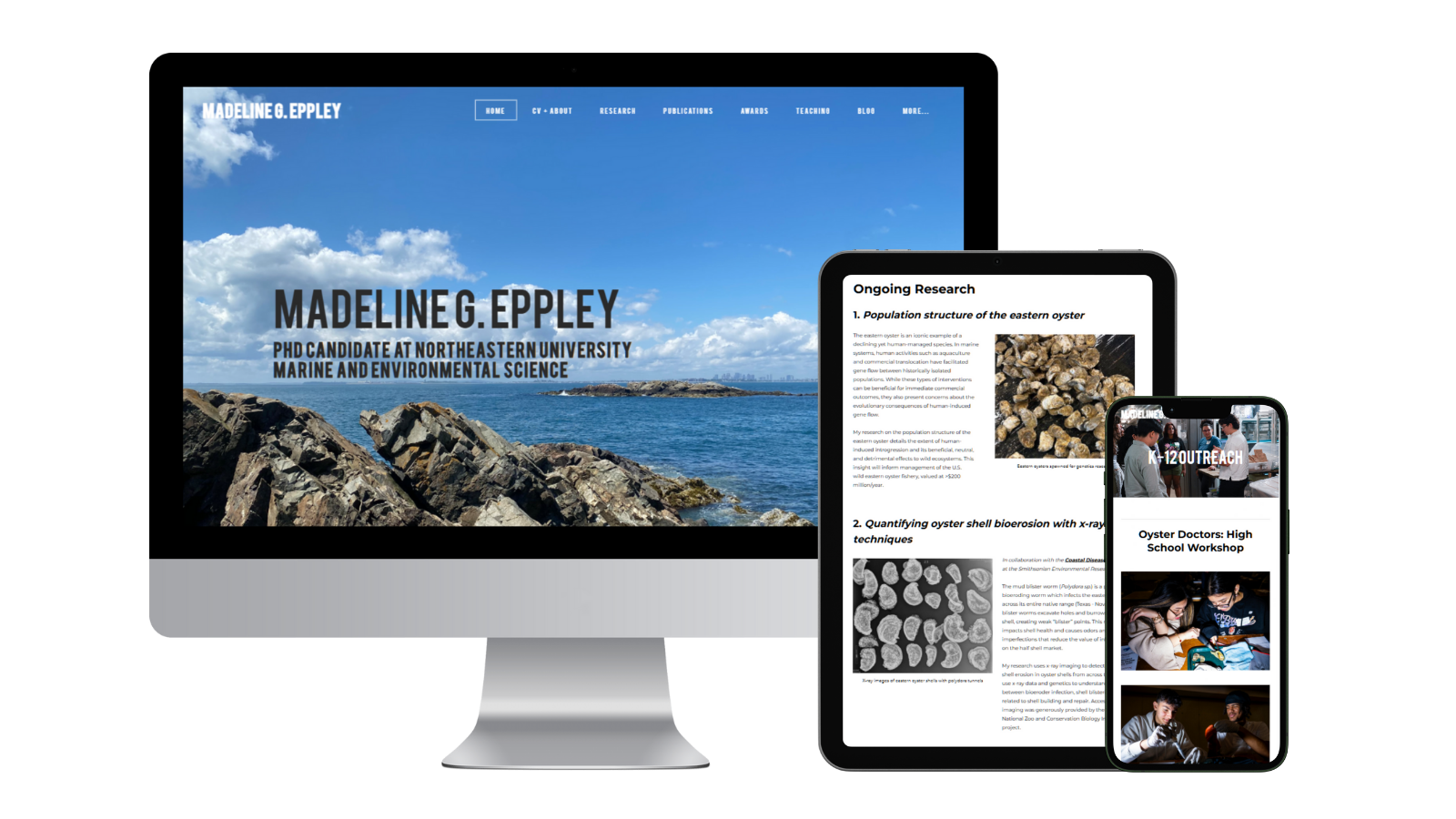
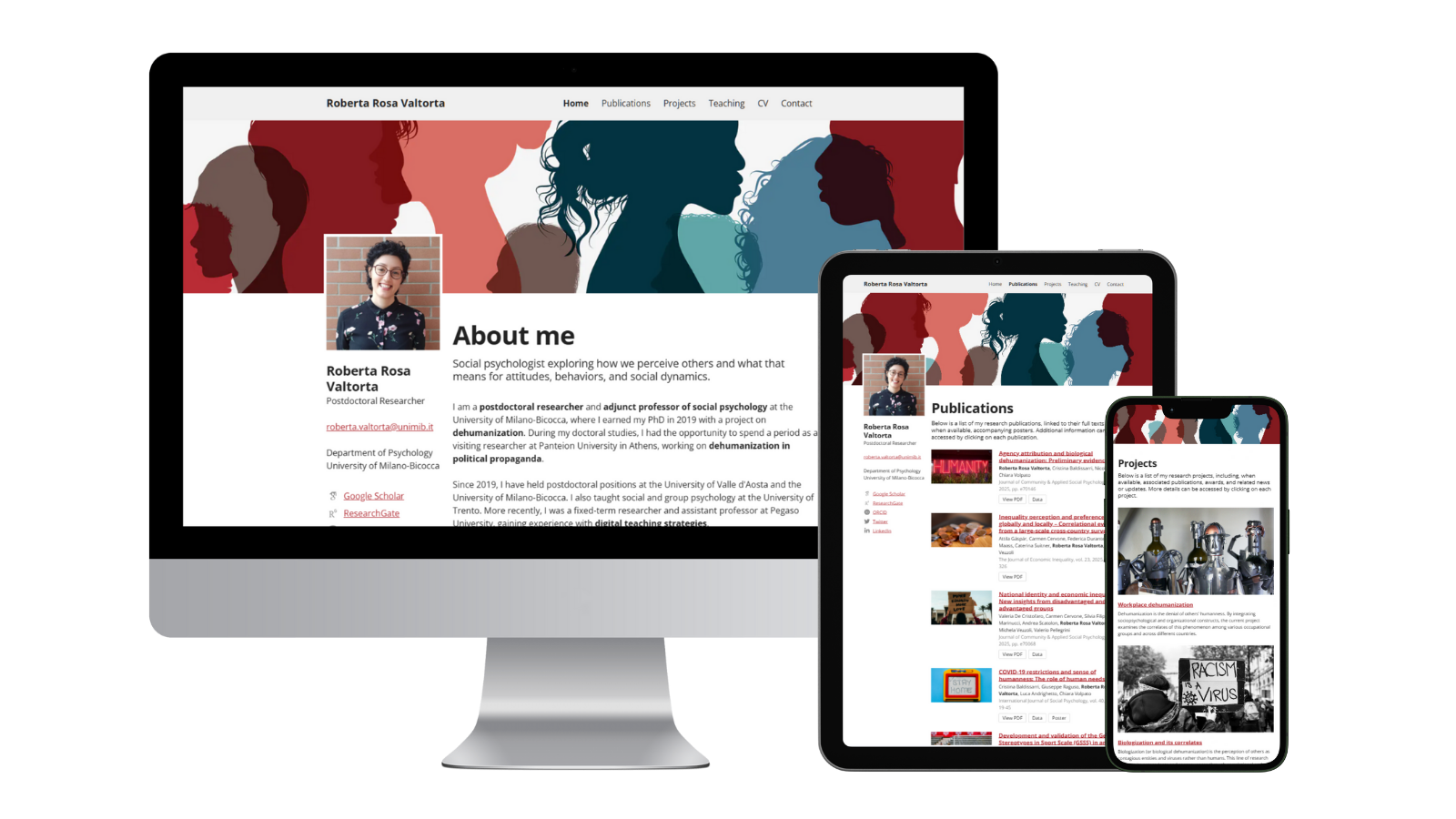
Madeline Eppley and Dr. Roberta Rosa Valtorta (tied)
“I made my website because I feel there is a substantial gap in science communication training for graduate students and the broader field of biology. I graduated undergrad in 2020 when a lot of networking and resources went virtual. During this really pivotal stage in my career development, I needed to develop better digital presence and science communication skills to keep pace with the rising importance of networking in virtual academic spaces (e.g. virtual conferences and social media). Through this process, I ended up finding my current PhD position on social media, and also built a digital network that made me feel more connected to the science community online.”
—Madeline Eppley
Notes from the judges
Jennifer van Alstyne: A visually engaging story-rich website. I hope Madeline’s website inspires people to take more photos because it makes such a difference. For instance, there’s a lot of content on this website, but it doesn’t feel overwhelming. While the top menu is initially hard to read, when I start scrolling there’s contrast. I like how Madeline’s research page shares ongoing research and completed research.
Brittany Trinh: I love Eppley’s website, from the bio to all the photos of the field research. On the homepage, Eppley makes her passion for research and science communication clear, as well as her future goals. The research page explains the importance and impact for each research project and specifies which projects are ongoing or completed. Looking at her website, I am now inspired to go update my own website and incorporate more science in it!
Ian Li: Eppley’s website is well-organized and provides a lot of details on what inspires her work and the results of her research. She also describes her outreach to college and high school students. Her blog has lots of stories about her research and experience on the field.
“I created my personal academic website for several reasons. First, to have one central place where all my work, publications, and projects are collected, making it easier for potential collaborators and anyone interested in my research to find accurate, up-to-date information. Second, to maintain control over my online presence, so that people searching for me don’t just find scattered pieces of information in different places. And finally, for a more personal reason: research can sometimes test self-esteem due to its competitiveness and constant pressure. Having a space where everything I have done is brought together helps me remember who I am, my roots, and the progress I have made.”
—Dr. Roberta Rosa Valtorta
Notes from the judges
Jennifer van Alstyne: A thoughtful use of space on an Owlstown website. Dr. Valtorta has an expansive portfolio of publications, projects, and teaching. This website also shares teaching values, such as ways courses contribute to the United Nations Sustainable Development Goals (SDGs). From downloadable syllabi to accessible data, this is a great academic website example.
Brittany Trinh: Valtorta’s website is great example of what you can do with an Owlstown website! The project pages include an overview, related awards, and related publications, which makes it easier to understand the impact of the research. The teaching pages provide a summary about the classes taught so we can understand the topics covered and importance of the course.
Ian Li: This is such a great example of an academic website. It is well-organized. Projects are described with related publications, Publications and courses are summarized well. Her intro describes her passion for her research and points to the development of her work. She also shares a blog that is regularly updated. She also provides information in both English and Italian, which widens the reach of her work.
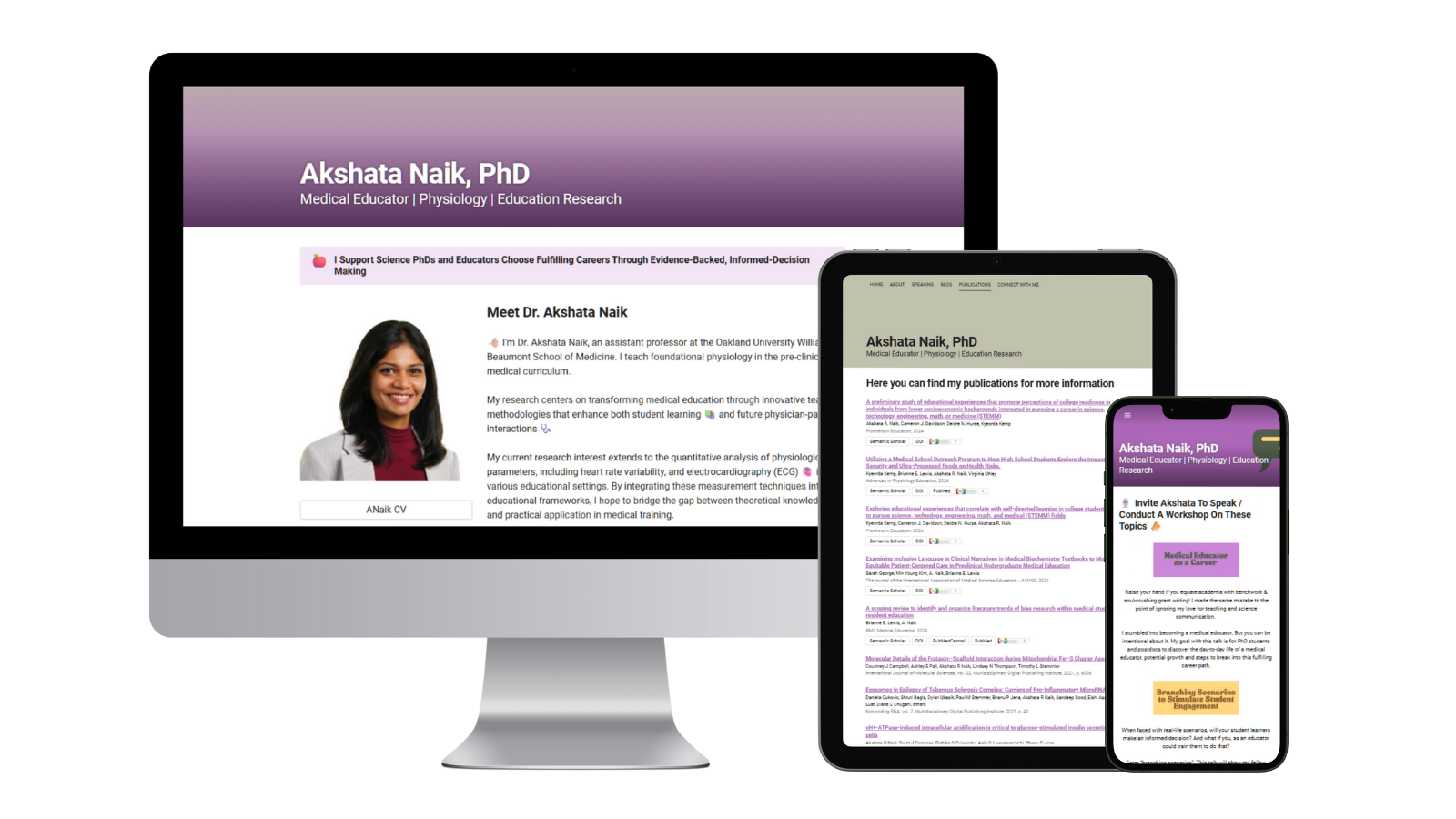
“I thrive on creativity! Science communication, teaching and new research ideas keep me going. So I wanted to create an online space to portray my work for networking with folks similar to my interests, and importantly serving the broader community via outreach. And being an academician is a good enough reason for building a digital presence as it strategically aligns with my tenure and promotion goals by amplifying the impact of my work beyond traditional boundaries.”
—Dr. Akshata Naik
Notes from the judges
Jennifer van Alstyne: I get such a sense of personality from an Owlstown website. This is great. Publications with abstracts make a difference. The buttons, like ‘Get to know me’ stand out as a lovely way to be approachable. The ‘Generated using Canva AI’ disclosure on an image on the blog feels thoughtful (and like the kind of information people appreciate even if they don’t use AI art themselves). The use of emojis in the middle of sentences isn’t ideal for accessibility, and is something I’d recommend revising.
Brittany Trinh: Naik does a great job on her Owlstown website sharing what she does and why she does it. My favorite page is her Speaking page because it highlights the different talks she has and shares more of her story.
Ian Li: Naik’s website is a great example of an Owlstown website. It’s very organized with information about herself, her publications, and her speaking engagements. She also shares a blog.
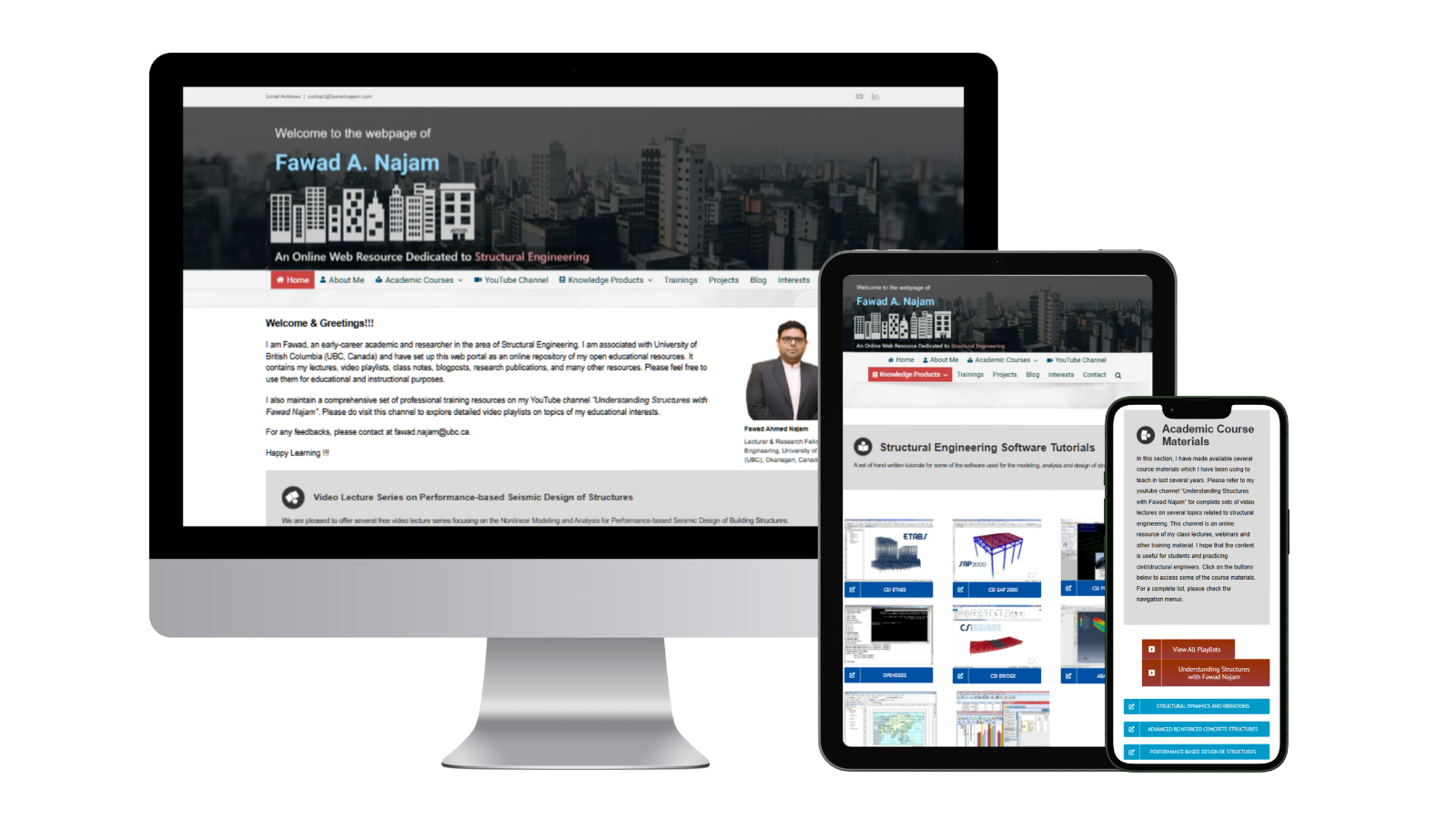
“I am an educator in the field of structural and earthquake engineering. I originally created my website to make structural and earthquake engineering concepts more accessible to my students, fellow educators, and professionals. My goal was to share open educational resources, interactive tools, and practical examples (I use in classroom) with a wider audience. Knowing that it is making a difference and inspiring others means a lot to me.”
—Dr. Fawad Ahmed Najam
Notes from the judges
Jennifer van Alstyne: A wealth of resources made accessible through this online space and good organization. While I don’t love the rotating icons for accessibility, every page of this website has videos, articles, blogs, and data to help people. I hope this website inspires people to consider: what do I already have that can help my students I’m open to sharing online?
Brittany Trinh: Najam’s website is jam-packed with resources for his courses. His website is well organized and the content is probably super helpful to his students and others who are interested in structural engineering!
Ian Li: If you want to learn about structural engineering, Najam’s website is the place to go. It is well-organized and has pages for course materials, YouTube videos, links to publications and resources.
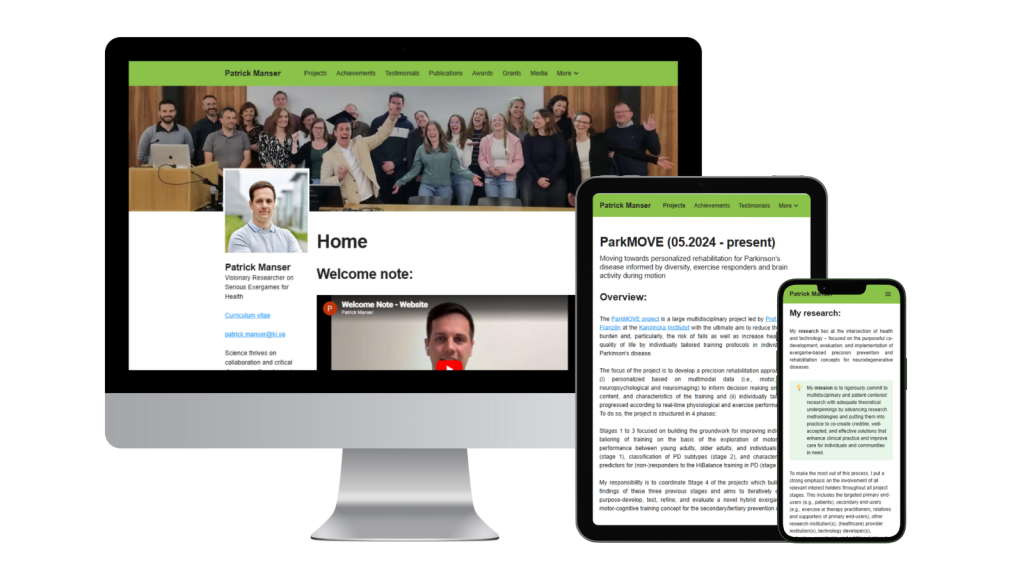
“I created my personal academic website to make my collaborative research more accessible, with the aim of fostering transparency, promoting interdisciplinary dialogue, and broadening the dissemination of knowledge. By sharing my work openly, I hope to spark new connections and collaborative efforts that not only advance science but also translate research into meaningful improvements in healthcare and community-based health promotion.”
—Dr. Patrick Manser
Notes from the judges
Jennifer van Alstyne: What a great welcome note video! I love it. That stood out because it was simple and invites folks to explore areas of the website. I felt like if I didn’t explore anywhere else, the video shared what, why and invited folks to get in touch. This website has far more on it than expected. While it’s mostly text-based with few visuals, it’s clear, easy to read, and well organized. I hope this website inspires people to consider video. Ooh, and requesting testimonials for their website too.
Brittany Trinh: Manser’s website is very extensive regarding his research and how it has been highlighted in media. Additionally, he includes many stats regarding his academic contributions in many different areas such as awards, grants, peer review, and more.
Ian Li: Manser’s website is full of information on his research work: publications, courses taught, media, grants, etc. He also provides short descriptions for every item, so you have an introduction to the item. It’s a great example of how an academic website can serve as a portfolio.
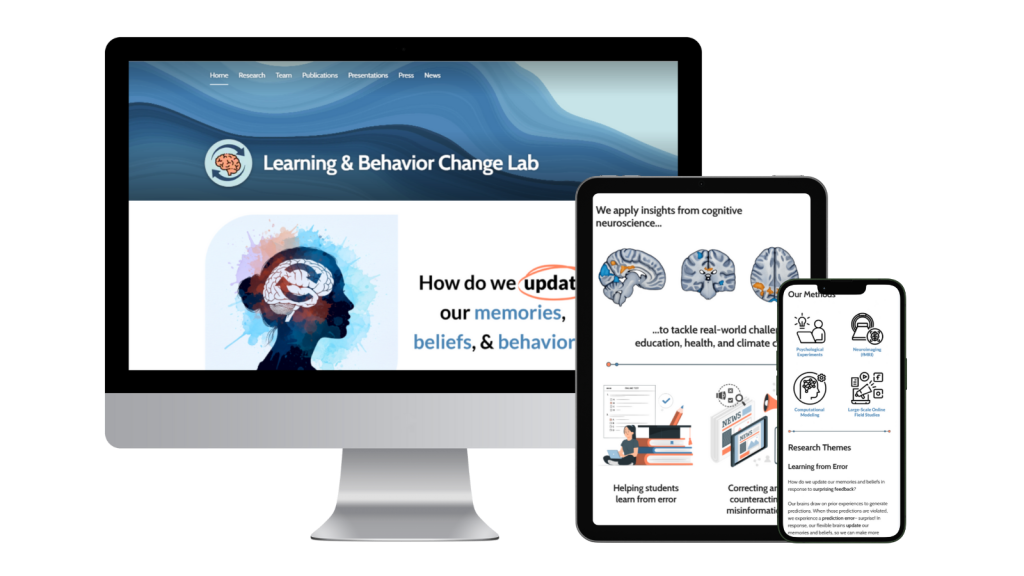
Dr. Allie Sinclair | Learning & Behavior Change Lab
“I was excited to make this website for my new lab, as I’ll be starting a faculty position at Rice University next year. I’ve spent many years dreaming of starting my own lab, although the exact vision has evolved over time. Now that the official website is ready, it finally feels real! I was motivated to create a fun and informative website this summer because I will be recruiting people to join my lab over the next year. I made the website with Owlstown, which made it easy to build and customize. I especially appreciated the features geared toward academics, like searching PubMed to find your publications and adding Altmetric badges.”
—Dr. Allie Sinclair
Notes from the judges
Jennifer van Alstyne: Scroll down the homepage of this website and you have a great sense of what their research is about. Words, graphics, and illustration shares the story, and we’re then invited to explore the research and team. Folks are getting so creative with their Owlstown sites. I like the illustrations. There’s a lot of info for folks who are considering joining the lab which shares it’s recruiting for Fall 2026. Cats, Lara Croft and Moxie the cats have their own space on the team page. Yes. I’m so into this.
Brittany Trinh: This is one of the best stylized Owlstown websites that I’ve seen. I love the cohesion of the color schemes in the visuals. I liked how they organized the research areas into three separate topics and had a link to the related publications. The publications page has the filter function so we can find papers related to a specific topic more easily.
Ian Li: This is a great example of a lab website. You get a comprehensive understanding of what the lab does. Research projects are summarized and linked to relevant papers. There’s also links to media appearances and collaborators. Plus, the website is beautifully done with graphics and well-chosen colors.
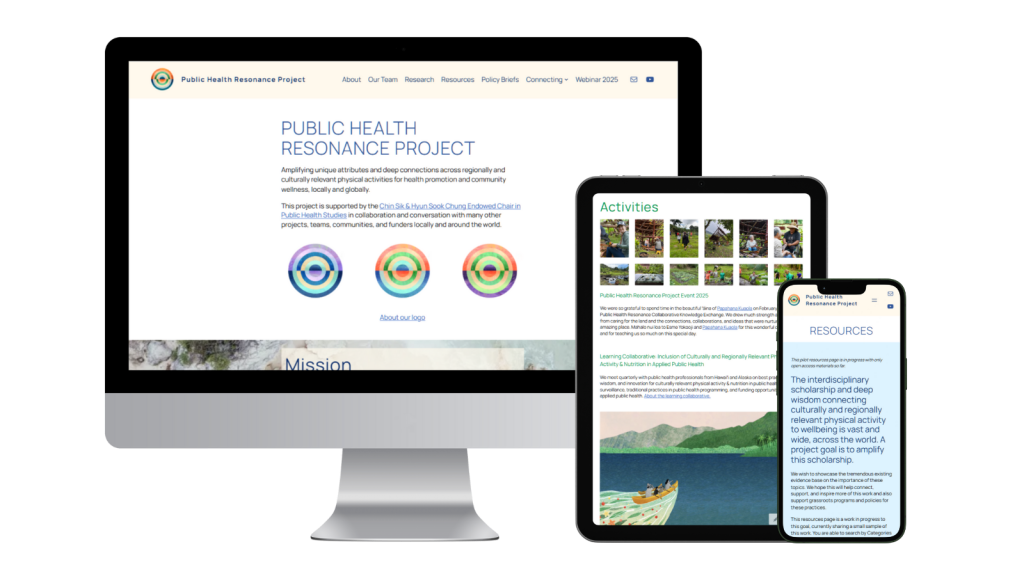
Dr. Tetine Sentell | Public Health Resonance Project
“Our interdisciplinary public health research collaboration is working together to help build the evidence base for regionally and culturally relevant physical activity for public health promotion. This work is designed to help connect and build this evidence base for public health promotion to produce actionable results for individuals, advocates, and communities to improve health outcomes and health equity. We wanted a beautiful and well-organized website to share information to support this goal. We plan to keep building on this website as the project continues and have been grateful to Jennifer van Alstyne for her support to make this possible!”
—Dr. Tetine Sentell
Notes from the judges
Jennifer van Alstyne designed this website. She did not judge this entry.
Brittany Trinh: This website is very well organized on their research page. Additionally, I love the use of real photos of the group in action in the field or at different events. It adds a personal flair to the website that makes it unique!
Ian Li: This website is a great example of a lab website. It has full descriptions of lab members, research projects, lab activities, and outreach. It shares links to media and conference appearances. You get a detailed picture of what the lab does.
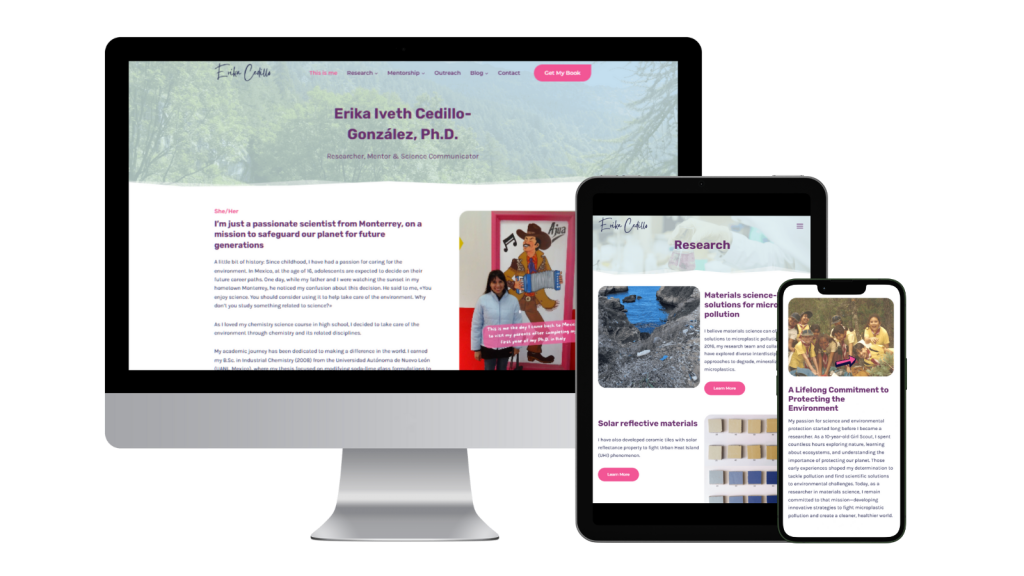
“I built my academic website to share what university profiles never did: my passion for research, my path as a mentor, and my dedication to protecting our planet. I believe each person in Academia carries a unique and inspiring journey that led them to science. A personal academic website offers the perfect space to share such story and remind others that research is also deeply human.”
—Dr. Erika Iveth Cedillo-González
Notes from the judges
Jennifer van Alstyne: Personal and professional with pops of color. This website shares Dr. Erika Iveth Cedillo-González’ passion for science. It has science communication that invites the general public to learn and engage. There’s clarity not only on what the research is about, but how it impacts people. Accessible communication without sacrificing the science, in this website you get both.
Brittany Trinh: I love how Cedillo tells her story of how she became a scientist and how it informs her research right from the start on her homepage. I also love that she has a blog for the Spanish-speaking ECR community, which serves as a resource and ties into her purpose and mission.
Ian Li: The story of Cedillo’s work really comes together on this website. Her bio shows what inspires Cedillo, then her research shows how inspiration resulted in findings, then her outreach shows how she spreads her research to the broader community.
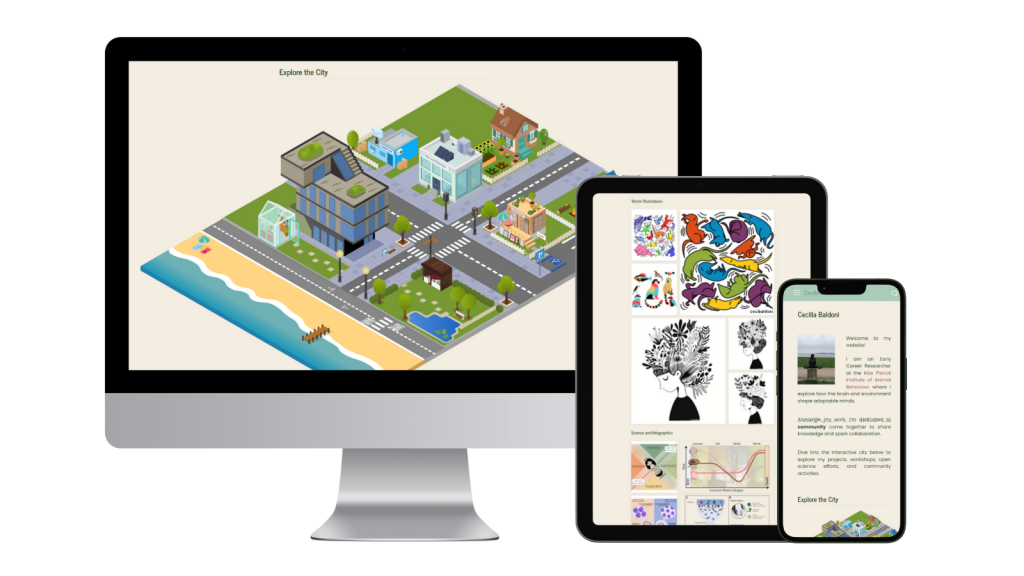
“I was looking for a new fun way to express my creativity, and learn new ways to code and use version control!”
—Dr. Cecilia Baldoni
Notes from the judges
Jennifer van Alstyne: Wow. I love the homepage interactivity. The blog post on Sketchnoting was great and the photos had captions. The Shrews page was visually engaging. I wish the text were a bit bigger (it felt like a lot of negative space on the text side). I’m obsessed with the Projects > Illustrations page. What a cute title page for their dissertation! Go explore this website. I hope it helps you imagine what’s possible for sharing your story too.
Brittany Trinh: My favorite page is the Shrews webpage. As you scroll down the story and research unfold, and it’s a very unique way to share their research findings.
Ian Li: The website has a bunch of interesting interactive elements. The Shrew’s page is a great example of how research can be presented in an interactive manner which elevates the understanding of the work. Baldoni also shares her slides which are viewable directly on the browser. Also, the city-like navigation on the front page.
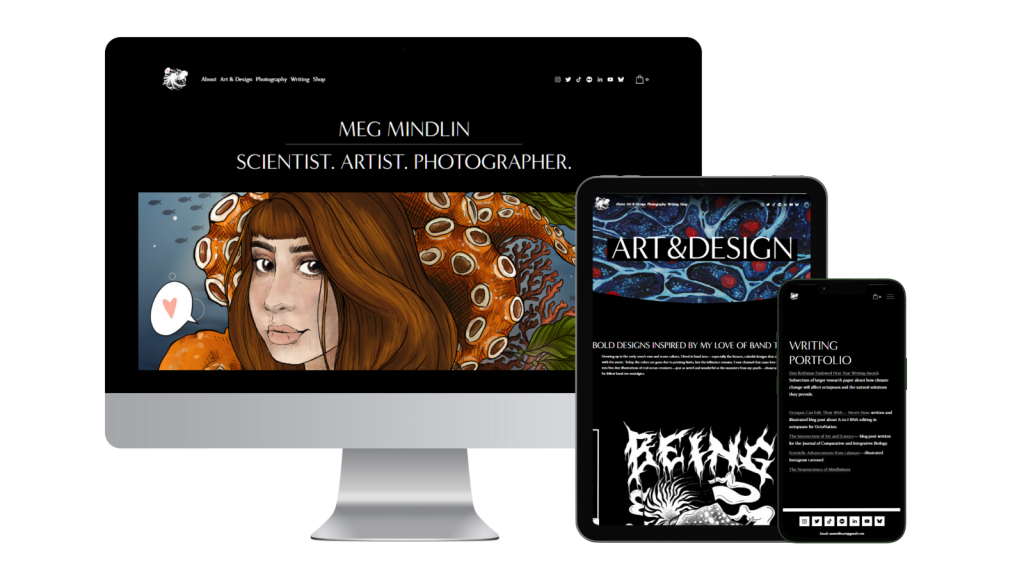
“I’ve always had a website for my art portfolio, and as I was about to enter the real world, post graduate school, I saw no reason to not also utilize my website for my scientific endeavors. Especially with a budding career as a science communicator.”
—Meg Mindlin
Notes from the judges
Jennifer van Alstyne did not judge Meg Mindlin’s website for this contest.
Brittany Trinh: I love this website so much! It is a great example of how to incorporate your science and entrepreneurial ventures, while tying it together with your personal story! It is now my inspiration to update my own website.
Ian Li: The illustrations and photography on this website are awesome. It’s a great example of visual communication of science.
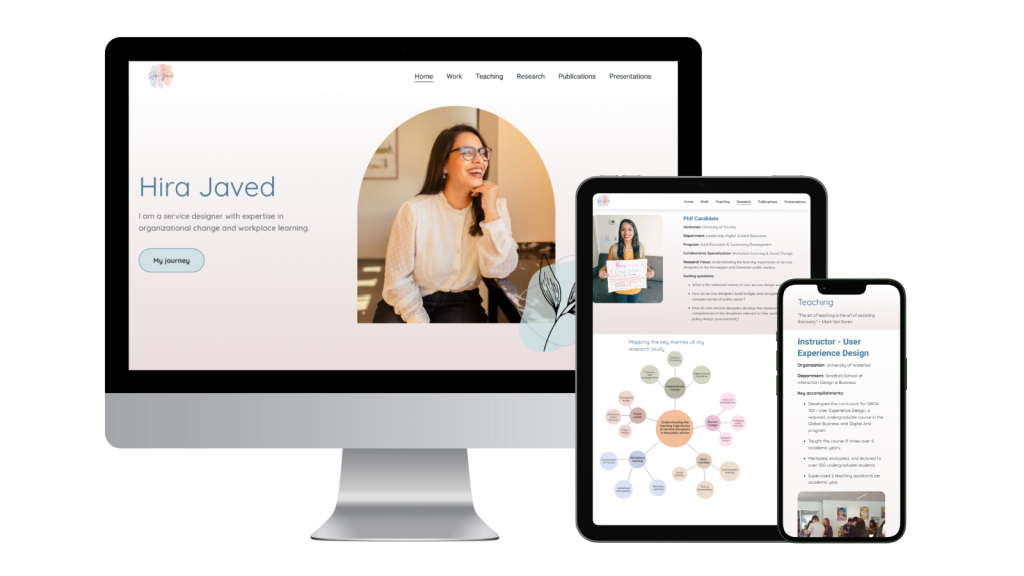
“I made this website to tell the story of my non-linear, multidisciplinary career trajectory. It was an excellent reflective exercise for me.”
—Hira Javed
Notes from the judges
Jennifer van Alstyne: This felt like a great portfolio website. A professional, resume-esque website without apology. I love that. The graphics are informative, visually engaging, and are thoughtful uses of color throughout the website. I wish that the My Journey section were built into the website rather than graphics. This section is beautiful, but the graphics make it less accessible. A favorite part of this website is the Presentations page where there’s a photo from each conference or event. That’s the dream.
Brittany Trinh: I love the color palette and cohesion between the illustrations. I also like how Javed’s resume is color-coded and organized- it’s a creative way to showcase your experience, which you can only do on a website, and not in your resume.
Ian Li: The coordination of the colors between the background, fonts, and graphical elements is really well done. The design serves the presentation of the Javed’s research projects, teaching, and presentations.
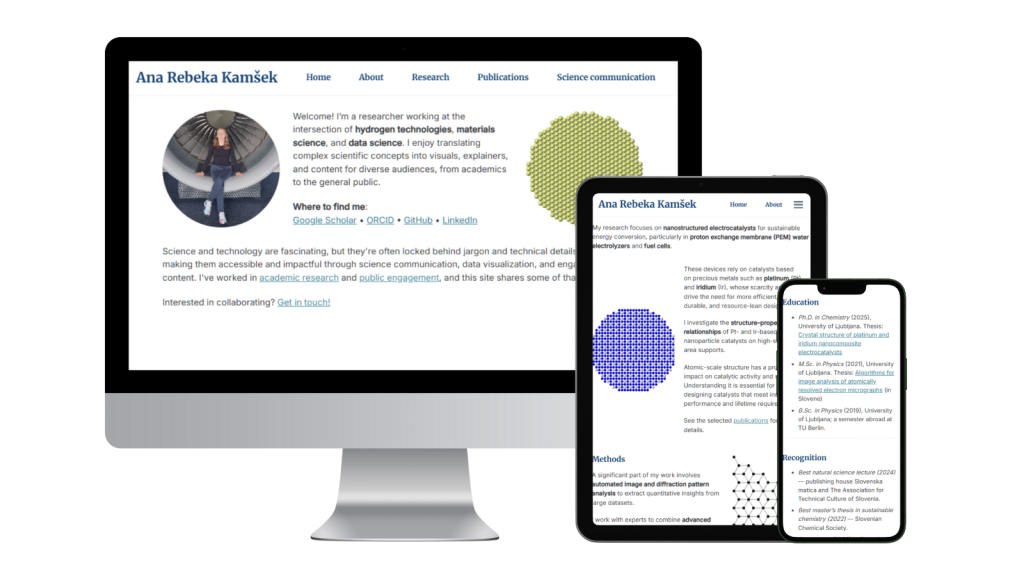
“As a researcher interested in science outreach, I noticed my work was spread across platforms. People who searched for my scientific papers rarely saw what I wrote for the public, and the mix of English and Slovenian further split my audience. I wanted a home where visitors could find everything I’m proud of, regardless of language or format. A personal website felt right, and the Best Personal Academic Websites Contest nudged me to make it happen.”
—Dr. Ana Rebeka Kamšek
Notes from the judges
Jennifer van Alstyne: Dr. Ana Rebeka Kamšek starts her website by sharing her value “I believe in making them accessible and impactful through science communication, data visualization, and engaging digital content.” This website does exactly that. You don’t need a huge website to share your story. A few figures, photos, with thoughtful text that considers what to say and how to share it.
Brittany Trinh: I like that Kamsek’s publications page includes a short overview and takeaway from the papers, instead of relying just on the abstract. Additionally, the papers, related news highlights, and codes are linked for easy access.
Ian Li: I really liked that Kamsek grouped her papers and described the relevance of each grouping. She also listed the related papers and linked to them. This made it easier to understand her work in context. She did something similar in the Science Communication page.
At first glance, Southeastern Michigan University’s website looks like it represents a real institution.
Smiling students in graduation regalia embrace, diplomas in hand, in the video on the front page. A chat bot pops up to ask, “How can I help you?” Southeastern Michigan’s website touts the university’s scholarships, array of accredited academic programs, award-winning faculty, 75 percent graduation rate and “vibrant campus life.”
But littered throughout the website are signs that something is off about Southeastern Michigan.
Blurry backgrounds and distorted limbs hint at the use of generative artificial intelligence. Some images seem likely to fool the untrained eye, while others—like a basketball player with veins bulging from his angular arms—could have been ripped from a poorly illustrated comic book. Meanwhile, paragraphs of text contain repetitive, grandiose and nonspecific language, characteristic of a chat bot’s writing.
In reality, the university is as fake as some of the content on its website. And it’s part of a much larger scam fueled in part by the rise of generative AI.
Some of the images on Southeastern Michigan University website appeared to be AI-generated.
“It took me a while to realize it wasn’t an actual institution,” said Aaron Ament, president of the National Student Legal Defense Network and a lawyer who has investigated for-profit colleges that have defrauded students. “For the average person who’s looking for a program, you could easily see how people would think it’s a real institution.”
Michigan attorney general Dana Nessel warned consumers about Southeastern Michigan University in an alert last week, following a complaint from Eastern Michigan University to her office about the fraudulent website using deceptive practices in an effort to scam students.
Southeastern Michigan is one of nearly 40 fake university sites that Inside Higher Ed recently uncovered, which appear to have been developed with or supplemented by AI. The sites seem to be part of a network, based on the use of identical language, the repetition of images and other design similarities. And many of these fake colleges also have a presence on social media sites, including LinkedIn, Instagram and Facebook.
An Inside Higher Ed analysis also turned up dozens of websites for nonexistent accreditors and a fake U.S. Department of Education website. They all contain at least some AI-generated images and design templates similar to the college websites’, including many that list those fake accreditors—and link to their websites—to give an air of legitimacy. The Education Department is also investigating the scam.
But the network uncovered by Inside Higher Ed reveals how the rise of generative AI is making it faster and easier for scammers to repackage an old ruse and deploy it on a much larger scale.
“This lowers the transaction costs for making a scam site,” said Jose Marichal, a professor of political science at California Lutheran University who studies how algorithms and AI are restructuring social and political institutions. “If I wanted to do this [before generative AI], it would have taken me a week, maybe a month, to put all this together. Now, it would take me a matter of hours.”
AI Increases Scammers’ Reach
The technology is also making it harder for consumers to immediately recognize fraudulent websites like Southeastern Michigan’s and dozens of other similar scam college websites Inside Higher Ed identified.
Large language models—which can immediately generate text and images like those populating the scam college websites—are becoming more sophisticated at mimicking human-created content by the day. For example, last week OpenAI released GPT-5, the latest version of ChatGPT, advertising it as its “smartest, fastest, most useful model yet,” capable of putting “expert-level intelligence in everyone’s hands.”
While suspicious, Marichal couldn’t say for certain if the fraudulent college websites were created using generative AI. But Junfeng Yang, a computer science professor at Columbia University who helped develop a novel tool that can discern whether text was generated by an LLM, had one of his graduate students peruse Southeastern Michigan’s website. “It appears that the [university’s] engineering page is AI generated,” he said in an email.
“A year ago, if you tried to do this, you may have had some bugs to work out,” Marichal said of the scam college websites. “Now, we’re getting to a place where you could keep spitting these out and it doesn’t cost much to host it. If you make 100 of them, you increase your yield. Instead of casting one fishing line, you cast 20, upping your chances of catching fish.”
‘Didn’t Seem Legit’
One prospective student who was looking for a business degree program almost got hooked by Southeastern Michigan’s con, according to Walter Kraft, a spokesperson for Eastern Michigan University, which is a real, accredited institution in Ypsilanti.
The fake Southeastern Michigan University prompted a complaint to the state attorney general from Eastern Michigan University, which has accused it of deceptive practices.
Source: Inside Higher Ed
“He came across an institution named Southeastern Michigan University, and it looked legit to him,” Kraft said. “So he contacted them and received a phone call telling him that his total tuition would be, like, $31,000, but he would receive a 90 percent scholarship and would only have to pay $3,100.”
The fake university asked the would-be student to provide documents for his scholarship application, but he never followed up. Two days later, he got a call from a number spoofing Eastern Michigan’s admissions office number, and the person on the other line told him he got the scholarship, despite never receiving any of his documentation.
After that, he received an admissions offer on letterhead that looked similar to Eastern Michigan’s, which raised his suspicions.
“He could sense that it didn’t seem legit, didn’t seem right, and questioned it,” recalled Kraft, who said two or three other people have reported similar concerns about Southeastern Michigan’s website, though he’s not aware of anyone who has fallen for the scam.
A spokesperson with the Michigan attorney general’s office said the office had “not received complaints from any potential students losing money in connection to these websites” but had contacted officials in two other states about similar schemes and referred concerns to the Federal Trade Commission.
But that doesn’t mean other people haven’t been scammed—or won’t in the future. As of Wednesday, the website was still live.
“That’s problematic, because until somebody finds out who’s responsible and takes that site down, other prospective students could be victimized,” Kraft said. “We certainly don’t want that to happen.”
Universities Push Back
While Eastern Michigan went to the state attorney general, other universities that have encountered similar websites have sought recourse with the World Intellectual Property Organization, a group that mediates domain disputes.
George Washington and New York Universities, as well as the University of Houston system, have all filed successful complaints to challenge websites using their trademarks or a similar name and URL. Those complaints shed more light on the scheme, which appears to date to at least 2021, per archived copies of the websites that were taken down. In its filing, GWU pointed to Kenneth Stone, a person the university believed to be connected to the scheme through a company called Domain Lance, a forwarding service that allows users to redirect URLs.
(NYU did not name a specific individual in its WIPO complaint, which noted that “little is known of the respondent” and indicated the domain owner provided a contact address in Panama. However, another version of that website—New York University of Business and Technology—with a slightly different URL has already emerged.)
The University of Houston system also named Stone in a complaint filed in December, along with William Morocco and Cole Brad as the people believed to be behind the website. The filing suggests that Stone is in Panama, while the other two are in the U.S. In its second complaint, filed in May, Houston pointed to websites in Panama. Despite winning the domain dispute, another version of the contested website has since emerged.
Houston’s complaints indicated that multiple fake college websites were created last year. Three of the websites flagged by Houston were registered between July and October of 2024, and another followed early this year. The fake accreditor websites mentioned in Houston’s complaint were all registered on May 10 of last year, according to the WIPO filing.
Houston University of Texas is one of nearly 40 fake college websites uncovered by Inside Higher Ed.
Source: Inside Higher Ed
Inside Higher Ed contacted two of the individuals it believed to be the persons referenced in the complaint based on a review of public records and LinkedIn profiles, but neither responded. A review of public records, including website registration information, suggests all three individuals are in the U.S., though the fake university websites are hosted on servers located overseas.
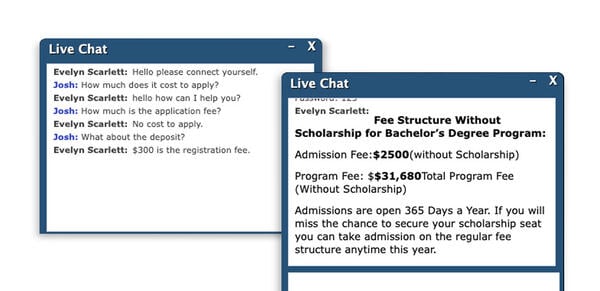
An Inside Higher Ed reporter also had conversations with individuals operating the chat service on three different websites connected to the network. After a reporter requested admissions info through Southeastern Michigan’s chat service, a woman called to talk him through the process.
Over a nearly half-hour conversation, the operator—a woman with a heavy accent—explained the tuition and fees, gave the reporter a password to a demo version of its student portal, and pressed hard for a $300 “registration fee.” When the reporter pushed back on the cost, she offered to lower it to $199 and stressed the importance of signing up while seats were available.
A chat operator at Southeastern Michigan University offered insights into the scheme.
Justin Morrison/Josh Moody
But when the reporter questioned the legitimacy of the operation, telling her it appeared to be a scam, she said, “I will suggest you contact the Department of Education, not me” and hung up.
Contacted by Inside Higher Ed, a Department of Education spokesperson wrote by email that “the department is currently investigating these malign activities and will work with the appropriate authorities to prevent predatory action toward our nation’s students.”
Sector Responses
Universities with similar names to fake college websites encouraged consumers to take steps to protect themselves from scams.
“Students have many affordable, high-quality education options among North Carolina’s public universities. It’s a shame that bad actors are creating fake university websites to prey on students who want to pursue their dreams of a college degree,” Andy Wallace, a spokesperson for the University of North Carolina system, wrote while encouraging people to report the sites.
University of Houston spokesperson Shawn Lindsey wrote by email that UH “continuously monitor[s] for threats, including false or misleading websites and domain names, and use[s] a variety of tools to support this vigilance” and noted UH’s legal team has acted on offending sites.
The Council for Higher Education Accreditation also condemned the rise of fraudulent college and accreditor websites designed to mimic legitimate institutions in an emailed statement.
“Accreditation is meant to assure quality and integrity in higher education—not to be misused as a tool for fraud,” CHEA president Nasser H. Paydar wrote. “These fake accreditors prey on the trust of students and the public, and we are committed to exposing and stopping them.”
But experts warn if these websites aren’t shut down—or similar ones continue to crop up—it could further weaken the public’s trust in higher education in an era marked by politicized attempts to discredit legitimate universities as overpriced and biased.
“People may not know what’s a real university and what isn’t, so they just throw their hands up and say, ‘Universities are too expensive anyway,’” said Marichal, the algorithm expert. “When people don’t know what’s true or false anymore, they’re less inclined to trust any of it.”
Join us for this informal chat about websites for academics in 2025. Some questions we cover:
What are your options for making your website?
What makes for the best website examples for academics?
How can I have a website fast (like today even)?
What should people prioritize when telling their story on their website?
What makes for the best portfolio websites (and what can go on them)?
Your contest co-hosts are back with another live to support your academic website project. Whether you’re a professor, researcher, scientist, postdoc, graduate student, independent scholar, you deserve space online.
Your website is no longer just a digital brochure. It’s the heart of your institution’s marketing, recruitment, and student engagement efforts. For most prospective students, it’s the very first touchpoint, and their decision to inquire, apply, or move on often hinges on what they find there.
More than 90% of students visit a college or university website during their school search. That means your site must not only attract attention but deliver a seamless experience that inspires trust and action.
What does that look like? It’s a blend of smart navigation, compelling visuals, personalized content, and performance that works flawlessly across all devices. It’s also about serving many different audiences, students, parents, alumni, and staff, without sacrificing clarity or focus.
In this article, we break down the 7 best practicesfor higher education websites, with examples from institutions putting them into action. These proven strategies will help your school build a web presence that engages users and drives real results, from exploration to enrollment.
Struggling with enrollment?
Our expert digital marketing services can help you attract and enroll more students!
1. Ensure a Mobile-Responsive, Mobile-First Design
Smartphones are the default browsing tool for most prospective students and their parents. If your institution’s website doesn’t offer a seamless mobile experience, you’re not just frustrating users; you’re losing them.
Why is mobile responsiveness crucial for higher education websites? Most students browse on mobile devices. A mobile-responsive site ensures readability, easy navigation, and fast loading, key for user experience and search rankings. Without it, your site could rank lower on Google and lose over half of the visitors who abandon slow or poorly displayed pages.
Mobile responsiveness means your content adjusts fluidly to any screen size, from smartphones to tablets. This isn’t a nice-to-have feature; it’s a necessity. Google now uses your site’s mobile version to determine how it ranks in search results (a process known as mobile-first indexing). If your site isn’t optimized for mobile, both your visibility and your credibility take a hit.
Use a responsive design that automatically adjusts layouts for smaller screens
Collapse navigation into a clean, mobile-friendly format
Display readable text without requiring zoom
Feature buttons and links that are easy to tap
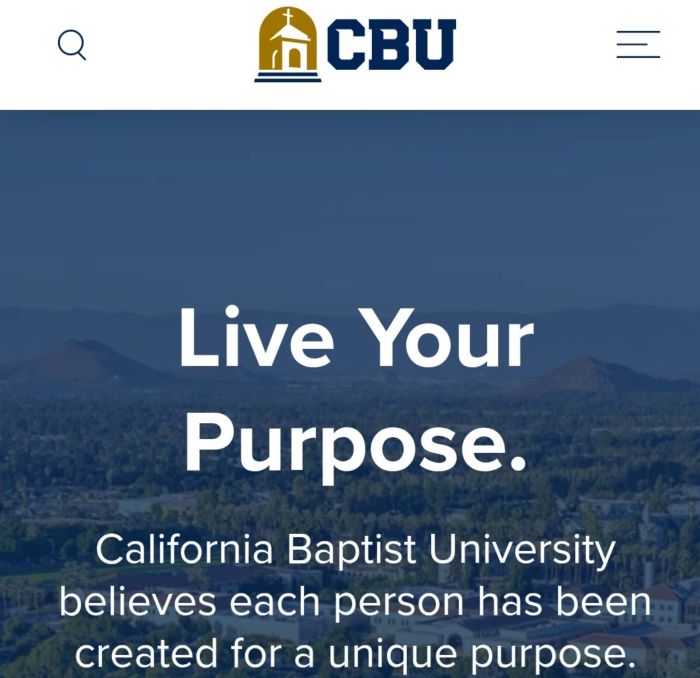
Example:California Baptist University delivers a standout mobile experience. Its responsive design stacks content cleanly for smaller screens, while large, tappable calls-to-action make it easy for prospective students to explore programs or request information. The site balances function and aesthetics, showing that CBU understands what mobile users need and delivers it.
How can improving website speed benefit my higher education institution? Faster websites reduce bounce rates and keep users engaged longer. Prospects find what they need quickly, improving their impression of your institution. Speed also boosts SEO rankings and increases the chances of conversions like form submissions or brochure downloads.
A smooth mobile journey doesn’t just meet expectations, it sends a clear message: your institution is accessible, student-focused, and ready to meet users where they are.
2. Optimize Your Site’s Speed and Performance
Speed matters. Gen Z users expect instant access, and if your pages lag, they’ll bounce, sometimes before they’ve even seen your programs.
Beyond user frustration, slow sites impact your visibility. Google uses page speed as a ranking factor, so sluggish load times can tank your SEO and conversions.
To keep your site performing at its best, follow these key practices:
Compress images and media. Use modern formats like WebP and apply compression tools to reduce file sizes without sacrificing quality.
Minify code and enable caching. Clean up your HTML, CSS, and JavaScript, and use browser caching to speed up page loads for returning visitors.
Implement a Content Delivery Network (CDN). CDNs serve content from servers closest to the user, minimizing delays caused by physical distance.
Limit heavy third-party scripts. Only use plugins and scripts that are essential—too many can drag your site’s performance down.
Test regularly. Tools like Google PageSpeed Insights, GTmetrix, or Lighthouse help you spot bottlenecks like oversized images or slow server response.
Example:University of Arkansas at Little Rock (UA Little Rock): In March 2025, UA Little Rock rolled out a major website overhaul that improved both user experience and performance speed. A key move was transitioning to modern cloud hosting, which “ensures greater reliability, multiple backups, and improved site performance,” especially during peak or emergency periods. The web team also streamlined the site’s content (trimming 8,000+ pages down by 30%) and modernized the codebase, which reduces load times by eliminating bloat.
Why this matters for higher ed: Even a one-second improvement in page load time can make a measurable difference in how long users stay and what actions they take. A fast website tells students you’re efficient, professional, and respectful of their time, a small detail that leaves a big impression.
If your site is slow, it’s time to speed things up.
3. Implement Strong SEO to Boost Search Visibility
You can have the most beautifully designed website in the world, but if prospective students can’t find it, it won’t deliver results.
That’s where search engine optimization (SEO) becomes critical. Most college students rely on search engines to explore programs, compare schools, and research next steps. If your institution doesn’t appear in those search results, you risk missing out on a massive share of qualified leads.
Think about the intent behind queries like:
“Best MBA programs in Canada”
“Colleges in Toronto for computer science”
“Online diploma in healthcare administration”
If your pages don’t show up, students won’t even know to consider you.
Here’s how to strengthen your SEO strategy and stay visible throughout the student journey:
Keyword Optimization
Start with the language students use. Research long-tail keywords that reflect real queries (e.g., “online MBA in finance” or “career college digital marketing course”). Then, use those terms naturally in your:
Program page titles and H1 headers
Metadata and image alt text
Body content and subheadings
This improves your rankings and helps students quickly identify whether your offerings match their needs.
High-Quality, Student-Centric Content
Search engines prioritize helpful content. So do students. Build rich pages and blog posts that answer common questions about admissions, tuition, career outcomes, or student life. Content that educates, informs, and reassures will keep users engaged and build trust.
Gen Z doesn’t want to dig for answers. Make them easy to find, and you’ll win the click.
On-Page SEO Basics
Each page on your site should have:
A unique meta title and description featuring relevant keywords
Structured headings (H1, H2, H3…)
Descriptive image alt text for both accessibility and SEO
These basic elements are easy to overlook, but they make a real difference in how Google interprets and ranks your content.
Technical SEO and User Experience
Your site’s infrastructure plays a big role in search visibility. Prioritize:
Mobile-friendliness (as covered in Section 1)
Fast page load times
Secure browsing (HTTPS)
Logical, crawlable URLs
Fixes for broken links and outdated pages
Google rewards user-friendly experiences. So do your prospective students.
Local and International SEO
Have a physical campus? Make sure your Google Business Profile is claimed and accurate. Serving international audiences? Offer multilingual content or geo-targeted landing pages to attract global prospects.
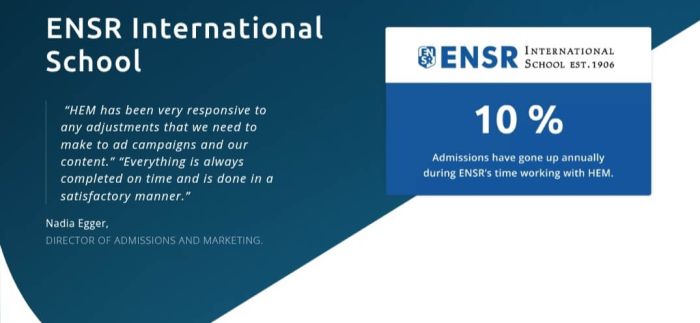
Example: When ENSR partnered with Higher Education Marketing (HEM) in 2019, the school sought to improve its online visibility and attract more qualified leads. HEM implemented a comprehensive SEO strategy that included technical website improvements, bilingual content creation, and targeted Google Ads campaigns. These efforts significantly enhanced ENSR’s search rankings and increased high-quality inquiries from families seeking international education in Switzerland.
Why this matters: SEO isn’t a quick win; it’s a long-term strategy. But done right, it builds sustained visibility across every stage of the student journey.
A prospect might first find your blog post about how to choose a business school. Weeks later, they search for [Your University] campus life. Eventually, they return to your site to click Apply Now. SEO ensures you’re present at each step.
And since over 90% of students visit your website before applying, showing up in search isn’t just a marketing boost, it’s mission-critical.
What role does SEO play in the success of a higher education website?
SEO helps your site appear in search results when students research programs. Strong SEO brings qualified traffic, builds credibility, and ensures your programs are seen, without relying solely on paid ads.
SEO brings it all together. A fast, accessible, content-rich, and mobile-optimized site naturally ranks better. That means more visibility, more engagement, and more students taking the next step with you.
4. Make Your Content Accessible and Inclusive to All Users
Accessibility is now a fundamental expectation. Your website should serve everyone, including users with visual, auditory, motor, or cognitive disabilities.
In the U.S., more than 61 million adults live with a disability, and in Canada are more than 27 million. Globally, the number reaches into the hundreds of millions. If your website isn’t accessible, you may be shutting out prospective students, parents, or staff who are eager to connect but simply can’t.
Beyond ethics, it’s also the law. New ADA Title II regulations in the U.S. now require public colleges and universities to comply with WCAG 2.1 Level AA standards. Similarly, Canada’s AODA (Accessibility for Ontarians with Disabilities Act) sets a comparable benchmark for accessibility. Failure to comply with these standards can result in lawsuits, financial penalties, loss of federal funding, and significant reputational damage.
An inclusive website is no longer optional. It’s a legal, ethical, and strategic imperative.
Best practices for accessible higher education websites:
Follow WCAG 2.1 AA guidelines. This includes alt text for images, captions or transcripts for videos, strong color contrast, and keyboard-friendly navigation.
Use semantic HTML. Headings, lists, and ARIA landmarks help users navigate with screen readers and assistive tech. Avoid flashy layouts that confuse accessibility tools.
Write descriptive link text. Replace vague links like “click here” with actionable, informative phrasing: Download the admissions brochure, for example.
Test with real users. Use accessibility checkers and consult individuals who rely on screen readers or other assistive devices; automated tools often miss real-world issues.
Why this benefits everyone: Captions aren’t just for deaf users; they help second-language learners, mobile viewers, and anyone watching a video in a noisy space. High-contrast design improves readability in bright light or on low-quality screens. And clean navigation benefits all users, whether or not they rely on assistive technology.
Accessibility makes your site better for everyone and signals your commitment to equity and inclusion.
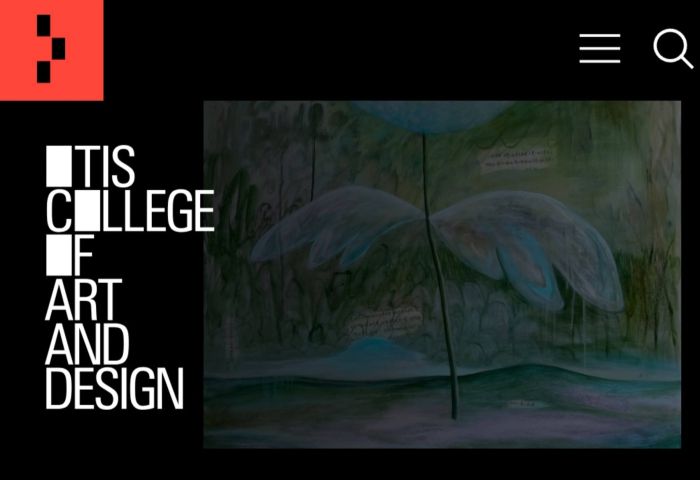
Example:Otis College of Art and Design proves that accessible websites don’t have to be boring. Their visually bold, design-forward site includes thoughtful accessibility features, like the ability to pause animated content and high-contrast elements that enhance readability. It’s proof that inclusive design and creativity can go hand in hand.
By prioritizing accessibility from the start, your institution not only meets regulatory standards, but it also opens the door to more prospects and strengthens its reputation as a place where everyone belongs.
5. Design Intuitive Navigation and User-Friendly Interfaces
Higher education websites often contain a massive amount of information, program details, admissions requirements, campus services, student life, alumni resources, and more. Without clear navigation, this wealth of content can quickly become overwhelming.
If prospective students can’t find basic information like how to apply, what programs you offer, or where to request info, they won’t stick around. They’ll simply move on to another institution that makes things easier.
Your goal? Make exploration effortless: Navigation should be clean, logical, and centered around user needs, not internal structures or department silos. Every menu, page layout, and search function should guide visitors toward their goals with clarity and speed.
Tips for intuitive higher ed site navigation:
Use simple, student-focused labels. Stick to clear menu items like “Programs,” “Admissions,” “About Us,” and “Contact.” Avoid institutional jargon. Limit top-level menu items to avoid overload, and organize deeper pages using dropdowns or mega menus.
Design for user journeys, not just departments. Group content around tasks or audience needs. Instead of listing academic departments, consider categories like Plan, Start, Succeed, or even Explore Programs and Find Support.
Create clear user paths for different audiences. Persona-based navigation (e.g., Prospective Students, Current Students, Parents, Alumni) lets visitors self-identify and jump directly to what matters to them. This reduces cognitive load and improves time-to-information.
Make CTAs impossible to miss. Buttons like Apply Now, Request Info, and Visit Campus should be visually distinct and consistently visible across key pages.
Maintain styling and structural consistency. Don’t make users relearn how to navigate with every new section. Ensure the styling, placement, and behavior of menus remain predictable and responsive for mobile users.
Example: Eastern Iowa Community Colleges: EICC structures its top-level navigation around the student journey with three clear categories: Plan, Start, and Succeed. This not only simplifies decision-making but also shows a deep understanding of student concerns. The site also includes an “I’m most concerned about…” section: addressing common hesitations head-on, with empathy and clarity.
A user-friendly website doesn’t just look polished; it feels helpful. Smart navigation says, “We understand your needs, and we’ve made it easy to find what you’re looking for.” Higher education website design can be the difference between a visitor who bounces and one who applies.
6. Provide Engaging Content and Clear Calls-To-Action
Content is what transforms a higher ed website from a digital brochure into a dynamic recruitment tool. Prospective students don’t just want information; they want answers, inspiration, and a glimpse of what their future might look like at your institution.
They’re searching for:
Program details
Admission requirements
Tuition costs
Campus life
Career outcomes
Student experiences
Your job is to deliver that content in a way that’s clear, engaging, and actionable.
Best Practices for Content That Drives Enrollment:
Showcase your academic programs clearly. Each program should have a dedicated page that covers curriculum highlights, faculty expertise, admissions requirements, and career prospects. Schools should prioritize program-level content because it’s the first place prospects look.
Use rich media to bring your campus to life. Photos, videos, virtual tours, and infographics add emotional and visual depth that text alone can’t match. Consider a homepage hero video, a student life highlight reel, or virtual walkthroughs of your campus and classrooms.
Incorporate authentic student voices. Today’s students want real stories. Feature testimonials, student spotlights, or day-in-the-life content that reflects your community’s diversity and vibrancy. Whether it’s a video diary from a nursing student or a blog from an international applicant, authenticity builds trust.
Keep your content fresh. Outdated information erodes credibility. Make it a priority to update admissions deadlines, program details, and tuition info regularly. Maintain a blog or news section to show your campus is active, but don’t let fresh content bury essential evergreen pages like Programs or How to Apply.
Guide users with clear, strategic CTAs. Every important page should ask: What’s the next step? Then answer it with a bold, well-placed button. Whether it’s “Apply Now,” “Download a Program Brochure,” or “Book a Virtual Tour,” your CTAs should stand out visually and match the context of the page.
Example: OCAD University (Canada) redesigned its admissions website with a bold visual identity, simplified navigation, and CTAs tailored to the user journey, like “Get Portfolio Help” or “Start Your Application.” The results? Within weeks of launch, the site saw a 21% increase in visits and a 15% increase in applicants. The combination of user-first content and clear actions paid off.
Content also reinforces every other best practice:
Accessible content means adding alt text and transcripts.
SEO-optimized content means using keywords that align with search intent.
Fast-loading content means using lightweight visuals and optimized media.
When your content delivers real value and your calls-to-action guide users clearly, you don’t just inform; you inspire. And that’s what drives conversions.
7. Integrate With a CRM for Lead Management and Personalization
A well-designed website gets visitors. A strategically integrated website gets conversions.
One of the most powerful ways to level up your higher ed site is by connecting it to a Customer Relationship Management (CRM) system. CRMs are central hubs for capturing, organizing, and nurturing prospective students through the enrollment journey.
When your website and CRM are integrated, lead data flows automatically from inquiry forms, newsletter signups, and event registrations into a centralized system, no more manual data wrangling, missed follow-ups, or siloed information.
Why CRM Integration Matters:
Instant lead capture and time savings Every time a prospect fills out a form, to download a course brochure or RSVP to an open house, their information is logged automatically in your CRM. This eliminates the need for staff to transfer spreadsheets or copy-paste emails. The result? Less administrative busywork and fewer mistakes, giving your admissions team more time to focus on real engagement.
Faster, personalized follow-up CRM integration lets you respond in real time. Someone requests info? They get a tailored email within minutes. And your recruiters are instantly notified with the lead’s details, so they can follow up while your institution is still top of mind. Prompt follow-up, especially within 24 hours, greatly increases contact and conversion rates. A connected CRM makes that speed possible.
Personalized web experiences Advanced CRMs like HubSpot or Mautic allow you to show smart CTAs and dynamic content based on the visitor’s behavior. If someone has already attended a webinar, your site might offer “Schedule a One-on-One Consultation” instead of “Register for Info Session.” Personalization like this increases engagement and accelerates movement through the funnel.
One institution used smart CTAs to tailor messaging for return visitors. New users saw English test prep offers, while returning prospects saw “Start Your Application” prompts, resulting in higher click-through and application rates.
Full visibility into the student journey Every interaction, form fill, email open, and event attendance is tracked in the CRM. Your team gets a 360° view of each lead’s engagement, helping them tailor conversations and prioritize follow-ups. You can also track which web pages and campaigns are driving the most conversions, helping you optimize over time.
For example, CRM data may reveal that campus tour sign-ups convert at twice the rate of general inquiries. Insights like these help you double down on what works.
A seamless, consistent user experience From a student’s perspective, CRM integration reduces friction. They won’t have to fill in the same information twice. Communications feel timely and relevant. Even if a staff member changes, the CRM ensures continuity, so the conversation picks up where it left off.
Behind the scenes, your team gains confidence that every lead is being handled properly, with full history and context at their fingertips.
The tools and payoff
Higher education institutions are increasingly using education-focused CRMs like HubSpot or HEM’s Mautic CRM. These tools enable automation at every stage, from capturing leads to triggering nurture emails to customizing website CTAs.
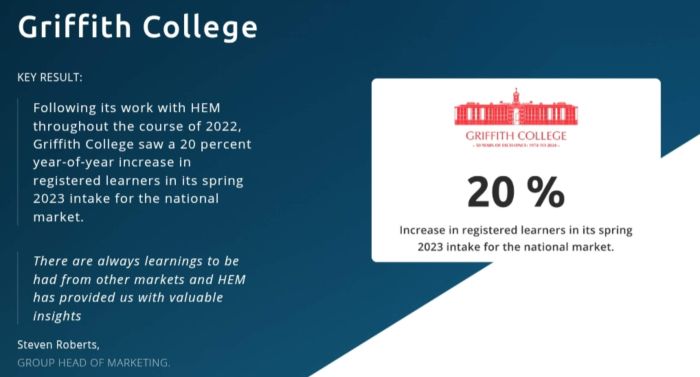
Example: Griffith College, Ireland’s largest independent college, partnered with Higher Education Marketing (HEM) to implement HubSpot CRM for more efficient lead management and personalized student recruitment. Through a comprehensive strategy that included conversion funnel audits, CRM staff training, automated workflows, and segmented lead nurturing, HEM helped Griffith streamline communications and improve follow-up with prospective students. As a result, the college achieved a 20% year-over-year increase in registered learners for its Spring 2023 intake.
CRM integration does require some technical setup and cross-department coordination. But the payoff is immense: your website becomes a two-way communication platform, collecting insights, responding to actions, and guiding visitors toward enrollment with relevance and precision.
For institutions serious about scaling recruitment and deepening personalization, connecting your CRM to your website is no longer optional. It’s a modern best practice and a clear path to smarter, more successful digital engagement.
Build a Website That Drives Enrollment
Your website isn’t just a marketing asset; it’s your institution’s top recruiter. Every click, scroll, and form fill is a chance to move a prospective student closer to enrollment.
By applying these best practices for higher education websites, from mobile-first design and fast performance to SEO, accessibility, and CRM integration, you create more than just a polished digital presence. You build a site that informs, inspires, and converts.
In a crowded higher ed market, the schools that win are the ones that treat their website like the powerful recruitment engine it is. Make yours work harder, smarter, and more strategically, starting now.
Struggling with enrollment?
Our expert digital marketing services can help you attract and enroll more students!
Frequently Asked Questions
Question: Why is mobile responsiveness crucial for higher education websites? Answer: Most students browse on mobile devices. A mobile-responsive site ensures readability, easy navigation, and fast loading, key for user experience and search rankings. Without it, your site could rank lower on Google and lose over half of the visitors who abandon slow or poorly displayed pages.
Question: How can improving website speed benefit my higher education institution? Answer: Faster websites reduce bounce rates and keep users engaged longer. Prospects find what they need quickly, improving their impression of your institution. Speed also boosts SEO rankings and increases the chances of conversions like form submissions or brochure downloads.
Question: What role does SEO play in the success of a higher education website? Answer: SEO helps your site appear in search results when students research programs. Strong SEO brings qualified traffic, builds credibility, and ensures your programs are seen, without relying solely on paid ads.
Entries to the 3rd Best Personal Academic Websites Contest are now open. We’re excited to celebrate your website! Enter now.
Entries are open through August 15, 2025 at 11:59pm Pacific Time. Winners will be announced here on The Social Academic blog in November 2025.
Thank you for helping us share this contest!
Do you have a personal academic website? Enter to win an award
I’m Jennifer van Alstyne of The Academic Designer LLC. My friends Brittany Trinh and Ian Li of Owlstown and I are teaming up again to bring you this professional development contest for
Faculty
Professors
Researchers
Scientists
Postdocs
Grad students
Independent researchers
This is the 3rd annual Best Personal Academic Websites Contest. Each year, it’s inspired people like you from around the world to create space for yourself online. And to celebrate the hard work you’ve put into your website project. I’m excited that we’re back again in 2025 to celebrate your website.
This contest is now open. Entries are free. The form takes just a couple of minutes to complete.
We want to recognize the hard work you’ve put into your personal academic or scientist website.
There will be awards in multiple categories. Here’s what you get if you win an award
A line on your CV
A digital badge for your LinkedIn profile and website
Be featured as a top academic website in the winner’s announcement and on social media
Bragging rights
Set up your personal academic website [Event Replay]
This event was recorded live on Zoom on August 1, 2023 at 6pm Pacific Time, hosted by Jennifer van Alstyne @HigherEdPR, Brittany Trinh @BrttnyTrnh, and Dr. Ian Li of Owlstown @Owlstown
A live conversation series for 2025 is coming soon. Stay in the loop when you subscribe to The Social Academic blog:
Resources for creating your personal academic website
Here are resources from Ian Li of Owlstown, Brittany Trinh Creative, and The Academic Designer LLC to help you make your website. Our goal is to help as many people as possible. Please share with your friends.
RESOURCES ON THE SOCIAL ACADEMIC BY CATEGORY
Question about the Best Personal Academic Websites Contest?
Hi, I’m Jennifer van Alstyne. I’m happy to answer your question. [email protected]
Download the Flyer
Please help us share the 2025 Best Personal Academic Websites Contest. Thank you!
How can we help new readers find your words? How can you help your book have a legacy? Website designer / book designer HR Hegnauer joins me for this featured interview. HR has designed over 350 books, creating award-winning covers and interiors for both print and ebook editions. She’s also an expert website designer who helps authors create a lasting presence for their writing online.
We attended the Jack Kerouac School for MFAs in Writing & Poetics at Naropa University (though at different times). HR has also taught in the Summer Writing Program which happens each year in Boulder, Colorado. I had the pleasure of collaborating with HR back in 2014-2016 on Something On Paper, a journal of poetics. I’m so happy she could join me for this featured interview.
Before we get started, don’t miss my live workshop on April 12 on Promoting Your Book Online for Academics. Sign up today.
Are you an academic author who needs a website? I’m partnering up with HR Hegnauer for Team Website VIP Days. If you’d like my team of experts to put our creative brains together for your online presence as an academic, don’t hesitate to reach out. I’m happy to chat with you. Schedule your no pressure Zoom call about working together.
Jennifer Van Alstyne: Hello and welcome to The Social Academic! I am Jennifer Van Alstyne, your host, and my guest today is all about books and book design, and book websites. So I’m so excited to have HR Hegnauer here. HR, would you please introduce yourself?
HR Hegnauer: Sure, yeah, thanks so much for having me, Jennifer. My name is HR. I work as a book designer and also a website designer and run my own design studio. And yeah, I love getting to do the work that I do.
Jennifer: So I think my first question for you is kind of about the book design process. So many people are like, they’re focused on writing their book, they’re so excited, they are getting it published. And then they’re like, “Well, what comes next?” I know it’s different with different presses, but do you think you could walk us through a little bit of the kind of book design process and what that’s like for people?
HR: Yeah, absolutely. And you’re totally right. It really does vary on kind of who that publisher is or maybe they’re self-publishing. There’s a huge spectrum. And I’ve been making books for about 18 years now. I’ve designed over 350 books. And so I’ve really seen that spectrum about every single type of publisher: corporate, institutional, universities, tiny micro nonprofit, self-publishing, the whole thing. When the person’s done writing that book, it’s going to of course go through the editing process and all of that. And then by the time I come on board, what we want to do is take that manuscript and make it into a really good book that someone wants to sit with and read and engage with, right? And it’s my job to make sure, right, that it can do that for the person. It’s legible, it works well. The design works for the book. The cover is like a visual articulation of what’s happening in the content.
Book design and book cover design
Jennifer: Hmm. What’s your process like for cover design? I know cover design and book design, the interior of it are a little bit different. I’d love to hear about covers because that’s honestly what I think people might have the most flexibility with when it comes to academic books. So what are your thoughts about cover design?
HR: That’s such a fun thing to dive into and it can be really hard for the writer to kind of imagine it too because they’re working in words, right? They’re the writer, they’re not working in visuals. And so in my process, I’ve developed this questionnaire over the last, you know, 18 years. And that helps us kind of set the visual tone, right? So is this, is it an academic book talking about something from the 19th century? Is it a hyper-modern poetry book? Is it something from the tech industry or a memoir? There’s all kinds of sort of, I guess, genres, right? That kind of help orient a little bit in ways. But then there’s all these other things to consider. Like maybe the person has a piece of art or photography they really wanna see on the cover, or maybe they wanna just go text only on the cover, which can be super fun. And then that text can be a graphic element itself, right?
Jennifer: So I’m curious, like I know that you partner with presses to sometimes do the cover design. Like what is the, almost like the technical process of like, let’s say an author gets their book accepted and their press is like, “Well, what do you want for the cover design?” Can they ask for a specific cover artist to work with them? What kind of input can they give if maybe they haven’t been offered someone like you to partner with?
HR: Yeah, you can definitely ask. Not sure always what the response is, but definitely ask for sure. I mean, to be an advocate for your own book because sometimes nobody else is. And so, you know and presses, some have their own in-house designers who are amazing. Some presses have certain style guides they’re trying to follow themselves or some series that they’re trying to work within. Oh, one of my friends, Dr. Echo Rivera, she was like really thinking about putting like a presentations book out in the world. And a press was very interested in working with her, but when she heard that she would have no control over the cover, that they were really stuck in this very set cover for the series that it was gonna be published under. She actually decided to not move forward with that project, with that press, just cause the cover is so important for something like presentations and design. Like that’s what she’s talking about. It can’t be a huge mismatch. So I love that you help people really get visual when it comes to their thinking, being introspective about their cover. Now, how does that differ from like the interior of the book? I mean, there’s so many academics that also are interested in self-publishing or wanna create resources that are more like book format. I’m curious about the interior. What’s that process like?
HR: Yeah, well, ideally they’re in conversation with each other, the cover and the interior. They’re not always, but I think when they are, that is when you have the best fully integrated one.
Jennifer: Yeah. (Laughing)
HR: And so what that means, technically speaking, is sometimes elements from the cover are coming into the interior. Maybe that’s in the title font choices or maybe some little graphical, graphic element or embellishment somewhere. But the main thing for the interior is that, sometimes I like to think, you know, if the reader is noticing something about the interior, it’s usually because maybe they’re struggling through it because it’s not well done or not well designed. And I don’t mean that in any kind of like design slight, I just mean it in like, if someone spends sometimes years writing a book, you want your reader to be able to really read it and engage with it and not have to like physically struggle. And so that’s a big part of it. Can your reader really engage with it? And so sometimes an author will come to me or a publisher or somebody and say, “I really love Helvetica. Can you lay out my 400 pages in it, in Helvetica?” Sure, technically speaking, I could. But you know what, that’s my job as a design professional to help the person understand why that’s really not a good design choice because your reader is not gonna be able to work with that themselves.
And then that means like, well number one, they’re not gonna read it. But then, maybe then they’re a professor and they’re not going to teach it either or no one’s going to write a review about it. You know, all these kinds of things that unfold in these multiple ways.
Jennifer: Hm. So it’s almost like when you are being more intentional about the experience that people will have while reading your book and how that plays out in terms of design, that it limits all of those potentials for almost like a breakdown in connection that could happen afterwards. Once people do have a good reading experience with your book, we want them to be able to take the next step, whether that’s in their own life or to help you share your book and so that’s really interesting. Oh, HR, one of the things that you brought up was about some of the things that authors have struggled with. I’m curious. What are some of those, some maybe mindset things, some maybe like just not knowing what their next steps are, what are some struggles authors have when it comes to book covers, book design, sharing their book?
HR: Sure, yeah, especially because, and it’s no fault of an author, it’s not them to have to know everything. The industry is constantly changing all of the time, even in terms of like what are options for self-publishing or then if you’re self-publishing, what does that mean in terms of distribution? How are you supposed to just know that? It’s not like an innate thing. And so those are real struggles. Or how do you promote your book? Maybe you have a really awesome publisher who has that support and foundation behind you, and that is so ideal, honestly, and that’s great. And then if you don’t, maybe you need to kind of build that team yourself. And so like one of the things, like for example, I don’t do marketing myself. I can make some materials to help do that marketing, but I don’t run like social media or something.
Jennifer: Yeah, yeah, you’re not like managing the marketing process.
HR: Yea, I can help that writer understand how to build a really successful team for themselves.
Jennifer: Hmm. I like that. Now you don’t just do like book design and book covers. You do websites for authors too which is, I mean, that is like a marketing deliverable in the sense that it’s long-term. So why should authors have websites for their books?
HR: Yeah, I know that is such a great question. And it’s really changed over a few years even, right? It didn’t always have to be necessary, or maybe someone has a LinkedIn page or something, some kind of digital version of their CV. Or maybe they’re a professor and they have a page on the university website or something. So why need their own website? And it’s such a great place to get to be in control of all your content for one, obviously, but then to get to really interact in different ways. So it can be this like digital up-to-date version of your CV and it can hold all kinds of things, including media and events and whatever you need. But one thing that has been so exciting to me the last couple of years, honestly, is I’ve gotten to work on some projects where it’s not just like a digital sales sheet to promote the book, but it gets to be this real extension of the book itself. So like, for example, you read a book and maybe there’s some images in it or something, or maybe you go to an event to support the book, but there’s some real limitations in how far that can go sometimes. And so, especially if a book really, and not all books need this, but some books really, really benefit from something a little more interactive or media-based or maybe someone is working with a lot of archives too, and they want to bring in different images. And that can get so exciting, I think. I’d love to, can I share just one project about that?
Jennifer: Yeah, yeah.
HR: Like I’ve been working with this woman, maybe you know of her, Sasha Steensen. She’s a professor at Colorado State University.
Jennifer: Cool.
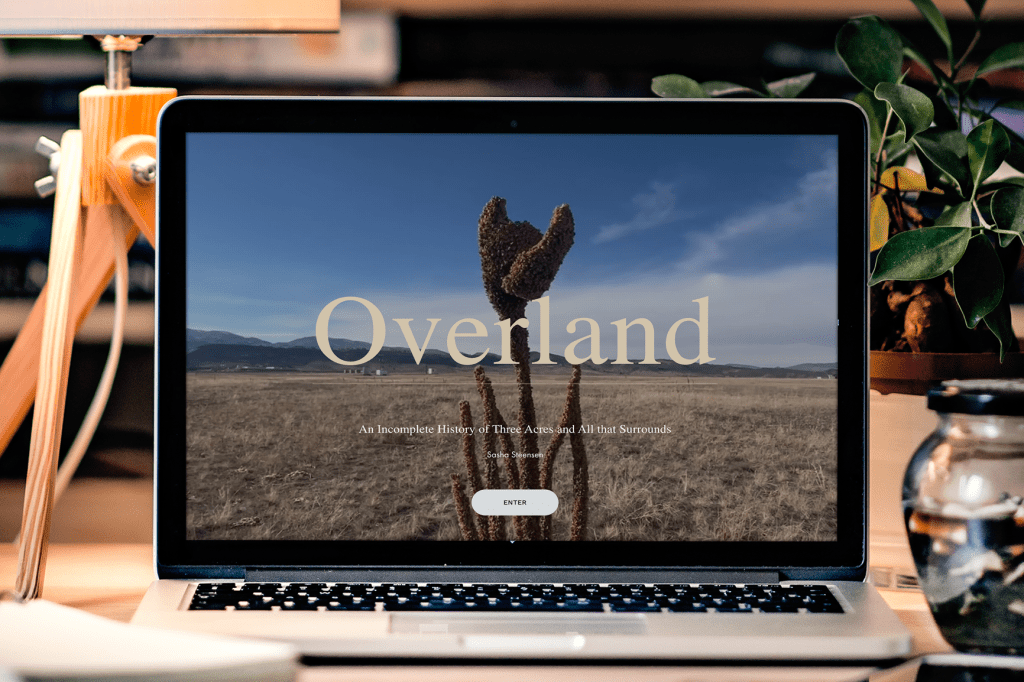
HR: And I’ve loved her writing for many years, but some authors I get to work with for, you know, well over a decade or more. I just love following their work personally, but she was working on this project and had institutional support and funding for it, which was so great. But looking at the past couple hundred plus years of her five acre property, and what happened on this exact plot of land in Colorado where she lives with her family.
Jennifer: Wow, that’s cool.
HR: Yeah, and like the archives, the federal transactional history there, a lot of devastation, all kinds of history on that exact spot where she spends her time with her family, right? And so at first we started making this website to help support that sort of already existing project she was doing. And then like once we’ve started building, there’s a number of pages on it, probably, I don’t know, 15 or so at this point.
And then it’s like we started to understand like, “Oh, this website, maybe what it can do is really actually now helping drive some of the creative work of the project. It’s really exciting, it’s still ongoing, you can go check it out. Stuff like that, it gets so fun.
Jennifer: Yeah, websites are so adaptable and like they can grow to fit your needs, but also they can inspire creativity and give you more flexibility with how you wanna reach people. So it’s fascinating that it sounds like once you started on the website together, it really grew and expanded based on what you were inspired to create long-term. I mean, all these things are so lasting, that’s why I love it. It’s like a book can get out there in the world, but honestly, it has potential to go out of print eventually or not get a second print run.
HR: Exactly, there’s that.
Jennifer: And the website, the resources that you create, the conversations that you have about your book, those things can stay. Oh, fun!
HR: Which means you’re seeing that website at presentations and class visits. And it’s not just for like the general public randomly who comes to it. It’s like, it’s also a teaching tool. It’s also a research archive. It’s also all these things, you know. And it’s a book, by the way.
Jennifer: Yeah, and the book, and the book. (Laughing)
When to start designing your book
Jennifer: Now, I’m curious, like, at what point did that professor reach out to you to maybe start working together? Like, at what point in your manuscript creation process should you start thinking about these things?
HR: Yeah, that’s such a great question. I mean, in that particular instance, I’ve worked with her on a many number of projects. Book cover, her author website to begin with. You know, so many authors I get to work with on multiple projects-
Jennifer: I love that.
HR: For years and really do know their work quite well. But yeah, so it really varies. I mean, sometimes a project like this, the book is not published, it’s not done. It’s an ongoing, real place of discovery in this way. It’s kind of become this collaboration almost.
Jennifer: Wow. That’s so cool!
HR: Yeah, I mean, and that’s fairly unique, I would say certainly. Others like, I’m really not involved in the editorial process in most instances, right? You know, I’m there to help bring that book into that publishing process, whatever that looks like physically or digitally or however. And it’s generally speaking after editorial is done, after editing is done, and that kind of thing.
Jennifer: What kind of transformation do you typically see with authors from before they have a website to after they have a website? Do their feelings change about it?
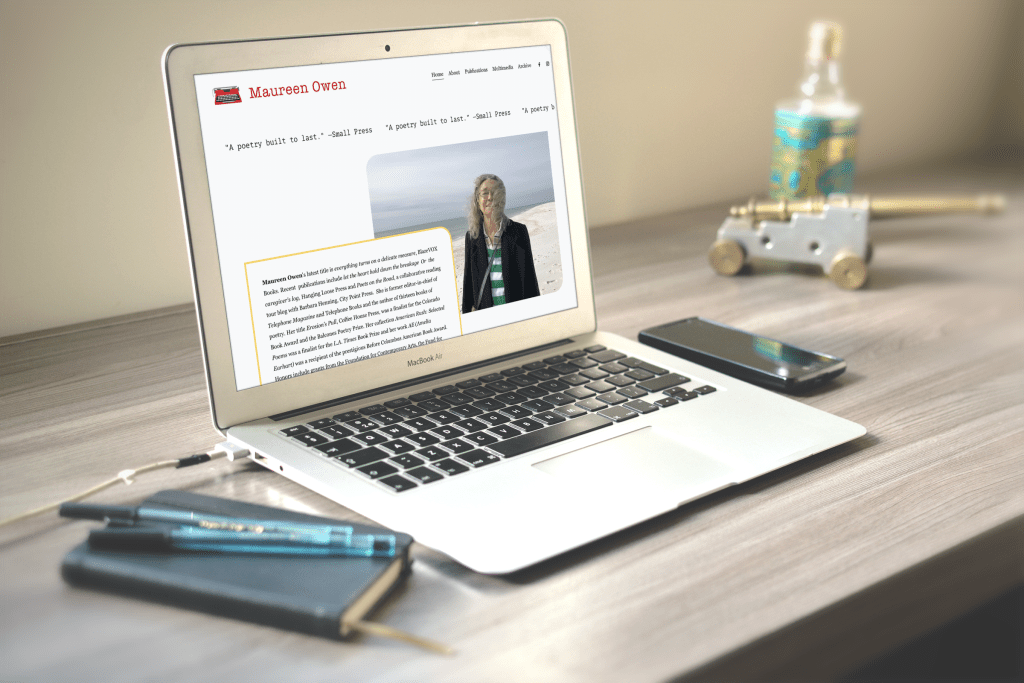
HR: Yeah, that’s a great question right, definitely. Because before they have a website . . . Okay, for example I made this website a year ago or so for this author, Maureen Owen. She’s a poet, has, I don’t know, 30 or more books, something like this, dozens of works.
Jennifer: She’s prolific.
HR: Beloved poet, right? I’ve loved her work for decades. She’s never had her own personal website, but of course with her books, they’re on publisher sites, on Amazon, on random places. Goodreads of course. There’s all kinds of disparate places where she exists on the web, right? And she has university archives you know in multiple universities, these kind of official places even, but there was not one hub of her place, of her work. And, you know number one, that’s a bummer for the reader trying to just find out more about her or access maybe her work as a student or a grad student learning about her, any of those things. And so to bring all of that together was so great. I mean, and then, exactly, and then for her, that transformation is like people see her in a different way because now they’re seeing, you know, people who don’t necessarily know her personally say are learning about her and they’re able to learn about her in a more comprehensive way in one place from her own voice that she’s in control of because it’s her own website, right?
Jennifer: Yeah, well, it makes such a difference. Some of the professors that I’ve worked with, I mean, many of them are authors. The focus of the website is less book than I think the websites that you typically design. But one of the things that they tell me afterwards is like their friends and their family, like people who they weren’t even expecting as like an initial audience for their website, people they know actually feel like they can understand them a little bit better, they can connect with the book or help share it more effectively. So I really like that there are kind of like unexpected sparks that can happen once you are more open to creating that kind of online presence for yourself.
HR: Definitely, yeah, for sure. And being able to articulate your research about things or your interests, excitement, whatever that might be.
Work with an awesome team
Jennifer: Yeah. Now this year, HR and I are going to be teaming up on some website VIP days. While of course you can work with just HR or just me, if you’re someone that is like, wow, how amazing would it be to have two professionals really thinking deeply with me about what is going to work for my website and actually creating it for you in a day?
I also want you to know HR is an amazing resource. If you need a book cover, if you need the interior of your book design, if you need that book website or author website, you should definitely reach out to her. She’s so nice. And someone that I really trust, someone that I trust to sit there with you and to think in ways that’s going to make sense for you. Not just the way that your publisher wants your book to be, but have you be more of a part of that conversation than sometimes happens in the editorial world. Yeah, I just wanted to be sure to share you with people.
HR: Thank you so much Jennifer. I’m really super excited, honestly, to be collaborating with you. it’s such a great thing. And I think one thing you said a second ago. You know, to get to work with someone who you actually know who they are as a human being and trust them, that means like the world, right? I mean, how do you, it’s such an abstract thing to just be like, “Okay, now I need a website. What does that even mean, right? Like, how do I do that?” Like, how is anybody supposed to know and what do they trust to do that? And I’ve worked with so many people, honestly, who have been like, tried to do some DIY approach over the years or maybe they did something with a student 15 years ago or something. And it’s just like, they’re still paying some ridiculous thing to some web host that, and I look at their stuff. I’m like, “What is going on here? This is so unnecessary. You’ve been, this is ridiculous.”
Jennifer: And you know it’s like, it’s unreasonable to think that anybody who’s not in that kind of field would just know what to do, right? I mean, like, I have professors who are like, information, technology, AI, like, really like experts in different tech areas that are like, “I’m not gonna learn how to make a website. Like, can I learn? Yes. But is it a good use of my time? Honestly, no.” And that’s okay.
HR: Absolutely, yea.
Jennifer: Like, you don’t have to do your website yourself, but also if you’ve done your website yourself and you don’t like it, don’t feel embarrassed. Like, come to us and we’ll help you.
HR: Really, no. Get it to a better place, for sure. And, you know, it’s not magic and it’s not rocket science. It’s just like, it’s something that is just valuable to bring up to speed, really.
Creativity for your author website
Jennifer: HR, is there anything else you feel authors should know either about the book design process or about author websites before we wrap up today?
HR: I just think, especially in say a website when someone, it is really their project and they get to be in control of it, to just really kind of, to really take that, you know, get in control of it. And either if you’re building it by yourself or working with someone, to just know that it is your website and it is, you know the reflection of who you are as a creative person or an academic or whatever that is for you, researcher. And to just think, you know, it doesn’t have to look like one thing or another, it doesn’t have to be some template that someone is telling you to go with because it’s the easiest option or whatever. You know, there’s such a huge spectrum of how things can kind of come together. And a lot of people don’t even know what those kind of possibilities are. So it’s like, it’s that the person who wants that website or needs that website, you know, they get to be in this creative place and then the person who can help bring that to them can like show up with some really fresh ideas for them. And sometimes that like synergy is what’s so exciting to really make something happen.
Jennifer: I love that. This was such a good conversation and perfect timing because I am having a How to Promote your Book for Academic Authors event next month. And so I think that having this interview is a resource that can help people. I mean, there’s so many different stages at which you’re like, “Oh my gosh, I think I need a book cover or I think I need this author website and I didn’t know I needed it before, but I need it now.” And if that’s you, I really, I hope you’ll reach out to HR, schedule a call to see if you’re a good fit to work together-
HR: Absolutely.
Jennifer: Because it really is, it’s like a no pressure call. It’s very warm. And I think that you’ll find that it’s a good space for you to actually have someone who knows who can talk with you about these things, not just your editor or, you know, your publisher. You have options.
HR: For sure. And I love chatting with anybody and about what those options can look like too. It doesn’t have to be with me, but I’m absolutely happy to talk with anybody.
Jennifer: Oh, that’s perfect. All right, thank you so much for joining me on this episode of The Social Academic. HR, how can people find you or get in touch with you afterwards?
My LinkedIn, if that’s a way that’s good to connect. Any of those ways. And on my website, there’s a little button that says like, you know, come and book a consult. Like, I really mean it, like just do it. I talk with people all the time, every week, you know, and love hearing what is going on for them. It’s not like a sales call. You don’t have to be like that, you know. Would love to though connect with anybody or help out with a question if somebody had a question.
Jennifer: I so appreciate your openness, HR. Thank you so much for coming on the show.
HR Hegnauer is a designer, writer, and creative professional specializing in book and web design for authors, independent publishers, and artists. As the owner of a design studio, HR has designed over 350 books, creating award-winning covers and interiors for both print and ebook editions. She is recognized for her website design as a Squarespace Circle Gold Level Member, ranking in the top 8% of over 100,000 professional Squarespace designers worldwide. With over a decade of web design experience, she builds engaging, intuitive websites that help authors not only establish but also grow their digital presence.
She is the author of When the Bird is Not a Human (Subito Press) and Sir (Portable Press at Yo-Yo Labs) and holds an MFA in Writing & Poetics from Naropa University, where she has also taught in the Summer Writing Program. With an MBA from the University of Denver, HR brings a unique blend of artistic sensibility and strategic expertise to her work. Her approach is highly collaborative, ensuring that every project—whether a book or website—amplifies the unique voice of its creator.
Search engine optimization (SEO) is essential for improving your school’s online visibility, ensuring that when local families search for educational options, your school is among the first they see. SEO helps your website rank higher in search engine results, making prospective parents more likely to find you before other schools in your area. SEO gives your school a competitive edge in reaching families who are actively seeking information on local educational options.
Knowing the value of SEO, most people ask how to do SEO for a school? To begin implementing SEO, schools can focus on three primary areas: On-page SEO, technical SEO, and Local SEO. In this blog, we’re focussing on local SEO.
An optimized online presence is crucial for K-12 schools to attract and engage prospective families within their local communities. By focusing on Local SEO, schools can increase their visibility in search engine results, connect with families nearby, and build trust as a leading choice for local education. With our 15 years of experience driving results for schools like yours, we know the unique challenges K-12 schools face in reaching prospective parents and students. This guide will walk you through the essential strategies to enhance your school’s local SEO, even if you’re new to search engine optimization.
Struggling with enrollment?
Our expert digital marketing services can help you attract and enroll more students!
Understanding Local SEO for K-12 School Websites and Why It Matters
Local SEO optimizes your school’s website and online presence to rank higher in local search results. This optimization specifically targets potential families searching for schools in your area, making it an essential component for K-12 schools looking to expand their visibility.
When someone searches “best private school near me” or “elementary school in [City],” the results that appear are influenced by local SEO practices. Google and other search engines analyze local relevance factors such as your school’s address, the presence of local keywords, online reviews, and overall domain authority to decide which websites to show at the top. Mastering local SEO for K-12 schoolwebsites can make a difference in being found online by families in your community.
Are you trying to implement effective digital advertising for parents of students? Reach out to learn more about our digital marketing services.
Claiming and Optimizing Your Google My Business Profile
What is the most effective strategy for local SEO? One of the most powerful steps you can take when marketing to K-12 students’ families in your area is to claim and optimize your Google My Business (GMB) profile. This profile is essential for local SEO because it provides search engines and families with critical information about your school, such as its location, contact information, and operating hours.
Begin by verifying your school’s GMB profile. When editing the profile, ensure all details are accurate, including the school’s name, address, phone number, website URL, and a brief description of the school’s values and offerings. Google also allows you to add photos, which can be a fantastic way to showcase your school’s facilities, activities, and unique educational experiences. Families browsing through profiles will be drawn to authentic visuals, which can help them feel connected to your school before they even step foot on campus.
Adding relevant categories (e.g., “Elementary School” or “Private School”) and attributes to your GMB profile increases your chances of appearing in local searches specific to your school type. Regularly update your GMB profile with fresh photos, events, and posts, as Google favors active profiles, enhancing your school’s local SEO ranking.
Example: This is how Google presents your institution to searchers when you create and optimize your Google My Business account. Your GMB profile provides critical information about your institution in an easy-to-consume layout.
Source: Randolph-Macon Academy | Google
Optimizing Your Website for Location-Based Keywords
Your website’s content should reflect keywords families might use when searching for schools in your area. Instead of generic phrases like “top K-12 school,” incorporate keywords that feature your location, such as “top K-12 school in [City]” or “private high school in [Suburb].” These location-based keywords help search engines understand that your school serves families in a specific area, increasing your chances of appearing in relevant searches.
Consider adding a dedicated “Location” or “About Our Community” page that details your school’s surrounding area, landmarks, or neighborhoods. This page could highlight the community values and amenities available, reinforcing that your school is embedded within the local community. Mentioning nearby cities, neighborhoods, or districts can also strengthen your local SEO, especially for families who want their children to be educated within specific geographic boundaries.
Each page of your website should also include the school’s full name, address, and phone number (often referred to as NAP – Name, Address, Phone Number) in a consistent format. Placing your NAP details in the footer ensures they appear across the entire site, building user trust and Google’s confidence in your school’s legitimacy and location.
Example: WillowWood School’s metadata uses the title WillowWood School | K-12 Private School | Toronto. In your metadata, include your school’s city to rank for location-based searches.
Source: WillowWood School
Creating High-Quality, Locally Relevant Content
Content marketing is an excellent way to boost your school’s visibility in search results. Develop blog posts, articles, and resource pages that speak to local concerns, events, and topics families in your area care about. Writing blog posts on subjects like “Why Choose a Private School in [City]” or “The Benefits of Small Class Sizes in [Neighborhood] Schools” can help attract local searches and establish your school as a knowledgeable voice within the community.
Another powerful content idea is to publish posts about school events, open houses, and seasonal programs like summer camps. These posts can generate interest from families looking for activities within your area, leading to higher engagement on social media platforms.
Local content can also come as testimonials and success stories from parents and students within the community. Encourage current families to share their experiences and post their stories on your blog or testimonials page. Positive testimonials boost your school’s reputation, and add keywords and phrases that resonate with other families in your area.
Example: Here, Nanjing International School shares culturally and geographically relevant content on its YouTube channel, helping it to attract prospects. When creating content, particularly visual, highlight your school’s location and discuss any advantages it offers students.
Source: Nanjing International School | YouTube
Encouraging Positive Online Reviews
Online reviews play an important role in local SEO, particularly for schools. Families considering your school will likely check online reviews to gauge what other parents and students think of your programs, culture, and overall quality. Reviews posted on Google, Yelp, Facebook, and niche educational sites help build trust and credibility while boosting your local SEO ranking.
One way to encourage reviews is by setting up an easy process for parents to leave feedback. After key events like open houses, school performances, or parent-teacher meetings, follow up with an email inviting parents to share their experience on Google or other review sites. Always respond to reviews in a timely, professional manner, whether positive or negative. This responsiveness shows that your school values feedback and is engaged with its community, which search engines recognize positively.
Example: Western Heights Montessori School’s website displays several positive reviews. These personal and specific reviews highlight the school’s unique selling points. When encouraging parents to write reviews, try to prompt them toward a similar result.
Source: Western Heights Montessori
Building Citations and Directory Listings
Citations, or mentions of your school’s name, address, and phone number on other websites, are a key component of local SEO. Citations help search engines confirm your school’s existence and location, ultimately building your website’s authority. Common places for citations include online school directories, community websites, and local educational resources.
Research reputable, relevant directories specific to education or your geographic area, and ensure your school’s information is listed accurately. Local chambers of commerce, community pages, and educational sites often provide directory listings or profiles where your school can be featured. Each additional citation strengthens your local SEO, contributing to a greater chance of appearing in local search results.
Example: This is GLCT’s listing on the International School Database. By appearing on directories like this, you’re expanding your online presence, making it easier for prospects to find your school.
Source: Great Lakes College of Toronto | International School Database
Building Local Backlinks
Backlinks, or links from other websites to your school’s website, are essential for establishing credibility in SEO. Local backlinks are even more valuable, as they signal to Google that your school is an authority in the community. Consider contacting local organizations, libraries, businesses, or news outlets that could mention or link to your school.
For example, if your school partners with local businesses for community events, ask them to link to your website in their event descriptions. Participating in community service projects or sponsoring local events can provide backlink opportunities. Press releases about notable achievements or events at your school, published on local news sites, can generate valuable backlinks.
Implementing Schema Markup
Schema markup is a form of structured data that helps search engines understand specific information on your website. For K-12 schools, schema can highlight important details such as your school’s name, location, contact information, and even specific features like tuition or grade levels offered.
Adding schema markup helps Google better understand the context of your website, often leading to enhanced search result displays with additional information like ratings, contact details, or event dates. Schools that use schema have a competitive advantage in local search results, as this markup can make your listing stand out.
For example, implementing schema to highlight upcoming events, open house dates, or application deadlines allows families searching for local school options to identify important details quickly. Schema markup may require technical assistance, but it’s worth considering to boost your local SEO efforts further.
Tracking and Adjusting Your Local SEO Strategy
After implementing these local SEO practices, tracking your progress is essential. Use Google Analytics and Google Search Console to monitor key metrics such as organic search traffic, click-through rates, and the keywords driving traffic to your site. These insights can help you understand which strategies are working and where adjustments are needed.
Regularly updating and refreshing your website’s content, profile listings, and SEO practices is vital to staying competitive. Local SEO is an ongoing process, and search engine algorithms frequently change, so periodically revisiting and refining your strategy can ensure your school continues to attract and engage the local community effectively.
Implementing local SEO for your K-12 school’s website may initially seem complex, but by focusing on the essential practices we’ve discussed today, you’ll soon see its value. By investing in local SEO, you’re building a more robust digital foundation and positioning your school as a valuable resource in your community.
Struggling with enrollment?
Our expert digital marketing services can help you attract and enroll more students!
FAQs
How to do SEO for a school?
To begin implementing SEO, schools can focus on three primary areas: On-page SEO, technical SEO, and Local SEO. In this blog, we’re focussing on local SEO.
What is the most effective strategy for local SEO?
One of the most powerful steps you can take when marketing to K-12 students’ families in your area is to claim and optimize your Google My Business (GMB) profile.
Your online presence creates a legacy for your work and supports your professional goals for your research, teaching, and leadership. And yes, you probably have been putting it at the bottom of your to-do list… Join us and let’s change that!
This Q&A was hosted by Ana Pineda, PhD, of I Focus And Write on October 10, 2024.
Introduction
Ana: This happens a lot to me too. Just quickly for the rest of us watching the recording. I started the recording a bit late, but I was introducing you to Jennifer Van Alstyne, and she’s the expert on having an online presence, not only academic, but personal branding, especially for academics. Although I think your profile goes much further and you all should start following her, and I will send you some links later for her social media, her channels, her website.
I discovered [Jennifer] very early on in this business and something that I hope we are going to speak more about it, I was struggling with my, my online presence as an academic and also as a business. I thought, “Ah, Jennifer one day she, she should come and tell us more. I teach you, this is something I encourage you all when you want to connect with someone, send them an email, send them a message in social media, tell them what you would like to maybe have a coffee with them or organize something with them. And that’s it. This is how Jennifer and I contacted and now she’s here talking with all of you and I’m super excited. Thank you. Jennifer, do you want to tell us a bit about you to start?
Jennifer: Hi everyone. I’m so happy to be here and to talk with you all. Let’s see, I have been helping professors one-on-one with their online presence since 2018. And it really started off as, as thinking that I would help with websites specifically, but most of my clients needed help with more than just their website because being online isn’t just about having a website. You can actually be online without a website, too. And so really figuring out online presence wasn’t a one size fits all solution. A website wasn’t going to be the answer for everyone helped me evolve my business over time.
Now, it’s been like, what, six and a half years and I help people with websites, social media, and bio writing. And really I’d say our work is about confidence. Our work is about the confidence to be able to show up and to feel like you’re worthy enough, and that you deserve space online. I love getting to help people with that.
Ana: Oh, so nice. And I love that you linked to, to this, to the aspect of feeling confident because I was telling to Jennifer like, I think 90% of my audience, of you here, of our students suffer severe imposter syndrome, and this feeling that we are not good enough. And I see that for me, but also probably for many of you that here, this stops us from showing up online and sharing our words. We always feel, I sent an email today with some of those thoughts. The, “who am I to say this on LinkedIn,” or, “am I bragging if I’m sharing this paper that got published.” Something also like, “What is this person going to think when it says that I post this,” right? Something some of my students say is I think on that teacher I had once or something a supervisor said that you had 10 years ago. Sometimes you still have these thoughts of, “What is this specific person going to think? And this stops us. It truly stops us. I hope that also for all of you that you live with some ideas of how to stop these imposter thoughts when it comes to your online presence today. Love it. So for today, it’s a, Jennifer told me, I love interactive sessions and we need your help. Please, we need your help for the, of course I have questions here ready for Jennifer, but we would love to hear your questions.
Jennifer: I have a question if that’s okay for everyone who’s listening. This is one of the questions that I, I like to ask people when we start working together because it really is different for everyone, no matter where you are on feeling imposter syndrome, no matter where you are in your career.
How you feel about your online presence is, is very internal. It’s very personal. So I’m curious if 0 is like, “I don’t have an online presence at all,” and 10 is like, “I have a great online presence, I’m really confident in it. It’s the exact online presence I want.” Where are you on that range? From like zero of no online presence at all to 10, amazing online presence.
How would you rate yourself? 4, 2, 3. Yeah. Quite low. Good. This is very, very normal. Very normal to feel like maybe there’s a lot more you could do or maybe want to do to have a stronger online presence.
I’m curious, those of you who feel like you’re on the really lower end of the scale, 0, 1, 2, 3, I’m curious, have you done something for your online presence already or is this like, “There’s a bunch of things that I want to do that I know I’m not doing and I really don’t have an online presence at all.”
Where are you thinking when you’re at the lower numbers? Is it more about actions that I haven’t taken or actions that I’ve taken that don’t feel like enough?
‘I think I’ve tried a lot.’ Yeah. Oh my, ‘the university forces me to,’ I love that answer. For a lot of people that is perfect. Yeah. Okay.
I just wanted to show even though we’re all here and we’re all here together and there is a range for where people feel for your online presence, my hope is that by the end of this workshop you’ll feel like there’s at least one small step that you can take to improve that in a way that’s really meaningful to your life. If not more. My hope is for more, but at least one.
‘I haven’t done anything because I thought why do I have to be online?’ Well, we’ll chat about that. It’s different for different people. So, saying that you have to be online for your research, you have to be online for a job market or you have to be online for, you know, any specific reason. It’s not going to work for everyone. And finding the true reason (or reasons), it’s going to be helpful for you. Hopefully we can get closer to that today as well.
What are reasons scientists and academics should have an online presence?
Ana: Oh, I love that. And actually that is how I would like to start. So what are the main reasons, Jennifer, that you say why you should, everyone have an online presence? Maybe there are a few things that you think, oh this situation, these moments, you really need to, to work on this.
Jennifer: Well, I’ll tell you why I thought when I started people should have a stronger online presence. I really thought that if you put your publications online and you create a way to help people find them, that more people from your potentially really niche topic would be able to read them, engage with them, and share them.
And that’s true, but that’s not actually a motivating reason for the majority of people that I work with. I would say for most of the professors that I work with, they want to help more people.
They want to help more people. They want to invite opportunity for themselves, but not just any opportunity. They want to invite aligned opportunities aligned with their research, aligned with their values, aligned with what they want to be focusing their time on.
Attracting opportunities is all about finding the right people. It’s about making sure that people can see and engage with what you share. That can potentially lead to greater connection, collaboration, or a long-term working relationship. I would say it’s mostly about people and making sure that that connection is possible even when you’re not in the same space.
Ana: Oh, I love this. And actually, you know, I mainly started using as online presence, let’s say Twitter, on social media. And I don’t know if you, you also said this, but in the past there was some, they did some study and they saw that the more people tweeted about papers, than the more citations they have.
Jennifer: Yes, that is definitely true. It’s also a bit limited in how we think about it.
Ana: Yes.
Jennifer: Yes, more people will see your paper when you share it online. The question is, is it the right people? Is it the right timing? Are they still going to see it after your one post?
There’s so many ways that we can share publications, really thinking about who we want it to reach and how we want to be able to help people with the hard work we’ve already done makes a really big difference for how we show up online.
So yes, always sharing your work gets more citations, gets more readers, which is great. My hope is that it’s really engaged readers, aligned readers. Readers who could potentially cite and use your work.
Jennifer: So I’ve actually gotten more narrow in my focus for who I’m hoping to reach in my work with professors.
Ana: Yes, I love that. And actually, it was later on that I think there was another paper that also, like you said, it was like, “more citations, really, but what was then the impact of this effect?” But what they saw is that the big impact in the end, like you said in people, in networking, in collaborations, in relationships. And this is really beautiful.
Lenny says here, ‘they trying to build multidisciplinary approach of a problem, building a network is the only way and networks are so important, right?’ Networks of the right people, like you said. I love that. Yeah. So good.
Why do professors want a website, social media, or blog?
Ana: And continue with the why Jennifer. I would also like to know why your clients come to you. So do they come, do they want a website? Do they want social media? Do they want blog? What is it? Tell us more please.
Jennifer: I would say most people come to me because they want, or are thinking about a website. Oftentimes it’s something that they’ve wanted for a long time. Maybe they tried to do themselves or did do themselves, but it isn’t meeting their needs.
My most popular service is like a big website plan where we either redesign or create a website that really meets their long-term needs. That takes in-depth interviews, I mean we spent about five hours talking before I even start planning the website. That’s because for a lot of people, their needs are are so nuanced. And we really get to understand what’s going to be exciting for them, what’s going to be engaging for the people that they hope their research or their teaching research reaches.
And then some people also have different areas of their life that they want to be able to share on their website. A lot of people also come to me because they want to bring together multiple identities into one personal academic website.
Or, occasionally a website that works for both your personal website and your lab website.
The website that’s right for you doesn’t necessarily look like the website that was right for someone else. That’s why professors like to work with me, cause we find that together. They feel like they don’t have to do it alone and if they don’t want to. They don’t have to touch the website themselves, they can just have it done for them.
So especially the people a bit later in their career, like to be a little bit hands off. People who are early career researchers, we get more involved and do more things together. So yeah, it’s really fun. We customize it to what best meets the professors need.
Ana: Yes, I love that also that you said it. Every need will be different, right? And I think that’s the problem with university websites, that they are very standard first and you don’t have much there to say. So actually, if you have any questions about websites right now, please share it in the chat. So maybe we can go through there.
Holly has posted a a question, Jennifer. Maybe you can read it.
Professional website vs. Academic website vs. Lab website
Jennifer: [Holly]: ‘What are the main differences between a professional website vs. an academic website?’
I’d say there, there’s not really one. I mean it’s just the label that we’ve called the website that is meant to represent you. So, if you as a person feel like your professional identity is different from your academic identity, which is true for many people, sometimes those people actually prefer two websites.
Or they prefer to focus their website on just their professional identity vs. their academic identity. When I say that, it’s more about the audience that you hope comes to the website. If you’re hoping to mostly focus on other academics and researchers, you might have academic content there even if you have a separate professional life and maybe you’re picking and choosing what goes on there. But overall, they could be the exact same website. You could have the same label for it. It’s more how you think about your own identity, if that makes sense.
Ana: And yes, jumping in the to the effort example, I find something really useful of websites that you can attract like stakeholders, right? Like people more like maybe policy makers or companies who might be interested in applying what you are working on or, or the press, right? More for science communication. Do you then recommend to have like one single website but maybe with different sections or apps? How, how do you recommend people to deal with that?
Jennifer: I always recommend one website when possible. The websites I recommend separating out are if you have a research lab where you’re going to be highlighting your team, oftentimes the professional/academic website, the personal website version of that. It makes better sense when it’s separate.
That’s not to say that a research lab website can’t support a personal identity. It’s just that the website that you may want to build out for yourself, maybe as extensive as the research lab website, but highlighting different things. I often, often recommend separate personal website and research lab website.
In terms of consulting or like a professional identity that is separate from an academic one, I often don’t recommend dividing it. Now, if you have a business that is like officially registered, you may have to divide it for like legal reasons for. Maybe for a Terms and Conditions page or a Privacy Policy that is specific to your country.
But for most people I would say that that one website works. You can have two in one. Adding a Consulting page, adding a Services page to your academic website can really enhance how people who are at NGOs, at corporations, at other universities, at federal and foundation funders. All sorts of people like publishers, people that are outside of academia, or outside of your institution will be able to better understand you and your services and your consulting. How you approach those things from the academic pages on your website as well. I don’t typically recommend splitting your identities when possible.
It’s also easier to manage one website. So less less work overall.
Stories about opportunities from your online presence
Ana: Yeah. That’s great. And actually I was wondering, do you have any win story of people after making their websites for us? We love those.
Jennifer: I’ll be really honest and say that I’m bad at keeping up with professors that I’ve worked with after the fact. But when I have, I get really delightful stories. So one of them, this is just like a few weeks after we’d launched his website and we were adding something in. We were meeting again live. He told me this funny story that he was just at a conference in his field. This was someone who was on sabbatical this year, so he wasn’t engaging as much with the research community. He was working for the federal government at the time for the year so he hadn’t been super engaged in the research community.
When he was at this conference and someone came up to him, they recognized him, like they’d seen his photo. They said, ‘I’ve explored your whole website, I learned all about you. I would like to talk with you about a job offer.’ Now my client was not job searching, he was very happy in his position. He had his next few years very planned out. But just the fact that someone knew so much about him, about the things that he cared about and brought this actually quite aligned conversation into an actual meeting space in person so soon after the website was launched was shocking.
Also, a PhD student whose dissertation was requested by a national publication. Like they wanted them to do a writeup for a national publication just a week after launch. That’s another example of opportunities that can just come essentially as soon as you have a stronger online presence.
But those are really kind of short-term things. And the long-term things that I care more about are really about how you feel about sharing what you do.
Most of the professors that come to me, no matter where they are in their career, I wouldn’t say it’s necessarily imposter syndrome, but there is a feeling that people might not care. Like, you can know that your research is really good, you can know that you’re respected, you can know that you have people who care about you and still feel like there’s not someone who will care when you celebrate something that might feel small in comparison to other things. Or, that might feel big but almost too overwhelming to share.
What I like about working with professors is that by the end of our work together, there is this transformation of, “I deserve to have this space.” Like, “I deserve to take up this space and when I take up this space, it helps more people. It helps more of the people that I’m already trying to reach with my research. It helps more people and more students that I’m teaching,” find maybe the network or connection that they’re hoping to. There are ways to help far more people than just yourself with your website or with your online presence.
Ana: Yes. This is so nice. Connecting how you can help others is a big thing. And you just pointed also to the students, it is said that many of my colleagues, especially those that have websites, they’re also very popular with students who want to do their master thesis with them.
Jennifer: Yeah.
You can have a website for your teaching (even when research isn’t your focus)
Ana: And and that’s really nice, right? That you are also sharing your work and students can find their passions thanks to that too. Eh, love it. Oh, there are some questions.
Jennifer: Before we jump into questions, I just wanted to say that I’ve had clients who are very research focused with their website and I’ve had clients who are very teaching focused with their website.
And you can be both, but some people who are more teaching focused in life sometimes feel like they don’t deserve that same space online. But teaching resources are so valuable for students, for other faculty, for other graduate students or PhD students who might be starting to teach in your field.
Oftentimes when we get into those interviews about: What can we create with your website? How can it change and impact your life? We find really nuanced ways that it’s going to be meaningful for you. Whether it’s creating a Recruiting page or sharing a Student Internships list. There’s just so many options for how to talk with and connect with your students through your online presence. If you want to.
Having an online presence when your research is about sensitive topics
Ana: Yes. So nice. Yes. So there are some questions coming in. So, something that was asked, “How can we deal with being out there online when we research sensitive topics such as police violence?”
Jennifer: Ah, that’s a great question. Actually, one of the examples that we can look at today with Dr. Cheryl L. Johnson, she’s an early career researcher who works with violence and weapons and guns, especially juveniles who carry weapons.
Sensitive topics is something that makes a lot of people stop in whatever actions they’re taking to have a stronger online presence. Part of that is for self-protection. Part of that is also knowing the reactions that people might have based on what you share.
Whenever you have a sensitive topic, I really want you to think about the people that you want to help. Think about the people who really you do need to reach rather than thinking about all the people you want to avoid focusing on who needs to see your research to make that difference. That’s the introspective part that I recommend starting with.
For many of the professors I work with who have a sensitive topic, I would say that is another reason why people come to me to work together. We have found that sometimes posting on social media feels less safe. There are some spaces online that feel less safe and that maybe they don’t want to explore at this time.
Whereas having a stronger online presence, it doesn’t mean that it’s necessary to be on social media. And so we found what they felt and we felt together were safer options was through having their personal website and through having a LinkedIn profile that was filled out to a point where it would show up in Google quite easily and people would be able to find them based on that particular research topic online. But, they wouldn’t feel like they had to post about their topic specifically inviting potential negative reactions in order to help people find them.
If you’re someone who has a sensitive topic and you’d like to be talking about that online, I also want you to consider your safety, your personal safety, but also your emotional and mental safety and think about how you’d like to respond to things and come up with kind of like worse, like what you’re going to do in a worst case scenario. Like, let’s say you do post about a sensitive topic and it goes viral and you know, this is really bad. You’re getting, you know, messages and comments and it just feels so overwhelming. What are the steps you’re going to take at that time to make yourself feel safe to, to help yourself move past this hopefully momentary situation? Yeah.
Ana: Yes. And just for everyone also to realize that indeed in social media, people comment, but on your website you don’t need to activate any comments, eh?
Jennifer: Yes.
Ana: So that is, it’s a way of keeping yourself safe and it, so social media platforms, you can deactivate comments too, right? That nobody can comment on your posts.
Jennifer: You can, but I do want to say that deactivating comments, having, having a website, like not inviting comments doesn’t mean that you won’t get comments. People who feel really strongly about things may still email you.
Ana: Yes.
Jennifer: People will report you to your university. I just want you to know that anything you do or say online, it can be screenshotted, it can be shared, it may be reported.
This isn’t to create fear in you. It’s to let you know that universities typically do not do anything on the other end of that. They get reported to all the time and oftentimes, there’s not a lot that happens.
Ana: Okay, thank you. Thank you for that Jennifer.
When social media doesn’t feel authentic to your personal values
Ana: Now actually, you are making recommendations about social media. So indeed we have another question from Vidal: “What to do when our online presence does not feel authentic to our personal values, especially in social media, but our field is very much dependent on that?” Do you have any advice for this?
Jennifer: I wouldn’t recommend anyone be on social media unless they want to. There have been scientists and researchers for decades who have not used social media and still found connection.
But then you’d want to potentially be intentional about how you are connecting with people and keeping those long-term relationships in some other way.
I like social media because it means I can connect with those people and I can still message them or communicate with them at some point in the future, even if we haven’t talked in years. And so if you’re someone who’s open to being on social media but not posting, that could be a good way to still get that kind of interaction online.
But if it goes against your values, like I’m not going to ask you to change your values and your university shouldn’t ask you that either. In fact, universities sometimes come and ask me to do workshops and I have said no depending on what they’re asking because I won’t force any professor to accept the terms and conditions of a social media platform. You know, there are, there are some things that they just don’t agree with.
I’m also not going to force any professor to have a website if they don’t want one. I really think that it is a personal choice and there are other ways to create connection lasting networking in your field beyond social media, even if that’s the norm in your field.
Ana: Yes, thank you so much. And actually a couple of comments about that that I only realized later, right? That social media is a type of marketing, social media marketing, but it’s not the only one. Actually something very common with scientists is to do PR, public relations and speaking and going to conferences. This is also a powerful way of marketing that you are doing. I don’t know if in, if it is required for social media, but maybe what is required is to do more of this marketing. So you could also consider to, well go to conferences which are more scientific, but maybe also work more with the press in journals, interviews with the radio, maybe block platforms that publish blog posts. There are indeed, definitely there are other ways.
What is your online presence for professors and scientists?
Jennifer: Now when I say online presence, what I mean is that when someone goes to Google or another search engine, if they put in your name (or maybe your name + the area of your research), are you going to come up?
And when you do appear in search results, can they find what you hope for them to find quickly? What you hope for them to find is probably a bit about you, potentially a photo of you, contact information, your areas of research.
Now when you’re hoping to communicate with journalists in the press, you want to come up pretty high. Like you want to come up high in those search results. You want to make sure that they’re able to find you for topics that you actually want to speak about. You don’t have to have a website, you don’t have to have social media profiles in order to attract media attention. But you do have to, if you go to Google, you have to be findable with your name and also with your areas of research.
Ana: And actually I want to drop there a little tip for everyone. If you don’t have Google Scholar, activate it. Please do so because Google Scholar is from Google. So if you search your name in Google and you have a Google Scholar account, that will pop up, often quite high. And when we do this, actually if you, I hope you all know how to add Incognito window in your browser. Maybe just now do this exercise. Open an Incognito window if you know how to do it. Otherwise just open a browser window and Google your name and research and see where do you appear.
Tell us in the chat, I’m curious. Count the number of position and are you the number one, are you the number 10, you are not on the first page. We’d love to see how that is because if-
Jennifer: Yeah, let’s do that.
Ana: Yeah, if you are not high, definitely there is more there to do. But if not, indeed Google Scholar, please be sure everyone has it with a picture, it’s really with the papers that are yours because otherwise Google Scholar puts random papers. So have a, an updated Google Scholar profile. We would love to see that.
Ana: In the meantime Jennifer, we can see more of the questions that came in. Jacqueline asks, ‘Are there specific website hosts domain you can recommend? I’m always a bit concerned about hidden costs with publishing a website.’
Jennifer: Yeah. Easiest way to make a website for free or very low cost is Owlstown.
Ana: Love that.
Jennifer: Owlstown is run by my friend Dr. Ian Li. He wanted to help more professors and scientists be able to create a website with ease.
And when I tell you it can go up in as little as 15 minutes, like if you start it now, it could be done by the end of our workshop. That is true. We have done it together live on a demo. So I really recommend that for a lot of people.
If you don’t care deeply about how your website looks and feels in terms of having control over all of the parts of it, Owlstown is an excellent option for you. I recommend it to a lot of people.
For professors who do want more control over the look and feel of your website, you want to be able to change all of the colors and have different types of pages and formats and layouts. I love WordPress.com.
WordPress.com has great customer service. It’s more affordable than some of the other hosts and it has built-in security and protection. If something goes wrong with your website because someone’s trying to attack it, they have a whole office that will deal with that.
If your website goes down like mine has twice, they have resolved that for me within an hour. I really like WordPress.com. That’s what I set up most of my clients on.
I also like Squarespace.
I do not like Wix. Wix is very buggy and glitchy. In fact, most of the people who’ve come to me for website redesigns have been quite unhappy with their experience on Wix. And so we’re migrating their site to typically WordPress.com.
If you like WordPress, but you don’t want WordPress.com, you want more control over your WordPress, Reclaim Hosting has really great prices for academics and they focus on the academic community. Yeah, Reclaim Hosting is my recommendation for a managed WordPress host where you have full control.
WordPress.com is my number one recommendation.
No Wix, no Weebly.Does that answer your questions?
Oh, Google Sites. I should mention that because my friend Brittany Trinh, who does websites for scientists, she likes Google Sites for people who are just starting out.
But if you like that personalization, WordPress.com or Squarespace is probably going to be a better fit.
Oh, for people who are trying to decide between WordPress.com and Squarespace ’cause they’re both very trusted, highly recommended companies? Squarespace is a little bit more sleek, but its features are a little bit more geared towards ecommerce and selling products. So, in the future you’ll see that some of the changes are more geared towards that.
Whereas WordPress has been a blogging platform for so long that it’s never going to lose all of those capabilities and it’s going to continue to improve them. I like WordPress if you ever plan to have a blog, podcast, or YouTube channel in the future ’cause it’ll give you more, like backend options for the structure of your website that helps Google better understand it. So if you think, “I don’t want to blog now, but I want one in like six years,” start your website on a WordPress site.
Ana: I just want to add something really funny. I have your worst recommendation that is Wix.
Jennifer: Sorry, sorry, If you have a Wix website and you like it, please keep it. Don’t worry.
Ana: No, but I recognize if I were to start over for what I do, which indeed I need much more capabilities, I would definitely do WordPress.
But I always recommend also Owlstown for academics who wants a simple solution because you can also do quite a lot and they show examples and they are really nice actually. Maria Jose, yes. Did hers and really enjoyed the process. Yeah, she was very fast in making it. It was amazing. This also is great. How funny. Okay, so I see Jennifer a lot of people are ranking number one. Amazing! But they had a very nice point, which links to another question we had.
Website, LinkedIn, X, or ResearchGate for scientists?
Ana: Natalia actually was asking also, “What is the difference between the website being active in LinkedIn, X, or ResearchGate? Do they have similar impacts? What’s your opinion?
Jennifer: Academic social media platforms are mostly for academics. And by that I mean that if you’re hoping to reach people in policy, if you’re hoping to reach practitioners, if you’re hoping to reach maybe researchers outside of the academy, if you’re hoping to reach nonprofits, NGOs or foundation or fellowship funding, all of these people like may not have access to or may not regularly use those academic social media platforms.
And that’s one of the reasons why having Google Scholar set up, making sure that when you Google yourself people can find you is really beneficial because there’s so many people beyond the researchers who like to read peer reviewed research who would benefit from finding and connecting with you and who you would benefit from finding and connecting with as well.
Because of that, I really like LinkedIn profiles because it’s where most of those professionals outside of academia do at least have a presence, even if they’re not actively spending time there. Google Scholar because it helps you better show up in Google search results.
And having any of the places that show up at the top of those search results. So maybe your faculty profile, maybe you have a bio on another website of some kind. Making sure those places that do show up at the top of Google search results are updated when possible. That’s going to help.
Anything else you do is going to enhance that. So like if you create a website that’s then going to show up at the top of search results, so it’s going to be an even better and more engaging experience where people can learn even more. But if, when you Google your name, you’re finding the search results that you want, you probably don’t need to increase your online presence in that kind of way unless it’s something that you want for yourself. Did that make sense?
Ana: Yes. We have Natalia there. I also always recommend, in terms of social media, for those of you who want to do social media, to do either LinkedIn or X, Twitter, is through, you hear and see in Twitter and X that there’s quite some haters, but at least in my experience in the academic world, no. And again, not in my academic world, but maybe indeed if you work in sensitive topics, you might get more of these haters. In my world, not really.
Jennifer: I would also say if you are a minority, if you are a person of color, again, yeah, sensitive topics, if you identify as LGBTQ+, there are haters on every platform.
So it’s not like if you go to Instagram over X, it’s going to drastically improve your experience. The people that I’ve interviewed on The Social Academic who’ve experienced really negative reactions experience them everywhere they go.
So I just want you to know that it’s not like you can avoid everything just by being on one, you know, the, the one platform where that doesn’t happen. People thought that Mastodon was going to be like that and it wasn’t. There was just as much hate people thought that Bluesky was going to be like that and it wasn’t.
There’s just as much negative reaction everywhere you go. I just want to put that out there. Like if you are feeling unsafe, it may not be the platform. It may be how you’re interacting with it. It may be that how you feel means that you shouldn’t be there at all.
And as someone who survived domestic violence and had to escape an abusive ex-husband, there have been points in my life where being online was not the safe choice. Where I really wanted to hide. And so I just want to put that out there if something happens that makes you feel unsafe online, it’s okay to remove yourself.
Ana: Yes. Thank you so much for sharing Jennifer. Because there might be people here who also feel like that. And you shouldn’t feel like also guilty for not being online.
Jennifer: Right, that’s what I wanted.
Ana: Yeah. Yes, exactly. I love that you pointed to that. So good. Just to add something to this conversation that adds something that I also recommend when you’re trying to choose like, “Okay, I cannot be doing everything. What should I choose?”
I always say like, what do you enjoy the most? Right? Yeah, some people really have fun on Twitter, others is on LinkedIn, others is maybe in ResearchGate. So just also maybe put more effort on that platform that you enjoy the most.
You also said the key word that I always tell my students, like updated, that’s the key word. I wonder whatever you choose is updated. Not with that. The last paper that you are showing is from four years ago. Have that profile updated and be where you also enjoy it.
I don’t know if I told you all this story, but I started, I just wanted to be a lurker. I just wanted to be there and not interact with anyone and just see what people were doing. So first a colleague told me, ‘but you can create a fake account so nobody knows it’s you, nobody’s going to follow you.’ And I say, ‘oh great.’ But my fake account had a name that was a little bit similar to mine. So of course once I started following the people I knew, they started following me back and this was like, okay, this fake account is not working.
But for years I would not do anything, just look at post. And this was great to stay updated about research, new papers. And then later I did my next step, which was liking and reposting. That would be it. I would never write a comment, I would never write a post, that was it.
And then came the next level which will be commenting to things of my friends, right? Like celebrating with them, they got a new job, you know, they got this grant, this paper and that will be it. There was all these levels that for me at least, each level was more and more challenging. So you also gotta decide what is your level that you feel comfortable with.
Jennifer: Yeah, I’ve actually had professors come to me because maybe they were on Twitter and they’re like, I don’t want to be be on Twitter anymore. Like, ‘I don’t like Elon’ or something like that. And they want to learn Instagram. So then we talk about Instagram, we talk about what that might look like. There’s so many features on Instagram. How you use Instagram isn’t going to be the same way someone else uses Instagram.
But when we talk about it, like they’re like, “Oh, I don’t like that.” They’re like, “I don’t like images.” or “I don’t want to do video.” And, and you know, realizing that actually they like writing text, they like thinking about things in text.
Thinking about what you like, thinking about what you don’t like, thinking about what you want to try, or what you don’t want to explore. Do that before you start a platform or do it as you’re starting a platform.
Don’t feel like once you create your account you’re going to have to have that forever. You can delete anything that you’re feeling like isn’t really a good fit.
Ana: Yeah, so good. And, and actually people also were asking like also alternatives for example to X or Twitter. Well I think we covered this. Probably LinkedIn is a good idea in that case.
Do I have enough publications to set up my faculty profile?
Ana: And Sabrina also had a very nice question. “Hey, my university has a website where I can set up a profile yet I’m hesitant to set up a profile because I don’t have any publications yet. Any advice?”
Jennifer: If your university let’s you set up a profile, you should, even if you don’t have any publications. Having one or two sentences in that area that just says what your research is focused on and who you’re hoping to connect with about that research is going to be just as effective as listing publications.
I have seen thousands of faculty profiles and a huge portion of those wherever they are in their academic career don’t have publications listed. Oftentimes that’s because the person who the profile is about hasn’t updated it or hasn’t provided information. Or, the process to update it or provide information just doesn’t exist or isn’t being managed in a way that can actually facilitate updates happening on the website.
I just want to say if you feel the publications or what’s been holding you back, you don’t have to wait because there’s so many faculty profiles out there that don’t have any publications on them. So I really encourage you to do, make that profile.
Whereas if your university offers you a website space, I would actually recommend not using it and making an external website yourself. So profiles, definitely have on your university website. Websites, I don’t recommend quite as much and we can talk about that if you want. But yeah, generally WordPress.com, Squarespace is a better option, or Owlstown. Better options for you.
Ana: Yes, I love that. And I also always recommend that too because yeah, at the end of the day you might leave that university, right? And your, I see your web website, like your home-
Jennifer: Yeah, but also your university may just decide to stop posting websites, which I’ve seen happen at like six universities before. So your website could just be gone next week and you’ll get an email that’s like, “Oh, we’re discontinuing this service,” and it disappears. I don’t want that to happen to you. And that’s why I’m saying it more so than the potential of you moving universities.
Sometimes if you move universities, you can actually keep that website space. I’ve seen that from people too. So it’s not like if you have a space already that like you should delete it. I’m just saying if you’re starting a website project, I would recommend it being on WordPress.com or Squarespace or somewhere outside of your university server when possible.
Do I have to be online every day as an academic?
Ana: Yes. Lovely. And we have here a question also from Elaine. “Can an academic build an online presence by not being online every day?” And this, I love this because we can also connect be with the how what, what would you recommend, and I guess this means more for social media because of course once you have the website, there it is. So what would you say about, about being online in social media?
Jennifer: That’s a good question. So actually I have a question for you, [Elaine]. When you say you don’t want to be online, does that mean you don’t want to post on social media or does that mean you don’t want to check social media at all for an extended period of time? Both answers are totally fine. I’m just curious how using it less looks like for you, if you don’t mind answering in the in the channel, I would love that.
Ana: Maybe Elaine can answer that.
Jennifer: Yeah, or or unmute yourself if you prefer.
Elaine: I meant that I don’t want to post every day. You know, I don’t want spend so much of time there.
Jennifer: That’s totally, that totally makes sense.
Elaine: I think that the algorithm forget you.
Jennifer: Ah, the algorithm.
So yeah, a lot of people feel like the algorithm forgets you. But the people that you’ve connected with do not.
When you think about who you’re connecting with, it’s actually more important than you posting because when people decide to connect with you, it means that they’re choosing to potentially see your post in the future.
Now with Twitter, it makes it really feel like the algorithm is kind of like working against you because you only get that kind of 10 minute window to reach potential people. Maybe they have you in the For You section, so you show up towards the top. But Twitter is the one platform that sometimes feels like you might be more beholden to that. I would just say, post the same thing twice and call it a day.
But other platforms like LinkedIn, if you post once, that post could continue to show up for people for not days, but weeks and months. I want you to think about your content that you share out there in any capacity as something that can last, something that can be useful for people beyond the time that you’re posting it.
Because of that, you do not need to post every day. Not only do you not need to post every day, you don’t need to post every week. In fact, for most of the professors that I work with, I recommend if you can consider, you don’t have to commit to it, but like if you can consider sharing one post per month that can really impact your online presence. Just one post per month. So people know when they visit your profile, you’re still somewhat active. That makes a really big difference.
You don’t have to post every day, definitely don’t have to post every week. And if you want to take extended months off from social media, but you have that stronger online presence when people Google you, you could do that. You could delete all your social media if people are finding you in those Google Search results with ease and they’re finding what you want them to see.
If you don’t want to be on social media at all or you just want to lurk, that’s an option too. I just want you to have that other side of being findable for the things that you’d like people to find you for that that also be something that supports you.
Ana: Yes, thank you. Okay, we’re going to then start moving into the section of the, the how. I think we indeed covered the, the why, the where.
Would you give us Jennifer some ideas of post that people can access easily I could post about this or about this other topic. Content pillars. Or type of post that they could work on.
Jennifer: There, there’s so many things that you can post about. It really depends on what your personal needs are. So like, I mean, if you have a new publication, there’s a ton of posts that we like, you want to do, we could talk about that for a sec?
Ana: Please, yes.
Jennifer: Yeah, so let’s say you have a a new thing. It doesn’t need to be a publication. Like let’s say a new publication, an upcoming conference talk, an event that you’re attending. There’s a thing that you can share.
That is something that can and probably should be shared more than once. So the first, easiest content pillar is sharing things multiple times.
Let’s say you have a publication. One way to start sharing it is actually before you have the publication, I really recommend talking about research in advance. I’m not saying to give away like all of the secrets that you feel like are really new research on Twitter, but what I am saying is sharing that you’re working on something in a particular topic is a great way to clue people in that there may be something to engage with or read in the future. And honestly, depending on where you’re at, if you’re in like the data collection stage, it might help shape and inform your research. So talking about publications even before their publications is great.
When you submit a publication is probably the most popular time for people to celebrate you. When your publication is accepted is the second most popular time for people to celebrate you. People are actually more excited by the process of publication than they are from the publication itself. And that’s not that your publication isn’t important. It’s that what people care about when they connect with you is you. And the publication itself is just the outcome of what you personally have done.
I’m not trying to downplay your publication at all. It’s amazing and there’s a ton of ways to share it once it’s out in the world, but I just wanted to encourage you to consider sharing it early and those kinds of mindsets about sharing things early is true for events, conferences, things that you care about.
If you’re on a committee, if you’re on any kind of service type thing that you’re doing that is important to you, share it while it’s in process, share it while it’s happening because people love that behind the scenes stuff. They love hearing a little bit more about what you’re doing.
If that feels uncomfortable for you and you’re someone who wants to wait until your publication is out, that’s absolutely fine.
We want to share the things that people really need to know. So that’s what is the publication about? Where can I find more information about it? Who should read this? Should I share it with any particular type of people? Answer questions for people who are unfamiliar with your research area and subject because far more people are going to see your tweet or your post about your publication then are going to be excited to read it.
And that’s not a bad thing, but we have to trust that those people have the potential to share it with someone else who might care, even if they personally do not benefit from reading your research themselves. I think that that’s something the scientists and professors that I’ve worked with have struggled with. There is even a feeling that like if I share this with my friends and family members, like they won’t care. Or like, ‘I celebrate this with my husband, but like my friends on Facebook, no one’s going to care about this.’
And that’s actually an assumption that I think a lot of people have. But when we take those extra steps to invite people into why it’s important to us, why it’s something that we spent that time on, who we want to help, it makes a really big difference. And it can really open your eyes to how much people care about you and the things that you’re doing.
Ana: Yeah, I love, I love that.
Jennifer: Sometimes we’re actually doing this like live on the call because the professor that I’m working with is so anxious about sharing this particular publication or sharing with this particular audience that it feels uncomfortable for them.
One time we were sharing a client’s new book. Their book had come out years before, but it was being released as paperback. And she was like, ‘No one is going to care about this book from 2012. This is so old.’
But when we did it together, she had such a response, not just from people who had read the book the first time, but people who were excited to share it with their students, excited to share it with other people, people who said and felt like it was relevant today. That’s the kind of engagement we can invite when we’re more open about what we do and why we care about it. Even if it’s years after the fact, it can still help people. And because of that you still have an opportunity to share it.
Ana: Whoa, this was so nice, Jennifer, because actually I want to share with all of you also that one of my biggest things was like I thought that we could never share anything again.
Jennifer: Yeah, right. So many people feel that way.
Ana: Like, I already did the post about this paper, I cannot talk about it. Yeah, never again. Right? And then indeed that’s not the game of social media. The game is that first, like for I have here the data for, for Twitter, only 5% of your followers are going to see that post, not to start. So yes, keep sharing even the same post.
But then what Jennifer said, all these ideas like before, before when you see me, right when it’s published, I always say when it’s online first, when it’s the final version. So out of one paper you can write different 10 different posts.
Jennifer: Oh at least. Not saying you have to. If you just like the one post, that’s fine. Try to include your why, like why this is important to me, why I want to help people.
But if you are open to posting more, I want you to know that there are many natural ways to do that. In fact, some, one of the exercises that I’ve done with professors is we take a larger piece of content, maybe it’s their article or a book or like a talk something, something that is quite long and figuring out all the ways we can take this one long piece and break it into different social media posts.
And before we do that, before we do this, like sharing, like lots of sharing things, that’s like a lot of time, right? We really think about who we want to help with that. So for instance, if your scientific paper is aimed at helping other researchers in a particular field, maybe all of your focus is reaching those researchers at different times of day so that someone who’s over in Europe and someone who’s in Australia and someone who’s in South America can see it has the possibility to see it. So just posting that same tweet three times at different times of day might make it easier for a variety of people globally to be able to see it.
Now thinking about the who and how we want to help them is what motivates us to then do the work of sharing it. And if you don’t have a good answer to that who and how it’s going to help them or me, it’s probably not going to be worth the time. And that’s okay.
It’s okay when things aren’t worth the time because that’s helping us better focus on other things. It’s helping us better prioritize. So before you start writing things just to write them, think about you know, who you want to talk with and how you want to help them because that’s, that’s going to help you feel like it’s a good use of your time.
Ana: Yes, that’s good. And then still something that helped me was batching. So although indeed it might take time, but for me it was also that moment of saying, okay, now the paper is coming out, let me write four or five posts thinking yeah, for different purposes and then scheduling. And then you have pause for a couple of months. You don’t need to worry about that anymore, eh. And the same, eh. And I love also the perspective again that Jennifer is giving us about the people.
Talking with some of our students, they were telling me, ‘I hate to talk about my own research but they were saying, okay, what about celebrating the people in your team?’ And then their face was like, ‘yeah, that’s fun.’ So they were very excited to, yes, make posts then about their students either like presenting in a conference or a paper of their student or whatever the student did and that motivated them to do this type of post.
So that’s also something that if some of you struggle to talk about your own work, you could start getting this practice talking about your students in your team, your favorite colleagues, why not, and other people that is not you.
Can you share your struggles and challenges on social media?
Ana: And thinking about that, there is a very nice question from S- now. “So what about sharing about challenges? I do like those posts that are very real and natural, but I be hesitant myself to share those like perfection is kicking in, right now.”
What about sharing about challenges, like personal challenges, that we go through?
Jennifer: Ooh, personal challenges really engage people. It really can actually shift someone else’s mindset or perspective and help them with what they’re going through too. So I love when people are open about posting their struggles or a problem that they’re having.
It’s great if you invite your network to get involved with that. If you find that you want support from people beyond your institution or your colleagues, you can ask social media for support. There’s also ways to ask for support anonymously, depending on what your situation is, there may be another account that can post it for you. I love that there are ways to be more open about your struggles.
I did an interview on The Social Academic on my podcast with Dr. Monica Cox, where she talked about her workplace struggles on social media and how actually posting things helped protect her in legal issues with the university. It actually made a big difference that she had posted these things and shared them in something that was admissible in court. I don’t think that that is a likelihood for everyone, but I do want people to know that posting about your struggles for whatever reason, may be beneficial for you. But it also may be beneficial for other people.
Ana: Yes, thanks for sharing. And here of course, it depends the style, your style, what you want to share, what you don’t want to share. Sometimes you might feel also more comfortable to share that struggle once you have overcome. Sometimes we say we don’t speak from the books anymore.
Jennifer: That’s true.
Ana: So that’s something that maybe some of you feel better or, I love personally, this is part of storytelling, right? The, the problem. And, and seeing, seeing you overcoming this problem. For example, when you, when we are talking about publications, if you tell us also something that was hard for that paper, right? Because we have this bias, bias image of paper finish everything successful while there is behind all those struggles that we all go through. So if you share something about that, that’s also a great way of, of connecting.
We are coming to the end. So I just wanted to show quickly. So Jennifer, I know you love examples and I wanted to show you also some examples of the websites that Jennifer has done. Let me see.
I pulled examples from two early career researchers. You’re going to see three websites. One is a personal website, one is a research lab website from the same person. And then another one is a personal website. So I hope that you find them hopeful, inspirational, and you get some ideas from them.
You do not need to work with me to have your own website. You can definitely make it yourself. And if not, you can hire support locally. You don’t have to work with me (but you can if you want my support). So there’s many ways to create your website and I would love if you shared it with me, if you have one, or if you’re thinking about creating one when it’s live, please email me. I always get excited when people have created websites.
Ana: Oh, this is so nice, Jennifer. Thanks for sharing. Let me drop them then here. And as I have a look, I have a look at them indeed. And we have at least one example of, of something that can be sensitive topic, eh? So you can have a look there also for inspiration.
Jennifer: They may be both sensitive topics to be honest ’cause one is sexual health including transgender people, and the other one is juvenile weapons and gun violence.
Ana: Oh, okay. So actually that the two you mentioned. This is amazing. So good. We are going to close trying to stay on time. I want to thank Jennifer for this super interesting talk. I hope all of you enjoyed. And if you have questions, send them over to me, to Jennifer also on social media. You can please all follow her, interact.
Jennifer: Oh yeah! Let’s get in touch.
Ana: Yes. And I’m going to send the replay tomorrow. We’ll send a replay of this talk in an email and also the links so you can also learn more about Jennifer.
And please, if you have the budget and you want help with this, here you have an amazing person to hire because it’s something important and something that more and more we are giving more attention of also ways of, there is so much time and effort and energy going into your research.
And I always say having this only presence, yes, it takes work, but it can boost that many times. And, and the hard work that you have done is a pity when we just give all that power to the journals to let know about your papers, right?
Jennifer: Yeah.
Ana: That’s it. When you can also boost all that, all that visibility.
Can I use research or professional development funding for my online presence?
Jennifer: Whether you work with me or not, you don’t have to always pay for this out of pocket.
Universities are becoming more and more open to the idea of funding this kind of professional development for PhD students, postdoctoral researchers, professors, other people who work at universities. So I want you to know that there are options that you can explore on campus or through your funders who may be able to support your work on your website or social media.
Ana: Yes, totally. And linking to that, I also work with a lot of people who are grant writing grant proposals. And I, this is also where we basically speak about how the importance of having a, a personal website. Scientists, these people, they don’t have yet a website.
Through that process, they use part of that money to build that website and boost that, that online presence. Because yeah, when you want, especially when you want to go to big funding and big, big funding calls, having a website, it can be quite helpful.
Jennifer: Yeah, funders love when you have an online presence ’cause it means you’re more likely to share the research that you’re doing, that they’re funding and helping the people that, that research ultimately supports. So they are very excited if you have a stronger online presence, whether it’s your LinkedIn or your website, they’re really happy.
Ana: Yes. So totally a moment for you also to, to work on this. Thank you! Thank you so much. Thank you to all of you here. Also those who stay till the end.
Jennifer: Thank you! So nice to meet you all.
Ana: So good. Stay in touch and see you all very soon. Bye bye.
Martine Cadet interviews me about faculty online presence for the professional development workshop she’s hosting at her university. What is faculty online presence? How can a personal academic website help professors and the people they care about? Let’s talk about your digital footprint as an academic.
Jennifer: Hi everyone, this is Jennifer van Alstyne of The Social Academic. Today I have a special guest who’s actually going to be interviewing me, Martine Cadet.
I’m so excited we’re recording this video as part of a faculty development workshop that you’re doing for your university. So let’s chat about online presence for academics. I’m happy to answer your questions.
Martine: I love it. Thank you so much, Jennifer, for taking the time to meet with me. It’s such an important topic, right? Being digital today is like, you know, brushing your teeth every day. It’s like a no brainer. Everybody has their phones and laptops.
I’m an adjunct professor, and I have found that several of my peers are not actually active digitally. And one of the things that came up is having a website. Mind you, digital marketing includes social media for sure, but it also includes that digital presence online overall websites and blogs and conversations like this on channels and podcasts and so on.
Today, I’m so excited to tap into your expertise in this area of building an academic website. I’m, I’m so excited. And so I have four questions that I truly believe will help any, you know, academic person to identify how important it is to explore having a website or perhaps if they already have one, to continue to maintain it and make it better. And so I’d love to dive in. If you’re ready, let me know, Jennifer, because I can’t wait to hear your expertise.
Jennifer: I am ready.
Martine: Wonderful. And so to get started, I wanted to ask you, Jennifer, can you explain the concept of a scholarly website and why it’s important for faculty to have one, even if they already have a strong presence on social media, why should they even look into kicking off a website and or maintaining one?
Jennifer: That is such a great question. I feel like so many faculty want a website. They’re not really sure if it’s for them, or they think that they don’t want a website, but actually it would really meet all of their professional goals. So let’s chat about it. What is a personal academic website? Well, it’s a place online that you own, that you control, where you can share things like your academic bio, a photo of you, and links to anywhere else that you’re online, whether it’s your faculty profile, your social media accounts.
The thing I love about personal websites for professors is that they can grow as big as you need them to be. They can change their shape and what they hold in terms of the contents and what you wanna share over time. So if you just want a one page personal website that has what we talked about, your bio, your headshot and contact links, that’s great. That’s a perfect place to start from.
But some of the professors that I work with have really extensive needs for their website. They’re trying to reach new audiences. They’re trying to communicate with their current collaborators, you know, attract research funders, share their publications, and really be helpful for their students. There is a teaching aspect to this that I think a lot of people don’t realize that they can have with their personal website. So a personal website can be anything you want it to be. And that’s the beautiful thing.
Professors, if you’ve been thinking about a website for yourself, I want you to know you can have one. You could definitely create your own personal website, or you can hire a professional to create one for you. But it can be up in as little as an hour with a service like Owlstown from my friend, Dr. Ian Li, that is an academic website builder that really supports you to make this a reality like today.
But for some people, you know, it takes a lot longer than that. I don’t want you to think it needs to go up fast or it needs to take a long time to be a good website. You can have the website that you want and that you need for your academic life.
Martine: I love that. And so having a website, the takeaway here, I’m getting right, Jennifer, you can be on social media, but it’s like this added bonus for you, right? To do all those things that you wanna do, that you share, sharing your research, engaging with your students, and so on and so forth.
Let’s talk about that content creation a little bit more. You touched on different aspects of the website that could have the content, either the bio and you know, information about your social and whatnot.
But let’s dive in for one that’s just starting out. Let’s just say I’m a faculty. I wanna do a website. I don’t have one. Can we briefly go back to that content creation and perhaps the resource that you shared is actually a template that’s prompting faculty to include that content. Like can you walk us through the most important content pieces as we get started? That should be there.
Jennifer: Definitely. So, yes, the tool that I mentioned, Owlstown does walk you through all of these steps. So if you have pieces and parts of your academic life, you’re not sure how to bring them together, it’s a step-by-step process that will guide you through that. I want you to know that it is very supportive.
But for anyone who’s looking to build a website outside of Owlstown, or who is gonna be working with a professional to make your website, let’s talk about the content that you need. Definitely a bio that’s the most important thing that you can put on your personal academic website. And you want your bio not to be the standard academic bio that you have. Maybe on your faculty profile, it needs to do a little bit more work because the people who see your academic bio are other academics. There are people who are probably seeing you at a conference, who are gonna be talking with you about your research. But people who come across your personal academic website might be from a variety of fields or countries. They may need a little bit more support to understand who you are, what you do, and the things that you value and care about most as a professor. So I want you to take some time and be introspective when you’re writing that bio to, to really help you make it feel like you, but also communicate with that wider audience. I want the media, the public, and your friends and family to also be able to understand you and connect with what you do based on what you share there. So academic bio is the number one thing that you’ll want to gather.
You’ll also want a headshot, a photo of you. Now, that can be a little bit tricky for some people. You know, I just did my first professional photo shoot. I had an amazing photographer for my engagement photos. And it was so much fun. If you can afford or want to work with a professional photographer, I highly recommend it. It was an amazing experience.
But for the longest time, I have only used selfies on my personal academic website. So I don’t want you to think you have to go out and spend money. You can take your phone and go take some selfies. You can ask a friend or a colleague to take some photos of you. I’ve actually done that for friends, for their first books and for a grant award. Things like, I love taking photos of other people. So I want you to know, you probably have someone in your life who’s willing to take a photo of you too.
There’s lots of opportunities to work with the people around you to create content, but sometimes a selfie is the easiest thing to do. Prop it up on some books. Take that photo with a timer and just call it a day. If you can get your photo and your bio, you can have a personal academic website. You don’t really need anything more than that.
Definitely gather your social media links if you have them. But the truth is, a lot of people with personal websites, maybe not on social media, or maybe they’re not super active on social media or that account that they made, they haven’t actually touched it in like four years. That’s okay.
That’s one of the things I love about personal academic websites. It’s this great tool to help share your online presence and the things that you care about, even when you’re sleeping, even when you’re not active on social media, even when you’re traveling for conferences or grants and you don’t have time to check your phone or don’t want to because you’re so focused on what you’re doing at hand. I want you to have those privileges. And when you have a personal website, it’s doing that work for you even when you’re not working. So I really love that.
Now, in terms of growing the site, there is more content to gather and some of that content, in fact, most of it is probably in your curriculum vitae (CV). So updating your CV and then seeing the different pieces of your life that feel important to you, whether it’s publications, speaking engagements, media mentions, or actually talking about your students and mentees and the people that you collaborate closely with that information. You’ve probably already done the hard work of gathering quite a bit of it. And so placing it on your personal academic website just from your CV, is an improvement.
Now, if you can also go in and add things like abstracts for your talks or publications, links to maybe the conference program or a video of that speaking engagement, if there is one. These are all ways to enhance your website, but I don’t want you to feel like if you don’t have these right at the start that you can’t hit publish, you totally can. Your website can grow with you over time.
Martine: Wonderful tips. My goodness, Jennifer. So good. I love the tip about the selfie. So good. ’cause I know as a faculty, we’re so busy, right? With our work and it, it’s so refreshing to hear the tips that you gave about, you know, reach out to a colleague to take your picture, take a selfie. It’s okay. Right?
I wanna hone back into the statement that you made that I love so much for my next question, when you said, let the website do the work for you, right? And I wanna go back to that.
You mentioned that a website has the added value here for us faculty is to be able to engage with our students, other faculty members and beyond. But how do we get them to come and to see it? Let’s talk about that engagement, right? Yeah. This whole SEO, you know, search engine optimization and website, it kind of scares me. What are your tips with that?
Jennifer: That’s a great question, actually. It reminds me of a conversation I had with a client just last week. We were looking over his new website together. It was a redesign from an existing personal academic website that he already has. And we’re right at the end of this project. And so there’s always this like, “Ooh, like is this gonna do everything I need” kind of feeling? And he said, “My current website doesn’t get a lot of views. Like, is this going to reach people?” And the answer is yes. If you do the work to share it, if you make it available, if you mention it to people, people are gonna come regardless of if they’re Googling you or not. You are someone who is on campus meeting people all the time. You have students coming to your classes. You have students considering your classes. You have people considering your talk for, you know, programs and conferences that they’re running. You have people who are thinking about potentially reaching out and working with you. But when you have that online presence, it’s doing a lot of that kind of in-person work with you.
It’s not like you don’t exist as a person anymore. You have an online presence, but your online presence enhances what people can learn about you even when you’re sleeping, even when you’re not in the room. And this is really important for scholars who, you know, maybe don’t have the funds to travel all the time. Or, who really need their work to reach people beyond their university, beyond their state, or even their country.
Online presence is something that can spark further conversations. But the first step is always being willing to share it yourself first. So places like your email signature, your social media profiles, your faculty profile, making sure that you mention your bio in, or excuse me, you mention your website, URL when you’re sharing your bio with event organizers and with other people who mention you in the media, you have agency and helping people find your website because they’re going to be searching your name and finding your website without you too.
But I want you to remember, like you, you shouldn’t hide your website once you’ve created it. There’s no reason to feel embarrassed or anxious. It’s not self-promotion. It’s actually helping people because when they’re on your website, they don’t have to be there. It’s not like social media where they’re scrolling and like they’re forced to, you know, take a quick look at what you share.
A website is exploratory. It sparks curiosity and it’s an invitation for people to learn more about you for the things that they wanna learn. And they can click off at any time. So I don’t want you to feel icky or negative about sharing your website. But sharing your website is definitely the first step. Google and other search engines, they’re gonna crawl your website. They’re going to start serving it in search results when people Google your name, potentially when people Google topics about your research. So that’s gonna do the work too. There are multiple ways that people can find you and your website, and I want you to know that you have responsibility, but also online that’s gonna do a lot of the work for you.
My favorite part about having an online presence with a personal academic website is it facilitates word of mouth references and collaborations. So if you have a collaborator who has an upcoming graduate student who’s interested in the same research as you, they’re looking for a postdoctoral position next year, that person can easily share your personal academic website with a really great potential applicant for your postdoc position. It facilitates that word of mouth connection that people have. It helps ’em better be able to share who you are and what you care about with other people who they think might be a really great fit to connect with you. So I really love that. It’s just, it’s yourself, it’s the people around you and it’s all of those kind of benefits of being online. So search engines can find you that can help share your website.
Martine: Oh, so good. You know what I love the most in all of this, the biggest takeaway that I’m taking from you here is this mindset shift that you shared about your website is not to be yourself promotional tool. It’s more about presenting yourself so you could help people.
Yeah, like when you said that, I’m like, “oh my gosh, that makes so much more sense,” right? Because then I feel more at ease to share what it is that I can help others do, right? I love this mindset statement that you shared such great nuggets. I wish I could be with you forever.
I have one more question for you, Jennifer. And that’s the big one in regards to what you shared that you said the online world is here and it’s here to stay. And it’s evolving, evolving very, very fast. I mean, two decades ago it wasn’t even half of what it is today.
And so my last question to you, Jennifer, as this whole digital landscape grows every day, what would you recommend a faculty to make sure that they keep in mind to ensure that their website remains relevant and that, you know, they, they update it? Because again, two decades ago it was a completely different experience and who knows what it’s gonna be next year, two years from now? What are your suggestions based on how you see the digital landscape is evolving to ensure that we do if we have a website?
Jennifer: Yeah, that is a great question because I wanna protect your futures too. Like, I’m not gonna give you information or guidance that’s gonna steer you down the wrong path and be a waste of your time. I like personal academic websites for professors because it is lasting. It’s not gonna disappear like if a social media platform no longer exists.
Your website not going to go away if you stop using it or stop having time or attention for it. At minimum, I recommend updating the content once a year. So if you can put a reminder in your calendar to, on that date every year you spend an hour looking through your website pages, just making a list,
what needs to be changed
what needs to be added
what needs to go away because it’s no longer relevant
If you can do that once a year, your website is gonna be doing far better than the vast majority of personal websites because most go un updated.
You know, most people, like, once they create it, it’s there and they’re like, I did the work. But the truth is that Google search engines and the people who are coming to your website, they need new and relevant information. They need to know who you are, what you care about, and the work that you’re doing now and the people that you want to be working with in the future. So taking that time for an annual update for sure.
My second tip is really just being open. I mean, things are going to change over time. I had an amazing guest on The Social Academic just last month that was totally focused on augmented reality, virtual reality, gamification, and all these cool things in the classroom. I know that the way that professors communicate about who they are and what they do, that’s gonna change over time too.
But I’ve met so many people on social media who just say, I’m not gonna join because I don’t know what it’s gonna look like 10 years from now. People are looking for you today. They’re not caring about what you’re gonna be doing in eight years unless they care about you now. You have that opportunity to start reaching people this year, this week, this month.
I want you to have all of that time to be reaching the people who actually care, the people who you want to be having conversations with, the people who you want to be collaborating with, the students who you want in your courses. You have more agency in what you share about yourself online than you might expect.
A lot of people don’t realize they can meet so many goals with their personal academic website, but just being open to having one. Being open that your website may and probably will change in the future because you are gonna change in the future. And your needs and your interests are gonna change in the future.
That’s the best thing that you can do. Be adaptable. Be open to new ideas and open to change if something new that you’re interested in exploring comes up. I think if you do that, you’re gonna be golden. You’re gonna be in such a good place with your online presence, not just now, but long-term. I’m excited for you.
Martine: That’s wonderful. I love this tip about, just check it once a year, pick a time and I’m guessing it could be any time of the year. If you wanna do it right at the end of the year or perhaps over the summer. If you have that break in between semesters and you’re just getting ready for the next semester, like maybe that’s the time. I love that. And it’s so relevant. It makes sense.
This is great, Jennifer. I am so, so grateful for this conversation and I know my peers are gonna be excited to hear all the tips that you shared with us today from why having a website is important as a academic faculty, personal academic website is important from that point to what’s the content creation, how do you make sure that it’s engaging and does the work for itself and truly looking out for the future of it?
My goodness, you gave us everything. And now I’m like, okay, I’m going to do what you’re doing right now watching. Go to the description here and, and click, click, click. Because I understand how exciting it feels to be hearing such information.
Like you said, Jennifer, having an online presence is going to really, really bring a reach of things that you never could have ever imagined. I couldn’t agree more. And so thank you again for this wonderful conversation. Jennifer, you’re amazing.
Jennifer: Thank you. I have loved these questions and I hope that your faculty find it super helpful.
What should go on my research lab website? Hi everyone! My name is Jennifer van Alstyne. Welcome to The Social Academic, my blog/podcast about managing your online presence in academia.
Today I want to talk about what is a research lab website? And, why should I have one?
This is a question that I’m asked often. Now that I’ve been doing this for 6 years, I have some new perspectives I’d like to share with you. So the 1st thing you need to know is that a research lab website is kind of a lot of work, and if you’re not willing to listen to this idea that it’s a lot of work, you probably aren’t going to be able to enjoy the benefits, and I promise you that the hard work is worth it.
The conversation today is going to be about structure, like what goes on a website. We’re going to talk about whether you need help, whether you want to hire professional support to make your website happen and what you need to consider before you actually take that step. We’ll get into all of the details.
Before we get into your research lab website, I want to give a shout out to my friend Dr. Sheena Howard, whose new book Academic Branding: A Step-by-Step Guide to Increased Visibility, Authority, and Income for Academics is out February 27, 2024.
Let’s talk about the structure of a research lab website. There are so many more pages that you could have on your website than people might expect, so I’m going to go through some ideas today and you can use whatever you find helpful and just not create pages for anything that you don’t.
Everyone needs a Homepage, a main landing page for your research lab website. That’s going to be the only page if you have a one page website, but a lot of people want more.
They want to be able to highlight the people who are involved in their lab, like their team. So you can have a Team page.
You could also have a page that really specifically focuses on your Research Impact and the people who your research is most trying to help: that end user that you’re trying to reach.
Definitely include a page for Publications. Your lab probably has a number of publications that come out every year, and while the individuals who work on those publications, it would be great for them to share them online. Having a research lab share those publications in one place makes it easy for anyone who cares deeply about the research that you’re doing. And helps people, find collaborators.
I love having a News page for research labs because it shows people all of the new things that you have going on, any events, conferences, meetings. This is a great place to curate that for people who are curious.
Speaking Engagements is a page that a lot of research labs don’t think about, to be honest. It’s not a common page on research lab websites, but it’s highly recommended. The people who are in your lab are going out and presenting research. They’re going to conferences. They’re spending money on that travel, whether it’s funded through the lab or self-funded beyond whatever professional development budget there is for that year. I want to make sure that if you have a research lab and the people who are in it are going out and presenting work that they’re doing associated with the lab, that people can still engage and come back and learn about the rest of the research that you’re doing through that Speaking Engagements page. Even though it’s not a common page, I do recommend it.
I love when research labs have a Photo Gallery, something that shows when you get together. Maybe it is just at the annual meeting, but that kind of personal touch makes such a difference for researchers. For students who are considering joining your lab and joining that particular research subject, knowing how personal it is can make a big difference. People are looking to understand the lab culture that you create as a P.I., and I want to make sure that they can see that through different visuals on your website whether you have a Photo Gallery page or just visuals on other pages of the website.
I highly recommend that the P.I., the principal investigator of the lab, has their own page, something that includes a bio, a photo, how people can get in touch with them, and the research topics that they care most about.
If you have a personal academic website that is separate from this page, your research lab should still have this page even if you have your own website. That’s because people really want to understand why you do the work that you do, what kind of impact that you hope to create in the world, and the values that you care about. If you can share that in your bio on your website, it makes a massive difference. Each co-P.I. should get their own page. So if there are multiple P.I.s in your lab, make sure that each person has their own page with their bio, headshot, and any links like contact information that they should have.
Some people really consider whether they want a Team page that has a bunch of bios on it or photos on it. Some people actually like to create an individual Bios pages for each member of their lab, more like a faculty profile. This is more work, but it can really help create an online presence for people who might not have one otherwise. And it’s a wonderful way to highlight staff and other supporters in your lab who may be there more permanently.
I want to make sure that you know that you can have a Team page with a number of bios on it, but each person could also have their own page if you’d find it helpful. This is particularly helpful if you are at a research center or have a larger group with multiple teams of researchers or multiple teams of P.I.s. The more people there are in a research lab, the better it is to have that information out there so people can better understand the person that they’re most closely collaborating with.
Anywhere on the website is a great place to have contact information, whether you’re on an individual bio for someone or on the homepage of the website. You want to make sure that that contact information is easy to find. Some people like having a form on their website, but I found that forms don’t always function correctly across different devices. Sometimes in different areas of the world. Having an email address at minimum is super helpful. Where you include that contact information? Definitely include it on the homepage. Include contact information on any bios. I like to have a contact button or a contact space in the upper menu in the heading. Even having contact information in the site footer. Basically, if you want people to be able to contact your lab, get in touch with you, if you want media to be interested in your research and be able to actually reach out to talk about it, having that contact information easy to find is super important.
Another question you want to consider is, do you want an email list? A lot of labs already have some kind of internal email list of members of the lab, people that they’re already communicating with. Would you like people to be able to subscribe to a larger email list or maybe a newsletter that you’re planning on having? That’s something to consider when you have a website because there are legal permissions and requirements that are involved when making that decision.
You want to make sure that you think about that when you’re starting that website project. So if you work with a developer, they know to make sure that you have all of the permissions correct. Basically, you want to protect people’s privacy and make sure that they’re legally opting in to receiving email from you. You’re not just sending it without permission.
I always recommend having a Research Funders page somewhere where you can thank the people who are helping fund your research and helping it really make an impact. So if you can have a Research Funders page to thank people? That is wonderful.
You might also consider a Partnerships page, especially if you partner with corporations or organizations.
The next question is with all of these pages in mind…and you don’t need all of these pages! You definitely can start with a 1, 2, or even 3 page website. You can grow it over time. So don’t feel like even though I just listed 15 pages or something that you have to have all of those.
But when you think about the website that you want and dream about for your research lab, or your research group, or your research center, are you like, “Oh yeah, we could do this ourselves! We actually, we have a communications person on staff or at the university who can support this project. I actually think that we can do this in house.”
Well hey, that’s great! Now you have a bunch of page ideas. You can start putting together a document that actually will support that person in making changes to your website.
But if you think about that question, “Can I do this myself?” And your answer is like, “Oh, I don’t think so. I definitely need to hire help with that.”
Let’s talk about what that looks like.
When people ask me questions like, “Can I do this myself?” I often turn that around and say, “Do you want to do this yourself? Is that something you want for yourself? Because the question of can I is of course. I mean you’re a professor, you’re likely a PhD. You can learn this. You can totally learn to build a website and develop those skills if you want to. And now you have a list of website pages that you might consider including on your research lab website. So not only can you develop the skills, you know what to put on the website.”
A question is, do you want to develop those skills? Because a lot of people that I talk to are like, “No, I’m busy doing my research. I’m busy being a mentor and doing these leadership positions on campus. I don’t have time. I don’t have time to develop these skills even if I wanted to.” And to be honest, most people that I talk to, they just don’t want to.
Now, if you want to develop the skills, I promise this is possible. You can create a personal academic website. And if you want a research lab website that doesn’t involve a lot of decision making, you just want to be able to add these pages? I highly recommend Owlstown. It is an academic website builder from my friend Dr. Ian Li. He knows that research labs need websites. He’s created a free service to help you create one yourself. Please know there are options for you if you want to do-it-yourself.
Another question that I typically have for people who come to me and say, “Can I do this myself? Do I need to hire help?” is, “Do you have time to do this?”
Because you might not have the time. You’re already doing a lot. You’re already adding value to the world. You might not have the capacity to build another skillset.
And even though you can create your website yourself, it may not be the best use of your time. You are someone who prioritizes your time very well. That’s why you’re in academia and being successful at it. But that also means knowing when to say no. So if you don’t want to do it yourself, but you want a website, hire help. If you don’t have the time or capacity to do it yourself, but you want a website, hire help. I mean, that is my goal, is to help you get help whether it’s working with me or whether I can direct you to someone else who’s better suited to help you.
“The truth is you either have to invest the time. Or you have to invest the money. To get it done in the best way possible, it often takes both.”
Hiring professional support for your research group website
Let’s talk about how to hire help. Most developers don’t know how to make a research lab website unless you know what you’re looking for, like the pages you want and the content that you want to share on those pages. These are also things that you need to build yourself. If you want to D.I.Y., your research lab website, so know what pages that you want to have and what you’d like to be included on each of those pages. Either way, that’s the step you’re going to need to take.
Actually, that is even a block for people like what to put on your website? You don’t know what goes on the page, what to say. There’s so many things to think about like photos or links or buttons. Sometimes it becomes hard to communicate with a website developer if you’ve not already thought about some of those things in advance.
I highly recommend that you create a Word Doc or any kind of document processor that you use, something that you can share with your website developer. If you already know your bio and you know what you want to link, like publications, now you have a Publications page. If you want to highlight team members and their bios, you got to gather all of that stuff. Put it into a document. That’s some work that you do have to do upfront. But once you have those things, the developer can make you a great website.
You need the vision and hopes for your website before you start talking to the website developer. That’s something that becomes surprising for a lot of people. And I want to tell you this because I’m trying to save you money.
The cost of a website can range wildly depending on the skill level of the developer, what country they’re located in. It can range from about $1,500 USD to over $65,000. A P.I. reached out to me at the end of 2023 who had been given a quote by a website design agency for their research lab website of $65,000. This is a huge range for professional websites that are specific like a research lab, research group, research center, or other grant-funded initiative.
But if you don’t know what you want on the website, the quote that a developer gives you is not going to be specific to your needs. They’re going to quote you what they think you need. Having things prepared in terms of what you want to be on your website in advance will result in a more accurate quote.
Your website will be launched quicker and you’ll be celebrating your new website. That’s what I want for you.
Doing this work, thinking about this, being a little introspective about what you want on your website upfront? Really helps set expectations for you and the website developer or designer on this project. I want to avoid any miscommunication. Having that information upfront will help you both know what to expect.
How a lab website can be life-changing for researchers
Okay, so what are the benefits now that we’ve gone through all the things you can have on your website, and if you need to hire help. Now you’re really like, “Oh, this is kind of tangible now. How is this going to affect my life?”
Well, a research lab website is great. It highlights the research that your lab does. Research can go on your Homepage, News, Research Impact pages. I mean, it shows visitors how they can actually engage with your research. And, with you, as a researcher and a person to potentially collaborate with in the future.
It really helps people invite you for speaking engagements that are really specific to your topic, because I know that there are things you have to say no to, that aren’t going to fit into your schedule.
I want to make sure that when people are reaching out to you, it’s even closer aligned to what you hope for that relationship in the future. Again, not everyone cares about that Speaking Engagements page, but that’s where you’re out talking with people who are in your research field and who already care about it. That’s why they’re coming to the talk. So having that page is something I highly recommend. I hope that maybe this podcast and blog makes an impact on research centers out there. I think that this is a page more people should have.
The impact of the hard work that you do for your research is apparent on each page of your website, but people can’t really explore that in any way now. When you don’t have a website, people are probably engaging with your research when they come across your publication, if they’re searching for it. When they see you on Twitter or LinkedIn, these are all kind of momentary.
Even meeting at a conference, it’s great to see the people that you care about, but you don’t always catch up on all the cool things that they’re doing. There’s just not time. And oftentimes that’s not the main topic of conversation.
When people can explore that in advance before they even come and meet you at the conference? Your lab website gives something for the conversation to be informed by. And it can really prompt new relationships, new collaborations, and help people better refer you or recommend you to the people who care about your research, whether it’s their students, their research funders, or other potential collaborators for you. I think it’s so great when you can highlight your research, media mentions, publications, collaborators, funders, events, speaking engagements. Gosh, there’s so much you can include on a research lab website, and it’s all really exciting.
Your website works for you even when you’re sleeping, even when you’re traveling, or going to conferences and meeting people in person. Your research lab website is a tool. It’s a boost to every in-person interaction that you’ll have in the future.
When people meet you or consider going to your talk, I mean they Google you, they just do, and they look at your research lab and sometimes they decided if they wanted to go to your panel or they want to go to someone else’s. Your website really helps them make that decision. And gets people excited to be in your audience.
People are already searching for you and the change that you want to see in the world. I want your research lab, your research group, or your research center to be more findable. I want your research lab to be the answer to the question that they’re looking for.
You are a part of your research lab website too
A lot of P.I.s are specifically looking for a research lab website, like, “This isn’t about me, it’s about my research or my team.”
I get it. They want ‘to remove the ego’ from their website. But a good research lab website is direct and clear about how you help people, and it actually helps people because it’s clear. And that includes sharing a bit about yourself as the P.I.
Be a little bit more open than you might be comfortable with.
Be proud of the research that your lab does and your team. Your website can proudly stand behind your work for you.
The labs, research centers, and grant funded initiatives that I work with care deeply about their team and their collaborators. They want their people, their staff, postdoctoral researchers, students, and sometimes the people that their research supports to actually inform the plan for their website. It gets everyone excited about the project.
My strategic website planning service starts with in-depth interviews with the principal investigators and members of your team. It’s my favorite part of the process because I get to discover all the amazing things you do. Especially the things that aren’t being communicated with your online presence. I’d love to help you with your research lab, research center, or grant funded initiative website.
I’m Jennifer van Alstyne. You can find me on social media @HigherEdPR. Thanks for listening to this episode of The Social Academic podcast. Please share it with a friend or a colleague who might find it helpful.
Subscribe to The Social Academic so you don’t miss the next one.
For more page ideas and tips for your academic lab website, check out this episode of the Beyond Your Science Podcast from my friend Brittany Trinh. I love her tip about updating your website content before recruitment season. Brittany and I love collaborating to create your website for you in as little as a single Team VIP Day.
Get inspired with the award winning lab websites from the 2023 Best Personal Academic Websites Contest which Brittany and I judged along with Dr. Ian Li from free academic website builder, Owlstown.