

The number of university civic centers established through a 2023 Ohio law in a bid to increase “intellectual diversity” at the state’s public colleges. Now, Republican lawmakers have released a budget proposal that would give the centers more influence by having their directors advise policymakers on “curriculum development and standards” at Ohio public colleges.
Tag: Week
-
Last Week in Parliament: Three Takeaways
It was a busy week in Parliament last week. The King came to Ottawa to deliver a Speech From the Throne. His speech – almost exclusively a re-hash of Liberal promises from the April election – was deeply depressing for anyone who thinks the words “knowledge economy” have any meaning.
The main feature of the Speech from the Throne was that it spelled out, in excruciating detail, how the Liberals intend to double down on re-creating the Canadian economy of the 1960s. Oh sure, the King uttered a line in there early on about how his government is committed to “building a new economy.” But read the document: that sentiment was in no way followed up by anything resembling a commitment to any kind of new economy. Instead, here are the major economic elements to which the government is committed:
- Speeding up permits for major construction projects like roads and pipelines and whatnot: because natural resources have to get to the coasts somehow!
- Building a lot of houses
- Spending more on defense
- Breaking down internal trade barriers
- Er…
- That’s it.
Whatever you think of the merits of the various proposals here, this is not a new economy. It is barely even a warmed-over version of the old economy. At best, it is about finding new markets for old products, not developing any new products. I am unsure if it is more that the Liberals have no sweet clue about how to create a new economy, or that they are uninterested in doing so. But it’s one of those two.
Now some might argue otherwise because look! Evan Solomon! Minister of Artificial Intelligence and Digital Innovation! How New Economy is that? All I can say is: please try not to be that person. Solomon is a Minster without a department with a mandate which is completely undefined. Is it an internally-facing ministry meant to diffuse digital innovation and AI throughout government? Or an externally-facing ministry meant to diffuse these things across the economy? Two weeks after Solomon was named Minister, we still have no clue. And the Liberal Manifesto and the cabinet’s One Big Mandate Letter give conflicting impressions about the extent to which the Government sees its AI/digital strategy is about skill expansion/diffusion vs. handing money to techbros (the mandate letter reads like the former, the manifesto the latter). One would be forgiven for suspecting the Carney government is making things up as it goes along.
Anyways, the point here is still: despite Carney’s globe-trotting central banker/Goldman Sachs reputation, this government seems to be staying as far away from a Davos/future industry agenda as humanly possible. The Liberal “new economy” is all pretty much all construction and primary industries. This is not a world which requires a lot of higher education.
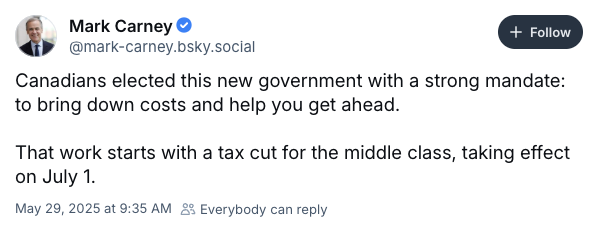
Scared yet? We’re just getting started. Back on Thursday our new Prime Minister was seen to tweet:
In other words, this government seems determined to continue in the tradition of both the former government – and the opposition parties for that matter – in framing the country’s ills as problems of costs to be solved by tax cuts and giveaways rather than problems of growth and the institutional investments required to generate it. This way lies Peronism and perpetual stagnation.
And this is from our allegedly “serious” party.
So, takeaway number one. Universities need to throw away EVERYTHING in their playbooks for Government Relations. Selling yourself as “the future” to a government that is desperately trying to reverse our economy into the 1960s is pointless. This government and this Prime Minster Do. Not. Care. Until they do, arguing for universities as “crucial” investments is a waste of time. The real fight is over the shape of the Canadian economy.
On to a more abstract point about budgeting. One of the reasons we aren’t getting a budget before fall, despite the government just having been elected with a pretty detailed budget-ready manifesto and the Department of Finance being perfectly capable of putting together a set of Main Estimates for the House of Commons (as it showed on Thursday), is that Carney is trying to introduce a new set of rules with respect to public budgeting. He spent part of this week insisting that he would balance the “operating budget” within three years, which sparked a lot of incredulity given that i) the economy is about to be in the tank and ii) the Liberals have ring-fenced most of the federal budget by saying they won’t touch transfers to provinces or transfers to institutions. In theory, that means very significant cuts to program spending. Like, say, research budgets.
Except: there is currently no such thing as an “operating budget”. What Carney wants to do is to exempt from the budget balance requirement anything that can be seen as “capital investment”, which means basically that the main game in Ottawa over the next few years is going to be how to get your favourite piece of spending classed as “capital” instead of “operating”. And that’s a live issue because the definition the Liberals touted in the election campaign, to wit…
…anything that builds an asset, held directly on the government’s own balance sheet, a company’s or another order of government’s. This will include direct investments the government makes in machinery, equipment, land and buildings, as well as new incentives that support the formation of private capital (e.g. patents, plan and technology) or which meaningful raise private sector productivity.
…is so loose you could drive a truck through it. Will CFI spending count as capital? Probably, but not necessarily since universities (in most provinces anyway) are neither a government nor a company. Will tri-council spending? Probably not, but that’s not going to stop folks claiming it supports capital formation/raises productivity, so who knows? So, takeaway number two: get used to arguing distinctions between capital and operating because this might be the only place the sector gets traction in the next little while.
A final point of importance is something that is not exactly new but has been given fresh salience by being in the Throne Speech, and that is the government’s commitment to limit temporary immigration – that is Temporary Foreign Workers (TFWs) plus international students – to below five percent of the population by 2027. Or, to put it another way: every extra TFW is one international student less. What the government has done here is set up a zero-sum game between institutions of higher education and people like the manager of the Kincardine Tim Horton’s whose business model simply cannot work if they are not allowed to employ foreign nationals at below-market rates.
This, my friends, is the fight post-secondary education needs to pick and needs to win. It won’t be easy, because the captains of Canadian industry are largely clueless about competing on anything other than price, meaning low-wage labour is pretty dear to their hearts and they will fight hard for TFWs. But it is the dilemma this country faces in a nutshell: should we use our scarce temporary immigration spots to make things cheaper in the short-term? Or should we use them to develop a skilled workforce and build our scientific and technological talent base for the long term?
So, I know this won’t come easy to institutions but: screw Bay Street. Light the torches. Find the pitchforks. Pick up anything you have handy and smash the windows of your local Tim Horton’s. Fight for international students and against TFWs. This is an existential contest: it decides whether Canada is going to be a country that gets wealthier based on investments in skills, education and science, or a country that bathes in mediocrity because we go mental if the price of a cruller goes up twenty-five cents.
And if the sector ducks this fight because direct confrontation with business is icky and makes some Board members uncomfortable? Well, then the sector deserves everything it gets. That’s the third, and most important takeaway of the last week.
-
Week in review: Trump administration targets Chinese student visas
Most clicked-on story from last week:
House Republicans passed — by one vote — a massive spending bill backed by President Donald Trump with heavy implications for higher education. Among other proposals, it would raise and expand the endowment tax, introduce a risk-sharing program that would put colleges on the hook for unpaid student debt, nix subsidized loans and narrow eligibility for Pell Grants. Many expect the Senate to make changes to the bill.
Number of the week
7
That’s how many regional branch campuses Pennsylvania State University is set to close after a 25-8 vote by its trustee board. The plan will pare down the university’s commonwealth campuses to 13 to cope with demographic declines and budget pressure. Detractors said the decision was made too hastily, ignored some campuses’ recent progress and could hurt the state’s rural areas.
Trump administration updates:
- The Trump administration aims to “aggressively revoke visas for Chinese students” while ramping up scrutiny and changing criteria for student visa applications from China and Hong Kong, U.S. Secretary of State Marco Rubio said Wednesday. With nearly 278,000 students from China studying in the U.S. during the 2023-24 academic year, the move could have a steep impact on U.S. colleges.
- Sixteen states sued the National Science Foundation over the agency’s 15% cap on indirect research costs and its mass termination of grants related to diversity, equity and other topics. The states’ colleges “will not be able to maintain essential research infrastructure and will be forced to significantly scale back or halt research, abandon numerous projects, and lay off staff,” plaintiffs said in their complaint.
- The Trump administration plans to cut Harvard University’s remaining federal contracts, amounting to about $100 million. An official with the U.S. General Services Administration cited what he alleged was “Harvard’s lack of commitment to nondiscrimination and our national values and priorities.” The salvo is the latest in the federal government’s escalating battle with the Ivy League institution.
Texas legislators look to tighten control of colleges:
- The Texas House approved a bill that would give the state’s regents — who are appointed by the governor — the power to recommend required courses at public colleges and to reject courses deemed too biased or ideological. Regents would also gain approval authority over the hiring of administrators.
- Another bill approved by the House would limit where and how students can protest on campuses. The Texas House and Senate are working to resolve their differences over the bill, according to The Texas Tribune.
Quote of the week:
“There’s a bit of anxiousness among accreditors and institutions and state legislators because of the uncertainty. Is it that they are intentionally being vague or general until they can work out all of the nuances of the policies that they want to implement? I can tell you, less is not more in this situation.”
That’s Cynthia Jackson Hammond, president of the Council for Higher Education Accreditation, on the effects of Trump’s executive order on college accreditation.
-

This week in 5 numbers: Trump eyes 15.3% cut for Education Department
The number of college presidents who testified before the House Committee on Education and Workforce this week about how they’ve handled alleged campus incidents of antisemitism. While Republicans have said they’re trying to combat antisemitism, some Democrats accused GOP lawmakers of using those concerns to quell constitutionally protected speech during the hearing with the leaders of Haverford College, DePaul University and California Polytechnic State University, San Luis Obispo. -
This week in 5 numbers: Sweeping higher ed bill advances
The federal funding that the Trump administration suspended to University of Pennsylvania in March, citing the Ivy League institution’s participation policies for transgender athletes. The U.S. Department of Education concluded this week Penn violated Title IX, though university leaders have said the institution is complying with current law and NCAA policies. -

Landmark New Mexico Education Equity Case Heads Back to Court Next Week – The 74
Get stories like this delivered straight to your inbox. Sign up for The 74 Newsletter
The parties in the long-running Yazzie-Martinez lawsuit over educational equity in New Mexico will meet in court next week to discuss a motion alleging the state has not complied with previous court orders, along with the plaintiffs’ request for a “remedial plan.”
The case, originally filed in 2014, led to a finding in 2018 by the late First Judicial District Court Judge Sarah Singleton, who found that the state was not providing equitable educational opportunities to Native students, English language learners, low-income students and students with disabilities. She ordered the state to take steps to address the needs of these at-risk students and ensure schools have the resources to provide them with the education they deserve.
Attorneys representing Louise Martinez and Wilhelmina Yazzie filed a joint motion of non-compliance in September 2024, arguing that the state has not made significant progress in addressing the needs of at-risk students. Specifically, in their motion, plaintiffs point to ongoing poor student performance; high turnover within the New Mexico Public Education Department; high teacher vacancy rates; and a lack of targeted funding for at-risk students.
Since Singleton’s decision, the state has increased funding for public education, but students are still being overlooked, Melissa Candelaria, education director for the NM Center on Law and Poverty, which represents the plaintiffs, told Source NM.
The motion hearing is scheduled for 9 a.m. Tuesday, April 29.
“We believe the court’s ruling should have been a wakeup call,” Candelaria said. “Our students can’t afford more bureaucratic churn and empty promises from PED. And we believe, the plaintiffs believe, the court must step in to enforce a real community-driven plan that reflects the urgency and the gravity to improve the overall state education system.”
Candelaria noted that the joint motion was not opposed by New Mexico Attorney General Raúl Torrez, who represents the state in the case. Court documents state that Torrez “agrees” that there has been “insufficient compliance.” However, private counsel for the PED did oppose the motion, particularly the plaintiff’s proposed remedial plan.
PED had not responded to a request from Source NM for comment prior to publication.
That plan, as detailed in court documents, includes nine components or goals, including: establishing a multicultural and multilingual educational framework; building an education workforce; increasing access to technology; developing methods of accountability; and strengthening the capacity of the PED.
“There’s no longer a debate that a statewide education plan is necessary. Now, the decision is who leads that development,” Candelaria said.
Candelaria also told Source the plaintiffs propose the Legislative Education Study Committee take the lead in developing the remedial plan because the department’s staff have knowledge and expertise in the area of education and have access to data. The department also has a director and permanent staff, as opposed to the PED, which has had multiple cabinet secretaries lead the department in the nearly seven years since Singleton’s decision, she noted.
“Without a plan, the efforts by the Legislature will still be piecemeal and scattershot and it’s not going to result in what we want to see in a transformed education system that’s equitable and that builds on the strengths and provides for the needs of the four student groups in the case,” Candelaria said.
The PED opposes the motion on this point, according to court documents, and argues the education department should take the lead in developing the plan. The department also says more time is needed to create and then implement the plan. Plaintiffs suggest that the five-year plan should be developed within six months of this month’s hearing.
Wilhelmina Yazzie, one of the original plaintiffs, told Source she feels “very optimistic” ahead of the motion hearing and that she hopes the judge agrees a plan is necessary. She added that the inequities in public education were emphasized during the COVID-19 pandemic.
“Especially our tribal communities who are really deeply impacted by that, and they still continue to suffer to the present time right now and just by the state not taking the action that we need them to take,” Yazzie said.
Yazzie’s son, Xavier Nez, 22, was in third grade when the lawsuit started. He is now in his third year studying at the University of New Mexico. Candelaria pointed out that since the 2018 court decision, multiple classes of students have made their way through the state’s educational system and failed to receive a comprehensive education. Yazzie’s youngest child, Kimimila Black Moon, is currently in third grade but attends private school.
“She’s not in the public school because I still haven’t seen changes,” she said.
Yazzie told Source that another goal of hers is to get out into communities throughout the state and speak with families because many parents are still unaware of the lawsuit and “they’re the ones that firsthand know what their children need, what they’re lacking, how they’re doing in school.”
Source New Mexico is part of States Newsroom, a nonprofit news network supported by grants and a coalition of donors as a 501c(3) public charity. Source New Mexico maintains editorial independence. Contact Editor Julia Goldberg for questions: [email protected].
Get stories like these delivered straight to your inbox. Sign up for The 74 Newsletter
-

AI in Education: Beyond the Hype Cycle
We just can’t get away from it. AI continues to take the oxygen out of every edtech conversation. Even the Trump administration, while actively destroying federal involvement in public education, jumped on the bandwagon this week.
Who better to puncture this overused acronym than edtech legend Gary Stager. In this conversation, he offers a pragmatic perspective on AI in education, cutting through both fear and hype. Gary argues that educators should view AI as simply another useful technology rather than something to either fear or blindly embrace. He criticizes the rush to create AI policies and curricula by administrators with limited understanding of the technology, suggesting instead that schools adopt minimal, flexible policies while encouraging hands-on experimentation. Have a listen:
More News from eSchool News

A recent survey found that 88 percent of U.S. parents believe AI is essential to their children’s education, but most aren’t even sure whether the technology is being used in their child’s classroom.

As AI becomes more widespread in education, more than half of high school students (56 percent) polled think it can go a long way in reducing math anxiety, a new global survey shows.

Teachers often seem to have eyes in the back of their heads. They respond to a murmured question in a class full of conversation. They can tell if someone’s skipping class a floor away by reading faces in the room.

While digital literacy has become an aspirational cornerstone of modern education, the exponential growth of data-driven decision-making across industries reveals critical gaps that demand a stronger focus on data literacy.

Teaching K-12 coding without computers may seem like a daunting task, but it can be a powerful way to introduce students to the fundamental concepts of computer science and problem-solving without the distraction of technology.

The most effective way for students to learn career-ready skills in fields such as advanced manufacturing and robotics is by applying these skills in the context of authentic projects and real-world scenarios.

In the Future of Jobs 2025 report, the World Economic Forum predicts that 60 percent of jobs will require upskilling or retraining, or they’ll be threatened. The skills we have today may not keep us secure for long.

Middle and high school counselors juggle overwhelming caseloads, expanded mental health duties, and additional administrative burdens–all of which limit their ability to provide individualized support for students.

When Adrienne Staten’s fellow teachers first started talking about using artificial intelligence tools in their classrooms, Staten was not on board.
Want to share a great resource? Let us know at submissions@eschoolmedia.com.
-

This week in 5 numbers: 133 international students have legal status restored
We’re rounding up recent stories, from a legal victory for some noncitizen students to Harvard University's legal fight against the Trump administration.
-

Funding for online education library ERIC is slated to end this week
When you’re looking for research on four-day school weeks or how to teach fractions, or trying to locate an historical document, such as the landmark Coleman Report of 1966, you might begin with Google. But the reason that high-quality research results pop up from your Google search is because something called ERIC exists behind the scenes.
ERIC stands for Education Resources Information Center and it is a curated online public library of 2.1 million educational documents that is funded and managed by the U.S. Education Department. The collection dates back to the 1960s and used to be circulated to libraries through microfiche. Today it’s an open access website where anyone can search, read online or download material. Neither a library card nor login credentials are needed. It is used by an estimated 14 million people a year. (I am one of them.) If you’re familiar with MedLine or PubMed for health care studies, this is the equivalent for the field of education.
This critical online library catalog is supposed to continue operating under a five-year contract that runs through 2028. Initially, ERIC was spared from the department’s mass contract cancellations in February. But according to Erin Pollard Young, the sole Education Department employee who managed ERIC until her job was eliminated in March, the Department of Government Efficiency or DOGE has since refused to approve disbursement of money that has already been authorized by Congress for the upcoming year.
Related: Our free weekly newsletter alerts you to what research says about schools and classrooms.
ERIC is scheduled to run out of money on April 23. After that date, no new documents can be added. “The contract, from my understanding, would die,” Pollard Young said in an interview.
“After 60 years of gathering hard to find education literature and sharing it broadly, the website could stop being updated,” Pollard Young posted on LinkedIn. “Yes, the data are backed up in so many places, and the website will likely remain up for a while. But without constant curation and updating, so much information will be lost.”
Parents, teachers, researchers and education policymakers are all affected. “Defunding ERIC would limit public access to critical education research, hindering evidence-based practices and informed policy decisions vital for the advancement of American education,” emailed Gladys Cruz, a superintendent of a school district called Questar III BOCES outside of Albany, New York, and a past president of the AASA, The School Superintendents Association.
Proposal to halve the cost
Pollard Young said that before she left the Education Department, she was frantically working to comply with a DOGE demand to slash ERIC’s annual budget by half, from $5.5 million to $2.25 million. The cuts were painful. She would have to cut 45 percent of the journals added to the database each year. The public help desk would be eliminated. And Pollard Young had agreed to personally take on the extra task of directly communicating with 1,500 publishers, something that had been handled by AEM Education Services, a vendor that collects, analyzes and manages data for the government.
These proposed cuts did not satisfy DOGE. Pollard Young said she received an email reply in all caps, “THIS IS NOT APPROVED,” with a request for more information. Pollard Young submitted the additional information but never received a response. She lost access to her work email about a week later on March 11, the day that Pollard Young and more than 1,300 other Education Department employees lost their jobs in a mass firing.
Pollard Young was the only Education Department employee who was involved with ERIC on a daily basis. She oversaw a team of 30 contractors at AEM Education Services, which did most of the work. Adding documents to the digital library involves many steps, from determining their importance to cataloging and indexing them. It is the metadata, or descriptive tags, that AEM inserts behind the scenes that allows documents on ERIC to be discoverable and rise to the top on Google searches. But the public can also search directly on the ERIC website.
“Fun fact,” Paige Kowalski, executive vice president of the Data Quality Campaign, an organization that advocates for data-driven decision making in schools, posted on LinkedIn. “Over the 20 years that DQC has been around we’ve had some poorly designed websites with atrocious search functions. I often couldn’t find resources I wrote! But could always find them on ERIC. Huge resource.”
The bulk of the collection consists of academic journal articles. Many are full text PDFs that would otherwise be inaccessible behind paywalls. ERIC also contains books, federal, state and local government reports and doctoral dissertations.
Gray literature
One of its gems is the large amount of “gray literature,” which Pollard Young described as unpublished studies from private research organizations and school district reports that are not cataloged in EBSCO, a private database of academic documents. That’s another reason that Google and AI cannot simply replace this curated ERIC collection. “In education so much research is produced outside of journals,” said Pollard Young. “Big, important RCTs [randomized controlled trials] are in white papers,” or special reports.
In response to specific questions about the future of ERIC, the Education Department responded more broadly about the need to restructure the Institute of Education Sciences (IES), where ERIC is managed. “Despite spending hundreds of millions in taxpayer funds annually, IES has failed to effectively fulfill its mandate to identify best practices and new approaches that improve educational outcomes and close achievement gaps for students,” said Madi Biedermann, deputy assistant secretary for communications, in an emailed statement. “The Department is actively evaluating how to restructure IES with input from existing leadership and expert stakeholders so that the Institute provides states with more useful data to improve student outcomes while maintaining rigorous scientific integrity and cost effectiveness.”
It is still possible that DOGE will approve the reduced budget proposal this week before the money runs out. But there will be no one at the Education Department to oversee it or communicate with publishers. “Best case scenario, ERIC operates at half of its budget,” Pollard Young posted on LinkedIn.
Related: DOGE’s death blow to education studies
Like other Education Department employees who were fired in March, Pollard Young is on administrative leave until June. But she said she is willing to risk potential retaliation from the administration and speak on the record about the threat to ERIC, which she had managed for more than a dozen years.
“I am aware of what some of the consequences are,” said Pollard Young. “But to me, it is important for the field to know that I am doing everything in my power to save ERIC and also for the country to understand what is happening. As I’m talking to people across the country, it is clear that they don’t fully understand what is happening in D.C. Hopefully we can put some pressure on it so we can keep the funding or bring it back.”
Contact staff writer Jill Barshay at 212-678-3595, jillbarshay.35 on Signal, or barshay@hechingerreport.org.
This story about ERIC was written by Jill Barshay and produced by The Hechinger Report, a nonprofit, independent news organization focused on inequality and innovation in education. Sign up for Proof Points and other Hechinger newsletters.
-

This week in 5 numbers: Another year of growth for faculty salaries
The amount in federal grants the Trump administration froze for Harvard University this week. The move came after the Ivy League institution refused to comply with federal officials’ demands to, among other things, eliminate diversity initiatives, curtail the power of some faculty and audit the viewpoints of students and employees.