Tag: Weighs

  • Supreme Court weighs state restrictions on transgender student athletes

    Supreme Court weighs state restrictions on transgender student athletes

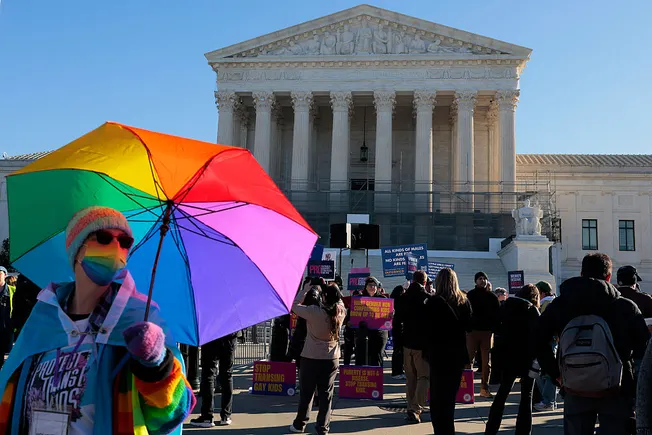
    The U.S. Supreme Court heard back-to-back oral arguments Tuesday over two cases that could determine whether transgender women and girls can play on sports teams aligning with their gender identity. 

    The two lawsuits center on two states, Idaho and West Virginia, that have banned transgender women and girls from such teams. Idaho was the first state to implement such a restriction in 2020, and 26 other states have since passed similar laws. 

    The student in each lawsuit alleges that their state’s restriction violates their 14th Amendment guarantee to equal protection under the law. One of them also contends that the restriction violates Title IX, the sweeping federal law banning sex-based discrimination in federally funded colleges and K-12 schools. 

    Conservative politicians have championed these policies, including President Donald Trump. 

    Early in his second term, Trump signed an executive order that threatened to pull federal funding from and open investigations into colleges and K-12 schools that allow transgender women and girls to play on sports teams aligning with their identities.

    Comments of the Supreme Court’s conservative majority on Tuesday and their past rulings suggest that those justices may be reluctant to strike down state laws restricting transgender students’ participation in college and K-12 sports. 

    Last year, the conservative majority upheld a Tennessee law barring transgender teenagers in the state from accessing puberty blockers and hormone treatments. And Brett Kavanaugh, one of the conservative justices, voiced concerns Tuesday about allowing transgender women and girls to play on the same teams as their cisgender peers. 

    “One of the great successes in America for the last 50 years has been the growth of women and girls sports,” Kavanaugh said. 

    He added that “a variety of groups” have argued that allowing transgender women and girls to participate on such teams will reverse that success. “For the individual girl who does not make the team, or doesn’t get on the stand for the medal, or doesn’t make all-league, there’s a harm there,” Kavanaugh said. “We can’t sweep that aside.” 

    Lawyers defending the state bans made similar comments. In defense of West Virginia’s law, state Solicitor General Michael Williams argued that “biological sex matters in athletics in ways both obvious and undeniable.” 

    Allowing students to participate on teams aligning with their gender identity turns Title IX into a law “that actually denies those opportunities for girls,” Williams said. 

    Meanwhile, lawyers for the two transgender students suing over the state policies argue that the bans deny them their constitutional rights. 

    Joshua Block, a lawyer with the American Civil Liberties Union representing the student contesting the West Virginia law, argued that the 14th Amendment’s equal protection clause and Title IX are meant to “protect everyone.” 

    In that case, West Virginia v. B.P.J., Becky Pepper-Jackson, now a high school student, and her mother sued the state in 2021 over its ban on transgender girls participating in girls’ sports. 

    Pepper-Jackson has identified as a girl since 3rd grade and takes puberty blockers. She won a narrow district court injunction in July 2021 that blocked West Virginia from applying the law to her, though the judge ended up ruling in favor of the state. The 4th U.S. Circuit Court of Appeals issued a ruling in 2023 allowing her to participate in girls’ sports again.  

    Block argued that if there are no “physiological differences” between Pepper-Jackson and other girls, there is no reason to exclude her from girls’ sports teams. 

    “West Virginia’s law treats BPJ differently from other girls on the basis of sex, and it treats her worse in a way that harms her,” Block said. 

    In the other case, Little v. Hecox, Boise State University student Lindsay Hecox, a transgender woman, sued the state of Idaho in 2020 over its statute, arguing that it violated her constitutional rights by discriminating against transgender women. 

    Hecox, who receives hormone therapy to suppress testosterone and increase estrogen, scored a victory when a federal judge blocked the law in 2020. Afterward, she tried out for Boise State’s NCAA track and cross-country teams but wasn’t fast enough to make them, so she joined the university’s club soccer and running instead. 

    Source link

  • New Jersey Weighs Biggest Update of Charter School Rules in 30 Years – The 74

    New Jersey Weighs Biggest Update of Charter School Rules in 30 Years – The 74


    Get stories like this delivered straight to your inbox. Sign up for The 74 Newsletter

    Senate lawmakers on Monday advanced legislation that would launch the most comprehensive overhaul of New Jersey’s regulation of charter schools in 30 years.

    The bill advanced by the Senate Education Committee on Monday would outright ban for-profit charter schools, require them to post a range of documents online, and impose residency requirements for some charter school trustees.

    “We have not looked at charter schools as a whole legislatively in this committee since the 1990s, so this is an opportunity where we’re trying to do that,” said Sen. Vin Gopal (D-Monmouth), the panel’s chair and the bill’s prime sponsor.

    The bill comes as New Jersey charter schools have faced scrutiny after reporting revealed top officials were paid far more than their counterparts at traditional public schools, including, among others, a Newark charter school CEO who was paid nearly $800,000 in 2024.

    The proposal, which Gopal said was the product of a year of negotiations, would require charter schools to post user-friendly budgets that include the compensation paid to charter school leaders and school business administrators. They must also post existing contracts.

    Charters would be required to post meeting notices, annual reports, board members’ identities, and facility locations online. Some critics have charged that charter schools routinely fail to provide notice of their public meetings.

    The legislation would also require the state to create a dedicated charter school transparency website to host plain language budgets, 990 disclosure forms filed with the IRS, contracts with charter management organizations, and a list of charter schools on probation, among other things.

    It would also ban fully virtual charter schools.

    “We support the bills as a step forward in holding all public schools in our state accountable for fiscal and transparency requirements that will ultimately best serve our students,” said Debbie Bradley, director of government relations for the New Jersey Principals and Supervisors Association.

    The two sides remained at odds over the membership of charter school boards.

    Charter critics argued residency for those positions — which, unlike traditional public school boards, are largely appointed rather than elected — should mirror those imposed on regular public schools.

    In New Jersey, school board members must live in the district they serve. That’s not the case for charter schools, whose trustees face no residency or qualification limits under existing law.

    The bill would only impose a residency requirement on one-third of a charter school’s trustees, and rather than forcing them to live in the district, the bill would require charter trustees to live in the school’s county or within 30 miles of the school.

    That language was criticized by statewide teachers union the New Jersey Education Association, which has called existing law governing charter schools outdated and flawed.

    “School board representation should remain primarily local, and when we mean local, we don’t mean within a 30-mile radius. A 30-mile radius of Newark could include Maplewood, South Orange, communities that don’t necessarily represent what Newark looks like as a community,” said Deb Cornavaca, the union’s director of government relations.

    Charter school supporters said their boards need flexibility because their leadership has broader responsibilities than counterparts in traditional public schools.

    “Running a charter is a little different than running a traditional district. You need experience in school finance. You need to fundraise a bunch of money on the front end because you’re not getting paid on the front end,” said New Jersey Charter School Association President Harry Lee, adding they also needed familiarity with real estate and community experience.

    Amendments removed provisions that would have required charter school board members to be approved by the state commissioner of education, though the commissioner retains sole power over whether to allow the formation of a new charter, a power that gives the commissioner some veto power over a charter’s board.

    Gopal acknowledged the 30-mile residency rule was a sticking point and said legislators would discuss it before the measure comes before the Senate Budget Committee. Earlier, he warned the bill was likely to see more changes as it moved through the Legislature.

    Some argued enrollment in charter schools should be more limited by geography, arguing that out-of-district enrollments that are common at New Jersey charters could place financial strain on the students’ former district.

    Most per-pupil state and local funding follows students who enroll in charter schools, even if their departure does not actually decrease the original district’s expenses because, for example, those schools still require the same number of teachers and administrators.

    Charter operators said that would make New Jersey a national outlier and argued that a separate provision that would bar new charter schools when there are empty seats in existing area charters should come out of the bill.

    “It could be read as a moratorium on charters, so we want to revisit that provision,” Lee said.

    Such vacancies could exist for various reasons, they argued, including student age distributions.

    Alongside that measure, the panel approved separate legislation that would bar charter schools from setting criteria to enroll students, ban them from imposing other requirements on a student randomly selected to attend, and place new limits on how such schools can enroll children from outside their district.

    That bill would also bar charter schools from encouraging students to break with the district. Some opponents have charged that charter schools push out low-performing students to boost their metrics.

    The committee approved the bills in unanimous votes, though Sens. Owen Henry (R-Ocean) and Kristin Corrado (R-Passaic) abstained from votes on both bills, saying they are broadly supportive but need more time to review amendments.

    New Jersey Monitor is part of States Newsroom, a nonprofit news network supported by grants and a coalition of donors as a 501c(3) public charity. New Jersey Monitor maintains editorial independence. Contact Editor Terrence T. McDonald for questions: [email protected].


    Did you use this article in your work?

    We’d love to hear how The 74’s reporting is helping educators, researchers, and policymakers. Tell us how

    Source link

  • U.K. Weighs Streamlining Visa Process for Researchers

    U.K. Weighs Streamlining Visa Process for Researchers

    The U.K. government has been urged to remove barriers in the visa process for researchers in order to capitalize on new U.S. restrictions imposed by Donald Trump.

    The U.S. president last weekend announced a $100,000 fee for applicants to the H-1B visa program, making a vital visa route used by skilled foreign workers in the U.S. inaccessible to many.

    The U.K. is reportedly considering removing fees for its global talent visa in response. The Campaign for Science and Engineering (CaSE) warned that high visa costs are already a significant barrier but said it is not the only change that needs to be made.

    In a new report, CaSE highlights the obstacles presented by the current system, including concerns raised by professionals who handle visa and immigration issues at U.K. research institutions.

    It warns that information about who is eligible for the visa route is often ambiguous and hard to navigate. According to the Wellcome Sanger Institute, which contributed to the report, the language around “exceptional talent” can be intimidating for talented applicants, although many institutions also receive a large number of low-quality applications.

    “These examples point to a wider issue of confusion and unclear messaging about who is eligible, resulting in missed opportunities and cost inefficiencies,” says the report.

    Visa policy is also increasingly complex and can put a significant strain on organizations, according to CaSE.

    The Sainsbury Laboratory (TSL), a research organization that specializes in molecular plant-microbe interactions, said visa support now demands a full-time employee in human resources as well as external support costing more than $21,000 per year in legal fees.

    “The U.K. visa system is becoming increasingly complex, unclear and time-consuming—especially for research institutes like TSL that depend on international talent.

    “Policy changes are poorly communicated, portals outdated and guidance inconsistent, requiring our HR to spend extensive time interpreting information.”

    TSL said that without a fair and functional visa system, the U.K. risks reaching a “breaking point in our ability to attract global talent and sustain world-leading research.”

    Alicia Greated, executive director of CaSE, said U.K. research faces “major challenges” under the current system. She wants to see the government take action that will improve things for skilled workers and those that employ them.

    Greated welcomed reports that the Labour administration was considering reducing visa fees for highly skilled researchers, adding, “If these changes happen, they will put the U.K. in a strong position to compete on the global skills market, especially given the changes in the opposite direction in the U.S.”

    However, she said that the removal of indefinite leave to remain, or permanent residency, from individuals already settled in the U.K.—as Reform UK is advocating—would be extremely damaging to U.K. R&D and the wider economy, as well as individuals and their families.

    “Policy proposals like this also have a negative impact on the attractiveness of the U.K. as a destination for the world’s brightest and best researchers because people may worry their right to be in the country could be taken away.”

    Source link