Tag: West

  • West Florida Finalizes Hire of Former GOP Lawmaker

    West Florida Finalizes Hire of Former GOP Lawmaker

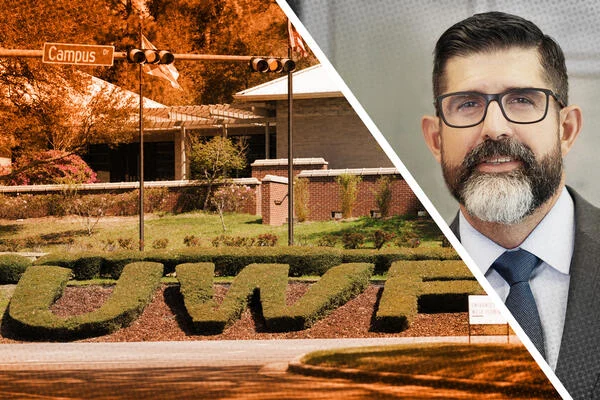
    The University of West Florida approved the hire of former Republican lawmaker Manny Diaz Jr. Thursday, seven months after he was appointed interim following a search critics saw as flawed.

    Diaz was the only candidate to emerge from a group of 84 applicants, according to past board statements. His elevation prompted faculty questions about why a more robust pool was not considered and whether Diaz could be properly evaluated for the job when there were no other finalists to weigh him against. Diaz, who has split his career between education and politics, must still be approved by the Florida Board of Governors, a body he served on for three years in his role as state education commissioner from 2022 to 2025. Before taking on that job, Diaz was a member of the State Legislature from 2012 to 2022.

    Between his base salary and other perks, he’ll earn nearly $1 million a year.

    Diaz joins a slew of other Republican politicians who have ascended to a top job at one of Florida’s 40 public institutions. Among the 12 institutions in the State University System of Florida, seven are led by former GOP lawmakers or others with ties to Republican governor Ron DeSantis. Multiple institutions in the 28-member Florida College System are also led by ex-politicos.

    Process Concerns

    The UWF Board of Trustees formally signed off on hiring Diaz on Thursday in a meeting that began with a statement of concern from a faculty member during the public comment section.

    Faculty Senate vice president Amy Mitchell-Cook told the board she had heard concerns from faculty, staff, students and community members about the legitimacy of the search effort.

    “I have served on and/or chaired several academic searches. If the committee in any of those searches thought that only one candidate was qualified, the search would have been reopened and expanded,” Mitchell-Cook told trustees. “If the search truly produced only one worthy candidate to bring on campus, then this should be considered a failed search. If, however, there were other worthy candidates, then the perception is that this search was predetermined or flawed.”

    Mitchell-Cook also questioned whether the search complied with Florida Board of Governors policies and argued that the unusual nature of the search created doubts about the legitimacy of the effort.

    Faculty Senate president Heather Riddell, a voting member of the UWF Board of Trustees, expressed similar concerns. Riddell was the lone vote against hiring Diaz at Thursday’s meeting, noting that her dissent was not aimed at the candidate but rather a questionable search process.

    “As a public institution, we are accountable to taxpayers and our community,” Riddell said.

    She pointed to a FLBOG regulation that stipulates a university must advance three applicants, unless there are extenuating circumstances, which she said there did not appear to be. Ultimately, she said, “Stakeholders are left without a clear understanding of the decision.”

    But Riddell was outnumbered by trustees supportive of Diaz, including some who have worked for Diaz in the political arena. Trustee Ashley Ross, for instance, was a contracted fundraiser for Diaz from 2018 to 2022, a fact she acknowledged in an email to Inside Higher Ed and at the meeting.

    “Since that time, I have had no business or employment relationships with him. I have consulted legal counsel, and it has been determined that I have no voting conflicts,” she wrote by email.

    Public records show that Diaz spent tens of thousands of dollars with the trustee’s firm, Ross Consulting. Diaz also appointed her husband, Scott Ross, to the Florida Education Foundation Board of Directors in 2022, along with current UWF board chair Rebecca Matthews, who also voted to hire him Thursday.

    Conflict of Interest Concerns

    The hiring process wasn’t the only concern that critics raised about Diaz.

    On Monday someone using the pseudonym ConcernedArgonaut—the UWF athletics moniker—wrote to state officials to express concerns about Diaz’s leadership as state education commissioner, as well as a potential charter school project under discussion at UWF.

    The writer pointed out a recent financial debacle at the Florida Department of Education, noting that an audit found that the state mismanaged its school voucher system under Diaz—Florida lost track of 30,000 students and the voucher program cost $398 million more than planned under Diaz’s leadership. The writer also referenced Diaz’s personal bankruptcy in 2012 and questioned whether the new president was capable of managing UWF’s budget.

    ConcernedArgonaut also noted “Diaz’s deep connections to the Florida charter school industry.” The letter pointed out that Diaz once worked for Doral College, which is connected to Academica, a large education company that provides services to more than 200 charter schools. Shortly after Diaz announced that a prospective charter school could be coming to the UWF campus, a website for Somerset University Preparatory Academy surfaced, advertising “A Private Elementary School located on the Beautiful University of West Florida Campus.”

    The address listed on the website is the same as UWF’s School of Education.

    The board did not ask Diaz about financial mismanagement concerns in a Thursday interview preceding the vote but offered him a chance to address the charter school discussions.

    Diaz dismissed the charter school concerns as “completely erroneous,” telling the board that discussions about establishing a school preceded his time there. He also said UWF would need approval from both trustees and the state before it could open a charter school on its campus.

    Independent journalist Kevin Danko, who writes the Higher Ed Heist newsletter, also flagged a potential conflict of interest in Diaz’s recent involvement with a new company called MDJ Consulting Group. The company was opened several months after Diaz was hired as interim, following the resignation of UWF president Martha Saunders, who stepped down in May amid tensions with trustees.

    A UWF spokesperson told Danko that the company “is Manny’s wife’s LLC” and was established “for special education consulting services.” Diaz, however, is also on the business filing. UWF spokesperson Brittany Sherwood told Inside Higher Ed by email the “LLC is for outside activity, allowed within the terms of his contract,” such as “consulting, speaking engagement, etc.”

    She added that work with the consulting firm is “separate from any University affairs.”

    Danko also shared records with Inside Higher Ed that show Diaz was already picking out office furniture in September. Those records show furniture package options ranging from $49,379 to $54,216.

    Sherwood wrote that standard practice at UWF is that “when a departing president returns to faculty, existing office furniture moves with them, leaving the space unfurnished. As a result, new furniture was required regardless of who serves as the next president.”

    “Furnishings were purchased with the intent of creating a long-term legacy office that will remain in place for many years and serve future University leadership,” she added. “The timing of the purchase does not reflect a predetermined outcome of the presidential search, which was conducted in accordance with Board of Governors regulations and Florida statute.”

    But Danko believes the UWF presidential search was a rigged game all along.

    “It’s clear that this is done according to an established plan, a template they’ve worked to perfect for installing state university system presidents,” he wrote by email. “Stack the board of trustees so they can install an unqualified non-academic with political connections as interim president of the school, using the interim period to graft credentials onto the candidate that can give a minimal appearance of legitimacy. Wait 6 months, pretend it wasn’t the plan all along, [and] hold an expensive, sham search process revealing the interim president as the best candidate all along.”
    Source link

  • VICTORY! 5th Circuit blocks West Texas A&M’s unconstitutional drag ban

    VICTORY! 5th Circuit blocks West Texas A&M’s unconstitutional drag ban

    NEW ORLEANS, Aug. 18, 2025 — In a victory for student expression on campus, the U.S. Court of Appeals for the Fifth Circuit today overruled a lower court to halt an unconstitutional ban on student drag performances at West Texas A&M University.

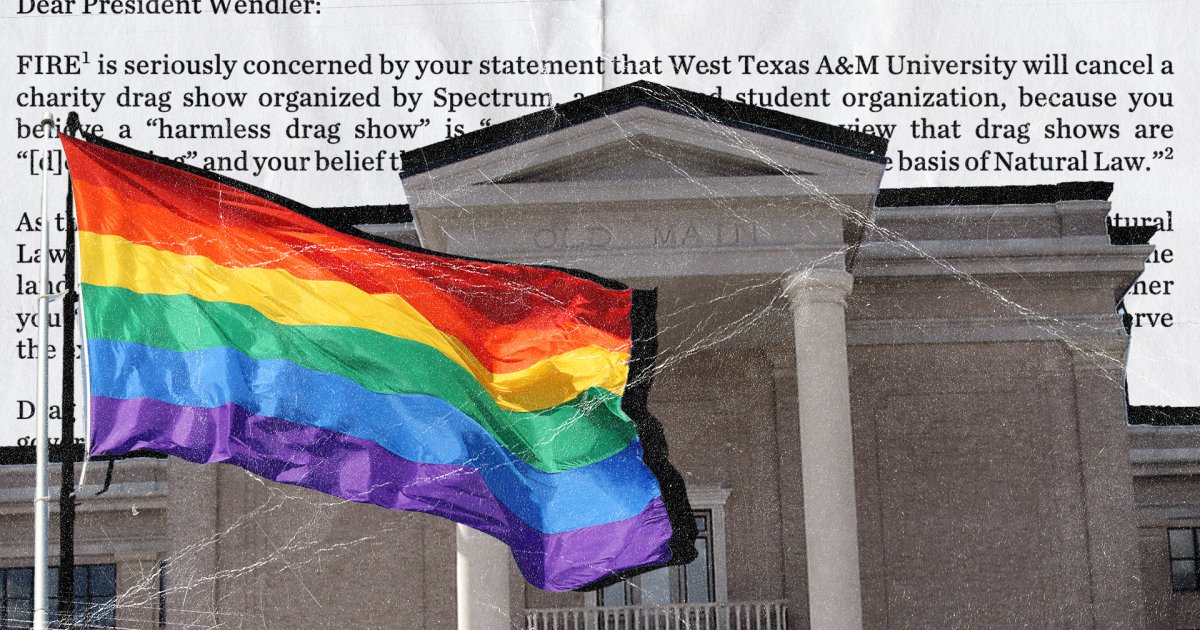
    In March 2023, West Texas A&M President Walter Wendler announced that he was unilaterally canceling a planned campus drag show hosted by LGBTQ+ organization Spectrum WT to raise money for suicide prevention. In a campus-wide email, Wendler said that he was canceling the event because he believes it offends and demeans women.

    As a public official at a state university, the First Amendment bars Wendler from censoring a performance based on nothing more than his personal disapproval. But astonishingly, Wendler admitted he was canceling the show even though “the law of the land appears to require” him to allow it.

    The Foundation for Individual Rights and Expression quickly jumped into action, filing a lawsuit against Wendler and West Texas A&M on behalf of Spectrum WT, its president Bear Bright, and vice president Marcus Stovall. FIRE’s lawsuit seeks to halt Wendler’s unlawful censorship and obtain damages for violating the students’ clearly established First Amendment rights.

    In September 2023, the district court denied FIRE’s motion for a preliminary injunction. While the case made its way through the courts, Wendler canceled a second drag show planned by Spectrum WT in March 2024.

    Today’s ruling from the Fifth Circuit overturns the district court’s ruling and places a temporary hold on Wendler’s enforcement of his illegal directive, allowing Spectrum WT and any other student organization to put on drag shows while litigation continues.

    The majority opinion from Judge Leslie H. Southwick found a substantial likelihood that Spectrum WT’s First Amendment claims would prevail on the merits.

    “Because theatrical performances plainly involve expressive conduct within the protection of the First Amendment, and because we find the plaintiffs’ drag show is protected expression,” the Fifth Circuit held Wendler’s censorship failed to pass constitutional muster. 

    “FIRE is pleased that the Fifth Circuit has halted President Wendler’s unconstitutional censorship and restored the First Amendment at West Texas A&M,” said FIRE Supervising Senior Attorney JT Morris. “This is a victory not just for Spectrum WT, but for any public university students at risk of being silenced by campus censors.”


    The Foundation for Individual Rights and Expression (FIRE) is a nonpartisan, nonprofit organization dedicated to defending and sustaining the individual rights of all Americans to free speech and free thought — the most essential qualities of liberty. FIRE educates Americans about the importance of these inalienable rights, promotes a culture of respect for these rights, and provides the means to preserve them.

    CONTACT:

    Alex Griswold, Communications Campaign Manager, FIRE: 215-717-3473; [email protected]

    Source link

  • Students for Fair Admissions drops lawsuits against West Point, Air Force Academy

    Students for Fair Admissions drops lawsuits against West Point, Air Force Academy

    This audio is auto-generated. Please let us know if you have feedback.

    Dive Brief:

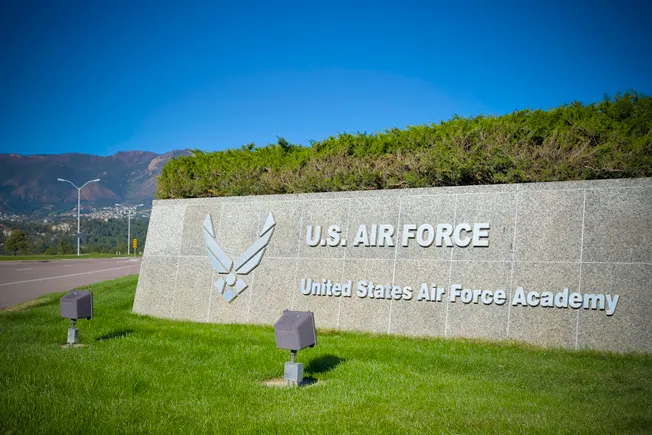
    • Students for Fair Admissions has dropped its lawsuits against the U.S. Military Academy at West Point and the U.S. Air Force Academy over race-conscious admissions — practices that are no longer in effect at either institution under the Trump administration.
    • Both academies axed admissions goals based on race, ethnicity and gender shortly after President Donald Trump’s defense secretary, Pete Hegseth, took office. 
    • SFFA had filed the lawsuits after the U.S. Supreme Court in 2023 sided with the anti-affirmative action group in its landmark ruling banning race-conscious admissions at colleges but allowed the practice to continue at military academies.

    Dive Insight:

    In a footnote to Chief Justice John Roberts’ majority opinion in Students for Fair Admissions v. Harvard — the case that ultimately ended decades of race-conscious admissions — the court said the decision did not address the practice at the nation’s military academies.

    While no military academy had been party to the case, the court effectively created a carve-out for race-conscious admissions at the institutions “in light of the potentially distinct interests that military academies may present.”

    In a friend-of-the-court brief to that case, the Biden administration wrote that “the Nation’s military strength and readiness depend on a pipeline of officers who are both highly qualified and racially diverse — and who have been educated in diverse environments that prepare them to lead increasingly diverse forces.”

    After the ruling came down, SFFA soon filed legal challenges against military academies and their race-conscious admissions policies. 

    In its 2023 complaint against West Point, SFFA alleged, “Instead of admitting future cadets based on objective metrics and leadership potential, West Point focuses on race.” 

    The lawsuit further argued: “West Point has no justification for using race-based admissions.” 

    SFFA’s cases against West Point and the Air Force Academy, along with another one against the U.S. Naval Academy, were in progress when Trump retook the presidency in January. 

    The group quickly found it had an ideological ally in the new administration, whose policies reflect SFFA’s goals.

    Hegseth banned race-based admissions at the nation’s military academies in January, days after being sworn in. In doing so, Trump’s defense secretary described diversity initiatives as “incompatible with the values of DoD,adding that “the DoD will strive to provide merit-based, color-blind, equal opportunities to Service members but will not guarantee or strive for equal outcomes.”

    Hegseth has gone much further than just rejecting race-conscious admissions at the academies. Under his leadership, the Pentagon ordered the military academies to purge hundreds of books from their libraries that deal with racism and gender issues, a move that has sparked outcry as well as lawsuits and at least one reversal.

    In June, the Justice Department and SFFA asked that the group’s lawsuit against the Naval Academy be declared moot, after that institution dropped race-conscious admissions under Hegseth’s directive. The case was under appeal at the time, after a federal judge upheld the institution’s policies in December. In July, an appeals court dismissed the case in response to the request from SFFA and the Justice Department.

    SFFA President Edward Blum said in a June statement, “We applaud this extraordinary accomplishment by the President and the Department of Defense which restores the colorblind legal covenant that binds together our military institutions.”

    Source link

  • Embattled University of West Florida Trustee Resigns

    Embattled University of West Florida Trustee Resigns

    Scott Yenor, chair of the Board of Trustees at the University of West Florida, resigned Wednesday ahead of a looming fight with lawmakers, The Pensacola News Journal reported.

    Yenor, a political science professor at Boise State University, made national headlines in 2021 when he made misogynistic remarks at the National Conservatism Conference, taking aim at feminism and arguing that women should not pursue certain career fields, such as engineering.

    He also described “independent women” as “medicated, meddlesome and quarrelsome.”

    Yenor and other conservative trustees appointed at UWF in January faced protests from the community. But it was ultimately pressure from state lawmakers over other remarks that seemed to push Yenor out. In a series of social media posts in February, Yenor seemed to imply that only straight white men should be in political leadership posts. Some critics, including Randy Fine, a Republican state senator at the time of the post, read his remarks as exclusionary of Jewish men. (Fine recently won a special election to represent Florida’s First Congressional District.)

    Fine, who is Jewish, subsequently called Yenor a “bigot” and “misogynist.”

    Under Florida law, a trustee appointed by the governor can begin serving immediately, before confirmation by the State Legislature. With the confirmation process underway, Yenor stepped aside amid speculation that lawmakers could refuse to sign off on his appointment.

    “Gov. Ron DeSantis’ higher education reforms are models for the country,” Yenor wrote in a resignation email obtained by The Pensacola News Journal. “I was looking forward to bringing the Governor’s positive vision for higher education to the University of West Florida (UWF) as a member of the Board of Trustees. Opposition to my nomination among a group within Florida’s senate, however, leads me to resign from UWF’s Board of Trustees effectively immediately.”

    The potential rejection would mark a rare break between DeSantis and Florida’s Republican-dominated Legislature, which has largely supported the governor’s agenda during his time in office. Earlier this year, the Senate Appropriations Committee did not confirm Adam Kissel, another UWF board appointee, though there is still a path for him to be confirmed anyway. In 2023, the Florida Senate rejected another DeSantis pick and bumped Eddie Speir from the New College of Florida board simply by not taking action on the confirmation rather than rejecting it.

    Source link

  • A West Virginia HBCU reviews programs after anti-DEI order

    A West Virginia HBCU reviews programs after anti-DEI order

    West Virginia State University has been tasked with reviewing its programs and practices after the state’s governor issued an executive order against diversity, equity and inclusion. While other public institutions in the state have to do the same, West Virginia State University is in a somewhat unique position: It’s a public, historically Black institution with a predominantly white student body. The university serves all, but diversity and inclusion are part of its founding mission.

    Higher ed experts say that while few public HBCUs are openly discussing the issue, West Virginia State isn’t the only such institution that’s undergoing this kind of review process as DEI bans proliferate. Some argue that subjecting HBCUs to these reviews is counterintuitive in light of their historic mission, raising questions about how such institutions will fare in the current state and federal policy landscape.

    West Virginia State launched its review after Governor Patrick Morrisey last month banned state institutions from using “state funds, property, or resources” to “grant or support DEI staff positions, procedures or programs.” He also prohibited mandating DEI statements or any training or programming that “promotes or encourages the granting of preferences based on one person’s particular race, color, sex, ethnicity, or national origin.” The Foundation for Individual Rights and Expression, an advocacy organization for free speech rights, castigated the executive order as overly broad and warned it could limit what’s taught in West Virginia classrooms.

    The executive order also required “all cabinet secretaries and department heads under the authority of the Governor” to complete a report within 30 days, identifying any positions, procedures or programs based in “theories of DEI.”

    In response, West Virginia State University, along with other public universities in the state, submitted a letter outlining diversity-related positions, programs and activities, said Ericke Cage, the university’s president.

    “If there are concerns raised by the governor’s office … then we need to work to negotiate possible resolutions,” Cage said, though he expects it won’t come to that.

    In the letter, the university’s general counsel, Alice R. Faucett, argued that a comprehensive review found no evidence the university engages in or supports “preferential treatment” based on DEI principles.

    At the same time, the response readily acknowledged the university’s history and mission as an HBCU.

    “All procedural practices and programs at WVSU are designed to foster an inclusive and equitable environment,” Faucett wrote. They also “promote fairness and equal access while ensuring no group receives preferential treatment. The University remains dedicated to serving all members of the community, particularly those who have been historically marginalized, as part of its longstanding mission.”

    The letter highlighted some practices and policies that reflect the university’s “commitment to diversity, inclusion and compliance with state directives.” They included annual Title IX trainings, services for sexual assault survivors, campus presentations on human rights law and email messages recognizing Black History Month, Martin Luther King Jr. Day, Women’s History Month and other observances.

    Faucett’s response also noted that the university receives some federal grants and privately funded scholarships with “DEI components,” without offering further detail.

    Felecia Commodore, an associate professor of higher education at the University of Illinois at Urbana-Champaign, said other public universities have taken a similar approach to DEI bans, arguing to state lawmakers that “there’s nothing to reorganize, because we’re not doing what you’re saying.”

    ‘Baked Into Who We Are’

    Though such DEI reviews might seem fraught for an HBCU, Cage believes the university is likely to come out unscathed—and it may even fare better under the governor’s scrutiny than its non-HBCU counterparts. He noted that West Virginia State doesn’t have a DEI office or specific DEI personnel, a detail also highlighted in the university’s response document.

    “When it comes to diversity and inclusiveness, that’s really baked into who we are as an institution as part of our DNA,” Cage said. “At our very core, we are all about being a highly inclusive institution where any student, regardless of their background, can come and get a good-quality education.”

    He also emphasized that WVSU’s student population is majority white. University data from fall 2024 shows white students made up about 72 percent of the roughly 3,200 enrollees, while Black students composed about 10 percent, making it hard to argue the HBCU favors one racial group over another. Nationwide, non-Black students made up 24 percent of enrollment at HBCUs in 2020, compared to 15 percent in 1976, a trend that’s sparked discussion within some of these institutions about how to preserve HBCUs’ legacy while attracting and serving an increasingly broad range of students.

    Commodore pointed out that, in fact, “HBCUs were some of the only institutions that never had race-based admissions.” HBCUs were founded after the abolition of slavery to educate Black Americans at a time when such students weren’t welcome at other higher education institutions.

    For a while, non-Black students “chose not to go to them, but [HBCUs] have been inclusive since their inception,” she said. “If the aim of these reviews of DEI is to ensure that institutions are not discriminating because of race or gender or sex, to ensure that people are not being prioritized or excluded … actually, HBCUs were the model for that.”

    Given that history, Cage theorized HBCUs may not be heavily affected by DEI bans for the same reasons he’s hopeful for his own institution: Diversity and inclusion are intrinsic to how these institutions operate, not housed in a particular office or center. At the same time, they serve all students. Non-HBCUs, on the other hand, have made changes over the years, building up supports and services for students of color, which are now at risk.

    For “predominantly white institutions [that] have not traditionally or historically had that focus on inclusivity, I think it will be a challenge,” Cage said. “It is important for institutions to be welcoming, to provide support systems for diverse students,” and DEI programs were intended to make sure students from underrepresented backgrounds “felt that they were part of the university community.”

    Some non-HBCUs in the state are scrambling to make changes to comply with the executive order. The state flagship, West Virginia University, just a few hours away from WVSU, reported in late January that it would shut down its Division of Diversity, Equity and Inclusion in response to the executive order, a move the governor celebrated as a “win.”

    “This is just the beginning of our effort to root out DEI,” Morrisey said in a video announcement about the division’s demise. “That’s going to happen more and more in the weeks and months ahead.”

    Concerns Remain

    Shaun Harper, University Professor and Provost Professor of Education, Business and Public Policy at the University of Southern California and an opinion contributor to Inside Higher Ed, said it’s become “incredibly pervasive” for public HBCUs to have to conduct reviews of their DEI work as state-level DEI bans spread—even if many HBCU leaders aren’t discussing the issue publicly.

    And such reviews are extra burdensome for HBCUs, he argued.

    “If a predominantly white institution gets that same request, it’s likely a lot easier for them to list their culture centers, their Office of Multicultural Affairs, perhaps the office of the chief diversity officer,” said Harper, who also serves as USC’s Clifford and Betty Allen Chair in Urban Leadership. For HBCUs, it’s “impossible, in fact, to catalog everything that would otherwise qualify in any other context as DEI” because most have majority-Black student populations and gear their programming and services toward their student bodies.

    “It’s really onerous for presidents and their cabinet members and others on their campuses to even attempt to complete this exercise,” Harper added. “It requires enormous sums of their time.”

    Harper doesn’t believe state lawmakers are gunning for HBCUs with anti-DEI bans; it’s more likely they thought very little about how hard it would be for them to list their diversity efforts, he said. Nonetheless, the bans make some public HBCU leaders fear for their state funding if they don’t comply, or if their DEI reviews fail to appease state lawmakers when many don’t have funding to spare.

    Paulette Granberry Russell, president of the National Association of Diversity Officers in Higher Education, said part of the challenge with many DEI bans is their “vagueness” and the “chaos” that can create for higher ed institutions.

    The wording of some laws and executive orders calls into question, what can an HBCU do “to acknowledge, teach, celebrate, promote, its roots?” she said. “Is celebrating a national holiday”—like Martin Luther King Jr. Day—“is that acceptable?”

    Cage said he hasn’t ruled out that some of WVSU’s programs could be at risk—including federal grants with DEI components or privately funded scholarships for students from certain racial backgrounds or geographic areas—as a result either of the governor’s executive order or President Donald Trump’s efforts to root out federal funding for DEI.

    “If those privately funded scholarships are put in jeopardy, or if federal grants are eliminated, there will be a direct impact on our ability to support our students or to advance research and innovation on our campus,” he said. “Our students come to us with a thirst for knowledge, but they also come to us with not a lot of financial resources. I can’t tell you where we would come up with the resources to fill that gap.”

    While the university is reviewing its academic programs as well, Cage said any changes to curricula or academic programming would fly in the face of the university’s accreditation standards, which require a commitment to academic freedom.

    “When it comes to academic freedom and integrity, those are things that we really need to hold the line on,” he said.

    Source link

  • West Point disbands student groups for women and minorities

    West Point disbands student groups for women and minorities

    The United States Military Academy in West Point, N.Y., has shut down a dozen student affinity clubs to comply with President Donald Trump’s executive orders to eliminate federal funding for diversity, equity and inclusion initiatives and ensure that no member of the military “be preferred or disadvantaged on the basis of sex, race, ethnicity, color, or creed,” The Washington Post reported.

    The Asian-Pacific Forum Club, the National Society of Black Engineers Club and the Latin Cultural Club are among the campus groups ordered to shut down, according to a memo sent Tuesday from Chad Foster, deputy commandant at West Point, to the Directorate of Cadet Activities.

    The memo orders all the identified clubs to “permanently cease all activities” and “unpublish, deactivate, archive or otherwise remove all public facing content.” It also orders the dozens of other clubs at West Point to “cease all activity” until they have been reviewed to ensure compliance with Trump’s executive orders and guidance from the Army and the Department of Defense. 

    Below is the full list of disbanded clubs, including some with decades-long histories at West Point, according to the Post:

    • The Asian-Pacific Forum Club
    • The Contemporary Cultural Affairs Seminar Club
    • The Corbin Forum
    • The Japanese Forum Club
    • The Korean-American Relations Seminar
    • The Latin Cultural Club
    • The Native American Heritage Forum
    • The National Society of Black Engineers (West Point chapter)
    • The Society for Hispanic Professional Engineers (West Point chapter)
    • The Society of Women Engineers (West Point chapter)
    • Spectrum
    • The Vietnamese-American Cadet Association

    Source link

  • West Virginia Executive Order on ‘DEI’ unconstitutionally limits university classroom discussions.

    West Virginia Executive Order on ‘DEI’ unconstitutionally limits university classroom discussions.

    West Virginia Gov. Patrick Morrisey issued an executive order yesterday to eliminate certain diversity, equity, and inclusion practices in state agencies and organizations that receive state money. While the state may limit certain programs or activities of state agencies, the executive order is written so broadly that it applies to classroom instruction in higher education. As such, the executive order violates the First Amendment and must be rescinded or amended to make clear that it does not affect what’s discussed in college classrooms. If the order is not rescinded or amended, West Virginia’s public institutions must protect faculty academic freedom rights and make sure that classroom teaching is not affected. 

    If you are a faculty member whose teaching may be impacted by Executive Order 3-25, FIRE is here for you.

    Provision 1.b. sweeps in an enormous amount of expression protected under the First Amendment protected expression at West Virginia’s universities and colleges. It provides: 

    [No] entity receiving state funds, shall utilize state funds, property, or resources to . . . Mandate any person to participate in, listen to, or receive any education, training, activities, procedures, or programming to the extent such education, training, activity, or procedure promotes or encourages the granting of preferences based on one person’s particular race, color, sex, ethnicity, or national origin over that of another.

    This language violates the First Amendment, reaching college classroom instruction and discussion. It is viewpoint-discriminatory, prohibiting faculty from sharing any material that “promotes or encourages” a view while allowing them to criticize that viewpoint. And while other states’ anti-DEI efforts have included language that might protect discussions in university and college classrooms, West Virginia’s does not — instead, it applies to any agency receiving state funds. West Virginia’s public universities cannot both comply with the executive order and their obligations under the first Amendment. 

    Governor Morrisey should rescind or amend the Executive Order to make clear that it does not affect higher education classroom instruction. 

    Whatever authority states might have to regulate other state agencies (including K-12 education and non academic higher education programming), the university classroom context is different. The First Amendment protects the right of faculty members at public universities and colleges to discuss pedagogically-relevant material in their courses, even if that material is offensive to students, colleagues, the public, or lawmakers. As the Supreme Court held in Keyishian v. Board of Regents of the University of the State of New York (1967), state officials cannot use the law to impose an “orthodoxy over the [college] classroom,” where students learn “through wide exposure to that robust exchange of ideas,” not “authoritative selection,” wrote Justice William Brennan.

    FIRE has defended this important right across the ideological spectrum in courts across the country, successfully suing over Florida’s “Stop WOKE Act” and maintaining an ongoing challenge against California’s requirement that faculty incorporate ‘anti-racist’ viewpoints into their classroom teaching.

    Executive Order 3-25 violates those First Amendment rights. Under Executive Order 3-25:

    • A law professor teaching constitutional law cannot present Supreme Court opinions arguing in favor of race-conscious admissions at universities and colleges, including the dissenting opinions in Students for Fair Admissions v. Harvard College or the plurality or majority opinions in Bakke and Grutter.
    • A college professor cannot recount other arguments in favor of affirmative action or racial preferences, which remain legal in many other circumstances outside of the university context.
    • A professor discussing reparations — including proposals recently introduced in the United States Senate — can only criticize reparations, but could not present arguments in favor, even if they want to dissect those arguments.
    • A history professor would have to think twice before presenting materials relating to historic immigration policies that limited immigrants by national origin, as that might “promote” preferences based on national origin.
    • A political science professor cannot present materials arguing in favor of continuing to limit Selective Service (i.e., the military draft) registration requirements to men, or limiting combat roles to men, as those arguments would “promote” preferences based on sex.

    Diversity, equity, and inclusion statements FAQ

    Issue Pages

    Vague or ideologically motivated DEI statement policies can too easily function as litmus tests for adherence to prevailing ideological views on DEI.


    Read More

    Worse still, it is impossible for an educator to know what might “promote or encourage the granting of preferences” with regard to a particular student. For instance, since students reading the Supreme Court decisions in Bakke and Grutter may find their arguments convincing, even teaching about these landmark cases would risk violating the executive order. This cannot be reconciled with the First Amendment and academic freedom rights of West Virginia students and professors.

    The plain language of the provision clearly conflicts with West Virginians’ constitutional rights. Governor Morrisey should rescind or amend the Executive Order to make clear that it does not affect higher education classroom instruction. If you are a faculty member whose teaching may be impacted by Executive Order 3-25, please contact FIRE: https://thefire.org/alarm.

    Source link