Tag: White

  • US Chamber sues White House to block ‘plainly unlawful’ H-1B visa fee

    US Chamber sues White House to block ‘plainly unlawful’ H-1B visa fee

    This audio is auto-generated. Please let us know if you have feedback.

    Dive Brief:

    • President Donald Trump’s proclamation placing a $100,000 fee on new H-1B visas is a “plainly unlawful” expansion of executive authority that violates the Administrative Procedure Act and federal immigration laws, the U.S. Chamber of Commerce alleged in a lawsuit Thursday.
    • Chamber of Commerce v. U.S. Dept. of Homeland Security, et. al. is at least the second such lawsuit against the fee proclamation, following a separate filing earlier this month by plaintiffs in California. The Chamber claimed the fee would “inflict significant harm on American businesses” and render the H-1B program economically unviable for many.
    • The Chamber asked the U.S. District Court of Appeals for the District of Columbia to enjoin the fee requirement and vacate any agency actions taken to implement it. A White House spokesperson did not respond to a request for comment.

    Dive Insight:

    The lawsuit is an immediate follow-up to the Chamber’s statement last month calling on the Trump administration to withdraw its fee proclamation. In that statement, the organization said Trump’s move could impede economic growth as well as domestic job creation by incentivizing employers to move some business functions overseas.

    A Chamber press release Thursday reiterated those concerns. Neil Bradley, the organization’s executive vice president and chief policy officer, credited the administration with “securing our nation’s border” while warning of the need for H-1B visas to support growth and attract global talent.

    The fee caught employers by surprise when it was announced in September, particularly so for those in the technology sector, where H-1B visas are routinely sought to staff highly-skilled positions in mathematics, computer science and similar fields. But the fee’s effects could be felt in other fields, including higher and K-12 education, plaintiffs in the California lawsuit alleged.

    New guidance from U.S. Citizenship and Immigration Services issued Monday appeared to give the higher education sector some relief, however. It said that the new fee wouldn’t apply to those who are inside the U.S. and “requesting an amendment, change of status, or extension of stay.” That means international students who recently graduated and have H-1B sponsorship wouldn’t be subject to it, Bloomberg Law reported

    Trump has touted the fee — which applies prospectively only to H-1B visa petitions filed on or after Sept. 21, 2025, — as a necessary measure to combat “systemic abuse” of the program by employers in an effort to artificially suppress wages while reducing job opportunities for U.S. citizens.

    The Chamber directly addressed this point in its lawsuit, conceding that while abuse of the H-1B program is a serious issue, Congress considered this problem when creating the program and authorized the executive to take certain measures to prevent and remediate such abuse.

    For example, the Chamber noted that Congress twice imposed a temporary $4,000 surcharge fee on certain employers with a high proportion of H-1B visa holders. It also implemented a regulatory framework, the Labor Condition Application, requiring employers seeking H-1B employees to certify that the positions offered to such candidates meet criteria outlined by Congress. The legislature gave the president the authority to enforce such requirements by issuing fines as well as bans on filing future H-1B petitions.

    “What Congress did not authorize is disincentivizing the use of the program by imposing a fee many times the amount of fees set by Congress,” the Chamber said.

    Separately, the organization echoed an argument used by the California plaintiffs in alleging that the fee is arbitrary and capricious and was not submitted to notice-and-comment rulemaking as required under the APA.

    The lawsuits against the fee add to employers’ confusion in the aftermath of the proclamation. Sources previously told HR Dive that businesses have since been left to parse just how to pay the fee or how it will apply to visa petitioners who are already physically present in the U.S.

    Editor’s note: Natalie Schwartz, senior editor at Higher Ed Dive, contributed to this story. 

    Source link

  • Podcast: Skills White Paper special

    Podcast: Skills White Paper special

    This week on the podcast we get across the Westminster government’s post-16 white paper – its headline target of two-thirds of young people in higher-level learning by 25, the plan to index the undergraduate fee cap to inflation (with TEF-linked eligibility), the maintenance package holding to the status quo, and a push for institutional specialisation via research funding alongside changes to access, participation, and regulation.

    We ask whether these levers add up – will automatic indexation and selective controls actually stabilise university finances while widening opportunity, or do TEF-conditioned fee rises, classroom-based foundation year limits, and OfS expansion risk new “cold spots”, tighter choice, and a tougher deal on student maintenance?

    Plus we discuss the proposed international student levy and quid-pro-quo on quality; tougher franchising rules and agent oversight; a “statement of expectations” on student accommodation; governance and TPS pressures; and much much more.

    With Debbie McVitty, Editor, Wonkhe, David Kernohan, Deputy Editor, Wonkhe, Jim Dickinson, Associate Editor, Wonkhe, Michael Salmon, News Editor, Wonkhe, and presented by Mark Leach, Editor-in-Chief, Wonkhe.

    What is in the post-16 education and skills white paper for higher education?

    You can subscribe to the podcast on Apple Podcasts, YouTube Music, Spotify, Acast, Amazon Music, Deezer, RadioPublic, Podchaser, Castbox, Player FM, Stitcher, TuneIn, Luminary or via your favourite app with the RSS feed.

    Source link

  • What is in the post-16 education and skills white paper for higher education?

    What is in the post-16 education and skills white paper for higher education?

    The government’s post-16 education and skills white paper is jointly fronted by the Department for Education, Department for Science, Innovation and Technology, and Department for Work and Pensions – and is accordingly ambitious in scope.

    Spanning proposals to address the number of NEET young people to widening access to postgraduate study, the plans break down into three key areas: joining up skills and employment throughout the system including through Skills England and funding reform; reforms in the further education/college sector; and reforms in the higher education sector. It’s the last of these we are concerned with here.

    The headlines

    Introducing the white paper in the House of Commons, Secretary of State for Education Bridget Phillipson announced the critical information many have been waiting for: a commitment to increase tuition fees and maintenance loans by predicted inflation for the next two years, and to legislate to make the fee increase automatic in future.

    The white paper arrives against the backdrop of the government’s new target for two-thirds under-25 participation in higher-level learning, but that target itself is fundamentally about the stuff the government has been talking about from the beginning: tackling skills shortages to support growth; and offering more, and broader, opportunities for post-16 education and training.

    Within all of that higher education emerges as a critical “strategic asset” – but nevertheless in need of reform, summed up as follows:

    Our ambition is to have a more sustainable, more specialised and more efficient sector, better aligned with the needs of the economy.

    In practice, if the government were to have its way (and that’s a big if) the outcome would be a fair bit of sector consolidation, with a more stratified sector incorporating fewer highly research-active institutions, operating within a regional ecosystem in which different types of institutions coordinate around an education offer that remains competitive in terms of subject and qualification choice, but attentive to regional skills needs.

    What’s missing, arguably, is the heavy policy lifting to make that real. As the text of the white paper suggests:

    The changes outlined here mark the beginning of a journey. We want to continue working with the sector to consider how best we can support greater specialisation in the future.

    Critically, what is not included here is anything on the pointier end of financial sustainability ie management of institutional insolvency or a special administration regime – the working assumption is that autonomous institutions will be able to identify opportunities to innovate, whether individually or in collaboration. That may be true, but while the risks of specialisation outweigh the prospective rewards, the government can encourage all it wants, but institutions will most likely continue to recruit to the courses that they believe there is a market for.

    What there does appear to be is a generalised vote of confidence in the Office for Students (OfS) – no proposals to tear up the Higher Education and Research Act here. In fact, when the parliamentary schedule allows, OfS is set to get more powers, particularly to crack down on low quality – and will now become the regulator for all provision at level 4 and above. Critically, OfS’ definition of quality will be given teeth both in the form of permission – or otherwise – to increase fees or issue restrictions on growth in student numbers.

    All together now

    In terms of strategic ambition, there are five objectives for the sector: economic growth, a high quality experience, national capability via specific research and skills development, regional impact, and an increase in international standing. International, these translate into global standing, nationally to government goals on growth, security and skills, regionally to meeting skills needs through collaboration, and at provider level, to specialisation and efficiency.

    Providers are challenged to:

    specialise in areas of strength within a more collaborative system, with clearer roles for teaching- and research-intensive institutions with areas of specialist advantage, and stronger access and participation.

    The argument is that too many providers are trying to sustain too broad a base of offering to the same student demographics rather than focusing on their core strengths. From the outset, however, it is clarified that higher education providers are autonomous and “it is not for government to impose these changes.” So institutions will be encouraged to innovate, to specialise and to collaborate rather than obliged to, with OfS tasked with working out what might help.

    The sting in the tail, however, is that the government intends to use research funding to drive some of this differentiation in the form of a “more strategic distribution of research activity,” which essentially means concentrating research funding which will have the knock-on impact that those who lose out will be obliged to revise their business models.

    In theory this could mean greater efficiency in the research system with better cost recovery, and more sharing of grants, facilities, and equipment. The idea here is because of the close relationship between research and teaching specialisation in one will drive specialisation in the other. And, just to be sure, providers are asked to align incentives for academics for research excellence and teaching excellence and to diversify recognition for research performance to include mentoring, peer review, commercialisation activities and public engagement.

    Sustainable footing

    That commitment to inflationary fee and maintenance loan rises – baked in for the first two years, with the intent to make it automatic in the longer term via legislation when parliamentary time allows – covers all provision with the exception of classroom-based foundation years – these will stick at £5,670 through 2026–27 and 2027–28 at least.

    There’s a big caveat – future fee uplifts will be conditional on providers achieving a “higher quality threshold” via the OfS’ quality regime. This isn’t spelled out, but it is reasonable to assume given the recent consultation that this might be new TEF silver and gold.

    The long-standing debate on full cost recovery appears to be tilting in support of costs, which the paper recognises “may result in funding a lower volume of research but at a more sustainable level.” The ask for providers here is effective collaboration and shared resources (again), and a commitment to to cost grants accurately. There’s a wider interest in improving research grant cost recovery alongside this – mostly stuff we already know about (equipment funded at 80 per cent of costs, a higher capital equipment threshold, confirmation that matched funding from providers is not required for UKRI) but there’s also wider research into costs (including on the sustainability of PhD programmes) underway.

    Dual support will remain (QR funding will stay), but there will be a modification of what the government expects in return – the idea for research generally is to stick to three priorities: curiosity-driven, delivering government priorities (missions, the industrial strategy), and targeted commercialisation and scale up support. There’s more on streamlining bureaucracy, including improvements to the way the Transparent Approach to Costing (TRAC) is used for assurance.

    A single line says the government will seek to “better understand concerns” about the Teacher’s Pension Scheme, which is used in providers formerly in local government control and where costs are rising well beyond the capacity of institutions to address them (which the government already knows).

    But again, there’s pro for the quid, in the form of expectations of higher education institutions to deliver efficiency.

    We knew that government was worried about HE governance and its general capability to deliver strategic change and sustainable operating models, and so the white paper confirms, with signals that OfS will consult on strengthening its condition of registration on governance, and endorsement of the current Committee of University Chairs governance review, which will strengthen its (voluntary) Code of Governance.

    There’s a note of thanks to the UUK Efficiency and Transformation Taskforce, endorsement of plans to develop an efficiency maturity model, and a wish to see more visibility for good collaboration practice (hats off to N8 and the Midlands Innovation partnership).

    In turn, the government will help make the Student Loans Company more efficient, foster closer relationships between OfS and UKRI on regulation and the delivery of the broader strategic aims of government, and strengthen OfS financial monitoring of the sector. OfS will be delivering a reformed regulatory framework that is focused on “driving out pockets of poor performance.”

    Access and student experience

    Much of the section on access and participation is taken up with reiterating student finance arrangement – LLE, targeted grants – but there is also a basket of other ideas and proposals, including reform to OfS’ approach to access and participation to be (even) more risk-based, consideration of patterns of PhD participation and access to postgraduate study, and notes on student accommodation, harassment, the extension of the mental health taskforce for another year with a new student support champion, and the existing funding to tackle antisemitism.

    Higher education cold spots and contextual admissions will be the main topics of conversation at a task and finish group to be chaired by University of Derby vice chancellor Kathryn Mitchell bringing together sector experts, charities, OfS, and UCAS.

    There is a recap of the details of the Lifelong Learning Entitlement, with an emphasis that available provision will expand beyond the priority areas in future. As has been widely acknowledged, this removes the distinction between full and part-time study – it will be possible to study multiple courses and modules at the same time. And there is a reminder that even if you have used up your (four year full-time) allocation, there will still be money available for priority courses.

    On that, there are some indications about the relationship between the LLE and the Growth and Skills Levy – the former will allow students to draw down loans to take modular courses at level 4 or above, particularly in FE colleges, while the latter will allow employer funding for “short courses.” Curiously, the only mention of apprenticeships is in relation to a new form of short course provision dubbed “apprenticeship units” designed to tackle critical skills shortages, tacit confirmation, perhaps, that the apprenticeship model may be too unwieldy and too challenging to scale to deliver on those critical areas at the pace required.

    Finally – first announced in 2010 – there is movement on creating an Alternative Student Finance scheme for those who are unable or unwilling to participate in the main scheme (primarily those individuals who consider themselves subject to Sharia law), which will launch “as soon as possible” after the introduction of the Lifelong Learning Entitlement (LLE) in January 2027.

    About growth

    The strategic priorities grant (which is the bits of OfS funding that currently include the stuff on high-cost subjects) will be reformed – as highlighted in the last grant letter to OfS, and with the groundwork on data collection achieved via the reforms to HESES.

    Those of a certain vintage will recall the ability for students to leave their degree with a certificate (L4) after year one and a diploma (L5) after year two – there’s a consultation pending on making student support for traditional (level 6) degrees conditional on doing something similar. A part of the hope here is allowing transferability between providers, though there is nothing on facilitating this kind of transfer (something that English higher education has traditionally struggled with). This comes alongside the established focus on levels 4 and 5 in higher technical qualifications (HTQs) – the twist here is that OfS will be able to bestow HTQ awarding powers in the same way it does degree awarding powers (or, cynically, foundation degree awarding powers) – with the designation process for HTQ courses becoming more flexible.

    Providers get “clearer expectations” around involvement in Local Skills Improvement Plans (LSIPs), which will cover technical skills needs between levels 4 and 8. This will be supported by a market-monitoring function within Skills England which will spot gaps between supply and demand nationally and locally.

    There’s a restatement of some research announcements in this bit – the protection of overall funding, access to horizon europe, and the protection of curiosity-driven research (UKRI gets a strategic objective year), work with public sector research establishments, and the increase to the maximum stipend.

    On commercialisation and scale-up, some UKRI funding will pivot towards government priorities (as in the industrial strategy) and a rethink of the way innovation funding is used to drive growth. And universities are encouraged to develop civic plans that align with their strengths and priorities.

    Finally in this section we get some lines on international standing – again this is mostly restatement of stuff like the Global Talent Visa reforms, but adding a hint of a refresh to the International Education Strategy. Recruitment must be sustainable and not put providers at undue risk, and there will be tighter enforcement of visa approvals via strengthening requirements on universities.

    Quality

    Teaching quality remains a core agenda, with the paper noting that:

    Among students who found their university experience worse than they had expected, teaching quality was among the most commonly cited reasons. Improving transparency about course quality is essential.

    The government will “consider options” to increase the capacity of OfS to conduct quality investigations, with the hoped-for outcome being that it can respond more rapidly to identified risks. Again, when parliamentary time allows, OfS will gain additional powers to intervene in cases of low quality, including imposing limitations on student numbers.

    The plans consulted on last year, which would make larger franchise providers register with OfS in order to access funding, will go ahead – while OfS will prioritise franchise investigations ahead of getting strengthened statutory powers to intervene “decisively” on this issue including stronger powers of entry, and the ability to make interim sanctions. And there’s more to come on tackling abuse of the system by recruitment agents – sharpening up access to student finance, and reinforced investigative powers for OfS.

    White papers traditionally include a section on improving applicant information, and this one is no different: the government welcomes the offer rates and historic grades on UCAS, and wants to add graduate outcomes information and completion rates from Discover Uni to what is on offer there.

    The time-honoured system of external examiners – where academics from elsewhere assure the quality and standards of provision at a provider – is up for debate, with an evidence base being built on the “effectiveness or otherwise” of this approach to feed into an OfS programme of reform that will also include employer views as part of a wider look at degree awarding powers.

    And there’s a progress 8 style measure (basically something akin to learning gain) in the offing, with the government and OfS working together on this.

    Finally in this section, a section on freedom of speech on campus summarises the changes made to the measures in the Higher Education (Freedom of Speech) Act, adding a note on the tension between these duties and a right not to be threatened, harassed, or intimidated.

    What happens now

    There’s a lot to digest in this white paper, with a lot of the proposals themselves requiring extensive action and further development – and we’ve not even covered the broader post-16 skills plans here, such as the new V levels. What’s missing though is a defined legislative agenda or timescale – indeed, this is not a traditional white paper in that it is not presented for public consultation at all. In that sense it is closer to what the Labour manifesto originally promised, which was a comprehensive post-16 education strategy, and it’s probably in that vein it should be read.

    With that in mind, it’s probably best to view the overall direction of travel as locked in – assuming this government can stick around long enough to realise some of its ambitions in practice. But there is still a great deal of work to be done to put flesh on the bones of these various proposals – and while some of these plans may go against the traditional sector grain, figuring out how to make them work in practice offers an opportunity to look again at what bits of higher education are critical to preserve – and what hitherto sacred cows can safely be allowed to slide into obscurity.

    Join the authors and the rest of Team Wonkhe at the Festival of Higher Education on 11-12 November in London where we’ll be digesting the government’s agenda for HE alongside a multitude of sector experts and commentators. Find out more and book your ticket here. 

    Source link

  • Dartmouth Joins Growing List of Elite Universities Rejecting White House Academic Compact

    Dartmouth Joins Growing List of Elite Universities Rejecting White House Academic Compact

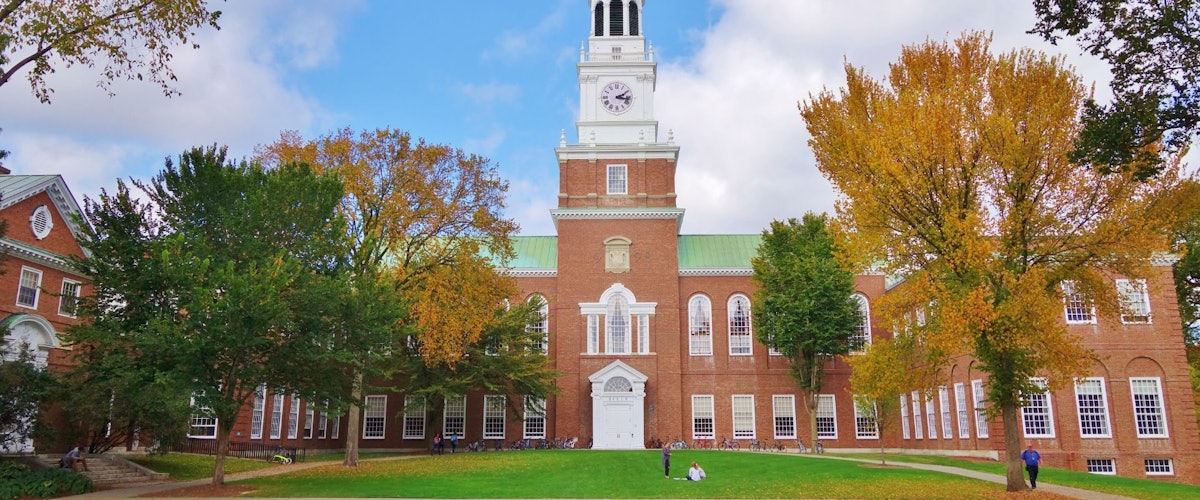
    Dartmouth CollegeFile photoDartmouth College has declined to sign the Trump administration’s “Compact for Academic Excellence in Higher Education,” becoming the latest prestigious institution to prioritize institutional autonomy over preferential federal funding access.

    In a statement released Saturday, Dartmouth President Dr. Sian Beilock firmly articulated the college’s position ahead of Monday’s deadline, emphasizing that governmental oversight—regardless of political affiliation—represents an inappropriate mechanism for directing the mission of America’s top research universities.

    “I do not believe that the involvement of the government through a compact—whether it is a Republican- or Democratic-led White House—is the right way to focus America’s leading colleges and universities on their teaching and research mission,” Beilock stated.

    The compact, extended to nine select institutions, promised enhanced access to federal research dollars in return for compliance with several administration policy mandates. These requirements included adopting the administration’s gender definitions for campus facilities and athletics, eliminating consideration of race, gender and various demographic factors from admissions decisions, and restricting international student enrollment.

    Despite rejecting the compact’s terms, Beilock expressed openness to dialogue, indicating her willingness to explore how to strengthen the traditional federal-university research partnership while maintaining higher education’s focus on academic excellence.

    The decision followed significant campus pressure, with nearly 500 Dartmouth faculty members and graduate students signing a petition advocating for rejection, according to the Valley News.

    In her statement, Beilock emphasized the fundamental principle at stake: “Universities have a responsibility to set our own academic and institutional policies, guided by our mission and values, our commitment to free expression, and our obligations under the law.”

    She framed institutional independence as essential to rebuilding public confidence across political lines and preserving American higher education’s global preeminence.

    Dartmouth’s decision aligns with rejections announced last week by peer institutions including the Massachusetts Institute of Technology, Brown University, the University of Pennsylvania and the University of Southern California, suggesting a coordinated defense of academic autonomy among elite research universities.

    Source link

  • White House to Meet With Universities Regarding Compact

    White House to Meet With Universities Regarding Compact

    Brendan Smialowski/AFP/Getty Images

    After four universities rejected the Trump administration’s compact for higher education, the White House is planning to meet Friday afternoon with the remaining five that have yet to respond.

    A White House official confirmed plans of the meeting to Inside Higher Ed but didn’t say what the purpose of the gathering was or which universities would attend. Nine universities were asked to give feedback on the wide-ranging proposal by Oct. 20.

    The virtual meeting will likely include May Mailman, a White House adviser, and Vincent Haley, director of the White House’s Domestic Policy Council, according to a source with knowledge of the White House’s plans. Mailman, Haley and Education Secretary Linda McMahon signed the letter sent to the initial nine about the compact.

    So far, the Massachusetts Institute of Technology, Brown University, the University of Pennsylvania and the University of Southern California have publicly rejected the deal. Dartmouth College, the University of Arizona, the University of Texas at Austin, the University of Virginia and Vanderbilt University haven’t said whether they’ll agree to the compact. Trump officials have said that the signatories could get access to more grant funding and threatened the funding of those that don’t agree.

    After USC released its letter rejecting the proposal, Liz Huston, a White House spokesperson, told the Los Angeles Times that “as long as they are not begging for federal funding, universities are free to implement any lawful policies they would like.”

    Following the first rejection from MIT last Friday, President Trump posted on Truth Social that all colleges could now sign on. The White House has said that some institutions have already reached out to do so.

    The source with knowledge of the White House’s plans said that the meeting “appears to be an effort to regain momentum by threatening institutions to sign even though it’s obviously not in the schools’ interest to do so.”

    The Wall Street Journal reported that Arizona State University, the University of Kansas and Washington University in St. Louis were also invited. According to the Journal, the goal of the meeting was to answer questions about the proposal and to find common ground with the institutions.

    Former senator Lamar Alexander, a Tennessee Republican and trustee at Vanderbilt, wrote in a Wall Street Journal op-ed that the compact was an example of federal overreach akin to previous efforts to impose uniform national standards on K–12 schools.

    “Mr. Trump’s proposed higher education compact may provoke some useful dialogue around reform,” he wrote. “But the federal government shouldn’t try to manage the nation’s 6,000 colleges and universities.”

    Inside Higher Ed reached out to the remaining five institutions as well as the new invitees, but they haven’t responded to a request for comment or to confirm whether they’ll attend the meeting.

    Source link

  • White House Meets With Universities Regarding Compact

    White House Meets With Universities Regarding Compact

    After four universities rejected the Trump administration’s compact for higher education, the White House met Friday with some universities about the proposal. 

    A White House official confirmed plans of the meeting to Inside Higher Ed but didn’t say what the purpose of the gathering was or which universities would attend. Nine universities were asked to give feedback on the wide-ranging proposal by Oct. 20.

    The virtual meeting planned to include May Mailman, a White House adviser, and Vincent Haley, director of the White House’s Domestic Policy Council, according to a source with knowledge of the White House’s plans. Mailman, Haley and Education Secretary Linda McMahon signed the letter sent to the initial nine about the compact.

    So far, the Massachusetts Institute of Technology, Brown University, the University of Pennsylvania and the University of Southern California have publicly rejected the deal. Dartmouth College, the University of Arizona, the University of Texas at Austin, and Vanderbilt University haven’t said whether they’ll agree to the compact. UVA said late Friday afternoon that it wouldn’t agree to the proposal.

    The Wall Street Journal reported that Arizona State University, the University of Kansas and Washington University in St. Louis were also invited. According to the Journal, the goal of the meeting was to answer questions about the proposal and to find common ground with the institutions.

    Inside Higher Ed reached out to the universities, but none confirmed whether they attended the meeting.

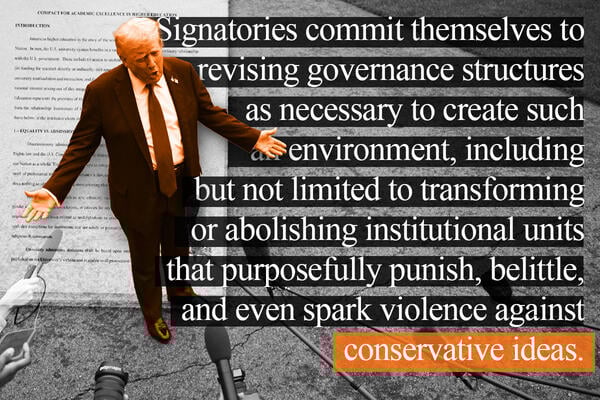
    The nine-page document would require universities to make a number of far-reaching changes from abolishing academic departments or programs that “purposefully punish, belittle, and even spark violence against conservative ideas” to capping international undergraduate enrollment at 15 percent. Institutions also would have to agree to freeze their tuition and require standardized tests for admissions, among other provisions.

    Trump officials have said that the signatories could get access to more grant funding and threatened the funding of those that don’t agree. The Justice Department would enforce the terms of the agreement, which are vague and not all defined.

    After USC released its letter rejecting the proposal, Liz Huston, a White House spokesperson, told the Los Angeles Times that “as long as they are not begging for federal funding, universities are free to implement any lawful policies they would like.”

    Following the first rejection from MIT last Friday, President Trump posted on Truth Social that all colleges could now sign on. The White House has said that some institutions have already reached out to do so.

    The source with knowledge of the White House’s plans said that the meeting “appears to be an effort to regain momentum by threatening institutions to sign even though it’s obviously not in the schools’ interest to do so.”

    Former senator Lamar Alexander, a Tennessee Republican and trustee at Vanderbilt, wrote in a Journal op-ed that the compact was an example of federal overreach akin to previous efforts to impose uniform national standards on K–12 schools.

    “Mr. Trump’s proposed higher education compact may provoke some useful dialogue around reform,” he wrote. “But the federal government shouldn’t try to manage the nation’s 6,000 colleges and universities.”

    A Joint Warning

    The American Council on Education and 35 other organizations warned in a joint statement released Friday that “the compact’s prescriptions threaten to undermine the very qualities that make our system exceptional.”

    The organizations that signed requested the administration withdraw the compact and noted that “higher education has room for improvement.” 

    But “the compact is a step in the wrong direction,” the letter states. “The dictates set by it are harmful for higher education and our entire nation, no matter your politics.”

    The letter is just the latest sign of a growing resistance in higher ed to the compact. Faculty and students at the initial group of universities rallied Friday to urge their administrators to reject the compact. According to the American Association of University Professors, which organized the national day of action, more than 1,000 people attended the UVA event. 

    And earlier this month, the American Association of Colleges and Universities released a statement that sharply criticized the compact. The statement said in part that college and university presidents “cannot trade academic freedom for federal funding” and that institutions shouldn’t be subject “to the changing priorities of successive administrations.” Nearly 150 college presidents and associations have endorsed that statement.

    The joint statement from ACE and others, including AAC&U, was a way to show that the associations, which the letter says “span the breadth of the American higher education community and the full spectrum of colleges and universities nationwide,” are united in their opposition.

    “The compact offers nothing less than government control of a university’s basic and necessary freedoms—the freedoms to decide who we teach, what we teach, and who teaches,” the statement reads. “Now more than ever, we must unite to protect the values and principles that have made American higher education the global standard.” 

    But not everyone in the sector signed on. 

    Key groups that were absent from the list of signatories include the Association of Public and Land-grant Universities, the Association of American Universities, the American Association of State Colleges and Universities, the National Association of Independent Colleges and Universities, Career Education Colleges and Universities, and the American Association of Community Colleges.

    Inside Higher Ed reached out to each of those groups, asking whether they were invited to sign and, if so, why they chose not to do so. Responses varied.

    AAU noted that it had already issued its own statement Oct. 10. AASCU said it was also invited to sign on and had “significant concerns” about the compact but decided to choose other ways to speak out.  

    “We are communicating in multiple ways with our member institutions and policymakers about the administration’s request and any impact it might have on regional public universities,” Charles Welch, the association’s president, said in an email.

    Other organizations had not responded by the time this story was published.

    Jessica Blake contributed to this article.

    Source link

  • Higher education policy: the lie of the land in England and Wales on the cusp of England’s post-16 white paper

    Higher education policy: the lie of the land in England and Wales on the cusp of England’s post-16 white paper

    • This speech was delivered by HEPI Director Nick Hillman at the University of Cardiff on Thursday, 16 October 2025.

    Introduction

    The other day, I was speaking to the University of Liverpool Council at the Ness Botanic Gardens on the Wirral, which as you know is four hours due north of here, pretty much on the Welsh / English border. I started my speech there by noting that I only exist because of the University of Liverpool, as my maternal grandparents met there in the early 1930s. Well, I also only exist because of the Welsh university system, as my parents met while they were students here in Wales in the early 1960s, just as my own children only exist because I met my wife in the early 1990s at university. 

    The fact that three generations of my family originally met while at university is a powerful reminder, at least to me, that higher education change lives. And at HEPI, we had another powerful reminder of that during our first event of this academic year, when – last month – we hosted the UK launch of the OECD’s Education at a Glance publication.

    Education at a Glance

    In case you have not come across it before, this is the most useful but worst titled publication on education that appears anywhere in the world each year. It is a vast 541-page compendium of comparative data that you need to pore over rather than glance at.

    This year’s OECD report had a particular focus on tertiary education. While we have become used to people beating up on the UK higher education sector, the OECD actually painted a picture of a very successful sector playing to its strengths. When you look in from the outside, it seems the UK’s higher education institutions are not so bad after all.

    For example, the OECD showed that, among the many developed countries covered in their report, the UK has:

    • higher than average participation in higher education;
    • lower than average graduate unemployment, irrespective of whether the individuals studied STEM, business or humanities; and
    • among the very highest undergraduate completion rates anywhere in the world, vying with Ireland for the top spot.

    I recognise the OECD is looking at averages for the UK as a whole and the position of Wales is not necessarily the same but, in general, the weaknesses the OECD found in were on the lack of good opportunities for people who do not succeed in education first time around.

    Specifically, the OECD found a profound problem among young men, a rising proportion of whom are classified as NEETs (Not in Employment, Education or Training). While the OECD use historic data for a year or two past, last week’s brand new NEET data for Wales confirms the depressing picture. Indeed, it was even more salutary, noting:

    The proportion of young people aged 16 to 24 in Wales who were not in employment, education or training (NEET) was 15.1% in the year ending June 2025, an increase of 3.6 percentage points over the year.

    The OECD additionally found that the UK has the biggest gap of all developed countries when it comes to the difference in earnings between low-skilled adults and those who leave school with A-Levels (or equivalent). This should perhaps worry Wales even more than the rest of the UK, given that Wales scores the worst for schoolchildren’s academic performance for any part of the UK. Indeed, Wales is the only part of the UK to perform worse than the OECD average in all three areas of Mathematics, Reading and Science.

    When it comes to funding of higher education, the OECD found the UK spends more than most other countries … but the shift to loan-based finance means direct government spending on each student in higher education is only half the OECD average and only half the amount spent ‘at primary to post-secondary non-tertiary levels’ ($13,000). Of course, the UK’s figures are distorted by England’s numbers because England is much larger than the other parts of the UK and has moved towards loans to a greater degree than Scotland, Wales or Northern Ireland. That is one reason why we have worked with London Economics and the Nuffield Foundation to look at the picture in each part of the UK separately.

    There are three profound differences. First, the Exchequer cost is lowest in England, which also has the highest per-student income for institutions. Scotland is at the other end of the scale, with the largest Exchequer cost but the lowest unit-of-resource for institutions. Wales is, as you may expect, somewhere in the middle, with an Exchequer cost and a per-student income for institutions that lies between those in England and Scotland. 

    There is a similar picture when we look – secondly – at the balance of who is paying the costs of higher education. In England, it is mainly former students via the loan system; in Scotland, it is entirely taxpayers (and then some). In Wales there is a more even split approaching 50:50 between the Exchequer and graduates, arguably reflecting the public and private benefits of higher education more accurately. There are probably lessons from Wales for the rest of the UK here, though seemingly not for Kemi Badenoch, who complained at the Conservative Party Conference last week that higher education in England still costs taxpayers too much.

    The third big difference is on student maintenance, where the system in Wales is more generous and more logical than those elsewhere in the UK. Each student gets more and the non-repayable grants are more generous in Wales than elsewhere – all undergraduates have at least a small grant whereas no one currently gets a grant in England, where grants were abolished in 2016. (Ministers promised the return of grants in England at the Labour Conference a fortnight ago, but only for some students on some courses, meaning it is likely to prove a mouse of an intervention and a very complicated one at that. It is certainly set to be nothing like the Welsh system.)

    Many people I know are fans of the system in Wales for the way that it tries to strike a balance. However, while there are certainly far worse systems even within the rest of the UK, I personally think the benefits of the Welsh system are sometimes oversold. For example, I think the structure of student support in Wales is excessively generous to students who come from wealthy households. In other words, it is not means tested enough, perhaps explaining the need for the recent cuts to postgraduate support.

    I have held this view consistently since the current Welsh funding system was introduced on the back of the Diamond review in 2018, but it has got me in trouble. After my concerns reached the front page of the Western Mail, I got not only an official rebuke from the Welsh Government but HEPI also received a formal complaint that came jointly from Universities Wales and NUS Wales. Rather than persuading me to change my view, I must admit this mainly had the effect of making me wonder if higher education debates in Wales are sometimes a little too cosy and stifled.

    Boys, Boys, Boys

    One other area where the OECD painted a less positive picture is on the differential educational performance of young men and young women. Women are more likely to obtain tertiary education across the developed world but the gap between men and women is bigger in the UK than elsewhere and has been growing while it has stayed the same on average across the OECD as a whole. According to the OECD:

    In the United Kingdom, they [women] accounted for 56% of first-time entrants in 2023, up from 55% in 2013. Across the OECD, women make up 54% of new entrants on average, the same share as in 2013.

    This is a convenient segue into some more of HEPI’s recent output because we have long worried about the educational performance of boys and young men and have published a number of papers on the topic over the years, with the most recent one appearing in March 2025. As Mary Curnock Cook wrote in the Foreword:

    Something has surely gone wrong with education if boys – in aggregate at least – do worse than girls at all stages of education from early years to higher education and beyond.

    Overall, out of every 100 female school leavers, 54 proceed to higher education by the age of 19; out of every 100 male school leavers, just 40 do so.

    Again, the problems are worse in Wales than elsewhere. Over half of Inner London school leavers eligible for Free School Meals reach higher education by the age of 19; it is hard to get directly comparable figures for Wales but it seems the numbers are less than half as much for FSM Welsh-domiciled school leavers. Overall, while the gap in school leavers’ entry rates to higher education between men and women is dire in England, it is even worse in Wales. In fact, the proportion of young men who make it to higher education in Wales is lower than in every other part of the UK. It has been a known problem for at least 20 years yet for whatever reason, and perhaps because of misplaced fears of seeming politically incorrect, it has not been addressed.

    Yet if male educational underachievement is not tackled, it seems certain that we will store up further societal problems for the future – including having more under-educated men veering towards the political extremes. Here, I note in passing the high polling of Reform for next year’s Senedd election. It is not rocket science to solve the boy problem, however, to take just one example, some schools following a ‘boy positive’ approach have managed to equalise their results for boys and girls and there is some great work underway in our own sector – for example, at Ulster University and the Arts University Bournemouth.

    What remains completely absent, however, is any concerted interest at a national and ministerial level – certainly at Westminster and as far as I can tell in the Senedd too. People who did not want to take the Black Lives Matter protests seriously a few years ago sought to deflect attention from them by saying ‘All Lives Matter’, as if that was ever in doubt. Similarly, when Ministers wish to deflect attention from the crisis in boys’ education they like to respond by saying things like ‘Opportunity should be available to all’, which is true but it papers over the specific challenges faced by young men.

    Our work on male underachievement sits alongside our work on the disadvantages faced by women, such as our reports on the substantial gender pay gap that remains in higher education as well as our other work on the overall gender pay gap among graduates. It also sits alongside a new HEPI report published just three months ago on the impact of menstruation on undergraduates’ attendance, academic engagement and wellbeing.

    This revealed 70% of female students report being unable to concentrate on their studies or assessments due to period pain and that female students miss an average of 10 study days per academic year due to menstrual symptoms. It also suggested that just 15% of universities have a specific menstruation policy and, for those that do, the policy relates solely to staff rather than students.

    So as I hope you can sense, the topics that tend to work best for HEPI are issues – like boys’ underperformance and the impact of menstruation on learning – that we should be speaking about more than we have done. Another area where that is true is public perceptions of higher education.

    Misperceptions

    A year ago, I had a drink with a neighbour who has a background in banking and two graduate children, meaning – in theory at least – that he knows the value of money and the value of education. However, when it came to universities, he expressed some typical rhetoric about them being too numerous, too big, too expensive and so on.

    I responded by telling him I was on the Board at the University of Manchester and asking him to guess that institution’s financial turnover. His reply was £30 million – which is between 40 and 50 times smaller than the actual number of c.£1.3 billion (and over 20 times smaller than Cardiff’s turnover). Once my hangover had subsided, I contacted Bobby Duffy of the King’s College Policy Institute, who is the UK’s greatest expert on misperceptions – that is, the difference between what is true and what we tend to believe is true. This led over a process of many months to a new research project on what the public think about higher education, which we and King’s College launched the results of last month.

    The findings are worth poring over in detail and we have brought hard copies of the work along for each you. Sone of the results particularly stand out.

    For example, we gave people a list of seven institutions: Manchester City, Manchester United, the University of Manchester, the University of Oxford, the Daily Mail, MoneySupermarket.com and Greggs bakery.

    When the public were asked about the relative financial size of these seven, the University of Oxford came fifth and the University of Manchester seventh, at the very bottom. More than half of respondents said they thought either Manchester City or Manchester United was the biggest in terms of their financial size; only 6% chose the right answer, the University of Oxford. The University of Manchester should be third in that list of seven by the way because, while it easily beats City and United in terms of its financial size, you might be surprised to know that Greggs has a turnover of £2 billion.

    Similarly, when we gave the public a list of five big industries – legal services, accountancy services, aircraft manufacturing, telecommunications and higher education – and asked them to say which is least important in terms of export revenues, higher education was the most popular option. That result could not be any more wrong because higher education actually brings in much more export income than each of the others.

    Let me share three other fascinating data points from the survey with you too:

    • people greatly overestimate the level of graduate regret about going to higher education – on average, the public guess 40% of graduates would opt not to go to university if they had their again, when the actual proportion of graduates who say this is only 8%;
    • on average, the public guess half (49%) of graduates say their university debt has negatively impacted their lives – in reality  only 16% of graduates feel this way; and
    • a majority of people, including a majority of Reform voters at the 2024 general election, have positive feelings about universities.

    Oversight and regulation

    Over the past decade, the oversight of tertiary education and research has been transformed in England, though not necessarily for the better. When I worked as a Special Adviser in Whitehall a dozen years ago, there was one Minister for Universities and Science who sat in one Government Department and who had oversight of one regulator that oversaw both teaching and research (known as the Higher Education Funding Council for England). But in recent years we have had different regulators, different Ministers and different Departments for the teaching and research functions of universities, meaning coordinated oversight has been missing.

    Moreover, while the Westminster Government has promised more ‘clarity and coherence’, the latest Machinery of Government changes have made the current situation even more of a dog’s dinner. The Minister for Skills, who has responsibility for higher education, now has one foot in the Department for Education and another in the Department for Work and Pensions, which has just taken on the responsibility for ‘skills’, while the Minister for Science has one foot in the Department for Science, Innovation and Technology and another in the Department for Energy Security and Net Zero. Split ministerial posts tend to be a recipe for chaos, as I saw close up during my own time in Whitehall.

    So while I know that the new Medr (the Commission for Tertiary Education and Research) here in Wales has had some teething challenges, on paper it makes a lot more sense than what England has. At one point, it was thought England’s long-awaited post-16 skills white paper was likely to be heavily influenced by Wales; given the latest reshuffle and associated changes, that now – perhaps regrettably – seems less likely.

    International students

    Finally, I want to end by touching on the issue of international students. The majority of the really big projects HEPI has undertaken over the past few years have focused on international students. Perhaps that is not surprising, given the OECD data I started with, which shows that, while there is one international student for every thirteen home students across the OECD as a whole, the ratio in the UK is completely different at 1:3.

    That helps to explain why we have calculated (more than once) the net economic benefits of international students to the UK. The latest iteration found a gross benefit of £41.9 billion for just one incoming cohort of students and a net benefit (after taking account of the impact on public services and so on) of £37.4 billion. We split up this total to reveal a number for each one of the 650 parliamentary constituencies across the UK, including Cardiff South and Penarth, which is the top-performing constituency in Wales and one where international students contribute significantly over £300 million a year.

    We have separately calculated the positive tax contributions of those former international students who stay in the UK to work after completing their studies, undertaken detailed studies on the Graduate Route visa and looked specifically at the experience of Chinese students in the UK. In addition, we produce each year a Soft-Power Index that looks at how many very senior world leaders have been educated to a higher level outside of their own home country. If they return home with fond memories of their time in the UK and a better understanding of our country, then this tends to bring real benefits. We will be launching the results for 2025 next week but last year’s Soft-Power Index, which is regularly quoted by Ministers, showed that, across the globe’s 195 countries, there were 58 serving world leaders who received some higher education in the UK, second only to the US.

    I am going to stop here because I started the speech on a positive – on the way higher education changes lives for the better. And despite all the numerous political, financial and geopolitical challenges facing higher education across the UK, the continuing immense soft-power benefits delivered by UK higher education institutions is another area where there is a huge amount of which we can be proud.

    Source link

  • White House Floats Compact for Preferential Treatment

    White House Floats Compact for Preferential Treatment

    The Trump administration has asked nine universities to sign on to a proposed compact, mandating certain changes in exchange for preferential treatment on federal funding.

    First reported by The Washington Post and confirmed, with additional details, by The Wall Street Journal, the proposal seeks an agreement with nine institutions that are being asked to commit to a 10-point memo referred to as the “Compact for Academic Excellence in Higher Education.”

    Among the various conditions, institutions are reportedly being asked to:

    • Ban consideration of race or sex in hiring and admissions processes
    • Freeze tuition for a five-year period
    • Limit international undergraduate enrollment to 15 percent of the student body
    • Commit to institutional neutrality
    • Require applicants to take standardized tests, such as the SAT or ACT
    • Clamp down on grade inflation
    • Ensure a “vibrant marketplace of ideas on campus” 
    • Restrict employees from expressing political views on behalf of the institution
    • Shut down departments that “punish, belittle” or “spark violence against conservative ideas”
    • Anonymously poll students and employees on compact compliance and publish the results

    Another requirement mandates that signatories “deploy their endowments to the public good,” such as by not charging tuition to students “pursuing hard science programs (with exceptions, as desired, for families of substantial means)” for universities with more than $2 million per undergraduate student in endowment assets. Universities would also be required to post more details about graduates’ earnings and refund tuition to those who drop out in their first semester.

    After leveraging funding freezes and other tactics to pressure colleges to make changes, the compact reflects a different approach from the administration while still geared toward the same goal—remaking higher education in Trump’s image. May Mailman, a Trump adviser, hinted at the plan in a New York Times interview a week before the proposal emerged, saying it could be a way for universities to affirm they are “doing the right things.”

    “The Trump administration does not want to be all Whac-a-Mole or all negative, but these are the principles that universities and the Trump administration and, frankly, private donors can ascribe to to say, ‘This makes a great university,’” she told the Times.

    Institutions reportedly invited to join are: Brown University, Dartmouth College, the Massachusetts Institute of Technology, the University of Arizona, the University of Pennsylvania, the University of Southern California, University of Texas at Austin, the University of Virginia and Vanderbilt University.

    Those that agree will receive “multiple positive benefits,” including “substantial and meaningful federal grants,” according to a copy of the memo published by The Washington Examiner.

    But failure to comply with the agreement would come with steep consequences. Noncompliant universities would “lose access to the benefits of this agreement” for a year. Subsequent violations would lead to a two-year punishment. And the federal government could claw back “all monies advanced by the U.S. government during the year of any violation.” Private donations would also be required to be returned, upon request.

    The Department of Justice would be tasked to enforce the agreements.

    Institutional Responses

    Most universities did not respond to requests for comment from Inside Higher Ed. But Texas officials seem eager to sign on, sharing a statement indicating their enthusiasm for the compact.

    University of Texas system Board of Regents chairman Kevin P. Eltife wrote in the statement that the flagship was “honored” to be among the institutions “selected by the Trump Administration for potential funding advantages” under the proposed compact, which it is currently reviewing.

    “Higher education has been at a crossroads in recent years, and we have worked very closely with Governor [Greg] Abbott, Lt. Gov. [Dan] Patrick and Speaker [Dustin] Burrows to implement sweeping changes for the benefit of our students and to strengthen our our [sic] institutions to best serve the people of Texas,” Eltife wrote. “Today we welcome the new opportunity presented to us and we look forward to working with the Trump Administration on it.”

    University of Virginia spokesperson Brian Coy told Inside Higher Ed by email that interim president Paul Mahoney “created a working group under the leadership of Executive Vice President and Provost Brie Gertler and Executive Vice President and Chief Operating Officer J.J. Davis to advise him” on UVA’s response to the letter but has not yet made a decision to sign or not.

    USC simply said in a statement, “We are reviewing the Administration’s letter.”

    Both the White House and the Department of Education initially responded to requests for comment with automatic replies because of the federal government shutdown, which began Wednesday. A press office official later responded only to confirm The Wall Street Journal’s reporting.

    Outside Perspectives

    News of the proposal prompted a flurry of criticism within academic circles.

    American Association of University Professors president Todd Wolfson blasted the idea in a Thursday statement and called on governing boards to reject it.

    “The Trump administration’s offer to give preferential treatment to colleges and universities that court government favor stinks of favoritism, patronage, and bribery in exchange for allegiance to a partisan ideological agenda. This compact is akin to a loyalty oath. Adherence by university administrations would usher in a new era of thought policing in American higher education,” Wolfson wrote.

    The executive committee of Penn’s AAUP chapter also opposed the proposal.

    The Foundation for Individual Rights and Expression also criticized it in a post on X, writing that “the compact includes troubling language” specifically pointing to the call to eliminate academic departments critical of conservative ideas, which it cast as undermining free speech.

    “A government that can reward colleges and universities for speech it favors today can punish them for speech it dislikes tomorrow. That’s not reform. That’s government-funded orthodoxy,” FIRE officials wrote.

    Trinity Washington University president Pat McGuire called the proposal “political extortion.”

    Brendan Cantwell, a higher education professor at Michigan State University, told Inside Higher Ed there are multiple issues with the proposal, including vague language about political speech that could allow universities or the federal government to single out faculty members for publicly discussing topics within their expertise. He added that “enforcement is so vague” that it would be easy for the federal government to declare universities out of compliance with the agreement.

    Cantwell suggested, “This is probably a bigger deal than the Columbia [settlement] because it’s creating an incentive structure” that spurs universities to go along or opens them up to retaliation from the federal government, making it risky whether a university signs on or not.

    (Columbia agreed to far-reaching changes to admissions, hiring, disciplinary processes and more in July, including a $221 million fine, when it reached a deal with the federal government to settle over findings that it failed to properly police antisemitism on campus. Columbia did not admit to wrongdoing, but administrators have acknowledged the need for reforms.)

    Brian L. Heuser, a Vanderbilt professor and long-standing member of the university’s Faculty Senate, urged fellow senators and other faculty colleagues to organize against the idea in an email shared with Inside Higher Ed. Heuser called the compact “a dangerous departure from the core values that should underpin our institutions—namely, free inquiry, open debate, and institutional autonomy” and argued that it endangers academic freedom, among other concerns.

    But some conservatives have lauded the idea and want ED to push harder.

    “Secretary [Linda] McMahon deserves credit for working to disincentivize the use of race or sex in college admissions,” U.S. Sen. Todd Young, an Indiana Republican, wrote in a social media post. “We must go further—federally accredited institutions should eliminate ALL preferences grounded in ancestry, such as legacy status, or other factors unrelated to merit.”

    Why These 9?

    While it is unclear how the federal government landed on the nine schools as candidates for the proposal, one official told The Wall Street Journal the Trump administration believed they would be “good actors.” But contextual clues offer insights into why some may have been picked.

    Of the nine, only five presidents signed on to a letter published earlier this year by higher education organizations pushing back on government overreach and political interference, which ultimately gathered 662 signatures. Of those five presidents, one has since resigned: Jim Ryan at UVA, who faced pressure from the Trump administration after it claimed the university failed to fully dismantle diversity, equity and inclusion programs.

    Two institutions—Brown and Penn—previously struck deals with the federal government.

    Others have drawn attention for political reasons. At Vanderbilt, Chancellor Daniel Diermeier has emerged as a leading voice advocating for institutional neutrality and has clashed with other campus leaders, arguing that higher education is in desperate need of reform, agreeing with frequent conservative criticisms of the sector. And Texas—one of three public institutions on the list—has an overwhelmingly conservative board, and both the system and flagship are led by former Republican elected officials.

    Source link

  • FIRE statement on the White House’s Compact for Academic Excellence in Higher Education

    FIRE statement on the White House’s Compact for Academic Excellence in Higher Education

    On Oct. 1, the Wall Street Journal reported that the White House is asking colleges to sign an agreement to secure preferential treatment for government funding. FIRE is working to obtain the full agreement, but initial reporting already indicates it raises threats to free speech and academic freedom.

    The following statement can be attributed to Tyler Coward, FIRE lead counsel for government affairs.

    Freedom thrives when the people, not bureaucrats, decide which ideas are worthy of discussion, debate, or support. 

    As FIRE has long argued, campus reform is necessary. But overreaching government coercion that tries to end-run around the First Amendment to impose an official orthodoxy is unacceptable. And the White House’s new Compact for Academic Excellence in Higher Education raises red flags.

    The compact includes troubling language, such as calling on institutions to eliminate departments deemed to “purposefully punish, belittle, and even spark violence against conservative ideas.” Let’s be clear: Speech that offends or criticizes political views is not violence. Conflating words with violence undermines both free speech and efforts to combat real threats.

    The compact also requires university employees to refrain from “actions or speech related to politics.” If the language merely barred high-ranking employees from engaging in partisan political activity on behalf of the university, it would reflect existing and generally permissible IRS restrictions. But the compact’s reported wording goes further by suggesting a blanket prohibition on all staff engaging in political speech. For public institutions, that is deeply problematic. Public university faculty have the First Amendment right to speak about politics in their teaching and scholarship. Outside of their official duties, faculty and non-faculty university employees retain full First Amendment rights to speak off-the-clock as private citizens on matters of public concern. Banning them from doing so would be flatly unconstitutional.

    A government that can reward colleges and universities for speech it favors today can punish them for speech it dislikes tomorrow. That’s not reform. That’s government-funded orthodoxy. 

    Source link